A hierarchical taxonomy for classifying hardness of inference tasks
Martin Gleize, Brigitte Grau
LIMSI-CNRSB.P. 133 91403 ORSAY CEDEX, France [email protected], [email protected]
Abstract
Exhibiting inferential capabilities is one of the major goals of many modern Natural Language Processing systems. However, if attempts have been made to define what textual inferences are, few seek to classify inference phenomena by difficulty. In this paper we propose a hierarchical taxonomy for inferences, relatively to their hardness, and with corpus annotation and system design and evaluation in mind. Indeed, a fine-grained assessment of the difficulty of a task allows us to design more appropriate systems and to evaluate them only on what they are designed to handle. Each of seven classes is described and provided with examples from different tasks like question answering, textual entailment and coreference resolution. We then test the classes of our hierarchy on the specific task of question answering. Our annotation process of the testing data at the QA4MRE 2013 evaluation campaign reveals that it is possible to quantify the contrasts in types of difficulty on datasets of the same task.
Keywords:inference, question answering, textual entailment
1.
Introduction
Exhibiting inferential capabilities is one of the major goals of many modern NLP systems dealing with question an-swering, information retrieval, information extraction or text summarization. In recent years, there has even been a focus on a new task called textual entailment, which pre-cisely aims at capturing semantic inferences (Dagan et al., 2006).
However, inferences have been defined in several ways in the past, and it is not always easy to know the kind of prob-lems we are faced with when dealing with textual entail-ment related tasks. In the context of machine reading, we can view an inference as any information we can reason-ably deduce from the text without it being explicitly stated. This is different from logical inference and statistical infer-ence, although techniques for both are used effectively in the resolution of textual inference problems (Moldovan et al., 2007; Poon, 2010).
This broad definition does not say much of what informa-tion we want to draw from the text, how to do it and whether it is an easy task or not. However, the ability to pinpoint the kind of inferential phenomena our systems are realistically able to handle seems really valuable to us. In this paper, we present a hierarchy of classes of inference. This hierarchi-cal view is designed with several goals in mind: the most important is being able to categorize instances of problems to spot where the difficulties lie and what nature and ex-tent of NLP techniques and resources we need to leverage to handle them. It also allows to conduct more fine-grained diagnostic evaluations of systems, to complement typical black-box evaluations.
We show in our experiments on QA4MRE 2013’s multiple-choice questions that our hierarchical classes do capture the variations of type and hardness of inference problems for the task of question answering and provide a basis for ex-perimenting and evaluating only on the data our systems are designed to handle.
2.
Related works
To our knowledge, few attempts have been made to categorize the difficulty of inferences in a manner helpful to computational systems.
The field of cognitive psychology (McKoon and Ratcliff, 1992) distinguishes bridging and elaborative inferences. Bridging inferences are drawn to fill the gaps in text and explicit –often through access to world knowledge– what is untold, yet required to understand what the text means. This is akin to what the machine reading system of Pe˜nas and Hovy (2010) does. Elaborative inferences are not required for textual coherence, but they serve to enrich our mental representation of the text and make it more memorable. They also are prominently used when answering questions on the text.
Such a distinction, although insightful to anticipate the de-sign of machine reading and question answering systems, is still far from giving us hints on the automatization of inference. Clark et al. (2012) provide a combination of well-known language resources used toward the common goal of textual entailment. Ablation tests are performed to compute the impact of each on the overall accuracy, but there is no way of knowing which resource helps best on a given type of questions or entailment pairs.
Interestingly, Huang et al. (2013) take the angle of model-ing human negative entailment capabilities. Findmodel-ing in the text hints of a contradiction with the hypothesis appears to be an effective way to tackle textual entailment, but the tools and resources are still lacking to yield significant improvements over state of the art RTE systems.
MacCartney and Manning (2007) introduce natural logic applied to textual inference. They describe the kind of inference problems this logic applied to natural language is capable of solving: natural logic handles monotonicity, in which the concepts or constraints expressed are expanded or contracted, but it is not designed to deal with paraphrase, temporal reasoning, or relation extraction.
Moldovan et al. (2003) measure their system’s accuracy by question class: factual, simple-reasoning, fusion-list, interactive-context, speculative. However, these classes are more about question types than they are about their difficulty, even if the two are likely correlated.
3.
The hierarchy
Each of our classes is built to encompass a range of natural language semantic problems, tools, techniques, resources, and even human cognitive processes and levels of world knowledge required. Practically, we say that a problem is of a given class if it can reliably be solved within that class, but not within the classes below it in the hierarchy. The aim is to capture the inference phenomena that are sufficient and necessary to solve the problem. In this respect, those classes can be used in the same way complexity classes are used: both to characterize problems and the systems solving them –a system is of a given class if it can solve problems of that class but not problems from higher classes.
While this all sounds ambitious, this hierarchy does not pretend to be absolute, and in fact it does not need to: simply setting up the groundwork towards a unified framework to discuss the contrasts in relative nature and difficulty inside the same problem –and sometimes the same dataset– is already helpful.
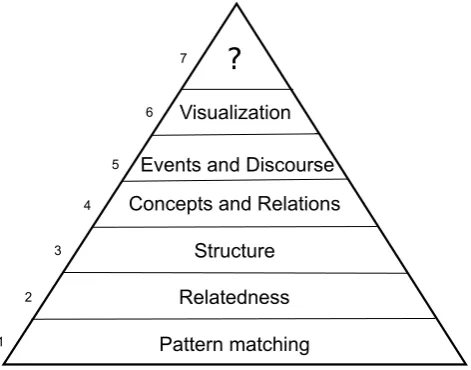
Pattern matching Relatedness
Structure Concepts and Relations
Events and Discourse Visualization
?
1 2
3 4
5 6
[image:2.595.53.289.425.610.2]7
Figure 1: Hierarchy of inference classes
The hierarchy is shown in Figure 1. There are seven classes, and the first six (from bottom to top) pair up in three tiers, corresponding roughly to the units of sense considered. As members of the hierarchy, higher classes will often still rely on the techniques and resources featured in classes below, and it is reasonable to assume that a system of a given class behaves well when faced with problems of lower classes. We also expect the difficulty of the problems –and the error rate of the current state of the art methods– to generally in-crease with the class.
We propose for each class examples of representative prob-lems. We chose to frame the problems, when possible, as
picking the most relevant item among several answer can-didates to a natural language query. While it seems reason-able to expect that our classes can still characterize the ab-solute difficulty level of the query alone, this level would be difficult to assess without some elements of context or ex-amples of concurrent wrong items our systems are suscep-tible to pick over the right ones. Providing this context and an explicit set of correct and incorrect items is a satisfying compromise which allows us to showcase which techniques and resources are needed to discriminate reliably between possible answers to the query. In our examples, we will put the number of the right answer in bold font.
We accordingly specify how several well-known natural language tasks reduce to this common framework.
In question answering, the query can take the form of a nat-ural language question, and items can be some choices of answer, the task being naturally to find a fitting answer to the question. Ranking answer candidates is also how state of the art question answering systems like IBM’s Watson computer operate (Ferrucci et al., 2010), so this is a quite direct formulation of the task.
In coreference resolution, the query is a sentence containing a pronoun, associated with the text preceding it. The items are entities of the text and the task is to find which entity the pronoun refers to. Recently, Levesque et al. (2011) have ar-gued that the problem of resolving the difficult pronouns in a carefully chosen set of sentences, which he refers to as the Winograd Schema Challenge, could serve as a conceptually and practically appealing alternative to the well-known Tur-ing Test (TurTur-ing, 1950). AccordTur-ing to Levesque, the pitfalls lie in the difficulty of providing problems whose resolution is obvious for humans but hard for machines. Knowing what is difficult for machines seems key to us and is one of the goals addressed in this paper. We will use exam-ples of Winograd Schemas to demonstrate that coreference resolution can reach a very high difficulty level. A Wino-grad Schema is a small reading comprehension test involv-ing the question of which of the two candidate antecedents for the definite pronoun in a given sentence is its correct an-tecedent. There is a word (called thespecialword) which appears in the text and sometimes the question. When it is replaced by another word (called the alternate word), the text still makes sense, but the answer to the question changes. In this special coreference task, we will set the query as the sentence and the question, and the candidate items as pairs of (special/alternate word, coreferent assign-ment), as shown for the classic Winograd scheme example in table 1.
Text: The city councilmen refused the demonstrators a permit because they [feared/advocated] violence. Question: Who [feared/advocated] violence?
1)feared→councilmen, advocated→demonstrators 2) feared→demonstrators, advocated→councilmen
Table 1: Winograd schema sample
answer to a question, and we choose as items correct and incorrect student answers. The task is to find correct stu-dent answers matching one reference answer. Some of our examples are sampled from Semeval 2013 Task 7’s Beetle test data.
Other problems which may fit this framework are word sense disambiguation and entity linking.
3.1.
Tier 1: Word level
3.1.1. Pattern matching
Class 1 pertains to problem instances that can be solved us-ing only words of the text, without any intent to capture the representation of a higher-level structure like the sentence, and using minimal world knowledge. Sentence chunking to create smaller groups of words, filtering words of the text (with a stop-word list, for example), tokenization, group-ing words in n-grams, basic stemmgroup-ing and lemmatization are the most advanced text processing needed to solve this class of problems.
Text: Bob is going to the swimming pool. Question: What is going to do Bob? 1) Eat a sandwich.
2)Go swimming.
Table 2: Question Answering (Class 1)
Reference answer: Terminal 4 and the positive termi-nal are separated by the gap
1) Because they aren’t damaged.
2)positive battery terminal is separated by a gap from terminal 4
Table 3: Semeval 2013 Task 7 (Class 1)
These sample problems (tables 2 and 3) are easily solved through counting the number of words common to a choice and the given text. It is enough to discriminate between the right choice (choice 2) and something irrelevant.
3.1.2. Relatedness
Class 2 does not need the inference process to represent a higher level of sense than Class 1 (we stay at word level), and uses mostly the same processing tools, but we add the notion of lexico-semantic variations of words to cap-ture a shallow notion of semantic relatedness. Lists of syn-onyms/hypernyms, taxonomies, thesauri –including Word-Net (Miller, 1995) used in the simplest ways– and dictio-naries are among common resources that are added in to deal with those problems.
In the example (table 4), counting the common words
be-Text: Bob bought this hamburger. Question: What has Bob done? 1)Obtained a sandwich. 2) Played in the water.
Table 4: Question Answering (Class 2)
tween the choices and the text is not enough and does not distinguish one answer from the other. Buthamburger is an hyponym ofsandwich. This can be learned from a good enough synonym/hypernym resource, like WordNet, or the Wiktionary1.
3.2.
Tier 2: Sentence level
3.2.1. Structure
Class 3’s inference problems require the capture of some notion of higher-level structure in the text, at least higher than the word, generally at sentence –or clause– level. Sev-eral of the most well-studied text processing techniques come in handy, like: part-of-speech tagging, chunking, syn-tactic parsing, predicate-argument extraction, semantic role labeling, or polarity detection. We note that we still often need techniques and resources mentioned in Tier 1, but we moreover need to know not only what the words are, but what roles they occupy relatively to the others in the sen-tence.
Text: As it’s raining today, Bob won’t go to the beach. Question: What is going to do Bob?
1)Stay home.
2) Go to the beach with his friends.
Table 5: Question Answering (Class 3)
Reference answer: Terminal 4 and the positive termi-nal are separated by the gap
1)terminal 4 is not connected to the positive battery terminal
2) because there is no gap between terminal four and the positive terminal
Table 6: Semeval 2013 Task 7 (Class 3)
The problem described in the examples is as expected harder than Tier 1 problems. Simple Tier 1 techniques can work against us and reliably pick the wrong choice. In ta-ble 5, we have to determine that no matter what, Bob will surely notgo to the beach, by parsing the text and detecting that this clause is negated, so we pick the other answer. This is also an example of using negative entailment in the deci-sion process. In example table 6, to pick the student answer corresponding to the reference answer (choice 1), we rely on polarity detection on some kind of predicate-argument structure extraction to establish typed links between the ter-minal 4andthe positive terminal. Note that it is necessary to know thatseparatedandconnectedare antonyms, which can be found in resources used in Class 2.
3.2.2. Concepts and relations
Similarly to the first two classes, Class 4 takes the com-plexity of Class 3 and adds in extended world knowledge. Establishing a link between a word –or sequence of words– and a real-world concept is now required, as well as us-ing not only the relations between concepts discovered in
the text, but also those stored in a background knowledge base. Named entity recognition, paraphrases, ontologies, relations and properties extracted from dictionaries, Word-Net or Wikipedia and even relations extracted through web-crawling (like TextRunner) are good techniques and re-sources to capture concepts and relations. Some basic rea-soning engine may be needed.
Text: Bob once gave his sister Alice a pendant. Question: Who gave Alice the pendant? 1)A brother.
2) A sister.
Table 7: Question Answering (Class 4)
Text: The lawyer asked the witness a question, but he was reluctant to [answer/repeat] it.
Question: Who was reluctant to [answer/repeat] the question?
1)answer→witness, repeat→lawyer 2) answer→lawyer, repeat→witness
Table 8: Winograd schema (Class 4)
In the question answering example (table 7), a system has to know that if a male individual has a sister, then he is the brother of that female individual, which is not linguistic knowledge easily obtainable in the previous classes. In the Winograd scheme (table 8), there are two main ways to go about it. Either you know that the indirect object of the verbaskoften has to answer the question after it is asked, which is quite complex reasoning that will be han-dled in class 5, or you just pick the character that is more likely to answer questions, when awitnessand alawyerare involved. For this method and this example, TextRunner gives as potential relations between witness andquestion only variants ofansweroraskat the passive form, while re-lations found betweenlawyerandquestionare much more diverse, modeling the fact that the witness is often one who strictly answers questions.
3.3.
Tier 3: Beyond the text
3.3.1. Events and discourse
Class 5’s phenomena go beyond a single sentence and deal with characters and events in the text. In particular, un-derstanding the overall structure of a sequence of several sentences is required: to know when an event might have happened without being mentioned in the text, what event might happen in the future, what roles are filling the char-acters. NLP techniques and resources at this stage are much more scarce. Discourse parsing can unveil simple causal or temporal relations between events. Event chains can help filling out the blanks in a succession of events. We feel like common-sense knowledge of human society and inter-actions would help at this stage, without needing the full extent of what Class 6 is about.
All of the choices in the example (table 9) are true state-ments, but are not the reason asked in the question. This
Example from QA4MRE 2013, entrance exams task Text: I probably would have [continued to argue with her], but as I lay there, I could tell that Susan’s phone call was not good news. I knew she had a boyfriend back home. From what I could hear her say, I guessed he had found a new girlfriend.
Question: Why was Susan so upset by the phone call? 1) Mary’s boyfriend had found a new girlfriend. 2) The call interrupted her argument with Mary. 3)Her boyfriend had lost interest in her. 4) The caller did not want to talk to Mary.
Table 9: Question Answering (Class 5)
question also deals with common states of mind of human beings.
Text: Susan knew that Ann’s son had been in a car accident, [so/because] she told her about it. Who told the other about the accident?
1) so→Ann, because→Susan 2)so→Susan, because→Ann
Table 10: Winograd schema (Class 5)
The Winograd schema of class 5 (table 10) requires us to keep track of 2 characters and their interaction in the text. Although technically all the information is included in the same sentence, there are multiple clauses to link together. Detecting a causal relationship –with reliable directionality– is a typical class 5 problem.
3.3.2. Visualization
Class 6 problems go beyond the text itself, and require an actual model of the situation at hand (Zwaan and Rad-vansky, 1998). A few dedicated NLP applications exist solely to solve one of the many facets of Class 6 inferences, including: temporal and spatial reasoning, sentiment de-tection. In general, computer systems are lacking human senses –vision and hearing– to deal with these problems in a generic fashion.
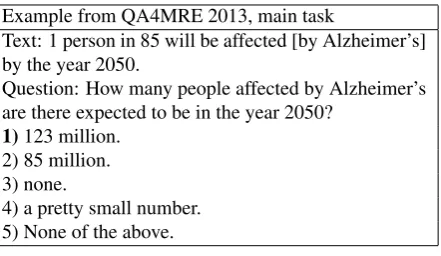
Example from QA4MRE 2013, main task
Text: 1 person in 85 will be affected [by Alzheimer’s] by the year 2050.
Question: How many people affected by Alzheimer’s are there expected to be in the year 2050?
1)123 million. 2) 85 million. 3) none.
[image:4.595.315.536.575.703.2]4) a pretty small number. 5) None of the above.
Table 11: Question Answering (Class 6)
Text: I tried to paint a picture of an orchard, with lemons in the lemon trees, but they came out looking more like [light bulbs / telephone poles].
Question: What looked like [light bulbs / telephone poles]?
1) light bulbs→lemons, telephone poles→lemon trees
2) light bulbs → lemon trees, telephone poles → lemons
Table 12: Winograd schema (Class 6)
global growing demographics on Earth, and know how to perform simple calculations. Alternatively, one has to guess that the other likely number (85 million) is probably just a decoy because the number 85 is present in the text but not to designate a population count; this kind of meta-reasoning about the task format (multiple choice questions) is not cur-rently handled by systems, and is not intended to be the main natural language problem to be addressed in the near future.
In the Winograd schema from table 12, it is much easier for a human to just imagine what fruits or trees might look like –relatively to their visual shape– than for a computer.
3.4.
Leaving room for the unexpected
We leave room for more complex inference problems and techniques.
4.
Experiments
Our data consist of the question answering test sets at QA4MRE 2013 (Pe˜nas et al., 2013). There are two tasks, the Main task and the Entrance Exams task, and both feature the same format: a series of long texts, and for each of them, several multiple-choice questions to answer. The Main task’s questions are traditionally designed to evaluate natural language processing systems. But the all new Entrance Exams task features tests of English as a foreign language at the Japanese University Entrance exams, hence this dataset is designed to evaluate humans. This is a key difference.
There are 284 questions over 4 topics of 4 reading doc-uments each in the Main task, and 45 questions over 9 reading documents in the Entrance Exams task. Questions have 5 answer choices in the Main task (including aNone of the above option to indicate that none of the provided answer choices is correct), 4 answer choices in the Exams task (aNone of the aboveoption is not present for those). Each question has been annotated with its correct answer (as provided by QA4MRE organizers) and our own annota-tions of a 3-sentence passage in the text containing a single answer sentence. We removed questions for which we couldn’t find a correct passage: in particular, all questions whereNone of the aboveis the correct answer were filtered out (39% of the Main dataset).
Our goal is to annotate each question with their class in our hierarchy. We turn the question answering problem into 2 separate subtasks: first we need to find the passage containing the answer, and once this is done –essentially reducing the search space for the answer from hundreds
of sentences to just three– we need to consider answer candidates present in this passage, and choose the correct one. Each of these tasks can be framed as described at the beginning of section 3.. For the passage retrieval subtask (PR), the query is the question and the candidate items are the passages of the text. For the answer choice subtask (AC), the query is the question and the 3-sentence passage –now assumed correct and containing the answer– and the candidate items are the answer choices. The overall difficulty of the question answering task (QA) can be approximated by taking the maximum of the difficulties of the two subtasks, passage retrieval and answer choice2. For convenience purposes, we run a baseline counting the common lemmatized non stop-words between candidate items and query and rank the candidate items according to their score. The tokenizer and lemmatizer used are part of the Stanford CoreNLP tagging tool (Toutanova et al., 2003). We then annotate for each question the class which corresponds to the passage retrieval part and the class which corresponds to the answer choice part, that is to say, the class that is necessary and sufficient to distinguish the correct item from the incorrect ones. When our baseline ranks the correct passage in first place, we automatically annotate this passage retrieval step as being of class 1. Similarly, when our baseline ranks the correct answer in first place –that is to say, the correct answer has strictly more words in common with the correct passage than all the other candidates–, we automatically annotate this answer choice step as being of class 1. The rest of the classes are manually annotated by two annotators (the authors of this paper) on all questions of the first document of each topic (documents 1, 5, 9 and 13) for the Main task, and on the first 7 documents of the Exams task, and a Cohen’s Kappa score of inter-annotator agreement is calculated (Cohen, 1968).
We get a Cohen’s Kappa of 0.81 on the passage retrieval subtask and 0.86 on the answer choice subtask for the Main dataset, on 51 questions annotated by both annotators, which denotes very high agreement. However, we have only a Cohen’s Kappa of 0.49 on the passage retrieval sub-task and 0.57 on the answer choice subsub-task for the Exams dataset, on 30 questions annotated by both annotators, which is a much lower agreement.
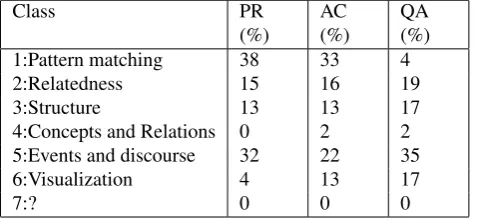
We observe (Tables 13 and 14) that the class distribution for the overall question answering task is different for Exams questions, even though the problem and format are the same. Exams contain significantly more questions of Tier 3 compared to Main. And among Tier 1 classes, they exhibit five times as much Class 2 phenomena as Class 1, whereas Main’s first two classes are balanced, with even a slight bias toward simple pattern matching questions.
2
Class PR (%)
AC (%)
QA (%)
1:Pattern matching 55 52 24
2:Relatedness 12 6 16
3:Structure 16 32 37
4:Concepts and Relations 4 0 2
5:Events and discourse 14 8 18
6:Visualization 0 2 2
7:? 0 0 0
Table 13: Class distribution for Main (docs 1, 5, 9 and 13) found by annotator 1
Class PR
(%)
AC (%)
QA (%)
1:Pattern matching 38 33 4
2:Relatedness 15 16 19
3:Structure 13 13 17
4:Concepts and Relations 0 2 2 5:Events and discourse 32 22 35
6:Visualization 4 13 17
[image:6.595.52.294.69.178.2]7:? 0 0 0
Table 14: Class distribution for Exams (all docs) found by annotator 1
This confirms the hypothesis that the nature of questions in the Entrance Exams corpus is different from that of the questions in Main. Tests for entrance exams use more reformulations of the text (pertaining to Class 2 inferences) to test the english vocabulary of the student. The questions can also involve cognitive processes of higher order (Class 5 and more) which make heavy use of common-sense knowledge, as it is assumed to be naturally available to a human being.
The table 15 attempts to provide some insights on why our inter-agreement rate is much lower on the Exams task than on the Main task. We found that for more difficult problems, it can be confusing to pinpoint the class to which a phenomenon belongs. For example, we report that there seems to be confusions between Class 2 and Class 4 at the passage retrieval level. Class 2 introduces the notion of semantic relatedness and exterior knowledge can already at this level be captured through the resources employed, which makes it close to Class 4 in term of external world knowledge.
Nevertheless, the class distribution of Entrance Exams being skewed towards the upper Tier 2 and Tier 3, with respect to Main’s distribution, we could expect the perfor-mance of systems which ran on both at QA4RME 2013 to be lower because the problem is overall harder. This is indeed the case, as seen in Table 16, all the more so as Entrance exams feature only 4 choices while Main features 5.
5.
Conclusion
We described a hierarchical taxonomy of textual inferences. This taxonomy is designed with computational systems in mind, and encompasses tasks, techniques, tools and
re-Annotators Annotator 1 Annotator 2
Annotators PR AC PR AC
1:Pattern matching 50 33 50 33
2:Relatedness 15 13 0 17
3:Structure 8 10 4 7
4:Concepts and Relations 0 3 19 27 5:Events and discourse 27 20 23 7
6:Visualization 0 20 4 10
[image:6.595.290.538.70.180.2]7:? 0 0 0 0
Table 15: Class distributions from 2 annotators for Exams (docs 1 to 7)
Systems Main
(c@1)
Exams (c@1)
jucs 0.59 0.42
nara 0.33 0.22
limsi 0.28 0.22
Class Main (%) Exams (%)
1:Pattern matching 24 4
2:Relatedness 16 17
3:Structure 37 17
4:Concepts and Relations 2 0 5:Events and discourse 18 40
6:Visualization 2 17
Table 16: c@1 of systems at QA4MRE 2013 and question classes, for both tasks
sources. As seen in the experiments, it can indeed make the contrasts within a dataset apparent, both in term of nature and overall difficulty of the task. From there we can guide further improvements on systems and choose the kind of problems we want to evaluate them on.
In future work, we plan to develop the specification of the annotation process of those classes, perform more fine-grained evaluations on systems and finally propose solu-tions to improve system performances on the higher classes of inference problems.
6.
References
Clark, P., Harrison, P., and Yao, X. (2012). An entailment-based approach to the QA4MRE challenge. In CLEF (Online Working Notes/Labs/Workshop). Citeseer. Cohen, J. (1968). Weighted kappa: Nominal scale
agree-ment provision for scaled disagreeagree-ment or partial credit. Psychological bulletin, 70(4):213.
Dagan, I., Glickman, O., and Magnini, B. (2006). The PASCAL recognising textual entailment challenge. In Machine Learning Challenges. Evaluating Predictive Uncertainty, Visual Object Classification, and Recognis-ing Tectual Entailment, pages 177–190. SprRecognis-inger. Dzikovska, M. O., Nielsen, R. D., Brew, C., Leacock, C.,
[image:6.595.52.291.222.332.2]Ferrucci, D., Brown, E., Chu-Carroll, J., Fan, J., Gondek, D., Kalyanpur, A. A., Lally, A., Murdock, J. W., Ny-berg, E., Prager, J., et al. (2010). Building Watson: An overview of the DeepQA project. AI magazine, 31(3):59–79.
Huang, H.-H., Chang, K.-C., and Chen, H.-H. (2013). Modeling human inference process for textual entailment recognition. InProceedings of the 51st Annual Meeting of the Association for Computational Linguistics (Vol-ume 2: Short Papers), pages 446–450, Sofia, Bulgaria, August. Association for Computational Linguistics. Levesque, H. J., Davis, E., and Morgenstern, L. (2011).
The Winograd schema challenge. InAAAI Spring Sym-posium: Logical Formalizations of Commonsense Rea-soning.
MacCartney, B. and Manning, C. D. (2007). Natural logic for textual inference. InProceedings of the ACL-PASCAL Workshop on Textual Entailment and Para-phrasing, pages 193–200. Association for Computa-tional Linguistics.
McKoon, G. and Ratcliff, R. (1992). Inference during reading.Psychological review, 99(3):440.
Miller, G. A. (1995). WordNet: a lexical database for en-glish.Communications of the ACM, 38(11):39–41. Moldovan, D., Pas¸ca, M., Harabagiu, S., and Surdeanu,
M. (2003). Performance issues and error analysis in an open-domain question answering system. ACM Trans-actions on Information Systems (TOIS), 21(2):133–154. Moldovan, D., Clark, C., Harabagiu, S., and Hodges, D.
(2007). Cogex: A semantically and contextually en-riched logic prover for question answering. Journal of Applied Logic, 5(1):49–69.
Pe˜nas, A. and Hovy, E. (2010). Filling knowledge gaps in text for machine reading. InProceedings of the 23rd International Conference on Computational Linguistics: Posters, pages 979–987. Association for Computational Linguistics.
Pe˜nas, A., Hovy, E., Forner, P., Rodrigo, ´A., Sutcliffe, R., and Morante, R. (2013). QA4MRE 2011-2013: Overview of question answering for machine reading evaluation. InInformation Access Evaluation. Multilin-guality, Multimodality, and Visualization, pages 303– 320. Springer.
Poon, H. (2010). Markov logic in natural language pro-cessing: Theory, algorithms, and applications. InHuman Language Technologies: The 2010 Annual Conference of the North American Chapter of the Association for Com-putational Linguistics, page 3.
Toutanova, K., Klein, D., Manning, C. D., and Singer, Y. (2003). Feature-rich part-of-speech tagging with a cyclic dependency network. InProceedings of the 2003 Con-ference of the North American Chapter of the Associa-tion for ComputaAssocia-tional Linguistics on Human Language Technology-Volume 1, pages 173–180. Association for Computational Linguistics.
Turing, A. M. (1950). Computing machinery and intelli-gence.Mind, pages 433–460.
Zwaan, R. A. and Radvansky, G. A. (1998). Situation