Impact of Channel Estimation Errors on
Multiuser Detection via the Replica Method
Husheng Li
Department of Electrical Engineering, Princeton University, Princeton, NJ 08544, USA Email:[email protected]
H. Vincent Poor
Department of Electrical Engineering, Princeton University, Princeton, NJ 08544, USA Email:[email protected]
Received 26 January 2005
For practical wireless DS-CDMA systems, channel estimation is imperfect due to noise and interference. In this paper, the impact of channel estimation errors on multiuser detection (MUD) is analyzed under the framework of the replica method. System performance is obtained in the large system limit for optimal MUD, linear MUD, and turbo MUD, and is validated by numerical results for finite systems.
Keywords and phrases:CDMA, multiuser detection, replica method, channel estimation.
1. INTRODUCTION
Multiuser detection (MUD) [1] can be used to mitigate mul-tiple access interference (MAI) in direct-sequence code divi-sion multiple access (DS-CDMA) systems, thereby substan-tially improving the system performance compared with the conventional matched filter (MF) reception. The maximum likelihood (ML)-based optimal MUD, introduced in [2], is exponentially complex in the number of users, thus being difficult to implement in practical systems. Consequently, various suboptimal MUD algorithms have been proposed to effect a tradeoffbetween performance and computational cost. For example, linear processing can be applied, based on zero-forcing or minimum mean square error (MMSE) crite-ria, thus resulting in the decorrelator [1] and the MMSE de-tector [3]. For nonlinear processing, a well-known approach is decision-feedback-based interference cancellation (IC) [1], which can be implemented in a parallel fashion (PIC) or successive fashion (SIC). It should be noted that the above algorithms are suitable for systems without channel codes. For channel-coded CDMA systems, the turbo principle can be introduced to improve the performance iteratively using the decision feedback from channel decoders, resulting in
This is an open access article distributed under the Creative Commons Attribution License, which permits unrestricted use, distribution, and reproduction in any medium, provided the original work is properly cited.
turbo MUD [4], which can also be simplified using PIC [5]. The decisions of channel decoders can also be fed back in the fashion of SIC, and it has been shown that SIC com-bined with MMSE MUD achieves the sum channel capacity [6].
theory, has been applied as a unified framework to both op-timal and linear MUD, resulting in explicit asymptotic ex-pressions for the corresponding bit error rates and spectral efficiencies. These results have been extended to turbo MUD in [12]. It should be noted that the replica method is based on some assumptions which still require rigorous mathemat-ical proof. However, the corresponding conclusions match simulation results and some known theoretical conclusions well.
In practical wireless communication systems, the trans-mitted signals experience fading. In the above MUD algo-rithms, the channel state information (CSI) is assumed to be known to the receiver. However, this is not a reasonable as-sumption since channel estimation is imperfect due to the existence of noise and interference. Therefore, it is of interest to analyze the performance of MUD with imperfect channel estimates. For linear MUD, the impact of channel estimation error on detection has been studied in [13,14,15] using the theory of large random matrices. In this paper, we will apply the replica method to analyze the corresponding impact on optimal MUD, and then extend the results to linear or turbo MUD, under some assumptions on the channel estimation error. The results can be used to determine the number of training symbols needed for channel estimation.
The remainder of this paper is organized as follows. The signal model is explained inSection 2and the replica method is briefly introduced in Section 3. Optimal MUD with im-perfect channel estimation is discussed inSection 4and the results are extended to linear and turbo MUD inSection 5. Simulation results and conclusions are given in Sections 6 and7, respectively.
2. SIGNAL MODEL
2.1. Signal model
We consider a synchronous uplink DS-CDMA system, which operates over a frequency selective fading channel of orderP
(i.e.,Pis the delay spread in chip intervals). LetKdenote the number of active users,Nthe spreading gain, andβK/N
the system load. In this paper, our analysis is based on the large system limit, where K,N,P → ∞while keepingK/N
andP/N constant.
We model the frequency selective fading channels as discrete finite-impulse-response (FIR) filters. For simplic-ity, we assume that the channel coefficients are real. Thez -transform of the channel response of userkis given by
hk(z)=
P−1
p=0
gk(p)zp, (1)
where {gk(p)}p=0,...,P−1 are the corresponding independent
and identically distributed (i.i.d.) (with respect to bothkand
p) channel coefficients having variance 1/P. For simplicity, we consider only the case in whichP/N 1. Thus we can ignore the intersymbol interference (ISI) and deal with only the portion uncontaminated by ISI.
The chip matched filter output at thelth chip period in a fixed symbol period can be written as
r(l)=√1 N
K
k=1
bkhk(l) +n(l), l=P,P+ 1,. . .,N, (2)
wherebkdenotes the binary phase shift keying (BPSK) mod-ulated channel symbol of userk with normalized power 1,
{n(l)}is additive white Gaussian noise (AWGN), which sat-isfiesE{|n(l)|2} =σ2
n,1and{hk(l)}is the convolution of the spreading codes and channel coefficients:
hk(l)=sk(l)gk(l), (3)
wheresk(l) is thelth chip of the original spreading code of userk, which is i.i.d. with respect to bothkandland takes values 1 and−1 equiprobably. We call the (N+P−1)×1 vec-tor2hk=(hk(0),. . .,hk(N+P−2))Ttheequivalent spreading codeof userk. Due to the assumption thatP/N 1, we can approximateN−P+ 1 byNfor notational simplicity. Then the received signal in the fixed symbol period can be written in a vector form
r= √1
NHb+n, (4)
where r = (r(P),. . .,r(N))T,H = (h
1,. . .,hK), and b =
(b1,. . .,bK)T. It is easy to show that (1/N)hk2 → 1, as
P → ∞. Thus, we can ignore the performance loss incurred by the fluctuations of received power in the fading channels and consider only the impact of channel estimation error.
2.2. Channel estimation error
In practical wireless communication systems, the channel co-efficients{gk(l)}are unknown to the receiver, and the corre-sponding channel estimates{gk(l)}are imprecise due to the existence of noise and interference. We assume that training symbol-based channel estimation [16] is applied to provide the channel estimates. On denoting the channel estimation error byδgk(l)gk(l)−gk(l),{δgk(l)}are jointly Gaussian-distributed and mutually independent for sufficiently large numbers of training symbols [16]. Therefore, it is reasonable to assume that {δgk(l)}is independent for different values ofkandl. In this paper, we consider only the following two types of channel estimation.
(i) ML channel estimation.It is well known that ML esti-mation is asymptotically unbiased under some regula-tion condiregula-tions. Thus, we can assume that the estima-tion errorδgk(l) has zero expectation conditioned on
gk(l), and is therefore correlated withgk(l).
1Note thatσ2
nis the noise variance, normalized to represent the inverse signal-to-noise ratio.
(ii) MMSE channel estimation.An important property of the MMSE estimate, namely the conditional expecta-tionE{gk(l)|Y}, whereYis the observation, is that the estimation errorδgk(l) is uncorrelated withgk(l), and thus is biased.
We assume that the receiver uses the imperfect channel estimates to construct the corresponding equivalent spread-ing code, namelyhk. Thus, the error of the ith chip ofhkis
from which it follows that the variance ofδhk(i) is given by
∆2
h=PVar{δgk(l)}.
Fixing{δgk(l)}and considering{δsk(l)}as random vari-ables, it is easy to show thatδhk(l) is asymptotically Gaussian asP → ∞by applying the central limit theorem to (5). Due to the assumption thatP/N1, for anyl,δhk(l) is indepen-dent of most{δhk(m)}m=lsince for any|l−m|> P,δhk(l) andδhk(m) are mutually independent. Thus, it is reasonable to assume that the elements in δhk are Gaussian and mu-tually independent, which substantially simplifies the analy-sis and will be validated with simulation results inSection 6. Similarly, we can assume that the elements ofhkare mutually independent as well.
3. BRIEF REVIEW OF REPLICA METHOD
In this section, we give a brief introduction to the replica method, on which the asymptotic analysis in this paper is based. The details can be found in [9,10,11,17].
On assumingP(bk =1)=P(bk = −1), we consider the
where σ2 is a control parameter. Various MUD algorithms
can be obtained using this ratio. In particular, we can obtain individually optimal (IO), or maximum a posteriori proba-bility (MAP), MUD (σ2=σ2
n), jointly optimal (JO), or ML, MUD (σ2=0) and the MF (σ2= ∞).
The key point of the replica method is the computation of the free energy, which is given by
FK(r,H)K−1logZ(r,H)
and the overbar denotes the average over the randomness of the equivalent spreading codes. It should be noted that the second equation is based on the self-averaging assumption [11].
To evaluate the free energy, we can use the replica meth-od, by which we have
FK(r,H)= lim
roughly considerbato be theath estimates of the received binary symbolsb.
An assumption, which still lacks rigorous mathemati-cal proof, is proposed in [11], which states thatΞnr around nr = 0 can be evaluated by directly using the expression of
Ξnr obtained for positive integersnr. With this assumption,
we can regardnras an integer when evaluatingΞnr, and{xa}
asnrreplicas ofx.
To exploit the asymptotic normality of
The cross-correlations of{va} are denoted by parame-ters{Qab}, whereQabvavb. With these definitions, we can obtain
Ξnr = Rexp
Kβ−1G{Q}µ
K{Q}
a<b
dQab, (13)
where3
µK{Q} =
b0,...,bnr
nr
a=0
Pba a<b
δbH
abb−KQab
, (14)
and
expG{Q}= 1
2πσ2
n R exp
− β
2σ2
n r
β−v0{Q}
2
×
nr
a=1
exp − β
2σ2
r
β−va{Q}
2
dr+OK−1. (15)
By applying Varadhan’s large deviations theorem [18],
Ξnrconverges to the following expression asK→ ∞:
lim K→∞K
−1logΞ
nr =sup
{Q}
β−1G{Q} −I{Q}, (16)
whereI{Q}is the rate function ofµK{Q}, which is based on an optimization over a set of parameters{Q˜ab}a<b.
Thus, the evaluation of the free energyFK(r,H) depends on the optimization of (16) over the parameters{Qab}and
{Q˜ab}, which is computationally prohibitive. This problem is tackled by the assumption ofreplica symmetry; that is,Q0a=
m, ˜Q0a=E, for alla=0 andQab=q, ˜Qab=F, for alla < b,
a = 0. Then the optimization of (16) is performed on the parameter set{m,q,E,F}. The optimal{m,q,E,F}are given by solving the following implicit expressions:
m=
Rtanh
√
Fz+EDz,
q=
Rtanh
2√Fz+EDz,
E= β−1B
1 +B(1−q),
F=β−1B2
B−1
0 + 1−2m+q
1 +B(1−q)2 ,
(17)
where Dz = (1/√2π)e−z2/2
dz,B0 = β/σn2, andB = β/σ2. Then, the performance of MUD can be derived from the free energy, which is determined bym,q,E,F. It is shown in [11] that the bit error rate of MUD is given by
Pe=Q
E √
F
, (18)
whereQ(z)=!z∞Dtis the complementary Gaussian cumu-lative distribution function. Thus the multiple access system
is equivalent to a single-user system operating over an AWGN channel with an equivalent signal-to-noise ratio (SNR)E2/F.
The parametersmandqare the first and second moments, respectively, of the soft output,bk=P(bk=1)−P(bk= −1). WhenB=B0(σ2 =σn2), it is easy to check thatm=qand
E=Fusing (17).
4. OPTIMAL MUD
In this section, we discuss two types of receivers distin-guished by whether or not the receiver considers the distri-bution of the channel estimation error. We denote the case ofdirectlyusing the channel estimates for MUD by a prefix D, and the case of considering the distribution of the channel estimation error tocompensatethe corresponding impact by a prefix C.
4.1. D-optimal MUD
In this subsection, we discuss the D-optimal MUD, where the receiver applies the channel estimates directly to MUD and does not consider the distribution of the channel estimation error. When the equivalent spreading codes contain errors incurred by the channel estimation error, the corresponding free energy is given by
FK
r,H=K−1logZr,H, (19)
whereHis the estimation of channel coefficientsHand
Zr,H {b}
P(b) exp
− 1
2σ2
r−√1
NHb
2
. (20)
We assume that the self-averaging assumption is also valid for
δHH−H, and thus (7) still holds with the corresponding
Ξngiven by
Ξn=
We can apply the same methodology as inSection 3to the evaluation of the free energy with imperfect channel es-timation. The only difference is that we need to take into ac-count the distribution of the channel estimation error. In a way similar to (12), we define
va=√1
For ML channel estimation,δhkis uncorrelated withhk, thus resulting inE{hkhk} = 1 andE{hkhk} = 1 +∆2h. Then we
For MMSE channel estimation,δhkis uncorrelated with
Thus, the free energy with imprecise channel estimation still depends on the same parameter set {m,q,E,F} as in Section 3. An important observation is that the existence of
{δhk}affects only the termG{Q}in (13), andµK{Q}remains unchanged, which implies that the expressions formandq
are identical to those in (17). Hence, we can focus on only the computation ofG{Q}. By supposing that the assumption of replica symmetry is still valid, the asymptotically Gaussian random variablesv0andvacan be constructed using expres-sions similar to those in [11]. For ML channel estimation, we have
whereu,t, and{za}are mutually independent Gaussian ran-dom variables with zero mean and unit variance.
With the same definitions ofu,t, and{za}, for MMSE channel estimation, we have
v0=u
Substituting the above expressions into (13), we can ob-tain the following conclusions using some calculus similar to that of [11]. For ML channel estimation, the free energy is given by
The correspondingEandFare given by
E= β−1B
For MMSE channel estimation, we can obtain
FK
and the correspondingEandFare given by
The corresponding output signal-to-interference-plus-noise-ratios (SINRs) of the ML and MMSE channel estima-tion are given by the following expressions, respectively:
SINRML=
Thus, we can summarize the impact of the channel esti-mation error on the D-optimal MUD as follows.
(i) The factors 1/(1 +∆2h) in (31) and 1−∆2h in the nu-merator of (32) represent the impact of the error of the desired user’s equivalent spreading codes, which is equivalent to increasing the noise level.
(ii) The imperfect channel estimation also increases the variance of the residual MAI, which equalsβ(1−2m+ (1 +∆2
h)q) for ML channel estimation-based systems and β(1−(1 −∆2
h)(2m −q)) for MMSE channel estimation-based systems.
(iii) The equationsm =q andE =F are no longer valid whenσ2 = σ2
n. Thus, there are no simple analytical expressions for obtaining the multiuser efficiency in a way similar to the Tse-Hanly equation [8].
4.2. C-optimal MUD
In this subsection, we consider the C-optimal MUD, where the distribution of the channel estimation error is exploited to compensate for the imperfection of channel estima-tion. For simplicity, we consider only the IO MUD (C-IO MUD).
4.2.1. ML channel estimation
When deriving the expressions of C-IO MUD, we consider a fixed chip period and drop the index of the chip period for simplicity. The conditional probabilityP({hk}|{hk}) should be taken into account to attain the optimal detection. Thus, the a posteriori probability of the received signalrat this chip period, conditioned on the channel estimates{hk}and the transmitted symbols{bk}, is given by
It should be noted that the above two expressions are based on the assumption of normality and mutual independence of
{δhk}inSection 2.2. Then we have
where the factors common for different{bk}are ignored for simplicity. tion error is compensated for merely by changing the equiv-alent noise variance and scaling the channel estimate with a factor of 1/(1 +∆2h).
Similarly to the analysis inSection 4.1, we can define
Then we can obtain the free energy, which is given by
An interesting observation is that the equationsm = q
andE=Fare recovered in this case. Also we can obtain the equivalent SINR, which is given by
SINRML=
The corresponding multiuser efficiencyηis given by solv-ing the followsolv-ing Tse-Hanly style equation:
1
From (42), we can see that the impact of channel es-timation error consists of three aspects, which are repre-sented by the three terms in the denominator of the ex-pression (42). The term σ2
n(1 + ∆2h) embodies the nega-tive impact of the channel estimation error on the user being detected, which causes uncertainty in the equivalent spreading codes of this user and is equivalent to scaling the noise by a factor of (1 + ∆2
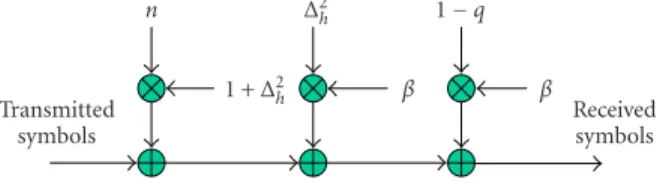
h). Besides implicitly af-fecting the parameter q in the third term, the channel es-timation error of the interfering users also results in the term ofβ∆2h; an intuitive explanation for this is that, since the output of IO MUD can be regarded as the output of an interference canceller using the conditional mean esti-mates of all other users [10], the channel estimation er-ror causes imperfection in the reconstruction of the sig-nals of the other users and the variance of residual interfer-ence equalsβ∆2
hwhen the decision feedback is free of errors. The corresponding equivalent channel model is illustrated in Figure 1.
Figure1: Bit error rate of D-IO MUD as a function of channel es-timation error variance.
4.2.2. MMSE channel estimation
For MMSE channel estimation, the channel estimation error
δhkis uncorrelated with the estimatehk. Thus, we have
Phk|hk
Applying the same procedure as ML channel estimation, we can obtain the LR of IO MUD, which is given by
Pbk=1|r
where the control parameter, or equivalent noise power,σ2=
σ2
Similarly to the case of ML channel estimation, the equations
m=qandE=Fare recovered as well. The equivalent out-put SINR is given by
SINRMMSE=
and the corresponding multiuser efficiency is given by solv-ing the followsolv-ing equation:
1
The intuition behind (47) is similar to that of ML chan-nel estimation. On comparing (43) and (48), an immediate conclusion is that the C-IO MUD is more susceptible to the error incurred by MMSE channel estimation than that in-curred by ML channel estimation, when ∆2
5. LINEAR MUD AND TURBO MUD
We now turn to the consideration of linear and turbo mul-tiuser detection. For simplicity, we discuss only ML chan-nel estimation-based systems in this section. MMSE chanchan-nel estimation-based systems can be analyzed in a similar way.
5.1. Linear MUD
The analysis of linear MUD can be incorporated into the framework of the replica method (for MMSE MUD, σ2 =
σ2
n; for the decorrelator,σ2 → 0) by merely regarding the channel symbols as Gaussian-distributed random variables. The system performance is determined by the parameter set
{m,q,p,E,F,G}and a group of saddle-point equations [11]. Particularly, whenσ2=σ2
n(MMSE MUD), the parame-ters can be simplified to{q,E}, which satisfyq =E/(1 +E) andE =β−1B
0/(1 +B0(1−q)). The multiuser efficiency is
determined by the Tse-Hanly equation [8].
5.1.1. D-MMSE MUD
Since the channel estimation error does not affectI{Q}, the parametersm,q, andpare unchanged. With the same ma-nipulation onG{Q}as inSection 4, we can obtain the pa-rametersE,F, andGas follows:
E= β−1B
1 +B(p−q)1 +∆2
h ,
F=
1 +∆2hβ−1B2B−1
0 + 1−2m+
1 +∆2hq
1 +B(p−q)1 +∆2h2 ,
G=F−1 +∆2
h
E.
(49)
5.1.2. C-MMSE MUD
Similarly to Section 4, the MMSE detector considering the distribution of the channel estimation error is given by merely scaling H with a factor of 1/(1 +∆2
h) and changing
σ2toσ2
n+β∆2h/(1 +∆2h). Then, we haveE=F,G=0,m=q, and p =0. The corresponding multiuser efficiency is given implicitly by
1 +∆2h+β∆
2
h
σ2
n
η+ βη
σ2
n+η
=1. (50)
5.2. Turbo MUD
5.2.1. Optimal turbo MUD
For optimal turbo MUD [4], since the channel estimation er-ror does not affectI{Q}when evaluating the free energy, the impact of channel estimation error is similar to the optimal MUD inSection 4, namely, the corresponding saddle-point equations remain the same as in [12] except that the parame-tersEandFare changed in the same way as in (28) and (41).
5.2.2. MMSE filter-based PIC
However, greater complications arise in the case of MMSE filter-based PIC [4], where the MAI is cancelled with the de-cision feedback from channel decoders and the residual MAI
is further suppressed with an MMSE filter. The correspond-ing MMSE filter is constructed with the estimated equivalent spreading codes{hk}and the estimated power of the residual interference. In an unconditional MMSE filter, the power es-timate is given by∆2bE{(bk−bk)2}, wherebkis the soft de-cision feedback; and in a conditional MMSE filter, the power estimate is given by 1−b2
k. However, this power estimate for userkis different from the true value|bk−bk|2sincebkis un-known to the receiver, thus making the filter unmatched for the MAI. Hence, the analysis in [12] may overestimate the system performance since such power estimation errors are not considered there. Thus we need to take into account the corresponding power mismatch. For simplicity, we consider only unbiased power estimation. Note that this scenario can be applied to general cases where the received signal power is not perfectly estimated.
For the MMSE filter-based PIC, the powers of the resid-ual interference are different for different users. Similarly to the analysis of unequal-power systems in [17], we can divide the users into a finite number (L) of equal-power groups, with power{Pl}l=1,...,L, estimated power{Pl}l=1,...,L, and the corresponding proportion{αl}l=1,...,L, and obtain the results
for any arbitrary user power distribution by lettingL → ∞. Confining our discussion to unbiased MAI power estima-tion, we normalize the MAI power such thatLl=1αlPl =1 and Ll=1αlPl = 1. The equivalent noise variance is given byσ2 =σ2
n/∆2b. Thus, the bit error rate of MUD is given by
Q(E/F∆2
b) since the power of the desired user is unity. Similarly to the previous analysis, we define
v0=√1
K
L
l=1
Pk
k∈Cl hkb0k,
va= √1
K
L
l=1
Pk
k∈Cl
hkbak, a=1,. . .,nr,
(51)
whereClrepresents the set of users with powerPl. We can see that the uneven and mismatched power distribution does not affect the analysis of exp(G{Q}), which incorporates the im-pact of channel estimation error. However, the rate function
I{Q}is changed to
I{Q} =sup
{Q˜}
a≤b ˜
QabQab− L
l=1
αllogM{Gl}{Q˜}
, (52)
where
MG
{l}{Q˜} =
1
2 Rnrexp
PlPlEb0nr a=1
ba+PlF
a<b
babb
+GPl 2
nr
a=1
b2
a n
a=1
Dba,
(53)
in which {ba}a=1,...,nr are Gaussian random variables.
energy, which is given by
FK
r,H= 1
2 L
l=1
αl
log1 + (F−G)Pl
− PlF+PlPlE2 1 + (F−G)Pl
+Em−1
2Fq+ 1 2Gp
− 1
2β
log1 +1 +∆2h(p−q)B
+B
B−1
0 + 1−2m+
1 +∆2
h
q
1 +B(p−q)1 +∆2h
.
(54)
LettingL→ ∞, we can obtain that
m=E
*
PPE
1 +P(F−G) +
,
q=E
,
P2PE2+F
1 +P(F−G)2
-,
p=E
,
P PPE2+ 2PF + 1−PG
1 +P(F−G)2
-,
(55)
where the expectation is with respect to the joint distribution ofPandP.
For the unconditional MMSE filter, the expressions for
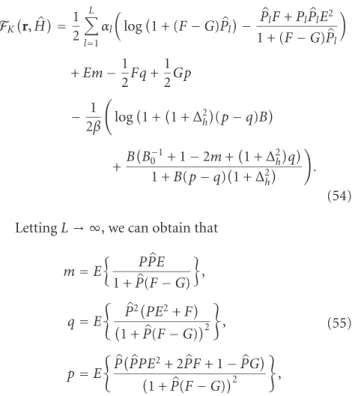
m,q, and p can be simplified to the following expressions, sinceP=E{P} =∆2
b:
m=
∆2
b 2
E
1 +∆2
b(F−G) ,
q=
∆2
b 2∆2
bE2+F
1 +∆2b(F−G)2,
p=∆
2
b
∆2
b 2
E2+ 2∆2
bF+ 1−∆2bG
1 +∆2
b(F−G)
2 .
(56)
This implies the interesting conclusion that if the MMSE MUD based receiver regards the received powers of different users as being equal to the average received power, the mul-tiuser efficiency will be identical to that of the correspond-ing equal-power system. It should be noted that the corre-sponding bit error rates are different although the multiuser efficiencies are the same. Thus, the analysis of the uncondi-tional MMSE filter-based PIC in [12] yields correct results. It should be noted that, for IO MUD with binary channel sym-bols, this conclusion does not hold since the expressions for
m,q, andpare nonlinear inP.
This conclusion can also be applied to frequency-flat fad-ing channels. When the received power is perfectly known, the multiuser efficiency of MMSE MUD is given by
η+E
* βPη
σ2
n+Pη +
=1, (57)
0.1 0.09 0.08 0.07 0.06 0.05 0.04 0.03 0.02 0.01
0.05 0.1 0.15 0.2 0.25 0.3 0.35 0.4 0.45 0.5
∆2 h
Bi
t
er
ror
ra
te
Convolution Independent Asymptotic
MMSE
ML
Perfect CSI
Figure2: Bit error rate of D-IO MUD as a function of channel es-timation error variance.
where the random variable P is the received power and the expectation is with respect to the distribution of P. When the receiver is unaware of the fading and uses equal-power MMSE MUD, the multiuser efficiency of this power-mismatched MMSE MUD is given by that of an equal-power system:
η+ βE{P}η
σ2
n+E{P}η
=1. (58)
Comparing (57) and (58) and applying the fact that, for any positive random variablex,E{x/(1 +x)} ≤E{x}/(1 +E{x}), we can see that this power mismatch incurs a loss in mul-tiuser efficiency.
6. SIMULATION RESULTS
In this section, we provide simulation results to verify and illustrate the analysis of the preceding sections.
Figure 2shows the bit error rates versus the variance of the channel estimation error for a D-IO MUD system with
K = 10, N = 150, P = 50, and σ2
0.18 0.16 0.14 0.12 0.1 0.08 0.06 0.04 0.02 0
0.05 0.1 0.15 0.2 0.25 0.3 0.35 0.4 0.45 0.5
∆2 h
Bi
t
er
ror
ra
te
Perfect CSI C-ML C-MMSE
D-MMSE D-ML
Figure3: Bit error rate of C-IO MUD as a function of channel esti-mation error variance.
0.16 0.14 0.12 0.1 0.08 0.06 0.04 0.02
0.05 0.1 0.15 0.2 0.25 0.3 0.35 0.4 0.45 0.5
∆2 h
Bi
t
er
ror
ra
te
D-LMMSE C-LMMSE Independent
Convolution Perfect CSI
Figure4: Bit error rate of MMSE MUD as a function of channel estimation error variance.
Figure 3compares the bit error rates in D-IO and C-IO MUD systems with β = 0.5 andσ2
n = 0.2. For ML chan-nel estimation, the C-IO MUD achieves considerably better performance than the D-IO MUD. For MMSE channel es-timation, the two IO MUD schemes attain almost the same performance.
Figure 4shows the bit error rates for MMSE MUD sys-tems with the same configuration as inFigure 3. Both the nu-merical simulations (for both independent and convolution models of the equivalent spreading codes) and asymptotic
0.045 0.04 0.035 0.03 0.025 0.02 0.015
0.1 0.15 0.2 0.25 0.3 0.35 0.4 0.45 0.5
∆2 h
Bi
t
er
ror
ra
te
Simulation Mismatched Optimal
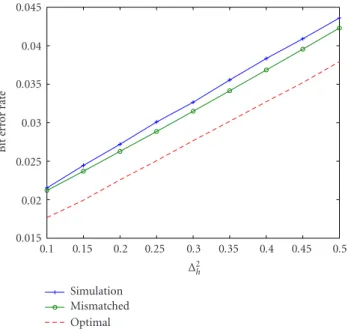
Figure5: Bit error rate of MMSE filter-based PIC as a function of channel estimation error variance.
results are given for D-MMSE MUD, and match fairly well. Note that C-MMSE MUD achieves marginally better perfor-mance than D-MMSE MUD.
Figure 5shows the bit error rates of MMSE filter-based PIC systems with the same configurations as inFigure 4. The decision feedback is from the channel decoder of a convolu-tional code (23, 33, 37)8when the input SINR is 3 dB. In this
figure, the theoretical and simulation results for the uncon-ditional MMSE filter are represented with “mismatched” and “simulation,” respectively; the results with the assumption that the residual interference power is known are represented by “optimal.” We can observe that the optimal scheme, which assumes that the decision feedback error is known, achieves only marginally better performance.
For Rayleigh flat-fading channels, the multiuser effi -ciency, obtained by numerical simulations, versus SNR is given inFigure 6. In this figure, “equal power” means the case of equal received power. For the case of Rayleigh-distributed received power, the results of mismatched (regarding the re-ceived power as being equal) MMSE MUD and optimal (the received powers are known) MMSE MUD are represented by “Rayleigh-mismatch” and “Rayleigh,” respectively. We can see that the numerical results verify our conclusion about the power-mismatched MMSE MUD in Section 5.2. Also, the knowledge of received power provides marginal improve-ment in multiuser efficiency.
InFigure 7, we apply the results for C-MMSE MUD to obtain the optimal proportion α of training symbols, ver-sus the coherence timeM(measured in symbol periods) and system load β, to maximize the spectral efficiency given by (1−α) log(1 +ηSNR), where SNR=5 dB,ηis determined by (50), and∆2
0.9 0.85 0.8 0.75 0.7 0.65 0.6 0.55 0.5 0.45 0.4
1 2 3 4 5 6 7 8 9 10
SNR (dB)
M
ultiuser
e
ffi
ciency
Equal power (β=0.2) Equal power (β=0.5) Rayleigh-mismatch (β=0.2)
Rayleigh-mismatch (β=0.5) Rayleigh (β=0.2)
Rayleigh (β=0.5)
Figure 6: Multiuser efficiency versus SNR for nonfading and Rayleigh fading systems.
0.16 0.14 0.12 0.1 0.08 0.06 20
25 30
35 40
45 50 Coher
ence time
Optimal
tr
aining
pr
opor
tion
1 0.8
0.6 0.4 0.2 0
β
Figure7: Optimal proportion of training symbols versus coherence times and system load.
7. CONCLUSIONS
In this paper, we have discussed the impact of channel es-timation error on various types of MUD algorithms in DS-CDMA systems by obtaining asymptotic expressions for the system performance in terms of the channel estimation error variance. The analysis is unified under the framework of the replica method. The following conclusions are of particular interest.
(i) The performance of MUD is more susceptible to MMSE channel estimation errors than ML ones. (ii) The MUD schemes that consider the distribution of
channel estimation errors can improve the system pformance, considerably for ML channel estimation er-rors and marginally for MMSE channel estimation errors.
(iii) When the MMSE MUD treats different users as be-ing received with equal power, it attains the same mul-tiuser efficiency as the corresponding equal-power sys-tems.
ACKNOWLEDGMENTS
This research was supported in part by the Office of Naval Research under Grant N00014-03-1-0102 and in part by the New Jersey Center for Wireless Telecommunications. This paper was presented in part at the 2004 IEEE Global Telecommunications Conference, Dallas, Tex, November 29– December 3, 2004.
REFERENCES
[1] S. Verd ´u, Multiuser Detection, Cambridge University Press, Cambridge, UK, 1998.
[2] S. Verd ´u, Optimal Multi-user Signal Detection, Ph.D. thesis, University of Illinois at Urbana-Champaign, Urbana, USA, August 1984.
[3] R. Lupas and S. Verd ´u, “Linear multiuser detectors for synchronous code-division multiple-access channels,” IEEE Trans. Inform. Theory, vol. 35, no. 1, pp. 123–136, 1989. [4] X. Wang and H. V. Poor, “Iterative (turbo) soft interference
cancellation and decoding for coded CDMA,” IEEE Trans. Commun., vol. 47, no. 7, pp. 1046–1061, 1999.
[5] P. Alexander and A. Grant, “Iterative detection in code-division multiple-access with error control coding,”European Trans. Telecommunications, vol. 9, no. 5, pp. 419–426, 1998. [6] S. Verd ´u and S. Shamai, “Spectral efficiency of CDMA with
random spreading,” IEEE Trans. Inform. Theory, vol. 45, no. 2, pp. 622–640, 1999.
[7] D. V. Voiculescu, K. J. Dykema, and A. Nica, Free Random Variables, vol. 1 ofCRM Monograph Series, American Mathe-matical Society, Providence, RI, USA, 1992.
[8] D. N. C. Tse and S. Hanly, “Linear multiuser receivers: eff ec-tive interference, effective bandwidth and user capacity,”IEEE Trans. Inform. Theory, vol. 45, no. 2, pp. 641–657, 1999. [9] H. Nishimori, Statistical Physics of Spin Glasses and
Informa-tion Processing, Oxford University Press, Oxford, UK, 2001. [10] D. Guo and S. Verd ´u, “Spectral efficiency of large-system
CDMA via statistical physics,” inProc. Conference on Infor-mation Sciences and Systems, The Johns Hopkins University, Baltimore, Md, USA, March 2003.
[11] T. Tanaka, “A statistical-mechanics approach to large-system analysis of CDMA multiuser detectors,” IEEE Trans. Inform. Theory, vol. 48, no. 11, pp. 2888–2910, 2002.
[12] G. Caire, R. M¨uller, and T. Tanaka, “Iterative multiuser joint decoding: optimal power allocation and low-complexity im-plementation,”IEEE Trans. Inform. Theory, vol. 50, no. 9, pp. 1950–1973, 2004.
[13] J. Evans and D. N. C. Tse, “Large system performance of linear multiuser receivers in multipath fading channels,”IEEE Trans. Inform. Theory, vol. 46, no. 6, pp. 2059–2078, 2000.
[14] H. Li and H. V. Poor, “Impact of imperfect channel estima-tion on turbo multiuser detecestima-tion in DS-CDMA systems,” in Proc. IEEE Wireless Communications and Networking Confer-ence (WCNC ’04), pp. 30–35, Atlanta, Ga, USA, March 2004. [15] Z. Xu, “Effects of imperfect blind channel estimation on
[16] H. Li and H. V. Poor, “Performance of channel estimation in long code DS-CDMA with and without decision feedback,” inProc. Conference on Information Sciences and Systems, The Johns Hopkins University, Baltimore, Md, USA, March 2003. [17] D. Guo and S. Verd ´u, “Multiuser detection and statistical me-chanics,” inCommunications, Information and Network Se-curity, V. Bhargava, H. V. Poor, V. Tarokh, and S. Yoon, Eds., chapter 13, pp. 229–277, Kluwer Academic Publishers, Nor-well, Mass, USA, 2002.
[18] F. den Hollander, Large Deviations, vol. 14 ofFields Institute Monographs, American Mathematical Society, Providence, RI, USA, 2000.
Husheng Lireceived the B.S. and M.S. de-grees in electronics engineering from Ts-inghua University, Beijing, China, in 1998 and 2000, respectively, and the Ph.D. de-grees in electrical engineering from Prince-ton University, PrincePrince-ton, NJ, in 2005. In 2005, he joined Qualcomm, San Diego, Calif. His research interests include statisti-cal signal processing, wireless communica-tion, and information theory.
H. Vincent Poorreceived the Ph.D. degree in EECS from Princeton University in 1977. From 1977 until 1990, he was on the fac-ulty of the University of Illinois at Urbana-Champaign. Since 1990 he has been on the faculty at Princeton, where he is the George Van Ness Lothrop Professor in engineering. He has also held visiting appointments at a number of universities, including recently Imperial College, Stanford, and Harvard.