R E S E A R C H
Open Access
An improved wolf colony search algorithm
based on mutual communication by a
sensor perception of wireless networking
Chenghai Wu
1*, Kaiyu Qin
1, Penghui He
2and Houbiao Li
2Abstract
Intelligence optimization algorithms have an important application in engineering calculation. Swarm intelligence optimization algorithms belong to the class of intelligent algorithms, which are derived from the simulation of natural biological evolution or foraging behaviours. But these algorithms have sometimes slow convergence, and for multi-peak problems, they are easy to fall into the local optimal solution in the later period of the algorithms. To solve these problems, in this paper, the advantages of these algorithms and the wolf colony search algorithm based on the strategy of the leader (LWCA) algorithm are used, to propose an improved wolf colony search algorithm with the strategy of the leader algorithm (ILWCA). ILWCA is based on mutual communication by the sensor perception of wireless networking, adding a global update strategy and a step acceleration network. In addition, by introducing the concept of individual density to depict the distribution density of the wolf, the problem of excessive input parameters of traditional wolf group algorithm is solved. Moreover, by adding the way of mutual migration, the algorithm increases the communication between wolves, and strengthens the overall performance of the optimization process. Finally, the experimental results show that the ILWCA algorithm achieves higher solution accuracy and better robustness compared with the accuracy and robustness of particle swarm optimization (PSO), gravitational search algorithm (GSA), swarm optimization algorithm (SOA), grey wolf optimizer (GWO), and genetic algorithms (GA).
Keywords:Intelligent algorithm, ILWCA algorithm, Mutual communication, Sensor network, Grey wolf optimizer
1 Introduction
Intelligent optimization techniques have become very popular over the past few decades. In engineering practice, “novel”algorithms or theories are often encountered. For example, simulated annealing, genetic algorithms, tabu search, and neural networks are representative of these in-novations. These algorithms and theories have some com-mon features, such as simulation of natural processes, which cast them as“intelligent algorithms”. They are very useful in solving some complex engineering problems.
Swarm intelligence optimization algorithm is a type of intelligent algorithm that is derived from the simulation of natural biological evolution or foraging behaviour. In re-cent years, intelligent algorithms have become very popu-lar, including genetic algorithms (GA) [1, 2], particle
swarm algorithm (PSA) [3, 4], monkey search algorithm [5], and artificial bee colony algorithm (ABC) [6]. How-ever, these algorithms sometimes encounter slow conver-gence, and for multi-peak problems, they are prone to fall into a local optimal solution in the later period of the algorithm.
On the basis of the hunting behaviour of the wolf group, the wolf swarm algorithm is proposed. The wolf swarm algorithm has both better robustness and global characteristic. The prey hunting behaviour of wolves consists of wandering, attack, and siege. There are now many algorithms related to the prey behaviour of wolves.
For examples, the LWCA [7] incorporated the addition
of a leader strategy to the original wolf pack algorithm (WPA) [8]. The GWPA [9, 10] approach added the
dir-ection dual chaos update strategy. The MWCA [11]
method joined an interactive mode with an interactive movement feature for the walking of raiding wolves in the foraging process, and increased the exchanges to * Correspondence:[email protected]
1School of Aeronautics and Astronautics, University of Electronic Science and
Technology of China, Chengdu 611731, China
Full list of author information is available at the end of the article
enhance the overall algorithm. Additionally, MWCA [8]
is aimed at multiple-peak problems, and MO-WCA [12]
is used to solve a multi-objective problem of WCA. This paper primarily uses the double gauss function updating
method in the small wolf pack algorithm (SWPA) [12].
The double gauss function update method is used to up-date the wolves, producing a better individual. Although the wolf swarm algorithm was proposed based on bionic wolves in 2007, it has been widely developed in recent years [13, 14]. Based on WPA, GWO [15, 16], and grey wolf optimization algorithm based on strengthening
hierarchy of wolves (GWOSH) [17] divided the wolves
into four grades, and different grades of wolves were capable of different ways to walk and run. In this paper, the advantages of these algorithms were extended to re-duce the input of the parameters of the wolf swarm algo-rithm, join an interactive walking movement, change the manner of walking, improve the update strategy, and propose a new ILWCA algorithm. The experiment is per-formed with 22 test functions and compared with GWO,
PSO, gravitational search algorithm (GSA) [18], swarm
optimization algorithm (SOA) [19], and GA. Based on ex-perimental results, the accuracy of the ILWCA algorithm is higher and shows better robustness.
The biological background of wolves is closely related to information science, as wolves in nature have a strict hierarchy. A pack of wolves usually has a leader wolf, an explorer wolf, and a fierce wolf, as well as other wolves apart from this hierarchy. Wolves, as the top group of predators at the peak of the natural food chain, have typ-ical overall characteristics in their systems such as rele-vance and integrity [20, 21]. The wolf that finds the best game will howl and attract other wolves to round up the prey. They capture the prey, ensure their overall survival, safeguard the integrity of the pack, and exhibit a clear division of labour for each individual in the wolf pack. According to the call behaviour of the wolves and their
mutual communication [22], the leader wolf, the
ex-plorer wolf, and the fierce wolf are able to communicate with each other in real time. While they work independ-ently but interact with each other as a wolf pack, they must also work and hunt together so that they can ac-complish what one wolf alone cannot do. With various kinds of behaviour, such as their visual observation, col-laborative predatory detection, sense of smell, psycho-logical induction, and body language, an intelligent sensor network of real-time communication with each other is established. Their communication methods are concise and efficient [23], and the wolf pack has strong abilities for seeking, coordinating, and controlling. These habits and characteristics of wolves are beneficial for a search algorithm based on the behaviour of wolves.
The rest of the paper is organised as follows: Section2
outlines the proposed ILWCA algorithm. The results
and discussion of benchmark functions that are used comprise Section 3 and Section 4, respectively. Finally,
Section 5 concludes the work and suggests some
direc-tions for future studies.
2 Problem formulation and methods
In this section, based on step acceleration technology and the global mutual communication update strategy, a new wolf group algorithm called ILWCA is presented that combines the advantages of other algorithms. ILWCA also adds an interactive way of walking, which can improve the wolf’s communication and optimization process. The al-gorithm also introduces the double gauss update strategy, which makes the algorithm produce better individuals while optimising the entire group of wolves.
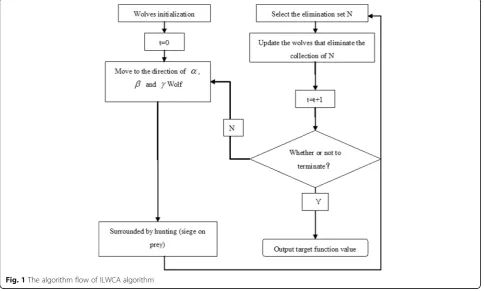
The algorithm flow of ILWCA algorithm is as follows in Fig.1.
The pseudo code of the ILWCA algorithm is pre-sented in Fig.2.
2.1 Initialization of the wolf group
The location of wolves is randomly initialized in the search space.
Xi¼ x1i;⋯;xDi
ð1Þ
xid¼xminþ randðxmax−xminÞ ð2Þ
where xmaxand xmin are the maximum and minimum
range of activity, respectively. Rand is a random number.
2.2 Wolves moved to three leading wolves (raid)
First, the fitness of each wolf was calculated, and the wolf with the optimal fitness was marked asα. Then, the wolf with the second best fitness was selected as β, and the third best wolf was selected as γ. The values of the
α,β, and γ wolves are recorded as fα,fβ,fγ, respectively. The sum of their adaptive values isf:
f ¼ fαþfβþfγ ð3Þ
In this paper, the Euclidean distance is used to depict the distance between two wolves. The distance between theXiwolf and theαwolf isdα. ddimension of the αwolf. The distance between theXi
wolf and theβwolf isdβ.
dγ¼
XD
i¼1 x d i−xdγ
2
1
2
ð6Þ
The sum ofdα,dβ,dγis defined asd.
d¼dαþdβþdγ ð7Þ
Therefore, the mode of raid may be built as follows:
zdi ¼xdi þ 1− fα feðt=tmaxÞ2
! 1−dα
d
xdα−xdi
þ 1−fβ f
1−dβ d
xd
β−xdi
þ 1−fγ f
1−dβ d
xdγ−xdi
ð8Þ
The farther theαwolf is from theXiwolf, the smaller the effect. The bigger the α wolf’s fitness value is, the greater the influence on the Xi wolf. The βand γwolves are the same. The introduction ofeðt=tmaxÞ2is used to
in-crease the influence of the α wolf with the increase in
the number of iterations and to accelerate the speed and convergence trend of the algorithm. If the location of the wolfXimoves to Ziððz1i;z2i;⋯;zDiÞÞ, the fitness of Zi is better than the current location. The position of the
Xiwolf is updated toZi. On the other hand, theXiwolf’s position does not move. The adaptation values of theXi wolf after updating were compared with the fitness values of the α, β, and γ wolves. The best three wolves were selected as the newα,β, and γwolves to complete the update ofα,β, andγwolves.
The interaction between individuals in intelligent algo-rithms helps to enhance the optimization ability of the algorithm and the ability to jump out of the local extremum. To increase the interactivity of the wolves, the following search method is applied.
wdi ¼xdi þφid xdα−xdi equal numbers.ϕidis theddimension coordinate of the Xkwolf. xdα is thed dimensional coordinate of the best solution. The first part of formula (9) enhanced the local optimization ability of the algorithm, and the second part enhanced the global search ability of the algorithm. It is a good balance of the exploitation and exploration ability of walking behaviour, which not only embodies the influence of the wolf on the entire wolf group but also reflects the ability of each individual to learn from each other, improving the diversity of the population. If the raid interaction position is Wiðw1i;w2i;⋯;wDiÞ, the
position of theXiwolf is updated toWi; otherwise, theXi
wolf’s position remains the same.
When moving to α, β, and γ, the locations of Zi and
Wiextend beyond the boundary; therefore, cross-border
processing should be performed.
where xdmax and xdmin represent the maximum and
mini-mum value of the d dimension of the search space, respectively.
2.3 Surrounded by hunting (siege)
After moving in the direction of the α, β, andγ wolves and given that the location of the αwolf stands for the location of the present optimal prey, the entire wolf pack is moved in the direction of theαwolf. If the position of a wolf in the siege is better than that of the α wolf, the wolf will take the place of theαwolf. The location of the
αwolf is updated, and the remaining wolves who are not
besieging continue to move to the newαwolf. The siege
does not end until all wolves carry out the siege. After the Xi wolves carry out a siege, the ddimension will be defined asvd
can attack the back area of prey. In addition, the trans-boundary treatment of Viðv1i;v2i;⋯;vDiÞis considered. If
the prey atViis better than the current location, the
lo-cation of the Xi wolf is updated to Vi; otherwise, theXi
wolf’s position is kept unchanged.
2.4 Updated decision
In the early stage, wolves tend to search globally, so the wolves should explore more unknown areas. If the wolves in the region are denser in this area, each wolf in the region is well-adapted, and it can be inclined to se-lect some of the poorly adapted wolves among the pack to search in other regions. Because wolves in the area are searching, they can avoid falling into a local optimum. In the later stage, the tendency is to search carefully to find better prey. Therefore, most of the wolves can be concentrated in a certain area for a de-tailed search. Every time the wolves are updated, the poorly adapted individuals tend to be eliminated.
Next, we introduce the method of the authors in [13] to depict the individual density of theXiwolf.
The truncated distance is defined by dc, which is a
parameter for determining whether a wolf is in the vicin-ity of another wolf. If the distance between the two wolves is smaller than the truncation distance, the dis-tance between the two wolves is very close.
λ is a truncated distance parameter that determines
the truncation distance, and it is determined by the user in advance. After sorting all the distances between all of the wolves, the cut-off distanceλ% is defined.
between theXiwolf and theXjwolf, andP= {1, 2,⋯,n}, wherenis the total number of wolves.
By sorting the local density of the wolves, 2 m wolves with the largest local density are selected. They are or-dered by density from large to small in setA. Then, 2 m wolves are selected to adapt to the worst wolves, and they are put into set Baccording to their fitness values from small to large. The intersection of setsA and Bis denoted byC:
C¼A∩B ð14Þ
C¼fc:ci∈B;ci∈A;i¼1;…;lg ð15Þ
The wolf in setChas a large local density and poor fit-ness. The elimination of wolves can be selected at the early stage of collectionC.
Two major elimination methods are adopted. Let N
store the eliminated individuals.
Random numbers are generated by the rand function for the interval [0, 1]. The probability of the establish-ment of rand>eðtmaxt Þ
2
in the early stage is larger. With the increase in iteration steps, the probability will be in-creasingly smaller. The algorithm tends to search glo-bally, and later, the algorithm tends to search locally.
Discussion of the cases:
cates that the former m elements are taken out in the
collection C. (A/C)[1 :m−l] means that after removing the intersection from set Ato setB, we choose the first
melements in the remaining elements. (B/C)[1 :m−l] is empathy. rand>eðtmaxt Þ
2
has great probability in the early stage of the algorithm, and with the increase of
iteration steps, the probability will be smaller and smaller. This indicates that ILWCA algorithm tends to eliminate individuals with larger local density in the earl-ier stage. To facilitate the exploration of more unknown areas, in the later stage, ILWCA algorithm tends to eliminate individuals with poor fitness, which should in-crease local search speed, speed up convergence, and search for better prey.
According to the principle of survival of the fittest,
we remove the wolves in set N. Then, m wolves are
generated by the double Gauss function update method. Such population is not easy to fall into local optimum and makes the population diversity. The double Gauss function is constructed to make the
lo-cation of Wi of new-born wolf Xi away from the
lo-cation of the original wolf Wi, because the location of
Wi does not have good population diversity. The d
di-mensional location of the new artificial wolf Wi is
defined as Xzi :
Xiz ¼δdi N2þ1−δdiXzi ð18Þ
where δdi is the ddimension updating coefficient of the artificial wolfWi, which is a randomly generated 0 or 1.
It is used to determine whether the location of the di-mension is updated.N2is the updating coefficient of the
position of the artificial wolfWi, obtained by the double
Gauss function update method. The difference between the newly generated wolves in the group of wolves is the result of the impact of many small, independent, and random factors from the perspective of probability and statistics. According to the central limit theorem, a new generation of an artificial wolf’s difference in position can be considered to have normal distribu-tion characteristics. At the same time, to promote the new generation of an artificial wolf who fled from the original artificial wolf’s position, more artificial wolves should be made that are far away from the original position; therefore, a new generation of artificial wolves is more likely to be started. To accomplish this aim, the new artificial wolf is generated by the following double Gauss function:
Table 1Multimodal benchmark functions
N2¼ xdminþσ1e
heavisideðr1−rÞ þ xdmaxþσ2e
heavisideðr−r1Þ ð19Þ
r¼ x
d i−xdmin
xd max−xdmin
ð20Þ
The variables σ1and σ2are the mean square variance
of the double Gauss function. The ddimensional space
is the position of the hunting grounds with the upper limit ofxd
max and a lower limit of xdmin. The mean double Gauss function is used to promote the new generation of an artificial wolf who fled the original region. The
variable e is used to comply with the standard normal
distribution of the random number;r1belongs to a
ran-dom number between [0,1], which is used to promote the new generation of artificial wolves who tend to stay away from the original position to escape. The unit step function used is heaviside(x), defined as follows:
heavisideð Þ ¼x
0; x<0 0:5; x¼0 1; x>0 8
<
: ð21Þ
If theddimensional position Wiof theXi new gener-ation artificial wolf Wi is beyond the scope of hunting,
the new position of the wolf is regenerated with the double Gauss function method. The update process is not stopped until the new artificial wolf’sddimensional position is in the hunting space.
3 Experimental design
To verify the effectiveness of the algorithm, 22 bench-mark functions [24] were selected for testing. The algo-rithm is compared with GWO, PSO, GSA, SOA, and
GA. Some benchmark functions are shown in Table1.
The initialization scale of ILWCA and GWO, GSA, SOA, PSO, and GA is 30, and the maximum iterations are set to 800. The number of wolves in which other
Table 2Results of benchmark functions
F ILWCA GWO PSO GSA SOA GA
F4 Average 2.3098e-07 1.6809e-01 5.9244e + 00 2.5968e + 03 8.7209e + 00 3.7533e-01
Best 2.0231e-08 6.5745e-02 2.7091e + 00 2.3267e + 03 3.7315e + 00 1.5339e-02
Worst 1.0011e-06 8.6775e-01 2.2001e + 01 2.7596e + 03 1.7043e + 01 1.2087e + 00
F10 Average −8.3013e + 03 −5.9874e + 03 −5.6100e + 03 −2.7100e + 03 −2.6426e + 03 −2.0209e + 03
Best −1.0709e + 04 −7.1086e + 03 −8.4041e + 03 −4.0804e + 03 −3.4663e + 03 −3.3395e + 03
Worst −7.0223e + 03 −4.7540e + 03 −2.8426e + 03 −1.7474e + 03 −2.0591e + 03 −1.3446e + 03
F12 Average 1.0207e + 00 4.1775e-02 3.4556e-03 4.5266e + 08 1.8131e + 00 2.2822e + 00
Best 3.8368e-21 6.7666e-03 3.2972e-11 1.2343e + 08 1.3187e-01 3.4683e-01
Worst 9.8116e + 00 1.2092e-01 1.0366e-01 6.5390e + 08 3.8369e + 00 3.9012e + 00
F16 Average −6.7145e + 01 −4.6695e + 01 −6.5902e + 01 −3.0162e + 01 −5.1201e + 01 −2.0334e + 01
Best −7.0698e + 01 −5.3634e + 01 −6.9157e + 01 −3.7542e + 01 −6.4863e + 01 −2.7265e + 01
Worst −6.4195e + 01 −3.9875e + 01 −6.3337e + 01 −2.6260e + 01 −3.8281e + 01 −1.5495e + 01
parameters are eliminated is m= 5. The truncated
dis-tance parameter is λ= 3. The updated double Gauss
function selects the Gauss function with a mean value of
0 and a variance of 1. For GWO, the parametera= 2.For
GSA, the initial gravitational constant G= 100, α= 20,
and the speed range is [−1,1].For SOA, the maximum
membership degree is Umax = 0.9500, and the minimum membership degree is Umin = 0.0111. For PSO, the iner-tia weight isC1=C2= 2. For GA, the cross probability is
0.75, and the mutation probability is 0.05.
4 Results and discussion
4.1 Results of benchmark functions
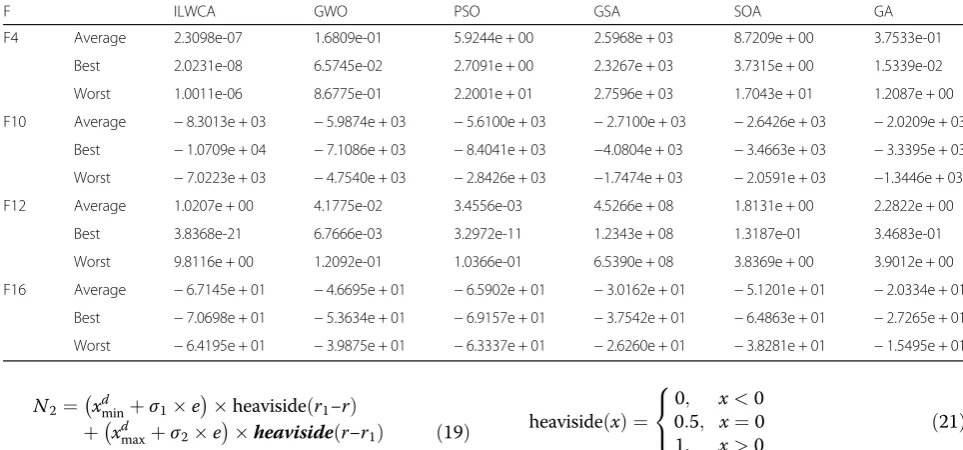
In the actual experiment, 22 independent functions were tested. To illustrate the convenience of the results, the results of four unimodal functions of F4, F10, F12, and F16 are shown below. The average value, the best value,
and the worst value are shown in Table 2. The
converging trend diagram of some functions is drawn for six algorithms. Additionally, the first dimension
vari-able of the α wolf position in the ILWCA algorithm is
used to change the graph of the optimization process (see Figs.3,4,5,6,7, and8).
The above six algorithms were analysed in terms of the following two aspects: the best value and the average value.
For function F4, the best value found by the ILWCA algorithm is the best among the algorithms, reaching 1E-08. The optimal values for GWO and GA are only 1E-02, and the other three algorithms achieve only up to 1E + 00. For the functions F10, F12, and F16, the ILWCA is superior to the other algorithms in finding the optimal values of these functions.
Comparison of mean value, as for functions F4, F10, and F16, the average value that ILWCA finds has good results, which are better than the other algorithms. For
Fig. 4F10 diagram and six algorithms converging trend diagram (F10)
function F12, the average value searched by GWO and PSO is the best, and ILWCA is second. For function F16, the average value obtained by ILWCA and PSO is 1E-30, and the exact solution is 0.
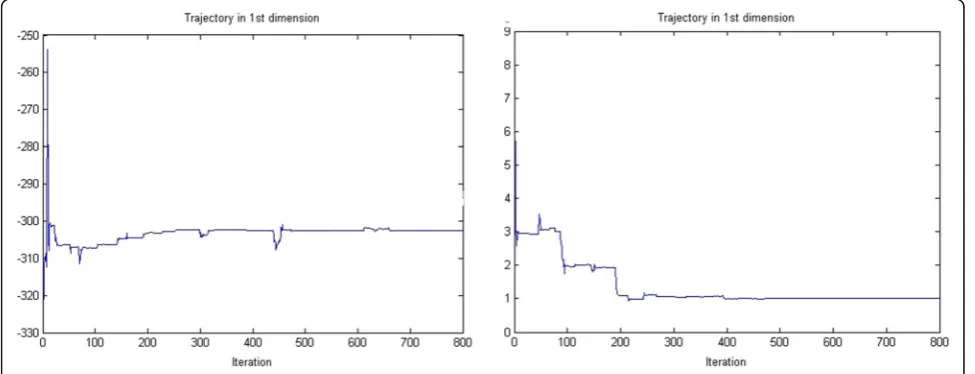
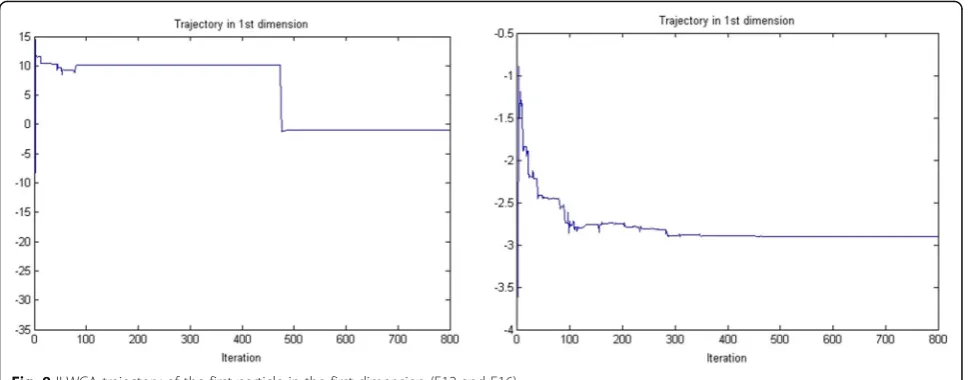
To make a clearer comparison of these algorithms, some functions within these twenty-two test functions were chosen. The images of the functions were observed, and the algorithm converges in the contrast graph and the track of the first-dimension variables in the search process of the ILWCA algorithm, see Figs. 3, 4, 5, 6, 7, and8.
4.2 Convergence behaviour analysis
In order to get a clearer understanding of the gaps in these algorithms and to make a clearer comparison of these algorithms, we choose some functions in these 22 test functions. The images of the functions are observed. We also draw six algorithms converging trend diagram of some functions, as well as the convergent contrast diagram (see Figs. 3, 4, 5, 6, 7, and 8), and the first
dimension variable of α wolf position in ILWCA
algo-rithm is used to change the graph of optimization process (see Fig.5and Fig.8).
From the convergence diagram of ILWCA algorithm, we can know that as the number of iterations increases, the value of functions presents monotonically increasing trend and approaches the global optimal solution. In order to further observe the convergence behaviour of the algorithm, we also drew the search history track of the first search agent in the first search dimension. From the first dimension of the first dimension of the above seven functions, we can learn that the trend of the first dimension of the first dimension of the wolf is very large in the early period of the search, but the search trajec-tory tends to be stable in the later period of the iteration. This behaviour guarantees that a SI algorithm will even-tually converge to the point in search space. This gives a good indication of the stability of the ILWCA algorithm. For Fig.8F12, to the later stage, the change trend graph is also unstable, because the function is a process
Fig. 6F12 diagram and six algorithms converging trend diagram (F12)
overlap, and the point of the function image is stereo-scopic in the vicinity of the global best advantage. The optimal prey searched by ILWCA algorithm is generally better than other algorithms.
5 Conclusions
This article presents a swarm intelligence algorithm based on the predation behaviour of wolves. The survival rule of the wolf group through the survival of the fittest was eval-uated to find the global optimal solution. IWCA was com-bined with the characteristics of other algorithms, and added an interactive walk to increase the overall algo-rithm. To reduce the probability of leading wolves to bring the entire group of wolves to the local solutions, an
im-proved manner of wolves’wandering was adopted.
In addition, this paper introduced a second excellent moderate value and the third best fitness value of a wolf. Together with the leader wolf, they led the entire group of wolves to find the best global value. The other wolves were affected by the three wolves, which were closely
re-lated to the wolves’ adaptation value and the distance
from the wolves. Therefore, the greater the adaptation value is, the closer the distance is, and the greater the ef-fect on the wolf is.
To make the wolves explore more unknown areas, if the wolves in a region were denser in a particular area, each wolf in the region had a better fitness value and was in-clined to select some of the poorly adapted wolves to go to other regions and search (elimination). Since there were already wolves in the area, falling into a local optimum could be avoided. In the later period of the algorithm, the search tended to be more careful to facilitate the search for better prey. Therefore, most of the wolves were concen-trated in a certain area for a detailed search. Every time the wolves were updated, the poorly adapted individuals tended
to be eliminated. In addition, the double Gauss function up-date method was introduced to generate better individuals.
Acknowledgements
The authors would like to thank Dr. Seyedali Mirjalili and other authors for providing us some codes during the research and preparation of the manuscript.
Funding
The authors are partially supported by NSFC (61702083), The Doctoral Programme Foundation of State Education Ministry Grant (20130185110023) and Fundamental Research Funds for the Central Universities (ZYGX2016J131, ZYGX2016J138).
Authors’contributions
CW and PH contributed to the conception and algorithm design of the study. PH and KQ contributed to the acquisition of simulation. CW and HL contributed to the analysis of the simulation data and approved the final manuscript. All authors read and approved the final manuscript.
Authors’information
Chenghai Wu received an M.S. degree and PhD as a student from the University of Electronic Science and Technology of China, in 2010 and 2012, respectively. He is a Senior Engineer in Beijing Special Vehicle Institute, Beijing, China. His research interests lie in Multi-Agent System, Coordinated Control, Vehicle Formation, Modelling and Simulation, Computational Intelligence, Communication and Electronics, Wireless Sensor Networks, Software Engineering and Internet of Things. (e-mail:[email protected]). Kaiyu Qin received the M.S. and PhD degrees from University of Electronic Science and Technology of China, in 1994 and 1999, respectively. He is a professor in the School of Astronautics and Aeronautics, University of Electronic Science and Technology of China, Chengdu, Sichuan, China. His research interests lie in the Simulation, Testing, Verification and Evaluation of Complex Electronic Systems, Space Electronic Systems, Microwave Modules and Component Technologies. (e-mail:[email protected]).
Penghui He is currently pursuing the M.S. degree with the School of Mathematical Science, University of Electronic Science and Technology of China, Chengdu, China. His research interests lie in artificial intelligence and image restoration. (e-mail: [email protected]).
Competing interests
The authors declare that they have no competing interests.
Publisher’s Note
Springer Nature remains neutral with regard to jurisdictional claims in published maps and institutional affiliations.
Author details
1School of Aeronautics and Astronautics, University of Electronic Science and
Technology of China, Chengdu 611731, China.2School of Mathematical
Sciences, University of Electronic Science and Technology of China, Chengdu 611731, China.
Received: 2 May 2018 Accepted: 30 May 2018
References
1. PM Pardalos, HE Romehn, Recent developments and trends in global optimization. J. Comput. Appl. Math.124(1–2), 209–228 (2000).https://doi. org/10.1016/S0377-0427(00)00425-8
2. X Yan, D Peng, J Ma, Analog circuit diagnosis based on wolf pack algorithm radical basis function network. Comput. Eng. Appl.53(19), 152–156 (2017). https://doi.org/10.3778/j.issn.1002-8331.1607-0182
3. Hollandjh, Outline for alogical theory of adaptive systems. J. Assoc. Comput. Mach.9(3), 297–314 (1962)
4. S Mirjalili, SM Mirjalili, A Lewis, Grey wolf optimizer[J]. Adv. Eng. Softw.69(3), 46–61 (2014).https://doi.org/10.1016/j.advengsoft.2013.12.007
5. LIU Chang-an, YAN Xiao—hu, LIU Chun-yang, et al., The wolf colony algorithm and its application. Chin. J. Electron.20(2), 212–216 (2011) 6. D Karaboga, B Basturk, A powerful and efficient algorithm for numerical
function optimization: Artificial bee colony (ABC) algorithm. J. Glob. Optim.
39(3), 459–471 (2007).https://doi.org/10.1007/s10898-007-9149-x 7. Q Zhou, Y Zhou, Wolf colony search algorithm based on leader strategy.
Appl. Res. Comput.30(9), 2629–2632 (2013).https://doi.org/10.3969/j.issn. 1001-3695.2013.09.018
8. J bin, Z Jin, Multi-objective sink nodes coverage algorithm based on quantum wolf pack evolution[J]. J. Electron. Inf.39(5), 1–7 (2017).https://doi. org/10.11999/JEIT160693
9. X Hui, G Qing, Z Yu, et al., An improved wolf pack algorithm. Control and Decision32(7), 1164–1172 (2017).https://doi.org/10.13195/j.kzyjc.2016. 0690
10. X Zhang, TU Qiang, Q Kang, et al., Grey wolf optimization algorithm with double-hunting modes and its application to multi-threshold image segmentation. J. Shanxi Univ.39(3):378-85 (2016).https://doi.org/10.13451/j. cnki.shanxi.univ(nat.sci.).2016.03.006
11. Y Liu, J Yong, W Song, et al., Track planning for unmanned aerial vehicles based on wolf pack algorithm. J. Syst. Simul.27(8), 1838–1843 (2015). https://doi.org/10.16182/j.cnki.joss.2015.08.027
12. J Xue, W Ying, J Xiao, et al., A small wolf pack algorithm and its convergence analysis. Control and Decision31(12), 2131–2139 (2016). https://doi.org/10.13195/j.kzyjc.2016.0690
13. H Zheng, Chenkeng, An incremental dynamic clustering method base on the representative points and the density peaks. J. Zhejiang Univ. Technol.
45(4), 427–433 (2017).https://doi.org/10.3969/j.issn.1006-4303.2017.04.014 14. T Wu, F Zhang, L Wu, New swarm intelligence algorithm-wolf pack
algorithm. Syst. Eng. Electron.35(11), 2431–2438 (2013).https://doi.org/10. 3969/j.issn.1001-506X.2013.11.33
15. Z Qiang, Y Zhou, Wolf colony search algorithm based on leader strategy. Appl. Res. Comput.30(9), 2630–2632 (2013).https://doi.org/10.3969/j.issn. 1001-3695.2013.09.018
16. PC Pinto, TA Runkler, JM Sousa, inWasp swarm algorithm for dynamic MAX-SAT problems, ed. by Adaptive and Natural Computing Algorithms. (Springer, 2007), pp. 350–357.https://doi.org/10.1007/978-3-540-71618-1_39 17. X Zhang, T Qiang, K Qiang, et al., Grey wolf optimization algorithm based
on stregthening hierarchy of wolves. J. Date Acquis. Process.32(5), 880–889 (2017).https://doi.org/10.16337/j.1004-9037.2017.05.004
18. NM Sabri, M Puteh, MR Mahmood, A review of gravitational search algorithm. Int. J. Adv. Soft Comput. Appl.5(3), 1-39 (2013)
19. KK Seo, Content-based image retrieval technique by combining swarm optimization algorithm and support vector machines[J]. J. Comput. Theor. Nanosci.10(8), 1693–1700 (2013)
20. X. Lu and Y. Zhou, A novel global convergence algorithm: bee collecting pollen algorithm. Advanced Intelligent Computing Theories and Applications. ed. by With Aspects of Artificial Intelligence (Springer, 2008), pp. 518–525. DOI:https://doi.org/10.1007/978-3-540-85984-0_62 21. AH Gandomi, AH Alavi, Krill herd: A new bio-inspired optimization
algorithm[J]. Commun. Nonlinear Sci. Numer. Simul.17(12), 4831–4845 (2012)
22. X-S Yang,Test problems in optimization. arXiv preprint arXiv:1008.0549, 2010.al Review Letters, vol. 116, no. 6, Article ID 061102(2016).https://doi.org/10. 1002/9780470640425
23. J Huang, Z Liang, Q Zang, Dynamics and swing control of double-pendulum bridge cranes with distributed-mass beams. Mech. Syst. Signal Process.54–55, 357–366 (2015)
24. X-S Yang, Firefly algorithm, stochastic test functions and design