R E S E A R C H
Open Access
Data offloading in IoT environments:
modeling, analysis, and verification
Ankan Ghosh
1,2, Osman Khalid
3*, Rao N. B. Rais
5, Amjad Rehman
6, Saif U. R. Malik
3,4and Imran A. Khan
3Abstract
Recent years have seen a significant growth in Internet of Things (IoT) technology consisting of a large number of devices embedded with sensors and deployed to perform monitoring and actuation tasks. The IoT devices collect large volumes of data that is usually uploaded to cloud to perform analytics and predictions. One of the main challenges in IoT is the transportation of large-scale data collected over a period of time at a remote site. Cellular networks are already facing explosive growth of mobile data traffic due to the proliferation of smart devices and traffic-intensive applications. An alternate solution is to perform the data offloading, where a portion of data can be offloaded from primary links and transferred using opportunistic terminal-to-terminal (T2T) network that relies on direct communication between mobile users, without any need for an infrastructure backbone. However, such approach may lead to data loss and delay if dynamics of time-varying topology and mobility of nodes is not taken care of. To address this challenge, we propose three prediction-based offloading schemes that exploit the mobility patterns and temporal contacts of nodes to predict future data transfer opportunities. We have utilized the High-level Petri Nets to model and formally analyzed the communication processes of the proposed schemes. The new symbolic model verifier (NuSMV) has been employed for the verification of the three schemes against the identified constraints. The verification results affirm the correctness and scalability of the models. The protocols are evaluated with performance metrics, such as the delivery ratio, latency, and overhead. Our results indicate significant improvement in performance compared to existing approaches.
Keywords:Internet of Things, Data offloading, Content dissemination, Delay tolerant routing, Modeling, Petri nets, Verification, NuSMV
1 Introduction
The recent emergence of Internet of Things (IoT) allows hundreds of low-cost wireless sensor devices to physic-ally connect, share, and produce data [1, 2]. It has been estimated that by the year 2020, the number of IoT de-vices will increase from 10 billion to 34 billion, and nearly $6 trillion will be spent on IoT solutions in the next 5 years [1, 2]. The IoT devices are usually embed-ded with sensors that continuously monitor surrounding and generate large volumes of data. It is reported that by the year 2019, 40% of IoT-generated data will be stored, processed, analyzed, and acted upon close to, or at the edge of the network [2]. One of the major challenges faced by the IoT is to transport the large volumes data over the network. Cellular networks are already facing explosive growth of mobile data traffic due to the
proliferation of smart devices and traffic-intensive appli-cations. As the terrestrial IoT grows in number and geo-graphic distribution, more infrastructure is required to maintain all of the communication links, resulting in additional costs and maintenance. This calls for an in-creasing demand for data offloading solutions, where a portion of data can be offloaded from primary links and transferred using alternate communication mechanisms [3]. One such method is to deploy a terminal-to-terminal (T2T) network that relies on direct communication between mobile users, without any need for an infrastruc-ture backbone.
Many IoT applications generate content that is intrinsic-ally delay-tolerant. For instance, IoT equipment deployed at a remote experimental site collecting time-insensitive data that can be stored for some period before being transferred to a distant laboratory for analysis and pro-cessing. Mobile data offloading enables an alternate trans-portation method for time-insensitive content during peak * Correspondence:[email protected]
3Department of Computer Sciences, COMSATS University, Islamabad, Pakistan Full list of author information is available at the end of the article
times, e.g., when the cellular network is overloaded or during outage, or from the places where it is infeasible to deploy cellular network infrastructure [4]. In such cases, a cellular provider may decide to send delay-tolerant IoT data only to a small subset of mobile nodes, and let these nodes spread the information through peer to peer (P2P) communications during opportunistic contacts [5]. The mobilityof nodes is a real enabler for mobile data offload-ing schemes. A mobile node may reach an access point (AP) or a neighbor that carries the content of interest, thereby increasing the offload capacity. Numerous studies have been conducted on human mobility and it has been established that the number of places visited by each person is regulated by some properties that are statistically similar among individuals [6–8]. Shahzad et al. verified through their experiments that real user mobility is char-acterized by correlation in locations and trajectories of users, often resulting in the formation of clusters [9]. Such predictable behavior of human mobility leads to an inter-esting area of research in mobile data offloading, termed as prediction-based offloading [3]. Prediction-based off-loading performs the offoff-loading of delay-tolerant content to those mobile nodes that have higher prediction of transferring data toward destinations during opportunistic P2P contacts [10]. The same idea has also been conceived by the Third Generation Partnership Project (3GPP) that is focusing on utilizing device-to-device communications for providing proximity-based services to complement traditional cellular-based communication [11].
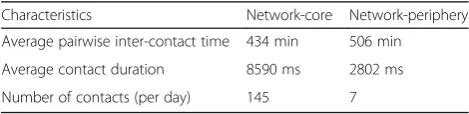
In this paper, we propose three prediction-based offloading schemes: (a) a hybrid scheme for message replication, (b) forecast and relay, and (c) utility-based scheme. The proposed schemes capitalize upon predict-ive behavior of human mobility to perform offloading of delay-tolerant data from a remote IoT site. Our research is motivated by the analysis of two separate large-scale data sets consisting of GPS traces of busses within a city, spanning over a period of 20 days [12]. The first data set is collected from DieselNet testbed in Amherst, Massa-chusetts, which is comprised of transit busses averaging 21 on the road. The second data set is collected from testbed, UMass DieselNet, consisting of an average of 20 transit busses in use on the road for 18 h/day daily in an area of about 360 km2. The network connections among nodes were distributed on the basis of bus-to-bus and bus-to-APs connectivity. Tables 1 and 2 present the characteristics of busses connectivity [12]. The APs were deployed at various locations at road side. The statistical analysis of both data sets revealed that the busses inter-acted more frequently with a subset of other busses and APs on regular basis on specific routes. Using this know-ledge, our proposed schemes exploit the mobility pat-terns and the temporal contacts of the nodes to predict the future contact opportunities. The decisions to
offload the messages to mobile nodes and further relay-ing of messages are based on the aforesaid predictions. The proposed schemes base their models on the time-series data of busses’connectivity collected over a period of time to forecast the future contact opportun-ities. We present the formal modeling and verification of the proposed schemes in the High-level Petri Nets (HLPNs) and the Z specification language [13, 14]. The HLPN furnish the (a) detailed mathematical analyses of the communication processes undergoing in the pro-posed schemes and (b) comprehensive overview of the components and information flow encompassing data offloading. To ensure the model correctness, we utilized new symbolic model verifier (NuSMV), which is an au-tomated model verification tool. To the best of our knowledge, no prior work has been devoted to the for-mal modeling, analyses, and optimized verification of opportunistic prediction-based offloading schemes for the types of network we targeted. We performed the simulations of our proposed schemes in our customized simulator and results indicate the improvement of per-formance of the proposed schemes compared to the related schemes.
The remainder of the paper is summarized as follows. In Section 2, we discuss the literature review. Section3
presents our system model, assumptions, and message transfer schemes. Section 4 presents the modeling, ana-lyses, and verification of the schemes. Section 5 exam-ines and describes the results of the simulation and verification of the content dissemination schemes con-sidered in this work. Section 6 presents the conclusion, and finally, Appendix is presented in Section 7.
2 Literature review
Mobile data offloading has been an active area of re-search for the past few years. With the advent of data-intensive mobile applications, such as video and
Table 1Characteristics of mobile to infrastructure and mobile to mobile contacts
Statistic Mobile to mobile Access point
Average unique nodes 21 busses 151
Number of contacts 242 4964
Average contact duration (sec) 10.3 15.17
Average bandwidth (KBPS) 204.9 N/A
Total transfer (MB) 482 15,071 (at 205 kbps)
Table 2Characteristics of the two regions in the network
Characteristics Network-core Network-periphery
Average pairwise inter-contact time 434 min 506 min
Average contact duration 8590 ms 2802 ms
multi-media content delivery services, the volumes of re-quested data from cellular networks has increased sig-nificantly. According to a Cisco’s report, the global mobile traffic is estimated to significantly increase to about 50 Exabyte per month by 2021, which is a five-times growth over 2017 [4, 15]. Over 78% of this mobile traffic will be video by 2021. With the emergence of more and more data-intensive applications, such as high-density video files download, and IoT, which is col-lecting thousands of tuples of data per second, the cellu-lar networks are under pressure trying to cope with this unprecedented data overload [3,4, 10,16]. Therefore, to address these challenges, several mobile data offloading schemes have been proposed in the literature to reduce the burden on backhaul links, and are generally catego-rized into (a) infrastructure-based (e.g., [17–21]), and (b) opportunistic-based offloading schemes (e.g., [22–29]).
One of the pioneer works in opportunistic mobile data offloading is proposed by Han et al. [27]. The authors addressed the target set selection problem and proposed three algorithms Greedy, Heuristic, and Random to se-lect a set of kmobile nodes on which the data is to be offloaded to minimize the mobile data traffic. The com-parisons of the proposed technique with Random showed better results. The work also implemented a prototype Opp-Off that utilized short range Bluetooth interface for relaying messages to mobile nodes. In [22], the authors propose a scheme to offload data from mo-bile devices to infrastructure through direct communica-tion or by the use of intermediate nodes. The authors investigate the relation between data size and unsuccess-ful delivery probability for a given path and time con-straint. The authors model the problem with a complex optimization procedure using various approximations that may affect the scalability and accuracy of the
pro-posed technique. The scheme is compared with
self-proposed techniques and comparisons with the existing works are missing.
Bao et al. proposed an incentive-based mechanism to reward the users that offer offloading space for the data offloading requesters [23]. The authors design a game theoretic approach based on Stackelberg game model in which multi-followers, as offloading requesters, corres-pond to a number of multi-leaders, as offloading han-dlers, for receiving data through opportunistic contacts through traffic offloading. The incentive amount is proportional to the data offloaded by each handler. The utility of a given flow is defined as a generic concave function. The authors assumed that the caching space of an offloading helper is unlimited. Moreover, no compari-sons with the related schemes are provided. In [24], the authors proposed a Wi-Fi based offloading strategy and formulated the problem as an offline policy based on in-teger linear programming. Each mobile user in the
proposed system needs to obtain a certain data from the Wi-Fi access point before deadline. The access point makes a decision of which mobile node to serve, when multiple mobile nodes connect to it simultaneously. The mobility of nodes causes intermittent connectivity. A mobile node obtains the data from the cellular networks only when the deadline is missed. The proposed ap-proach requires an advance knowledge of the mobility patterns of nodes. Moreover, the technique is compared only with round robin and random.
Valerio et al. analyzed a real-world cellular traffic dataset of video requests collected in a large metropolitan area over a period of 1 month to devise possible offloading strategy [25]. The authors proposed a solution that con-sisted of two parts: (a) data caching and (b) opportunistic data offloading. For caching, the system requires the infra-structure in the form cache servers deployed by the oper-ator in the cellular network. For the offloading, the proposed system utilizes the flooding-based scheme, and a central dissemination controller is required to initiate and monitor the offloading process. There are no comparisons of proposed technique with the related schemes. In
an-other work [26], Valerio et al. proposed an
operator-assisted offloading system in which a central controller decides dynamically over time to which nodes the content must be sent through the cellular network, based on the current status of dissemination. The ac-knowledgments are sent by the nodes over the network to indicate the content is received. To some nodes, the con-tent is directly injected by the cellular network. The authors utilized reinforcement learning to train the cen-tralized controller for dissemination decisions. The pro-posed work is dependent on the centralized control and not purely of opportunistic nature.
instances are the (a) Markov chain models of the message dissemination process [39], (b) stochastic models of the de-livery delay and the task completion time [32], (c) Poisson model of the network and encounter process [40], (d) coali-tional game model of the decision making process among nodes [40], (e) graph model of the mobility and mathemat-ical forecasting model [36], and (f) Colored Petri Net (CPN) model of the anycast communication process [41]. Moreover, the authors in [42] made use of the Queueing Petri Nets to model the communication-based aspects of the data transfer in delay tolerant environments. However, the work was based on the existing routing schemes (similar to [32, 39]) and presented a theoretical analysis. Wireless network proto-cols such as the Bluetooth device discovery, and those encompassing the wireless sensor and local area networks, have been verified extensively in the literature [43]. How-ever, the verification of opportunistic routing of offloaded data received less attention comparatively. In [41], the proposed CPN model for the opportunistic anycast com-munication process was abstractly verified without the use of a suitable model checking tool.
Most of the above-mentioned schemes are either too com-plex that they need to apply certain simplifying assumptions or approximations that will have a negative effect when the same deployed in realistic scenarios, or they are of small scale covering a small area and subset of nodes. Moreover, these schemes do not compare their performance with the related schemes which makes it difficult to judge the offload-ing quality. Furthermore, to the best of our knowledge, none of the existing works were conceived for the design, formal analyses, and verification of novel content dissemination schemes for the mobile data offloading.
3 System model, assumptions, and message transfer schemes
We consider a road network on which various transpor-tation services, e.g., busses, cabs, trams, etc. operate on
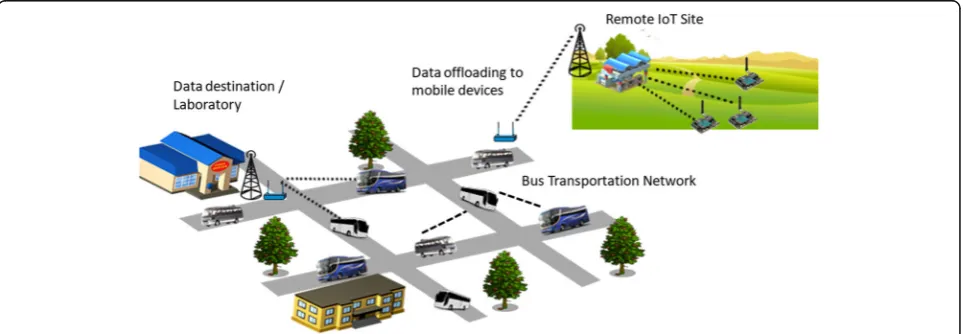
their specific routes. The IoT equipment is deployed at a remote site as shown in Fig.1.
The large volumes of data collected through sensors are transferred to cellular base station installed closer to the IoT site. From the base station, the prediction-based off-loading of data is performed to the en route busses fitted with specialized communication equipment. Once the data is offloaded to busses, the further relaying of data to-ward destination is performed through bus-to-bus or bus-to-AP data transfer opportunities. To generalize the scenario, we use termnodesin lieu of busses, comprising of a set of mobile nodes, such as the PDAs, smartphones, handheld devices, and the fixed access points (APs). The nodes rely on opportunistic P2P contacts for the exchange of the network state information through in-band control signaling and message transfer.
We assume that all the nodes in the network have a unique network identifier, denoted asN_ID. The attributes of a message include a unique sequence number M_ID, source, destination, life-time or time-to-live (TTL), and size. The three lists that a node maintains relative to mes-sages are the (a) message list (ML), containing the physical messages generated or to be relayed by the node, in the message buffers; (b) received list (RL), comprising of the M_IDs of the messages that were received by the node; and (c) acknowledgment list (AL), consisting of theM_IDs of the messages that the node has successfully delivered to the corresponding destinations. It is important to mention here that the size of ML will not grow too big, as those messages that are already delivered to the destination, or whose TTL is expired are regularly being deleted from ML. Moreover, the remaining two lists RL and AL will also be of considerably smaller sizes because they are sup-posed to contain only the IDs of the messages, not the message content/payload.
The transfer of the messages between any two nodes in the network requires the two nodes to be in each
other’s transmission range. When two nodes come in the communication range of each other, the node that initiates the connection (connection initiator or CI) incepts the communication with the connected node (CN). The nodes exchange the information about the contents of their MLs, RLs, and also, to figure out the messages that can be exchanged. Firstly, the CI transfers the messages that are destined for the CN. The messages destined for the CI are then transferred by the CN. Sub-sequently, based on the prediction-based computations, the CI transfers the messages that can be relayed by the CN to the destinations of the messages. The CN then transfers the messages that can be relayed by the CI. More precisely, a message can be transferred directly to the destination on making an opportunistic contact with the source. In the absence of an end-to-end path from the source to the destination, the replicas of the content can be opportunistically relayed toward the destination by using replication through the intermediate nodes known as the relay nodes. To cooperate in the message transfer, the resourceful nodes allocate a limited portion of their buffers for opportunistic data. The nodes keep log of all the previous contacts and use this data to fore-cast the future contacts. The decision to relay or not is based on the underlying content dissemination scheme we proposed in the paper. The scheme also decides whether or not to retain a message after a node relays the replica to a relay. In the following text, we describe the three content dissemination schemes considered in this work.
3.1 Forecast and relay scheme
The forecast and relay (FAR) protocol considers only the contact duration (CD) between any two nodes as an indi-cator of the meeting quality for performing the prediction-based computation. When two nodes (iandj) make an opportunistic contact at a time instant t, the nodes record the meeting quality, denoted byCij(t), which is quantified by the CD between the nodes. Each of the nodes in cellular network stores the meeting qualities for other nodes in the network in the form of time-series en-tries. The higher the value of meeting quality between two nodes, the greater is the probability of a successful mes-sage transfer. When a source nodesgenerates a message mfor a destinationd, and cannot establish a direct contact withd, the node decides whether or not to replicatemon an intermediate relay noder, i.e., using a conditional repli-cation, based on the following:
Fsdð Þ ¼t ϕCsdðt−1Þ þð1−ϕÞ Fsdðt−1Þ ð1Þ In the above equation, the parameter 0≤ϕ≤1 denotes the smoothing constant, the parameterCsd(t) represents
the meeting quality ofs withduntil the timet, the par-ameterFsd(t) is the current forecast of the meeting qual-ity betweensandd. In (1),swill replicatemonr, if and only if rhas a better forecasted meeting quality with d. The condition may also be expressed as:Frd(t) >Fsd(t). A limit is set to the maximum number of time-series en-tries stored by a node (denoted asω) using a sliding time window [1,ω]. When a new entry is added, the oldest entry is automatically deleted. Information freshness and accuracy are ensured by assigning progressively decreas-ing weights to the older entries and by prioritizdecreas-ing the recent ones. Moreover, in (1), if we substitute the value ofFsd(t−1) = [ϕ·Csd(t−2) + (1−ϕ) ·Fsd(t−2)], we get: tain (3) and solving recursively, we finally obtain (4).
Fsdð Þ ¼t ϕCsdðt−1Þ þϕð1−ϕÞ Csdðt−2Þ In the above equation, each of the entries for the meeting qualityCsd(t) has been assigned a certain weight such that as an entry becomes older, it contributes lesser to the overall forecasted value. The base case value of the recursionFsd(0) is given as follows:
Fsdð Þ ¼0
The above equation indicates the average of the meet-ing qualities ofsanddwithin the interval [1,ω].
3.2 Hybrid scheme for message replication
process in the network through conditional replication, by computing the utility values ofi andjfor the message to be replicated. The utilities are (a) the probability that the message will be delivered to the destination before life-time expiry and (b) the probability that the contact duration between a node (ior j) and the destination will be greater than the time required to transfer the message. If both of the probabilities ofjare greater than that of i, the message will be relayed tojand deleted from the buf-fer of i. The process is known as conditional deletion. In the case ofjexhibiting just only higher value for the case (b) but not for case (a), the message will be replicated onj and retained in the buffer of i. The HSM performs the aforementioned prediction-based computations to condi-tionally replicate the message between two nodes. The parameters considered in the HSM for the conditional replication are the (a) contact duration (CD) and (b) inter-contact time (ICT).
The CD and ICT values between any two nodesiandj are denoted byCijandIij, respectively. Each of the nodes in the network maintains a 2-tuple, bounded time-series data (of sizeω) that are the CD and ICT values for every encounter, represented as: <Cij½τ;Iij½τ>, at time in-stant τ. The parameter ω denotes the index of the last entry in the time-series. Let Tkw denote the time since the creation of a messagemk destined ford, and Tk
L be
the TTL of the message mk where k represents the kth message. We compute the utility value of a message k for a nodeiusing the following equation based on [44].
Uik;d¼P Z dið Þτ <TLk−Tkw: ð6Þ
In the above equation,ZdiðτÞis the mean ICT of node iwithd.Therefore, the utilityUk
i;dis the probability that
ICT of nodei withdis less than life time or TTL (Tk L)
of message k minus the time already spent by message waiting in buffers (Tkw). In other words, the utility value will be greater, if the nodeiwith messagemkis expected to meet with the destinationdearlier than the remaining life time of the messagemk. Few of the nodes in the net-work follow a partially scheduled mobility pattern. Such patterns allow to forecast the value of Zd
iðτÞ, using the
In the above equation, the parameter 0≤α≤1 denotes the time-series smoothing constant, the parameter Id
i½τ
represents the ICT of the nodeiwith the nodedat time instant τ, the parameter Zdi½0 is the base value of the
recursion, and ZdiðτÞ denotes the forecasted ICT of the nodeiwith the noded. The nodes in the network allocate a limited memory for the opportunistic data and cannot store the information about all of the past meetings. The sliding time window [1,ω] limits the maximum number of entries that a node may store. To ensure freshness in the information, the entries in the range [1,ω] are assigned progressively decreasing weights that allows the recent entries to contribute more to the overall forecasting. The base case value of the recursionZdi½0is given as follows:
The above equation represents the average ofωentries of the ICT between i and d. If Tkt denotes the time re-quired to transfer a message mk during an opportunistic contact, then the message will be successfully trans-ferred, if and only if the CD between the two nodes is greater than Tkt. The utility value denoted as Vki;d¼P½ Tkt <CdiðτÞrepresents the probability that the message will be successfully transferred between the nodes iand d within the mean CD time. The utility of a nodei for messagemkwill be greater if the mean CD of nodeiand d is lesser than transfer time ofmk between the node i and d. To compute the Vk
d, then the node i decides whether or not to replicate the message on an encountered relay, based on the mean CD and ICT values CdiðτÞ and ZdiðτÞ, respectively. We modify and denote the aforementioned mean CD and ICT values here as Cki;dðτÞ andZki;dðτÞ, respectively. The parameter k represents the kth message mk and τ de-notes the current time instant. With the knowledge of the CD and ICT values, we now compute the aggregate utilityWk
of how good a nodeiis in terms of successfully delivering mktodbefore the life-time expiry. The higher theCki;dðτÞ value and the lower theZki;dðτÞvalue between nodesiand d, the better are the chances ofmkbeing delivered todby i. During an opportunistic contact betweeniand a relayr, the UBS computes the difference of Wk
i;dðτÞand Wkr;dðτÞ
for a messagemkand subsequently, for all of the messages in the ML ofi. IfMis the set of messages in the ML ofi, the notation ðWk
i;dðτÞ−Wrk;dðτÞÞ, ∀m
k∈
M depicts the aforesaid difference. With the obtained differences of the aggregate utilities ofiandrfor each of the messages, the ML of iis reordered in an ascending order, such that the message for which the difference value is the least is moved to the top of the list. This implies that the mes-sages are reordered according to progressively decreasing probabilities of being delivered by r. Subsequently, all messages that are not in the ML ofrare relayed. Evidently, the UBS performs flooding by prioritizing the messages and does not implement the conditional replication or de-letion, as performed by the HSM and FAR. The number of prediction-based computations performed on a node remains the same, as we still use the CD- and ICT-based data. We verified through experiments (in results section) that using such designed approach, the performance of UBS has improved. In the next section, we present the for-mal modeling and verification of the proposed schemes.
4 Formal modeling and verification
In this section, we present a discussion on the verification of the three schemes HSM, FAR, and UBS. The verifica-tion involves the modeling of the highly unpredictable and dynamic communication processes in a comprehensive, yet optimized way, and is an exceedingly time-consuming process. The verification process includes (a) translation of the HLPN models of the three schemes into the NuSMV models, written in the NuSMV language, and (b) automated formal verification of the three models for
identified constraints through exhaustive model checking. The constraints are defined as specification in the compu-tational tree logic (CTL), (c) testing of the models in the presence of up to 100 nodes and 100 messages to verify the scalability and correctness, and (d) use of the optimization techniques offered by the NuSMV to verify the specifications in finite time. We affirm that the HLPNs can be used effectively to model the dynamic prediction-based offloading schemes. Moreover, the work will corrob-orate the fact that the formal verification of similar complex schemes may not be merely limited to the cation of the correctness of the models. In addition, verifi-cation can also be capitalized upon to pave the way for newer routing models, verify their scalability, and to enhance the general performance.
4.1 High-level Petri Nets
The Petri Nets are modeling tools used for the graphical and mathematical modeling of various systems that can be characteristically concurrent, asynchronous, distrib-uted, parallel, non-deterministic, or stochastic [13]. In this work, a variant of the classical Petri Nets, namely the High-level Petri Nets (HLPNs) [13], have been used to model the proposed schemes. Relevant details on the Petri Nets have been presented in [14].
Definition 1 (HLPN) [13]. A HLPN can be defined as a 7-tuple,N= (P,T,F,φ,R,L,M0), where the variable:
1. Prepresents a finite set comprising of the places. The places represent overall state of the system. 2. Tis a finite transition set, such thatP∩T= . 3. Frepresents a flow relation (set of arcs), such that
F (P×T)∪(T×P).
4. φdenotes a mapping function, used to mapPto the data types, such thatφ:P→Type.
5. Rrepresents the rules for mappingTto the predicate logic formulae, such thatR:T→Formula.
6. Lrepresents the labels, and is used to mapFto the labels, such thatL:F→Label.
7. M0is the initial marking, such thatM:P→Tokens.
The variablesP,T, andFfurnish the information about the structure of the HLPN and the variablesφ, R, andL contribute to the static semantics, signifying that the in-formation present in the system is unvarying.
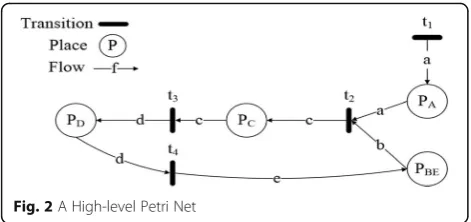
with those arcs. As an example, in Fig.2, the variablesaand b from the placesPA andPBE, respectively, will be respon-sible for the firing of the transitiont2. The post-condition is
the result of a fired transition and utilizes the outgoing vari-ables, such asc(fort2). Assuming that the values ofa= 1,b
= 2.5, and c= 3.15, example of a rule for the transition t2
would be: R(t2)≔(a= 1)˄(b= 2.5)˄(c= 3.15), where (a= 1) ˄(b= 2.5) is called the pre-condition, and (c= 3.15) is called the post condition. Simply put, firing an initial transition (t1)
enables the system to fire the transition t2. The transitions
utilize the data flowing through the incoming arcs to per-form computations and the outgoing arcs are used to carry the results to corresponding places.
4.2 NuSMV
NuSMV is a software tool for the formal verification of finite state systems [45]. It is the re-implementation ver-sion of SMV symbolic model checker with enhance-ments. The basic objective of NuSMV is to check a given finite state system against the specifications defined in the temporal logic CTL (computational tree logic) [46]. The input language of NuSMV allows the de-scriptions of the finite state system to be defined in the NuSMV environment using data types offered by the language. The NuSMV language utilizes the expressions in propositional calculus to describe the transition relations of a finite Kripke structure [47]. Therefore, in our paper, the properties of the proposed schemes are translated into NuSMV language and verified using NuSMV’s automated model checking (Table3).
4.3 Modeling and analysis of HSM
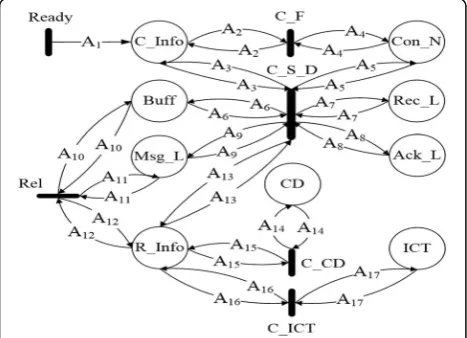
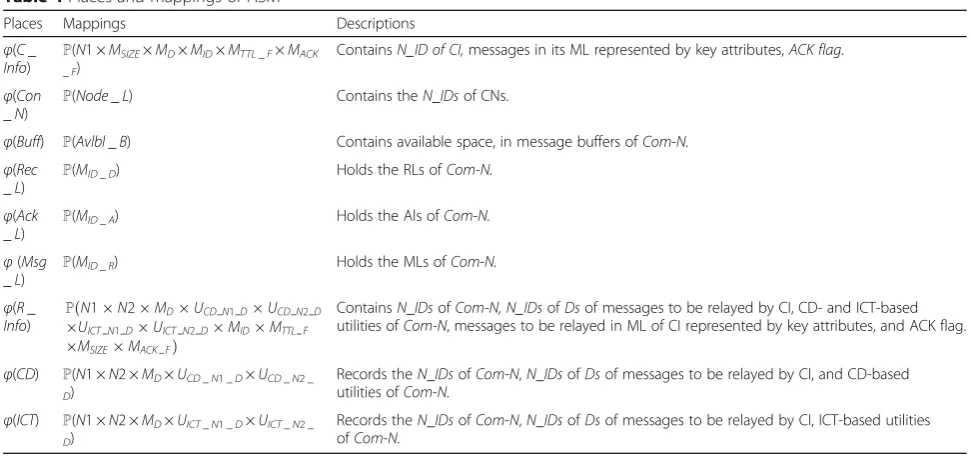
We first present the modeling of HSM, as this scheme is the incremental improvement of FAR, so this saves us from re-writing all the equations again for FAR that are already contained in the model of HSM. The HLPN model of the HSM is illustrated in Fig. 3. The nine places depicted in Fig. 3 constitute the set of places P. The names of the places and the corresponding map-pings (φ) to the tokens or data of various data types, are shown in Appendix Table 4. The data types are described in Table 5. In Fig.3, the set of transitions are denoted as: T= {Ready,C_F,C_S_D,C_CD,C_ICT,
Rel}. The set of arcs F (flow relation) and the corre-sponding labels (L) are also shown in Fig. 3. The initial marking (M0) is simply the tokens of different data types
placed atP, as shown in Appendix Table4.
Here, we briefly discuss the communication processes indicated in Fig. 3. For a detailed description of transi-tions involved, the reader is advised to refer to (14), (15), (16), and (17) in Appendix. The Ready transition indi-cates that the node is ready to initiate a connection with any other node in the network that enters into the trans-mission range of current node. A node can initiate simultaneous connections with multiple nodes. We name the node that first sends the connection request, the connection initiator CI, and the node to which the connection request is sent is called connecting node CN. The information about CI and CN is maintained by the system in the placesC_InfoandCon_N, respectively. If there is no CN in the range of CI, the connection failure transitionC_Fis fired, which is defined with the follow-ing formula:
RðC FÞ ¼∀a2∈A2;∀a4∈A4 ja4∶¼Nil: ð10Þ
However, if there is one or more nodes present in the range of CI, then the connection successful transitionC_ S_Dis fired. The information about the attributes of mes-sages (e.g., size, destination, M_ID, and TTL) contained in the message list ML of CI is defined in the placeC_Infoof the petri net. The detailed process of firing of transitionC _S_D, the pre-conditions, and the post-conditions is de-fined in (14) of Appendix. To summarize, first of all, both nodes CI and CN exchange their message IDs contained in buffer (represented by the place Msg_L), the received mes-sage IDs (represented by place Rec_L), and acknowledged message IDs (represented by the place Ack_L). Both nodes delete those messages from Msg_L that are already marked as delivered to destination (through relay nodes), i.e., they have entry in the places Ack_L or Rec_L. The buffer space of the node (represented by the place Buff) is updated accordingly. In the next step, those messages are ex-changed between nodes for which the nodes are the mes-sages’ destinations. The Ack_L and Rec_L are updated accordingly, and the transferred messages are deleted from Msg_L of both nodes, updating theBuff.
Finally, those messages are left with CI whose destination is not CN, and that needs to be opportunistically replicated. Using the network information available about nodes and messages in R_Info, the system computes the CD- and ICT-based utilities (see Section3.2) of the messages using the transitionsC_CD andC_ICT, respectively, and store the utilities in the placesCD and ICT. The details of the transitionsC_CD andC_ICTare mentioned in (15) and (16) of Appendix. The node CI begins replicating messages
to CN with the conditional firing of transition Rel that makes use of aforementioned computed utilities and the in-formation stored inR_Infoto perform conditional replica-tion. The inner details of the involved pre-conditions and post-conditions are mentioned in (17) in Appendix. Once the node CI finishes message replication to CN, the same procedure is repeated by the node CN. The CI will repeat the process with the other connected nodes one by one. The model does not check if an incoming message to a node had been previously replicated by the node.
4.4 Modeling and analysis of FAR
The HLPN model of the FAR is depicted in Fig. 4. Evidently, the model resembles the model of the HSM. The only notable difference is that the ICT-based place
(ICT) and transition (C_ICT) are not considered in the model of the FAR. The reason is that the replications in the FAR are solely based on the CD. The places and the corresponding mappings to the data types are shown in Tables6and7, respectively in the Appendix. Tables6and
7entail only the mappings and data types that have been modified from the contents of Tables4and5. The modifi-cation is simply the exclusion of ICT-based data and the inclusion of the CD-based meeting quality values (against the CD-based utility), as compared to the model of the HSM. The contents and mappings for the rest of the places, alongside the flow and labels, remain the same as that of the HSM. The set of transitionsT= {Ready,C_F, C_S_D,C_CD,Rel}.
Apart from Rel, the functionality of the pre- and post-conditions (formulae) for the rest of the transitions remain the same, and have not been shown (please refer to Appendix for details). The functions used in the model remain the same as the ones used for the HSM. The only difference is that the transitionC_CDemploys the function FMQ_CDto compute the forecasts of the meeting qualities of the communicating nodes. The function Comp_CD had been used for the HSM to compute the CD-based utility. Therefore, apart from the replication process, the behavior of the model is exactly the same as that of the HSM that allows us to move on to the replication processRelshown in (18) of Appendix. Again, the model does not check if an incoming message to a node had been previously replicated by the node.
4.5 Modeling and analysis of UBS
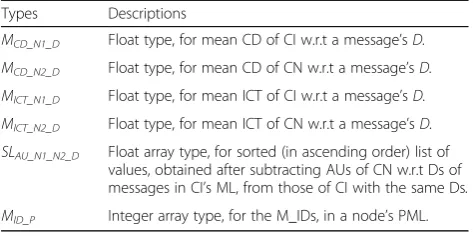
The HLPN model of the UBS is exhibited in Fig.5. The inclusions of the place passed message list (PML) con-taining the PMLs of the communicating nodes and a sorted list of aggregate utilities of the communicating nodes are the modifications made to the model of the HSM. We use the mean CD and ICT values computed in Section 3, instead of the CD- and ICT-based utilities of the HSM. The modifications improve the design limi-tation and facilitate the flooding-based routing. The places and their data type mappings that are modified from or added to the contents of Tables 6 and 7 are shown in Tables 8 and 9, respectively in the Appendix. The aggregate utility (AU) has been added to the list of acronyms. The contents and mappings for the rest of the places, alongside the flow and labels, remain the same as that of the HSM. The set of transitions is given as T= {Ready,C_F,C_S_D,C_CD,C_ICT,Rel}. Being an extension of the HSM, the basic communication pro-cesses and the transitions in the UBS remain the same. The detailed description of transitionRelbe seen in (19) of Appendix.
Apart from Rel, the functionality of the formulae to the rest of the transitions are the same as that of the
Table 3Parameters used in simulations
Parameter Value(s)
World size 4500 × 3900 m
Simulation time per run 12 h
Radio interface Speed: 250 kbps (2 Mbps)
Range: 20 m for cars, 100 m for busses
Message Size: 500 kb–1 MB
Interval: 1 per min TTL: 500 min
Buffer size 10 MB (maximum buffer size that a node is willing to allocate for message distribution)
Nodes Busses: 8
Cars: 20 Pedestrians: 72 Total: 100
Node average speed Busses: 10–35 km/h Cars: 10–50 km/h Pedestrians: 0–5 km/h
Mobility City environment, real connectivity traces
Parameters for HSM, UBS α= 0.6,ω= 50, andn= 10
Parameters for FAR ϕ= 0.6 andω= 50
HSM. The only difference from the HSM lies in the flooding-based replication and the incorporation of the PML. The functions used in the model remain the same as the ones used for the HSM. The functionsComp_CDand Comp_ICTare modified to compute the mean CD and ICT values, instead of the utilities. The information on the communicating nodes, messages, and the mean CDs and ICTs are made available atR_InfoandRelis fired to initi-ate the replications, as indiciniti-ated in (19). In (19), the only differences as compared to the replication process of the HSM in (17) are as follows: (a) messages are processed
from the reordered ML of the CI and only the messages that are not in the ML and PML of the CN are considered for replication; (b) after relaying a message successfully, the CI adds the corresponding M_ID to its PML, if it was not already included; and (c) all of the messages referred to in (a) are replicated, and there is no conditional replication or deletion. The rest of the process is the same as (17).
4.6 Verification of HSM, FAR, and UBS
Formal verification is a methodical procedure that incor-porates mathematical reasoning for the development,
Table 4Places and mappings of HSM
Places Mappings Descriptions
φ(C_ Info) ℙ
(N1 ×MSIZE×MD×MID×MTTL_F×MACK _F)
ContainsN_ID of CI,messages in its ML represented by key attributes,ACK flag.
φ(Con _N)
ℙ(Node_L) Contains theN_IDsof CNs.
φ(Buff) ℙ(Avlbl_B) Contains available space, in message buffers ofCom-N.
φ(Rec
_L) ℙ
(MID_D) Holds the RLs ofCom-N.
φ(Ack _L)
ℙ(MID_A) Holds the Als ofCom-N.
φ(Msg
_L) ℙ
(MID_R) Holds the MLs ofCom-N.
φ(R_ Info)
ℙðN1N2MDUCD N1DUCD N2D UICT N1DUICT N2DMIDMTTL F MSIZEMACK FÞ
ContainsN_IDsofCom-N, N_IDsofDsof messages to be relayed by CI, CD- and ICT-based utilities ofCom-N, messages to be relayed in ML of CI represented by key attributes, and ACK flag.
φ(CD) ℙ(N1 ×N2 ×MD×UCD_N1 _D×UCD_N2 _ D)
Records theN_IDsofCom-N,N_IDsofDsof messages to be relayed by CI, and CD-based utilities ofCom-N.
φ(ICT) ℙ(N1 ×N2 ×MD×UICT_N1 _D×UICT_N2 _ D)
Records theN_IDsofCom-N,N_IDsofDsof messages to be relayed by CI, ICT-based utilities ofCom-N.
Table 5Data types used in the model of HSM
Types Descriptions
N1 Integer type, for theN_IDof theCI.
MSIZE Float type, for the size of a message.
MD Integer type, for theN_IDof theDof a message.
MID Integer type, for theM_IDof a message.
MTTL_F Boolean type TTL flag that is TRUE throughout the life-time of a message, is FALSE on life-time expiry.
MACK_F Boolean type ACK flag that sets to TRUE on the successful ACK of a message, is FALSE otherwise.
Node_L Integer array type, for theN_IDsof the CNs.
Avlbl_B Float type, for available space, in a node’s message buffer.
MID_D Integer array type, for theM_IDs, in a node’s RL.
MID_A Integer array type, for theM_IDs, in a node’s AL.
MID_R Integer array type, forM_IDsof messages, in a node’s ML.
N2 Integer type, for theN_IDof the CN.
UCD_N1_D Float type, for CD-based utility of CI w.r.t a message’sD.
UCD_N2_D Float type, for CD-based utility of CN w.r.t a message’sD.
UICT_N1_D Float type, for ICT-based utility of CI w.r.t a message’sD.
specification, and verification of the correctness of systems [43]. Model checking is a verification technique, used to verify the properties of a system. The process encom-passes an exhaustive search of all of the possible states that the system may enter during the execution [43]. The process comprises of the (a) specification of the system properties, (b) system modeling, and (c) verification of the specifications, using tools, such as NuSMV.
Definition 2 (model checking) [13]. Formally, given a Kripke structureM= (S,I,R,L), and a temporal logic for-mulaφ, the model checking problem is to find the set of states satisfyingφ, given as: {s∈S|M,s⊨φ}, whereSis a finite set of states,Iis the set specifying the initial states, R⊆S×S is a transition relation, used to specify the possible state-to-state transitions, andLis a labeling func-tion for labeling the states with atomic proposifunc-tions.
Definition 3 (NuSMV model) [47]. A NuSMV model is a Kripke structure is given asM= (S,I,R), where each of the states of S can be labeled by a predicate ⋀k
i¼1ðvi ¼diÞ, the finite set var(M) = {v1, …,vk} represents the
set of state variables, with {d1, …,dk} representing their
interpreted values over the domain {D1, …,Dk}, andRis
the transition relation that updates the state variable interpretation.
The NuSMV language flexibly describes the transition relation of a finite Kripke structure [47] using the propos-itional calculus [45]. State variables with certain domains are used to depict the behavior of a NuSMV model. Each of the states in the model corresponds to an assignment
of values to the state variables [47]. The NuSMV trans-forms the FSM of the system under verification to a BDD. A Boolean formula and its BDD are a compact depiction of the set of states that satisfy the formula. The transition relation for the Kripke structure may be represented by a Boolean formula and consequently the BDD, comprising of the current and next state variables [47]. A temporal logic, such as the CTL that has been used in this work for property specifications, is used to express the behavior of Kripke structures. Relevant details on the Kripke struc-tures and CTL temporal operators may be found in [13].
For each of the HLPN models (M) presented in this work, we specify a propertyφin CTL. The NuSMV veri-fiesφby finding all of the states that satisfyφ, represented as: {s∈S | M,s⊨φ}, according to Definition 2. The NuSMV performs the verification and furnishes the result as atrueor afalse. The property that we have verified for the HLPN models of theHSMandFARreflects their de-sign limitation. The property is stated as:a node accepts the same message that it has previously relayed in the net-work and eventually deleted from the ML after one or more replications. The property that we have verified for the HLPN model of theUBSencompasses the addressing of the aforementioned design limitation. The property is stated as:once a message is replicated by a node,the same message can never be accepted back by the node,even after being deleted from the ML. In the three schemes, a mes-sage may be deleted by a node, if the node finds the message to be in the RL or AL of a CN. While the deletion of a message in the schemes can also occur due to the lack of buffer space, HSM also supports conditional deletion. The model checking of the communication processes in an opportunistic network necessitates a very high compu-tation time. The optimizations used in this work to achieve the results in finite time are [46] (a) dynamic vari-able reordering, (b) forcing the construction of a partial model comprising of only the variables that affect the spe-cification by using the cone of influence, and (c) disabling the computation of reachable states.
Fig. 4HLPN model of the FAR
Table 6Places and mappings ofFAR
Places Mappings Descriptions
φ(R_Info) ℙðN1N2MDFCD N1DFCD N2D MIDMTTL FMSIZEMACK FÞ
Same as Table4, except for inclusion of CD-based current MQs ofCom-Ninstead of the two utilities.
φ(CD) ℙ(N1 ×N2 ×MD×FCD_N1 _D×FCD_N2 _D) Same as Table4, only CD-based utilities are replaced by current MQs ofCom-N. Table 7Data types used in the model of FAR
Types Descriptions
FCD_N1_D Float type, for CD-based MQ of CI w.r.t a message’sD.
5 Results and discussion
5.1 Simulation scenario
We designed a customized simulation framework based on extending the opportunistic network envir-onment (ONE) simulator [48], which is a platform in-dependent Java-based simulator. The ONE simulator provides various base classes for mobility models and scenarios that can be extended to develop a custom-ized simulation environment. The simulator allows importing of real-world street maps into the simula-tion environment. Moreover, the simulator allows de-fining some target locations on the map, which can either be randomly chosen, or predefined. Such loca-tions on the map are known as points of interest (POI), and the mobile nodes can be programmed to follow the shortest routes towards POIs with some probabilities. The POI may represent frequently vis-ited real-world destinations, such as offices, homes, shopping malls, or restaurants. The worldwide street map of various cities is available online at www.open-streetmap.org. For our simulations, we imported a portion of the map of city of Fargo, USA, and utilized the GIS tool OpenJUMP [49] to post-process the map with various POIs. Nodes are divided in different
groups and assigned different locations and mobility models. The data producing IoT sites are distributed randomly on the map at far distances. The busses are assigned to various routes on the road network with a few passing near to the IoT sites. The cars and other transportation services travel randomly on vari-ous highways. Figure 6 shows a portion of the se-lected map in OpenJUMP where the post-processing is performed, whereas Fig. 7 shows the same portion of map opened in the ONE simulator. The simula-tions with real trace data are also performed to see the performance of the proposed schemes in realistic scenarios.
Table3 represents the summary of simulation settings used.
5.2 Performance metrics
The protocols are evaluated for three performance met-rics: (a) delivery ratio, (b) latency, and (c) overhead. The following subsections illustrate these metrics.
5.2.1 Delivery ratio
Delivery ratio is the percentage of messages delivered successfully. The unit of delivery ratio is “% of suc-cessful message deliveries”. The increased message delivery ratio is the major goal opportunistic data off-loading scheme.
Message delivery ratio is calculated as follows:
Delivery ratio¼ 1
M XM
k¼1
Rk; ð11Þ
where M is total messages created and Rk= 1 if mes-sagemkis delivered, otherwiseRk= 0.
5.2.2 Latency
Latency is the total time spent between message creation and delivery to the destination. The average latencies of messages contribute to the overall latency measure of protocol. A protocol must minimize latency but without compromising message delivery ratio. The latency average (in seconds) is given by:
Fig. 5HLPN model of the UBS
Table 8Places and mappings of UBS
Places Mappings Descriptions
φ(R_Info) ℙðN1N2MDMCD N1DMCD N2D MICT N1DMICT N2DSLAU N1N2D MIDMTTL FMSIZEMACK FÞ
Same as Table4, only CD- and ICT-based utilities ofCom-Nare replaced with mean CDs and ICTs and a sorted list of subtracted AUs ofCom-Nis introduced.
φ(CD) ℙ(N1 ×N2 ×MD×MCD_N1 _D×MCD_N2 _D) Same as Table4, mean CDs replace CD-based utilities. φ(ICT) ℙ(N1 ×N2 ×MD×MICT_N1 _D×MICT_N2 _D) Same as Table4, mean ICTs replace ICT-based utilities.
Latency average in secondsð Þ whereNis the total number of messages received, the parameters receive timek and creation timek represents the receiving time and creation time of messagek.
5.2.3 Overhead
The overhead is calculated as the relative estimate of number of message transmissions:
Overhead ratio¼Total relayed−total delivered total delivered :
ð13Þ
In the above equation, total relayed represents the total number of message relaying in the network and total delivered indicates the total number of messages delivered to the destination, where total delivered≤total relayed. The overhead ratio indicates extra transmissions for each delivered message. The overhead just represents a ratio with same metric (number of messages) as nu-merator and denominator; hence, it does not have any units. For instance, if total relayed is 5 and total deliv-ered is also 5, then overhead = (5–5)/5 = 0, which means, the messages were directly delivered to the destinations by the source nodes. On the other hand, if suppose total relayed = 20 and total delivered = 5, then overhead = (20–5)/5 = 3. This implies that each of the delivered message (out of five) had on the average three extra transmissions before reaching the final destination node.
5.3 Simulation results
In this subsection, we present the simulation results of the proposed schemes with comparisons to the existing baselines. We have run simulations to show results for the above mentioned performance metrics: (a) delivery ratio, (b) latency average, (c) overhead ratio, and (d) buf-fer time average, by varying: (a) number of nodes, (b) buffer size, (c) transmission range, and (d) TTL. It is im-portant to mention that usually, it is very difficult for a
scheme to give best performance for all the performance metrics. The attempt to improve one metric may degrade the performance of other metric. This is primar-ily due to the numerous stochastic factors involved in opportunistic communication processes. Therefore, our main objective in the proposed schemes is to increase the number of messages successfully delivered, i.e., we aim for higher value of message delivery ratio.
5.3.1 Varying the number of nodes
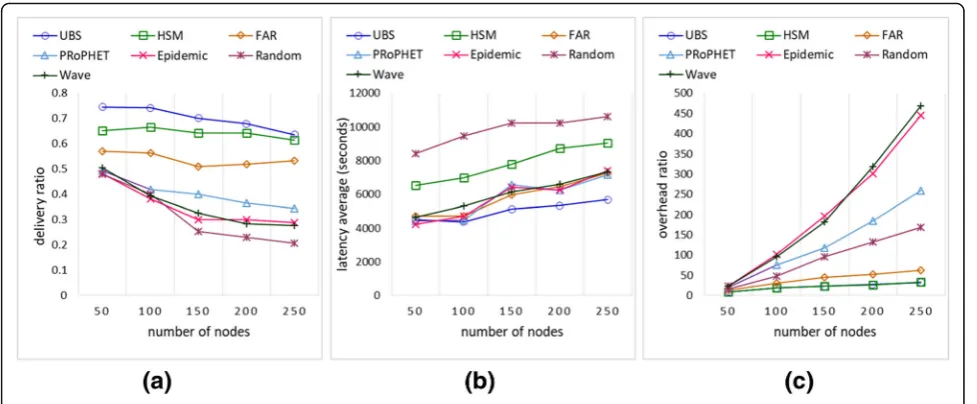
Figure 8 shows the performance of the proposed schemes FAR, HSM, and UBS, compared to the existing schemes, namelyPRoPHET[28],Epidemic,Random, and Wave[29]. The selected schemes are found to show bet-ter performance in the environments analogous to the one we modeled in the simulations [29]. The HSM achieved better performance for delivery ratio and over-head. This is because of the efficient prediction mechan-ism of HSM giving priority to the most recent contacts among time-series data. On the contrary, the PRoPHET computes the future contact predictions based on just the number of contacts with the existing nodes without considering the time varying pattern of contact duration and inter-contact times. TheEpidemic scheme performs replication of message to every node in flooding manner. However, the increased flooding may overburden the limited resources of mobile devices which results in increased message drop rate to create space for new messages. TheRandom scheme forwards single message copy to any randomly selected neighbor, whereas the Wave scheme performs replica flooding in a controlled manner. Despite that both the aforementioned schemes are resource conservative, they exhibit low performance than HSM. This is because these schemes do not utilize the past meeting patterns to perform a node’s utility estimations.
The delivery ratio of FAR is less than HSM and UBS be-cause of less efficient prediction computation; however, there is a decrease in latency due to the removal of add-itional checks that are imposed in HSM. The improvement in latency of FAR comes at the cost of increased overhead because the number of message relaying is higher in FAR compared to HSM. This is because, message replication decision of FAR does not take into account the node’s inter-contact times’ utility. Due to this, a message has to traverse through multiple relays before reaching the final destination, thus increasing the overhead ratio. Therefore, this limitation is addressed in the HSM protocol that improves the delivery estimation of message, thus reducing the extra replications and overhead ratio.
Compared to the baseline schemes, the FAR still achieves better performance in terms of delivery ratio, latency, and overhead because of the efficient computa-tion of future contact prediccomputa-tions from the time-series
Table 9Data types used in the model of UBS
Types Descriptions
MCD_N1_D Float type, for mean CD of CI w.r.t a message’sD.
MCD_N2_D Float type, for mean CD of CN w.r.t a message’sD.
MICT_N1_D Float type, for mean ICT of CI w.r.t a message’sD.
MICT_N2_D Float type, for mean ICT of CN w.r.t a message’sD.
SLAU_N1_N2_D Float array type, for sorted (in ascending order) list of
values, obtained after subtracting AUs of CN w.r.t Ds of messages in CI’s ML, from those of CI with the same Ds.
Fig. 7A portion of map shown in ONE simulator. The circle surrounding nodes represent communication radius
data of nodes’ mobility and contacts. The performance of UBS supersedes the performance of HSM and FAR in terms of delivery ratio, latency, and overhead. The upgraded performance of UBS can be attributed to it be-ing a hybrid of HSM and FAR, with an additional feature of flooding based but controlled message transfer. Sort-ing the aggregate utilities in the UBS ensures that each of the messages with a node contributes to the improve-ment in message delivery and latency. As all of the messages are transferred, the messages spend less time waiting in the buffers; thereby, lowering the latency. The UBS increases the message copies and does not perform conditional deletion; thereby, enhancing the delivery ratio. Disallowing the transfer of an already-replicated message in the UBS prevents message loops, lowers the message drop rate, and improves delivery ratio and overhead.
Figure 9 shows the average time spent by the messages into nodes’ buffers. Compared to the other two schemes, UBS exhibits highest average buffer time. This is a tradeoff with an increased delivery ratio of UBS. As the message drop rate is lesser in UBS, the messages tend to stay longer in buffers till their lifetime expiry, or final delivery to the destin-ation. Just like UBS, the messages are also not deleted from FAR and tend to stay in buffers until expiry of lifetime or delivery. However, the HSM performs conditional deletion of messages, so there are less number of messages that stayed longer buffers, thus decreasing the buffer time average. The buffer time average of remaining protocols is less, as due to the increased message drop ratio in these schemes, the mes-sages do not stay in buffers for longer durations.
5.3.2 Varying the buffer size
Figure 10 shows the performance of the schemes with increasing the buffer size. It is interesting to note that
after a certain increase in size, the performance of the protocols becomes constant. This also proves that buffer size has a partial impact in a protocol’s performance, as there are numerous other stochastic factors, such as nodes mobility, network disconnectedness, and trans-mission range, that simultaneously have an effect on a protocol’s performance. There is an initial increase in delivery ratio performance with an increase in the buffer size. The obvious reason is that more buffer space becomes available for the messages, and there is de-creased message drop rate due to buffer overflows. In-creasing buffer space has an interesting impact on overhead ratio. This behavior is in accordance with the (13). When the buffer size is small, then fewer messages are delivered as more messages are dropped due to buf-fer overflows. Therefore, (13) will produce a higher over-head value. With increase in buffer capacity, the number of messages delivered also increases, which leads to a de-crease in overhead.
5.3.3 Varying the range radius
Figure 11shows the results by increasing the transmis-sion radius. The performance of our schemes supersedes the baselines in terms of delivery ratio. The reason is that as the nodes remain connected, they get more net-work information to share, thereby improving the utility computation. However, similar to the case of increasing buffer size, the latency performances become constant after increasing the range to a certain threshold, due to the impact of other stochastic factors involved. The pro-posed schemes also exhibit better performance in the case of latency average and overhead ratio. The latency of HSM is higher initially. This is due to the fact that HSM performs conditional deletion of messages, so if there are few copies of a message in the network, it also
decreases the probability of quick delivery of message. However, the aforementioned setback is compensated as the transmission range is increased as nodes now have greater opportunities to make contact and share messages.
5.3.4 Varying the message life time
Figure12shows the comparisons by increasing the mes-sage life time (TTL). With shorter lifetime, the mesmes-sage drop ratio is higher, thus decreased delivery ratio. The delivery ratio increases with the increase in lifetime of messages. However, when the message life time reaches a certain threshold, we see the gradual drop in delivery ratio. This is again due to the increase in message drop
ratio, as the older messages are residing in the buffers for longer durations, they are deleted frequently to make room for new messages. The increasing life time has an obvious effect on latency, which increases as now mes-sages can stay in buffers for longer durations. The pro-posed schemes exhibit minimum overhead compared to the baselines with the increase in TTL, as the number of delivered messages is greater, (13) produces lower over-head value.
5.3.5 Performance comparison on real connectivity trace data
In Fig.13, the simulations are performed with real-world connectivity traces. The trace datasets were collected under Haggle project during Infocom 2006 conference and are available at an online repository [50]. The pa-rameters used for simulation are bandwidth: 250 kbps (2 Mbps), message size: 500 KB–1 MB, packet-lifetime: 500 min, number of nodes: 98, and buffer size: 10 MB. The data set is sparse, and frequently the nodes abort connections as they go out of range. As shown in Fig.13, the performance of our proposed schemes outperforms the other schemes in delivery ratio due to better message utility predictions. However, this comes at a tradeoff slight performance loss in latency average and overhead ratio. It can be observed that the performance of the proposed schemes with real connectivity traces is con-sistent with the synthetic mobility models, which proves the validity and applicability of the proposed schemes in realist scenarios of opportunistic mobile data offloading.
5.4 Verification results
The verification has been done by translating the HLPN models of the HSM, FAR, and UBS, to the respective NuSMV models written in the NuSMV language. The properties discussed in Section 3 are specified in the
Fig. 9The buffer time average by varying number of nodes.
CTL. To verify the communication processes and the scalability, we have chosen a communication path in each of the models. The lengths of the paths have been scaled up progressively by increasing the number of nodes and messages. The paths have been verified in the presence of up to 100 nodes and 100 messages. Being a highly time-consuming procedure, the computation time is an important metric to consider for the verification of the schemes. Figure 14 demonstrates the computation time (in seconds) required to verify the property of the HSM, FAR, and UBS, by varying the number of (a) nodes with 20 messages (Fig.14a), (b) messages with 30 nodes in (Fig. 14b), and (c) nodes and messages in Fig. 14c. The three schemes exhibit similar trends of
increasing computation times in the results, in all of the cases. The reason behind the aforementioned phenomenon fact is that the lengths of the communication paths are simultaneously scaled up as well. Moreover, the number of combinations encompassing the variables and parameters considered in the models proliferate with the scaling.
The computation of the ICT in the HSM mandates higher computation time than the FAR. However, as the number of nodes and messages are increased simultan-eously, the FAR exhibits a greater computation time than the HSM. This is due to the fact that the deletion of a message from a node’s buffer in the HSM can be comparatively quicker, due to the inherent conditional deletion. The UBS records the highest computation
Fig. 11The performance of schemes by varying range.
time. The reasons are as follows: (a) while the models of the HSM and FAR require a single execution path to corroborate the design limitation, the UBS re-quires each of the execution paths to be free of the limitation and (b) the implementation of the PML, aggregate utilities, and their sorting further adds to the processing time.
6 Conclusions and future work
In this work, we proposed three novel schemes for prediction-based data offloading in opportunistic envi-ronments. The communication processes in the pre-sented schemes have been formally analyzed in detail, aided by the HLPNs. The presented schemes exploit the mobility patterns and the temporal contacts of the nodes to predict the future contact opportunities. The results assert that the schemes are ideal for the content dissemination in the dynamic and delay-tolerant data environments. The schemes are shown to outperform the existing schemes. The UBS, conceived to obliterate a design limitation common to the HSM and FAR, distinctly outperforms the existing schemes. The HSM and FAR have been formally verified against the design limitation using complete model checking, while the
UBS is shown to eliminate the limitation. To verify the specifications in finite time, model checking optimizations have been used. The verification results affirm the scalabil-ity and correctness of the models of the HSM, FAR, and UBS. The work corroborates that the (a) HLPNs can be ef-fectively exploited to depict the communication processes in the opportunistic environments and (b) formal verifica-tion can be capitalized upon to design efficient routing solutions. As a part of our future endeavors, we intend to design, model, analyze, and verify the platforms for oppor-tunistic data transfer, content sharing, job distribution, and information search, in the IoT environments. We also aim at investigating modeling techniques that eliminate the requirement of model checking optimizations.
7 Appendix
Here, we explain the notations and detailed transitions involved in the communication processes of the three proposed schemes.
7.1 Notations and transitions details for HSM scheme
The acronyms considered in the tables in this section are: acknowledgment (ACK), communicating nodes (Com-N), destination (D), and with respect to (w.r.t).
Fig. 13The performance evaluation on real connectivity trace data
Equation (14) shows the pre-conditions and post conditions of the successful firing of transitionC_S_D, when the connection is successfully established with the peer node. The specific details of this transition are mentioned in Section 4.3. The below equation de-tails the transitionC_S_Dshown in Fig.3.
In the above formula, the connectivity between the CI and CN is checked through the function conn and information is exchanged for a successful connection. The functions M_L, Rcvd_L, and Ackn_L provide access to the MLs, RLs, and Als of the communicating nodes that are placed at Msg_L, Rec_L, and Ack_L, respectively. The function Avlbl_Buff furnishes the available space in the buffers of the communicating nodes from Buff. In (14), the CI deletes those M_IDs from the ML whose life-times did not expire and that are in the (a) RL of the CN and (b) AL of the CN. The functionSize returns the total size of the messages de-leted through (a) and (b). The buffer space is updated accordingly. Finally, the CI sends those messages from its ML that are destined for the CN. The CN adds the M_IDs of the incoming messages to its RL. On receiv-ing the ACKs, the CI adds the M_IDs of the sent
messages to its AL, removes them from the ML, and updates the buffer space accordingly.
Subsequently, the CN will execute the same process (14) on the CI. The exchange of the messages that are destined for the two nodes is complete. The N_IDs of the two nodes and the attributes of the remaining messages in the ML of the CI are passed toR_Info to commence the replication in (14). The replications re-quire the computation of the CD- and ICT-based util-ities. Therefore,C_CDandC_ICTare fired. The pre/ post conditions of the successful contact duration transition is mentioned in the below equation.
RðC CDÞ ¼∀a14∈A14;∀a15∈A15 j
The pre/post conditions of the successful inter-contact time transition is mentioned in the below equation. This transition is shown in the petri net of HSM in Fig.3.
RðRelÞ ¼∀a10∈A10;∀a110∈A11;
The replication process is instantiated in (17), aided by the information on the communicating nodes, messages, and the utilities, made available atR_Info through (14), (15), and (16). The MLs and buffers of the communicat-ing nodes are accessed from Msg_L and Buff, through the functions M_L and Avlbl_Buff, respectively. The function Buff_Sizeis used to retrieve the buffer sizes of the nodes.
In (17), each of the remaining messages in the ML of the CI whose life-times did not expire and that are not in the ML of the CN are processed for replication. Only the messages that are smaller in size, as compared to the buffer size and the available buffer space of the CN, are processed. A message is conditionally replicated on the CN if and only if the (a) CD-based utility of the CN is higher than that of the CI or (b) if both of the utilities (CD- and ICT-based) of the CN are higher than that of
the CI. The corresponding M_ID is added to the ML of the CN and after the buffer space is updated, an ACK is sent to the CI. For the case (b), on receiving the ACK, the M_ID is conditionally deleted from the ML of the CI, and its buffer space is updated accordingly. If the CN cannot accommodate an incoming message due to the lack of space in the buffer, the function Del_Old_ Msgs_Until_Spcis used to delete the older messages to create space. The message is accommodated after the space is created in the buffer. Thereafter, the CN executes the process (17), on the CI.
After the communication between the CI and CN is completed, the CI looks for the availability of the remaining CNs in Con_N. The same procedures are in-stantiated with each one of the CNs. All of the above-mentioned processes will be repeated for each of the CIs in the network (through the presented formulae). There-fore, the model captures the behavior of all of the nodes in the network. Evidently, the model does not check if an incoming message to a node had been previously replicated by the node.
7.2 Notation meanings and transitions details for FAR scheme
Apart from the acronyms declared previously, the meet-ing quality (MQ) is the only acronym introduced in Tables6and7.
The below Eq. (18) shows the pre/post conditions of message relay transition for FAR protocol as shown in the petri net model of Fig.4.
are (a) a message is replicated by the CI on the CN, if and only if the CN bears a better forecasted meeting quality with the destination of the message, instead of the CD-and ICT-based utilities in (17) and (b) there is no condi-tional deletion. The rest of the process is the same as (17). Again, the model does not check if an incoming message to a node had been previously replicated by the node.
7.3 Notation meanings and transitions details for UBS scheme
Equation (19) shows the pre/post conditions of the petri net model depicted in Fig.5.
RðRelÞ ¼∀a10∈A10;∀a110∈A11;
In (19), the subtracted aggregate utility values of the CI and CN for each of the messages in the ML of the CI
are the inputs to the function AU_SSA. The function sorts the values in an ascending order and stores them at R_Info. The function PM_L provides access to the PMLs of the communicating nodes, placed at PML. The function Update_N1 _ML reorders the ML of the CI according to the sorted aggregate utilities, and is intro-duced in the model.
Abbreviations
3GPP:Third Generation Partnership Project; AL: Acknowledgment list; AP: Access point; AU: Aggregated utility; CD: Contact duration; CI: Connection initiator; CN: Connected node; CPN: Colored Petri Nets; CTL: Computational tree logic; DTN: Delay tolerant networks; FAR: Forecast and relay; HLPN: High-level Petri Net; HSM: Hybrid scheme for message replication; ICT: Inter-contact time; IoT: Internet of Things; KBPS: Kilobits per second; MB: Megabytes; ML: Message list; MSN: Mobile social networks; NuSMV: New symbolic model verifier; ONE: Opportunistic network environment; P2P: Peer to peer; PML: Passed message list; POI: Point of interest; RL: Received list; T2T: Terminal to terminal; TTL: Time to live; UBS: Utility-based scheme
Funding
There is no specific funding to support this work.
Availability of data and materials
The dataset that we used for analysis is hosted online by the contributors on the following URLs:
DieselNet Fall 2007. DieselNet Fall 2007 - AP Connectivity. URL:http:// traces.cs.umass.edu/index.php/Network/Network
Authors’contributions
AG is the primary contributor in drafting the paper. OK contributed in designing the mobile data offloading strategies. RNBR performed the critical technical review and suggested the improvements in proposed strategies. SURM contributed in formulating the formal verification section. IAK and AR contributed in reviewing, editing, and verifying the draft for English or technical anomalies. All authors read and approved the final manuscript.
Authors’information
Ankan Ghosh received a B.Tech. degree in Electronics and Communication Engineering, from WBUT, WB, India. Currently, he pursued his M.S. degree, from the North Dakota State University, Fargo, ND, USA. His research interests include the wired, wireless, opportunistic, and mobile networks, modeling, and verification.
Osman Khalid completed Masters in Computer Engineering from CASE—Pakistan, and Ph.D. from North Dakota State University, Fargo, USA. He is Assistant Professor in COMSATS University, Pakistan. His areas of research include Internet of Things (IoT), Fog Computing, opportunistic networks, recommendation, trust, and reputation systems. His website ishttp://osman.pakproject.com
Saif U. R. Malik received his MS degree from COMSATS Institute of Information Technology, Islamabad, Pakistan, and a PhD from the North Dakota State University, Fargo, ND, USA. His primary research interests include formal verification, modeling, cyber physical systems, cloud computing systems, routing protocols, and HPC. Rao N. B. Rais received his MS and PhD degrees in Computer Engineering with specialization in Networks and Distributed Systems from University of Nice, Sophia Antipolis, France in 2007 and 2011 respectively. Before that, he got BE in Computer Systems from National University of Science and Technology, Pakistan in 2002. He is currently working as Associate Professor of College of Engineering and Information Technology, Ajman University, Ajman, UAE.
Imran A. Khan received his PhD from China. He is serving as Associate Professor in computer sciences department, COMSATS University. His research interests include, distributed computing and wireless ad hoc networks.
Amjad Khan did is Ph.D. from Universiti Teknologi Malaysia, Malaysia. He is Assistant Professor and Chairman MIS Department COBA Al Yamamah University Riyadh 11512 Saudi Arabia.
Competing interests