R E S E A R C H
Open Access
An efficient construction of polar codes
based on the general partial order
Wei Wang
1, Liping Li
1*and Kai Niu
2Abstract
Traditionally, the construction of polar codes requires intense computations to sort all bit channels. In previous works, two types of partial orders (POs) of polar codes were proposed to decrease the computations in the construction process. In this paper, a procedure is presented to employ POs with complexityO(N2), which is lower than the existing procedures, whereN=2nis the code length (n≥1). To further reduce the computation
complexity, in this paper, we propose a general partial order (GPO), which works at a lower dimension (nu<n) to sort bit channels. The principle of the GPO is to divide the binary expansion of bit channels into two parts: the upper part and the lower part. First, the relationships among bit channels formed from the upper part (with lengthnu) are completely determined. Existing algorithms are called in this new levelnuwhen needed. Second, we prove that the ordering at this lower dimensionnucan be combined with the PO ordering of bit channels formed from the lower part. Therefore, more intrinsic relationships among bit channels are obtained. Working at the lower dimensionnu<n, the complexity of GPO is inherently smaller than the existing sorting algorithms. The studies show that forn=10 and the code rateR=0.5 (the worst code rate from the empirical studies), the GPO can order 82% of bit channels, which is 32% larger than that obtained from using only POs. The proposed GPO in this paper can significantly reduce computations in the construction of polar codes.
Keywords: Polar code, Polar code construction, Partial orders
1 Introduction
Polar codes [1] have attracted researchers from around the world since their introduction in [1]. As proven in [1], polar codes can achieve the channel capacity at a low encoding and decoding complexity of O(NlogN)
for binary-input, memoryless, output-symmetric (BMS) channels (here,N is the code length). A successive can-celation (SC) decoder was proposed to decodeN synthe-sized bit channelsWN(i),i = 1, 2,· · ·,N. The theoretical analysis of the polarization rate of bit channels is reported in [1–4]. The performance of polar codes with practical code lengths is investigated in [5–8] and their references.
The construction problem of polar codes is as fol-lows: for the given code rate R, how to select the
K = NR best bit channels from all bit channels
WN(i)
N
i=1to transmit information bits. The inputs of the
*Correspondence:[email protected]
1Key Laboratory of Intelligent Computing and Signal Processing of the Ministry
of Education of China, Anhui University, Hefei, People’s Republic of China Full list of author information is available at the end of the article
remaining bit channels are frozen and are made known to the transmitter and the receiver. The quality of a bit channelWN(i)can be measured, for example, by the error probability Pe
WN(i). However, determining the quality of the bit channels is not an easy task with the excep-tion of binary erasure channels (BECs). Note that the channel input alphabet size is assumed to be two. Non-binary input alphabets in [9–11] are not discussed in this paper.
LetI denote the set containingK indices of the good bit channels, and let F denote the set containing the indices of the frozen bit channels. Let W : X → Y be the underlying channel with a transition probabil-ity W(y|x). Sorting the bit channels is difficult because of the large number of output alphabets|Y|N. Evaluat-ing this large number of transition probabilities for each bit channel is beyond the reach of a practical system. Monte-Carlo simulations are proposed in [1] to sort the bit channels, with a high complexity of O(MNlogN)
(M denotes the iterations of the Monte-Carlo simula-tions). Density evolution is used in [12] to construct polar codes. The density evolution process involves function convolutions whose numerical calculation precisions are limited by the complexity. In [13], bit channel approx-imations are proposed with a controlled complexity of ON·μ2logμ (μ represents a user-defined parameter to limit the number of output alphabet at each approxima-tion stage). Another family of polar code construcapproxima-tion is to use Gaussian approximation (GA) on additive white Gaussian noise (AWGN) channels [14–16]. The GA method is inherently limited by the approximation function [16] and may not be applicable to all block lengths. Partial order (PO) relations are reported in [12,17,18]. We borrow the notations from [17] to denote the two types of POs:1 and2. The first type of PO,1, is investigated in [17] and [18]; it orders the bit channels with the same Ham-ming weight (here, the HamHam-ming weight is the HamHam-ming weight of the binary expansions of the bit channel indices). The second type of PO,2, is stated in [12], which orders the channels with different Hamming weights. These two POs are channel independent: the orders are uni-versal for all types of underlying channels. In [17], the authors show that the two POs can be used to simplify the encoding construction. However, no algorithm is pre-sented to employ these two POs; therefore, no detailed results are provided there in [17] to quantify the exact savings.
In this paper, an efficient procedure is proposed to employ the two POs1and2. Theoretical foundation enabling this efficient procedure is provided in Proposi-tion1and Lemma1–Lemma3. Compared with the work in [19], the proposed procedure to find the relationships determined by the two POs has a lower complexity: our proposed algorithm has a complexity ofON2while the complexity in employing the two POs is at leastON5/2
in [19]. Although both procedures can be performed off-line, the proposed procedure in this paper is more efficient in employing POs. Note that the proposed procedure in the paper can be refined by exploring the nesting and symmetric properties of POs in [20].
For a given channelW, to reduce the computation com-plexity of the construction of polar codes, we introduce a general partial order (GPO), which works by dividing the binary expansion of bit channels into two parts: the upper part with nu ≥ 1 bits and the lower part with
nl=n−nubits (here,n=log2N). Considering the upper part as a set of new bit channels withnubits, the ordering of these new bit channels at this smaller levelNu = 2nu can either be derived from the two POs or from calling any sorting algorithm [12,13]. Since the channel indepen-dent ordering ofNu bit channels is part of POs, we only consider their new channel-dependent ordering obtained from the existing sorting procedures such as [12, 13].
This paper proves that this channel-dependent ordering of Nu bit channels can be combined with 1 and 2 to obtain the ordering for the given underlying channel
W and block lengthN. The POs and GPO aim to find the intrinsic relationship between any two bit channels. After applying POs and GPO, additional intrinsic relation-ships can be identified when considering the transitivity of bit channel degradation (or upgradation). These tran-sitive relations are termed indirect relations. Algorithms to explore PO 1, PO 2, GPO, and the transitivity of bit channel degradation (or upgradation) are provided to quantify the savings of each. The choice of the dimen-sionnu is also discussed in the paper. A quasi-analytical equation that can be used to estimate the optimal nu, which produces the most efficient construction of polar codes, is provided. The calculations in our study indicate that for n = 10 and the code rate R = 0.5 (the worst code rate), incorporating PO relations can determine 50% of the bit channels, which produces only 50% of the sort-ing calculations. With our proposed GPO, the determined portion of the channels increases to 82%, which causes a significant complexity reduction in the construction of polar codes.
Note that portions of this work are presented in [21], where three lemmas of the procedure to find relation-ships determined by POs are not introduced. The theorem of GPO is not proven and the indirect relationships are not considered due to the limited space of [21]. The main contributions of this current paper are as fol-lows: (1) The three lemmas related to POs are intro-duced. These lemmas are the basis for the proposed procedure in finding relationships determined by PO1 and PO 2. The complexity of the proposed procedure is lower than the existing procedure when employing the two POs. (2) A complete proof of the proposition related to GPO is given. The procedures of GPO are channel-independent while the ordering obtained from GPO is channel dependent. (3) A proposition to find all indirect relationships is presented and proven. (4) The GPO parameter is optimized. The simulated construc-tion time follows the predicconstruc-tion of the construcconstruc-tion time and shows a construction time around 30% of the origi-nal Tal-Vardy’s construction time for code lengths up to
N =1024. (5) The algorithms for implementing POs and GPO are refined with specific mathematical expressions due to new introduced mathematical details compared with [21].
proposed construction algorithms. Conclusion remarks are presented at the end in Section5.
2 Polar code and partial orders
The first part of this section includes the relevant basics of polar codes from [1]. For other details of polar codes, please refer to the materials in [1]. The second part restates some results of partial orders from [12,17].
2.1 Notation specification
The notations in this paper are as follows: The nota-tionvN1 is used to represent a row vector with elements
(v1,v2, ...,vN). Then-bit binary expansion of the integeri is written asi=(in,in−1, ...,i1)b. Given the vectorvN1, the vectorvjiis a subvector(vi, ...,vj)with 1≤ i,j≤ N. For a setA∈ {1, 2, ...,N},vAdenotes a subvector with elements in{vi,i∈A}.
2.2 Polar codes
LetWbe any BMS channel with the transition probability
W(y|x). The input alphabetX takes values in{0, 1}, and the output alphabet is Y. The generator matrix isG = BF⊗n, where Bis a bit-reversal permutation matrix and
F =
1 0
1 1 . The operation F
⊗n is the nth Kronecker
power ofFover the binary fieldF2. Polar codes synthesize N=2n(n≥1)bit channels,W(i)
N
N
i=1, out ofN indepen-dent copies ofW. The transformation has a tree structure in [1], which has a basic one-step channel transformation defined as(W,W)→
W,W
, where
W(y1,y2|u1)=
u2 1
2W(y1|u1⊕u2)W(y2|u2)
(1)
W(y1,y2,u1|u2)= 1
2W(y1|u1⊕u2)W(y2|u2) (2) A bit channeliwithi−1=(in,in−1, ...,i1)b(1≤i≤N, the left most bit is the MSB) is transformed in each tree level according to the bit ofi−1 at that level: at tree level 1 ≤ k ≤ n, bit channelitakesW ifik = 0. Otherwise,
W is taken at levelk. The Bhattacharyya parameters of
WandWsatisfy the following conditions:
ZW=Z(W)2 (3)
Z
W
≤2Z(W)−Z(W)2 (4)
ZW≥Z(W)≥ZW (5)
Note that for binary erasure channels (BEC), the Bhattacharyya parameterZWhas an exact expression
ZW= 2Z(W)−Z(W)2, resulting in a recursive cal-culation of the Bhattacharyya parameters of the final bit channels. Finally, after the channel transformations, the transition probability for bit channeliis defined as
WN(i)
yN1,ui1−1|ui
=
uNi+1∈XN−i 1 2N−1W
NyN 1|uN1G
(6)
whereWN(·)is the underlying vector channel (Ncopies of the channelW).
2.3 Channel degradation
First, we restate the concept of stochastic channel degra-dation as presented in [13]. For a channel Q : X → Z and channelW : X → Y, Qis stochastically degraded with respect toW if there exists an intermediate channel
P:Y→Zsuch that
Q(z|x)=
y∈Y
W(y|x)P(z|y) (7)
for allx∈X andz∈Z. In this case, we writeQW(or
W Q) as in [13].
As proven in both ([22], p. 207) and [13], for BMS channels, the probability of error and the Bhattacharyya parameter preserves degradation. Let Pe(W) denote the error probability when transmitting a single bit over the channelW. LetQandW be two BMS channels andQis stochastically degraded with respect toW:QW. Then, from ([22], p. 207) and [13], the following statements hold:
Pe(Q)≥Pe(W) (8)
Z(Q)≥Z(W) (9)
Note that in [1], Arıkan suggested choosing bit channels with the smallest Bhattacharyya parameters as the good channel indices, that is, if the setIcontains the good bit channels, then for anyi ∈ I and anyj ∈/ I:Z
WN(i)
≤
ZWN(j). In [13], the error probabilities of all approxi-mated bit channels are calculated. The information set I therein contains all the bit channels with the smallest error probabilities. In summary, [1,13] utilize (9) and (8), respectively, as criterions to select the good bit channels.
2.4 Partial orders
Consider two bit channelsiandjwith binary expansions
i−1 = (in,in−1, ..., 1)b andj− 1 = (jn,jn−1, ..., 1)b. In [17], if the binary expansion of j − 1 can be obtained from the binary expansion of i − 1 by switching some higher position 1s with some lower position 0s, then
LetN=24=16. Consider bit channelsi=13 andj=11 with binary expansions i−1 = 13−1 = (1100)band
j−1 =11−1= (1010)b. From the binary expansion of
i−1, it can be seen that switching value 1 at position 3 with value 0 at position 2 results in the binary expansion ofj−1. Therefore, bit channeljis degraded with respect to bit channeli, irrespective of the underlying channels.
The second PO is from [12], which is denoted as2. For the two bit channelsiandj, if every bit of the binary expansion ofi−1 is greater than or equal to every bit of the binary expansion ofj−1, thenWN(j)2WN(i). With a sym-metric underlying channelW,WN(j) 2WN(i) =⇒ W
(j) N
WN(i)is proven in [12]. Therefore, the second partial order 2can also be employed to order the bit channels. The PO 2is also transitive. An example of this PO2also adopts N = 24 =16. Consider bit channelsk = 15 andi = 13, with binary expansions ofk−1=15−1= (1110)band
i−1 = 13−1 = (1100)b. It can be seen that for these two bit channels, the two ones of the binary expansion of
i−1 are the same as those ofk−1 at the same positions. However, at position 2, the value of the binary expansion ofk−1 (value 1) is greater than that ofi−1 (value 0). This is exactly PO2. Therefore, bit channeliis degraded with respect to bit channelk. Combining the example in PO1, it can be concluded thatW16(11) W16(13)W16(15), irrespective of the underlying channels.
The constructions in [12–16] sort allN bit channels. The inherent ordering of polar codes from1and2is not utilized before sorting all bit channels. Therefore, the amount that we can save in the construction by apply-ing POs is not clear. In this paper, we apply 1 and2 before sorting allNbit channels and to quantify the sav-ings in this process. Three sets, which correspond to the good bit channels (I), the frozen bit channels (F), and the undetermined bit channels (U), are selected by applying the two POs. If the number of bit channels inIis smaller thanK, then a sorting algorithm, for example, the approx-imation in [13], can be applied to sort the bit channels in U to select K − |I| best bit channels fromU and place those K− |I| best bit channels inI. (Note that by fix-ing the number of information bitsKin one code block, it is always that|I| ≤ K since the bit channels are com-pared among themselves, and at most the bestK can be selected.) The smaller is the size ofU, the larger are the savings. The POs are channel independent and universal for all BMS channels. Therefore, the setsI,U, andFfor the given block lengthN and the code rateRneed to be calculated only once and can be calculated off-line. Note that the finalK best bit channels that are selected from applying the two POs before calling any sorting algorithm from [12–16] should be the same as calling the sorting algorithm since the good bit channels selected from the POs are channel independent.
3 Construction combining POs and GPO
In this section, the definition of the partial order indi-cator (POI) and the implementation of the POs is first introduced. The detailed theory and a proof of the general partial order (GPO) are presented in Section3.2. Then, indirect relationships after applying POs and GPO are dis-cussed in Section3.3. The optimal choice of the parameter
nu < n, on which the GPO works, is discussed in3.4. At last, a top-level algorithm of the proposed general partial order (GPO) is provided.
Given the three sets defined in Section2.4, the follow-ing proposition can be used to determine whether a bit channel should be inI,F, orU.
Proposition 1If a bit channel i is stochastically upgraded with respect to at least N−K bit channels, then i ∈ I. If a bit channel j is stochastically degraded with respect to at least K bit channels, then j∈F. All other bit channels are in the undetermined setU.
Because the proof of this proposition is straightforward, it is omitted here.
3.1 Definition of POI matrix and implementation of POs
The matrixOis defined as anN ×N matrix whose ele-ment(i,j)is the partial order indicator (POI) between bit channeliand bit channelj(i>j). The matrixOis a lower triangular matrix (excluding the diagonal), and the POIs ofOcan be written as:
Oij=
⎧ ⎪ ⎪ ⎪ ⎪ ⎪ ⎨ ⎪ ⎪ ⎪ ⎪ ⎪ ⎩
1, if i>j and WN(i)WN(j)
−1, if i>j and WN(i)≺WN(j)
0, if i>j but WN(i)andWN(j)
is unknown 0, if i≤j
(10)
In practical implementations, the unused part of O(the upper triangular part) can be saved. Algorithm 1 finds the POIs when applying PO1and PO2.
To explain Algorithm 1, the following lemma is intro-duced first.
Lemma 1 For a polar code with the code length N, con-sider two bit channels1≤i,j≤N with j<i. Then, purely from PO1and PO2, it is impossible for bit channel j to be stochastically upgraded with respect to bit channel i.
Proof The proof is straightforward. The binary expan-sions of the two bit channels arei−1 = (in,in−1, ...,i1)b and j − 1 = (jn,jn−1, ...,j1)b. With i > j, there must be a position k (1 ≤ k ≤ n) at which (1)ik = 1 but
smaller thank. These two conditions are the basic require-ments fori>j. With these two conditions, PO1cannot be applied toj−1 = (jn,jn−1, ...,j1)bto reach any inter-mediate channelvequal or upgraded with respect to bit channeli: with(in,in−1, ...,ik+1)=(jn,jn−1, ...,jk+1), there is not a larger positionk>kso thatik =1 andjk =0 to switch with positionkin order to makejk =1. Withik =1 andjk = 0 and PO1not applicable, PO2naturally is not valid:jk<ik. Therefore, forj<i, with PO1and PO 2, it is impossible for bit channeljto be stochastically upgraded with respect to bit channeli.
Remark 1Lemma1 does not mean that bit channel j cannot be stochastically upgraded with respect to bit chan-nel i when j < i. Lemma 1 has a condition: from the POs point of view, bit channel j cannot be stochastically upgraded with respect to bit channel i, indicating that Oi,j = −1 according to the definition of (10). POs are
channel independent. When it comes to any specific chan-nel, the relationship between bit channel j and bit channel i with j<i can be evaluated using an existing sorting pro-cedure. For example, with N = 16, consider the two bit channels i−1= 10−1= (1001)band j−1= 8−1=
(0111)b. From the two POs, bit channel i is not
stochasti-cally upgraded with respect to bit channel j and bit channel j cannot be stochastically upgraded to bit channel i either from Lemma1. However, consider an AWGN channel with a SNR of 1 dB, bit channel j is found to be stochastically upgraded with respect to bit channel i.
For any two bit channelsi− 1 = (in,in−1, ...,i1)b and
j−1=(jn,jn−1, ...,j1)b, denote the following two sets:
P= {1≤k≤n|ik=1 andjk=0} (11) M= {1≤k≤n|ik=0 andjk=1} (12)
Letp = |P| andm = |M|. At all the other positions except those specified byPandM, the binary expansions ofi−1 and j−1 share the same values zeros or ones. Assume the setsPandMare in descending order.
The following two lemmas state the conditions when PO 1and PO2can (or cannot) be applied.
Lemma 2For a polar code with the block length N =
2n, consider two bit channels i−1 =(in,in−1, ...,i1)band
j−1=(jn,jn−1, ...,j1)bwith i>j. The setsP andMare
defined in(11)and(12), respectively. When m= |M| =0, then from PO2, bit channel j is stochastically degraded with respect to bit channel i.
ProofWhenm= |M| =0, it means there is no position
k(1≤k≤n) at whichjk =1 andik =0. In other words, all values of the binary expansion ofj−1=(jn,jn−1, ...,j1)b are equal or smaller than that ofi−1. Withi> j,
invok-ing the definition of PO2, it can be concluded that bit channel j is stochastically degraded with respect to bit channeli.
Before introducing the following lemma, let us define thatP1mcontains element one to elementmof the setP. Also, the expressionP1m > Mm1 indicates the element-wise comparison betweenP1mandMm1.
Lemma 3For a polar code with the block length N =
2n, consider two bit channels i−1 =(in,in−1, ...,i1)band
j−1=(jn,jn−1, ...,j1)bwith i>j. The setsP andMare
defined in(11)and(12), respectively, and are in descending order. If p= |P| ≥m = |M|(m > 0) andP1m > Mm1, then PO1can be applied to achieve that bit channel j is stochastically degraded with respect to bit channel i.
ProofIt can be first observed that when p < m, PO 1 cannot be applied to i − 1 = (in,in−1, ...,i1)b to obtain any intermediate channel equal or stochastically upgraded with respect toj−1 = (jn,jn−1, ...,j1)b: there are not enough positions with values ones in i −1 =
(in,in−1, ...,i1)b(denoted by the setP) to switch to posi-tions inMbecausep < m. Therefore, to apply PO1, p≥mis necessary. Consider the definition of PO1: for a bit channeli, switching a higher position with value one with a lower position with value zero resulting in a channel which is degraded with respect to bit channeli. Therefore, with the descending setsPandM, whenP1m>Mm1, PO 1can be performed toi−1=(in,in−1, ...,i1)b: for each element in M, there is a larger element inP to switch with. Bit channel j is therefore stochastically degraded with respect to bit channeli.
Remark 2Lemma3is actually a combination of PO1 and PO2. There is an inherent PO2in Lemma3as explained below. Let the intermediate channel after switch-ingP1m withMm1 of bit channel i as bit channel v. Then, bit channel j is stochastically degraded with respect to bit channel v. If p=m, then v=j, which is the case of PO1. If p> m, there are remaining elements inP after switch-ing with elements inM. Comparing bit channel j and bit channel v, the new setM = ∅(m = 0). From Lemma2, bit channel v is stochastically upgraded with respect to bit channel j by invoking PO2. But for our purpose of determining the relationship between bit channel i and bit channel j, the proof of Lemma3is sufficient.
Algorithm 1 implements Lemmas1to3. For any given bit channeli, bit channelj<iis compared with it (line6
in Algorithm 1). In Algorithm 1, −1s do not exist in O
is the size of U, the smaller the number of remaining computations is.
Algorithm 1Find all the POIs that POs can determine, and store the results in the matrixO
Require: initialize the value in matrixOas 0
3: fori←2 toNdo
17: //element-wise comparison of descending
sets
The relationship between some bit channels cannot be determined from POs1,2, or their combinations. Here is an example: ForN = 28, consider bit channeli−1 =
(10011110)bandj−1 = (01101011)b. Applying the two POs and their combinations yields no decision regarding whetherWN(i)is stochastically upgraded or degraded with respect toWN(j). For general BMS channels, the relation-ship between bit channel iand bit channel jcannot be determined: WN(i) WN(j) holds for one given underly-ing channel W; however, this relationship may not hold for another underlying channel W. For a specific chan-nel BMS chanchan-nelW, we can further reduce the size ofU.
Let us consider the two bit channels in the previous exam-ple. LetZu denote the upper part of the descending set Zn = {n,n−1,. . ., 1}withnu = |Zu|. Then,ZuisZu = {n,n−1,. . .,n−nu+1}. Similarly,Zlrepresents the lower parts ofZnwithnl = |Zl|, andZl = {nl,nl−1,. . ., 1}. The sizes satisfy 0 ≤nu,nl ≤nandnu+nl =n. Divide the binary expansion ofi−1 into two consecutive parts:
i−1 = (iZu,iZl)b. The upper partiZu defines a new bit channel at the block lengthNu = 2nu ≤ N = 2n:WN(iuu) (here,iu −1 =(iZu)b). For the lower part, there is simi-larly a new bit channel. For this specific example,nu = 5 andnl=3. One of the two new bit channels can be deter-mined:W(jl)
Nl 1W
(il)
Nl . Only the relationship between the two upper channels cannot be determined.
For a given BMS channelW, if the upper bit channels areW(ju)
Nu W
(iu)
Nu by any sorting algorithm, then the fol-lowing proposition of general partial order (GPO) can be used to determine more intrinsic relationships among bit channels.
Proposition 2 General partial order (GPO): For a given underlying channel W, consider bit channels i and j(1 ≤
i,j ≤ N) with i− 1 = (in,in−1, ...,i1)b and j− 1 =
(jn,jn−1, ...,j1)b. Divide the binary expansions of i−1and
j−1into two parts: i−1=(iZu,iZl)band j−1=(jZu,jZl)b.
If the relationship between W(iu)
Nu and W
(ju)
Nu is obtained
for the given underlying channel W and the relationship between W(il)
Nl and W
(jl)
Nl is channel independent, then
W(iu)
Proof From[23](Lemma 4.7), the following is proven:
WN(i)WN(i)whenWW (14)
For notational convenience, denoteQ = W(iu)
Nu andZ =
W(ju)
Nu . Then, the left-hand side of (15) means that chan-nelZis stochastically degraded with respect to channelQ. From the channel polarization process in [1], it is known that each bit channel goes through n levels of one-step transformation defined in (1) and (2). The two channelsQ
andZare the output channel of the firstnu levels of bit channeliand bit channelj, respectively. These two chan-nels are the input to the remaining levels denoted byiland
jl. Then,WN(i)=Q tically degraded with respect to channelQ, then invoking (14), channelZ(jl)
Nl is stochastically degraded with respect to channelQ(il)
Now, we prove that wheniu = ju, the following
state-Nl and the relationship betweenW
(il) Nl andW(jl)
Nl is channel independent (the condition of this proposition), we can conclude that no matter what the condition ofQis,WN(i)WN(j)holds. To prove this statement, let us define an intermediate channelk:k−1=(kZu,kZl)b=(iZu,jZl)b. From (16), we haveWN(i)WN(k). From (15), we haveWN(k)WN(j). From the transitivity of the degradation relationship [13], it can be concluded thatWN(i)WN(j).
The procedure to implement GPO is provided in Algorithm 2. From the definition of the matrixOin (10),
Algorithm 2Apply the GPO to determine more intrinsic relationships among bit channels.
Require:
O; Ensure:
O;
1: //We divide a channel into two parts, eg: 2: //xx · · ·x
9: // the relationship between bit channels iu and ju can be obtained from POs or from calling any sort-ing algorithm; the relationship between bit channelsil
andjlis obtained from POs
10: if
14: //bit channeljis degraded with respect to bit
channeli 15: Oji← −1
16: end if 17: end if 18: return O;
POIs are stored in the lower triangular part (excluding the diagonal). Therefore, in line12of Algorithm 2, POI
Oij = 1 if condition (13) holds and ifi > j. When con-dition (13) holds andi < j,Oij cannot set to be one as line12does, because only the lower triangular part ofOis defined. Instead, we putOji= −1 in line15to express the same thing: bit channeljis stochastically degraded with respect to bit channeli.
Remark 3The GPO obtained from Proposition2works for a given underlying channel W and can be used to order the bit channels constructed from W. Any existing con-struction procedure (Tal-Vardy’s[13], GA[14–16], or den-sity evolution[12]) can be called to order the bit channels at level nu ≤ n. For example, if the underlying
chan-nel W is a binary symmetric chanchan-nel (BSC), GPO works by first obtaining the relationships determined from POs (Algorithm 1). Then, n is divided as n=nu+nl. Any sorting
algorithm can be applied at level nu to sort the bit
chan-nels in the range of[ 1, Nu =2nu]. In this case, Tal-Vardy’s
merging procedure can be applied. The channel-dependent sorting at the level nu is combined with the PO ordering
at level nl to produce more relationships among bit
chan-nels at level n. In this case, GA does not work since the underlying channel is not an AWGN channel.
Remark 4The procedures of the GPO are not channel dependent: they are universal for all supported channel types. But the ordering obtained from the GPO is depen-dent on W; therefore, the resulted ordering obtained from the GPO is not universal, such as that of the POs. For any given channel W, GPO can be used to reduce the construc-tion complexity of polar codes because of the operaconstruc-tion at a smaller level nuinstead of level n. It can be easily shown
that the relationship obtained from Proposition2 is also transitive. The final K best bit channels that are selected when applying GPO are the same as calling any sorting algorithm[12–16]: In a GPO, the upper bit channels are determined from the given sorting algorithm, and the lower part is channel independent.
3.3 Indirect relationships
For the given underlying channelW, the direct use of GPO and POs sometimes cannot determine the relationship between two bit channels. Instead, some relationships can be obtained from several intermediate channels. Here, is an example. For N = 29, consider the bit channels
i−1= (100110000)bandj−1= (000111001)b. Apply-ing the two POs and GPO yields no decision regardApply-ing whetherWN(i)is stochastically upgraded or degraded with respect to WN(j). Let us take a look at a bit channel k−
1 = (011000001)b. We can determine that bit channel
i is stochastically upgraded with respect to bit channel
channel “1001” is stochastically upgraded with respect to bit channel “0110” from the Tal-Vardy algorithm and bit channel “10000” is statistically upgraded with respect to bit channel “00001” from the POs. We can determine that bit channel k is stochastically upgraded with respect to bit channel j because bit channel “011000” is stochasti-cally upgraded with respect to bit channel “000111” from the Tal-Vardy algorithm for the same AWGN channel and bit channel “001” is the same as bit channel “001.” There-fore, we haveWN(i) WN(k)andWN(k) WN(j), resulting in
WN(i)WN(j).
If the relationship between bit channeliand bit channel
jcan be obtained from one intermediate bit channel, we must be able to obtain the relationship between bit chan-neliand bit channelj. There can be several intermediate bit channels between bit channel i andjbefore we can obtain the relationship between bit channeliand bit chan-nelj. Let us refer to these POIs as indirect relationships. Proposition3can identify all indirect relationships in the matrixOafter applying the POs and GPO.
Proposition 3For a bit channel k (1 ≤ k ≤ N), if there are bit channels i and j (whose relationship is unde-termined from POs and GPO) such that WN(i) WN(k)and WN(k) WN(j), then WN(i) WN(j)is newly identified. When k is searched from 1 to N and i and j is also looped from 1 to N under the loop of k, then ALL indirect relationships between ALL bit channels can be identified.
ProofThe first half of this proposition is the direct use of the transitive property of the POs and GPO. According to the second half of the proposition, when the interme-diate channelkgoes from 1 toN and the bit channels i
andjare also looped from 1 toN(within the loop ofk), all indirect relationships among all bit channels can be iden-tified. In the following, the second part of this proposition is proven.
For the existing POIs determined from the POs and GPO (stored in O), pick any two bit channels i and j
(1≤i,j≤N) whose relationship is undetermined:Oij=0 andOji=0. However, from the relationship matrixO, the following relationships can be determined: first transitive relationship W(kl−1)
N W
(kl) N W
(kl+1) N is encountered. Then, the POI between bit channelkl−1 andkl+1can be updated in the matrixO. The remaining
Compared with the relationship in (17), the relationship in (18) has one less bit channelW(kl) tinues with one new direct POI updated in each step until the last step, whereWN(i) WN(j)is reached. As the inter-mediate channelkgoes from 1 toNandiandjalso goes from 1 toNwithin the loop ofk, any indirect relationship between bit channeliandj(1≤i,j≤N) can be identified during the three loops.
3.4 GPO parameter optimization
For the GPO, a parameter to be determined is the upper level nu. In this paper, the sorting algorithm in [13] is employed. The parameter nu is estimated based on this sorting algorithm. In thelth (1 ≤ l ≤ n) approximation stage, different calculations are called according to “0” or “1” of thelth bit of the binary expansion of a bit channel. Denotet0andt1as the calculation time that corresponds to 0 and 1. Then, the calculating time for any channel is
x×t0+y×t1(x,yis the number of 0s and 1s of the binary expansion of this channel). Assume that the average Ham-ming weight of the channels inUiswu. From the two POs, we can easily show that the three bit channels with the smallest indices are the worst, and the three bit channels with the largest indices are the best. Therefore, the order-ing of these six bit channels can be saved for all sortorder-ing algorithms. The approximate calculation time to sort the bit channels at levelnuand to sort the bit channels atUis:
Tnu =
(Nu−6)nu
2 (t0+t1)+Ku(n−wu)t0+Kuwut1 (19)
whereKu= |U|is cardinality of the setU.
From (19), the calculation time of GPO is dependent on the size of the setU,Ku, and the average Hamming weight of the binary expansion of the elements in U. There-fore, a theoretical estimation of the optimal selection of
nu is unavailable. However, any selection of 3 ≤ nu ≤
N−1 can achieve an advantage in terms of the construc-tion time given the nature of the GPO. In Secconstruc-tion 4, a quasi-analytical estimation ofnufornup to 10, which pro-duces the most efficient construction of polar codes, is performed. Estimation ofnu with larger block lengths is readily achievable.
3.5 Outline of the overall GPO algorithm
Algorithm 3 is a top-level algorithm that implements PO 1, PO2, GPO, and the indirect relationships presented in Proposition3.
some intrinsic relationships exist between bit channels that cannot be obtained from POs and GPO, but can be obtained from several intermediate channels. This type of intrinsic relationship is obtained from Proposition3, whose algorithm is clear; therefore, it is omitted here.
Once the POI matrixOis updated by Proposition3(line 7 of Algorithm 3), we can obtain the two vectorsvN1 and
wN1: the entryviofvN1 corresponds to the number of bit channels that are stochastically degraded with respect to bit channeli, and the entrywj ofwN1 corresponds to the number of bit channels that are stochastically upgraded with respect to bit channelj(line11of Algorithm 3). Then, Proposition1can be applied to assign elements to the sets I,F, andU(line12-13of Algorithm 3).
4 Numerical results
In this section, the efficiency of applying POs and GPO is quantified. The underlying channel is the AWGN with a SNR of 1 dB. When applying the GPO, the algo-rithm called to sort the lower dimension channels is from [13]. We use PO to refer to the results obtained after applying the two POs. The legend PO+GPO indi-cates that POs (Algorithm 1) and GPO (Algorithm 2) are all employed. If indirect relationships (IR) from Propo-sition 3 is also applied after PO and GPO, the legend is PO+GPO+IR. All construction results in this section
Algorithm 3Determine elements ofI,F,U. Require:
n,R,snr; Ensure:
I,F,U;
1: N←2n,K← N×R,Nf ←N−K
2: nu←n−3,Nu←2nu
3: //Implementation of the two POs: PO1, PO2
4: Call Algorithm 1, return the matrixOon the basis of
n.
5: //Implementation of GPO
6: Call Algorithm 2, return the matrixO.
7: ProcessOaccording to Proposition3to obtain
addi-tional POIs.
8: vectorsN1:sithe number of bit channels degraded with respect to bit channeli
9: vectorf1N:fithe number of bit channels upgraded with respect to bit channeli
10: // this function counts the number of channels
degraded with respect to each bit channel and upgraded with respect to each bit channel
11: sN1,f1N←counting channels fromO 12: I←findsN1 ≥Nf
13: F←findf1N ≥K
14: Put elements not inIandFtoU
match the constructions in [13]. Therefore, in the follow-ing, we show only the efficiency results.
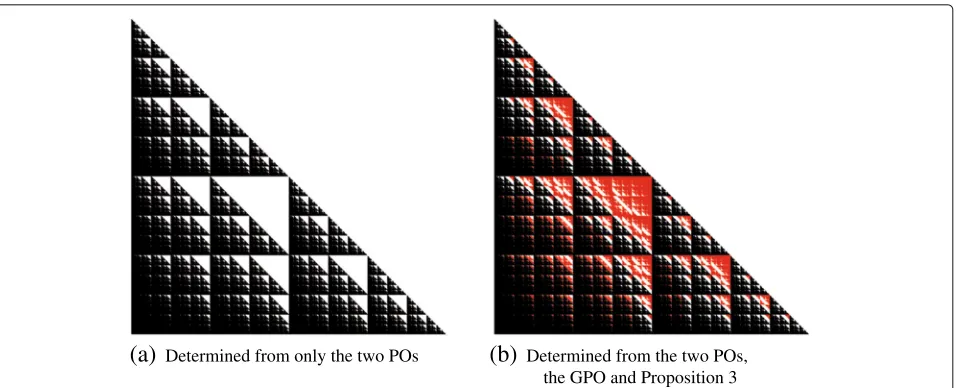
To obtain the first impression of how well PO1, PO 2, GPO, and indirect relationships work, the elements of the matrix O are plotted in Fig. 1, where a black or a red dot at Oij denotes that the relationship between bit channel i and bit channel j is determined, and the white space indicates that the corresponding relations are not determined. In Fig. 1, the polar code has the block length N = 29, and the underlying channel is AWGN with a SNR of 1 dB. In Fig. 1a, the black dots indi-cate that the relationship is determined from the two POs, and the red dots in Fig.1b indicate the additional intrinsic relationships obtained from the GPO and the indirect relationships. The application of GPO and indi-rect relationships fills some portion of the white space in Fig. 1a, which indicates that additional relations are identified.
Before quantifying the savings of GPO and IR (here, we use IR to refer to the results obtained from Proposition3), the parameternuof the GPO needs to be quantified. Let us considern = 9,N = 2n = 512,R = 0.5, and SNR = 1 dB as an example to show the optimal selection of the dimensionnu. Among all code rates,R = 0.5 is the worst case, which produces the largest size ofU. When
R = 0.5, we assume that the set U has the same prop-erty of the entire set{1, 2, ..,N}: the average weight of the binary expansion of the bit channels inUiswu≈ n2. From
(19), we have Tnu =
(Nu−6)nu
2 +
Kun
2
(t0 +t1). If the upper dimension isnu = 6,Ku = 104 elements exist in the undetermined setU (obtained from the algorithm of POs). Note that the quality of 58 bit channels needs to be calculated on the smaller dimensionnu = 6 (removing the largest six bit channels and the smallest six bit chan-nels). In this example,T6=
(64−6)×6
2 +1042×9
(t0+t1)= 642(t0+t1)must be satisfied to select the bestKbit chan-nels. As a comparison, the original complete sorting based onn=9 requiresT9=29×92(t0+t1)=2304(t0+t1)to select theKbest bit channels. Table1lists the theoretical calculation times based on different dimensionsnu. The expressionnu = 6 produces the most efficient construc-tion of polar codes. Table II lists the comparison of the theoretical calculation time and the real implementation time relative to the complete construction of polar codes. In Table2, the ratio isTnu/Tn. As shown in Table2, the approximation of the calculation time in (19) is similar for
R=0.5.
(a)
Determined from only the two POs(b)
Determined from the two POs, the GPO and Proposition 3Fig. 1The relationship of all bit channels withN=29.aBlack dots indicate that the relationship is determined from the two POs whereas white dots indicate that the relationship cannot be determined from the two POs.bThe underlying channel is AWGN with a SNR of 1 dB. On top of the black dots, the red dots indicate the additional intrinsic relationships obtained from the GPO
nucan be obtained based onTnuin (19). In this section, all examples considernu=n−3, which works fornup to 10. The size Ku = |U| determines the remaining calculations of the sorting algorithms. For example, Ku determines the number of callings of the Tal-Vardy algorithm [13]. In Fig.2, the ratio γ = Ku/N is plotted forN =29as a function of the code rateR(the solid cir-cled line), which shows that the combinations of the two POs can determine 91% of the bit channels withγ =9% forR=0.1. ForR=0.5, which is the worst case, the two POs determine 50% of the bit channels, which is still a sig-nificant saving, considering the complexity of the sorting algorithms [12,13]. A smallγ is desired since it indicates a low sorting effort. The dash-dotted line in Fig.2 isγ when applying POs and GPO (without running the search for the indirect relationships). The legend for this line is “PO+GPO.” The dotted line in Fig.2 isγ after applying POs, GPO, and Proposition3(searching for indirect rela-tionships). The gap between PO+GPO and PO+GPO+IR shows that after running PO+GPO, there are indirect rela-tionships imbedded in the POI matrix O. As shown in Fig.2, the value ofγ decreases withRwhenR> 0.5 and increases withRwhenR< 0.5. At the code rateR= 0.5, all three lines (PO, PO+GPO, and PO+GPO+IR) have the largest value ofγ. However, the savings of applying GPO and Proposition3is the largest atR= 0.5. For the small
Table 1The theoretical time of then=9 for differentnu
nu 4 5 6 7 9
Ku 212 150 104 68 0
Tnu/(t0+t1) 974 740 642 733 2304
code rateR≤0.1, less than 10% of the remaining channels are in the undetermined setU.
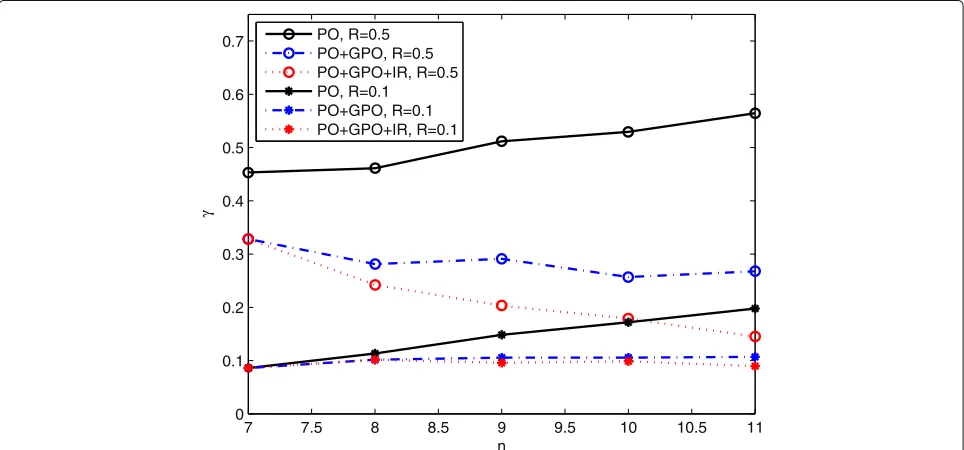
Figure3shows the relationship betweenγ and the block length for two fixed code rates R = 0.5 andR = 0.1. The three circled lines representR = 0.5: the solid line denotes POs, the dashed-dotted line denotes PO+GPO, and the dotted line is PO+GPO+IR. Similarly, the three lines with stars are values of γ forR = 0.1. As shown in Fig. 3, the number of undetermined channels slowly increases with the block length when applying POs. For PO+GPO and PO+GPO+IR, the trend is the opposite: the portion of undetermined bit channels decreases with the block length. This is caused by the following facts: with the increase of the block length N = 2n, there are more positions for bits 0 and 1 to choose from, producing more combinations of bit channels whose binary expan-sions cannot be characterized by the two POs. This in turn causes the increase of the size of the undetermined setU, leading to a slow increase ofγ when applying POs only, as seen in Fig. 2. By applying GPO, these undeter-mined relationships are revealed from calling any existing sorting procedure (Tal-Vardy’s algorithm in our work).
Table 2The ratio ofTnu/Tnto select theKbest bit channels for n=8,n=9 andn=10
n Simulated ratio Theoretical ratio
8 0.307 0.306
9 0.286 0.279
10 0.270 0.262
0 0.2 0.4 0.6 0.8 1 0
0.1 0.2 0.3 0.4 0.5
R
γ
PO PO+GPO PO+GPO+IR
Fig. 2Value ofγas a function of the code rateRwith POs and GPO+PO. The underlying channel is AWGN with a SNR of 1 dB. The block length is
N=29
Therefore, the portion of relationships being newly dis-covered increases withn, resulting in a decreasingγ with
n. From Fig. 3, it can be seen that GPO+PO+IR can produce approximately 82% of the savings in terms of the computation time for polar code construction with a code rateR=0.5 andN=1024.
5 Conclusion
In this paper, partial orders of polar codes for reduc-ing the construction complexity are investigated. Detailed
quantification of the existing partial orders, which dis-plays a clear potential of combining partial orders in the construction of polar codes, is provided. To further reduce the computation complexity, a general partial order, which works at a lower block length than the given block length, is proposed. In addition to the relationships obtained from the existing partial orders and the proposed general par-tial order, indirect relationships are also discussed in the paper. Detailed algorithms for implementing all the par-tial orders and finding indirect relations are provided to
7 7.5 8 8.5 9 9.5 10 10.5 11
0 0.1 0.2 0.3 0.4 0.5 0.6 0.7
n
γ
PO, R=0.5 PO+GPO, R=0.5 PO+GPO+IR, R=0.5 PO, R=0.1
PO+GPO, R=0.1 PO+GPO+IR, R=0.1
quantify their savings. Substantial savings are observed when combining all the partial orders in the paper for polar code construction.
Abbreviations
AWGN: Additive white Gaussian noise; BEC: Binary erasure channels; BMS: Binary-input, memoryless, output-symmetric; GA: Gaussian approximations; GPO: General partial order; IR: Indirect relationships; PO: Partial order; POI: Partial order indicator; SC: Successive cancelation
Funding
This work was supported in part by National Natural Science Foundation of China through grant 61501002, in part by Natural Science Project of Ministry of Education of Anhui through grant KJ2015A102, and in part by Talents Recruitment Program of Anhui University.
Availability of data and materials Not applicable.
Authors’ contributions
LL proposed the polar code construction reduction in the paper. WW implemented it and proved the theorems in the paper. KN provided format and logic structures of the paper. All authors read and approved the final manuscript.
Authors’ information
Liping Li is now an associate professor of the Key Laboratory of Intelligent Computing and Signal Processing of the Ministry of Education of China, Anhui University, Hefei, China. She got her PhD in Dept. of Electrical and Computer Engineering at North Carolina State University, Raleigh, NC, USA, in 2009. Her current research interest is in channel coding, especially polar codes. Dr. Li’s research topic during her PhD studies was multiple-access interference analysis and synchronization for ultra-wideband communications. Then she worked on a LTE indoor channel sounding and modeling project in University of Colorado at Boulder, collaborating with Verizon. From 2010 to 2013, she worked at Maxlinear Inc. as a staff engineer in the communication group. At Maxlinear, she worked on SoC designs for the ISDB-T standard and the DVB-S standard, covering modules on OFDM and LDPC. In Sept. 2013, she joined Anhui University and started her research on polar codes until now. Wei Wang is currently pursuing the B.S. degree in the Key Laboratory of Intelligent Computing and Signal Processing of the Ministry of Education of China, Anhui University and School of Electronics and Information Engineering, Anhui University. His research interest is in polar codes. Specifically, his research is to reduce the complexity of polar code construction. He was awarded the first prize of the Seventh National College Students Mathematics Competition in 2015. He was awarded the third prize of the thirtieth national middle school physics competition in Anhui Province in 2013. He was awarded the national inspirational scholarship for 2014 and 2015 academic year. He also achieved the second prize of the Ninth International Students’ Innovation and Entrepreneurship Competition in Anhui Province (I CAN) in 2016. Kai Niu received the B.S. degree in information engineering and Ph.D. degree in signal and information processing from Beijing University of Posts and Telecommunications (BUPT), Beijing, China, in 1998 in 2003, respectively. Currently, he is a professor at the School of Information and Communication Engineering of BUPT. His research interests are in the area of channel coding and broadband wireless communication, particularly on the practical design of polar codes and study of polar decoding algorithms.
Competing interests
The authors declare that they have no competing interests.
Publisher’s Note
Springer Nature remains neutral with regard to jurisdictional claims in published maps and institutional affiliations.
Author details
1Key Laboratory of Intelligent Computing and Signal Processing of the
Ministry of Education of China, Anhui University, Hefei, People’s Republic of
China.2Key Laboratory of Universal Wireless Communication, Ministry of
Education, Beijing University of Posts and Telecommunications, Beijing 100876, People’s Republic of China.
Received: 17 December 2017 Accepted: 11 December 2018
References
1. E. Arıkan, Channel polarization: a method for constructing capacity-achieving codes for symmetric binary-input memoryless channels. IEEE Trans. Inf. Theory.55(7), 3051–3073 (2009) 2. E. Arıkan, I. E. Telatar, inIEEE International Symposium on Information
Theory (ISIT). On the rate of channel polarization, (2009), pp. 1493–1495 3. S. B. Korada, E. Sasoglu, R. Urbanke, Polar codes: characterization of
exponent, bounds, and constructions. IEEE Trans. Inf. Theory.56(12), 6253–6264 (2010)
4. S. H. Hassani, R. Mori, T. Tanaka, R. L. Urbanke, Rate-dependent analysis of the asymptotic behavior of channel polarization. IEEE Trans. Inf. Theory. 59(4), 2267–2276 (2013)
5. N. Hussami, S. Korada, R. Urbanke, inIEEE International Symposium on Information Theory (ISIT). Performance of polar codes for channel and source coding, (2009), pp. 1488–1492
6. A. Eslami, H. Pishro-Nik, in48th Annual Allerton Conference on Communication, Control, and Computing (Allerton). On bit error rate performance of polar codes in finite regime, (2010), pp. 188–194 7. J. Guo, M. Qin, A. G. i Fabregas, P. H. Siegel, in2014 IEEE International
Symposium on Information Theory Proceedings (ISIT). Enhanced belief propagation decoding of polar codes through concatenation, (2014), pp. 2987–2991
8. U. U. Fayyaz, J. R. Barry, in2013 IEEE International Conference on Communications (ICC). Polar codes for partial response channels, (2013), pp. 4337–4341
9. E. Sasoglu, E. Telatar, E. Arikan, inIEEE Information Theory Workshop(ITW). Polarization for arbitrary discrete memoryless channels, (2009) 10. R. Mori, T. Tanaka, inIEEE Information Theory Workshop(ITW). Non-binary
polar codes using Reed-Solomon codes and algebraic geometry codes, (2010), pp. 1–5
11. A. G. Sahebi, S. S. Pradhan, in2011 49th Annual Allerton Conference on Communication, Control, and Computing (Allerton). Multilevel polarization of polar codes over arbitrary discrete memoryless channels, (2011), pp. 1718–1725
12. R. Mori, T. Tanaka, Performance of polar codes with the construction using density evolution. IEEE Commun. Lett.13(7), 519–521 (2009) 13. I. Tal, A. Vardy, How to construct polar codes. IEEE Trans. Inf. Theory.
59(10), 6562–6582 (2013)
14. P. Trifonov, Efficient design and decoding of polar codes. IEEE Trans. Commun.60(11), 3221–3227 (2012)
15. D. Wu, Y. Li, Y. Sun, Construction and block error rate analysis of polar codes over AWGN channel based on Gaussian approximation. IEEE Commun. Lett.18(7), 1099–1102 (2014)
16. J. Dai, K. Niu, Z. Si, J. Lin,Evaluation and optimization of Gaussian approximation for polar codes, (2016).https://arxiv.org/abs/1511.07236 17. C. Schurch, inIEEE International Symposium on Information Theory (ISIT). A
partial order for the synthesized channels of a polar code, (2016), pp. 220–224
18. M. Bardet, V. Dragoi, A. Otmani, J.-P. Tillich,Algebraic properties of polar codes from a new polynomial formalism, (2016).https://arxiv.org/abs/1601. 06215
19. M. Mondelli, S. H. Hassani, R. Urbanke, inIEEE International Symposium on Information Theory (ISIT). Construction of polar codes with sublinear complexity, (2017)
20. G. He, J.-C. Belfiore, I. Land, G. Yang, X. Liu, Y. Chen, R. Li, J. Wang, Y. Ge, R. Zhang, W. Tong,β-expansion: a theoretical framework for fast and recursive construction of polar codes, (2017).https://arxiv.org/abs/1704.05709 21. W. Wang, L. Li, inIEEE International Wireless Communications and Mobile
Computing Conference. Efficient construction of polar codes, (2017), pp. 1594–1598
22. T. Richardson, R. Urbanke,Modern coding theory. (Cambridge University Press, Cambridge, 2008)