Internet Argument Corpus 2.0:
An SQL schema for Dialogic Social Media and the Corpora to go with it
Rob Abbott, Brian Ecker, Pranav Anand, Marilyn A. Walker
University of California, Santa Cruz[email protected], [email protected], [email protected], [email protected]
Abstract
Large scale corpora have benefited many areas of research in natural language processing, but until recently, resources for dialogue have lagged behind. Now, with the emergence of large scale social media websites incorporating a threaded dialogue structure, content feedback, and self-annotation (such as stance labeling), there are valuable new corpora available to researchers. In previous work, we released the INTERNETARGUMENT CORPUS, one of the first larger scale resources available for opinion sharing dialogue. We now release the INTERNETARGUMENTCORPUS2.0 (IAC 2.0) in the hope that others will find it as useful as we have. TheIAC 2.0provides more data thanIAC 1.0and organizes it using an extensible, repurposable SQL schema. The database structure in conjunction with the associated code facilitates querying from and combining multiple dialogically structured data sources. TheIAC 2.0schema provides support for forum posts, quotations, markup (bold, italic, etc), and various annotations, including Stanford CoreNLP annotations. We demonstrate the generalizablity of the schema by providing code to import the ConVote corpus.
Keywords:dialogue, argument mining, sentiment, stance, data integration, online forums, debate
1.
Introduction
Large scale corpora have benefited many areas of search in natural language processing, but until recently, re-sources for dialogue have lagged behind. This is changing as more and more researchers work with social media sites structured in the form of dialogues, such as 4Forums, Cre-ate DebCre-ate and Reddit as well as sites such as Twitter that provide dialogic affordances such as synchronized commu-nity Tweet-Ups and the use of replies to other tweets (Abu-Jbara et al., 2012; Biran and Rambow, 2011; Somasundaran and Wiebe, 2009; Rosenthal and McKeown, 2015; Sridhar et al., 2015; Hassan et al., 2010; Cook et al., 2014; Cook et al., 2013; Bamman and Smith, 2015). In previous work, we released the INTERNET ARGUMENT CORPUS, one of the first larger scale resources available for opinion sharing dialogue (Walker et al., 2012b).
Dataset Authors Discussions Posts Tokens
4forums 3.5K 11K 414K 57M
ConvinceMe 5.5K 5.4K 65K 6.5M
CreateDebate 709 61 3K 275K
Table 1: The size of each dataset included. This paper describes the INTERNETARGUMENTCOR
-PUS2.0 (IAC 2.0).1 We have developed a larger scale
dia-logic corpus by adding conversations from additional sites and structuring them into a novel data schema in SQL. See Table 1. TheIAC 2.0schema provides support for forum posts within distinct dialogues, quotations, markup (bold, italic, etc), and various human and machine developed an-notations, including Stanford CoreNLP anan-notations, such as POS tags, parses, and named entities. We provide Python code that facilitates querying and combining data from dif-ferent sources. We also demonstrate the generalizability of the schema with code to import the ConVote corpus (Thomas et al., 2006).
1IAC 2.0 is available at https://nlds.soe.ucsc.
edu/iac2
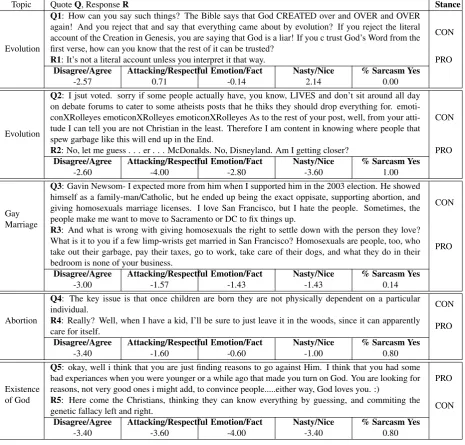
TheIAC 2.0corpus can support research on many differ-ent aspects of social language and dialogue structure. The language of dialogue, and particularly of conversations in online forums on social and political topics, is very differ-ent from newspaper articles or broadcast news. Subjective genres in traditional media tend to be both monologic and formal, while online debates are strongly dialogic, interper-sonal, and colloquial, often containing emotional and col-orful language, as exemplified by the excerpts in Fig. 1.
Fig. 1 illustrates, for example, the frequent use of discourse cues such as But, If andBecause to mark dis-course relations, e.g. comparison and contingency relations (Prasad et al., 2008). Dialog strategies in the corpus also often includerhetorical questions, which are intended to elicit responses by challenging another’s evidence or as-sumptions: And what is wrong with giving homosexuals the right to settle down with the person they love? (R3 in Fig. 1). Utterances may also be strongly emotional or highly rational, e.g. contrastWhat is it to you if a few limp-wrists get married in San Francisco? (R3 in Fig. 1) withIt’s not a literal account unless you read it that way
(R1 in Fig. 1). About 10% of the utterances in the corpus are sarcastic, e.g.,Really? Well, when I have a kid, I’ll be sure to just leave it in the woods, since it can apparently care for itself(R4 in Fig. 1, see also see Q2 and R2). In-sults are common:Here come the Christians, thinking they can know everything by guessing, and commiting the ge-netic fallacy left and right(R5 in Fig. 1).
Topic QuoteQ, ResponseR Stance
Evolution
Q1: How can you say such things? The Bible says that God CREATED over and OVER and OVER again! And you reject that and say that everything came about by evolution? If you reject the literal account of the Creation in Genesis, you are saying that God is a liar! If you c trust God’s Word from the first verse, how can you know that the rest of it can be trusted?
CON
R1: It’s not a literal account unless you interpret it that way. PRO Disagree/Agree Attacking/Respectful Emotion/Fact Nasty/Nice % Sarcasm Yes
-2.57 0.71 -0.14 2.14 0.00
Evolution
Q2: I jsut voted. sorry if some people actually have, you know, LIVES and don’t sit around all day on debate forums to cater to some atheists posts that he thiks they should drop everything for. emoti-conXRolleyes emotiemoti-conXRolleyes emotiemoti-conXRolleyes As to the rest of your post, well, from your atti-tude I can tell you are not Christian in the least. Therefore I am content in knowing where people that spew garbage like this will end up in the End.
CON
R2: No, let me guess . . . er . . . McDonalds. No, Disneyland. Am I getting closer? PRO Disagree/Agree Attacking/Respectful Emotion/Fact Nasty/Nice % Sarcasm Yes
-2.60 -4.00 -2.80 -3.60 1.00
Gay Marriage
Q3: Gavin Newsom- I expected more from him when I supported him in the 2003 election. He showed himself as a family-man/Catholic, but he ended up being the exact oppisate, supporting abortion, and giving homosexuals marriage licenses. I love San Francisco, but I hate the people. Sometimes, the people make me want to move to Sacramento or DC to fix things up.
CON
R3: And what is wrong with giving homosexuals the right to settle down with the person they love? What is it to you if a few limp-wrists get married in San Francisco? Homosexuals are people, too, who take out their garbage, pay their taxes, go to work, take care of their dogs, and what they do in their bedroom is none of your business.
PRO
Disagree/Agree Attacking/Respectful Emotion/Fact Nasty/Nice % Sarcasm Yes
-3.00 -1.57 -1.43 -1.43 0.14
Abortion
Q4: The key issue is that once children are born they are not physically dependent on a particular
individual. CON
R4: Really? Well, when I have a kid, I’ll be sure to just leave it in the woods, since it can apparently
care for itself. PRO
Disagree/Agree Attacking/Respectful Emotion/Fact Nasty/Nice % Sarcasm Yes
-3.40 -1.60 -0.60 -1.00 0.80
Existence of God
Q5: okay, well i think that you are just finding reasons to go against Him. I think that you had some bad experiances when you were younger or a while ago that made you turn on God. You are looking for reasons, not very good ones i might add, to convince people...either way, God loves you. :)
PRO
R5: Here come the Christians, thinking they can know everything by guessing, and commiting the
genetic fallacy left and right. CON
Disagree/Agree Attacking/Respectful Emotion/Fact Nasty/Nice % Sarcasm Yes
-3.40 -3.60 -4.00 -3.40 0.80
Figure 1: Sample Quote/Response Pairs from4forums.comwith Mechanical Turk annotations for topic, stance, agreement, hostility, argument type (emotional appeal or fact based), and sarcasm. The agreement/hostility/etc. are mean annotator judgments on a [-5,+5] scale while sarcasm is the percentage of annotators who selectYesof
Yes/No/Unsureoptions.
Boltuzic and ˇSnajder, 2014; Conrad et al., 2012; Habernal and Gurevych, 2015; Habernal and Gurevych, 2016).
In our own work to date, we have used the corpus for studies on distinguishing agreement and disagreement (Sridhar et al., 2014; Misra and Walker, 2015; Abbott et al., 2011) and to classify posts by stance-side (Walker et al., 2012c; Sridhar et al., 2014; Walker et al., 2012a; Anand et al., 2011). We have put together a corpus of summaries of the dialogic threads of arguments on Gay Marriage (Misra et al., 2015), and done studies using these summaries as in-dicators of the importance of arguments and the facets of particular arguments that recur frequenly across the corpus. We have also used this corpus to develop methods for ex-tracting highly specific well-formed arguments on particu-lar topics (Swanson et al., 2015).
Other to date has used IAC 1.0 to recognize sarcasm and nastiness in dialogue (Lukin and Walker, 2013; Justo et al., 2014; Swanson et al., 2014), and to distinguish factual from
emotional argumentation (Oraby et al., 2015). Subcorpora of IAC 2.0 useful for working on these topics are also avail-able for download https://nlds.soe.ucsc.edu. Oraby et al.’s bootstrapped corpus of factual vs. feeling arguments (Oraby et al., 2015) and subsets of IAC la-belled for disagreement and sarcasm have also been used by other researchers (Pavlick and Tetreault, 2016; Schl¨oder and Fern´andez, 2014; Joshi et al., 2015).
2.
Internet Argument Corpus 2.0 Data
TheIAC 2.0provides an expanded dataset consisting of dialogues from4forums.com,CreateDebate.com, andConvinceme.Net.
com-monly invoked mechanism which provides precise context. IAC 1.0 contained only discussions from 4forums. The 4forums section of IAC 2.0 is based on a rescraping of 4forums, which resulted in 24,000 additional posts. How-ever we now exclude discussions with only one author (pri-marily those with only one post) so the number of discus-sions dropped from 11,800 to 11,079. IAC 2.0 features im-proved unicode handling, expanded and imim-proved topic an-notations, simpler direct quotes (quotes now use their own text objects instead of referencing a segment within a post’s text object), supporting code in Python3 instead of Python2. Most importantly the dialogues are organized into an SQL schema, as presented in this paper, instead of JSON and CSV format.
Figure 2: Diagram illustrating 4forums. The highlighted text is quoting a previous post.
The IAC 2.0 4forums dataset consists of 414,453 posts in 11,079 threads by 3452 authors and 56M tokens. We have a number of annotations for this site including topic (2894 discussions), author stance (2248 authors by topic), agreement, sarcasm, and hostility measures (9975 quote-response pairs).
ConvinceMe. In addition to the 4forums dataset, IAC 2.0includes dialogues fromConvinceMe.net, a highly structured debate site. This is an expanded version of the data used in (Anand et al., 2011) and (Walker et al., 2012d). The dataset consists of 65,368 posts in 5413 debates by 5783 authors. Users may initiate a debate by specifying the topic and sides. Other users are then forced to self-label stance when commenting by posting on the side they sup-port or by using a rebuttal mechanism, which forces their post to the opposite side.
By choosing which side to post on authors self-label for stance. We annotated discussions for topic and mapped the discussion stance to a broader topic stance. Noting the lack of a human topline for stance classification in previ-ous work (Somasundaran and Wiebe, 2010; Thomas et al., 2006), we collected human topline stance annotations for
Figure 3: Diagram illustrating ConvinceMe. Au-thors choose which side of a debate to post on.
this corpus (Anand et al., 2011). The annotation task pre-sented the annotators with the topic, sides, and a sample post from each side, and then asked them to decide which side of the debate a post belonged to. Context, such as a parent post, was not provided, because this most nearly approximated the conditions under which automatic algo-rithms for stance classification operated at that time. These annotations are included in the release.
CreateDebate. We also introduce a gun control specific subset of CreateDebate.com, a debate site that, like ConvinceMe, exhibits a highly structured two-sided format. The subset consists of 2958 posts, 16,671 sentences, and 275,472 tokens. Similarly toConvinceMe, the user start-ing the debate defines the topic, an introduction post, and the sides/stances to the debate. Top level posts are placed in the left or right column based on their stance. Respond-ing posts must label their stance from the available sides when posting and must respond with asupport,clarify, or
disputetag. Unlike ConvinceMe, responses on CreateDe-bate appear inline under their parents, creating a more nat-ural discourse. It is also possible for a user to dispute the post of another user even if they self-label the same stance, which creates the opportunity to analyze how debaters sup-porting the same stance may disagree on certain sub-issues (Sridhar et al., 2014). Like ConvinceMe, CreateDebate al-lows users to vote on other posts, which the dataset also in-cludes. These votes have been used to analyze persuasion effectiveness (Jaech et al., 2015).
There are other releases of subsets of CreateDebate (Hasan and Ng, 2013; Rosenthal and McKeown, 2015). We believe that the IAC 2.0 schema applied to CreateDebate provides a more complete representation of CreateDebate’s extensive affordances and post-response system. It is pos-sible to import other CreatDebate subsets into the IAC 2.0 schema.
Figure 4: The schema’s core elements. This and other schema diagrams are included in the documentation.
affordances (Thomas et al., 2006).
3.
Database Description
The SQL database provides a single consistent storage location for all data relevant to a given dataset including text, metadata, parses, annotations and partial computa-tions. Extensive foreign keys help to explain relationships within a dataset and ensure referential integrity. Using SQL means that basic tasks can be accomplished with a simple query instead of running code and iterating over the dataset. By using the same schema for multiple datasets it is not only easier for humans to understand those datasets but also enables a single codebase with minimal dataset spe-cific code. Using SQL also gives the option of non-local storage & access (client-server).
Because data that would be otherwise stored together in an XML file is scattered across several tables, some straightforward queries may involve several joins. Thus, for instance, to find sentences in a topic area, one must join a clutch of tables together (posts, discussions, topics, texts, and sentences). However, this is balanced by the fact that we do not have to loop over the entire dataset to find objects of interest.
In general the schema attempts to minimize redundancy, use foreign keys where possible, use consistent column names (thereby enablingNATURAL JOINs and theUSING
keyword), and prefer fixed width tables. Composite pri-mary keys are used throughout and usually contain one or more foreign keys. For more complex tasks we provide a Python3 interface using an SQLAlchemy based ORM.
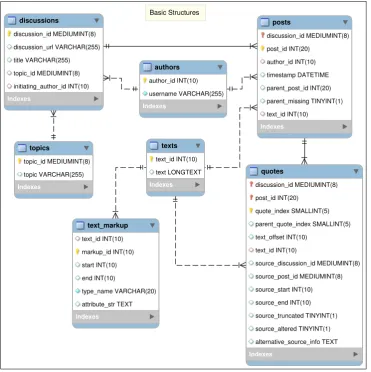
Basic Structures.The core portion of the schema consists of tables for discussions, posts, authors, quotes, and texts. Fig. 4 illustrates a minimal set of tables and columns which
Figure 5: Posts are stored in several tables. The
posts table has foreign keys to the authors and
new datasets should provide to be importable. Additional dataset specific columns or even tables may be included (e.g.author.ui language,post.votes, etc.). We also provide an SQL view (virtual table) joining thepoststable with the others in order to reduce boilerplate and make the schema more user friendly. See Fig. 5.
Rather than putting post text in thepoststable we store it in a dedicated table, because there are text strings outside of posts (discussion introductory blurbs) as well as inside posts (quotes) that we wish to store, and a unified location simplifies that task. This also allows markup and annotation tables (including the CoreNLP tables) to reference the text regardless of its source.
Quotes are an important affordance of the IAC. While quotes typically come verbatim from previous posts, they are ultimately a form of markup, and users often alter quoted material or quote from posts elsewhere in a dis-cussion or on the site as well as external sources (e.g., Wikipedia). We store quote information as standoff anno-tation in thequotestable. If a quote’s original source post can be identified, it is referenced by identifiers and a text offset. We also mark differences between the quote and its source.
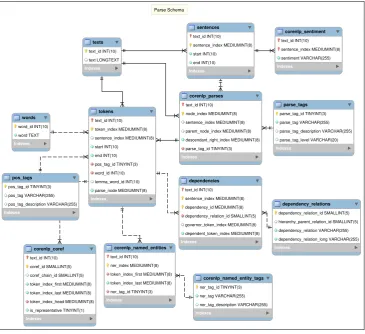
Parses. The schema provides support for Stanford CoreNLP (Manning et al., 2014) annotations including to-kenization, part of speech tags, parse trees, dependencies, named entities, coreference, and sentence level sentiment. Scripts are provided for calling CoreNLP to generate xml output and storing the parses in the database. We store the constituency parses in a nested set data structure which sup-ports queries over parse structures. See Fig. 6.
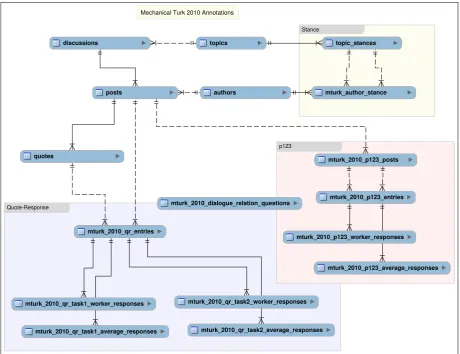
Annotations.There are also a large number of annotations for the corpus with additional annotations being added all the time. See Fig. 7.
4.
Examples
Simple Query. This query finds sentences in a particular topic area. It can be simplified further using a view that combines the tables relevant to posts.
SELECT
Access Using R. This example queries the database and then plots posts by hour using R.
l i b r a r y(RMySQL)
Figure 8: This plot illustrates accessing the database using R (see example code). It shows activity on 4forums as a function of time.
Iterate over posts using Python. This example illus-trates using the provided Python code to iterate over post objects printing their text and dependencies. We use SQLAlchemy’s ORM to map the database to Python ob-jects.
Figure 6: The schema diagram for parses.
c o r e n l p p a r s e s . t e x t i d , c o r e n l p p a r s e s . n o d e i n d e x ;
Dependency Parses Query. This query finds all depen-dencies which are within noun phrases. The selection is also limited to posts thereby excluding quotes or other text sources. It makes use of thedependencies viewwhich re-duces the boilerplate code pulling in the governor and de-pendent tokens as well as various reference tables.
SELECT r e l a t i o n , g o v e r n o r w o r d , d e p e n d e n t w o r d
FROM d e p e n d e n c i e s v i e w NATURAL JOIN p o s t s
−− O n l y p o s t s , n o t q u o t e s
NATURAL JOIN c o r e n l p p a r s e s NATURAL JOIN p a r s e T a g s WHERE p a r s e t a g = ’NP ’
AND d e p e n d e n t n o d e i n d e x >= n o d e i n d e x
AND d e p e n d e n t n o d e i n d e x <= d e s c e n d a n t r i g h t i n d e x AND g o v e r n o r n o d e i n d e x >=
n o d e i n d e x
AND g o v e r n o r n o d e i n d e x <= d e s c e n d a n t r i g h t i n d e x ;
Annotation Query. This query pulls out Quote-Response pairs with annotations as used in Fig. 1. The list it returns is sorted so that particularly sarcastic posts appear first.
SELECT t o p i c , d i s a g r e e a g r e e ,
a t t a c k i n g r e s p e c t f u l , e m o t i o n f a c t , n a s t y n i c e , s a r c a s m y e s ,
q u o t e t e x t . t e x t AS q u o t e , −− t h e r e s p o n s e may be o n l y a
−− p o r t i o n o f t h e p o s t ’ s t e x t
−− s o we u s e s u b s t r ( )
SUBSTR( t e x t s . t e x t , t e x t o f f s e t + 1 ,
I F ( r e s p o n s e t e x t e n d I S NOT n u l l , r e s p o n s e t e x t e n d−t e x t o f f s e t , LENGTH( t e x t s . t e x t ) )
) AS r e s p o n s e
FROM m t u r k 2 0 1 0 q r e n t r i e s NATURAL JOIN
m t u r k 2 0 1 0 q r t a s k 1 a v e r a g e r e s p o n s e s NATURAL JOIN p o s t s
NATURAL JOIN t e x t s
−− Can ’ t NATURAL JOIN q u o t e s s i n c e
−− i t s t e x t i d i s n o t t h e same a s p o s t s
JOIN q u o t e s
USING( d i s c u s s i o n i d , p o s t i d ,
q u o t e i n d e x ) JOIN t e x t s AS q u o t e t e x t
Figure 7: The schema diagram for our 4forums annotations
5.
Acknowledgements
This work was funded by NSF Grant IIS-1302668- 002 under the Robust Intelligence Program. The collection and annotation of the IAC corpus was supported by an award from NPS-BAA-03 to UCSC and an IARPA Grant under the Social Constructs in Language Program to UCSC by subcontract from the University of Maryland.
6.
Bibliographical References
Abbott, R., Walker, M., Jean E. Fox Tree, Anand, P., Bow-mani, R., and King, J. (2011). How can you say such things?!?: Recognizing Disagreement in Informal Polit-ical Argument. InProc. of the ACL Workshop on Lan-guage and Social Media.
Abu-Jbara, A., Diab, M., Dasigi, P., and Radev, D. (2012). Subgroup detection in ideological discussions. InProc. of the 50th Annual Meeting of the Association for Com-putational Linguistics: Long Papers - Volume 1, ACL ’12, pp. 399–409,
Anand, P., Walker, M., Abbott, R., Jean E. Fox Tree, Bow-mani, R., and Minor, M. (2011). Cats Rule and Dogs Drool: Classifying Stance in Online Debate. InProc. of the ACL Workshop on Sentiment and Subjectivity. Bamman, D. and Smith, N. A. (2015). Contextualized
sar-casm detection on twitter. InNinth Int. AAAI Conf. on Web and Social Media.
Biran, O. and Rambow, O. (2011). Identifying justifica-tions in written dialogs. In2011 Fifth IEEE Int. Conf. on Semantic Computing (ICSC), pp. 162–168. IEEE. Boltuzic, F. and ˇSnajder, J. (2014). Back up your stance:
Recognizing arguments in online discussions. InProc. of the First Workshop on Argumentation Mining, pp. 49– 58.
Conrad, A., Wiebe, J., et al. (2012). Recognizing arguing subjectivity and argument tags. InProc. of the Workshop on Extra-Propositional Aspects of Meaning in Computa-tional Linguistics, pp. 80–88. Association for Computa-tional Linguistics.
Cook, J., Kenthapadi, K., and Mishra, N. (2013). Group chats on twitter. InProc. of the 22nd international con-ference on World Wide Web, pp. 225–236. Int. World Wide Web Conf. s Steering Committee.
Cook, J., Das, A., Kenthapadi, K., and Mishra, N. (2014). Ranking twitter discussion groups. In Proc. of the sec-ond edition of the ACM conference on Online social net-works, pp. 177–190. ACM.
Habernal, I. and Gurevych, I. (2015). Exploiting de-bate portals for semi-supervised argumentation mining in user-generated web discourse. InProc. of the 2015 Conf. on Empirical Methods in Natural Language Processing, pp. 2127–2137.
abs/1601.02403.
Hasan, K. S. and Ng, V. (2013). Frame semantics for stance classification. InCoNLL, pp. 124–132.
Hasan, K. S. and Ng, V. (2014). Why are you taking this stance? identifying and classifying reasons in ideological debates. InProc. of the Conf. on Empirical Methods in Natural Language Processing.
Hassan, A., Qazvinian, V., and Radev, D. (2010). What’s with the attitude?: identifying sentences with attitude in online discussions. InProc. of the 2010 Conf. on Empiri-cal Methods in Natural Language Processing, pp. 1245– 1255.
Hassan, A., Abu-Jbara, A., and Radev, D. (2012). Detect-ing subgroups in online discussions by modelDetect-ing posi-tive and negaposi-tive relations among participants. InProc. of the 2012 Joint Conf. on Empirical Methods in Natural Language Processing.
Jaech, A., Zayats, V., Fang, H., Ostendorf, M., and Ha-jishirzi, H. (2015). Talking to the crowd: What do people react to in online discussions? arXiv preprint arXiv:1507.02205.
Joshi, A., Sharma, V., and Bhattacharyya, P. (2015). Har-nessing context incongruity for sarcasm detection. In
Proc. of the 53rd Annual Meeting of the Association for Computational Linguistics, v 2, pp. 757–762.
Justo, R., Corcoran, T., Lukin, S. M., Walker, M., and Torres, M. I. (2014). Extracting relevant knowledge for the detection of sarcasm and nastiness in the social web.
Knowledge-Based Systems.
Lukin, S. and Walker, M. (2013). Really? well. apparently bootstrapping improves the performance of sarcasm and nastiness classifiers for online dialogue. NAACL 2013, page 30.
Manning, C. D., Surdeanu, M., Bauer, J., Finkel, J. R., Bethard, S., and McClosky, D. (2014). The stanford corenlp natural language processing toolkit. In ACL (System Demonstrations), pp. 55–60.
Misra, A. and Walker, M. A. (2015). Topic independent identification of agreement and disagreement in social media dialogue. InProc. of the 15th Annual Meeting of the Special Interest Group on Discourse and Dialogue. Misra, A., Anand, P., Jean E. Fox Tree, and Walker,
M. (2015). Using summarization to discover argument facets in dialog. InProc. of the 2015 NAACL Conf.. Murakami, A. and Raymond, R. (2010). Support or
Op-pose? Classifying Positions in Online Debates from Re-ply Activities and Opinion Expressions. InProc. of the 23rd Int. Conf. on Comp. Ling., pp. 869–875.
Oraby, S., Reed, L., Compton, R., Riloff, E., Walker, M., and Whittaker, S. (2015). And thats a fact: Distinguish-ing factual and emotional argumentation in online dia-logue.NAACL HLT 2015, page 116.
Pavlick, E. and Tetreault, J. (2016). An empirical analysis of formality in online communication. Transactions of the ACL, 4:61–74.
Prasad, R., Dinesh, N., Lee, A., Miltsakaki, E., Robaldo, L., Joshi, A., and Webber, B. (2008). The penn discourse treebank 2.0. InProc. of the 6th Int. Conf. on Language Resources and Evaluation (LREC 2008), pp. 2961–2968.
Rosenthal, S. and McKeown, K. (2015). I couldnt agree more: The role of conversational structure in agreement and disagreement detection in online discussions. In
16th Annual Meeting of the Special Interest Group on Discourse and Dialogue, pp. 168.
Schl¨oder, J. J. and Fern´andez, R. (2014). The role of po-larity in inferring acceptance and rejection in dialogue. In15th Annual Meeting of the Special Interest Group on Discourse and Dialogue, pp. 151.
Somasundaran, S. and Wiebe, J. (2009). Recognizing stances in online debates. In Proc. of the 47th Annual Meeting of the ACL, pp. 226–234.
Somasundaran, S. and Wiebe, J. (2010). Recognizing stances in ideological on-line debates. In Proc. of the NAACL HLT 2010 Workshop on Computational Ap-proaches to Analysis and Generation of Emotion in Text, pp. 116–124.
Sridhar, D., Getoor, L., and Walker, M. (2014). Collec-tive stance classification of posts in online debate forums.
ACL 2014, page 109.
Sridhar, D., Foulds, J., Huang, B., Getoor, L., and Walker, M. (2015). Joint models of disagreement and stance in online debate. InAnnual Meeting of the Association for Computational Linguistics (ACL).
Swanson, R., Lukin, S., Eisenberg, L., Corcoran, T. C., and Walker, M. A. (2014). Getting reliable annotations for sarcasm in online dialogues. InLanguage Resources and Evaluation Conf. , LREC 2014.
Swanson, R., Ecker, B., and Walker, M. (2015). Argument mining: Extracting arguments from online dialogue. In
Proc. of the 16th Annual Meeting of the Special Interest Group on Discourse and Dialogue, pp. 217–226. ACL. Thomas, M., Pang, B., and Lee, L. (2006). Get out the
vote: Determining support or opposition from Congres-sional floor-debate transcripts. InProc. of the 2006 con-ference on empirical methods in NLP, EMNLP. pp. 327– 335. ACL.
Walker, M., Anand, P., Abbott, R., Jean E. Fox Tree, Martell, C., and King, J. (2012a). That’s your evidence?: Classifying stance in online political debate. Decision Support Sciences.
Walker, M., Anand, P., Abbott, R., and Fox Tree, J. E. (2012b). A corpus for research on deliberation and de-bate. In Language Resources and Evaluation Conf. , LREC2012.
Walker, M., Anand, P., Abbott, R., and Grant, R. (2012c). Stance classification using dialogic properties of persua-sion. InMeeting of the North American Association for Computational Linguistics. NAACL-HLT12.
Walker, M. A., Anand, P., Abbott, R., Tree, J. E. F., Martell, C., and King, J. (2012d). That is your evidence?: Classi-fying stance in online political debate.Decision Support Systems, 53(4):719–729.