Sentence Similarity based on Dependency Tree Kernels for Multi-document
Summarization
S¸aziye Bet ¨ul ¨
Ozates¸
∗, Arzucan ¨
Ozg ¨ur
∗, Dragomir R. Radev
† ∗Department of Computer Engineering, Bo˘gazic¸i University34342, Bebek, Istanbul, Turkey
{saziye.bilgin, arzucan.ozgur}@boun.edu.tr
†Department of EECS, University of Michigan
3917 Beyster Building, Ann Arbor, MI 48109 [email protected]
Abstract
We introduce an approach based on using the dependency grammar representations of sentences to compute sentence similarity for extractive multi-document summarization. We adapt and investigate the effects of two untyped dependency tree kernels, which have originally been proposed for relation extraction, to the multi-document summarization problem. In addition, we propose a series of novel dependency grammar based kernels to better represent the syntactic and semantic similarities among the sen-tences. The proposed methods incorporate the type information of the dependency relations for sentence similarity calculation. To our knowledge, this is the first study that investigates using dependency tree based sentence similarity for multi-document summarization.
Keywords:multi-document summarization, sentence similarity, dependency grammars
1.
Introduction
Multi-document summarization (MDS), which refers to the task of automatically generating a summary of multiple documents about the same topic without losing the most important information, is one of the most promising solu-tions proposed to overcome the information overload prob-lem (Li et al., 2007).
Sentence similarity calculation is a crucial task for many extractive approaches to MDS (Erkan and Radev, 2004; Mihalcea and Tarau, 2005; Wang et al., 2008; Aliguliyev, 2009). Most of them use a bag of words model to com-pute sentence similarity. However, the bag of words model is sometimes inadequate for capturing the syntactic and se-mantic similarities among the sentences, which may affect the qualities of the summaries. To address this problem, we propose to employ dependency grammars, which represent the syntactic dependencies among the words in a sentence, for sentence similarity computation in MDS. Using this ap-proach, concepts in multiple documents and relations be-tween similar contents can be captured.
In this study, we first adapt two dependency tree based sen-tence similarity kernels in order to use them in MDS. These kernels are proposed by Culotta and Sorensen (2004) and Choi and Kim (2013) respectively, for relation extraction. They do not take the dependency relation types into account while calculating sentence similarity. We then propose a series of new sentence similarity kernels based on typed dependency grammars and test these kernels on LexRank (Erkan and Radev, 2004), a well-known and publicly avail-able MDS system, by replacing its tf-idf based cosine ilarity method with each of the kernels. The proposed sim-ilarity kernels make use of the binary dependency relations in the sentences. We conduct experiments on DUC 2003 and DUC 2004 Task 2 data sets. The results show that the best one of the proposed methods outperforms the other un-typed tree kernels and LexRank’s own sentence similarity
method in terms of ROUGE-1 and ROUGE-2 scores.
2.
Related Work
summa-rization (Zhuang et al., 2006; Somprasertsri and Lalitro-jwong, 2010). In addition, dependency parsing has been used to align sentences in documents with their human gen-erated summaries in (Hirao et al., 2004) and to generate a dependency-based language model for Information Re-trieval as in (Gao et al., 2004). To the best of our knowl-edge, none of the previous studies have used the depen-dency grammar concept to compute sentence similarity in a text summarization approach.
3.
Methodology
Dependency tree representations of sentences allow us to utilize the syntactic dependency relations among words. Therefore, it is a more powerful approach than the bag of words representation for modeling the syntactic and se-mantic information in sentences. Considering this strength of dependency grammars, we first adapt two state-of-the-art dependency tree kernels (Culotta and Sorensen, 2004; Choi and Kim, 2013) originally proposed for relation ex-traction, to the MDS task. We refer to these kernels as the Dependency Tree Kernel (DTK) and the Dependency Tri-gram Kernel (Tri-K) throughout the paper. Next, we design a series of new sentence similarity methods based on typed dependency grammars. The following subsections describe the proposed dependency tree based similarity methods in detail.
3.1.
Dependency Bigram Kernels
DTK and Tri-K do not take into account the types of de-pendencies in a sentence. They treat all dede-pendencies in a dependency tree as having equal importance. However, there are different types of dependency relations in a tree and not all of them are equally important. For example, the dependency relation between a verb and its subject is more semantically significant than the dependency relation be-tween a noun and its determiner for capturing the meaning of a sentence better.
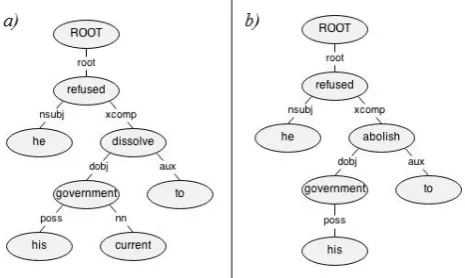
We design a series of new methods that make use of typed dependency grammars to compute sentence similarity. Our methods use dependency treebigram unitsand measure the similarity of two sentences using bigram unit matches. A bigram unit denotes a branch in the dependency tree, con-sisting of adependentword, aheadword, and thetypeof the dependency relation between them. For instance, the nodeshe andrefused, as well as the type of their depen-dency relationnsubjin the first sentence of Figure 1 form a bigram unit as{he, nsubj, ref used}. The existance of similar bigram units in two sentences can give more clues about their semantic similarities.
We design four sentence similarity kernel methods which make use of these bigram structures.
Let us first defineAbi ={dAi, tAi, hAi}as theithbigram of sentenceAwhere,dAiis the dependent node,tAiis the type, andhAi is the head node ofAbi. Then, theSimple Approximate Bigram Kernel(SABK) is defined as fol-lows for the sentencesAandB:
SABK(A, B) =
Figure 1: Typed dependency trees of the sentences“He re-fused to dissolve his current government.”and“He refused to abolish his government.”, respectively.
wheremandnare the number of words in sentencesAand
B, respectively. The functionsimis defined as:
sim(Ab
wheresandqare binary functions:
s(a, b) =
andθ is a constant greater than 1 that determines the in-fluence of a type match. The function sim gives partial scores to bigram unit comparisons, even if they do not to-tally match with each other. Bigram units that only have a common dependent word or a head word are considered as an approximate match. If their types also overlap, the similarity score is increased by a factor ofθ.
SABK treats all words as having equal importance. How-ever, this is hardly true for many cases. To model the importance of a word, we include the tf-idf (term frequency - inverse document frequency) values of the dependent and head words to the formula and form the TF-IDF Based Approximate Bigram Kernel(TABK) as defined below:
T ABK(A, B) =
whereN(A)is the normalizer function:
andsimtis defined as:
TABK does not encourage consecutive bigram matches that form a subtree in the dependency trees. However, a common subtree in the dependency trees of two sentences means that these sentences contain similar substructures. To emphasize this point, we design theMatching Subtrees Kernel(MSK) below:
wherecx denotes the set of children nodes of the nodex andcx(i)is theithchild of the nodex. Children kernelKc
Here, ν is a decay factor to prevent high increase in the similarity score. In addition to comparing each bigram unit of the first sentence with each bigram unit of the second sentence, this kernel also tries to find matching subtrees by comparing the children nodes of matching bigrams.Kc re-cursively compares the children of a matching dependent word pair and gives a fixed score ofαto matching children nodes of a matching bigram pair.
We also derive aComposite Kernel (CK) by combining tf-idf based kernels as follows:
CK(A, B) =β.T ABK(A, B) +δ.M SK(A, B) (10)
whereβandδdetermine the influence of the corresponding kernel in the calculation of sentence similarity.
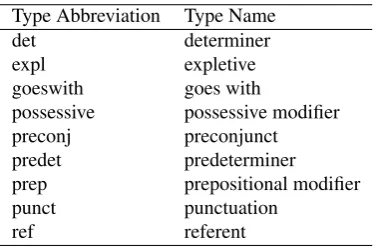
Type Abbreviation Type Name
det determiner
Table 1: Unimportant dependency relation types.
4.
Experiments and Results
4.1.
Data Sets
We evaluated our methods on the Task 2 data sets of DUC 20031 and DUC 20042. For the evaluation of the systems, the ROUGE3metric is used with the stemming option.
4.2.
Experiments
Erkan and Radev (2004), evaluated their LexRank method using the MEAD summarization system, where they com-bined the LexRank method with Position and Length fea-tures, and used the Cross-Sentence Informational Sub-sumption (CSIS) reranker (Radev et al., 2004). Since we tested our similarity kernels in the LexRank system by re-placing its own sentence similarity method, we used their environment in our experiments. We used the Dragon Toolkit4, which is a development package for Information
Retrieval and Text Mining (Zhou et al., 2007), to develop the dependency grammar kernels.
At the preprocessing phase, we first generated the depen-dency parse trees of the sentences in our data sets by using the Stanford Parser (Klein and Manning, 2003). Then, the feature set given in (Culotta and Sorensen, 2004) was cre-ated for each node in the tree. The word, POS tag, and
general POS tagfeatures were generated using the Stan-ford Parser. The entity typefeature was created using the Stanford Named Entity Recognizer (NER) tool which is available in the Stanford CoreNLP Package5.TheWordNet
hypernyms feature was generated using JAWS (Java API for WordNet Searching) (Spell, 2009). All words were stemmed using the Porter Stemmer (Porter, 1980).
For the bigram kernels, we filtered the dependency relation types in Table 1 as they did not improve the performances of the kernels in the experiments.
After these pre-processing steps, we ran the LexRank MDS method by setting the weights of both the continuous LexRank feature and the Position feature to 1. To stick with the experimental setup in (Erkan and Radev, 2004), we used the sentence length cutoff value of 9 and the CSIS reranker with the threshold value of 0.5. The results were
All Systems DUC 2003 Task 2 DUC 2004 Task 2 Rouge-1 Rouge-2 Rouge-1 Rouge-2
Simple Approximate Bigram Kernel (SABK) 0.3740 0.0954 0.3839 0.0946 TF-IDF based Apprx. Bigram Kernel (TABK) 0.3733 0.0964 0.3888 0.0957 Matching Subtrees Kernel (MSK) 0.3741 0.0985 0.3892 0.0955 Composite Kernel (CK) 0.3726 0.0970 0.3895 0.0964 Dependency Tree Kernel (DTK) 0.3611 0.0874 0.3689 0.0872 Dependency Trigram Kernel (Tri-K) 0.3611 0.0866 0.3721 0.0880 LexRank (tf-idf) 0.3673 0.0900 0.3832 0.0934
Lead-based 0.3590 0.0872 0.3666 0.0842
Random 0.3038 0.0473 0.3090 0.0447
Submodular Functions Approach - - 0.3890
-Best sytem of DUC 2004 - - 0.3822
-Table 2: ROUGE-1 and ROUGE-2 scores of the bigram kernels, untyped dependency tree kernels, and baseline models in the LexRank system on DUC 2003 and DUC 2004 Task 2 data sets.
then compared with the original LexRank system that uses tf-idf based cosine similarity function as well as the Lead-based summarization approach, which selects sentences by using only the Position feature (Erkan and Radev, 2004), and the Random approach which composes a summary by selecting sentences in a random manner as the baseline ap-proaches.
4.3.
Results
Table 2 shows the ROUGE-1 and ROUGE-2 scores6 for
the experiments made for the bigram kernels, the best mod-els of the untyped dependency tree kernmod-els, and the base-line models on DUC 2003 and DUC 2004 Task 2 data sets. MSK outperforms all of the other methods on DUC 2003 although SABK shows almost the same performance with MSK according to ROUGE-1 scores. When we look at the ROUGE-2 scores of the methods, we observe that MSK reaches the best performance on DUC 2003. All of our approximate bigram kernels achieve better ROUGE-1 and ROUGE-2 scores than the untyped dependency tree kernels and LexRank’s original similarity method. The best perfor-mance on DUC 2004 is reached by the composite kernel CK according to both ROUGE-1 and ROUGE-2 scores. Our experimental results illustrate that detecting common subtrees in the dependency trees of two sentences leads to an increase in performance in terms of ROUGE-1 and ROUGE-2. Common subtree detection is used by our MSK and CK kernels and they both achieve the best results on the two data sets. It is also observed that including tf-idf values into the similarity calculation steps improves the results. This is due to the fact that the tf-idf measure is effective at highlighting the importance of a word.
The experimental results show that representing sentences as a set of their dependency bigram relations is a more effective approach than the bag-of-words representation model for sentence similarity computation in the MDS task. We compared the ROUGE-1 scores of our methods with the best system on DUC 2004 (Conroy et al., 2004) and one of the recent state-of-the-art methods, the submodular
func-6ROUGE version 1.5.5 with following options: -n 2 -m -w 1.2
-b 665 -c 95 -r 1000 -f A -p 0.5 -t 0 -2 4 -u -a -d
tions approach (Lin and Bilmes, 2011). Our MSK and CK kernels achieve similar performances with the submodular functions method and perform better than the best system on DUC 2004.
DTK and Tri-K obtain better performances than the lead-based method on both data sets. However, these untyped dependency tree based approaches failed to achieve higher scores than the original similarity method of the LexRank system.
5.
Conclusion
We presented sentence similarity computation methods for MDS based on the dependency parse trees of the sentences. We adapted two different dependency tree based sentence similarity kernels, which have originally been proposed for relation extraction. We also proposed a number of new methods that make use of the typed dependency grammar representations of sentences. We evaluated these meth-ods within the LexRank system and compared their perfor-mances with the original bag of words based sentence sim-ilarity method of LexRank. We showed that, although the untyped dependency tree based kernels DTK and Tri-K out-performed bag of words based kernels for relation extrac-tion, they failed to achieve higher 1 and ROUGE-2 scores than the bag of words based cosine similarity ker-nel in the task of MDS. All of the proposed sentence sim-ilarity methods outperformed the two untyped dependency tree kernels, LexRank’s original similarity method, and the best system of DUC 2004. Similar performance with the state-of-the-art submodular functions approach is achieved. However, the improvement in the performance of LexRank by our typed dependency tree kernels is not found to be statistically significant. This might be due to the n-gram matching based nature of ROUGE. The limitations of the LexRank system might have also constrained these kernels from showing up their actual efficacy.
Our results demonstrate that the types of dependency rela-tions are crucial for identifying the important parts of the sentences, and utilizing the dependency tree structures of sentences helps us to find similar substructures in them.
6.
Acknowledgements
We gratefully acknowledge the support of this study by T ¨UB˙ITAK (The Scientific and Technological Research Council of Turkey) in the form of a graduate scholarship.
7.
Bibliographical References
Aliguliyev, R. M. (2009). A new sentence similarity mea-sure and sentence based extractive technique for auto-matic text summarization.Expert Systems with Applica-tions, 36(4):7764–7772.
Aliguliyev, R. M. (2010). Clustering techniques and dis-crete particle swarm optimization algorithm for multi-document summarization. Computational Intelligence, 26(4):420–448.
Barzilay, R. and McKeown, K. R. (2005). Sentence fusion for multidocument news summarization. Computational Linguistics, 31(3):297–328.
Blake, C., Kampov, J., Orphanides, A. K., West, D., and Lown, C. (2007). UNC-CH at DUC 2007: Query expan-sion, lexical simplification and sentence selection strate-gies for multi-document summarization. InProceedings of the Document Understanding Conference 2007. Choi, M. and Kim, H. (2013). Social relation extraction
from texts using a support-vector-machine-based depen-dency trigram kernel. Information Processing & Man-agement, 49(1):303–311.
Conroy, J. M., Schlesinger, J. D., Goldstein, J., and O’leary, D. P. (2004). Left-brain/right-brain multi-document summarization. InProceedings of the Document Under-standing Conference (DUC 2004).
Culotta, A. and Sorensen, J. (2004). Dependency tree ker-nels for relation extraction. InProceedings of the 42nd Annual Meeting on Association for Computational Lin-guistics, page 423. Association for Computational Lin-guistics.
Das, D. and Martins, A. F. (2007). A survey on automatic text summarization. Literature Survey for the Language and Statistics II course at CMU, 4:192–195.
Erkan, G. and Radev, D. R. (2004). Lexrank: Graph-based lexical centrality as salience in text summarization. J. Artif. Intell. Res.(JAIR), 22(1):457–479.
Filippova, K. and Strube, M. (2008). Sentence fusion via dependency graph compression. InProceedings of the Conference on Empirical Methods in Natural Language Processing, pages 177–185. Association for Computa-tional Linguistics.
Fiszman, M., Rindflesch, T. C., and Kilicoglu, H. (2004). Abstraction summarization for managing the biomedical research literature. In Proceedings of the HLT-NAACL Workshop on Computational Lexical Semantics, pages 76–83. Association for Computational Linguistics. Gao, J., Nie, J.-Y., Wu, G., and Cao, G. (2004).
Depen-dence language model for information retrieval. In Pro-ceedings of the 27th annual international ACM SIGIR
conference on Research and development in information retrieval, pages 170–177. ACM.
Hennig, L. and Labor, D. (2009). Topic-based multi-document summarization with probabilistic latent se-mantic analysis. In Recent Advances in Natural Lan-guage Processing (RANLP).
Hirao, T., Suzuki, J., Isozaki, H., and Maeda, E. (2004). Dependency-based sentence alignment for multiple doc-ument summarization. InProceedings of the 20th inter-national conference on Computational Linguistics, page 446. Association for Computational Linguistics. Klein, D. and Manning, C. D. (2003). Accurate
unlexical-ized parsing. InProceedings of the 41st Annual Meeting on Association for Computational Linguistics - Volume 1, ACL ’03, pages 423–430, Stroudsburg, PA, USA. As-sociation for Computational Linguistics.
Li, S., Ouyang, Y., Wang, W., and Sun, B. (2007). Multi-document summarization using support vector regres-sion. InProceedings of DUC. Citeseer.
Lin, H. and Bilmes, J. (2011). A class of submodular func-tions for document summarization. In Proceedings of the 49th Annual Meeting of the Association for Com-putational Linguistics: Human Language Technologies-Volume 1, pages 510–520. Association for Computa-tional Linguistics.
Mihalcea, R. and Tarau, P. (2005). A language independent algorithm for single and multiple document summariza-tion. InProceedings of IJCNLP, volume 5.
Mihalcea, R. (2004). Graph-based ranking algorithms for sentence extraction, applied to text summarization. In
Proceedings of the ACL 2004 on Interactive poster and demonstration sessions, page 20. Association for Com-putational Linguistics.
Nastase, V. (2008). Topic-driven multi-document summa-rization with encyclopedic knowledge and spreading ac-tivation. InProceedings of the Conference on Empirical Methods in Natural Language Processing, pages 763– 772. Association for Computational Linguistics. Pei, Y., Yin, W., Fan, Q., and Huang, L. (2012). A
supervised aggregation framework for multi-document summarization. In Martin Kay et al., editors,COLING, pages 2225–2242. Indian Institute of Technology Bom-bay.
Porter, M. F. (1980). An algorithm for suffix stripping.
Program: electronic library and information systems, 14(3):130–137.
Radev, D. R., Jing, H., Sty´s, M., and Tam, D. (2004). Centroid-based summarization of multiple documents.
Information Processing & Management, 40(6):919–938. Shen, C. and Li, T. (2010). Multi-document summariza-tion via the minimum dominating set. In Proceedings of the 23rd International Conference on Computational Linguistics, pages 984–992. Association for Computa-tional Linguistics.
Somprasertsri, G. and Lalitrojwong, P. (2010). Mining feature-opinion in online customer reviews for opinion summarization.J. UCS, 16(6):938–955.
summariza-tion using cluster-based link analysis. In Proceedings of the 31st annual international ACM SIGIR conference on Research and development in information retrieval, pages 299–306. ACM.
Wang, D., Li, T., Zhu, S., and Ding, C. (2008). Multi-document summarization via sentence-level semantic analysis and symmetric matrix factorization. In Proceed-ings of the 31st annual international ACM SIGIR con-ference on Research and development in information re-trieval, pages 307–314. ACM.
Wang, D., Zhu, S., Li, T., and Gong, Y. (2009). Multi-document summarization using sentence-based topic models. InProceedings of the ACL-IJCNLP 2009 Con-ference Short Papers, pages 297–300. Association for Computational Linguistics.
Yousfi-Monod, M., Prince, V. V., et al. (2008). Sentence compression as a step in summarization or an alternative path in text shortening. InColing’08: International Con-ference on Computational Linguistics, pages 137–140. Zhou, X., Zhang, X., and Hu, X. (2007). Dragon
Toolkit: Incorporating auto-learned semantic knowledge into large-scale text retrieval and mining. InProceedings of the 19 th IEEE International Conference on Tools with Artificial Intelligence (ICTAI.