S T U D Y P R O T O C O L
Open Access
Gestational weight gain and optimal
wellness (GLOW): rationale and methods
for a randomized controlled trial of a
lifestyle intervention among pregnant
women with overweight or obesity
Susan D. Brown
1, Monique M. Hedderson
1, Samantha F. Ehrlich
1,2, Maren N. Galarce
1, Ai-Lin Tsai
1,
Charles P. Quesenberry
1and Assiamira Ferrara
1*Abstract
Background:Excess gestational weight gain (GWG) is common among women with overweight or obesity, increasing their risks for pregnancy complications, delivering a large infant, and postpartum weight retention. To date, only intensive interventions have had success and few interventions have been designed for implementation in healthcare settings.
Methods:We describe the development, rationale, and methods of GLOW (GestationaL Weight Gain and Optimal Wellness), a randomized controlled trial evaluating the efficacy of a lifestyle intervention to prevent excess GWG among racially/ethnically diverse women with overweight or obesity in an integrated healthcare delivery system. Participants in Kaiser Permanente Northern California will be randomized, within 2 weeks of completing a study baseline clinic visit at 10 weeks’gestation, to either usual medical care or a multi-component pregnancy lifestyle intervention adapted from the Diabetes Prevention Program (targetN= 400). Informed by focus groups with patients and designed to be feasible in a clinical setting, the intervention will include 13 weekly individual sessions (11 delivered by telephone) focused on behavior change for weight management, healthy eating, physical activity, and stress management. Outcomes will be assessed in women and their infants from randomization to 12 months postpartum. The primary outcome is GWG. Secondary outcomes include changes in diet and physical activity during pregnancy and infant birthweight. Exploratory outcomes include cardiometabolic profile assessed via pregnancy blood samples and cord blood samples; and postpartum weight retention and infant anthropometrics up to 12 months of age. The trial includes systematic approaches to enhance intervention fidelity, intervention adherence, and participant retention in trial assessments.
Discussion:GLOW is among few trials targeting excess GWG among diverse women with overweight or obesity in a healthcare setting, with long-term maternal and infant outcomes assessed up to 12 months after delivery. This evaluation of a multi-component intervention is designed to produce generalizable results to inform potential adoption of the intervention in clinical settings.
Trial registration:ClinicalTrials.gov (NCT02130232): submitted April 30, 2014; posted May 5, 2014.
Keywords:Pregnancy, Obesity, Gestational weight gain, Lifestyle intervention, Clinical trial, Protocol
© The Author(s). 2019Open AccessThis article is distributed under the terms of the Creative Commons Attribution 4.0 International License (http://creativecommons.org/licenses/by/4.0/), which permits unrestricted use, distribution, and reproduction in any medium, provided you give appropriate credit to the original author(s) and the source, provide a link to the Creative Commons license, and indicate if changes were made. The Creative Commons Public Domain Dedication waiver (http://creativecommons.org/publicdomain/zero/1.0/) applies to the data made available in this article, unless otherwise stated.
* Correspondence:[email protected]
1Division of Research, Kaiser Permanente Northern California, Oakland, CA
94612, USA
Background
Exceeding the Institute of Medicine (IOM) guidelines for gestational weight gain has significant implications
for women and their infants [1]. Up to 64% of women
with overweight or obesity experience excess gestational weight gain (GWG) [2, 3], which elevates their risks for gestational diabetes mellitus, Cesarean delivery, postpar-tum weight retention, and obesity in later years [4–7], and for having an infant who is large-for-gestational age [8] and at increased risk for overweight or obesity in childhood [9].
Until recently, GWG interventions in women with overweight or obesity have had limited success [10] and few trials included diverse samples, despite excess GWG significantly impacting women across racial and ethnic groups [11]. Trials arising from the Lifestyle Interven-tions for Expectant Moms (LIFE-Moms) consortium now show that intensive behavioral lifestyle interven-tions, such as in-person counseling or in-person coun-seling paired with partial meal replacements, prevent excess GWG among women with overweight or obesity [12]. Still, intensive interventions may not be feasible for many women and may be difficult to implement in healthcare delivery settings. In addition, data are needed on long-term maternal and infant health outcomes be-yond the immediate postpartum period [13].
Here we provide an overview of the GestationaL Weight Gain and Optimal Wellness (GLOW) random-ized controlled trial. The trial compares usual medical care to a mainly telephone-based lifestyle intervention designed to be feasible in healthcare settings, which we hypothesize will prevent excess GWG among pregnant women with overweight or obesity. The primary out-come is rate of GWG per week, measured as a continu-ous variable and whether it meets the 2009 IOM
guidelines [1]. Secondary GWG outcomes include
weekly rate of GWG between study clinic visit assess-ments at 10 weeks’and 32 weeks’gestation, total GWG, and whether total GWG meets the IOM guidelines. Other secondary outcomes include changes in diet and physical activity during pregnancy and infant birth-weight. Exploratory outcomes include changes in
cardio-metabolic markers assessed at 10 weeks’ and 32 weeks’
gestation, cardiometabolic profile in cord blood, postpar-tum weight retention at 6 and 12 months, and children’s anthropometrics at up to 12 months of age.
Methods
GLOW is a two-arm, parallel group randomized con-trolled trial testing the efficacy of a multi-component pregnancy lifestyle intervention adapted from the Dia-betes Prevention Program (DPP) [14] and delivered pri-marily via telemedicine, as compared to usual medical care. GLOW is funded by the National Institutes of
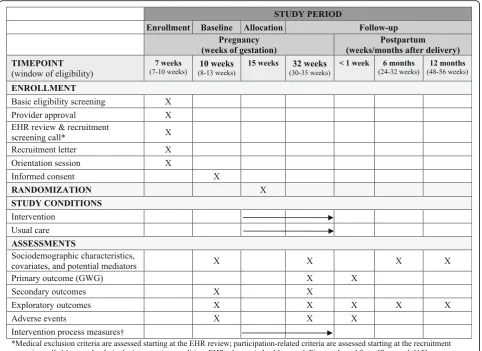
Health (R01 HD073572; PI: Ferrara); registered at Clini-calTrials.gov (NCT02130232; submitted April 30, 2014, posted May 5, 2014); and approved by the Kaiser Foun-dation Research Institute Human Subjects Committee. This article follows the SPIRIT (Standard Protocol Items: Recommendations for Interventional Trials) guidelines for reporting clinical trial protocols [15]. The sequence of trial activities for participant enrollment, intervention, and assessment appears in Fig.1.
Setting
GLOW will be conducted within Kaiser Permanente Northern California (KPNC), a large pre-paid, integrated healthcare delivery system serving over 4 million mem-bers broadly representative of the population in the
underlying geographic area [16]. GLOW will recruit
pregnant women from four medical centers, in Oakland, San Leandro, Santa Clara/Fremont, and Walnut Creek. These medical centers were selected based on their ra-cial/ethnic diversity and high volume of deliveries.
Eligibility and recruitment
GLOW aims to recruit a racially and ethnically diverse group of 400 participants to increase generalizability. Pregnant women receiving care at the selected medical centers will be first identified in the electronic health record (EHR) system. Only those < 8 weeks’gestational age will be evaluated to confirm eligibility criteria: ≥18 years of age, pre-pregnancy body mass index (BMI)
be-tween 25 and 40 kg/m2 (based on weight measured in
the clinical setting within 6 months before the last men-strual period), and a singleton pregnancy. Eligibility will be further assessed through a tiered process beginning with approval from medical providers to contact each patient, and EHR review. Medical exclusion criteria that may impact dietary and/or outcome assessment will be determined through the EHR review and a recruitment screening call. These include being pregnant with multi-ples; pregnancy loss; fertility-assisted pregnancy;
diag-nosed with diabetes before pregnancy; current
disinterest in being randomized; and currently being over 13 weeks of gestation.
At the recruitment call, women will be asked to verify their pre-pregnancy weight as assessed in the EHR, since this measured weight will be used to calculate the GWG outcomes for all women in the trial; and for GWG goal setting for those randomized to the intervention condi-tion. Women with a discrepancy of > 5 lbs. between the pre-pregnancy weight assessed in the EHR and by self-report will not be considered eligible to participate in the baseline clinic visit.
Consent and randomization
Trained research assistants will obtain informed consent at the baseline clinic visit at 10 weeks’gestation. Follow-ing this visit, women will complete at least two of three 24-h diet recalls by telephone within one week. Women will also wear an accelerometer for at least 10 h a day over at least four out of seven days (described below in section 2.6.). Women who complete fewer than two diet recalls or provide fewer than four 10-h days of
accelerometer data will not be eligible for
randomization. Women will also no longer be eligible for randomization if they experience a pregnancy loss between the baseline clinic visit and the time of randomization. Women with a pregnancy loss after randomization will be withdrawn from the study.
Eligible women who consent and complete the baseline assessment will be randomly assigned to either the usual care or intervention conditions. To generate each partici-pant’s random assignment, unblinded study staff will use MinimPy, a free open-source computerized randomization program [17]. The adaptive randomization procedure is de-signed to ensure that equal numbers of patients are assigned to each study condition and that the two condi-tions remain balanced overall, within each medical center, and on each level of key characteristics: age (< 30 and≥30 years), pre-gravid BMI (< 30, 30–34.9, and≥35 kg/m2), and race/ethnicity (Asian/Pacific Islander; Black; Latina; White; and multiethnic/other/unknown). The process cannot be manipulated by study personnel. The assignment will be re-corded in a Microsoft Access tracking database, where it is
only accessible to non-blinded personnel (e.g., lifestyle coa-ches). The research assistants conducting data collection, study investigators, biostatistician, and programmer analyst will be blinded to condition assignment.
Steps taken to ensure the confidentiality of informa-tion about prospective and enrolled participants will in-clude keeping all study information in a secured computer system used only for research, and identifying participants by a unique study identification number ra-ther than name or medical record number. No informa-tion from the study will be placed in participants’ medical records or shared with the Kaiser Foundation Health Plan.
Usual care
Women randomized to the usual care condition will re-ceive standard KPNC prenatal medical care. This in-cludes an initial prenatal visit at 7–10 weeks’ gestation; an additional 7 routine prenatal visits between 16 weeks’ gestation and delivery; and periodic health education newsletters, which include the IOM GWG guidelines and advice on healthy eating and activity in pregnancy. Medical staff routinely weigh patients at each prenatal visit.
Lifestyle intervention
In addition to usual care as described above, women randomized to the intervention condition will receive a multi-component pregnancy lifestyle intervention called “Getting in Balance.” The Getting in Balance interven-tion was adapted from the DPP [14] and our prior re-search [18, 19] to be feasible among pregnant women for possible adoption in a healthcare system setting. The intervention targets behavior changes for weight man-agement, healthy eating, physical activity, and stress management to meet a trial goal of gaining at the lower limit of the IOM-recommended range for GWG: 7 kg
for women with overweight (BMI 25.0–29.9 kg/m2
) and 5 kg for women with obesity (BMI≥30.0 kg/m2).
Theoretical basis and behavior change techniques
The intervention follows a step-wise, phased approach to behavior change based on Bandura’s social cognitive theory [20, 21] and the Transtheoretical model [22]. Coaches will use motivational interviewing techniques to support participant autonomy and behavior change, e.g., by guiding participants to identify personal pros and cons of lifestyle changes [23,24]. Behavior change tech-niques, categorized according to a standard taxonomy [25], includeself-monitoring ofandfeedback on behavior
(e.g., daily self-monitoring of dietary and physical activity behaviors); self-monitoring of and feedback on outcomes of behavior (e.g., daily self-monitoring of weight); goal setting; review of behavior goals (e.g., reviewing dietary
self-monitoring records and modifying goals accord-ingly); problem solving; action planning; social support;
prompts and cues(e.g., encouraging participants to cre-ate visual cues to be active); self-rewards (e.g., encour-aging participants to give themselves non-food rewards
after achieving goals); providing information about
health consequences (e.g., information on the benefits of healthy eating during pregnancy); and providing infor-mation from acredible source(e.g., a lifestyle coach).
Patient input
To refine the intervention to be feasible among pregnant
women, we explored patients’ perspectives on weight
gain, lifestyle behaviors, and proposed intervention ma-terials using a mixed methods approach. In 2013, we re-cruited pregnant women with overweight or obesity from two of the proposed KPNC medical facilities, Oak-land and Santa Clara. After obtaining informed consent, trained moderators administered a brief survey followed by a 90-min focus group discussion, for which partici-pants were reimbursed with a $50 gift card. The sample included 25 participants, 36% (n= 9) with overweight
and 64% (n= 16) with obesity, from diverse
back-grounds: 36% Black (n= 9), 32% White (n= 8), 24% La-tina (n= 6), 4% Asian (n= 1), and 4% multiracial (n= 1). Sixteen percent had a high school education or less (n= 4), 32% some college education or a 2-year degree (n= 8), and 52% a four-year college degree (n= 13). Survey data indicated frequent discrepancies between the IOM guidelines and women’s beliefs about how much they should gain during their current pregnancy: 48% of
women (n= 12) reported an ideal weight gain amount
that would exceed the IOM guidelines for their BMI
cat-egory, 48% (n= 12) reported an amount within the
the need for a weight gain chart to be accompanied by non-judgmental professional support.
Patient input reinforced including key elements in the intervention, such as health information about the IOM guidelines and the rationale for weight gain goals. With many women estimating their appropriate GWG as above the guidelines, we deemed it important to counsel women on the rationale for gaining less weight than they may otherwise have assumed. Additional key elements included the rationale for self-weighing, and ways to use a scale and weight gain chart effectively; social support; stress management; and pregnancy-specific barriers to weight management and lifestyle behavior change.
Intervention structure and content
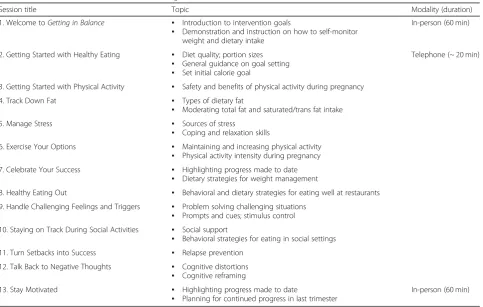
The intervention will be delivered by trained lifestyle coaches through 13 individual weekly counseling ses-sions: a first in-person session (60 min in duration), followed by 11 telephone sessions (20 min each) and a final in-person session (60 min; Table1). Coaches will be registered dietitians trained in physical activity, weight management during pregnancy, motivational interview-ing, and behavior change techniques. Coaches will re-ceive regular group and individual supervision from master’s- and doctoral-level study staff.
The intervention promotes four goals: 1) manage GWG, 2) eat a healthful diet in appropriate portion sizes, 3) achieve 150 min per week of moderate- to vigorous-intensity physical activity, and 4) build skills to manage stress and other challenges that can get in the way of healthy lifestyle behaviors. Healthy eating recom-mendations emphasize vegetables, fruits, lean protein, and high fiber foods while limiting saturated and trans fats and added sugars (e.g., sugar-sweetened beverages). Physical activity recommendations emphasize being ac-tive in 10-min bouts and gradually working up to at least 30 min of activity on 5 days of the week. Recommenda-tions encourage activities such as brisk walking and dis-courage activities that pose a risk for falls, loss of balance, or abdominal trauma (e.g., bicycling).
At session 1, participants will receive a body weight scale for use at home throughout pregnancy; a personal-ized electronic and/or paper-based graph to track their weight over time in relation to the trial goal for GWG (see Additional file1); print materials including a guide-book of the 13 core sessions, a fat and calorie counting booklet, and paper-based self-monitoring logs; and measuring cups and spoons. Participants will first be asked to self-monitor their “baseline” dietary intake for the first week. At session 2, participants will receive an initial personalized calorie goal based on their average
Table 1Overview of core sessions for theGetting in Balanceintervention: The GLOW trial
Session title Topic Modality (duration)
1. Welcome toGetting in Balance ▪ Introduction to intervention goals
▪ Demonstration and instruction on how to self-monitor weight and dietary intake
In-person (60 min)
2. Getting Started with Healthy Eating ▪ Diet quality; portion sizes ▪ General guidance on goal setting ▪ Set initial calorie goal
Telephone (~ 20 min)
3. Getting Started with Physical Activity ▪ Safety and benefits of physical activity during pregnancy
4. Track Down Fat ▪ Types of dietary fat
▪ Moderating total fat and saturated/trans fat intake
5. Manage Stress ▪ Sources of stress
▪ Coping and relaxation skills
6. Exercise Your Options ▪ Maintaining and increasing physical activity ▪ Physical activity intensity during pregnancy 7. Celebrate Your Success ▪ Highlighting progress made to date
▪ Dietary strategies for weight management
8. Healthy Eating Out ▪ Behavioral and dietary strategies for eating well at restaurants
9. Handle Challenging Feelings and Triggers ▪ Problem solving challenging situations ▪ Prompts and cues; stimulus control 10. Staying on Track During Social Activities ▪ Social support
▪ Behavioral strategies for eating in social settings 11. Turn Setbacks into Success ▪ Relapse prevention
12. Talk Back to Negative Thoughts ▪ Cognitive distortions ▪ Cognitive reframing
13. Stay Motivated ▪ Highlighting progress made to date
▪ Planning for continued progress in last trimester
caloric intake in the prior week and their weight gain trajectory. For example, coaches will recommend an ini-tial calorie goal that is equivalent to current intake for participants whose weight is at or below the target weight for their gestational age; otherwise, coaches will rec-ommend a 200-cal reduction. At each subsequent session, coaches will engage participants in systematic problem solving to generate effective strategies to meet the calorie goal [28,29]; and collaborate with participants to adjust the goal as needed given their weight gain trajectory. For ex-ample, coaches will recommend retaining the same calorie goal for participants who are meeting the calorie goal, are near the target weight for their gestational age, and have gained no more than 0.5 lbs. in the prior week. In contrast, coaches will recommend decreasing the goal by 200 cal for participants who are meeting the goal but have gained 0.5 lbs. or more in the past 1–2 weeks. Recommended calorie goals will never be fewer than 1200 cal at any point during the intervention. Throughout the intervention, participants will be encouraged to self-monitor their weight daily using the study-provided scale, with an emphasis on attending to patterns of weight change over time (e.g., over 1- to 2-week periods, rather than any single day’s measurement); and to self-monitor their dietary intake and physical activity daily using paper-based logs or commercially-available web- or mobile-based apps (e.g., MyFitnessPal).
Following the 13 core sessions, participants will be of-fered biweekly maintenance sessions by telephone until 38 weeks’gestation. Participants and lifestyle coaches will collaboratively select topics to revisit from the core cur-riculum. No intervention will be provided during the postpartum period.
Fidelity
Our approach to intervention fidelity will follow the comprehensive framework developed by the National
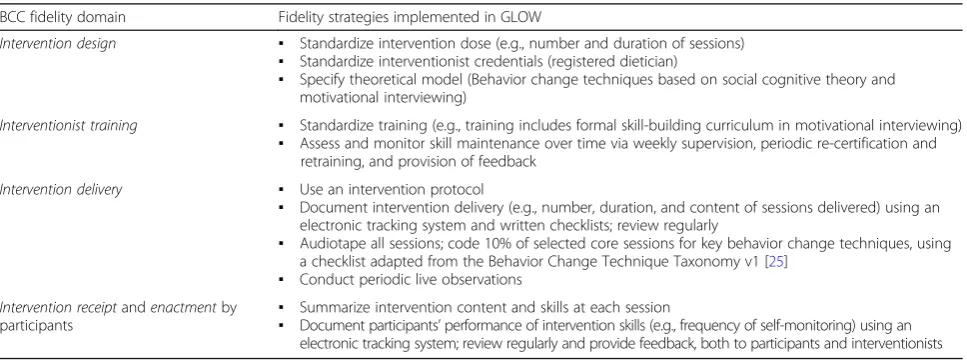
Institutes of Health Behavioral Change Consortium (BCC) [30, 31]. Table 2 describes strategies to address each domain of fidelity from the BCC framework: inter-vention design, interventionist training, intervention de-livery, intervention “receipt”(participants’ understanding and ability to perform intervention skills), and interven-tion“enactment”(participants’actual use of intervention skills). Lifestyle coaches will use a Microsoft Access tracking database to record all contacts with partici-pants, including the duration of each call, adherence to self-monitoring, and goals set at each session. Coa-ches will audio record every session, with participant consent, to facilitate a systematic assessment of inter-vention delivery. Trained research staff will randomly select, review, and code session recordings for the
de-livery of key intervention content and behavior
change techniques (e.g., self-monitoring, goal setting, and problem solving) using checklists developed in large part from the Behavior Change Technique Tax-onomy v1 [25]. Staff will code at least 10% of the re-cordings for five of the core sessions (sessions 1, 2, 3, 9, and 13) which are representative of the interven-tion goals and behavior change techniques.
Intervention process measures
All participants randomized to the intervention who complete at least one of the 13 core sessions, and who do not have a pregnancy loss, will be asked to complete a mailed evaluation survey. Quantitative and qualitative survey items will assess acceptability, satis-faction, and perceived effectiveness of the interven-tion. Additional process measures assessed by lifestyle coaches will include attendance at each session and adherence to intervention components (e.g., frequency of weight self-monitoring).
Table 2Intervention fidelity plan: The GLOW trial
BCC fidelity domain Fidelity strategies implemented in GLOW
Intervention design ▪ Standardize intervention dose (e.g., number and duration of sessions) ▪ Standardize interventionist credentials (registered dietician)
▪ Specify theoretical model (Behavior change techniques based on social cognitive theory and motivational interviewing)
Interventionist training ▪ Standardize training (e.g., training includes formal skill-building curriculum in motivational interviewing) ▪ Assess and monitor skill maintenance over time via weekly supervision, periodic re-certification and
retraining, and provision of feedback
Intervention delivery ▪ Use an intervention protocol
▪ Document intervention delivery (e.g., number, duration, and content of sessions delivered) using an electronic tracking system and written checklists; review regularly
▪ Audiotape all sessions; code 10% of selected core sessions for key behavior change techniques, using a checklist adapted from the Behavior Change Technique Taxonomy v1 [25]
▪ Conduct periodic live observations
Intervention receiptandenactmentby
participants ▪
Summarize intervention content and skills at each session
▪ Document participants’performance of intervention skills (e.g., frequency of self-monitoring) using an electronic tracking system; review regularly and provide feedback, both to participants and interventionists
Data collection
Data will be collected at clinic visits conducted by trained research staff (blinded to randomization assign-ment) in the medical centers where women receive their usual care, and from the EHR. The baseline study clinic visit assessment will occur at approximately 10 weeks’ gestation (between 8 and 13 weeks). Follow-up study clinic visit assessments will occur at approximately 32 weeks’gestation (30–35 weeks); delivery (within 1 week afterwards); 6 months postpartum (24–32 weeks after delivery); and 12 months postpartum (48–56 weeks after delivery). Trained research staff based at the Division of Research will oversee data quality and management.
Women’s weight, height, LMP, and gestational age
The date of the last menstrual period (LMP) and gesta-tional age will be confirmed by ultrasounds performed before the baseline study clinic visit and abstracted from EHR. Pre-pregnancy weight and height, as measured by a KPNC healthcare provider within six months of the LMP, will be abstracted from the EHR. If more than one weight is recorded in the EHR, the weight closest to the LMP will be chosen. If pre-pregnancy weight is not available, we will obtain the earliest pregnancy weight
measured before 10 weeks’ gestation. These
measure-ments will be used to calculate BMI for initial assess-ment of eligibility. Women’s weight and height will be measured at the baseline study clinic visit at 10 weeks’ gestation by trained research staff using a standard scale and stadiometer. Women will wear light-weight clothing without shoes, with measurements taken in duplicate to the nearest 0.1 lb. and 0.1 cm, respectively. The average of the two measurements will be used if the difference between them is less than 1.0 lb. or 1.0 cm, respectively; otherwise, a third measurement will be taken. Weight will likewise be measured at study clinic visits conducted at 32 weeks’gestation, delivery, and at 6 and 12 months postpartum. The last weight prior to delivery, measured by a KPNC healthcare provider, will be abstracted from the EHR.
Women’s diet and physical activity
Within the week of attending their study clinic visit at 10 weeks’ and 32 weeks’ gestation, trained staff at the Fred Hutchinson Cancer Research Center will conduct gold-standard 24-h dietary recalls on three randomly se-lected days over one week (including two week days and one weekend day) [32]. Mean intake over the three days will be used to estimate daily intake. Recalls will employ the Nutrition Data System for Research (NDSR), recog-nized as one of the best nutrient composition databases for research purposes [33–36]. The NDSR uses a com-puterized interface [37] to ensure uniformity of recalls conducted by interviewers trained and certified by
NDSR. Women will also complete the 55-item Block Fat/Sugar/Fruit/Vegetable Screener [38] at all pregnancy and postpartum clinic visits (except delivery).
Physical activity will be assessed objectively within one week after the clinic visits at 10 and 32 weeks’gestation. Participants will wear an ActiGraph (ActiGraph, LLC, Pensacola, FL) wGT3X-BT accelerometer on their
non-dominant wrist for a 7-day period, with
non-consecutive days permitted to improve adherence. Since negative feedback was received regarding over-night wear when piloting the devices, and because sleep is not an outcome of this trial, participants will be instructed to take the device off each night before bed-time and put it back on first thing in the morning. Par-ticipants will be asked not to submerge the device in water (i.e., not wear it while bathing or swimming); and to complete a written log of each time the device was put on and taken off, and the days and times they partic-ipated in activities that are not sufficiently measured by the device (e.g., swimming or biking). Participants will receive periodic text message reminders to encourage protocol adherence. Accelerometer data will be sent to the University of Tennessee, Knoxville where experts will oversee data processing using ActiLife version 6.13.3 software. Two output files will be created: a count file (i.e., exported in 1-s epochs with a low frequency exten-sion applied) and a raw csv file (i.e., exported in 30-Hz raw acceleration values). Files will then be evaluated in R statistical software: wear time will be ascertained with the algorithm developed by Choi et al. [39–42] (count files) and metabolic equivalent (MET) values with an al-gorithm developed for ActiGraph wGT3X-BT devices worn on the non-dominant wrist specifically (raw files) [43, 44]; these data files will then be merged. The par-ticipant logs will be used to identify the first full calendar day of wear [42]; or, if the log is not returned, the infor-mation will be obtained via visual inspection in ActiLife. Standard days (i.e., weekday- and weekend day-specific) will be defined as the periods in which 70% of a sub-sample of participants wear the device, and a complete day defined as a day in which the device is worn for at least 80% of a standard day [45]. The object-ive physical activity assessments will include 4 to 7 complete days, including at least one weekend day [46]; all physical activity outcomes will be weighted (i.e., weekdays vs. weekend days) daily averages. Self-reported activity will be measured at all pregnancy and postpar-tum clinic visits (except delivery) using the validated Pregnancy Physical Activity Questionnaire (PPAQ) [47,
48] to assess physical activity frequency, duration, and
estimated volume; and the validated Stanford
Cardiometabolic markers
Women’s fasting blood samples will be collected to measure levels of glucose, insulin, adiponectin, leptin,
free fatty acid, total cholesterol, triglycerides,
high-density lipoprotein (HDL), low-density lipoprotein (LDL), and very low-density lipoprotein (VLDL) at 10 and 32 weeks’gestation. Cord blood samples will be ob-tained to measure levels of glucose, insulin, adiponectin, leptin, free fatty acid, and C-peptide. Blood samples will be processed at the laboratory of the medical center where women will be seen for their clinic visits and de-livery. Samples will then be transferred by courier under climate-controlled conditions to the Kaiser Permanente Research Bank biorepository for aliquoting, where they will be stored at −80°C until being shipped to the Uni-versity of Washington’s Northwest Lipid Metabolism and Diabetes Research Laboratories for analyses.
Infant weight, length, and percent of body fat
Infant weight and recumbent length at birth will be ob-tained from the EHR. In a subsample, trained staff will also measure infant recumbent length and flank skin-folds on the left side of the infant’s body at 1 to 7 days after birth, following a standard protocol.
Women’s body composition
In two of the largest medical centers from which women will be recruited, study staff will use an ImpediMed bioimpedance spectroscopy (BIS) device to estimate
body fat mass at 10 and 32 weeks’ gestation. BIS is a
non-invasive procedure that applies a very low-level electrical current to measure the body’s conductive and nonconductive tissue and fluid, including total body water (TBW). The increase in TBW accounts for the lar-gest proportion of weight gain during pregnancy, and is highly variable [51]. The BIS device measures electrical resistance over a range of frequencies to estimate TBW as accurately as isotope dilution procedures in pregnant women [52].
Sociodemographic characteristics and covariates
We will assess sociodemographic and clinical character-istics including race/ethnicity, age, work and marital sta-tus, household income and size, smoking and alcohol use, and medical, weight, and reproductive history at the baseline study clinic visit at 10 weeks’gestation. We will assess other covariates including quality of well-being (EuroQol-5D) [53], pregnancy-specific stress (Revised Prenatal Distress Questionnaire) [54], and general per-ceived stress (Perper-ceived Stress Scale) [55] using validated
surveys at 10 and 32 weeks’ gestation; and depression
(using the Patient Health Questionnaire-8) [56] and
sleep duration [57] using validated surveys at 10 and 32
weeks’ gestation and at 6 and 12 months postpartum.
We will assess lactation and infant feeding [58] via interviewer-administered assessments at 6 and 12 months postpartum.
Potential mediators
We will assess self-efficacy [59, 60] and social support [61,62] for healthy eating and physical activity behaviors using validated surveys at 10 and 32 weeks’ gestation. We will assess self-weighing behavior at 10 and 32
weeks’ gestation and at 6 and 12 months postpartum
using a survey item adapted from prior studies [26,27].
Adverse events
Perinatal adverse outcomes occurring after randomization such as pregnancy loss, gestational diabetes, preeclampsia, pregnancy-induced hypertension, Cesarean delivery, pre-term birth (< 37 weeks), and low birthweight (< 2500 g), as well as possible adverse events related to physical activity such as fractures, will be abstracted from the EHR.
Outcome measures
The primary outcome is rate of GWG per week. GWG will be defined as the difference between the last mea-sured pregnancy weight and the pre-pregnancy weight measured within 6 months prior to the LMP (or the pregnancy weight measured before 10 weeks of gestation if pre-pregnancy weight is missing), with all weights ob-tained from the EHR. Rate of GWG per week will be de-fined as GWG divided by the number of weeks between the date of the LMP and the last measured pregnancy weight. Rate of GWG per week will also be assessed as the proportion of women exceeding the 2009 IOM GWG guidelines for rate of GWG per week. The pro-portion of women who exceed the IOM guidelines for appropriate weekly rate of GWG up to delivery will be defined as being above the upper limit of the first tri-mester recommended amount (2.0 kg) plus the upper limit of the recommended weekly rate of 0.33 kg for overweight (BMI 25.0–29.9) or 0.27 kg for obesity
(BMI≥30.0 kg/m2), times the number of gestational
weeks in the 2nd and 3rd trimester.
Secondary GWG outcome measures include weekly rate of GWG between study clinic visit assessments at
10 weeks’ and 32 weeks’gestation, total GWG, whether
exceeding guidelines, GWG will be greater than 11.5 kg (overweight) or 9.0 kg (obesity); for meeting guidelines, GWG will be 7–11.5 kg (overweight) or 5–9 kg (obesity); and for below guidelines, GWG will be less than 7 kg (overweight) or 5 kg (obesity). Meeting the trial goal for GWG will be defined as total GWG that does not ex-ceed the lower limit of the IOM-recommended range: no more than 7 kg (overweight) or 5 kg (obesity).
Other secondary outcomes include changes in
women’s diet (total caloric intake and percent of calories from total fat, saturated fat, and unsaturated fat) as well as physical activity (intensity and duration), which will be assessed at 10 and 32 weeks’gestation.
Exploratory outcomes include changes in maternal cardiometabolic markers assessed at 10 weeks and 32 weeks’gestation, cardiometabolic profile in cord blood, postpartum weight retention at 6 and 12 months
(de-fined as postpartum weight minus pre-pregnancy
weight), birthweight for gestational age, and infant an-thropometrics at 6 months and 12 months of age.
For the subsample of infants who have flank skinfold measures, infant fat mass will be calculated from birth-weight, length, and flank skinfold measurements accord-ing to the equation of Catalano et al. [63], which is based on measurements of total body electrical conduct-ivity (percent body fat is calculated as 100 x fat mass/ birthweight). World Health Organization child growth standards will be used to determine weight-for-age, length-for-age, weight-for-length, and BMI-for-age per-centiles [64,65].
Strategies to enhance clinical trial retention
To maximize retention in the trial, we will employ a multi-pronged approach focused on communication and valuing participants as essential research partners [66– 68]. This includes the Methods-Motivational Interview-ing (MMI) strategy of participant orientation sessions conducted prior to consent and randomization, which are designed to calibrate prospective participants’ expec-tations of the clinical trial process [69]. Additional strat-egies will include greeting cards and newsletters highlighting trial milestones, preliminary results, and participants’ contributions to the trial’s potential im-pact [67, 68]; communication via multiple modalities (calls, text messages, email, and mail); and
reimburse-ment [70] with a $50 gift card for each completed
study clinic visit assessment and delivery measure-ment, for a maximum of $250. No reimbursement will be provided for completing the intervention por-tion of the trial. Given the impact of staff on partici-pants’ experiences in clinical research [71], priorities include retaining a diverse professional staff and maximizing continuity across clinic visits.
Data safety and monitoring
The trial will be monitored by an independent Data and Safety Monitoring Board (DSMB). Goals of the DSMB will be to enhance the integrity of study procedures and data quality, provide oversight of the study’s progress, and make recommendations concerning its continu-ation. The DSMB will receive quarterly reports and may request additional reports due to unforeseen problems.
Statistical analyses
Statistical analyses will be intent-to-treat, and will be conducted before and after adjusting for the variables used in the adaptive randomization procedure (age, pre-pregnancy BMI category, and race/ethnicity) [72]. We will use multiple linear regression models to exam-ine the overall average difference between usual care and intervention conditions in mean rate of GWG and total GWG, as well as to examine the average differences in diet and physical activity variables and cardiometabolic biomarkers. We will use chi-squared tests and Poisson regression to compare conditions on the proportion of women exceeding IOM guidelines for weekly rate of GWG and total GWG, as well as to compare conditions on dichotomous outcomes.
Power and sample size
The target sample size is 400 participants, with 200 per condition. This sample size provides 80% power to de-tect a between-condition difference in mean weekly rate of GWG of at least .053 kg/week, assuming 10% attrition (α= .05, two-sided test; expected standard deviation = 0.18 kg/week given preliminary data). In addition, the maximum (protective effect assumed) detectable relative risk (intervention vs. usual care) of exceeding the IOM GWG guideline is 0.75 (power = .80, α= .05, two-sided test; expected proportion in the usual care condition = 59%, given preliminary data).
Discussion
Interventions that are feasible in the clinical settings in which women receive their routine care are urgently needed. The intervention tested in GLOW is primarily delivered by telephone; this is similar to standard-of-care telemedicine, previously shown to be effective, by which women with gestational diabetes in the KPNC health system receive weekly calls from a nurse or dietitian [74]. As such, the intervention tested here holds poten-tial for being adopted into clinical practice, if found to be efficacious, to help pregnant women with overweight or obesity manage GWG.
Strengths of the trial design include recruitment from a racially and ethnically diverse patient population; the ability to enroll participants very early in pregnancy by leveraging the EHR; and the systematic assessment of fi-delity to a theory-based intervention. Data collection strengths include the use of measured (rather than
self-reported) pre-pregnancy weight; assessment of
women’s objective physical activity during pregnancy; rigorous assessment of dietary intake; collection of women’s blood twice in pregnancy and cord blood to as-sess cardiometabolic profile; and creation of a bioreposi-tory for future research. The 12-month follow-up period will facilitate examining whether potential improvements in GWG correspond to improvements in postpartum weight retention, as has been shown in high-risk patient
populations [75]. Results will be published in the
peer-reviewed scientific literature.
A critical challenge in clinical trials is the need to maintain high, non-differential retention across condi-tions. Consistent with best practices [66], our approach will include multiple strategies, ranging from monetary reimbursement to orientation sessions conducted prior to randomization [69]. To our knowledge, GLOW is one of only two trials to implement the MMI orientation
ses-sion approach among pregnant women [76].
In sum, the GLOW trial is designed to expand our un-derstanding of the efficacy of behavioral lifestyle inter-ventions to reduce excess gestational weight gain. This rigorous evaluation of a multi-component, theory-based intervention is designed to produce generalizable results to inform clinical practice.
Additional file
Additional file 1:Sample gestational weight gain chart. Example of a
gestational weight gain chart, illustrating a woman’s current gestational weight gain and the recommended goal, issued at session 1 for participants randomized to the GLOW lifestyle intervention. (PDF 169 kb)
Abbreviations
BCC:Behavior Change Consortium; BIS: Bioimpedance spectroscopy; BMI: Body mass index; DPP: Diabetes Prevention Program; DSMB: Data and Safety Monitoring Board; EHR: Electronic health record; GLOW: Gestational Weight Gain and Optimal Wellness; GWG: Gestational weight gain; HDL: High-density lipoprotein; IOM: Institute of Medicine; KPNC: Kaiser
Permanente Northern California; L-Cat: Stanford Leisure-time Categorical Item; LDL: Low-density lipoprotein; LMP: Last menstrual period; MET: Metabolic equivalent; MMI: Methods-Motivational Interviewing; NDSR: Nutrition Data System for Research; PPAQ: Pregnancy Physical Activity Questionnaire; SPIRIT: Standard Protocol Items: Recommendations for Interventional Trials; TBW: Total body water; VLDL: Very low-density lipoprotein
Acknowledgements
We gratefully acknowledge the GLOW trial participants and staff; Lifestyle Coaches Tali Sedgwick, RDN, Rena Needle, MPH, RD, and Jessica Guterman, MS, RDN; and Scott E. Crouter, PhD, David R. Bassett, Jr., PhD, Dawn P. Coe, PhD, and Paul R. Hibbing, MS of the University of Tennessee, Knoxville.
Funding
GLOW is funded by the National Institutes of Health via grant R01 HD073572 (PI: Ferrara). Additionally, Dr. Ferrara received support from P30 DK092924; Dr. Brown received support from K01 DK099404; and Dr. Ehrlich received support from K01 DK105106. The funders had no role in the study design, data collection, analysis, decision to publish, or preparation of the manuscript.
Availability of data and materials
Datasets arising from the current study are available upon reasonable request from the corresponding author, Assiamira Ferrara, MD, PhD.
Authors’contributions
AF., MMH., SDB., and CPQ. conceived and designed the study; acquired, analyzed, and interpreted data; and drafted and critically revised the manuscript for important intellectual content. SFE. acquired, analyzed, and interpreted data; and drafted and critically revised the manuscript for important intellectual content. MNG. acquired and interpreted data; and drafted and critically revised the manuscript for important intellectual content. A-LT. acquired, analyzed, and interpreted data; and critically revised the manuscript for important intellectual content. AF. is the guarantor of this work and, as such, had full access to all the data in the study and takes responsibility for the integrity of the data and the accuracy of the data analysis. All authors read and approved the final manuscript.
Ethics approval and consent to participate
This study is approved by the Kaiser Foundation Research Institute Human Subjects Committee. All participants provide written informed consent to participate.
Consent for publication
Not applicable.
Competing interests
The authors declare that they have no competing interests.
Publisher’s Note
Springer Nature remains neutral with regard to jurisdictional claims in published maps and institutional affiliations.
Author details 1
Division of Research, Kaiser Permanente Northern California, Oakland, CA 94612, USA.2The University of Tennessee, Knoxville, TN, USA.
Received: 15 November 2018 Accepted: 12 April 2019
References
1. Institute of Medicine (IOM), National Research Council (NRC): Weight Gain During Pregnancy: Reexamining the Guidelines. Washington (DC): National Academies Press (US); 2009.
2. Deputy NP, Sharma AJ, Kim SY, Hinkle SN. Prevalence and characteristics associated with gestational weight gain adequacy. Obstet Gynecol. 2015; 125(4):773–81.
4. Goldstein RF, Abell SK, Ranasinha S, Misso M, Boyle JA, Black MH, Li N, Hu G, Corrado F, Rode L, et al. Association of gestational weight gain with maternal and infant outcomes: a systematic review and meta-analysis. J Amer Med Assoc. 2017;317(21):2207–25.
5. Margerison Zilko CE, Rehkopf D, Abrams B: Association of maternal gestational weight gain with short- and long-term maternal and child health outcomes. Am J Obstet Gynecol 2010, 202(6):574.e571–e578. 6. Hedderson MM, Gunderson EP, Ferrara A. Gestational weight gain and risk
of gestational diabetes mellitus. Obstet Gynecol. 2010;115(3):597–604. 7. Amorim AR, Rossner S, Neovius M, Lourenco PM, Linne Y. Does excess
pregnancy weight gain constitute a major risk for increasing long-term BMI? Obesity (SilverSpring). 2007;15(5):1278–86.
8. Savitz DA, Stein CR, Siega-Riz AM, Herring AH. Gestational weight gain and birth outcome in relation to prepregnancy body mass index and ethnicity. Ann Epidemiol. 2011;21(2):78–85.
9. Oken E, Taveras EM, Kleinman KP, Rich-Edwards JW, Gillman MW. Gestational weight gain and child adiposity at age 3 years. Am J Obstet Gynecol 2007. 196(4):322 e321–8.
10. Muktabhant B, Lawrie TA, Lumbiganon P, Laopaiboon M. Diet or exercise, or both, for preventing excessive weight gain in pregnancy. Cochrane Database Syst Rev. 2015;6 Cd007145.
11. Headen IE, Davis EM, Mujahid MS, Abrams B. Racial-ethnic differences in pregnancy-related weight. Adv Nutr. 2012;3(1):83–94.
12. Peaceman AM, Clifton RG, Phelan S, Gallagher D, Evans M, Redman LM, Knowler WC, Joshipura K, Haire-Joshu D, Yanovski SZ, et al. Lifestyle interventions limit gestational weight gain in women with overweight or obesity: LIFE-moms prospective meta-analysis. Obesity. 2018;26(9):1396–404. 13. Phillips JK, Higgins ST. Applying behavior change techniques to weight
management during pregnancy: impact on perinatal outcomes. Prev Med. 2017;104:133–6.
14. Diabetes Prevention Program (DPP) Research Group. The diabetes prevention program (DPP): description of lifestyle intervention. Diabetes Care. 2002;25(12):2165–71.
15. Chan AW, Tetzlaff JM, Gotzsche PC, Altman DG, Mann H, Berlin JA, Dickersin K, Hrobjartsson A, Schulz KF, Parulekar WR, et al. SPIRIT 2013 explanation and elaboration: guidance for protocols of clinical trials. BMJ. 2013;346:e7586. 16. Similarity of the Adult Kaiser Permanente Membership in Northern
California to the Insured and General Population in Northern California: Statistics from the 2011–12 California Health Interview Survey [https:// divisionofresearch.kaiserpermanente.org/projects/memberhealthsurvey/ SiteCollectionDocuments/chis_non_kp_2011.pdf].
17. Saghaei M, Saghaei S. Implementation of an open-source customizable minimization program for allocation of patients to parallel groups in clinical trials. J Biomed Sci Eng. 2011;4(11):734–9.
18. Ferrara A, Hedderson MM, Albright CL, Brown SD, Ehrlich SF, Caan BJ, Sternfeld B, Gordon NP, Schmittdiel JA, Gunderson EP, et al. A pragmatic cluster randomized clinical trial of diabetes prevention strategies for women with gestational diabetes: design and rationale of the gestational Diabetes' effects on moms (GEM) study. BMC Pregnancy Childbirth. 2014;14:21. 19. Ferrara A, Hedderson MM, Brown SD, Albright CL, Ehrlich SF, Tsai AL, Caan
BJ, Sternfeld B, Gordon NP, Schmittdiel JA, et al. The comparative effectiveness of diabetes prevention strategies to reduce postpartum weight retention in women with gestational diabetes mellitus: the gestational Diabetes' effects on moms (GEM) cluster randomized controlled trial. Diabetes Care. 2016;39(1):65–74.
20. Bandura A. Social foundations of thought and action: a social cognitive theory. Englewood Cliffs, NJ: Prentice-Hall; 1986.
21. Bandura A. Self-efficacy: the exercise of control. New York, NY, US: W H Freeman/Times Books/ Henry Holt & Co; 1997.
22. Prochaska JO, CC DC. Common processes of self-change in smoking, weight control and psychological distress. In: Shiffman S, Wills T, editors. Coping and Substance Use: New York: Academic Press; 1985. p. 345–63. 23. Miller WR, Rollnick S. Motivational interviewing: preparing people to change
addictive behavior. New York: Guilford Press; 1991.
24. Miller WR, Rollnick S. Motivational interviewing: preparing people for change. New York: Guilford Press; 2002.
25. Michie S, Richardson M, Johnston M, Abraham C, Francis J, Hardeman W, Eccles MP, Cane J, Wood CE. The behavior change technique taxonomy (v1) of 93 hierarchically clustered techniques: building an international consensus for the reporting of behavior change interventions. Ann Behav Med. 2013;46(1):81–95.
26. Lytle LA, Svetkey LP, Patrick K, Belle SH, Fernandez ID, Jakicic JM, Johnson KC, Olson CM, Tate DF, Wing R, et al. The EARLY trials: a consortium of studies targeting weight control in young adults. Transl Behav Med. 2014; 4(3):304–13.
27. Kiernan M, Brown SD, Schoffman DE, Lee K, King AC, Taylor CB, Schleicher NC, Perri MG. Promoting healthy weight with "stability skills first": a randomized trial. J Consult Clin Psychol. 2013;81(2):336–46.
28. Perri MG, Limacher MC, Durning PE, Janicke DM, Lutes LD, Bobroff LB, Dale MS, Daniels MJ, Radcliff TA, Martin AD. Extended-care programs for weight management in rural communities. Arch Intern Med. 2008;168:2347–54. 29. Perri MG, Nezu AM, Viegener BJ. Improving the long-term management of
obesity: theory, research, and clinical guidelines. New York: John Wiley and Sons; 1992.
30. Borrelli B, Sepinwall D, Ernst D, Bellg AJ, Czajkowski S, Breger R, DeFrancesco C, Levesque C, Sharp DL, Ogedegbe G, et al. A new tool to assess treatment fidelity and evaluation of treatment fidelity across 10 years of health behavior research. J Consult Clin Psychol. 2005;73(5):852–60. 31. Borrelli B. The assessment, monitoring, and enhancement of treatment
fidelity in public health clinical trials. J Public Health Dent. 2011;71(Suppl 1): S52–63.
32. Willett W. Nutritional epidemiology. Oxford: Oxford University Press; 1998. 33. Bazzano LA, He J, Ogden LG, Loria CM, Vupputuri S, Myers L, Whelton PK. Agreement on nutrient intake between the databases of the first National Health and nutrition examination survey and the ESHA food processor. AmJEpidemiol. 2002;156(1):78–85.
34. Sievert YA, Schakel SF, Buzzard IM. Maintenance of a nutrient database for clinical trials. ControlClinTrials. 1989;10(4):416–25.
35. Calle EE, Rodriguez C, Jacobs EJ, Almon ML, Chao A, McCullough ML, Feigelson HS, Thun MJ. The American Cancer Society Cancer prevention study II nutrition cohort: rationale, study design, and baseline characteristics. Cancer. 2002;94(2):500–11.
36. McDowell MA, Briefel RR. Nutrient database development and
management: an NHANES perspective. Public Health Rev. 1998;26(1):49–53. 37. Feskanich D, Sielaff BH, Chong K, Buzzard IM. Computerized collection and analysis of dietary intake information. ComputMethods Programs Biomed. 1989;30(1):47–57.
38. Lalonde L, Graham M, Slovinee-D'Angelo M, Beaton L, Brown J, Block T. Validation of the Block Fat/Sugar/Fruit/Vegetable Screener in a Cardiac Rehabilitation Setting. In: Canadian Association of Cardiac Rehabilitation (CACR) Annual Meeting and Scientific Abstracts. Toronto, Ontario, Canada; 2008.
39. Choi L, Liu Z, Matthews CE, Buchowski MS. Validation of accelerometer wear and nonwear time classification algorithm. Med Sci Sports Exerc. 2011;43(2): 357–64.
40. Choi L, Ward SC, Schnelle JF, Buchowski MS. Assessment of wear/nonwear time classification algorithms for triaxial accelerometer. Med Sci Sports Exerc. 2012;44(10):2009–16.
41. Choi L, Beck C, Liu Z, Matthews CE, Buchowski MS. PhysicalActivity: Process Accelerometer Data for Physical Activity Measurement [software]. Version 0. 2–2. 2018. Available from:https://CRAN.R-project.org/package=
PhysicalActivity.
42. Keadle SK, Shiroma EJ, Freedson PS, Lee IM. Impact of accelerometer data processing decisions on the sample size, wear time and physical activity level of a large cohort study. BMC Public Health. 2014;14:1210. 43. Hibbing PR, Lamunion SR, Kaplan AS, Crouter SE. Estimating energy
expenditure with ActiGraph GT9X inertial measurement unit. Med Sci Sports Exerc. 2018;50(5):1093–102.
44. Hibbing PR, van Hees VT. TwoRegression: Process Data from Wearable Research Devices Using Two-Regression Algorithms [software]. Version 0.1.2. 2018. Available from:https://CRAN.R-project.org/package=TwoRegression. 45. Catellier DJ, Hannan PJ, Murray DM, Addy CL, Conway TL, Yang S, Rice JC.
Imputation of missing data when measuring physical activity by accelerometry. Med Sci Sports Exerc. 2005;37(11 Suppl):S555–62. 46. Migueles JH, Cadenas-Sanchez C, Ekelund U, Delisle Nystrom C,
Mora-Gonzalez J, Lof M, Labayen I, Ruiz JR, Ortega FB. Accelerometer data collection and processing criteria to assess physical activity and other outcomes: a systematic review and practical considerations. Sports Med. 2017;47(9):1821–45.
48. Chasan-Taber L, Freedson PS, Roberts DE, Schmidt MD, Fragala MS. Energy expenditure of selected household activities during pregnancy. Res Q Exerc Sport. 2007;78(2):133–7.
49. Kiernan M, Schoffman DE, Lee K, Brown SD, Fair JM, Perri MG, Haskell WL. The Stanford leisure-time activity categorical item (L-cat): a single categorical item sensitive to physical activity changes in overweight/obese women. Int J Obes. 2013;37:1597–602.
50. Ross KM, Leahey TM, Kiernan M. Validation of the Stanford leisure-time activity categorical item (L-cat) using armband activity monitor data. Obesity science & practice. 2018;4(3):276–82.
51. Hytten FE, Chamberlain G: Clinical physiology in obstetrics. Oxford; Boston; St. Louis, Mo.: Blackwell Scientific Publications ; Blackwell Mosby Book Distributors; 1980.
52. Van Loan MD, Kopp LE, King JC, Wong WW, Mayclin PL. Fluid changes during pregnancy: use of bioimpedance spectroscopy. J ApplPhysiol. 1995; 78(3):1037–42.
53. Shaw JW, Johnson JA, Coons SJ. US valuation of the EQ-5D health states: development and testing of the D1 valuation model. Med Care. 2005;43(3): 203–20.
54. Lobel M, Cannella DL, Graham JE, DeVincent C, Schneider J, Meyer BA. Pregnancy-specific stress, prenatal health behaviors, and birth outcomes. Health Psychol. 2008;27(5):604–15.
55. Cohen S, Kamarck T, Mermelstein R. A global measure of perceived stress. J Health Soc Behav. 1983;24(4):385–96.
56. Kroenke K, Strine TW, Spitzer RL, Williams JB, Berry JT, Mokdad AH. The PHQ-8 as a measure of current depression in the general population.
JAffectDisord. 2009;114(1–3):163–73.
57. Taveras EM, Rifas-Shiman SL, Rich-Edwards JW, Mantzoros CS. Maternal short sleep duration is associated with increased levels of inflammatory markers at 3 years postpartum. Metabolism. 2011;60(7):982–6.
58. Gunderson EP, Matias SL, Hurston SR, Dewey KG, Ferrara A, Quesenberry CP Jr, Lo JC, Sternfeld B, Selby JV. Study of women, infant feeding, and type 2 diabetes mellitus after GDM pregnancy (SWIFT), a prospective cohort study: methodology and design. BMC Public Health. 2011;11:952.
59. Chang MW, Nitzke S, Brown RL, Baumann LC, Oakley L. Development and validation of a self-efficacy measure for fat intake behaviors of low-income women. JNutrEducBehav. 2003;35(6):302–7.
60. Albright CL, Steffen AD, Novotny R, Nigg CR, Wilkens LR, Saiki K, Yamada P, Hedemark B, Maddock JE, Dunn AL, et al. Baseline results from Hawaii's Na Mikimiki project: a physical activity intervention tailored to multiethnic postpartum women. Women Health. 2012;52(3):265–91.
61. Ball K, Crawford D. An investigation of psychological, social and
environmental correlates of obesity and weight gain in young women. Int J Obes. 2006;30(8):1240–9.
62. Kiernan M, Moore SD, Schoffman DE, Lee K, King AC, Taylor CB, Kiernan NE, Perri MG. Social support for healthy behaviors: scale psychometrics and prediction of weight loss among women in a behavioral program. Obesity (Silver Spring). 2012;20(4):756–64.
63. Catalano PM, Thomas AJ, Avallone DA, Amini SB. Anthropometric estimation of neonatal body composition. AmJObstetGynecol. 1995;173(4):1176–81. 64. Group WHOMGRS. WHO child growth standards: length/height-for-age,
weight-for-age, weight-for-length, weight-for-height and body mass index-for-age: methods and development in. Geneva: World Health Orgainzation; 2006.
65. Group WHOMGRS. WHO child growth standards: head circumference-for-age, arm circumference-for-circumference-for-age, triceps skinfold-for-age and subscapular skinfold-for-age: methods and development. Geneva: World Health Organization; 2007.
66. Robinson KA, Dinglas VD, Sukrithan V, Yalamanchilli R, Mendez-Tellez PA, Dennison-Himmelfarb C, Needham DM. Updated systematic review identifies substantial number of retention strategies: using more strategies retains more study participants. J Clin Epidemiol. 2015;68(12):1481–7. 67. Kost RG, Lee LM, Yessis J, Coller BS, Henderson DK. Research participant
perception survey focus group S: assessing research participants' perceptions of their clinical research experiences. Clin Transl Sci. 2011;4(6): 403–13.
68. Kost RG, Lee LM, Yessis J, Wesley RA, Henderson DK, Coller BS. Assessing participant-centered outcomes to improve clinical research. N Engl J Med. 2013;369(23):2179–81.
69. Goldberg JH, Kiernan M. Innovative techniques to address retention in a behavioral weight-loss trial. Health Educ Res. 2005;20(4):439–47.
70. Brueton VC, Tierney JF, Stenning S, Meredith S, Harding S, Nazareth I, Rait G. Strategies to improve retention in randomised trials: a Cochrane systematic review and meta-analysis. BMJ Open. 2014;4(2):e003821.
71. Kost RG, Lee LM, Yessis J, Coller BS, Henderson DK. Research participant perception survey focus group subcommittee: assessing research participants' perceptions of their clinical research experiences. Clin Transl Sci. 2011;4(6):403–13.
72. Raab GM, Day S, Sales J. How to select covariates to include in the analysis of a clinical trial. Control Clin Trials. 2000;21(4):330–42.
73. U.S. Preventive Services Task Force. Final Research Plan: Healthy Weight and Weight Gain During Pregnancy: Counseling. 2018. Available from: [https:// www.uspreventiveservicestaskforce.org/Page/Document/final-research-plan/ healthy-weight-and-weight-gain-during-pregnancy-behavorial-counseling-interventions].
74. Ferrara A, Hedderson MM, Ching J, Kim C, Peng T, Crites YM. Referral to telephonic nurse management improves outcomes in women with gestational diabetes. Am J Obstet Gynecol. 2012;206(6):491.e491–5. 75. Hedderson MM, Brown SD, Ehrlich SF, Tsai AL, Zhu Y, Quesenberry CP,
Crites Y, Ferrara A. A tailored letter based on electronic health record data improves gestational weight gain among women with gestational diabetes mellitus: the gestational Diabetes' effects on moms (GEM) cluster-randomized controlled trial. Diabetes Care. 2018;41(7):1370–7.