© 2019, IJCSMC All Rights Reserved 143 Available Online atwww.ijcsmc.com
International Journal of Computer Science and Mobile Computing
A Monthly Journal of Computer Science and Information Technology
ISSN 2320–088X
IMPACT FACTOR: 6.199IJCSMC, Vol. 8, Issue. 5, May 2019, pg.143 – 148
SMART AGRICULTURE USING IOT
Sweksha Goyal
1; Unnathi Mundra
2; Prof. Sahana Shetty
31
Department of CSE, School of Engineering and technology- Jain University, Bangalore, India
2
Department of CSE, School of Engineering and technology- Jain University, Bangalore, India
3
Department of CSE, School of Engineering and technology- Jain University, Bangalore, India
[email protected]; [email protected], [email protected]
ABSTRACT: There has always been a vital role of agriculture in country like India and issues concerning agriculture have become very common these days. Smart agriculture can act as a pillar to the development of the country. The methodology proposed in this paper gives an idea about smart agriculture using Internet of Things (IoT). IoT sensors have capability of providing meaningful information for agriculture making this concept more emerging and attractive day by day. This paper aims in making a technology which is completely automated. The paper takes care of all major factors of agriculture i.e. monitoring, irrigation and security. The methodology used in this system can monitor the humidity, moisture level and can even detect motions. According to the data received from all the sensors the water pump, cutter and sprayer get automatically activated or deactivated. The methodology not only focuses on the crop field but also takes care of the warehouse where all cultivated crops are being stored. The warehouse is embedded with various sensors which help in detection of humidity and theft. Based on the humidity sensor reading heater or cooling fan is automatically turned on. Similar way the motion sensor if detects any theft then an alarm is turned on to notify the farmer.
KEYWORDS: IoT, Raspberry Pi, Obstacle sensor, Cloud computing.
I. INTRODUCTION
Agriculture is a most popular and common source of income in India, about 70% of India‟s population depends on agriculture to fulfil their basic necessities. The methods used for the irrigation system in our country is more manual rather the being automatic. Farmers in India still use manual techniques for soil fertilisation, monitoring, irrigation, ploughing, etc. This shows a need for automating this process to enhance the productivity of crops which in turn will give us better revenues.
Statistics says that in the past few years the production of crops in India has been fallen down to a greater extent which in turn is affecting the prices of the food availability in the market, hiking it day by day. Multiple factors like low soil fertility, climate change or disease become the most common reason for reducing in crop production. This makes the need inventions in process of agriculture very important. By 2050, the global population is about to reach 9.6 billion. The implementation of Morden techniques in the field of agriculture can get us humongous changes in the productivity of crops, making the farming techniques more efficient for the farmers.
IoT can play a huge role in automating the process of agriculture. Farming based on IoT will help the farmers to improve the productivity of the crops and to reduce the waste.
© 2019, IJCSMC All Rights Reserved 144
can monitor the crop anytime and from anywhere. These reasons make the modern technique of agriculture i.e. IoT highly efficient and reliable technique to persuade with.
When it comes to environmental problems, smart agriculture using IoT provides us with multiple advantages which include efficient use of water, use of pesticides, etc. IoT helps agriculture in multiple ways such as precision farming, agricultural drones, livestock monitoring, smart greenhouses, etc. Precision farming is been used in agriculture from last few years. It is a method to make the procedure of farming more precise and accurate. The key components used for precision farming are automated hardwares, wireless sensors, robotics, etc. Two types of agriculture drones i.e. ground-based and aerial-based drones are used in this area to improve the productivity of crops. Livestock monitoring helps the farmers to keep an eye on crops and cattle from any place and at any time which reduces the labor cost. Temperature, humidity, heating and water are the four components of IoT for smart farming. These four components are used as sensors in the field of agriculture and is used to measure various environmental parameters.
The combination of both traditional techniques and IoT using wireless sensors can lead to a modern and useful technique and monitoring irrigation and security of crops. Wireless sensors can be used to collect meaningful information from the soil and accordingly fertilisers and pesticides can be used for soil to grow crops. IoT within agriculture helps the producers of crops to collect meaningful and sustainable data with the help of sensors.
II. FORMER WORK
Agriculture using IoT has constantly been valuable to farmers across the globe. The fundamenta l
objective of smart agriculture using IoT is to improve the productivity and irrigation facilities of the
crop field and generate better revenues.
A. Analysis of existing IoT techniques used for agriculture
There are various methodologies available in the field of agriculture but there is a need to deploy a
model which is cost effective and easily understandable to all the common people providing all the
farming necessities like irrigation, theft control, monitoring, security, etc.
One way is “A Model for Smart Agriculture Using IoT” proposed in [1]. This model implements a
real-time soil monitoring system which monitors the soil moisture content, its ph level, and
temperature and these values are used to deploy a decision-support system. This decision support
system helps in pest and crop disease identification and sends SMS based alert to the owner. The
proposed architecture consists of three modules: client side, server side, and farm side. A generic sensor board
called Ubi-Sense Mote (M) is used to measure temperature, humidity, barometric pressure, and proximity
sensing. The data collected by Ubi-Sense Mote is then sent to the server side. Server-side consists of a decision
support system. Decision support system then sends the required information received from the sensors to the
client side which consists of web application and mobile application for Android. The drawback within this
system is that there is no technique proposed for improving the irrigation facilities and the mobile app isn't
available for iOS-based phones.
Another system proposed is “ IoT based smart crop-field monitoring and automation irrigation
system” proposed in [2]. In the methodology, two sensors i.e. the soil moisture sensor and the temperature sensor is placed in the crop field. The data is collected from this sensor with the help of
© 2019, IJCSMC All Rights Reserved 145
a user login available for the owner to check and facilitate the further process. If the soil moisture content is less or if the temperature level is less than that of the threshold value than the motor is
turned on and a buzzer sound is made. Vice versa happens when the soil moisture content is either
equal to or greater than that of the threshold value. The drawback with this methodology is that no
security protocols have been implemented in the system.
Another approach for smart agriculture is ” IoT based smart agriculture system” proposed in [3]. The
aim for implementation of this system
is to allow decisions to be taken for watering the plants according to the soil moisture content and
continuous environmental conditions on the field. The system contains temperature, humidity
sensor, motion sensor and soil moisture sensor which are deployed near the plant root area. The value of these sensors is sent to the Arduino board which is a microcontroller and acts as a gateway
to transfer information. The data from the Arduino board is uploaded to the cloud which is further
sent to the mobile application created. User can access to all this information using the same mobile
app. The software is designed in such a way that whenever the values of sensors cross the threshold
level notification is sent to the user of the app. The user has control over the water pump from
anyplace. When the user selects „TURN ON‟ the notification is sent to cloud and the same is
received by Arduino board which in turn switches the motor ON.
Another approach that can be taken into picture is “Real Time Automation of Agricultural
Environment” proposed in [4]. In the proposed system deals with the irrigation facilities of the
farm. There is a soil moisture sensor available which gives us the value of moisture content in the soil at fixed time intervals. If this value is less then that of the predefined threshold value the motor
is turned on if the following conditions are met:
I) availability of water in water source.
II) Continuous power supply.
If the above mentioned conditions are not met the farmer is notified via SMS. The motor will
automatically get turned off when the sensor again detects the soil moisture content and it is equal to
greater than that of the threshold value . The hardware used for this implementation is a RTC i.e. a
real time clock, a GSM modem, water level sensor, and a soil moisture sensor. The limitation with
this methodology is that data is sent at a fixed interval which may sometime lead to damage of crop
and there is no security system implemented with this methodology.
© 2019, IJCSMC All Rights Reserved 146
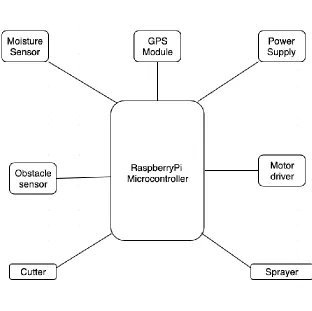
Figure 1. GPS Based Vehicle
III.METHODOLOGY
The general methodology of the system is represented in figure 1. The system basically consists of two sections:
A) GPS based vehicle attached with all sensors and a camera.
B) A warehouse where crops are stored.
In this methodology, the entire farming process is divided into two sections i.e. the crop field where
the production is done and the warehouse where the cultivated crops are stored. Both the sections
consists of different and multiple sensors. The first section shown in figure 1. i.e. the crop field
consist of a GPS based vehicle which can be controlled manually as well as we can automate it.
This GPS vehicle is attached with a microcontroller. The microcontroller is further connected
with power supply, GPS module, moisture, temperature, humidity, and obstacle sensor.
The GPS based vehicle can be moved automatically or manually all over the field. The values from
the sensors are recorded each and every moment and these values are sent to micro controller i.e. Raspberry Pi. Raspberry Pi can take its own decisions if the system is working on automated mode
or the user can give commands to Raspberry Pi manually. The advantage to this system is that the
GPS vehicle also consist of cutter and sprayer. The system automates the process of spraying
pesticides and fertilisers with the help of sprayer attached to it. The soil moisture sensor detects the
data from the soil and send it to microcontroller and accordingly the motor pump is switched on or off. The obstacle sensor helps to detect any obstacle that comes infant of the vehicle so that vehicle
© 2019, IJCSMC All Rights Reserved 147
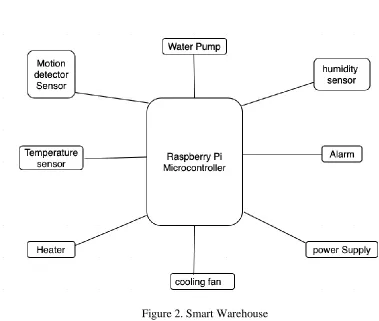
Figure 2. Smart Warehouse
The second section shown in figure 2. i.e. the warehouse consist of motion detector sensor,
temperature sensor, humidity sensor, cooling fan, heater, water pump and alarm. The motion
detector sensor is used to detects any theft in the warehouse. As soon as someone comes in
contact with the motion detection sensor and alert is made to the owner so that the owner can
take actions regarding this. The temperature and humidity sensors are used to detect humidity
and if the humidity crosses the threshold then the cooling fan is switched on automatically until
it reaches back to the threshold level. Heater is switched on in case the humidity reaches below
the threshold level. All this sensors are again connected to a microcontroller and a power supply.
In this section the power supply do not need to be wireless as the system stays in a particular area
and do not need move prominently.
The information gathered from both the sections are then sent to cloud which further send the data to a mobile app. The farmer can connect to the mobile app and get all information regarding
the crop field and the warehouse. There are multiple options available in the app through which
the farmer can have a control over the field as well as the warehouse. Whenever there is a theft in
the warehouse a buzzer sound is automatically made by the app so that the farmer can take the
necessary actions regarding theft control.
Another important technique added to this methodology is the detection of pests on the crops.
Pests plays a major role in productivity of crops. As the amount of pest increases the farmer
needs to increase the amount of pesticide spraying too. This may intern affect the productivity
and cultivation of crops. So to detect the presence of crop and image processing technique has
© 2019, IJCSMC All Rights Reserved 148
vehicle is moving. This video is then converted into multiple images and the images are
segmented into RGB scale for comparison. All images are compared with each other and if any
changes in image is seen then the necessary action is taken regarding that.
IV.CONCLUSION
Smart Agriculture using IoT can have a booming effect on today‟s agricultural growth. The
environmental conditions and the soil conditions can be easily and accurately monitored with the
help of IoT based sensors. This methodology has a capability of sensing the moisture, humidity,
temperature and obstacle. These values can be used in an efficient and effective way to take all
necessary steps and automate the process to agriculture.
REFERENCES
1. Prof K.A. Patil and Prof N.R. Kale “ A Model of Smart Agriculture Using IoT ” in Institute of Electrical and Electronic Engineers, 2016.
2. Nageswara Rao and B. Sridhar “ IoT based smart crop-field monitoring and automation irrigation system” in Institute of Electrical and Electronic Engineers, 2018.
3. G. Sushanth and S. Sujatha” IoT Based Smart Agriculture System ” in Institute of Electrical and Electronic Engineers, 2018.