Generic Fully Simulatable Adaptive Oblivious Transfer
?Kaoru Kurosawa1, Ryo Nojima2, and Le Trieu Phong2
1
Ibaraki University, Ibaraki, Japan,[email protected] 2
National Institute of Information and Communications Technology (NICT), Tokyo, Japan
{ryo-no,phong}@nict.go.jp
Abstract. We aim at constructing adaptive oblivious transfer protocols, enjoying fully simulatable security, from various well-known assumptions such as DDH,d-Linear, QR, and DCR. To this end, we present two generic constructions of adaptive OT, one of which utilizes verifiable shuffles together with threshold decryption schemes, while the other uses permutation networks together with what we call
loosely-homomorphickey encapsulation schemes. The constructions follow a novel designing approach called “blind permutation”, which completely differs from existing ones. We then show that specific choices of the building blocks lead to concrete adaptive OT protocols with fully simulatable security in the standard model under the targeted assumptions. Our generic methods can be extended to build universally composable (UC) secure, and leakage-resilient OT protocols.
Keywords: adaptive OT, fully-simulatable, verifiable shuffles, permutation networks, loose homomor-phism, leakage resilience
1 Introduction
1.1 Background
Oblivious transfer (OT) with adaptive queries, or adaptive OT for short, was first examined by Naor and Pinkas in [27], in which there are a sender and a receiver. The sender holdsn messages, and the receiver would like to retrieve kof them, one after the other, so that: (1) the sender does not know what the receiver obtains, and (2) the receiver gets nothing more beside thek messages. The key applications of this type of OT are in patent searches, oblivious search, medical databases etc.
The security notion capturing the above requirements has evolved in the literature. The notion of full simulatability was introduced by Camenisch, Neven, and Shelat in [3], following the real-world, ideal-world paradigm. In the ideal real-world, there exists a trusted third party (TTP), to which the sender gives all of his messages. When a receiver wants to obtain a message, he simply sends the corresponding index to the TTP. On the other hand, in the real world, there is no TTP at all, and the protocol of adaptive OT is run by the sender and the receiver. The intuition of full simulatability is that the real world is indistinguishable from the ideal world, with respect to any poly-time adversary.
There are a few approaches in building fully simulatable adaptive OT protocols. Let us have a look at them below.
The “assisted decryption” approach:Beginning with the work of Ogata and Kurosawa [30], at
the core of this approach is a blind signature scheme. The blind property helps hiding the indexes of ?
the receiver. The signatures assist the decryption at the receiver side, so that the desired message is obtained. The unforgeability of the blind signature scheme ensures that the receiver cannot obtain more signatures (and hence messages) than requested.
Ogata and Kurosawa [30] used the RSA blind signature scheme in the random oracle model, so their corresponding OT scheme was in that model. Also in ROM, Chu and Tzeng [4] presented an OT scheme using the Boldyreva’s blind signature scheme [2].
Camenisch et al. [3] generalized and refined the schemes given in [4, 30]. They furthermore gave a construction in the standard model, using q-based assumptions (in which q depends on n) in pairing groups.
Efforts have been devoted to further extending the approach. In ROM, Green and Hohenberger [11] showed a protocol under the decisional bilinear Diffie-Hellman assumption. In [12], Green and Hohenberger constructed a universally-composable, so fully-simulatable, scheme under theq-hidden LRSW assumption in the standard model. The same authors in [13] gave a construction under the decision 3-party DDH (3DDH) assumption in pairing groups.
The “oblivious PRF” approach: Jarecki and Liu [19] joined the research line with a scheme
based on the q-DHI assumption yet in RSA groups. The scheme is based on an oblivious pseudo-random function, in which the receiver with index σ can obtain, without revealing σ, the output PRFK(σ) where PRF’s keyK is held by the sender.
The above approaches, up to now, yield adaptive OT schemes based on dynamic, or q-based assumptions in the standard model, with only an exception in [13] under the 3DDH assumption.
Our “blind permutation” approach: With respect to assumptions which are notq-based, we
in [21] showed a simple scheme fully simulatable under the DDH assumption. However, the scheme suffered from a large communication cost of O(n) in each transfer, as pointed out by Green and Hohenberger in [13]. Soon afterwards, we in [22], using a verifiable shuffle protocol, overcome the demerit in [21] by reducing the cost to O(1), while still maintaining the DDH assumption for security. Specifically, the work [22] used the verifiable shuffle protocol of Neff [29] which is a 7-move honest verifier zero-knowledge protocol for proving the relation between (g,X1,. . .,Xn) and
(gc,Xπc(1),. . .,Xπc(n)), whereπ is a random permutation and cis random. Note that Neff’s shuffle protocol is computationally zero-knowledge under the DDH assumption, so that it seems impossible to utilize the shuffle beyond the DDH case.
This paper continues and refines the blind permutation approach. This approach is unique since, so far, it is the only one effectively yielding adaptive OT schemes fully simulatable under standard, well-known assumptions.
1.2 Our contribution
We present two generic methods for constructing fully simulatable adaptive OT in the standard model. They yield numerous protocols from various assumptions, including the DDH, d-linear (d≥ 2), quadratic residuosity (QR), and decisional composite residuosity (DCR) assumptions. A comparison with previous works is given in Table 1, in which our DDH-based OT protocol has less number of moves in the initialization phase than that of [22]. Note that our schemes based on the QR and DCR assumptions induce a bit higher communication cost for initialization.
Table 1. Fully simulatable adaptive OT schemes without random oracles. TheOalso hides the message length in the QR case, which is assumed small compared ton.
Scheme Assumption Communication Cost Initialization Cost (each transfer)
CNS [3] q-strong DH andq-PDDH O(1) O(n) GH [12] q-hidden LRSW (UC secure) O(1) O(n)
JL [19] q-DHI (RSA group) O(1) O(n)
KN [21] DDH O(n) O(n)
GH [13] decision 3-party DH (3DDH) O(1) O(n)
KNP [22] DDH O(1) O(n)
(more moves)
This work
DDH
O(1)
O(n) (less moves)
d-Linear O(n)
DCR O(nlogn)
QR O(nlogn)
The first condition allows us to use the verifiable shuffle protocol of Groth and Lu [14] which is a statistical zero-knowledge shuffle protocol for proving the relation between E(m1), . . . , E(mn)
and E(mπ(1)), . . ., E(mπ(n))
, where π is a random permutation. However, we cannot obtain any adaptive OT even if we directly replace Neff’s shuffle protocol by Groth-Lu’s shuffle protocol into [22]. This is because the sender can compute π from E(mπ(1)), . . . , E(mπ(n))
. To overcome this problem, we use 2-out-of-2 threshold decryption. From this method, new adaptive OTs are obtained under the DDH assumption and thed-linear (d≥2) assumption, respectively.
Our second method can be applied to any key encapsulation mechanisms (KEM) satisfying what we call loosely-homomorphicproperty. We use permutation networks for this case while we do not use threshold decryption. From this method, new adaptive OTs are respectively obtained from the QR and DCR assumptions.
Theoretically, the generic constructions show that encryption, with some homomorphic property, implies adaptive OT.
Technically, we will later assume that the receiver never repeats its requests, which is not quite a strict restriction. For applications sensitive to this, by adding dummy messages as elaborated in [31], one can easily overcome the restriction.
Our generic methods enjoy further extensions. In Sect.5.1, we show how to obtain UC-secure adaptive OT protocols, with a little loss in efficiency. Specifically, we use a transformation of Σ -protocols to UC-secure ones [17, 26], with the help of a recent UC-secure commitment scheme [25] by Lindell. The communication cost becomes O(L) for soundness error 2−L.
Furthermore, in Sect.5.2, we show an adaptive (and hence 1-out-of-2) OT protocol which is resilient to the randomness leakage of the sender’s first step. As an independent work, Damgard, Hazay and Patra [9] recently considered a framework for leakage resilient two party protocols. However, they were unable to construct such a 1-out-of-2 OT (see Sect.6 of [9]).
1.3 Intuition behind our protocols
getsxR. This will prevent full decryption of a ciphertext without the cooperation from either party.
LethS =gxS,hR =gxR, andh=hShR be public. The sender with private inputs (xS, M1, . . . , Mn),
and the receiverRwith private inputs (σ, xR) acts as follows forRto obtain Mσ.
1. S sends ElGamal ciphertexts (Ai, Bi) = (gri, Mihri) to Rfor all 1≤i≤n.
2. R with index σ sends back (C1, C2) = Rand(Aσ, Bσ) = (grσ+r
0
, Mσhrσ+r
0
) where r0←$ Zq is
chosen byR.
3. Ssends the partial decryptionµS=C1xS toR, who computesµR=C1xR andµ=µSµR to obtain
Mσ =C2/µ.
If both parties are honest-but-curious,Scannot knowσ due to the re-randomization at the second step. Also, Rcannot obtain other messages due to the encryption at the first step.
To attain full simulability, we add zero-knowledge proofs to each step. For the first and third steps, the proofs are Schnorr-type ones, and are efficient. The second one is difficult, in which we need to ensure that the re-randomized ciphetext (C1, C2) is either
Rand(A1, B1)∨ · · · ∨Rand(An, Bn)
which can be implemented by an OR zero-knowledge proof. Naive and direct implementation of this zero-knowledge proof requiresO(n) communication cost foreachreceiver’s index. Quite surprisingly, in Sect.3, we are able to reduce the cost to O(1) by utilizing shuffle protocols.
The above ideas work well with the DDH and its weaker variants. For the DCR case, it is hard to share the secret key between the parties. For the QR case, we are unable to find a proper shuffle protocol to work with since the message space is of order 2 (or 2`). We overcome these difficulties in Sect.4, employing permutation networks for shuffling. The communication cost for each receiver’s index is stillO(1), but the initialization cost is slightly increased as shown in Table 1.
2 Preliminaries
2.1 Notations
Throughout the paper, OTn
k×1 denote the adaptive OT with n messages of the sender and k choices of the receiver. ZKPK stands for zero-knowledge proof of knowledge, while ZKPM for zero-knowledge proof of membership. WIPK means witness-indistinguishable proof of knowledge. Furthermore, ZKPK{(x) : X = gx} means a ZKPK protocol showing the knowledge of secret x
satisfying the equation; and similar notations for more complex ZKPK, ZKPM, WIPK protocols will be used.
Taking an element a randomly from a set A is denoted by a←$ A. We use a[i] to indicate the
i-th component of a. For example, when ais a bit string, a[i] is the i-th bit; when a is a tuple of elements,a[i] becomes the i-th element.
2.2 Fully-simulatable OTnk×1
We use almost the same presentation as [21], and consider a weak model of universally composable (UC) framework as follows.
– A can send a message, denoted by Aout, to an environment Z after the end of the protocol.
However, A cannot communicate with Z during the protocol execution. (This property makes the definitions weaker than standard UC security.)
The ideal functionality of OTnk×1 will be shown below. For a protocol Π = (S,R), define the advantage of Z as
Adv(Z)def=
Pr(Z = 1 in the real world)−Pr(Z= 1 in the ideal world)
where the real and ideal worlds are defined below.
The ideal world:there are a few parties consisting of the ideal functionalityFadapt, an ideal world
adversaryA0, and the environment Z. Also we have dummy sender S0 and receiver R0. The parties behave as follows.
Initialization phase
1. The environment Z sends (M1, . . . , Mn) to the dummy senderS0.
2. S0 sends (M1∗, . . . , Mn∗) to Fadapt, where (M1∗, . . . , Mn∗) = (M1, . . . , Mn) if S0 is not corrupted.
Transfer phasei= 1, . . . , k
1. Z sends σi to the dummy receiverR0, where 1≤σi≤n.
2. R0 sendsσ∗i toFadapt, whereσ∗i =σi ifR0 is not corrupted.
3. Fadapt sends receivedtoA0.
4. A0 sends b= 1 or 0 toFadapt, whereb= 1 if S0 is not corrupted. 5. Fadapt sends Ei toR0, where
Ei=
M∗
σ∗
i ifb= 1
⊥ ifb= 0
6. R0 sendsEi toZ.
After the end of the protocol,A0 sends a messageA0out toZ. FinallyZ outputs 1 or 0.
The real world: Simply in this world, the protocol Π = (S,R) is executed as specified by its construction (thus without Fadapt). The environment Z and the real world adversary A behave in
the same way as above.
Definition 1. Protocol Π = (S,R) is secure against the sender (resp, receiver) corruption if for any real world adversary A who corrupts the sender S (resp, receiver R), there exists an ideal world adversaryA0 who corrupts the dummy senderS0 (resp, dummy receiverR0) such that for any poly-time environmentZ, the advantageAdv(Z) is negligible.
3 Generic adaptive OT from verifiable shuffles
3.1 Building blocks
Threshold PKE We need an 2-out-of-2 threshold PKE scheme TPKE, which consists of the
following algorithms.
–TGen: Two partiesSandRrun a protocol so that they respectively obtain (pk, skS) and (pk, skR)
where pk = (pkS, pkR) is the agreed public key and skS, skR are the shares of secret key. (The
public key is needed for all algorithms below, and we omit writing it for clarity.) – TEnc(M;r): output a ciphertextC for a plaintext M and a random coinr.
–TDec(skP, C): forP∈ {S,R}, outputµPwhich is the decryption share of the ciphertextC under
secret keyskP.
– TComb(C, µS, µR): output a plaintext M by combining the inputC, µS, µR.
We require the following properties on the TPKEscheme.
Homomorphism: Namely,
TEnc(M;r)⊗TEnc(M0;r0) =TEnc(M⊕M0;rr0),
where ⊗,⊕,are the operators on the corresponding spaces.
Semantic security: Assuming either S orRis honest, we require that for all M, the ciphertext
Enc(M;r) for random r is computationally indistinguishable from random elements over some group.
Verifiable shuffles Consider a set of ciphertexts Ci = TEnc(Mi;ri) for 1 ≤ i≤ n of the TPKE
scheme forming byS. LetI be the identity element of the message space. It is easy enough forRto choose a permutationπ on{1, . . . , n}, and randomsi to form the set ofCi0 =Cπ(i)⊗TEnc(I;si) for
1≤i≤n, so that both sets of ciphertexts contain the same plaintexts. The set of Ci0(1≤i≤n) is called a shuffle of the original one. If the schemeTPKEis semantically secure, publishing the shuffle
Ci0(1≤i≤n) reveals nothing on the permutation π toS. Correctness of the shuffle is verified via the following protocol
ZKPK
(π, si) :Ci0=Cπ(i)⊗TEnc(I;si)∀1≤i≤n ,
which has efficient implementations for homomorphic encryption schemes such as ElGamal or Pail-lier3 as shown in the work of Groth and Lu [14]. More generally, the results of Groth and Lu apply for homomorphic encryption schemes with the following properties:
Proper message space: the order of the message space does not have any small prime factor
(say less than 280).
Root extraction: from Ce = TEnc(M;R), it is possible to efficiently extract (m, r) such that
C =TEnc(m;r) for everyeco-prime with the order of the message space.
The protocols for verifiable shuffles given in [14] are statistical strong HVZK arguments of three rounds, and can be turned into fully zero-knowledge by standard techniques.
The additional property below will be needed in proving sender security.
3
Computing µS without skS: Let µS = TDec(skS, C0) where C0 = Cπ0−1(σ) as above for some
1 ≤σ ≤n. Note that C0 =Cσ⊗TEnc(I;sπ−1(σ)) for Cσ =TEnc(Mσ;rσ). We require that µS
can be alternatively expressed as a function ofpk, Cσ, Mσ, sπ−1(σ), andskR. Namely there exists
an efficiently-computable function f such that we haveµS =f(pk, Cσ, Mσ, sπ−1(σ), skR).
3.2 The OT protocol
Initialization:
1. The sender S and the receiver R run the protocol TGen so that they obtain a common public key pk = (pkS, pkR); and S gets secret key skS,R gets secret key skR.The receiver Rproves in
ZKPK that he knows skR corresponding topkR.
2. For 1≤i≤n,S computes and sends
Ci =TEnc(Mi;ri)
toRwhere ri are randomness used byTEnc.
3. The sender S then proves to R by ZKPK that he knows Mi for all i. (This is equivalent to
proving the knowledge ofri in our below instantiations.)
4. (Shuffling) The receiver R chooses a permutation π on {1, . . . , n} and randomness si for 1≤
i≤n, and computes then sends toS for all i
Ci0=Cπ(i)⊗TEnc(I;si),
where I is the unit element of the message space.
5. The receiver Rproves to Sin ZKPK that he knowsπ and si(1≤i≤n) satisfying the equation
at Step 4.
The j-th transfer:
6. The receiver Robtains an indexσ as input, and sends π−1(σ) to S. 7. The sender Schecksπ−1(σ)∈ {1, . . . , n}, then computes and sends µ
S=TDec(skS, Cπ0−1(σ)) to
R.
8. The sender Sthen proves in ZKPM that he did the right (partial) decryption, with skS
corre-sponding to pkS, in the above step.
9. The receiver Rhimself computes µR=TDec(skR, Cπ0−1(σ)), and then obtaining Mσ =TComb(pk, Cπ0−1(σ), µS, µR).
To prove correctness of the OT, note that
C0 =Cπ0−1(σ)=Cσ⊗TEnc(I;sπ−1(σ)) =TEnc(Mσ, rσ)⊗TEnc(I;sπ−1(σ))
which means C0 encrypts the plaintextMσ thanks to the homomorphic property of the threshold
PKE scheme. Now, by the correctness of the threshold PKE scheme, TComb(pk, C0, µS, µR) is
exactlyMσ as required.
Theorem 1 The generic OTnk×1 from verifiable shuffles above is fully simulatable, if the TPKE scheme has semantic security.
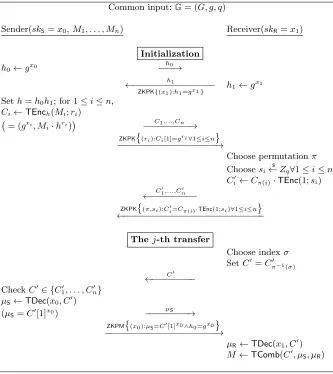
Common input:G= (G, g, q)
Sender(skS=x0,M1, . . . , Mn) Receiver(skR=x1)
Initialization
h0←gx0
h0
−−−→ h1
←−−−−−−−−−−−−−−−−
ZKPK{(x1):h1=gx1}
h1←gx1
Seth=h0h1; for 1≤i≤n,
Ci←TEnch(Mi;ri) = (gri, M
i·hri)
C1,...,Cn −−−−−−−−−→
ZKPK(ri):Ci[1]=gri∀1≤i≤n −−−−−−−−−−−−−−−−−−−−→
Choose permutationπ Choose si
$
←Zq∀1≤i≤n Ci0←Cπ(i)·TEnc(1;si) C01,...,Cn0
←−−−−−−−−−
ZKPK(π,si):C0i=Cπ(i)·TEnc(1;si)∀1≤i≤n ←−−−−−−−−−−−−−−−−−−−−−−−−−−−−
The j-th transfer
Choose indexσ SetC0=Cπ0−1(σ)
C0 ←−−−−−−−−− CheckC0∈ {C10, . . . , C
0
n} µS←TDec(x0, C0)
(µS=C0[1]x0)
µS
−−−−−−−−−→
ZKPM(x0):µS=C0[1]x0∧h0=gx0
−−−−−−−−−−−−−−−−−−−−−−→
µR←TDec(x1, C0)
M ←TComb(C0, µS, µR)
Fig. 1.The OTn
k×1 secure under the DDH assumption.
3.3 Instantiations from DDH and linear assumptions
OTnk×1 from the DDH assumption We will use the threshold ElGamal encryption scheme. The scheme works on a cyclic group G= (G, g, q) where g is the generator of prime order q, and has
semantic security under the DDH assumption onG.
– TGen: S chooses skS = x0
$
←Zq, computes and sends h0 ← gx0 to R. Similarly, R chooses
skR=x1
$
←Zq and sends h1 ←gx1 toS. The agreed public key is thenh=h0h1. – TEnc(M;r): OutputC = (C[1], C[2]) = (gr, M ·hr) forr←$ Zq and M ∈G.
– TDec(skP, C): OutputµP =C[1]skP forP is eitherS orR.
– TComb(C, µS, µR): Output C[2]/(µSµR).
can be alternatively expressed as4
µS=f(pk, Cσ, Mσ, sπ−1(σ), skR) def
=Cσ[2]Mσ−1Cσ[1]−x1h sπ−1(σ)
0 ,
which is the formula needed when proving sender security.
Since the threshold ElGamal encryption scheme has semantic security under the DDH assump-tion, thanks to Theorem 1, the OTnk×1 in Fig.1 is fully-simulatable under the same assumption.
OTnk×1 from the d-linear assumptions We also works on G= (G, g, q), and let us introduce
some more notations. For two vectorsv= (v[1], . . . , v[l])∈G1×l,u= (u[1], . . . , u[l])∈Zq1×l define
v·u|=u·v|=
l
Y
i=1
v[i]u[i]∈G.
Matrix-matrix and matrix-vector multiplications are defined in the same manner. Sometimes, the
· operators are implicitly understood. Also recall that for u, u0 ∈ Zq1×l, we have u+u0 = (u[1] +
u0[1], . . . , u[l] +u0[l]) as normal. It is easy to check that (u+u0)·v| = (u·v|)(u0·v|) ∈ G, and
v·(u+u0)|= (v·u|)(v·u0|)∈G.
Ford≥2, the following PKE scheme, introduced by Naor and Segev [28], has semantic security under the d-linear assumption.
– Gen: sk←$ Zq(d+1)×1, φ
$
←Gd×(d+1). The secret key is sk, and the public key is pk = (φ, ψ) for
ψ=φ·sk∈Gd×1.
– Enc(M;R): On message M ∈ G and random R ∈ Zq1×d as input, output the ciphertext C = (Rφ,(Rψ)M)∈G1×(d+1)×G.
– Dec(sk, C): On input C and sk, outputC[2]/(C[1]·sk).
The correctness of the PKE scheme comes from the equation (R·φ)·sk=R·(φ·sk).
The semantic security of the PKE scheme implies that, givenφ, ψ, the pairEnc(1;R) = (Rφ, Rψ) is indistinguishable from random over G1×(d+1)×G.
We now present the 2-out-of-2 threshold variant of the above PKE, whose necessary properties are checked in Appendix B. The resulting OT scheme is given in Fig.2.
–TGen: The partiesSandR, usingG, agree on the matrixφ∈Gd×(d+1). They then choose secrets skS and skR respectively in Z
(d+1)×1
q ; S publishes ψS =φ·skS ∈Gd×1 while Rdoes the same
with ψR = φ·skR ∈ Gd×1. The agreed common public key is φ,ψS, ψR in which ψ =ψSψR =
(ψS[1]ψR[1], . . . , ψS[d]ψR[d])|∈Gd×1 will be used in encryption. Note thatψ=φ·(skS+skR).
–TEnc(M;R): OutputC =Enc(M;R) = (Rφ,(Rψ)M)∈G1×(d+1)×Gas above. –TDec(skP, C): Output µP=C[1]·skP∈GforP∈ {S,R}.
–TComb(C, µS, µR): OutputC[2]/(µSµR).
4 Generic adaptive OT from permutation networks
We present OTnk×1 withO(1) communication cost for the transfer phase, while withO(nlogn) for the initialization phase. The assumptions used for security will be DCR or QR.
4Let us elaborate a bit on the formula. We have C
σ[2]Mσ−1Cσ[1]−x1h sπ−1 (σ)
0 = (Mσhrσ)Mσ−1Cσ[1]−x1h sπ−1 (σ)
0 =
hrσ(grσ)−x1hsπ−1 (σ)
0 = (h0h1)rσ(h−1rσ)h
sπ−1 (σ)
0 =h
rσ+sπ−1 (σ)
0 =g
(rσ+sπ−1 (σ))x0
=C0[1]x0 =µ
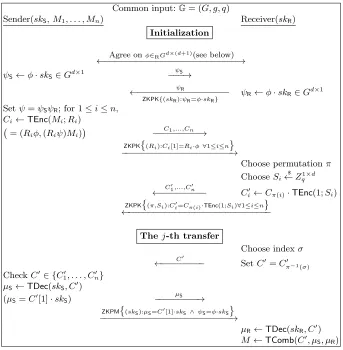
Common input:G= (G, g, q)
Sender(skS,M1, . . . , Mn) Receiver(skR)
Initialization
Agree onφ∈RGd×(d+1)(see below)
←−−−−−−−−−−−−−−−−−−−−−−−−−−→
ψS←φ·skS∈Gd×1
ψS
−−−→ ψR
←−−−−−−−−−−−−−−−−−−
ZKPK{(skR):ψR=φ·skR}
ψR←φ·skR∈Gd×1
Setψ=ψSψR; for 1≤i≤n,
Ci←TEnc(Mi;Ri) = (Riφ,(Riψ)Mi)
−−−−−−−−−→C1,...,Cn
ZKPK(Ri):Ci[1]=Ri·φ∀1≤i≤n −−−−−−−−−−−−−−−−−−−−−−→
Choose permutationπ ChooseSi
$
←Z1×d q C01,...,C0n
←−−−−−−−−− Ci0←Cπ(i)·TEnc(1;Si)
ZKPK(π,Si):Ci0=Cπ(i)·TEnc(1;Si)∀1≤i≤n ←−−−−−−−−−−−−−−−−−−−−−−−−−−−−
The j-th transfer
Choose indexσ C0
←−−−−−−−−− SetC0=Cπ0−1(σ)
CheckC0∈ {C0 1, . . . , C
0
n} µS←TDec(skS, C0)
(µS=C0[1]·skS)
µS
−−−−−−−−−→
ZKPM(skS):µS=C0[1]·skS ∧ψS=φ·skS
−−−−−−−−−−−−−−−−−−−−−−−−−−→
µR←TDec(skR, C0)
M←TComb(C0, µS, µR)
Fig. 2.The OTn
k×1 secure under thed-linear assumption. The matrix φ ∈ Gd
×(d+1) can be agreed by Sand R as
follows.Schooses and sendsφS= (gti,j)(i,j) $
←Gd×(d+1)toR, and then proves in ZK the knowledge of allti,j.Rdoes the same with φR= (gt
0
i,j). The matrixφ is set as (φS[i, j]φR[i, j])(i,j), which remains uniformly distributed even if eitherSorRis corrupted.
4.1 Loosely homomorphic KEM
A key encapsulation mechanism KEM consists of algorithms Gen, Encap, Decap as follows: Gen
produces keys (pk, sk); Encap(pk) outputs (ψ, K) where ψ is the encapsulation of the key K;
Decapsk(ψ) returns K as the decapsulation of ψ. We write Encap(pk;r) to emphasize the random coin r. We need the following conditions on KEM.
Semantic security: Suppose Encap(pk) = (ψ, K). Given pk, ψ, the key K is indistinguishable from random.
Uniformity of encapsulation: LetEncap(pk;r) = (ψ(r), K) for uniformly distributed random-ness r. Then,ψ(r) is also uniformly distributed over some group.
Loose homomorphism: Given (ψ, K) and (ψ0, K0), there are efficiently computable functions
f1, f2 such that
Decapsk(ψ·ψ0) =f1(ψ, ψ0, K, K0) and K0 =f2 ψ, ψ0, K,Decapsk ψ·ψ0
The former equation is used in proving sender security, while the latter is for the OT’s correct-ness. It is clear that a KEM is loosely homomorphic if it is homomorphic (namely, satisfying
Decapsk(ψ·ψ0) =K⊕K0).
Let us now show some concrete examples of loosely homomorphic KEM.
First example KEMDCR: Gengenerates primesp, q, setting pk=N =pq, andsk= (p, q).Encap takes r←$ ZN and computes (ψ, K) ∈ ZN2 satisfying rN = ψ+K ·N modN2. Note that ψ =
[rN modN] ∈ ZN. Using sk, Decapsk(ψ) first computes r satisfying rN = ψmodN, an then
outputsK = (rN −ψmodN2)/N. The computationψ·ψ0 is normally defined overZ N.
The semantic security of KEMDCR comes from the DCR assumption. To show that it is loosely homomorphic, consider (ψ, K) and (ψ0, K0) satisfyingrN =ψ+K·N modN2, andr0N =ψ0+K0· N modN2. Writingψψ0 =S+T N modN2, we have
(rr0)N = [(ψ+KN)(ψ0+K0N) modN2] = [S+ (T +Kψ0+K0ψ)N modN2],
so that ˆK =Decapsk(ψψ0 ∈ ZN) = T +Kψ0+K0ψmodN, which is the function f1. Moreover,
since (ψ+KN)(ψ0+K0N) =S+ ˆKN modN2, the keyK0 can be computed as
K0= [(S+ ˆKN)(ψ+KN)
−1−ψ0] modN2
N ,
which expresses the function f2.
Second example KEMQR: To apply the recent 3-move ZKPK of Cramer and Damg˚ard [6], we
will use an expanded version of the Goldwasser-Micali encryption scheme. In particular,Genis the same as above, except that a quadratic non-residue y ∈ QN R+1N is added to pk. The algorithm
Encaptakes K← {$ 0,1}` and r $
←ZN` , returning the keyK and its encapsulation
ψ=yK[1]r[1]2 modN, . . . , yK[`]r[`]2modN.
The algorithmDecapsk(ψ), for 1≤i≤`, returns K[i] = 0 if ψ[i] is a quadratic residue modulo N; otherwise returnsK[i] = 1. The scheme KEMQR is homomorphic, and has semantic security under the QR assumption.
In [6], the protocol WIPK{(K, r) : ψ = Encap N; (K, r)}, is realized by a Σ-protocol, with soundness error 2−` and communication cost O(`) (instead of O(`2) via the cut-and-choose tech-nique). Turning the Σ-protocol into a fully zero-knowledge one with 4 moves can be done by standard techniques (e.g., see [8]).
4.2 The OT protocol
We show that an adaptive OTnk×1 can be constructed from a loosely homomorphic KEM = (Gen, Encap, Decap).
Initialization Phase
2. For i = 1, . . . , n, the sender S generates (ψ(ri), Ki) = Encap(pk;ri) by choosing ri randomly
and sends to R
Ci = (Ai, Bi) = (ψ(ri), KiMi),
where ri is a random string used byEncap.
3. The sender proves by ZKPK that he knows ri of ψ(ri) for every 1≤ i≤ n. Alternatively, he
proves that he knowssk by ZKPK.
4. (Permuting and Blinding) The receiver chooses ui randomly for 1≤i≤n, and generates
Encap(pk;ui) = (ϕ(ui), Ki0).
He then randomly picks a permutation π on{1, . . . , n}, computes Ui =Aπ(i)·ϕ(ui), and sends
U1, . . . , Un to the sender. The receiver, equipped with secrets (u1, . . . , un) and π, proves in
ZKPK that
h
U1 =Aπ(1)·ϕ(u1)
i
∧ · · · ∧hUn=Aπ(n)·ϕ(un)
i .
We will describe in Sect.4.3 how to perform the ZKPK with O(nlogn) communication cost.
The jth Transfer Phase
5. The receiver chooses an index 1≤σ ≤n, then sendsU =Uπ−1(σ).
6. The sender checks U ∈ {U1, . . . , Un}, computes ˆK =Decapsk(U) and sends ˆK to the receiver.
7. The sender proves that ˆK =Decapsk(U) by ZKPM. 8. Note that U =Aσ ·ϕ(uπ−1(σ)). The receiver computes
Kσ =f2
Aσ, ϕ(uπ−1(σ)), Kπ0−1(σ),Kˆ
,
and then obtains Mσ by computing BσKσ−1. (In additive groups, this becomes Bσ −Kσ, and
all Bi as above are Ki+Mi.)
Theorem 2 The generic OTnk×1 from permutation networks above is fully simulatable, if theKEM scheme has semantic security. In other words, loosely-homomorphic KEM implies adaptive OT.
The proof is postponed in Appendix C. Below we will show how to obtain efficient instantiations based on specific complexity assumptions.
4.3 How to execute the ZKPK at Step 4
The case n= 2: First, let us focus on n= 2, proving the knowledge ofu1, u2 such that
U1 =Aπ(1)·ϕ(u1)∧U2 =Aπ(2)·ϕ(u2), forsomepermutation π on{1,2}. The task is equivalent to proving
U1=A1·ϕ(u1)∧U2 =A2·ϕ(u2)
∨U1=A2·ϕ(u1)∧U2 =A1·ϕ(u2)
,
depending on whether π(1), π(2)
= (1,2) or (2,1). Expanding further, what is proved becomes
U1=A1·ϕ(u1)∨U1 =A2·ϕ(u1)
∧U1=A1·ϕ(u1)∨U2 =A1·ϕ(u2)
∧ U2 =A2·ϕ(u2)∨U1 =A2·ϕ(u1)
∧U2=A2·ϕ(u2)∨U2 =A1·ϕ(u2)
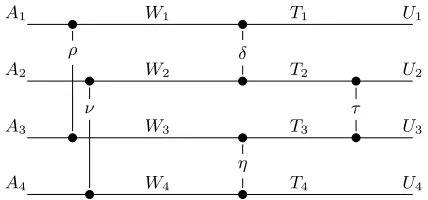
A1
A2
A3
A4
ρ
ν
W1
W2
W3
W4
δ
η T1
T2
T3
T4
τ U1
U2
U3
U4
Fig. 3.Fromn= 2 ton= 4 with a permutation network of five switches.
The above are exactly four OR-proofs. If one can implement the interactive proof WIPK{(u) :
U =A·ϕ(u)}by aΣ-protocol, then it is well-known that one can efficiently realize the OR-proofs also with Σ-protocols. Note that if u1, u2 are known, then the permutationπ can be extracted as well. Transforming Σ-protocols to ZKPK ones can be done by well-known techniques [7]. There-fore, the ZKPK for n= 2 in consideration can be implemented in four rounds, and we count its communication cost asymptotically asO(1).
From 2 to general n: We will use the idea of n-permutation networks, which turn ninputs ton
outputs, and the outputs are a permutation of the inputs. It is known thatn-permutation networks can be built from 2-ones, which are called switches. There are constructions of n-permutation networks withO(nlog2n) [5] or evenO(nlogn) switches [1, 10]. A comprehensive treatment on the topic can be found in [5, Chapter 28].
The idea is now we replace the switches by the WIPK protocol for n= 2 described above. We needO(nlogn) protocols as switches, and each protocol requiresO(1) communication cost, so that the total communication cost becomesO(nlogn).
Let us concretely illustrate how one proceeds from n = 2 to n = 4, using the permutation network depicted in Fig.3 of five switches. The elements Wi, Ti, Ui are sent to the sender by the
receiver5. The first two switchesρ and ν prove that
W1 =Aρ(1)·ϕ(w1), W3=Aρ(3)·ϕ(w3), W2 =Aν(2)·ϕ(w2), W4 =Aν(4)·ϕ(w4). Consequently, the second two switches δ and η ensure
T1 =Wδ(1)·ϕ(t1), T2=Wδ(2)·ϕ(t2), T3 =Wη(3)·ϕ(t3), T4 =Wη(4)·ϕ(t4). The final switch τ is between T2 and T3, showing
U2 =Tτ(2)·ϕ(v2)∧U3 =Tτ(3)·ϕ(v3).
To ease the illustration, let us take concrete switches τ = (2 3) (namely 2 to 3 and vice versa),
δ = (1 2), ν = (2 4), and the others are identity switches. Denote U ∼ A if there is u such that
U =A·ϕ(u), so that
U1∼T1 ∼W2∼A4
U2∼T3 ∼W3∼A3
U3∼T2 ∼W1∼A1
U4∼T4 ∼W4∼A2
5
which means (U1, U2, U3, U4) blinds and permutes (A1, A2, A3, A4) as expected.
Instantiations:As shown above, we just need to implement the atomic WIPK{(u) :U =A·ϕ(u)}
by aΣ-protocol.
DCR assumption: Set ϕ(u) = uN modN for u ∈ ZN, so that the atomic WIPK is similar to
the GQ proof [15].
QR assumption:Set
ϕ(u= (K, r)) =yK[1]r[1]2 modN, . . . , yK[`]r[`]2 modN
for u= (K, r) ∈Z2`×ZN` . The elegant result of Cramer and Damg˚ard [6] gives us the desired 3-move WIPK with soundness error 2−`.
4.4 How to execute other zero-knowledge protocols
The ZKPM at step 7, in the case of KEMDCR, is equivalent to proving rN = U + ˆKN modN2 for some r, for which the 4-move ZK protocol can be found in [24]. For KEMQR, proving U = (yKˆ[1]r[1]2modN, . . . , yKˆ[`]r[`]2modN) for somer∈ZN` is needed, which can be accomplished by the 4-move ZK protocol for the knowledge of` square roots in [6].
We now turn to the necessary protocols for the validity of the public key. Provingyis a quadratic non-residue can be done in 4 moves as in [6]. What is left is how to prove the validity ofN, namely
N =pqfor some distinct primesp, q. We proceed in two steps: first proving gcd(N, φ(N)) = 1 in 4 moves (see Appendix D), and then showing N =pq as required. Merging the moves of the former and the latter gives us the 4-move protocol for the validity ofN. The latter protocol is accomplished as follows.
Proving N =pq in four moves:Suppose gcd(N, φ(N)) = 1 and N is not a prime, so that N =
Qν
i=1pi for ν ≥ 2, and let y ∈ JN+1 \(ZN∗)2. Improving a cut-and-choose protocol in [20], the
following protocol proves thatν = 2.
1. The verifier sends random z1, . . . , z` ∈ JN+1 to the prover.
2. The prover shows that there are (mi, ri)∈Z2×ZN∗ satisfying
z1 =ym1r12∧ · · · ∧z`=ym`r2`,
by the 4-move ZK protocol of Cramer and Damg˚ard [6], whose communication cost is O(`) elements inZN∗ with soundness error 2−`.
The completeness, soundness, and zero-knowledge properties are checked in Appendix E.
5 Extensions
5.1 UC-secure OT under the DDH assumption
Observe that all zero-knowledge proofs used in Sect.3 can be effectively realized from Σ -protocols. Therefore, if we can turn aΣ-protocol into a UC-secure zero-knowledge one, then we are done. Fortunately, such a transformation is presented by Hazay and Nissim [17] (see also [26]) with the help of a UC-secure commitment scheme (e.g., by Lindell [25]), with a bit sacrifice in efficiency. Let (a, c∈ {0,1}, z) be transcripts of theΣ-protocol, we roughly describe the transformation here for completeness.
1. The prover generates (a,0, z0) and (a,1, z1). The prover then commits a, z0, z1 to the verifier via a UC-secure commitment scheme (e.g. [25]).
2. The verifier sends back a challenge c← {$ 0,1}.
3. The prover decommits a, zc. The verifier then checks whether (a, c, zc) is correct as in the basic
Σ-protocol.
One needs to repeat the aboveLtimes to obtain soundness error 2−L. Plugging this transformation into the instantiation in Sect.3, we obtain a UC-secure OT protocol under the DDH assumption. (Note that the UC-secure commitment scheme of Lindell [25] is under the DDH assumption.) The trade-off for this higher security is the efficiency loss by a factorL.
5.2 Leakage-resilient adaptive OT under the DDH assumption
Let us re-consider the generic construction given in Sect.4, yet further assume that the randomness of the sender at the first step is somehow leaked. Namely, the randomness used to generate the secretskis leaked. We show that if using leakage-resilient encryption, the resulting OT instantiation remains secure. Specifically, under the DDH assumption, consider the following KEM derived from Naor and Segev [28, Eprint, Sect.5.2]. The scheme is proved leakage-resilient with rate 1−o(1).
– Gen: s1, . . . , s`
$
←Zq, g1, . . . , g`
$
←G, h = Q`
i=1g
si
i . Set the public key pk = (g1, . . . , g`, h) and
the secret key s= (s1, . . . , s`).
– Encap: Take r←$ Zq, the encapsulation of K =hr is (g1r, . . . , gr`). – Decap: To decapsulate (gr1, . . . , g`r), computeQ`
i=1(gir)si, which equals hr.
The KEM is homomorphic and leakage-resilient, so we can apply the result in Sect.4 to obtain a leakage-resilient OT protocol under the DDH assumption. The atomic WIPK used in the permuta-tion network is to essentially prove the knowledge ofr∈Zq satisfyingC= (g1r, . . . , g`r). This WIPK
and other required zero-knowledge proofs can be realized efficiently.
References
1. M. Ajtai, J. Koml´os, and E. Szemer´edi. AnO(nlogn) sorting network. InSTOC, pages 1–9. ACM, 1983. 2. A. Boldyreva. Threshold signatures, multisignatures and blind signatures based on the gap-diffie-hellman-group
signature scheme. In Y. Desmedt, editor,Public Key Cryptography, volume 2567 ofLecture Notes in Computer Science, pages 31–46. Springer, 2003.
3. J. Camenisch, G. Neven, and A. Shelat. Simulatable adaptive oblivious transfer. In M. Naor, editor, EURO-CRYPT, volume 4515 ofLecture Notes in Computer Science, pages 573–590. Springer, 2007.
4. C.-K. Chu and W.-G. Tzeng. Efficient k-out-of-n oblivious transfer schemes with adaptive and non-adaptive queries. In S. Vaudenay, editor,Public Key Cryptography, volume 3386 ofLecture Notes in Computer Science, pages 172–183. Springer, 2005.
6. R. Cramer and I. Damg˚ard. On the amortized complexity of zero-knowledge protocols. In Halevi [16], pages 177–191.
7. R. Cramer, I. Damg˚ard, and P. D. MacKenzie. Efficient zero-knowledge proofs of knowledge without intractability assumptions. In H. Imai and Y. Zheng, editors, Public Key Cryptography, volume 1751 of Lecture Notes in Computer Science, pages 354–373. Springer, 2000.
8. I. Damg˚ard. On Σ-protocols, 2010. Course notes in Cryptologic Protocol Theory, http://www.daimi.au.dk/ ~ivan/CPT.html.
9. I. Damg˚ard, C. Hazay, and A. Patra. Leakage resilient secure two-party computation. Cryptology ePrint Archive, Report 2011/256, 2011. http://eprint.iacr.org/.
10. M. T. Goodrich. Randomized shellsort: A simple oblivious sorting algorithm. InProceedings 21st ACM-SIAM Symposium on Discrete Algorithms (SODA), 2010.
11. M. Green and S. Hohenberger. Blind identity-based encryption and simulatable oblivious transfer. In K. Kuro-sawa, editor,ASIACRYPT, volume 4833 ofLecture Notes in Computer Science, pages 265–282. Springer, 2007. 12. M. Green and S. Hohenberger. Universally composable adaptive oblivious transfer. In J. Pieprzyk, editor,
ASIACRYPT, volume 5350 of Lecture Notes in Computer Science, pages 179–197. Springer, 2008.
13. M. Green and S. Hohenberger. Practical adaptive oblivious transfer from simple assumptions. In Ishai [18], pages 347–363.
14. J. Groth and S. Lu. Verifiable shuffle of large size ciphertexts. In T. Okamoto and X. Wang, editors,Public Key Cryptography, volume 4450 ofLecture Notes in Computer Science, pages 377–392. Springer, 2007.
15. L. C. Guillou and J.-J. Quisquater. A ”paradoxical” indentity-based signature scheme resulting from zero-knowledge. In S. Goldwasser, editor,CRYPTO, volume 403 ofLecture Notes in Computer Science, pages 216–231. Springer, 1988.
16. S. Halevi, editor. Advances in Cryptology - CRYPTO 2009, 29th Annual International Cryptology Conference, Santa Barbara, CA, USA, August 16-20, 2009. Proceedings, volume 5677 ofLecture Notes in Computer Science. Springer, 2009.
17. C. Hazay and K. Nissim. Efficient set operations in the presence of malicious adversaries. In P. Q. Nguyen and D. Pointcheval, editors,Public Key Cryptography, volume 6056 ofLecture Notes in Computer Science, pages 312–331. Springer, 2010.
18. Y. Ishai, editor. Theory of Cryptography - 8th Theory of Cryptography Conference, TCC 2011, Providence, RI, USA, March 28-30, 2011. Proceedings, volume 6597 ofLecture Notes in Computer Science. Springer, 2011. 19. S. Jarecki and X. Liu. Efficient oblivious pseudorandom function with applications to adaptive OT and secure
computation of set intersection. In O. Reingold, editor,TCC, volume 5444 ofLecture Notes in Computer Science, pages 577–594. Springer, 2009.
20. K. Kurosawa, Y. Katayama, W. Ogata, and S. Tsujii. General public key residue cryptosystems and mental poker protocols. InEUROCRYPT, pages 374–388, 1990.
21. K. Kurosawa and R. Nojima. Simple adaptive oblivious transfer without random oracle. In M. Matsui, editor,
ASIACRYPT, volume 5912 of Lecture Notes in Computer Science, pages 334–346. Springer, 2009.
22. K. Kurosawa, R. Nojima, and L. T. Phong. Efficiency-improved fully simulatable adaptive OT under the DDH assumption. In J. A. Garay and R. D. Prisco, editors,SCN, volume 6280 ofLecture Notes in Computer Science, pages 172–181. Springer, 2010.
23. K. Kurosawa, R. Nojima, and L. T. Phong. Generic fully simulatable adaptive oblivious transfer. In J. Lopez and G. Tsudik, editors,ACNS, volume 6715 of Lecture Notes in Computer Science, pages 274–291, 2011. 24. K. Kurosawa and T. Takagi. New approach for selectively convertible undeniable signature schemes. In X. Lai
and K. Chen, editors,ASIACRYPT, volume 4284 ofLecture Notes in Computer Science, pages 428–443. Springer, 2006.
25. Y. Lindell. Highly-efficient universally-composable commitments based on the DDH assumption. In K. G. Paterson, editor,EUROCRYPT, volume 6632 ofLecture Notes in Computer Science, pages 446–466. Springer, 2011.
26. Y. Lindell and B. Pinkas. Secure two-party computation via cut-and-choose oblivious transfer. In Ishai [18], pages 329–346.
27. M. Naor and B. Pinkas. Oblivious transfer with adaptive queries. In M. J. Wiener, editor,CRYPTO, volume 1666 ofLecture Notes in Computer Science, pages 573–590. Springer, 1999.
28. M. Naor and G. Segev. Public-key cryptosystems resilient to key leakage. In Halevi [16], pages 18–35. Full version available athttp://eprint.iacr.org/2009/105.pdf.
30. W. Ogata and K. Kurosawa. Oblivious keyword search. J. Complexity, 20(2-3):356–371, 2004. Also available at
http://eprint.iacr.org/2002/182.
31. B. Zhang. Simulatable adaptive oblivious transfer with statistical receiver’s privacy. In X. Boyen and X. Chen, editors,ProvSec, volume 6980 ofLecture Notes in Computer Science, pages 52–67. Springer, 2011.
A Proof of Theorem 1
Lemma 3 (Receiver security) The OTnk×1 protocol in Sect.3 is secure against sender corrup-tion.
Proof. For every real-world adversary A who corrupts the sender, we construct an ideal-world adversaryA0 such that the advantage Adv(Z) is negligible.
We will consider a sequence of games beginning from game G0, which is the real world exper-iment, and proceed to the final game, which is the ideal world experiment as in Sec.2.2. For each integeri, let
Pr(Gi) = Pr (Z = 1 in game Gi),
and denote Pr(Gi)≈Pr(Gj) when the two values are negligibly close.
Game G0: This is the real world experiment such that the sender is controlled by the adversary
A. By definition Pr(G0) = Pr(Z = 1 in the real world).
Game G1: This game is the same as the previous one except the following. In the initialization phase, the game extractsMi∗(1≤i≤n) fromA by using the knowledge extractor of the ZKPK.
If it fails, then the protocol stops. Since the failure occurs with negligible probability, we have Pr(G0)≈Pr(G1).
Game G2: This game is the same as game G1 except that, in the initialization phase, the game uses two zero-knowledge simulators of the ZKPKs for proving the knowledge of skR, and (π, si)
respectively. Since ZKPK protocols are zero-knowledge, we have Pr(G1)≈Pr(G2).
Game G3: This game is the same as the previous one, except that Ci0(1 ≤ i ≤ n) are ran-domly chosen from the ciphertext space. We have Pr(G3) ≈ Pr(G2), thanks to the semantic security of the threshold encryption scheme. (Namely, TEnc(I;si) are almost random, so are
Ci0 =Cπ(i)TEnc(1;si).)
GameG4: This game is the same as the previous one except the following. In each transfer phases, the receiver choosesC0 randomly and distinctly from the set {C10, . . . , Cn0}. Since the view of A is unchanged, we have Pr(G4) = Pr(G3).
Game G5: This game is the ideal world experiment in which an ideal-world adversary A0 uses A as a black-box as follows.
1. A0 receives (M
1, . . . , Mn) from Z, and sends (M1, . . . , Mn) toA.
2. A0 runs game G4 withA, whereA0 plays the role of the receiver, which can be accomplished sinceσ, the secret index of the receiver, is not used in gameG4.
3. A0 sends the extracted (M∗
1, . . . , Mn∗) as in gameG1 toFadapt.
4. In each transfer phase, if A behaved in an acceptable way, then A0 sends b = 1 to Fadapt. Otherwise A0 sendsb= 0 to F
adapt.
We have Pr(G4) = Pr(G5), and by definition Pr(Z= 1 in the ideal world) = Pr(G5). Summing up all above, we haveAdv(Z) =|Pr(G0)−Pr(G5)|is negligible as required. ut
Lemma 4 (Sender security) TheOTnk×1 protocol in Sect.3 is secure against receiver corruption.
Proof. For every real-world adversary A who corrupts the receiver, we construct an ideal-world adversaryA0 such that the advantage of the environment Adv(Z) is negligible.
We again consider a sequence of games in which the first is the real world experiment of Sec.2.2, while the final is the ideal world experiment. Again, let Pr(Gi) = Pr(Z = 1 in game Gi).
Game G0: In this game the receiver is controlled by the adversaryA, and by definition Pr(G0) = Pr(Z = 1 in the real world).
GameG1: This game is the same as gameG0 except the following. In the initialization phase, the game extractsskR, and (π, si) by using the extractors of the corresponding ZKPKs respectively.
Unless the extractors fail, which occurs with negligible probability, games G1 and G0 are iden-tical, so that Pr(G1)≈Pr(G0).
Game G2: In this game the index σ used in the transfer phase is extracted as follows. Since A sends C0 such thatC0 ∈ {C10, . . . , Cn0}, the sender searches the index 1≤ρ≤nsatisfying C0 =Cρ0. Recall C0 = Cπ0−1(σ), so π−1(σ) = ρ, and hence σ =π(ρ). Since the change is syntactic, we have
Pr(G2) = Pr(G1).
GameG3: This game is the same as the previous one except the following. In each transfer phase, the game computes µS as
µS =f(pk, Cσ, Mσ, sπ−1(σ), skR).
Since the change is syntactic, we have Pr(G3) = Pr(G2).
GameG4: This game is the same as the previous one except the following. In each transfer phase, instead of running the ZKPK proving the correct decryption ofC0 under skS, the zero-knowledge
simulator of the ZKPK is run so that Pr(G4) = Pr(G3).
Game G5: This game is the same as the previous one except the following. In the initialization phase, eachCi is randomly chosen. It is easy to see that Pr(G5)≈Pr(G4) thanks to the semantic
security of the TPKEscheme.
Game G6: This game is the ideal world experiment in which an ideal-world adversary A0 uses A as a black-box as follows.
1. A0 runs gameG5 withA, whereA0 plays the role of the sender.
2. In each transfer phase,A0 sends σ which is extracted as in gameG2 toFadapt, and obtainsMσ.
Then A0 computes µ
S as in game G3.
3. Suppose that A sendsAout toZ at the end of the game. Then A0 sends A0out=Aout toZ.
We have by definition Pr(G6) = Pr(Z= 1 in the ideal world). Summing up all above, we have
B The properties of the d-linear assumption-based threshold PKE
Correctness: The correctness of the threshold variant comes from the following equations Rψ=
R(φ(skS+skR)) = (Rφ)(skS+skR) =C[1](skS+skR) = (C[1]skS)(C[1]skR) =µSµR∈G.
Homomorphism: Following from below equations
TEnc(M;R)·TEnc(M0;R0) = Rφ,(Rψ)M· R0φ,(R0ψ)M0
= (Rφ)(R0φ),(Rψ)(R0ψ)M M0
= (R+R0)φ,(R+R0)ψM M0
=TEnc(M M0;R+R0).
Semantic security: The security of the threshold variant can be reduced to its original PKE as follows. Note that TEnc(1;R) = Rφ, Rφ·(skS +skR)
= Rφ,(Rφ·skS)(Rφ ·skR)
=
Rφ,(RψS)(RψR)
.
SupposeS is corrupted. In that case we have (Rφ, RψR) is indistinguishable from random from
the view of S, so is TEnc(1;R). Similarly, TEnc(1;R) is still random-like if R is corrupted. Therefore, even either SorRis corrupted, TEnc(1;R) still looks random.
Proper message space: This (and the right below property) is for the usage the shuffle protocols of [14]. The message space is G of prime orderq, which does not have small prime factors if q
is big enough.
Root extraction: Given Ce =TEnc(M;R) = Rφ,(Rψ)M
with (e, q) = 1, we want to extract (m, r) satisfying C = TEnc(m;r). This is done by just putting m = M[e−1modq], and r =
R·[e−1modq] = R[1](e−1modq), . . . , R[d](e−1 modq).
Computing µS without skS: Referring to Fig.2, we show that the elementµS=TDec(skS, C0) =
C0[1]·skS can be computed byRin case the receiver already knew Mσ. Note that
C0 =Cπ0−1(σ)=Cσ·TEnc(1;Sπ−1(σ)) =TEnc(Mσ;Rσ+Sπ−1(σ))
so that C0[1] = (Rσ+Sπ−1(σ))φ, and hence
µS = (Rσ+Sπ−1(σ))φ·skS = (Rσφ·skS)(Sπ−1(σ)φ·skS)
= Rσφ·(sk−skR)
Sπ−1(σ)φ·(sk−skR)
forsk=skS+skR
= (Rσφsk)·(Sπ−1(σ)φsk)·Rσφ(−skR) ·Sπ−1(σ)φ(−skR)
= (Cσ[2]Mσ−1)·(Sπ−1(σ)ψ)·Cσ[1](−skR) ·Sπ−1(σ)φ(−skR) def
=f(φ, ψ, Cσ, Mσ, Sπ−1(σ), skR),
which is a function of what Rhas, as desired.
C Proof of Theorem 2
Proof. For every real-world adversary A who corrupts the sender, we construct an ideal-world adversary A0 such that the advantage Adv(Z) is negligible. We consider a series of games as
follows.
Game G0: This is exactly the real-world experiment where the sender is corrupted.
Game G1: This game is the same as the above game except that it extracts the secret keysk from the corrupted sender. It is easy to see that Pr(G1)≈Pr(G0).
GameG2: The difference in this game is thatU1, . . . , Unis chosen randomly and sent to the sender.
Then the simulator for the corresponding ZKPK (at step 4) is run. It is clear that Pr(G2)≈Pr(G1).
Game G3: This is the ideal experiment in which A0 runs gameG2 with A. Since A0 extracts sk fromA, it obtainsMi∗ from Ci for 1≤i≤nand sends all the messages toFadapt. In each transfer, A0 choosesU randomly and distinctly from{U1, . . . , Un}. Moreover, if the ZKPM (at step 7) passes,
A0 sends 1, otherwise sends 0 toFadapt.
We thus have Pr(G3) = Pr(G2) and hence Pr(G3)≈Pr(G0), meaning the ideal and real worlds are indistinguishable, so thatAdv(Z) must be negligible as required. ut
Lemma 6 (Sender security) TheOTnk×1 protocol in Sect.4 is secure against receiver corruption. Proof. For every real-world adversary A who corrupts the receiver, we construct an ideal-world adversary A0 such that the advantage of the environment Adv(Z) is negligible. We consider a series of games as follows. First, gameG0 is the real-world experiment.
Game G1: This game is identical to the above game, except that it extracts the secretsu1, . . . , un
and π from the corrupted receiver. We have Pr(G1)≈Pr(G0).
Game G2: In this game, the index σ is extracted as follows. In the transfer phase, when the receiver sendsU, the game searches for an index 1≤ρ≤nsuch thatU =Uρ. By the construction
U =Uπ−1(σ) so that ρ=π−1(σ) and henceσ =π(ρ). We have Pr(G2)≈Pr(G1).
Game G3: In this game, ˆK =Decapsk(Uπ−1(σ)) =Decapsk Aσ·ϕ(uπ−1(σ)) is alternatively
com-puted as ˆK =f1 Aσ, ϕ(uπ−1(σ)), BσMσ−1, K0
π−1(σ)
. We have Pr(G3)≈Pr(G2).
Game G4: In this game, all Ci= (Ai, Bi) are randomly chosen. By the semantic security ofKEM,
we have Pr(G4)≈Pr(G3).
Game G5: This is the ideal world in whichA0 runs A as in game G4. The adversary A0 extracts
σ as in game G2, and the index is sent to Fadapt to obtain Mσ. Then the key ˆK is computed as
in game G3. All the zero-knowledge proofs to the corrupted receiver are replaced by the simulated ones. It is clear that Pr(G5) ≈Pr(G4) so that Pr(G5) ≈Pr(G0), and hence Adv(Z) is negligible
as required. ut
D Proving gcd(N, φ(N)) = 1
Suppose that N is odd and not a prime. The factorization of N is
N =
ν
Y
i=1
pri
i ,
for odd, distinct primes pi, integers ri ≥1, and ν ≥1. We suggest the following 4-move protocol
showing that gcd N, φ(N)
1. The verifier sends random y1, . . . , y` ∈ZN∗ to the prover.
2. The prover shows in ZKPM that there are xi ∈ZN∗ satisfying yi=xNi for all 1≤i≤`.
Completeness:if gcd N, φ(N)= 1 thenx7→xN is a bijection overZN∗. Given y1, . . . , y` ∈ZN∗,
the prover then can compute the N-th roots xi to complete the protocol. Soundness: Suppose gcd N, φ(N)>1. We have the set (ZN∗)N ={xN :x∈Z∗
N} is a subgroup
of (but does not equal) ZN∗, so that |(ZN∗)N| ≤ φ(N)/2. Thus for a random y ∈ ZN∗, Pr[y ∈
(ZN∗)N]≤1/2, so that
Pr[∃xi ∈ZN∗ :yi =xNi ∀1≤i≤`] = Pr[yi ∈(ZN∗)N∀1≤i≤`]≤2−`,
which is the soundness error.
Zero-knowledge: coming directly from the sub-protocol.
If gcd N, φ(N)= 1, thenri = 1 for alli, which is the fact we use in provingN =pq. To see why,
note thatφ(N) =Qν
i=1p
ri−1
i (pi−1), so that 1 = gcd N, φ(N)
≥Qν
i=1p
ri−1
i , and henceri = 1 for
all i.
E Proofs for ZKPM of N =pq
Completeness:Ifν = 2, namelyN =p1p2, then for allz∈ JN+1 =QRN∪ QN R+1N , there always
exists (m, r)∈Z2×ZN∗ meeting z=ymr2 modN.
Soundness:Supposeν≥3. SinceN is not a square of an integer,|J+1
N |=φ(N)/2 and|(Z ∗ N)2|=
φ(N)/2ν. Thus [JN+1 : (ZN∗)2] = 2ν−1 ≥4. For a randomz∈ JN+1, Pr[z=ymr2 for somem, r∈Z2×ZN∗]
= Pr[z=r2 for somer] + Pr[zy−1 =r2 for somer] = Pr[z∈(ZN∗)2] + Pr[zy−1 ∈(ZN∗)2]
≤2·1
4 = 1 2,