
Multiparty Computation from Somewhat Homomorphic
Encryption
Ivan Damg˚ard1, Valerio Pastro1, Nigel Smart2, and Sarah Zakarias1
1
Department of Computer Science, Aarhus University 2
Department of Computer Science, Bristol University
Abstract. We propose a general multiparty computation protocol secure against an active adversary corrupting up ton−1 of thenplayers. The protocol may be used to compute securely arithmetic circuits over any finite fieldFpk. Our protocol consists of a preprocessing phase that is both independent of the
function to be computed and of the inputs, and a much more efficient online phase where the actual computation takes place. The online phase is unconditionally secure and has total computational (and communication) complexity linear inn, the number of players, where earlier work was quadratic inn. Moreover, the work done by each player is only a small constant factor larger than what one would need to compute the circuit in the clear. We show this is optimal for computation in large fields. In practice, for 3 players, a secure 64-bit multiplication can be done in 0.05 ms. Our preprocessing is based on a somewhat homomorphic cryptosystem. We extend a scheme by Brakerski et al., so that we can perform distributed decryption and handle many values in parallel in one ciphertext. The computational complexity of our preprocessing phase is dominated by the public-key operations, we need O(n2/s) operations per secure multiplication wheresis a parameter that increases with the security parameter of the cryptosystem. Earlier work in this model neededΩ(n2) operations. In practice, the preprocessing prepares a secure 64-bit multiplication for 3 players in about 13 ms.
1 Introduction
A central problem in theoretical cryptography is that of secure multiparty computation (MPC). In this problem n parties, holding private inputs x1, . . . , xn, wish to compute a given function
f(x1, . . . , xn). A protocol for doing this securely should be such that honest players get the correct
result and this result is the only new information released, even if some subset of the players is controlled by an adversary.
In the case ofdishonest majority, where more than half the players are corrupt, unconditionally secure protocols cannot exist. Under computational assumptions, it was shown in [8] how to con-struct UC-secure MPC protocols that handle the case where all but one of the parties are actively corrupted. The public-key machinery one needs for this is typically expensive so efficient solutions are hard to design for dishonest majority. Recently, however, a new approach has been proposed making such protocols more practical. This approach works as follows: one first designs a general MPC protocol in thepreprocessing model, where access to a “trusted dealer” is assumed. The dealer does not need to know the function to be computed, nor the inputs, he just supplies raw material for the computation before it starts. This allows the “online” protocol to use only cheap information theoretic primitives and hence be efficient. Finally, one implements the trusted dealer by a secure protocol using public-key techniques, this protocol can then be run in a preprocessing phase. The current state of the art in this respect are the protocols in Bendlin et al., Damg˚ard/Orlandi and Nielsen et al. [5, 13, 25]. The “MPC-in-the-head” technique of Ishai et al. [18, 17] has similar overall asymptotic complexity, but larger constants and a less efficient online phase.
FHE scheme; then they evaluate the desired function on the ciphertexts using the homomorphic properties, and finally they perform a distributed decryption on the final ciphertexts to get the results. The advantage of the FHE-based approach is that interaction is only needed to supply inputs and get output. However, the low bandwidth consumption comes at a price; current FHE schemes are very slow and can only evaluate small circuits, i.e., they actually only provide what is known as somewhat homomorphic encryption (SHE). This can be circumvented in two ways; either by assuming circular security and implementing an expensive bootstrapping operation, or by extending the parameter sizes to enable a “levelled FHE” scheme which can evaluate circuits of large degree (exponential in the number of levels) [6]. The main cost, much like other approaches, is in terms of the number of multiplications in the arithmetic circuit. So whilst theoretically appealing the approach via FHE is not competitive in practice with the traditional MPC approach.
1.1 Contributions of this paper.
Optimal Online Phase. We propose an MPC protocol in the preprocessing model that computes securely an arithmetic circuit C over any finite field Fpk. The protocol is statistically UC-secure against active and adaptive corruption of up ton−1 of thenplayers, and we assume synchronous communication and secure point-to-point channels. Measured in elementary operations in Fpk the total amount of work done isO(n· |C|+n3) where|C|is the size ofC. All earlier work in this model had complexity Ω(n2· |C|). A similar improvement applies to the communication complexity and the amount of data one needs to store from the preprocessing. Hence, the work done by each player in the online phase is essentially independent of n. Moreover, it is only a small constant factor larger than what one would need to compute the circuit in the clear. This is the first protocol in the preprocessing model with these properties3.
Finally, we show a lower bound implying that w.r.t the amount of data required from the preprocessing, our protocol is optimal up to a constant factor. We also obtain a similar lower bound on the number of bit operations required, and hence the computational work done in our protocol is optimal up to poly-logarithmic factors.
All results mentioned here hold for the case of large fields, i.e., where the desired error probability is (1/pk)c, for a small constant c. Note that many applications of MPC need integer arithmetic, modular reductions, conversion to binary, etc., which we can emulate by computing in Fp with p
large enough to avoid overflow. This naturally leads to computing with large fields. As mentioned, our protocol works for all fields, but like earlier work in this model it is less efficient for small fields by a factor of essentiallyd sec
logpke for error probability 2
−Θ(sec), see Appendix A.4 for details.
Obtaining our result requires new ideas compared to [5], which was previously state of the art and was based on additive secret sharing where each share in a secret is authenticated using an information theoretic Message Authentication Code (MAC). Since each player needs to have his own key, each of thenshares need to be authenticated withnMACs, so this approach is inherently quadratic in n. Our idea is to authenticate the secret value itself instead of the shares, using a single global key. This seems to lead to a “chicken and egg” problem since one cannot check a MAC without knowing the key, but if the key is known, MACs can be forged. Our solution to this
3
involves secret sharing the key as well, carefully timing when values are revealed, and various tricks to reduce the amortized cost of checking a set of MACs.
Efficient use of FHE for MPC. As a conceptual contribution we propose what we believe is “the right” way to use FHE/SHE forcomputationally efficient MPC, namely to use it for implementing a preprocessing phase. The observation is that since such preprocessing is typically based on the classic circuit randomization technique of Beaver [3], it can be done by evaluating in parallel many small circuits of small multiplicative depth (in fact depth 1 in our case). Thus SHE suffices, we do not need bootstrapping, and we can use the SHE SIMD approach of [27] to handle many values in parallel in a single ciphertext.
To capitalize on this idea, we apply the SIMD approach to the cryptosystem from [7] (see also [16] where this technique is also used). To get the best performance, we need to do a non-trivial analysis of the parameter values we can use, and we prove some results on norms of embeddings of a cyclotomic field for this purpose. We also design a distributed decryption procedure for our cryptosystem. This protocol is only robust against passive attacks. Nevertheless, this is sufficient for the overall protocol to be actively secure. Intuitively, this is because the only damage the adversary can do is to add a known error term to the decryption result obtained. The effect of this for the online protocol is that certain shares of secret values may be incorrect, but this will caught by the check involving the MACs. Finally we adapt a zero-knowledge proof of plaintext knowledge from [5] for our purpose and in particular we improve the analysis of the soundness guarantees it offers. This influences the choice of parameters for the cryptosystem and therefore improves overall performance.
An Efficient Preprocessing Protocol. As a result of the above, we obtain a constant-round prepro-cessing protocol that is UC-secure against active and static corruption of n−1 players assuming the underlying cryptosystem is semantically secure, which follows from the polynomial (PLWE) assumption. UC-security for dishonest majority cannot be obtained without a set-up assumption. In this paper we assume that a key pair for our cryptosystem has been generated and the secret key has been shared among the players.
Whereas previous work in the preprocessing/online model [5, 13] use Ω(n2) public-key opera-tions per secure multiplication, we only need O(n2/s) operations, wheres is a number that grows with the security parameter of the SHE scheme (we have s≈12000 in our concrete instantiation for computing inFpwherep≈264). We stress that our adapted scheme is exactly as efficient as the
basic version of [7] that does not allow this optimization, so the improvement is indeed “genuine”. In comparison to the approach mentioned above where one uses FHE throughout the protocol, our combined preprocessing and online phase achieves a result that is incomparable from a theo-retical point of view, but much more practical: we need more communication and rounds, but the computational overhead is much smaller – we need O(n2/s· |C|) public key operations compared to O(n· |C|) for the FHE approach, where for realistic values of n and s, we have n2/s n. Furthermore, we only need a low depth SHE which is much more efficient in the first place. And finally, we can push all the work using SHE into a, function independent, preprocessing phase.
Performance in practice. Both the preprocessing and online phase have been implemented and tested for 3 players on up-to-date machines connected on a LAN. The preprocessing takes about 13 ms amortized time to prepare one multiplication in Fp for a 64-bit p, with security level
(the error probability can be lowered to 2−80by repeating the ZK proofs which will at most double the time). This is 2-3 orders of magnitude faster than preliminary estimates for the most efficient instantiation of [5]. The online phase executes a secure 64-bit multiplication in 0.05 ms amortized time. These rough orders of magnitude, and the ability to deal with a non-trivial number of players, are born out by a recent implementation of the protocols described in this paper [11].
Concurrent Related Work. In recent independent work [24, 2, 16], Meyers at al., Asharov et al. and Gentry et al. also use an FHE scheme for multiparty computation. They follow the pure FHE approach mentioned above, using a threshold decryption protocol tailored to the specific FHE scheme. They focus primarily on round complexity, while we want to minimize the computational overhead. We note that in [16], Gentry et al. obtain small overhead by showing a way to use the FHE SIMD approach for computing any circuit homomorphically. However, this requires full FHE with bootstrapping (to work on arbitrary circuits) and does not (currently) lead to a practical protocol.
In [25], Nielsen et al. consider secure computing for Boolean Circuits. Their online phase is similar to that of [5], while the preprocessing is a clever and very efficient construction based on Oblivious Transfer. This result is complementary to ours in the sense that we target computations over large fields which is good for some applications whereas for other cases, Boolean Circuits are the most compact way to express the desired computation. Of course, one could use the preprocessing from [25] to set up data for our online phase, but current benchmarks indicate that our approach is faster for large fields, say of size 64 bits or more.
We end the introduction by covering some basic notation which will be used throughout this paper. For a vectorx= (x1, . . . , xn)∈Rnwe denote bykxk∞:= max1≤i≤n|xi|,kxk1 :=P1≤i≤n|xi|
and kxk2 :=pP|xi|2. We let(κ) denote an unspecified negligible function of κ. If S is a set we
letx←S denote assignment to the variablex with respect to a uniform distribution onS; we use x ←s for a value s as shorthand forx ← {s}. If A is an algorithm x ←A means assign to x the output ofA, where the probability distribution is over the random coins ofA. Finallyx:=ymeans “x is defined to bey”.
2 Online Protocol
Our aim is to construct a protocol for arithmetic multiparty computation overFpk for some prime p. More precisely, we wish to implement the ideal functionality FAMPC, presented in Figure 15 in Appendix Ethe full version. Our MPC protocol is structured in a preprocessing (or offline) phase and an online phase. We start out in this section by presenting the online phase which assumes access to an ideal functionality FPREP (Figure 16 of Appendix E). In Section 5 we show how to implement this functionality in an independent preprocessing phase.
In our specification of the online protocol, we assume for simplicity that a broadcast channel is available at unit cost, that each party has only one input, and only one public output value is to be computed. In Appendix A.3 we explain how to implement the broadcasts we need from point-to-point channels and lift the restriction on the number of inputs and outputs without this affecting the overall complexity.
in [5], we authenticate the shared value itself. More concretely, we will use a global key α chosen randomly inFpk, and for each secret valuea, we will shareaadditively among the players, and we also secret-share a MACαa. This way to represent secret values is linear, just like the representation in [5], and we can therefore do secure multiplication based on multiplication triples `a la Beaver [3] that we produce in the preprocessing.
An immediate problem is that opening a value reliably seems to require that we check the MAC, and this requires players know α. However, as soon as α is known, MACs on other values can be forged. We solve this problem by postponing the check on the MACs (of opened values) to the output phase (of course, this may mean that some of the opened values are incorrect). During the output phase players generate a random linear combination of both the opened values and their shares of the corresponding MACs; they commit to the results and only then open α (see Figure 1). The intuition is that, because of the commitments, whenα is revealed it is too late for corrupt players to exploit knowledge of the key. Therefore, if the MAC checks out, all opened values were correct with high probability, so we can trust that the output values we computed are correct and can safely open them.
Protocol ΠOnline
Initialize: The parties first invoke the preprocessing to get the shared secret key [[α]], a sufficient number of multiplication triples (hai,hbi,hci), and pairs of random valueshri,[[r]], as well as single random values [[t]],[[e]]. Then the steps below are performed in sequence according to the structure of the circuit to compute.
Input: To sharePi’s inputxi,Pitakes an available pairhri,[[r]]. Then, do the following:
1. [[r]] is opened toPi (if it is known in advance thatPi will provide input, this step can be done already
in the preprocessing stage). 2. Pibroadcasts←xi−r.
3. The parties computehxii ← hri+.
Add: To add two representationshxi,hyi,the parties locally computehxi+hyi.
Multiply: To multiplyhxi,hyithe parties do the following:
1. They take two triples (hai,hbi,hci),(hfi,hgi,hhi) from the set of the available ones and check that indeed
a·b=c.
– Open a representation of a random value [[t]].
– partially opent· hai − hfito getρandhbi − hgito getσ
– evaluatet· hci − hhi −σ· hfi −ρ· hgi −σ·ρ, and partially open the result.
– If the result is not zero the players abort, otherwise go on withhai,hbi,hci.
Note that this check could in fact be done as part of the preprocessing. Moreover, it can be done for all triples in parallel, and so we actually need only one random valuet.
2. The parties partially openhxi − haito getandhyi − hbito getδand computehzi ← hci+hbi+δhai+δ Output: We enter this stage when the players havehyifor the output valuey, but this value has been not been
opened (the output value is only correct if players have behaved honestly). We then do the following: 1. Leta1, . . . , aTbe all values publicly opened so far, wherehaji= (δj,(aj,1, . . . , aj,n),(γ(aj)1, . . . , γ(aj)n)).
Now, a random value [[e]] is opened, and players set ei = ei for i = 1, . . . , T. All players compute a←P
jejaj.
2. Each Pi callsFCom to commit toγi ←Pjejγ(aj)i. For the output valuehyi,Pi also commits to his
shareyi, and his shareγ(y)iin the corresponding MAC.
3. [[α]] is opened.
4. EachPi asksFCom to openγi, and all players check thatα(a+Pjejδj) =Piγi. If this is not OK, the
protocol aborts. Otherwise the players conclude that the output value is correctly computed.
5. To get the output valuey, the commitments toyi, γ(y)iare opened. Now,yis defined asy:=Piyiand
each player checks thatα(y+δ) =P
Representation of values and MACs. In the online phase each shared value a∈Fpk is represented as follows
hai:= (δ,(a1, . . . , an),(γ(a)1, . . . , γ(a)n))
wherea=a1+· · ·+anandγ(a)1+· · ·+γ(a)n=α(a+δ). PlayerPi holdsai, γ(a)i andδ is public.
The interpretation is thatγ(a)←γ(a)1+· · ·+γ(a)nis the MAC authenticatingaunder the global
key α.
Computations. Using the natural component-wise addition of representations, and suppressing the underlying choices of ai, γ(a)i for readability, we clearly have for secret values a, b and public
constantethat
hai+hbi=ha+bi e· hai=heai, and e+hai=he+ai,
wheree+hai:= (δ−e,(a1+e, a2, . . . , an),(γ(a)1, . . . , γ(a)n)).This possibility to easily add a public
value is the reason for the “public modifier” δ in the definition of h·i. It is now clear that we can do secure linear computations directly on values represented this way.
What remains is multiplications: here we use the preprocessing. We would like the preprocessing to output random triples hai,hbi,hci, where c = ab. However, our preprocessing produces triples which satisfyc=ab+∆, where∆is an error that can be introduced by the adversary. We therefore need to check the triple before we use it. The check can be done by “sacrificing” another triple hfi,hgi,hhi, where the same multiplicative equality should hold (see the protocol for details). Given such a valid triple, we can do multiplications in the following standard way: To compute hxyi we first open hxi − hai to get , and hyi − hbi to get δ. Then xy = (a+)(b+δ) =c+b+δa+δ. Thus, the new representation can be computed as
hxi · hyi=hci+hbi+δhai+δ.
An important note is that during our protocol we are actually not guaranteed that we are working with the correct results, since we do not immediately check the MACs of the opened values. During the first part of the protocol, parties will only do what we define as a partial opening, meaning that for a valuehai, each partyPi sendsaitoP1, who computesa=a1+· · ·+an
and broadcasts ato all players. We assume here for simplicity that we always go via P1, whereas
in practice, one would balance the workload over the players.
As sketched earlier we postpone the checking to the end of the protocol in the output phase. To check the MACs we need the global key α. We get α from the preprocessing but in a slightly different representation:
[[α]] := ((α1, . . . , αn),(βi, γ(α)1i, . . . , γ(α)in)i=1,...,n)),
where α = P
iαi and Pjγ(α) j
i = αβi. Player Pi holds αi, βi, γ(α)i1, . . . , γ(α)in. The idea is that
γ(α)i ← Pjγ(α)ji is the MAC authenticating α under Pi’s private key βi. To open [[α]] each Pj
sends to each Pi his share αj of α and his share γ(α)ji of the MAC on α made with Pi’s private
key and then Pi checks that Pjγ(α) j
i =αβi. (To open the value to only one party Pi, the other
parties will simply send their shares only toPi, who will do the checking. Only shares ofα andαβi
are needed.)
The full protocol for the online phase is shown in Figure 1. It assumes access to a commitment functionality FCom that simply receives values to commit to from players, stores them and reveals a value to all players on request from the committer. Such a functionality could be implemented efficiently based, e.g., on Paillier encryption or the DDH assumption [12, 19]. However, we show in Appendix A.3 that we can do ideal commitments based only on FPREP and with cost O(n2) computation and communication.
Complexity. The (amortized) cost of a secure multiplication is easily seen to beO(n) local elemen-tary operations inFpk, and communication ofO(n) field elements. Linear operations have the same computational cost but require no communication. The input stage requires O(n) communication and computation to open [[r]] to Pi and one broadcast. Doing the output stage requires opening
O(n) commitments. In fact, the total number of commitments used is also O(n), so this adds an O(n3) term to the complexity. In total, we therefore get the complexity claimed in the introduction: O(n· |C|+n3) elementary field operations and storage/communication complexityO(n· |C|+n3) field elements.
We can now state the theorem on security of the online phase, and its proof is in Appendix A.3.
Theorem 1. In theFPREP,FCom-hybrid model, the protocol ΠOnline implementsFAMPC with
sta-tistical security against any static4 active adversary corrupting up ton−1 parties.
Based on a result from [28], we can also show a lower bound on the amount of preprocessing data and work required for a protocol. The proof is in Appendix B.
Theorem 2. Assume a protocol π is the preprocessing model can compute any circuit over Fpk of size at most S, with security against active corruption of at most n−1 players. We assume that the players supply roughly the same number of inputs (O(S/n) each), and that any any player may receive output. Then the preprocessing must output Ω(Slogpk) bits to each player, and for any player Pi, there exists a circuit C satisfying the conditions above, where secure computation of C
requires Pi to execute an expected number of bit operations that is Ω(Slogpk).
It is easy to see that our protocol satisfies the conditions in the the theorem and that it meets the first bound up to a constant factor and the second up to a poly-logarithmic factor (as a function of the security parameter).
3 The Abstract Somewhat Homomorphic Encryption Scheme
In this section we specify the abstract properties we need for our cryptosystem. A concrete instan-tiation is found in Section 6.
We first define the plaintext space M. This will be given by a direct product of finite fields (Fpk)s of characteristic p. Componentwise addition and multiplication of elements in M will be
denoted by + and·. We assume there is an injective encoding functionencodewhich takes elements in (Fpk)s to elements in a ring R which is equalZN (as a Z-module) for some integer N. We also assume a decode function which takes arbitraryelements in ZN and returns an element in (Fpk)s. We require that for all m ∈ M that decode(encode(m)) = m and that the decode operation is compatible with the characteristic of the field, i.e. for any x∈ZN we havedecode(x) =decode(x
(modp)). And finally that the encoding function produces “short” vectors. More precisely, that for all m∈(Fpk)s kencode(m)k∞≤τ whereτ =p/2.
The two operations in R will be denoted by + and ·. The addition operation inR is assumed to be componentwise addition, whereas we make no assumption on multiplication. All we require is that the following properties hold, for all elements m1,m2∈M;
decode(encode(m1) +encode(m2)) =m1+m2,
decode(encode(m1)·encode(m2)) =m1·m2.
From now on, when we discuss the plaintext spaceM we assume it comes implicitly with theencode
and decode functions for some integerN. If an element in M has the same component in each of
the s-slots, then we call it a “diagonal” element. We let Diag(x) for x ∈ Fpk denote the element (x, x, . . . , x)∈(Fpk)s.
Our cryptosystem consists of a tuple (ParamGen,KeyGen,KeyGen∗,Enc,Dec) of algorithms de-fined below, and parametrized by a security parameter κ.
ParamGen(1κ, M): This parameter generation algorithm outputs an integerN (as above), definitions of theencodeanddecodefunctions, and a description of a randomized algorithmDdρ, which outputs vectors in Zd. We assume that Ddρ outputs r with krk∞ ≤ ρ, except with negligible probability. The algorithm Dd
ρ is used by the encryption algorithm to select the random coins needed during
encryption. The algorithm ParamGen also outputs an additive abelian groupG. The groupG also possesses a (not necessarily closed) multiplicative operator, which is commutative and distributes over the additive group ofG. The groupGis the group in which the ciphertexts will be assumed to lie. We writeandfor the operations onG, and extend these in the natural way to vectors and matrices of elements ofG. FinallyParamGenoutputs a setC of allowable arithmetic SIMD circuits over (Fpk)s, these are the set of functions which our scheme will be able to evaluate ciphertexts over. We can think of C as a subset of Fpk[X1, X2, . . . , Xn], where we evaluate a function f ∈ Fpk[X1, X2, . . . , Xn] a total ofstimes in parallel on inputs from (Fpk)n. We assume that all other algorithms take as implicit input the outputP ←(1κ, N,encode,decode,Ddρ, G, C) ofParamGen.
KeyGen(): This algorithm outputs a public keypk and a secret keysk.
Encpk(x,r): On input of x∈ZN,r∈Zd, this deterministic algorithm outputs a ciphertext c∈G. When applying this algorithm one would obtain x from the application of the encode function, and r by calling Ddρ. This is what we mean when we write Encpk(m), where m ∈ M. However,
it is convenient for us to define Enc on the intermediate state, x = encode(m). To ease notation we write Encpk(x) if the value of the randomness r is not important for our discussion. To make
our zero-knowledge proofs below work, we will require that addition ofV “clean” ciphertexts (for “small” values of V), of plaintext xi in ZN, using randomness ri, results in a ciphertext which
could be obtained by adding the plaintexts and randomness, as integer vectors, and then applying
Encpk(x,r), i.e.
Encpk(x1+· · ·+xV,r1+· · ·+rV) =Encpk(x1,r1)· · ·Encpk(xV,rV).
Decsk(c): On input the secret key and a ciphertext c it returns either an element m ∈M, or the
symbol⊥.
letfbdenote the function onGinduced byf. That is, givenf, we replace every + operation with a
, every ·operation is replaced with a and every constant c is replaced by Encpk(encode(c),0).
Also, given a set of n(f) vectors x1, . . . ,xn(f), we define f(x1, . . . ,xn(f)) in the natural way by
applying f in parallel on each coordinate.
Correctness: Intuitively correctness means that if one decrypts the result of a function f ∈ C applied ton(f) encrypted vectors of variables, then this should return the same value as applying the function to the n(f) plaintexts. However, to apply the scheme in our protocol, we need to be a bit more liberal, namely the decryption result should be correct, even if the ciphertexts we start from were not necessarily generated by the normal encryption algorithm. They only need to “contain” encodings and randomness that are not too large, such that the encodings decode to legal values. Formally, the scheme is said to be (Bplain, Brand, C)-correct if
Pr [P ←ParamGen(1κ, M), (pk,sk)←KeyGen(), for any f ∈C,
any xi,ri, withkxik∞≤Bplain, krik∞≤Brand, decode(xi)∈(Fpk)s,
i= 1, . . . , n(f), and ci←Encpk(xi,ri), c←fb(c1, . . . , cn(f)) :
Decsk(c)6=f(decode(x1), . . . ,decode(xn(f))) ] < (κ).
We will say that a ciphertext is (Bplain, Brand, C)-admissibleif it can be obtained as the ciphertext
cin the above experiment, i.e., by applying a function fromC to ciphertexts generated from (legal) encodings and randomness that are bounded by Bplain and Brand.
KeyGen∗(): This is a randomized algorithm that outputs a meaningless public key fpk. We require
that an encryption of any messageEnc
f
pk(x) is statistically indistinguishable from an encryption of 0.
Furthermore, if we set (pk,sk)←KeyGen() andpkf←KeyGen∗(), thenpkandpkfare computationally
indistinguishable. This implies the scheme is IND-CPA secure in the usual sense.
Distributed Decryption: We assume, as a set up assumption, that a common public key has been set up where the secret key has been secret-shared among the players in such a way that they can collaborate to decrypt a ciphertext. We assume throughout that only (Bplain, Brand, C)-admissible
ciphertexts are to be decrypted, this constraint is guaranteed by our main protocol.
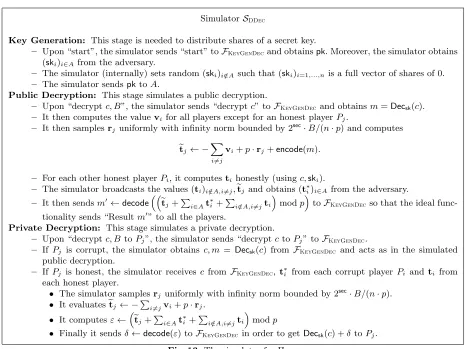
We note that some set-up assumption is always required to show UC security which is our goal here. Concretely, we assume that a functionality FKeyGen is available, as specified in Figure 2. It basically generates a key pair and shares the secret key among the players using a secret-sharing scheme that is assumed to be given as part of the specification of the cryptosystem. Since we want to allow corruption of all but one player, the maximal unqualified sets must be all sets of n−1 players.
FunctionalityFKeyGen
1. When receiving “start” from all honest players, runP←ParamGen(1κ, M), and then, using the parameters
generated, run (pk,sk)←KeyGen() (recallP, and hence 1κ, is an implicit input to all functions we specify). Sendpkto the adversary.
2. We assume a secret sharing scheme is given with whichskcan be secret-shared. Receive from the adversary a set of sharessjfor each corrupted playerPj.
3. Construct a complete set of shares (s1, . . . , sn) consistent with the adversary’s choices andsk. Note that this
is always possible since the corrupted players form an unqualified set. Sendpkto all players andsito each
honestPi.
We note that it is possible to make a weaker set-up assumption, such as a common reference string (CRS), and using a general UC secure multiparty computation protocol for the CRS model to implement FKeyGen. While this may not be very efficient, one only needs to run this protocol once in the life-time of the system.
We also want our cryptosystem to implement the functionality FKeyGenDec in Figure 3, which essentially specifies that players can cooperate to decrypt a (Bplain,Brand, C)-admissible ciphertext,
but the protocol is only secure against a passive attack: the adversary gets the correct decryption result, but can decide which result the honest players should learn.
FunctionalityFKeyGenDec
1. When receiving “start” from all honest players, run ParamGen(1κ, M), and then, using the parameters generated, run (pk,sk)←KeyGen(). Sendpkto the adversary and to all players, and storesk.
2. Hereafter on receiving “decryptc” for (Bplain, Brand, C)-admissible cfrom all honest players, send c and m←Decsk(c) to the adversary. On receiving m0 from the adversary, send “Resultm0” to all players, Both mandm0may be a special symbol⊥indicating that decryption failed.
3. On receiving “decryptctoPj” for admissiblec, ifPj is corrupt, sendc, m←Decsk(c) to the adversary. If Pjis honest, sendcto the adversary. On receivingδfrom the adversary, ifδ6∈M, send⊥toPj, ifδ∈M,
sendDecsk(c) +δ toPj.
Fig. 3.The Ideal Functionality for Distributed Key Generation and Decryption
We are now finally ready to define the basic set of properties that the underlying cryptosystem should satisfy, in order to be used in our protocol. Here we use an “information theoretic” security parametersec that controls the errors in our ZK proofs below.
Definition 1. (Admissible Cryptosystem.) Let C contain formulas of form (x1+· · ·+xn)·
(y1 +· · ·+yn) +z1+· · ·+zn, as well as all “smaller” formulas , i.e., with a smaller number of
additions and possibly no multiplication. A cryptosystem isadmissible if it is defined by algorithms (ParamGen,KeyGen,KeyGen∗,Enc,Dec)with properties as defined above, is(Bplain, Brand, C)-correct,
where
Bplain=N ·τ ·sec2·2(1/2+ν)sec, Brand=d·ρ·sec2·2(1/2+ν)sec;
and where ν > 0 can be an arbitrary constant. Finally there exist a secret sharing scheme as required inFKeyGen and a protocol ΠKeyGenDec with the property that when composed withFKeyGen
it securely implements the functionality FKeyGenDec.
The setCis defined to contain all computations on ciphertext that we need in our main protocol. Throughout the paper we will assume thatBplain, Brand are defined as here in terms ofτ, ρandsec.
This is because these are the bounds we can force corrupt players to respect via our zero-knowledge protocol, as we shall see.
4 Zero-Knowledge Proof of Plaintext Knowledge
This section presents a zero-knowledge protocol that takes as input sec ciphertexts c1, . . . , csec
has been generated fromDdρ(so we may assume thatkrik∞≤ρ). Our protocol is a zero-knowledge proof of plaintext knowledge (ZKPoPK) for the following relation:
RPoPK={(x, w)|x= (pk,c), w = ((x1,r1), . . . ,(xsec,rsec)) :
c= (c1, . . . , csec), ci←Encpk(xi,ri),
kxik∞≤Bplain, decode(xi)∈(Fpk)s, krik∞≤Brand}.
The zero-knowledge and completeness properties hold only if the ciphertextsci satisfy kxik∞≤τ and krik∞≤ρ.
In our preprocessing protocol, players will be required to give such a ZKPoPK for all ciphertexts they provide. By admissibility of the cryptosystem, this will imply that every ciphertext occurring in the protocol will be (Bplain, Brand, C)-admissible and can therefore be decrypted correctly. The
ZKPoPK can also be called with a flag diag which will modify the proof so that it additionally proves thatdecode(xi) is a diagonal element.
The protocol is not meant to implement an ideal functionality, but we can still use it and prove UC security for the main protocol, since we will always generate the challengeeby calling theFRand ideal functionality (see Appendix E). Hence the honest-verifier ZK property implies straight-line simulation5. As for knowledge extraction, the UC simulator we construct in our security proof will know the secret key for the cryptosystem and can therefore extract a dishonest prover’s witness simply by decrypting. In the reduction to show that the simulator works, we do not know the secret key, but here we are allowed to do extraction by rewinding.
The protocol and its proof of security are given in Appendix A.1, Figure 9 and its computational complexity per ciphertext is essentially the cost of a constant number of encryptions. In Appendix A.1, we also give a variant of the ZK proof that allows even smaller values forBplain, Brand, namely
Bplain =N·τ·sec2·2sec/2+8,Brand=d·ρ·sec2·2sec/2+8, and hence improves performance further.
This variant is most efficient when executed using the Fiat-Shamir heuristic (although it can also work without random oracles), and we believe this variant is the best for a practical implementation.
5 The Preprocessing Phase
In this section we construct the protocol ΠPREPwhich securely implements the functionalityFPREP (specified in Figure 16) in the presence of functionalitiesFKeyGenDec(Figure 3) andFRand(Figure 14). The preprocessing uses the above abstract cryptosystem with M = (Fpk)s, but the online
phase is designed for messages in Fpk. Therefore, we extend the notationh·iand [[·]] to messages in M: since addition and multiplication on M are componentwise, for m= (m1, . . . , ms), we define
hmi= (hm1i, . . . ,hmsi) and similarly for [[m]]. Conversely, once a representation (or a pair, triple)
on vectors is produced in the preprocessing, it will be disassembled into its coordinates, so that it can be used in the online phase. In Figures 4,5 and 6, we introduce subprotocols that are accessed by the main preprocessing protocol in several steps. Note that the subprotocols are not meant to implement ideal functionalities: their purpose is merely to summarize parts of the main protocol that are repeated in various occasions. Theorem 3 below is proved in Appendix A.5.
5F
Randcan be implemented by standard methods, and the complexity of this is not significant for the main protocol
Theorem 3. The protocolΠPREP(Figure 7) implementsFPREP with computational security against any static, active adversary corrupting up ton−1parties, in theFKeyGen,FRand-hybrid model when the underlying cryptosystem is admissible6.
ProtocolReshare
Usage: Input is em, where em = Encpk(m) is a public ciphertext and a parameter enc, where enc =
NewCiphertext or enc = NoNewCiphertext. Output is a share mi of m to each player Pi; and if enc =
NewCiphertext, a ciphertexte0m. The idea is thatem could be a product of two ciphertexts, which Reshare
converts to a “fresh” ciphertexte0m. SinceReshareuses distributed decryption (that may return an incorrect
result), it is not guaranteed thatemande0m contain the same value, but itisguaranteed that
P
imiis the
value contained ine0m.
Reshare(em, enc) :
1. Each playerPisamples a uniformfi∈(Fpk)s. Definef:=Pni=1fi.
2. Each playerPicomputes and broadcastsefi ←Encpk(fi).
3. Each playerPiruns ΠZKPoPK acting as a prover onefi. The protocol aborts if any proof fails.
4. The players computeef←ef1· · ·efn, andem+f ←emef.
5. The players invokeFKeyGenDecto decryptem+f and thereby obtainm+f.
6. P1 setsm1←m+f−f1, and each playerPi(i6= 1) setsmi← −fi.
7. If enc=NewCiphertext, all players set e0m ←Encpk(m+f)ef1· · ·efn, where a default value for
the randomness is used when computingEncpk(m+f).
Fig. 4.The sub-protocol for additively secret sharing a plaintextm∈(Fpk)s on input a ciphertextem=Encpk(m).
ProtocolPBracket
Usage: On input sharesv1, . . . ,vnprivately held by the players and public ciphertextev, this protocol generates
[[v]]. It is assumed thatP
iviis the plaintext contained inev.
PBracket(v1, . . . ,vn, ev) :
1. Fori= 1, . . . , n
(a) All players seteγi←eβiev(note thateβiis generated during the initialization process, and known
by every player)
(b) Players generate (γi1, . . . γin)←Reshare(eγi,NoNewCiphertext), so each playerPj gets a shareγ j i of v·βi.
2. Output the representation [[v]] = (v1, . . . ,vn,(βi, γi1, . . . , γin)i=1,...,n). Fig. 5.The sub-protocol for generating [[v]].
ProtocolPAngle
Usage: On input sharesv1, . . . ,vnprivately held by the players and public ciphertextev, this protocol generates
hvi. It is assumed thatP
iviis the plaintext contained inev.
PAngle(v1, . . . ,vn, ev) :
1. All players set ev·α ←eveα (note thateα is generated during the initialization process, and known
by every player)
2. Players generate (γ1, . . . , γn)←Reshare(ev·α,NoNewCiphertext), so each playerPigets a shareγiofα·v.
3. Output representationhvi= (0,v1, . . . ,vn, γ1, . . . , γn).
Fig. 6.The sub-protocol for generatinghvi.
6The definition of admissible cryptosystem demands a decryption protocol that implements F
KeyGenDec based on
Protocol ΠPREP
Usage: The Triple-step is always executedsectimes in parallel. This ensures that when calling ΠZKPoPK, we can always give it thesecciphertexts it requires as input. In addition both ΠZKPoPKand ΠPREPcan be executed
in a SIMD fashion, i.e. they are data-oblivious bar when they detect an error. Thus we can execute ΠZKPoPK
and ΠPREPon the packed plaintext space (Fpk)s. Thereby, we generates·secelements in one go and then
buffer the generated triples, outputting the next unused one on demand.
Initialize: This step generates the global keyαand “personal keys”βi.
1. The players call “start” onFKeyGenDecto obtain the public keypk
2. Each playerPigenerates a MAC-keyβi∈Fpk
3. Each playerPigeneratesαi∈Fpk. Letα:=Pni=1αi
4. Each playerPicomputes and broadcastseαi←Encpk(Diag(αi)),eβi←Encpk(Diag(βi))
5. Each playerPi invokes ΠZKPoPK (withdiagset to true) acting as prover on input (eαi, . . . , eαi) and on
input (eβi, . . . , eβi), whereeαi, eβi are repeatedsectimes, which is the number of ciphertexts ΠZKPoPK
requires as input. (This is not very efficient, but only needs to be done once for each player.)
6. All players computeeα←eα1· · ·eαn, and generate [[Diag(α)]]←PBracket(Diag(α1), . . . ,Diag(αn), eα) Pair: This step generates a pair [[r]],hri, and can be used to generate a single value [[r]], by not performing the
call toPangle
1. Each playerPigeneratesri∈(Fpk)s. Letr:=Pni=1ri
2. Each playerPicomputes and broadcastseri ←Encpk(ri). Leter=er1· · ·ern
3. Each playerPiinvokes ΠZKPoPK acting as prover on the ciphertext he generated
4. Players generate [[r]]←PBracket(r1, . . . ,rn, er),hri ←PAngle(r1, . . . ,rn, er) Triple: This step generates a multiplicative triplehai,hbi,hci
1. Each playerPigeneratesai,bi∈(Fpk)s. Leta:=Pni=1ai,b:=Pni=1bi
2. Each playerPicomputes and broadcastseai ←Encpk(ai),ebi ←Encpk(bi)
3. Each playerPiinvokes ΠZKPoPK acting as prover on the ciphertexts he generated.
4. The players setea←ea1· · ·ean andeb←eb1· · ·ebn
5. Players generatehai ←PAngle(a1, . . . ,an, ea),hbi ←PAngle(b1, . . . ,bn, eb).
6. All players computeec←eaeb
7. Players set (c1, . . . ,cn, e0c)←Reshare(ec,NewCiphertext).
8. Players generatehci ←PAngle(c1, . . . ,cn, e0c).
Fig. 7.The protocol for constructing the global key [[α]], pairs [[r]],hriand multiplicative tripleshai,hbi,hci.
6 Concrete Instantiation of the Abstract Scheme based on LWE
We now describe the concrete scheme, which is based on the somewhat homomorphic encryption scheme of Brakerski and Vaikuntanathan (BV) [7]. The main differences are that we are only interested in evaluation of circuits of multiplicative depth one, we are interested in performing operations in parallel on multiple data items, and we require a distributed decryption procedure. In this section we detail the scheme and the distributed decryption procedure; in Appendix D we discuss security of the scheme, and present some sample parameter sizes and performance figures.
ParamGen(1κ, M): Recall the message space is given byM = (Fpk)s for two integerskands, and a primep, i.e. the message space isscopies of the finite field Fpk. To map this to our scheme below, one first finds a cyclotomic polynomial F(X) := Φm(X) of degree N := φ(m), where N is lower
bounded by some function of the security parameter κ. The polynomial F(X) needs to be such that modulop the polynomialF(X) factors intol0 irreducible factors of degreek0 wherel0 ≥sand kdividesk0. We then define an algebraAp asAp :=Fp[X]/F(X) and we have an embedding ofM
intoAp,φ:M →Ap. By “lifting” modulo pwe see that there is a natural inclusion ι:Ap →ZN, which maps the polynomial of degree less than N with coefficients in Fp into the integer vector
ι(φ(m)) for m∈(Fpk)s, with decode defined by φ−1(x (modp)) forx∈ZN. It is clear, by choice of the natural inclusionι, that kencode(m)k∞≤p/2 =τ.
We pick a large integerq, whose size we will determine later, and definedAq := (Z/qZ)[X]/F(X), i.e. the ring of integer polynomials modulo reduction by F(X) and q. In practice we consider the image of encode to lie in Aq, and thus we abuse notation, by writing addition and multiplication
in Aq by + and ·. Note, that this means that applying decode to elements obtained from encode
followed by a series of arithmetic operations may not result in the value in M which one would expect. This corresponds to where our scheme can only evaluate circuits from a given setC.
The ciphertext space G is defined to be A3q, with addition defined componentwise. The multiplicative operatoris defined as follows
(a0,a1,0)(b0,b1,0) := (a0·b0,a1·b0+a0·b1,−a1·b1),
i.e. multiplication is only defined on elements whose third coefficient is zero.
We define Ddρas follows: The discrete GaussianDZN,s, with Gaussian parameters, is defined to be the random variable on ZNq (centered around the origin) obtained from samplingx∈RN, with
probability proportional to exp(−π· kxk2/s2), and then rounding the result to the nearest lattice
point and reducing it modulo q. Note, sampling from the distribution with probability density function proportional to exp(−π · kxk2/s2), means using a normal variate with mean zero, and
standard deviation r := s/√2·π. In our concrete scheme we set d := 3·N and define Ddρ to be the distribution defined by (DZN,s)3. Note, that in the notation Ddρ the implicit dependence on q has been suppressed to ease readability. The determining of q and r as functions of all the other parameters, we leave until we discuss security of the scheme.
KeyGen(): We will use the public key version of the Brakerski–Vaikuntanathan scheme [7]. Given the above set up, key generation proceeds as follows: First one samples elements a ← Aq and
s,e ← DZN,s. Then treating s and e as elements of Aq one computes b ← (a·s) + (p·e). The
public and private key are then set to be pk←(a,b) and sk←s.
Encpk(x,r): Given a messagex←encode(m) wherem∈M, andr∈Ddρ, we proceed as follows: The
element ris parsed as (u,v,w)∈(ZN)3. Then the encryptor computesc0 ←(b·v) + (p·w) +x
and c1 ←(a·v) + (p·u). Finally returning the ciphertext (c0,c1,0).
Decsk(c): Given a secret key sk = s and a ciphertext c = (c0,c1,c2) this algorithm computes
the element in Aq satisfying t = c0 −(s·c1)−(s·s·c2). On reduction by q the value of ktk∞
will be bounded by a relatively small constant B; assuming of course that the “noise” within a ciphertext has not grown too large. We shall refer to the value t mod q as the “noise”, despite it also containing the message to be decrypted. At this point the decryptor simply reducest modulo p to obtain the desired plaintext in Aq, which can then be decoded via thedecode algorithm. KeyGen∗(): This simply samplesba,bb←Aq and returns cpk:= (ba,bb).
Following the discussion in [7] we see that with this fixedciphertext space, our scheme is some-what homomorphic. It can support a relatively large number of addition operations, and a single multiplication.
as
s=s1,1+· · ·+sn,1, s·s=s1,2+· · ·+sn,2.
As remarked earlier this one-time setup procedure can be accomplished by standard UC-secure multiparty computation protocols such as that described in [5]. The following theorem is proved in Appendix A.6. It depends on the constant B defined above. In Appendix D we compute the value ofBwhen the input ciphertext is (Bplain, Brand, C)-admissible, and show how to choose parameters
for the cryptosystem such that the required bound onB is satisfied.
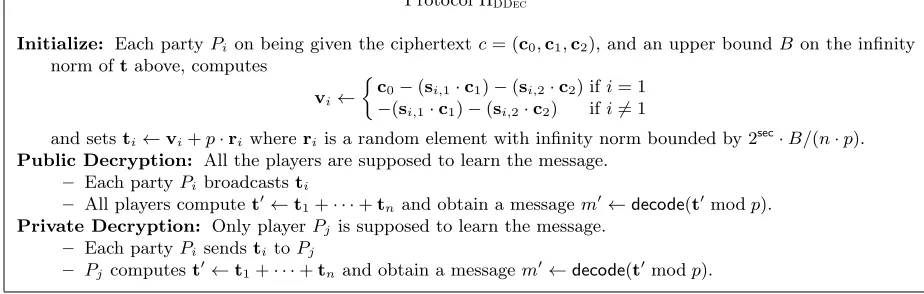
Theorem 4. In theFKeyGen-hybrid model, the protocol ΠDDec(Figure 8) implements FKeyGenDec with statistical security against any static active adversary corrupting up to n−1 parties if B+ 2sec·B < q/2.
Protocol ΠDDec
Initialize: Each partyPi on being given the ciphertextc= (c0,c1,c2), and an upper boundB on the infinity norm oftabove, computes
vi←
c0−(si,1·c1)−(si,2·c2) ifi= 1 −(si,1·c1)−(si,2·c2) ifi6= 1
and setsti←vi+p·riwhereriis a random element with infinity norm bounded by 2sec·B/(n·p). Public Decryption: All the players are supposed to learn the message.
– Each partyPi broadcaststi
– All players computet0←t1+· · ·+tnand obtain a messagem0←decode(t0modp).
Private Decryption: Only playerPjis supposed to learn the message. – Each partyPi sendstitoPj
– Pj computest0←t1+· · ·+tn and obtain a messagem0←decode(t0modp).
Fig. 8.The distributed decryption protocol.
7 Acknowledgements
The first, second and fourth author acknowledge support from the Danish National Research Foun-dation and The National Science FounFoun-dation of China (under the grant 61061130540) for the Sino-Danish Center for the Theory of Interactive Computation, within which [part of] this work was performed; and also from the CFEM research center (supported by the Danish Strategic Research Council) within which part of this work was performed.
The third author was supported by the European Commission through the ICT Programme under Contract ICT-2007-216676 ECRYPT II and via an ERC Advanced Grant ERC-2010-AdG-267188-CRIPTO, by EPSRC via grant COED–EP/I03126X, the Defense Advanced Research Projects Agency (DARPA) and the Air Force Research Laboratory (AFRL) under agreement number FA8750-11-2-0079, and by a Royal Society Wolfson Merit Award. The US Government is autho-rized to reproduce and distribute reprints for Government purposes notwithstanding any copyright notation hereon. The views and conclusions contained herein are those of the authors and should not be interpreted as necessarily representing the official policies or endorsements, either expressed or implied, of DARPA, AFRL, the U.S. Government, the European Commission or EPSRC.
References
1. S. Arora and R. Ge. New algorithms for learning in presence of errors. In L. Aceto, M. Henzinger, and J. Sgall, editors,ICALP (1), volume 6755 ofLecture Notes in Computer Science, pages 403–415. Springer, 2011. 2. G. Asharov, A. Jain, A. L´opez-Alt, E. Tromer, V. Vaikuntanathan, and D. Wichs. Multiparty computation with
low communication, computation and interaction via threshold fhe. In D. Pointcheval and T. Johansson, editors,
EUROCRYPT, volume 7237 ofLecture Notes in Computer Science, pages 483–501. Springer, 2012.
3. D. Beaver. Efficient multiparty protocols using circuit randomization. In J. Feigenbaum, editor, CRYPTO, volume 576 ofLecture Notes in Computer Science, pages 420–432. Springer, 1991.
4. E. Ben-Sasson, S. Fehr, and R. Ostrovsky. Near-linear unconditionally-secure multiparty computation with a dishonest minority. IACR Cryptology ePrint Archive, 2011:629, 2011.
5. R. Bendlin, I. Damg˚ard, C. Orlandi, and S. Zakarias. Semi-homomorphic encryption and multiparty computation. InEUROCRYPT, pages 169–188, 2011.
6. Z. Brakerski, C. Gentry, and V. Vaikuntanathan. Fully homomorphic encryption without bootstrapping. Elec-tronic Colloquium on Computational Complexity (ECCC), 18:111, 2011.
7. Z. Brakerski and V. Vaikuntanathan. Fully homomorphic encryption from ring-lwe and security for key dependent messages. In P. Rogaway, editor,CRYPTO, volume 6841 ofLecture Notes in Computer Science, pages 505–524. Springer, 2011.
8. R. Canetti, Y. Lindell, R. Ostrovsky, and A. Sahai. Universally composable two-party and multi-party secure computation. InSTOC, pages 494–503, 2002.
9. Y. Chen and P. Q. Nguyen. Bkz 2.0: Better lattice security estimates. In D. H. Lee and X. Wang, editors,
ASIACRYPT, volume 7073 of Lecture Notes in Computer Science, pages 1–20. Springer, 2011.
10. R. Cramer, I. Damg˚ard, and V. Pastro. On the amortized complexity of zero knowledge protocols for multiplica-tive relations. InICITS, 2012. To appear.
11. I. Damg˚ard, M. Keller, E. Larraia, C. Miles, and N. P. Smart. Implementing aes via an actively/covertly secure dishonest-majority mpc protocol. IACR Cryptology ePrint Archive, 2012:262, 2012.
12. I. Damg˚ard and J. B. Nielsen. Perfect hiding and perfect binding universally composable commitment schemes with constant expansion factor. In M. Yung, editor, CRYPTO, volume 2442 of Lecture Notes in Computer Science, pages 581–596. Springer, 2002.
13. I. Damg˚ard and C. Orlandi. Multiparty computation for dishonest majority: From passive to active security at low cost. InCRYPTO, pages 558–576, 2010.
14. N. Gama and P. Q. Nguyen. Predicting lattice reduction. In N. P. Smart, editor,EUROCRYPT, volume 4965 ofLecture Notes in Computer Science, pages 31–51. Springer, 2008.
15. C. Gentry. Fully homomorphic encryption using ideal lattices. In M. Mitzenmacher, editor,STOC, pages 169–178. ACM, 2009.
16. C. Gentry, S. Halevi, and N. P. Smart. Fully homomorphic encryption with polylog overhead. In D. Pointcheval and T. Johansson, editors,EUROCRYPT, volume 7237 ofLecture Notes in Computer Science, pages 465–482. Springer, 2012.
17. Y. Ishai, E. Kushilevitz, R. Ostrovsky, and A. Sahai. Zero-knowledge from secure multiparty computation. In D. S. Johnson and U. Feige, editors,STOC, pages 21–30. ACM, 2007.
18. Y. Ishai, M. Prabhakaran, and A. Sahai. Founding cryptography on oblivious transfer - efficiently. In D. Wagner, editor,CRYPTO, volume 5157 ofLecture Notes in Computer Science, pages 572–591. Springer, 2008.
19. Y. Lindell. Highly-efficient universally-composable commitments based on the ddh assumption. InEUROCRYPT, pages 446–466, 2011.
20. R. Lindner and C. Peikert. Better key sizes (and attacks) for lwe-based encryption. In A. Kiayias, editor,
CT-RSA, volume 6558 ofLecture Notes in Computer Science, pages 319–339. Springer, 2011.
21. V. Lyubashevsky. Fiat-shamir with aborts: Applications to lattice and factoring-based signatures. In M. Matsui, editor,ASIACRYPT, volume 5912 ofLecture Notes in Computer Science, pages 598–616. Springer, 2009. 22. V. Lyubashevsky, C. Peikert, and O. Regev. On ideal lattices and learning with errors over rings. 2011.
Manuscript.
23. D. Micciancio and O. Regev. Lattice-based cryptography, 2008.
24. S. Myers, M. Sergi, and abhi shelat. Threshold fully homomorphic encryption and secure computation. IACR Cryptology ePrint Archive, 2011:454, 2011.
25. J. B. Nielsen, P. S. Nordholt, C. Orlandi, and S. S. Burra. A new approach to practical active-secure two-party computation. IACR Cryptology ePrint Archive, 2011:91, 2011.
27. N. P. Smart and F. Vercauteren. Fully homomorphic simd operations.IACR Cryptology ePrint Archive, 2011:133, 2011.
28. S. Winkler and J. Wullschleger. On the efficiency of classical and quantum oblivious transfer reductions. In
CRYPTO, pages 707–723, 2010.
A Proofs
A.1 Zero-Knowledge Proof
Construction of the Protocol. We will give two versions of the protocol. The first is a standard 3-move protocol, the second uses an “abort” technique to optimize the parameter values, this one is best suited for use with the Fiat-Shamir heuristic, and may be the best option for a practical implementation.
For the protocol, we will need thatτ =p/2, so thatkencode(m)k∞≤τ =p/2. This means that each entry in encode(m) corresponds to a uniquely determined residue mod p (or equivalently an element in Zp) and conversely each such residue is uniquely determined by m. We did not ask for
this in the abstract description, but the concrete instantiation satisfies this. Note that one problem we need to address in the protocol is that not all vectors in the input domain of decode will give us results in Fpk. However, if an input is equivalent mod p to encode(m) for some m then this is indeed the case, since then decode will return m. Therefore the verifier explicitly checks whether the encodings the prover sends him decode to legal values, this will imply that the ciphertexts in question also decode to legal values.
We let R denote the matrix in Zsec×dwhose ith row is ri. It makes use of a matrixMe defined as follows. Let V := 2·sec−1. For e∈ {0,1}sec we define M
e ∈ ZV×sec to be the matrix whose (i, k)-th entry is given by ei−k+1, for 1≤i−k+ 1≤secand 0 otherwise.
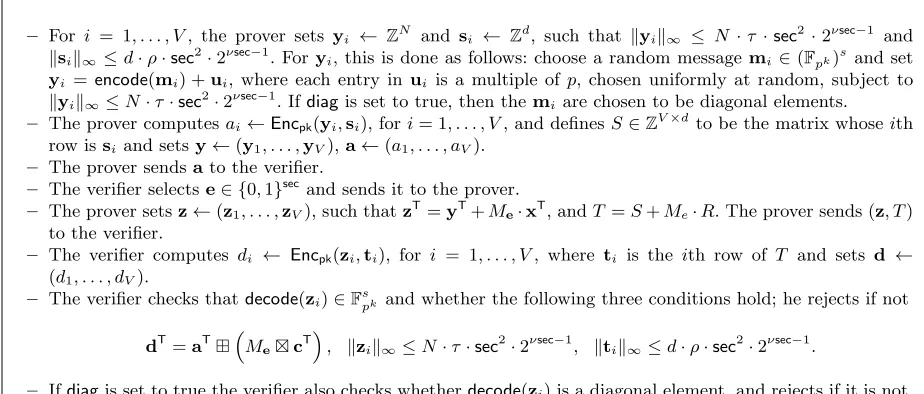
Protocol ΠZKPoPK
– For i = 1, . . . , V, the prover sets yi ← ZN and si ← Zd, such that kyik∞ ≤ N ·τ ·sec2 ·2νsec−1 and ksik∞≤d·ρ·sec2·2νsec−1. Foryi, this is done as follows: choose a random messagemi∈(Fpk)s and set yi =encode(mi) +ui, where each entry inui is a multiple of p, chosen uniformly at random, subject to kyik∞≤N·τ·sec2·2νsec−1
. Ifdiagis set to true, then themiare chosen to be diagonal elements.
– The prover computesai←Encpk(yi,si), fori= 1, . . . , V, and definesS∈ZV×dto be the matrix whoseith row issiand setsy←(y1, . . . ,yV),a←(a1, . . . , aV).
– The prover sendsato the verifier.
– The verifier selectse∈ {0,1}secand sends it to the prover.
– The prover setsz←(z1, . . . ,zV), such thatzT=yT+Me·xT, andT =S+Me·R. The prover sends (z, T)
to the verifier.
– The verifier computes di ← Encpk(zi,ti), for i = 1, . . . , V, where ti is the ith row of T and sets d ←
(d1, . . . , dV).
– The verifier checks thatdecode(zi)∈Fspkand whether the following three conditions hold; he rejects if not
dT=aTMecT
, kzik∞≤N·τ·sec2·2νsec−1, ktik∞≤d·ρ·sec2·2νsec−1.
– Ifdiagis set to true the verifier also checks whetherdecode(zi) is a diagonal element, and rejects if it is not.
Fig. 9.The ZKPoPK Protocol, interactive version.
Proof (Theorem 5).
Completeness: Assume the prover is honest. For i = 1, . . . , V the verifier checks if Encpk(zi,ti)
equals aiMe,i·cT, sinceMe,i is a scalar matrix we write multiplication with·as opposed to .
The check passes because of the following relation:
ai
Me,i·cT
=Encpk(yi,si)seck=1(Me,i,k·ck)
=Encpk(yi,si)seck=1(Me,i,k·Encpk(xk,rk))
=Encpk yi+ sec
X
k=1
Me,i,k·xk, si+ sec
X
k=1
Me,i,k·rk
!
=Encpk
yi+Me,i·xT, si+Me,i·rT
=Encpk(zi,ti).
Moreover, given thatzi=yi+Me,i·xT and that all ciphertexts incare (τ, ρ)-ciphertexts, we get
that each single coordinate in Me,i·xT is numerically at most sec·τ. Each coordinate of yi was
chosen from an interval that is a factor N ·sec·2νsec−1 larger. By a union bound bound over the N·seccoordinates involved, each coordinate in zi fails to be in the required range with probability
exponentially small insec. A similar argument shows that the checkktik∞ also fails with negligible
probability. Finally, each yi was constructed to be congruent mod p to the encoding of a value in
Fspk. Since this is also the case for thexi’s if the prover is honest, the same is true for thezi’s, and
they therefore decode to a value inFspk. Ifdiagwas set to true, allxi,yi contain diagonal plaintexts,
and then the same is true for the zi.
Soundness: We consider a prover making a verifier accept both (x,a,e,(z, T)) and (x,a,e0,(z0, T0)) with e 6= e0. Since both checks dT = aT(Me·cT) and d0T = aT(Me0 ·cT) passed, one can
subtract the two equalities and obtain
(Me−Me0)cT= dd0T (1)
In order to findxandRsuch thatck=Encpk(xk,rk) fork= 1, . . . ,sec, we first solve (1) as a linear
system in c. Let j be the highest index such that ej 6=e0j. The sec×sec submatrix of Me−Me0,
consisting of the rows of Me−Me0 between j and j+sec−1 both included, is upper triangular
with entries in {−1,0,1} and its diagonal consists of the non-zero value ej−e0j (so it is possible
to find a solution for c). Since the verifier has values zi,ti,z0i,t0i such that di =Encpk(zi,ti) and
d0i=Encpk(z0i,ti0), and given thatci=Encpk(xi,ri), it is possible to directly solve the linear system
inx and R (since the cryptosystem is additively homomorphic), from the bottom equation to the one “in the middle” with indexsec/2. Sincekzik∞,kz0ik∞≤N·τ·sec2·2νsec−1 andktik∞,kt0ik∞≤ d·ρ·sec2·2νsec−1, we conclude that csec−i is a (s·τ ·sec2·2νsec+i, d·ρ·sec2·2νsec+i)-ciphertext
(by induction on i). To solve for c1, . . . csec/2, we consider the lowest index j such that ej 6= e0j,
construct an lower triangular matrix in a similar way as above, and solve from the first equation downwards. We conclude thatccontains (N·τ·sec2·2(1/2+ν)sec, d·ρ·sec2·2(1/2+ν)sec)-ciphertexts. We note that since the verifier accepted, each zi has small norm and decodes to a value in
(Fpk)s. Since we can write xi as a linear combination of the zi, it follows from correctness of the
cryptosystem that thexi also decode to values in (Fpk)s. Finally, ifdiag was set to true, the verifier
only accepts if allzidecode to diagonal values. Again, since we can writexi as a linear combination
Zero-Knowledge: We give an honest-verifier simulator for the protocol that outputs accepting con-versations. In order to simulate one repetition, the simulator samples e∈ {0,1}sec uniformly and
z, T uniformly with the constrain thatd contains random ciphertexts satisfying the verifiers check, i.e.,zi,tiare uniform, subject tokzik∞≤N·τ·sec2·2νsec−1,ktik∞≤d·ρ·sec2·2νsec−1, where more-overziis generated asencode(mi)+uiwheremiis a random plaintext (diagonal ifdiagis set to true)
and ui contains multiples ofpthat are uniformly random, subject to kzik∞≤N·τ ·sec2·2νsec−1. Finally, a is computed as aT ← dT (Me·cT). In the real conversation, the provers choice of values in zi andti are statistically close to the distribution used by the simulator. This is because
the prover uses the same method to generate these values, except that he adds in some vectors of exponentially smaller norm which leads to a statistically close distribution. Since e has the correct distribution and a follows deterministically from the last two messages, the simulation is statistically indistinguishable.
u t
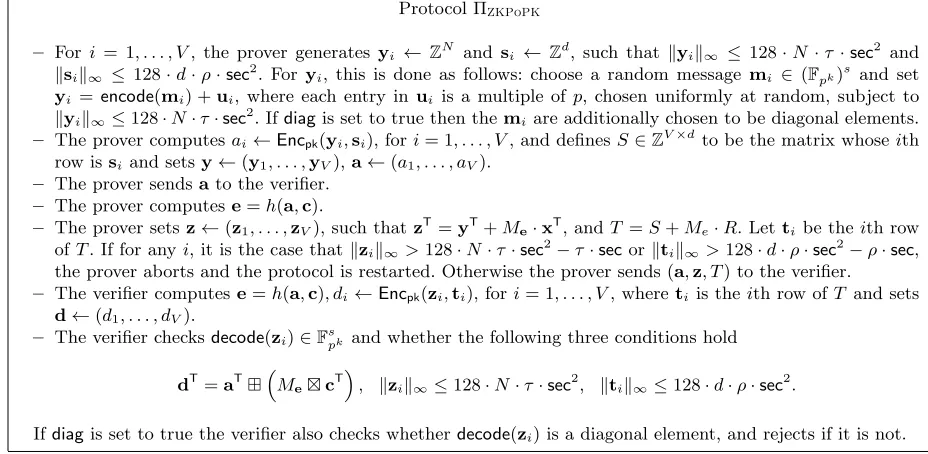
We now give a protocol that leads to smaller values of the parameters and hence also allows better parameters for the underlying cryptoystem. This version, however, is better suited for use with the Fiat-Shamir heuristic. The idea is to let the prover choose his randomness in a smaller interval, and abort if the last message would reveal too much information. This is an idea from [21]. When using the Fiat-Shamir heuristic, this is not a problem as he prover only needs to show a successful attempt to he verifier. We leth be a suitable hash function that outputssec-bit strings.
Protocol ΠZKPoPK
– For i = 1, . . . , V, the prover generatesyi ←ZN and si ← Zd, such that kyik∞ ≤ 128·N ·τ ·sec2 and ksik∞ ≤ 128·d·ρ·sec2. For yi, this is done as follows: choose a random message mi ∈ (Fpk)s and set yi =encode(mi) +ui, where each entry inui is a multiple of p, chosen uniformly at random, subject to kyik∞≤128·N·τ·sec2. Ifdiagis set to true then themiare additionally chosen to be diagonal elements.
– The prover computesai←Encpk(yi,si), fori= 1, . . . , V, and definesS∈ZV×dto be the matrix whoseith row issiand setsy←(y1, . . . ,yV),a←(a1, . . . , aV).
– The prover sendsato the verifier.
– The prover computese=h(a,c).
– The prover setsz←(z1, . . . ,zV), such thatzT=yT+Me·xT, andT =S+Me·R. Lettibe theith row
ofT. If for anyi, it is the case thatkzik∞>128·N·τ·sec2−τ·secorktik∞>128·d·ρ·sec2−ρ·sec, the prover aborts and the protocol is restarted. Otherwise the prover sends (a,z, T) to the verifier.
– The verifier computese=h(a,c), di←Encpk(zi,ti), fori= 1, . . . , V, whereti is theith row ofT and sets d←(d1, . . . , dV).
– The verifier checksdecode(zi)∈Fspk and whether the following three conditions hold
dT=aTMecT
, kzik∞≤128·N·τ·sec2, ktik∞≤128·d·ρ·sec2.
Ifdiagis set to true the verifier also checks whetherdecode(zi) is a diagonal element, and rejects if it is not.
Fig. 10.The ZKPoPK Protocol, version for Fiat-Shamir heuristic.
We claim that the Fiat-Shamir based protocol is a proof of knowledge for the relation in question in the random oracle model. In this case, however, we can guarantee that the adversarially generated ciphertexts are (N·τ·sec2·2sec/2+8, d·ρ·sec2·2sec/2+8)- ciphertexts.
Completeness: Assume the prover is honest. Note first that eachyiwas constructed to be congruent
honest, the same is true for thezi’s, and they therefore always decode to a value in (Fpk)s. Ifdiag was set to true, all xi,yi contain diagonal plaintexts, and then the same is true for thezi.
Next, fori= 1, . . . , V the verifier checks ifEncpk(zi,ti) equalsaiMe,i·cT, sinceMe,iis a scalar
matrix we write multiplication with· as opposed to. The check passes because of the following relation:
ai
Me,i·cT
=Encpk(yi,si)seck=1(Me,i,k·ck)
=Encpk(yi,si)seck=1(Me,i,k·Encpk(xk,rk))
=Encpk yi+
sec
X
k=1
Me,i,k·xk, si+ sec
X
k=1
Me,i,k·rk
!
=Encpk
yi+Me,i·xT, si+Me,i·rT
=Encpk(zi,ti).
Moreover, given thatzi=yi+Me,i·xT and that all ciphertexts incare (τ, ρ)-ciphertexts, we get
that each single coordinate in Me,i·xT is numerically at most sec·τ. Each coordinate of yi was
chosen from an interval that is a factor 128·N ·sec larger. Therefore each coordinate in zi fails
to be in the required range with probability 1/(128·N ·sec). Note that this probability does not depend on the concrete values of the coordinates in Me,i·xT, only on the bound on the numeric
value.
By a union bound over theN coordinates ofzi we get thatkzik∞≤128·N·τ·sec2−τ·secfails with probability at most 1/(128·sec), and by a final union bound over the 2 sec−1 ciphtertexts that all checks on the zi’s are ok except with probability at most 1/64. A similar argument shows that
the checkktik∞≤128·d·ρ·sec2−ρ·secfails also with probability at most 1/64. The conclusion is that the prover will abort with probability at most 1/32, so we expect to only have to repeat the protocol once to have success.
Soundness: By a standard argument, a prover who can efficiently produce a valid proof is able to produce (x,a,e,(z, T)) and (x,a,e0,(z0, T0)) withe6=e0 that the verifier would accept. Since both checks dT=aT(Me·cT) and d0T=aT(Me0·cT) passed, one can subtract the two equalities
and obtain
(Me−Me0)cT= dd0T (2)
In order to findxandRsuch thatck=Encpk(xk,rk) fork= 1, . . . ,sec, we first solve (2) as a linear
system in c. Let j be the highest index such that ej 6=e0j. The sec×sec submatrix of Me−Me0,
consisting of the rows of Me−Me0 between j and j+sec−1 both included, is upper triangular
with entries in {−1,0,1} and its diagonal consists of the non-zero value ej−e0j (so it is possible
to find a solution for c). Since the verifier has values zi,ti,z0i,t0i such that di =Encpk(zi,ti) and
d0i=Encpk(z0i,ti0), and given thatci=Encpk(xi,ri), it is possible to directly solve the linear system
inx and R (since the cryptosystem is additively homomorphic), from the bottom equation to the one “in the middle” with index sec/2.
Since kzik∞,kz0ik∞≤128·N ·τ·sec2 and ktik∞,kt0ik∞≤128·d·ρ·sec2, we conclude thatcsec−i
must be a (256·N ·τ ·2i ·sec2,256·d·ρ·2i ·sec2)-ciphertext (by induction on i). To solve for c1, . . . csec/2, we consider thelowestindexj such thatej 6=e0j, construct an lower triangular matrix
We note that since the verifier accepted, each zi has small norm and decodes to a value in
(Fpk)s. Since we can write xi as a linear combination of the zi, it follows from correctness of the
cryptosystem that the xi also decode to values (Fpk)s. Finally, if diag was set to true, the verifier only accepts if allzidecode to diagonal values. Again, since we can writexi as a linear combination
of the zi, thexi also decode to diagonal values.
Zero-Knowledge: We give an honest-verifier simulator for the protocol that outputs an accepting conversation (that does not abort).
In order to simulate one repetition, the simulator samples e ∈ {0,1}sec uniformly and z, T
uniformly with the constrain thatdcontains random (8·N·τ·sec2−τ·sec,8·d·ρ·sec2−ρ·sec )-ciphertexts. where moreover zi is generated as encode(mi) +ui where mi is a random plaintext
(a diagonal one if diag is set to true) and ui contains multiples of p that are uniformly random,
subject tokzik∞≤8N·τ·sec2−τ·sec. Finally,ais computed asaT←dT(Me·cT). Define the random oracle to outputeon inputa,c, output (a,e,(z, T)) and stop.
We argue that this simulation is perfect: The distribution of a simulated eis the same as a real one. Also, it is straightforward to see that in a real conversation, given that the prover does not abort, the vectors zi,ti will be uniformly random, subject to kzik∞ ≤ 8·s·τ ·sec2−τ ·sec and ktik∞≤8·d·ρ·sec2−ρ·sec. So the simulator chooses zi,ti with exactly the right distribution.
Since the value of afollows deterministically from the e,zi,ti, we have what we wanted.
Doing without random oracles. The above protocol can also be executed without using the Fiat-Shamir heuristic. In this case, the prover will start sec/5 instances of the protocol, computing
a1, . . . ,asec/5. We choose this number of instance because it will ensure that the prover fails on all
of them with probability only (1/32)sec/5 = 2−sec. The prover commits to all these values, which can be done, for instance, with a Merkle hash tree, in which case the commitment will be very short, and any of a’s can be opened by sending a piece of information that is only logarithmic in
sec.
The verifier selects e, the prover finds an instance where he would not abort the protocol with this e, opens the correspondinga and completes that instance.
This is complete and zero-knowledge by the same argument as above plus the hiding property of the commitment scheme used. Soundness follows from the fact that if the prover succeeds with probability significantly greater that 2−sec·sec/5 he must be able to answer different challenges correctly for some fixed instance out of the sec/5 we have. Such answers can be extracted by rewinding, and then the rest of the argument is the same as above.
A.2 The UC Model
In the following sections, we show that the online and preprocessing phases of our protocol are secure in the UC model. We briefly recall how this model works: we will use the variant where there is only one adversarial entity, the environment Z. The environment chooses inputs for the honest players and gets their outputs when the protocol is done. It also does an attack on the protocol which is our case means that it corrupts up to n−1 of the players and takes control over their actions. WhenZ stops, it outputs a bit. This process where Z interacts with the real players and protocol is called the real process.
![Fig. 5. The sub-protocol for generating [[v]].](https://thumb-us.123doks.com/thumbv2/123dok_us/1876728.1244397/12.612.69.535.366.475/fig-the-sub-protocol-for-generating-v.webp)
![Fig. 7. The protocol for constructing the global key [[α]], pairs [[r]], ⟨r⟩ and multiplicative triples ⟨a⟩, ⟨b⟩, ⟨c⟩](https://thumb-us.123doks.com/thumbv2/123dok_us/1876728.1244397/13.612.70.533.48.413/fig-protocol-constructing-global-key-pairs-multiplicative-triples.webp)
![Fig. 16. The ideal functionality for making the global key [[α]], pairs [[r]], ⟨r⟩ and triples ⟨a⟩, ⟨b⟩, ⟨c⟩](https://thumb-us.123doks.com/thumbv2/123dok_us/1876728.1244397/46.612.71.535.94.645/fig-ideal-functionality-making-global-key-pairs-triples.webp)