Systems
ChangKyun Kim, Eun-Gu Jung, Dong Hoon Lee, Chang-Ho Jung, and Daewan Han
ETRI, Korea
{kimck, egjung, dlee, zangho, dwh}@ensec.re.kr
Abstract. The cryptographic algorithm called INCrypt32 is a MAC al-gorithm to authenticate participants, RFID cards and readers, in HID Global’s iCLASS systems. HID’s iCLASS cards are widely used contact-less smart cards for physical access control. Although INCrypt32 is a heart of the security of HID’s iCLASS systems, its security has not been evaluated yet since the specification has not been open to public. In this paper, we reveal the specification of INCrypt32 by reverse engi-neering an iCLASS card and investigate the security of INCrypt32. As a result, we show that the secret key of size 64 bits can be recovered using only 218MAC queries if the attacker can request MAC for chosen
messages of arbitrary length. If the length of messages is limited to pre-determined values by the authentication protocol, the required number of MAC queries grows to 242to recover the secret key.
Key words: INCrypt32, HID’s iCLASS, RFID, reverse engineering, chosen message attack.
1
Introduction
Nowadays Radio Frequency Identification (RFID) is widely used in our life such as electronic payment system and access control. Since wireless communi-cation is easy to intercept and tamper with, its security is a major concern to cryptographic researchers, especially when RFID systems use some proprietary cryptographic algorithms and unpublished protocols. The most representative examples are NXP’s MIFARE Classic systems [10] and HID Global’s iCLASS systems [8].
According to Kerckhoffs’s principal, a proprietary algorithm does not enhance the security of the system [2]. In case of MIFARE Classic, Nohl and Pl¨otz have reverse engineered the hardware of the MIFARE Classic card and introduced weaknesses in its proprietary primitive [6]. So far, several related papers [3, 5, 7, 1] have been published and MIFARE Classic system is considered to be fully broken. One can easily recover a secret key of a MIFARE Classic card and replicate it by using a card emulator such as Proxmark III and OpenPCD.
reader [4]. However, they have not recovered the proprietary cryptographic al-gorithm and the details of security protocols. This means that although the attacker is only able to access (read and write) iCLASS cards, they cannot replicate cards because the diversified key of each card and the details of the proprietary cryptographic algorithm are required to replicate cards.
Our Contribution This paper describes the proprietary cryptographic algo-rithm called INCrypt321 of HID’s iCLASS systems. With authors’ best
knowl-edge, this is the first published work to describe the details of the INCrypt32 algorithm. We fully recover the INCrypt32 algorithm and communication pro-tocols.
Furthermore, we investigate the security of INCrypt32. Our study shows that INCrypt32 is vulnerable to chosen message attacks. If attacker is allowed to request MAC for arbitrary messages, then the secret key can be recovered within 218 MAC queries. If the length of messages is limited to the specified value (determined by an authentication protocol), then the required number of MAC queries grows to 242.
Organization This paper is organized as follows. The next section briefly de-scribes the structure of the HID’s iCLASS card and the overview of the au-thentication protocol between iCLASS cards and readers [9]. In Section 3, we explain how to reveal INCrypt32 algorithm and introduce the full description of the algorithm. But we omit the details of reverse engineering procedure since it is beyond the scope of this paper. In Section 4, we present the weaknesses of INCrypt32. Finally, we conclude in Section 5.
2
Preliminaries
2.1 Structure of HID’s iCLASS Cards
HID’s iCLASS cards are widely used contactless smart cards for physical access control and are compliant with ISO 15693 and 14443B standards. The iCLASS card is fundamentally a memory card with simple security mechanisms for access control. The memory is divided into data blocks which are grouped into application areas.
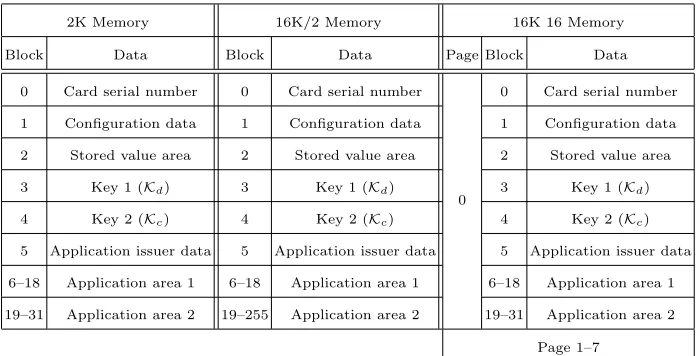
The iCLASS 2K (256-byte) has 32 blocks configured with 2 application areas. This card does not allow for ISO 14443B standard. While the iCLASS 16K/2 has 256 blocks with 2 application areas, the iCLASS 16K/16 has 256 blocks with 16 application areas split into 8 pages evenly. These cards allow for both ISO 15693 and ISO 14443B standards. The memory map of each card is shown in Table 1.
1 We borrow the algorithm name ‘INCrypt32’ fromhttp://www.insidesecure.com/
Table 1.iCLASS card memory map
2K Memory 16K/2 Memory 16K 16 Memory
Block Data Block Data Page Block Data
0 Card serial number 0 Card serial number
0
0 Card serial number
1 Configuration data 1 Configuration data 1 Configuration data
2 Stored value area 2 Stored value area 2 Stored value area
3 Key 1 (Kd) 3 Key 1 (Kd) 3 Key 1 (Kd)
4 Key 2 (Kc) 4 Key 2 (Kc) 4 Key 2 (Kc)
5 Application issuer data 5 Application issuer data 5 Application issuer data
6–18 Application area 1 6–18 Application area 1 6–18 Application area 1
19–31 Application area 2 19–255 Application area 2 19–31 Application area 2
Page 1–7
The first 6 blocks contain special data. Block 0 contains the card serial num-ber (CSN) used in the anti-collision procedure. Block 1 has card configuration information which contains a security option, application limit for secured page, and read/write access. The value stored in block 2 is for the electronic purse. Increment and decrement of this value should be authenticated usingKc (Credit Key) andKd(Debit Key), respectively. Block 3 and 4 contain secret keys which are derived values from the master key and the CSN to create a unique key. These keys are used for an authentication with the reader to allow the execution of read and write commands. Data blocks from 6 to 18, application area 1, are protected byKd and the others, application area 2, are protected byKc.
2.2 Communication Protocols Using INCrypt32
MIFARE Classic makes use of an authentication protocol by means of the proprietary stream cipher CRYPTO-1. After an authentication protocol is per-formed successfully, all communications are encrypted by CRYPTO-1. However, iCLASS only makes use of the proprietary symmetric cryptographic algorithm INCrypt32 when an authentication and write commands are performed [9].
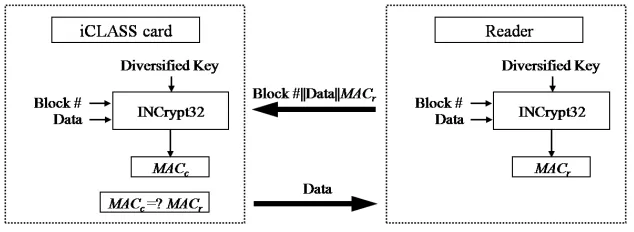
Authentication Protocol To get an access right over the iCLASS card, the card and the reader need to perform an authentication protocol. This protocol is based on INCrypt32 with the 8-byte keyKdor Kc. The authentication protocol is shown in Fig. 1.
Fig. 1.Authentication protocol
an 8-byte MAC. At this point, the card can compute an 8-byte MAC in the same way. If MAC0r is correct, the card will answer the other 4-byte signature (MAC1c) that enables the reader to authenticate the card. Therefore, the au-thentication protocol needs to perform INCrypt32 with 12-byte input and 8-byte output data.
Write Protocol If the authentication protocol succeeds, the reader is able to read data blocks without an additional authentication procedure. However, to write an 8-byte data in a data block, the reader needs to perform INCrypt32 every time. The write protocol is described in Fig. 2.
Fig. 2.Write protocol
Therefore, the write protocol needs to perform INCrypt32 with 9-byte input and 4-byte output data.
3
Revealing the INCrypt32 Algorithm
We describe how to reveal the proprietary symmetric cryptographic algo-rithm INCrypt32 from its silicon implementation alone. The details of INCrypt32 will be described as well.
3.1 Hardware Reverse-Engineering of iCLASS Cards
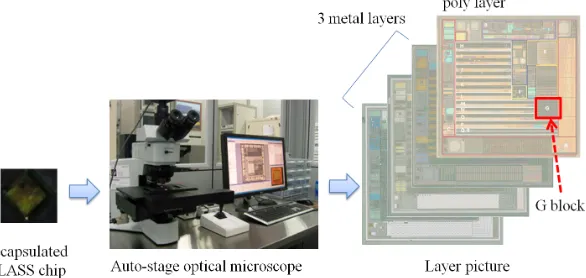
Several steps were taken for the hardware reverse-engineering of the iCLASS 2K card. After removing the card packaging, we decapsulated the card chip. For die delayering, we stripped off an upper layer to expose a lower layer. The picture of each layer was obtained with an auto-stage optical microscope at a magnification of 1,000x after die deprocessing, as shown in Fig. 3.
The chip on iCLASS cards is small with a total area of one square millimeter. This chip consists of three metal layers and a single poly layer and is implemented with 0.5µm CMOS process. We extracted 108 different logic gates with different driving strengths by analyzing the poly layer picture and the first metal layer picture.
Fig. 3.iCLASS chip’s layered picture and physical location of INCrypt32
Since the block (we denote it by G block) near the right bottom corner iso-lated from other blocks has the largest number of XOR/XNOR gates, we guessed that G block would contain INCrypt32 (see Fig. 3). Fortunately, INCrypt32 was found at the guessed block. It contains single 16-bit LFSR, single 8-bit LFSR, two 8-bit full adders composed of 1-bit full adders, 16 1-bit D flip-flops, and an output block with complex Boolean functions.
Without reconstructing control circuits, the roles of input/ouput pins were derived from analyzing two types of captured signals of the communication pro-tocol between the reader and the card. The first one is obtained from RF sniffing and the other is taken from decapsulated chip probing using a probestation with active probes, where probing pads are made by a Focused Ion Beam equipment.
3.2 Description of INCrypt32 Algorithm
We will describe bytes and words(2 bytes) as capital letters and describe a bit as a small letter.xi means ai-th lsb ofX. For example, a byteX is same to x7· · ·x0.
INCrypt32 consists of internal 40-bit registers (P, Q, R, S), 64-bit keyK, and a state update function F. The details of internal registers and the key are as follows:
– P, Q: 1-byte registers, respectively.
– R: 1-byte register.ri is used as the state of 8-bit LFSR.
– S: 2-byte register.si is used as the state of l6-bit LFSR.
– K= (K0,· · ·, K7): 64-bit key, where eachKi is a byte.
In addition, a superscript of each register such asPi represents the number of updating the state from the initial state (for example P0). In other words,
(Pi, Qi, Ri, Si) = F(Pi−1, Qi−1, Ri−1, Si−1). Moreover pij means a j-th bit of Pi. We will use following notations for the description ofF.
– A+B: addition of bytesA andB modulo 28. – A⊕B: byte-wise XOR ofA andB.
– a⊕b: bit-wise XORaandb.
– ab: bit-wise AND ofaandb.
– Al: rightl-bits shift ofA.
– al: a byte(word) which is made from leftl-bit shift of a bita.
For an input bitmiand the keyK,F updates the internal state (Pi−1, Qi−1, Ri−1, Si−1) to the next state (Pi, Qi, Ri, Si) as follows.
Pi= (Xi−1⊕Ri−1) +Qi−1 Qi=Pi−1+Pi
Ri= (Ri−11)⊕((r4i−1⊕r5i−1⊕ri6−1⊕x0i−1⊕qi0−1)7) e=si0−1⊕s1i−1⊕si4−1⊕s5i−1⊕si8−1⊕s10i−1⊕si14−1⊕si15−1 Si= (Si−11)⊕((e⊕pi3⊕pi7)15)
u=pi0⊕pi4⊕p1ipi3⊕pi2pi4⊕e
v=pi3⊕p5i ⊕pi6⊕pi3pi5⊕pi4pi6⊕pi5pi7 w=mi⊕pi0⊕p
i
1⊕p
i
2⊕p
i
5⊕p
i
6⊕p
i
7⊕p
i
0p
i
2⊕p
i
5p
i
7⊕e
Xi=Kφ(u,v,w)
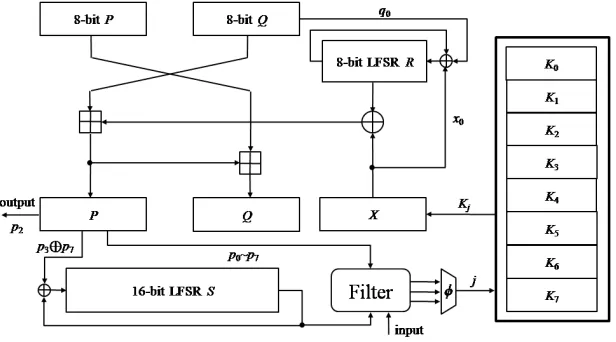
In the above we used dummy variables Xi, e, u, v, w, which do not exist in the real iCLASS card.F is depicted also in Fig. 4.
Fig. 4.State update functionF of INCrypt32
INCrypt32 consists of an initialization step and a MAC computation step. The both steps use the same state update function F. The difference is that the former step initializes the internal state with each input message bit without output and the latter step outputs MAC bits assuming that input bit is 0. Overall process of INCrypt32 is described in Algorithm 1.
Algorithm 1INCrypt32 algorithm
Require:
1.K= (K0, K1,· · ·, K7): the secret key
2. (m1, m2,· · ·, mα): arbitrary input message of lengthα
3. (b1, b2,· · ·, bβ): MAC output of lengthβ
Ensure:
1. initial state:P0 =0xcb;Q0 =0x21;R0 =0x4c;S0 =0xe012;X0=K0
1: Init State((m1, m2,· · ·, mα))
2: Compute MAC( )
3: procedureInit State((m1, m2,· · ·, mα))
4: fori=1 to αdo 5: State update(mi) 6: end for
7: end procedure
8: procedureCompute MAC( ) 9: fori=1 to βdo
10: State update(0) 11: bi=pα2+i 12: end for 13: end procedure
4
Cryptanalysis of INCrypt32
In this section we describe two kinds of key recovery attacks on INCrypt32. The purpose of our attacks is to recover the secret key. In our attacks, the attacker is able to request MAC for arbitrary messages of his/her choice. The first attack allows messages of any length, especially very short messages. It requires only about 218 MAC queries to recover the secret key. In the second
attack, the ability of the attacker is limited that he/she can only request MAC for messages of the fixed length (eg. 72 or 96 bits) as implemented in HID’s iCLASS systems. Thus the second attack scenario is more natural. It requires about 242 MAC queries to recover the key.
We would like to mention that we did not break the algorithm inrealHID’s iCLASS systems. The system does not allow MAC queries for messages of ar-bitrary length. Even in the second attack scenario, the required time for MAC query is too long to mount the attack since the speed of communications between cards and readers is very slow.
4.1 How to Choose Messages
u=pi0⊕pi4⊕p1ipi3⊕pi2pi4⊕e
v=pi3⊕p5i ⊕pi6⊕pi3pi5⊕pi4pi6⊕pi5pi7 w=mi⊕pi0⊕p
i
1⊕p
i
2⊕p
i
5⊕p
i
6⊕p
i
7⊕p
i
0p
i
2⊕p
i
5p
i
7⊕e (1)
Xi=Kφ(u,v,w)
According to the above Equation (1), the attacker can control thew value by selectingmi as he/she wants. In particular, wcan be selected to be zero by selectingmi as follows.
mi=pi0⊕p
i
1⊕p
i
2⊕p
i
5⊕p
i
6⊕p
i
7⊕p
i
0p
i
2⊕p
i
5p
i
7⊕e.
In other words, the indices of the selected key byte determined byφ(u, v, w) can be always even number. Thus if the attacker knows the half of the secret key (K0, K2, K4, K6), he/she can initialize the internal state for the selected message.
It is easy to show thatmiis uniquely determined if (K0, K2, K4, K6) is given. We
call the uniquely determined message bit for the half key by theeven message bit. Similarly, even messages of arbitrary length consist of only even message bits. Note that theeven messageof a given length is uniquely determined for a half key.
On the other hands, the attacker knows the internal state after initialization for even messages assuming that he/she knows the half key. Then he/she also computes the first bit of MAC for the message since the output bit is derived from the internal state after initialization. Therefore the attacker can guess the half of the key and filter out the wrong key by comparing the first bit of two MACs (computed and queried) for even messages. Our attack strategy is as follows.
1. Guess the half of the secret keyHK= (K0, K2, K4, K6).
(a) Find the even messages and tweak messages for the half key HK and compute the first bit of MACs of each message assuming the guessed key is correct.Tweakmessages will be explained later.
(b) Request the correct MACs for theeven messagesandtweakmessages. (c) Compare the first bit of two MACs (computed and queried) and filter
out the wrong half key until finding the correct one. 2. Determine the rest of the secret key.
4.2 Attack with Short Messages
In the first attack, we request MAC for short messages of length at most 33 bits. At first, we define some notations for a given half keyHK= (K0, K2, K4, K6).
– mi: even message bits fori= 1,2,· · ·.
– Mi= (m1, m2,· · ·, mi): even message of lengthi.
Making a Precomputation Table As described in Section 4.1, we have to determine even message bits mi (i = 1,2,· · ·, 16) for a given half key HK. This process can be done independent of the target card. Thus we can make a precomputation table with even message bitsmi and additional informationci associated with 32-bit half keys in advance.
To make a table, each HK is regarded as a index (memory address) and (m1, m2,· · ·, m16 |c1, c2,· · ·, c16) is stored as a 32-bit data for the indexHK.
Hence we need a memory space of size 4·232 bytes (16GB). Note that the
distribution of the data is uniform in the sense that the number of elements in the table with the firsti bits are identical is about 232−i fori = 1,· · · ,16 and that ci can be 0 or 1 with the probability 1/2.
Reducing the Number of Candidates of the Half Key This is the first step of online phase. Now we are ready to request MACs for short messages. We request MACs for 1-bit messages (0) and (1) respectively. Let the first bit of the MACs beb0 and b1 respectively. Then we can filter out the half keys such that
the data has forms of (0,∗,· · · |b0⊕1,∗,· · ·) and (1,∗,· · · |b1⊕1,∗,· · ·) where
∗ can be any value. As a result, about 231 candidates can survive.
Next, we request MACs for all 2-bit messages (0,0), (0,1), (1,0), and (1,1) respectively. Let the first bit of the MACs be b00, b01, b10, and b11
respec-tively. Then we also filter out the survived keys such that the data has forms of (0,0,∗,· · · | ∗, b00 ⊕1,∗,· · ·), (0,1,∗,· · · | ∗, b01 ⊕1,∗,· · ·), (1,0,∗,· · · |
∗, b10⊕1,∗,· · ·), and (1,1,∗,· · · | ∗, b11⊕1,∗,· · ·). As a result, about 230
candi-dates can survive.
In the same manner, we request MACs for all the messages of length at most 16 bits and can filter out wrong key candidates by comparing the first bit of MACs and the precomputed table. Finally, we have about 216 candidates of the
half key. The required number of MAC queries is 2 + 22+· · ·+ 216= 217−2.
Determining the Correct Half Key After above filtering, we have 216
can-didates of the half key and associated 16-bit even messages. In the second phase, we verify the correctness of each candidate in turn.
LetHK be one of the survived keys. We determine 17-th even message bit m17and computec17as described in the previous section. Then we request MAC
forM17= (m1,· · ·, m17) and compare the first bit of the MAC withc17. If they
are different, then HK can be filtered out. The probability that a wrong key passes the test is 1/2. If the candidate passes the test, we proceed the same test for longer even messages M18,· · ·, M33. If HK is correct, all the tests should
be passed. Since the probability that a wrong key passes all the tests is 1/217,
we can expect that the only correct key survives. The required number of MAC queries is 216+ 215+· · ·+ 1 = 217−1.
Determining the Rest of the Key In this phase, we will find new tweak messages slightly different from even messages. Letm1be the first even message
We guessK2l+1. LetT1be (m1⊕1) which is the firsttweakmessage. Since we
guessedK2l+1, we can update the internal state and computec1forT1. Then we
request MAC forT1 and compare the first bit of the MAC withc1. If the both
values do not coincide, the guessedK2l+1is not correct. Otherwise, we proceed
to find the nexttweakmessageTi fori≥2. Thei-th message bit is selected such that the key index should be even number. We denote such a message bit by ˜mi fori≥2. Thus Ti has the following form.
Ti= (m1⊕1,m˜2,· · ·,m˜i).
Then we can check the correctness of the guessed valueK2l+1. We expect the only
one value would be survived after 9 consecutive tests and it would be the correct K2l+1. The required number of MAC queries is about 28+ 27+· · ·+ 1 = 29−1.
The other secret keys with odd index can be found in the similar way. The required number of MAC queries is also same respectively. Therefore the total number to determine the rest of the key is about 211−4.
4.3 Attack with Messages of the Fixed Length
The messages of the authentication protocol in real environments are for-matted and have fixed lengths (72 or 96 bits). Hence the previous attack cannot be applied to HID’s iCLASS systems. In the second attack, we assume that the attacker can request MAC for messages of the fixed length determined by the authentication protocol.
In this attack, we guess the half keyHK= (K0, K2, K4, K6), and we find the
unique even message of given length (eg. 72 bits) forHKand compute additional informationc =p732 to compare with the first bit of the MAC. As the previous
attack, we request MAC for the even message and filter out wrong candidates by comparing the first bit of MACs. Thus we have 231candidates of the half key. Let (m1,· · · , m72) be the even message for a survivedHKandvibe the index of selected key byte ini-th updating process, i.eXi=K
vi. Thenvi ∈ {0,2,4,6}.
We will simultaneously find the rest of the secret key with odd index in the process of checking the validity of HK. For example, we start withK1. Let
I0={i1,· · · , ik}be the set of indicesisuch thatvi= 0.
For a possible value of K1, we have to find the tweak messageTj for each j∈I0such that the firstvj−1 bits are identical to the even message, the next bit is flipped, and the other bits are selected astweakmessage bits as the previous subsection.
Tj= (m1,· · ·, mvj−1, mvj⊕1,m˜vj+1,· · · ,m˜72).
Since we know HK = (K0, K2, K4, K6) and K1, we can initialize the internal
state with the tweak messageTj and computecj=p732 . We request MAC forTj and compare the first bit of the MAC with cj. If both values are identical, we repeat the test for another j∈I0. We have to carry out the test until we find a
If we can not find a value ofK1 passing the above test, then the candidate
HK must be incorrect. The probability that wrong (HK,K1) passes the test is
1/2n0 wheren
0is the number of elements inI0.n0is expected about 18 = 72/4.
If we find a candidate K1, we proceed the above test for K3, K5, and K7
in turn in the same way. The wrong 64-bit key may pass the above test with probability 1/272, thus it hardly happens. Therefore the survived value is the
full secret key. The required number of MAC queries is at most 231·4(28+ 27+
· · ·+ 1)'242.
5
Conclusion
Although INCrypt32 plays a key role in the security of HID’s iCLASS sys-tems, it has not been evaluated the security since the structure of INCrypt32 is not known to public. In this paper, we revealed the unknown algorithm by reverse engineering iCLASS cards. Unfortunately, we showed that there are some security flaws in cryptographic sense. The secret key of iCLASS cards can be recovered using MAC queries for chosen messages. The number of MAC queries is 218or 242 which depends on the attack scenario.
Note that our analysis for INCrypt32 is not realistic yet since our attack requires many (in real environments) MAC queries for unauthorized messages. But our work shows that a proprietary cryptographic algorithm does not enhance the security of a system. Moreover, if INCrypt32 were used in other applications which allow very short messages, then the security of a whole system could be totally compromised.
References
1. Garcia, F.D., de Koning Gans, G., Muijrers, R., van Rossum, P., Verdult, R., Schreur, R.W., and Jacobs, B.: Dismantling MIFARE Classic. In: Jajodia, S., Lopez, J. (eds.) ESORICS 2008. LNCS, vol. 5283, pp. 97-114. Springer, Heidel-berg (2008)
2. Kerckhoffs, A.: La cryptographie militaire. Journal des Sciences Militaires IX. 5–38 (1883)
3. de Koning Gans, G., Hoepman, J.-H., Garcia, F.D.: A practical attack on the MIFARE Classic. In: Grimaud, G., Standaert, F.-X. (eds.) CARDIS 2008. LNCS, vol. 5189, pp. 267–282. Springer, Heidelberg (2008)
4. Meriac, M.: Heart of darkness - exploring the uncharted backwaters of HID iCLASSTMsecurity. In: 27th Chaos Communication Congress (2010)
5. Nohl, K., Evans, D., Starbug, Pl¨otz, H.: Reverse-engineering a cryptographic RFID tag. In: 17th USENIX Security Symposium 2008. pp. 185–193. (2008).
6. Nohl, K., Pl¨otz, H.: Mifare, little security despite obscurity. In: 24th Chaos Com-munication Congress (2007)
7. Teepe, W., Nohl, K.: Making the best of MIFARE Classic (manuscript, 2008) 8. HID Global.: http://www.hidglobal.com/technology.php?tech\_cat=2\
&subcat\_id=9\&techno\_id=2