A Comprehensive Evaluation of Mutual Information Analysis Using
a Fair Evaluation Framework
Carolyn Whitnall and Elisabeth Oswald
University of Bristol, Department of Computer Science, Merchant Venturers Building, Woodland Road, BS8 1UB, Bristol, UK
Abstract. The resistance of cryptographic implementations to side channel analysis is matter of consider-able interest to those concerned with information security. It is particularly desirconsider-able to identify the attack methodology (e.g. dierential power analysis using correlation or distance-of-means as the distinguisher) able to produce the best results. Attempts to answer this question are complicated by the many and varied factors contributing to attack success: the device power consumption characteristics, an attacker's power model, the distinguisher by which measurements and model predictions are compared, the quality of the estimations, and so on. Previous work has delivered partial answers for certain restricted scenarios. In this paper we assess the eectiveness of mutual information analysis within a generic and comprehensive evaluation framework. Complementary to existing work, we present several notions/characterisations of attack success, as well as a means of indicating the amount of data required by an attack. We are thus able to identify scenarios in which mutual information oers performance advantages over other distinguishers. Furthermore we observe an interesting feature unique to the mutual information based distinguisher resembling a type of stochastic resonance, which could potentially enhance the eectiveness of such attacks over other methods in certain noisy scenarios.
Keywords: side channel analysis, mutual information
1 Introduction
Side Channel Analysis (SCA) refers to a collection of cryptanalytic techniques for extracting secret information from the physical leakage of a device as it executes a cryptographic algorithm. Various types of SCA techniques exist. One of the most popularly studied is dierential power analysis (DPA); it involves applying some type of statistic (the distinguisher) to identify a correct hypothesis about (part of) the secret key from the set of all possible hypotheses about this key. Popular choices of distinguishers are the Pearson correlation coecient and the Distance-of-Means test. Mutual information (MI) measures the total dependency between two random variables, and was rst proposed for use as a distinguisher at CHES 2008 ([6]). A priori it was expected to display certain advantages over other distinguishers, loosely summarized by three (informal) conjectures:
1. By comprehensively exploiting all of the information contained within trace measurements it could have an eciency advantage over existing side-channel distinguishers such as correlation (which measures linear dependencies only).
2. By capturing total dependency between the true device leakage and the modeled leakage it could prove eective in scenarios where an accurate model for the data-dependent leakage of the device is not known, thereby serving as a `generic' distinguisher.
3. By natural extension to multivariate statistics it might be adapted to the context of higher-order attacks against (for example) protected implementations. Existing distinguishers operate on univariate data only and therefore require trace data to be pre-processed, resulting in loss of information.
functions and power consumption patterns) where it oers a useful advantage: see Batina et al. [2] for an overview of these issues.
In this paper we introduce a framework for assessing and comparing DPA attacks in any given scenario on a theoretical basis, abstracting away from the problem of practical estimation. We use this to gain fresh insight into the ndings of the existing MIA literature and to clarify when and in what sense the a priori intuition regarding MIA does hold. Moreover, we are able to identify and describe attack scenarios in which MIA is theoretically successful whilst other distinguishers fail, or in which its theoretic advantage is large enough to potentially translate to a practical advantage. Further, we demonstrate that the (standardised) MIA vector exhibits the property of stochastic resonance as the noise levels in the power consumption vary. This feature, which is not shared by correlation-based DPA, could potentially be exploited to enhance MIA attacks via noise injection.
In what follows, we rst give the relevant preliminary information on DPA attacks, including details of particular distinguishers and a discussion of previous work in Sect. 2. In Sect. 3 we describe our methodology, whilst Sect. 4 reports on our ndings as they relate to various attack scenarios. We conclude in Sect. 5.
2 DPA Attacks
We consider a `standard DPA attack' scenario such as dened in [12]: The power consumption Lof the target
device depends on some internal value (or state) fk∗(x): a function of some part of the plaintext x ∈ X, as
well as some part of the secret key k∗ ∈ K. Hence, we have thatL=L◦fk∗(x) +ε, where Lis some function
which describes the data-dependent component andεcomprises the remaining power consumption which can be modeled as independent random noise. The attacker hasN power measurements corresponding to encryptions ofN known plaintextsxi∈ X, i= 1, . . . , N and wishes to recover the secret keyk∗. The attacker can accurately compute the internal values as they would be under each key hypothesis{fk(xi)}Ni=1, k∈ Kand uses whatever
information he possesses about the true leakage function Lto construct a modelM.
DPA exploits the fact that the modeled power traces corresponding to the correct key hypothesis should bear more resemblance to the true power traces than do the modeled traces corresponding to incorrect hypotheses. An attacker is thus concerned with quantifying and comparing the degree of similarity between the true and modeled traces for each key hypothesis. A range of comparison tools `distinguishers' are available, of which mutual information and Pearson's correlation coecient are popular examples. We introduce these formally and examine them in more detail in the remaining parts of this section. We use the shorthands CDPA and MIA to refer (respectively) to correlation-based and MI-based DPA attacks.
2.1 Reasoning about the Success and Eciency of DPA Attacks
Previous work has made some progress towards providing meaningful and practically relevant denitions for the `success' and `eciency' of DPA attacks. Standaert's work [19] put forward the notion of the success rate, which we adopt for our purposes here: The theoretic attack distinguisher isD={D(k)}k∈K ={D(L◦fk∗(X) +
ε, M ◦fk(X))}k∈K, where the plaintext input X takes values in X according to some known distribution
(usually uniform). We say the attack is theoretically successful ifD(k∗)> D(k)∀k6=k∗. We say it is o-th order theoretically successful if #{k∈ K:D(k∗)≤D(k)}< o.
However, in practice D must be estimated. Suppose we have observations corresponding to the vector of inputsx={xi}n
i=1, and writee={ei}
n
i=1to be the observed noise (i.e. drawn from the distribution ofε). Then
the size #Kestimated vector isDˆN ={DˆN(k)}k∈K ={DˆN(L◦fk∗(x) +e, M◦fk(x))}k∈K. We then say the
attack is successful if DˆN(k∗)>Dˆ
N(k)∀k6=k∗ and o-th order successful if#{k∈ K: ˆDN(k∗)≤DˆN(k)}< o. Since we are particularly interested in the impact ofLon attack outcomes, it is desirable to abstract away from the impact of noise, as well as from the estimation process. We dene a distinguisher as ideally successful if it is theoretically successful in a noise-free scenario.
Ideal success thus depends on the target intermediate function, the form of the data-dependent device leakage L, the set X0 ⊆ X of plaintexts being encrypted, and the choice of power model and distinguisher.
actual outcome will be determined by whether or not an attacker has adequate resources to estimate Dˆ with
sucient precision to detect a dierence of that size.
2.2 Distinguishers for DPA Attacks
Standaert et al. [18] provide a good overview of the many distinguishers that have been employed in the literature since DPA was rst introduced in the late 1990s [9]. In this paper, we focus on mutual information and compare it with one other distinguisher of interest: Pearson's correlation coecient.
In very recent work, Mangard et al. [12] have shown that in the scenario of standard DPA attacks, the three most popular distinguishers, Pearson correlation, distance of means, and Bayes, are equally successful. They also show that in this particular scenario, with additional assumptions about the distribution of leakages and models, there is a mapping between correlation coecient and mutual information. We seek to be more general and do not make assumptions about distributions of leakages and models in this work.
Mutual Information Mutual information measures, in bits, the total information shared between two random variables X and Y. It is most intuitively expressed in terms of entropies via Shannon's formula: I(X;Y) =
H(X)−H(X|Y).1
Mutual information is a functional of probability distributions, and estimation is a much studied problem with no simple answers ([4,8,13,17,20]). All estimators are biased, and further no `ideal' estimator exists that is to say, dierent estimators perform dierently depending on the underlying structure of the data.
The usual approach is to rst estimate the underlying marginal and conditional densities and then to substitute these into Shannon's formula via a `plug-in' estimator for discrete entropy. There are many dierent ways to estimate densities and the quality of the resulting estimator for MI is very sensitive to the methods and parameters chosen. If we have a good understanding of the underlying distributions we can t a parametric model such as a Gaussian mixture (see Veyrat-Charvillon et al. [21])2. However, since MIA has been proposed
for use in scenarios where our usual assumptions do not hold we are generally more interested in nonparametric methods, which are somewhat sensitive to user approach and known to incur an overhead in terms of estimation costs. In practice, due to the large sample space and small datasets we usually estimate the densities via anm -bin regularisation of the space. By an important data processing inequality3this means we are always estimating
a lower bound on the mutual information as the binning or mesh becomes ner the estimate approaches the true mutual information monotonically from below ([13]).
In security evaluations we often would like to be able to talk about the number of traces needed for an attack to be successful. This requires knowing the sampling distribution for the distinguisher under reasonable assumptions. Unfortunately, estimators for MI do not `behave nicely' as do other statistics (such as the cor-relation coecient see below); in fact, there are no universal rates of convergence ([13]), so that whatever estimator we pick, we can always nd a distribution for which the error vanishes arbitrarily slowly.
The relationship between the ideal MI and the theoretic MI in the presence of noise is complex (see, for example, [10]). In particular, whilst I(X +ε;Y) ≤ I(X;Y) (X, ε independent), it is not the case that I(X;Y)−I(X+ε;Y) =I(X;Z)−I(X+ε;Z). Thus, the elements of the theoretic MIA vector are dierentially
aected so that ideal outcomes do not directly generalise to theoretic outcomes in the presence of noise.
Pearson's Correlation Coecient Pearson's correlation coecient measures the total linear dependency between two random variables X and Y. It is dened as ρX,Y = covσ(X,Y)
XσY . It takes values from -1 to 1 and,
as with mutual information, is zero whenever X and Y are independent. However, the converse is not true; namely,X andY may be (non-linearly) dependent with a (linear) correlation of 0.
It is estimated via the sample correlation coecient:r=
Pn
i=1(Xi−X¯)(Yi−Y¯)
√
Pn
i=1(Xi−X¯)2
√
Pn
i=1(Yi−Y¯)2. This is a consistent
estimator for ρX,Y and, moreover, is asymptotically unbiased and ecient if X and Y have a joint Normal
1The original (but equivalent) denition is I(X;Y) = P y∈Y
P
x∈XpX,Y(x, y) log2
p
X,Y(x,y)
pX(x)pY(y)
, where pX,Y is the
joint probability density ofX andY andpX,pY are the marginal densities.
2Under strong simplifying assumptions, estimating an MIA parametrically can be shown to be equivalent to conducting
a correlation attack ([12]).
distribution. Under the same assumptions, we can even approximate the sampling distribution which leads to `nice' results such as the number of trace measurements required for attacks to be successful (see Chap. 6.4 of [11]).
The relationship between the ideal correlation and the theoretic correlation in the presence of noise is straightforward. In fact, as derived in Chap. 6.3 of [11], ρ(L+ε, Mk) = ρ(L,Mk)
r
1+ σ2ε
Var(L)
. Thus, the larger the noise,
the more diminished are the correlations. But crucially the denominator does not depend on the key hypothesis; the theoretic distinguisher vector is thus scaled in such a way that the rankings and other relative features are preserved. This does not at all imply that practical CDPA attacks are immune to noise: As the sample variance of the estimator increases, the number of traces required to reach a sucient level of precision also increases (see Chap. 4 of [11])).
3 A Comprehensive Evaluation Framework
We compute and examine ideal/theoretic CDPA and MIA vectors for a broad spectrum of possible leakage scenarios in unproled attacks where the true leakage L is unknown and modeled via the Hamming weight (HW) or the raw value (ID) of the target function output. For CDPA, this is the same as assuming that the leakage is proportional to the HW or ID of the target, whereas for MIA this is the same as allowing the leakage to be dierent for each distinct HW or ID value, without any restriction on the nature of that dependency (for example, it needn't be a monotonic relationship). These vectors provide insight into the relative strengths and weaknesses of the distinguishers. We are particularly interested in nding scenarios where MIA has an ideal/theoretic advantage over CDPA. To do this we need to formulate an appropriate notion of advantage we have thus xed upon the following set of criteria:
1. Correct key ranking: The (possibly tied) position of the correct key when ranked by distinguisher value. If this is greater than 1 then the attack is considered to have failed, and the size of the ranking is an indicator of the extent to which it fails.
2. Success order: This is the number of key candidates equally ranked at position 1, provided the correct key is among them. (If it is equal to the number of key hypotheses then the attack is considered to have failed it has revealed nothing).
3. Average distinguishing power: The number of standard deviations above (or below) the mean for the distin-guisher value corresponding to the correct key. This matches the DPA signal-to-noise ratio described by [7] and indicates how well the attack isolates the correct key from the incorrect keys, on average. It remains meaningful for failed attacks, when it can be positive or negative.
4. Nearest-rival distinguishing power: The dierence (in number of standard deviations) between the correct key distinguisher and the distinguisher for the highest ranked incorrect key. This indicates the strength of the correct key ranking. It can be zero for attacks with success orders greater than 1, or negative for failed attacks, where it gives further indication of the extent of the failure.
By computing the above measures for uniformly drawn plaintextsX unif.← X, we are able to compare theoretic
behaviour of attacks when provided with full information. We propose to explore the sensitivity of attacks to restricted information by inspecting ideal/theoretic attack vectors for reduced subsets of the plaintext space. These vectors depend not only on the size but also on the composition of the input set; we cannot perform the computation exhaustively over the entire space of possible subsets (it is too large), but by repeated random draws of increasing size we can estimate the average support size needed for attack success.
This approach is designed to provide some clues to the how many traces? problem for MIA. Recall that we would like to compute the sample size required to translate a theoretically plausible attack into a practically successful one, but not enough is known about the sampling distributions of the estimators to do this in general. Instead, we look at the support size required to achieve ideal/theoretic success, which we argue at least provides some insight into the relative limitations of attacks on small samples. We thus add the following measures:
6. Support required for x% success rate: The support size for which the rate of success (of the appropriate order) is at leastxper cent.
Our criteria are best viewed in conjunction with one another rather than in isolation, and trade-os between them will interplay dierently with practical considerations. For instance, a methodology which achieves only oth-order success (whereo >1) might be preferable to one achieving1st-order success if the distinguisher vector
can be estimated more precisely and/or eciently. Likewise, nearest-rival distinguishing power may be more important than average minimum support in the presence of high noise.
In some parts of this study it is more desirable to measure the average behaviour of an attack in a class of scenarios than to describe results under a specic scenario. This is relevant, for example, when considering functions of sucient arbitrariness that we cannot detail each case exhaustively. In such cases, as with the analysis of restricted input support, we estimate average behaviour by using randomly sampled examples.
Ideal/Theoretic vs. Practical Attacks. Recall that we dene theoretic (as well as ideal, i.e. noise-free) attacks to abstract away from the impact of the estimation process (and from noise). As such, theoretic outcomes depend on the target intermediate function, the device leakage (including how much noise is present), the set of plaintexts used as inputs, the attackers choice/knowledge about the power model, and the theoretical distinguisher (which is in this case the estimand). Practical outcomes depend on an additional, crucial factor, namely the estimator the quality of which, and the sensitivity to the underlying population parameters and noise, will ultimately determine whether an observed ideal/theoretical advantage is translated into a real advantage in a practical attack.
Our framework extends the currently standard notion of the success rate (see Standaert et al. [19]) because we want to evaluate ideal/theoretic attacks: results of ideal/theoretic attacks might rank keys equally (in contrast to practical attacks where equal key rankings are highly unlikely due to the estimation process involved). Hence the need to report both correct key ranking and success order. Further, we want to gain an insight into the dierent qualities of the distinguishers, which means we need more nuanced notions of success and of the amount of data needed. Note that our approach separates the study of the quality of the estimands as distinguishers from the study of the qualities of the estimators: this is new and allows us, as we will demonstrate in latter parts of the paper, to gain insights into the strengths and weaknesses of dierent distinguishers in practice.
4 Results
We now evaluate MIA and correlation distinguishers using the framework and considerations w.r.t. leakage models as spelled out before. For the sake of clarity and conciseness, we rst show one detailed example (Hamming-weight device leakage, and DES algorithm), and then briey report outcomes for some other leak-age models. The choice for our focus is motivated by previous practical work which has focused on DES implementations [2], and the fact that DES is still used as predominant algorithm in the banking world. Note though that our framework could be used in the same way in a dierent context, and that the results of our evaluation of MI as a distinguisher are not strongly dependent on our specic choice.
4.1 Hamming-Weight Leakage
We begin with an ideal evaluation of MIA relative to CDPA in the simplest and most popularly studied scenario: the rst S-Box in a DES implementation (short: DESS1) with a Hamming-weight (HW) leakage. As attacker
power models we consider HW and the identity (short: ID) power model. For the sake of simplicity we use the following abbreviations: CDPA(HW) as short-hand for correlation-based DPA with a HW power model, MIA(HW)/MIA(ID) as short-hand for MI-based DPA with a HW/ID power model, and MMIA for multivariate MI-based DPA. Using the notation as introduced before we rst evaluate
CDPA(HW):{ρ(L(DESS1(x, k∗), M(DESS1(x, k))}k∈K, (1)
MIA(HW):{I(L(DESS1(x, k∗);M(DESS1(x, k))}k∈K (2)
This is a scenario in which we expect CDPA(HW) to perform well: the use of the true power model enables perfect prediction of the data-dependent leakage under the correct key hypothesis, whilst the choice of the S-Box as target ensures that the alternative hypotheses will each give rise to substantially dierent predictions (see [15]).
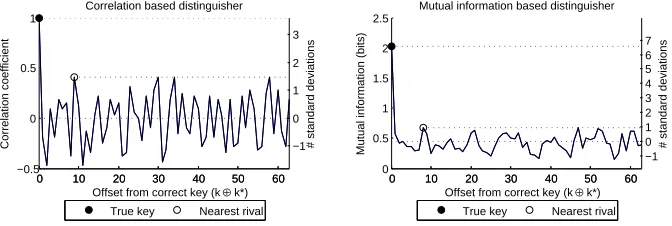
Figure 1 shows the ideal distinguisher values for a CDPA(HW) and an MIA(HW) attack. Since the target function has the Equal Images under dierent Subkeys (EIS) property and the plaintexts are assumed uniformly distributed, attack outcomes are key independent ([12]): the correct hypothesis yields the same distinguisher value under any key, and only the arrangement of the remaining vector entries changes.
It is evident that both attacks are rst-order successful by a clear margin, but that MIA(HW) has a substantial ideal advantage, with a nearest-rival distinguishability score of 5.61 compared with just 2.14 for
CDPA(HW). This simple result conrms that it must instead be a combination of the impact of noise and the relative eciency of estimating the correlation coecient which enables CDPA to consistently outperform MIA in practical attacks with a good power model.
0 10 20 30 40 50 60
−0.5 0 0.5 1
Offset from correct key (k ⊕ k*)
Correlation coefficient
Correlation based distinguisher
0 10 20 30 40 50 60
−1 0 1 2 3
# standard deviations
True key Nearest rival
0 10 20 30 40 50 60
0 0.5 1 1.5 2 2.5
Offset from correct key (k ⊕ k*)
Mutual information (bits)
Mutual information based distinguisher
0 10 20 30 40 50 60
−1 0 1 2 3 4 5 6 7
# standard deviations
True key Nearest rival
Fig. 1: Ideal distinguishing vectors using the HW power model against the output of the rst DES S-Box.
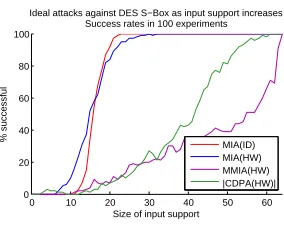
As a partial insight into the quantity of data needed we next look at the minimum input support size required for the distinguishers to approach their full ideal potential. The space of possible plaintext combinations is too large to explore exhaustively, so we look at the average behaviour of the attacks in repeated random draws from the plaintext space.
0 5 10 15 20 25 30
0 20 40 60 80 100
Size of input support
% successful
Ideal attacks against DES S−Box as input support increases Success rates in 100 experiments
MIA(ID) MIA(HW) MMIA(HW) CDPA(HW)
Fig. 2: Ideal success as the input support size increases, for a DES implementation leaking the Hamming weight.
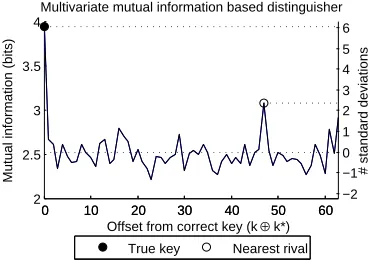
We next investigate the enhancement of MIA via the incorporation of an additional data point in a multi-variate attack on AddRoundKey and the rst S-Box jointly. Figure 3 plots the ideal outcome. First observe that the distinguisher is greater in size (by a factor of about two) than that of the single point attack that is, we are capturing a larger amount of information. However, the increase applies across the range of key hypotheses so does not automatically raise the distinguishing power. In fact the true key is less strongly distinguished than in the attack against the S-Box alone: the nearest-rival distinguishability is reduced from 5.61to 3.66. Moreover,
the attack requires a larger input support 13 on average compared with 8 for MIA(HW).
0 10 20 30 40 50 60 2
2.5 3 3.5 4
Offset from correct key (k ⊕ k*)
Mutual information (bits)
Multivariate mutual information based distinguisher
0 10 20 30 40 50 60 −2 −1 0 1 2 3 4 5 6
# standard deviations
True key Nearest rival
Fig. 3: Ideal MIA vector against the DES AddRoundKey and the rst S-Box jointly.
Table 1 summarises outcomes for a wider selection of attacks, including MIA(ID) the proposed `generic' attack of [6].
MIA(ID):{I(L(DESS1(x, k∗);M(DESS1(x, k))}k∈K
={I(HW(DESS1(x, k∗);ID(DESS1(x, k))}k∈K (3)
Unsurprisingly, in this rst example where the leakage is proportional to the HW, MIA(ID) displays a disadvantage relative to MIA(HW). The generic capabilities of MIA will be of more relevance in leakage scenarios where the attacker is not able to correctly model the true leakage.
The attacks against AddRoundKey well illustrate the role of the target function: distinguishing power is greatly reduced in the case that incorrect key hypotheses give rise to outputs closely resembling the correct key outputs. Greater precision (and therefore a greater number of measured traces) will be required in order to detect a dierence of this size in a practical attack, and moreover in the case of MIA there will remain an ambiguity between the true key k∗ and its bitwise complementk¯∗.
Table 1: Ideal strength of CDPA and MIA attacks against DES with Hamming weight leakage.
DES AddRoundKey DES S-Box Multivariate (DES)
DES with a HW leakage CDPA MIA CDPA MIA MIA MMIA
(HW) (HW) (HW) (HW) (ID) (HW)
Correct key ranking (order) 1 (1) 1 (2) 1 (1) 1 (1) 1 (1) 1 (1)
Average distinguishing power 2.45 4.48 3.61 6.59 6.35 6.04
Nearest-rival distinguishing power 0.82 0.00 2.14 5.61 5.08 3.66
Average minimum support 6 9 6 8 16 13
Support required for 90% success rate 8 11 8 11 19 15
Support required for100% success rate 11 15 12 14 22 21
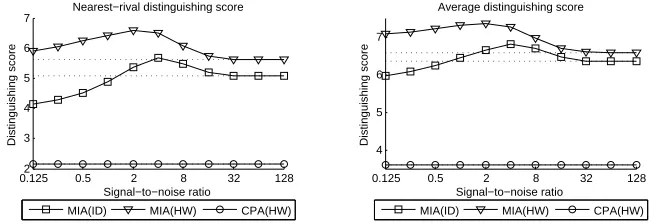
distinguishing power reaches a maximum, after which it diminishes to that of the ideal (as depicted by the dashed lines). Such a phenomenon is called stochastic resonance [3], and can (in principle) occur in any nonlinear measurement system. Perhaps surprisingly, the required support sizes for both MIA(HW) and MIA(ID) match the ideal requirements and remain constant though in general, such measures could also be subject to similar eects.
Recall, from Sect. 2.2, that by the properties of correlation, (standardised) CDPA outcomes are unaected by the level of noise. Hence the opportunity to enhance MIA (at least theoretically) via noise injection is not available in the context of CDPA.
0.1252 0.5 2 8 32 128
3 4 5 6 7
Signal−to−noise ratio
Distinguishing score
Nearest−rival distinguishing score
MIA(ID) MIA(HW) CPA(HW)
0.125 0.5 2 8 32 128
4 5 6 7
Signal−to−noise ratio
Distinguishing score
Average distinguishing score
MIA(ID) MIA(HW) CPA(HW)
Fig. 4: The eect of Gaussian noise on HW and ID attacks against HW leakage of the rst DES S-Box.
4.2 Hamming-Distance Leakage
Whilst the Hamming weight model is very popular in the literature, Hamming distance leakage can be widely observed in practical devices using CMOS logic. Broadly speaking there are three scenarios which may be encountered. Firstly, the previous state is known to the attacker, in which case the attacks are equivalent to Hamming weight attacks. Secondly, the previous state is unknown to the attacker but xed. Thirdly, the previous state is unknown to the attacker and can vary. The latter two scenarios are the focus of the following discussion.
Constant Reference State Now let us suppose, as in [5], that the reference state is a constant but unknown machine wordR. The device no longer leaks L(fk∗(X))but rather L(R⊕fk∗(X)).
First observe that no attack against a linear target function such as AddRoundKey can achieve rst order success, because the `true key' values are perfectly replicated under an incorrect key hypothesis, namelyk∗⊕R. The power consumption for a plaintext X will be proportional to HD((k∗⊕X), R) =HW((k∗⊕X)⊕R) =
HW((k∗⊕R)⊕X), so that when our hypothesis is k = k∗⊕R we get maximum correlation/MI (for both HW and ID models) and in fact the theoretical distinguishing vector is identical to that of a successful attack against HW leakage with a key of k∗⊕R.
Targeting the S-Box avoids this predicament thanks to the high nonlinearity of the S-Box. In particular, there is noR0 such that S-Box(k∗⊕X)⊕R=S-Box((k∗⊕R0)⊕X)∀X ∈ X so no incorrect key will produce
the correct predictions. It remains to be seen whether the resemblance between the imperfect predictions (with naive power models) and the true power consumption remains strong enough for the correct key and weak enough for the alternative hypotheses for any sort of attack to be successful.
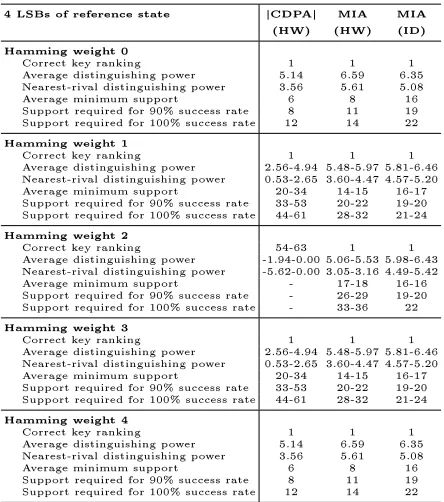
Ideal CDPA(HW) succeeds precisely in those scenarios where the HW of the reference is 1 (or 0) and fails whenever it is 2 (see Table 2). Further, were we to use the absolute value of the correlation to distinguish (denoting this strategy as |CDPA(HW)|) the resulting ideal attack would succeed whenever the HW of the reference state is 3 or 4. MIA(HW) and MIA(ID) both succeed in all scenarios, but observe that the true key MI under an ID power model is unaected by the introduction of an unknown reference state whilst the same quantity under a HW power model is substantially diminished.
homogeneity of our measures within each category. We have already seen that ideal |CDPA(HW)| does not succeed when the HW is 2, and are now able to conrm that its theoretic strength is substantially reduced when the HW is 1 or 3. MIA(HW) gains a considerable advantage both in terms of the ideal distinguishing power with full information (nearest-rival scores are in the range of 3.6 to 4.5 for MIA(HW) but just 0.5-2.7 for |CDPA(HW)|) and also in terms of the minimum input support required for success (on average, 14 to 15 for MIA(HW) compared with 17 to 18 for |CDPA(HW)|). In fact, for some reference states |CDPA(HW)| requires almost the entire plaintext set to determine the correct key (see Figure 5).
We can take advantage of the non-injectivity of the DES S-Box to launch generic MIA(ID) attacks. These turn out to be virtually unaected by reference state so that nearest-rival distinguishing power is always around 5 for MIA(ID) and average support requirement around 16. This means that when R∈ {0000(2),1111(2)}(i.e.
L is the HW function) the generic attacks are less eective than the equivalent methods combined with a HW power model, but in all other reference state scenarios they gain an advantage. The consistency and ideal strength of these attacks might be sucient to translate into a practical advantagea possibility which we will investigate in a latter section.
0 10 20 30 40 50 60 0
20 40 60 80 100
Size of input support
% successful
Ideal attacks against DES S−Box as input support increases Success rates in 100 experiments
MIA(ID) MIA(HW) MMIA(HW) |CDPA(HW)|
Fig. 5: Ideal success as the input support size increases, for a DES implementation leaking the Hamming distance from constant reference state ending in 0100.
We have thus shown that MIA applied with little consideration for or knowledge about the true leakage can be eective even when that leakage actually depends on an unknown reference state. CDPA, applied equally blindly, is far less likely to yield a successful attack. However, Brier et al. ([5]) showed how to adapt it in order to determine R as an unknown of the problem in addition to fk∗(X)⊕R, which together reveals the secret
key k∗. Whilst this two-stage process does require a greater number of searches than a standard CDPA(HW) attack, it could yet turn out to be more ecient than MIA; not only does MIA require more traces for precise estimation, but MIA with an ID power model can be computationally costly.
A Note on DRP logic. We observe an important and useful parallel between HD leakage and the expected behaviour of DPA-resistant dual-rail precharge (DRP) logic. In fact, an imperfect realisation of the logic style can be shown to exhibit data-dependent power consumption of a similar form to the HD from a constant reference state, enabling us to clarify its vulnerability to the `generic' MIA(ID) attack described by Gierlichs et al. in [6].
DRP logic attempts to eradicate the data-dependency of the power consumption by making it equal in each clock cycle. This is achieved insofar as the capacitances of the complementary output wires in each logic gate can be balanced, a dicult feat in practice ([14]). Suppose the ithbit of anm-bit word xis carried by a DRP
Table 2: Rank and correct key distinguisher values for constant reference states in a DES implementation.
HW of CDPA(HW) |CDPA(HW)| MIA(HW) MIA(ID)
ref. state D(0) Rank D(0) Rank D(0) Rank D(0) Rank
0 1.000 1 1.000 1 2.031 1 2.031 1
1 0.500 1 0.500 1 1.250 1 2.031 1
2 0.000 33-38 0.000 64 1.061 1 2.031 1
3 -0.500 64 0.500 1 1.250 1 2.031 1
logic gate driving two dierential outputs with imperfectly balanced capacities (αi, βi), so that αi =βi+γi. The power consumption of such a circuit can be shown to be equivalent to leakage scenarios with which we are more familiar, enabling us to comment on theoretical attack capabilities.
Let us initially consider the simplied case that both capacitances are the same throughout the circuit: βi=β, αi=β+γ, ∀i∈ {0, . . . , m−1}. Then the data-dependent leakage is proportional to:
HW(x)α+HW(¯x)β =HW(x)(β+γ) +HW(¯x)β
= (HW(x) +HW(¯x))β+HW(x)γ
=mβ+HW(x)γ
The constant m is absorbed into the non-data-dependent component and we thus obtain the result that the leakage is proportional to the Hamming weight. Both CDPA(HW) and MIA(HW) will be theoretically capable of returning the correct key; practical success will depend on ability and resources to estimate the distinguishing vectors with sucient precision, in which case CDPA(HW) is likely to have an advantage, as we have already seen.
Now suppose that the capacitances are the same throughout the circuit but that the order changes, i.e. so that some gates have capacitances(α, β)and others(β, α), whereα=β+γ. We can express this by introducing R= (r0, . . . , rm−1)∈ {0,1}msuch that gateiis(β, α)ifri = 1and(α, β)otherwise. Then the data-dependent
leakage is:
HW(x⊕R)α+HW(x⊕R¯)β =HW(x⊕R)(β+γ) +HW(x⊕R¯)β
= (HW(x⊕R) +HW(x⊕R¯))β+HW(x⊕R)γ
=mβ+HW(x⊕R)γ
That is, the data-dependent leakage is proportional to the Hamming distance from R, which equates to the scenario of a more conventional logic style (such as CMOS) consuming power proportional to the number of transitions from a constant, unknown reference state. We have already shown that MIA(ID) remains ideally successful against such leakage, whilst CDPA(HW) is (depending on the state) either unsuccessful or greatly reduced in distinguishing power. This conrms that DRP logic gives rise to leakage scenarios under which rst-order MIA(ID) could be useful, in particular, shedding light on the experimental result of [6].
In the most general case, the size of the capacitances and not just the direction of the dierences may vary over the circuit. Suppose the gates corresponding to bits i = 1, . . . , m have capacitances (αi, βi) such
that αi =βi+γi where γi can be positive or negative. Letting x= (x1, . . . , xm)and α= (α1, . . . , αm), β= (β1, . . . , βm), γ= (γ1, . . . , γm)we get a leakage function ofx·α+ (x⊕1)·β = (x+x⊕1)·β+x·γ=1·β+x·γ,
so that the data-dependent power consumption is proportional to a weighted combination of the bits of x, where the weights can take negative values. Further investigation is needed to establish the expected behaviour of our distinguishers as the relative weights become increasingly disproportionate.
Data-Dependent Reference State We next investigate ideal performance against Hamming distance leakage allowing for Rto take two or more dierent values depending on the plaintext, unknown to the attacker, but restricting it to be constant in repeated runs. In practice this could happen due to an incorrect implementation of a masking scheme.
In the (commonly studied) case of an 8-bit micro-controller, the reference states (or masks) take values in
{0,1}8={0, . . . ,255}. Since our attacks on DES S-Box target 6-bit key portions, our plaintext inputs are drawn
from {0,1}6 = {0, . . . ,63} there could be up to 64 dierent input-dependent reference states. The number
of possible ways that r reference states could be associated with the 64 input values is given by the Stirling number of the second kind: 64
r =
1
r!
Pr j=0(−1)
r−j r j
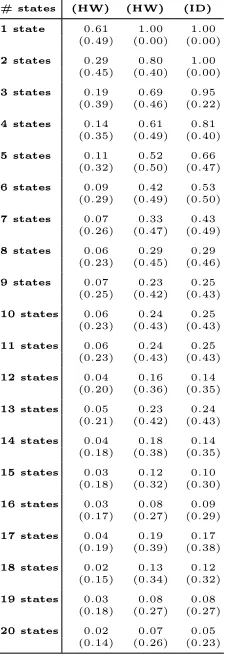
j64, so it is no longer possible to exhaustively explore every scenario. Instead, we calculate the success rates in 1,000 random experiments for increasing numbers of dierent reference states, randomly assigned to approximately equal-sized subsets of the input space (see Table 4).4We nd that MIA is much better able to succeed than |CDPA|, particularly when provided with an 4When the reference state is constant, only the 4 bits which are replaced by the S-Box output contribute to the
ID power model although even then it does not achieve 100% success for attacks with more than 2 dierent states and for more than 6 states success rates drop to below 50%. The success of |CDPA(HW)| degrades rapidly; for attacks with about 20 dierent states it is no better than a random guess, whilst MIA(ID) and even MIA(HW) appear to retain some advantage over guessing.
Thus, when very little is known about the leakage an attacker may well be able to recover a great deal of information just by applying a `blind' MIA though even ideal success will be partially determined by chance, and the number of traces required for adequate estimation may be prohibitive. Such an approach may not be the best way of exploiting the available data: where resources permit, it may prove more eective or ecient to rene a CDPA based approach (or similar), investing greater eort in understanding the leakage to begin with perhaps through proling.
4.3 Theoretical vs. Practical Success
We now return to a scenario which was identied as a candidate for MIA to hold an advantage over CDPA in practice: Hamming-distance leakage from a reference state unknown to the attacker (taken to be 0100(2)
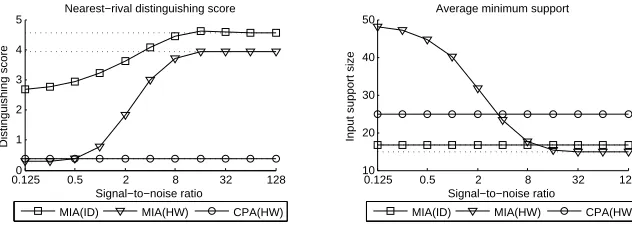
for the purposes of our example). We wish to investigate whether the observed ideal advantages generalise (theoretically) in the presence of noise and hence whether they can be translated into practical advantages. Figure 6 shows the impact of Gaussian noise on theoretic attack eectiveness, both in terms of nearest-rival distinguishability and in terms of the minimum support size required for rst-order success. MIA(HW) distin-guishability is not very robust to the addition of noise, even falling below that of CDPA(HW). Moreover, there is a hefty penalty in terms of required support size. By contrast, MIA(ID) distinguishability is more robust and even exhibits some evidence of stochastic resonance type behaviour, whilst required support size remains constant in the tested range.
0.1250 0.5 2 8 32 128
1 2 3 4 5
Signal−to−noise ratio
Distinguishing score
Nearest−rival distinguishing score
MIA(ID) MIA(HW) CPA(HW)
0.125 0.5 2 8 32 128
10 20 30 40
50 Average minimum support
Signal−to−noise ratio
Input support size
MIA(ID) MIA(HW) CPA(HW)
Fig. 6: Nearest-rival distinguishability and required support size of theoretic attacks against Hamming distance leakage (with a reference state of 0100) for varying levels of Gaussian noise.
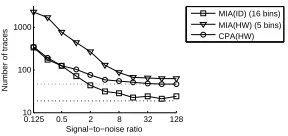
Our simulated attacks use histogram-based estimators where bin counts are chosen equal to the cardinality of the power model domain, according to the heuristic which has emerged from the literature ([2]). In a pure-signal scenario (see the dashed lines in Figure 7) the 5-bin estimator for MIA(HW) requires fewer traces than CDPA(HW) to identify the correct key, but the introduction of even the smallest amount of noise incurs a burden so that across the tested range it is substantially less ecient. By contrast, the 16-bin estimator for MIA(ID) approaches the eciency achieved in the pure-signal scenario as the SNR increases, and moreover substantially outperforms CDPA(HW) once the SNR is at least 1. We have thus conrmed thatin this instance at leastideal MIA advantages can be translated into practical advantages.
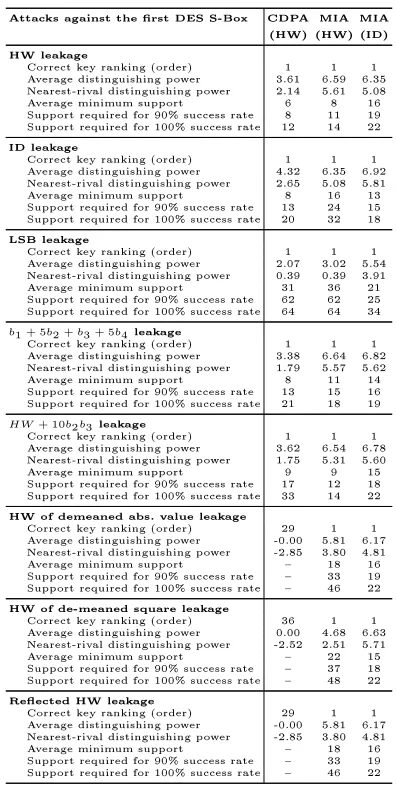
4.4 `Highly Nonlinear' Leakage Functions
0.125 0.5 2 8 32 128 10
100 1000
Signal−to−noise ratio
Number of traces
MIA(ID) (16 bins) MIA(HW) (5 bins) CPA(HW)
Fig. 7: Average number of traces required for key recovery in simulated practical attacks against Hamming-distance leakage (with a reference state of0100(2)), for varying levels of Gaussian noise.
is still linear) is not suciently dissimilar to the HW for CDPA(HW) to fail; moreover, despite an apparent increase in the distinguishing advantage of MIA(HW), there is also a rise in the comparative cost in terms of input support required. The addition of a quadratic term in the leakage does not render it suciently non-linear to confound CDPA(HW) or increase the advantage to MIA(HW/ID). CDPA is unsuccessful against the symmetric and highly non-linear leakages; MIA(HW) remains successful against all tested examples, although with some loss of distinguishing power and some cost in terms of the input support required. MIA(ID) is also successful in all tested scenarios and, moreover, in attacks against the more unusual leakages it exhibits an advantage over MIA(HW), in terms both of the overall distinguishing power and of the input support required.
5 Conclusions
In this paper we have presented a framework for evaluating and comparing DPA methodologies on a like-for-like, ideal/theoretic basis. Our outcome measures allow for a nuanced assessment of the relative strengths and weaknesses of particular distinguishers as employed under dierent leakage scenarios. We have thus been able to compare MIA and CDPA as abstracted away from the confounding problem of estimation, gaining valuable insight into the empirical results of existing literature which tends to focus on practical instantiations of the attacks. We have identied scenarios in which MIA oers a substantial theoretic advantage over CDPA, and demonstrated that such theoretic advantages can be translated into practical advantages. Particular candidate scenarios for MIA to be useful arise when the leakage takes the form of the Hamming distance from an unknown reference state or in implementations using dual-rail precharge logic and, in fact, we are able to demonstrate a relationship between these two cases. The generic capabilities of MIA are found to be an advantage as the HW model degrades relative to the true leakage, but multivariate extensions do not exhibit much if any advantage over univariate attacks in the rst-order `unprotected' setting. Lastly, we observe for the rst time (to our knowledge) the noise-sensitivity of the (standardised) MIA distinguishing vector, which exhibits an eect which can be likened to stochastic resonance and which could possibly be exploited in certain noisy scenarios to enhance the distinguishing power of MIA attacks. This is a question for further research. Another open problem which persistently arises in the context of MIA is that of nding estimators which most eectively translate theoretical advantages into practical ones.
References
1. M. Akkar, R. Bevan, P. Dischamp, and D. Moyart. Power analysis, what is now possible ... In T. Okamoto, editor, Advances in Cryptology ASIACRYPT 2000, Proceedings, Lecture Notes in Computer Science, pages 489502, 2000. 2. L. Batina, B. Gierlichs, E. Prou, M. Rivain, F.-X. Standaert, and N. Veyrat-Charvillon. Mutual Information
Analysis: A comprehensive study. Journal of Cryptology, pages 123, 2010.
3. R. Benzi, G. Parisi, A. Sutera, and A. Vulpiani. Stochastic resonance in climatic change. Tellus, 34(1):1016, 1982. 4. J. Bonachela, H. Hinrichsen, and M. Munoz. Entropy estimates of small data sets. Journal of Physics A
Mathe-matical and Theoretical, 41(20), 2008.
5. E. Brier, C. Clavier, and F. Olivier. Correlation power analysis with a leakage model. In M. Joye and J.-J. Quisquater, editors, Cryptographic Hardware and Embedded Systems CHES 2004, Proceedings, volume 3156 of Lecture Notes in Computer Science, pages 135152. Springer Berlin / Heidelberg, 2004.
7. S. Guilley, P. Hoogvorst, and R. Pacalet. Dierential power analysis model and some results. Smart Card Research and Advanced Applications Vi, pages 127142, 2004.
8. M. Hutter. Distribution of mutual information. Advances in Neural Information Processing Systems, 14:399406, 2002.
9. P. Kocher, J. Jae, and B. Jun. Dierential power analysis. In Proceedings of CRYPTO 1999, pages 388397. Springer-Verlag, 1999.
10. M. Madiman. On the entropy of sums. In 2008 IEEE Information Theory Workshop, 2008.
11. S. Mangard, E. Oswald, and T. Popp. Power Analysis Attacks: Revealing the Secrets of Smart Cards. Springer, 2007.
12. S. Mangard, E. Oswald, and F.-X. Standaert. One for all - all for one: Unifying standard DPA attacks. IET Information Security, 2011. to appear.
13. L. Paninski. Estimation of entropy and mutual information. Neural Computation, 15(6):11911253, 2003.
14. T. Popp and S. Mangard. Masked dual-rail pre-charge logic: DPA-resistance without routing constraints. In J. Rao and B. Sunar, editors, Cryptographic Hardware and Embedded Systems CHES 2005, Proceedings, volume 3659 of Lecture Notes in Computer Science, pages 172186. Springer Berlin / Heidelberg, 2005.
15. E. Prou. DPA attacks and S-boxes. Fast Software Encryption, 3557:424441, 2005.
16. E. Prou, M. Rivain, and R. Bevan. Statistical analysis of second order dierential power analysis. Computers, IEEE Transactions on, 58(6):799 811, june 2009.
17. M. Shiga and Y. Yokota. An optimal entropy estimator for discrete random variables. In Proceedings of the Inter-national Joint Conference on Neural Networks, IEEE InterInter-national Joint Conference on Neural Networks (IJCNN), pages 12801285, New York, 2005. IEEE.
18. F.-X. Standaert, B. Gierlichs, and I. Verbauwhede. Partition vs. comparison side-channel distinguishers: An empirical evaluation of statistical tests for univariate side-channel attacks against two unprotected CMOS devices. ICISC 2008, 5461:253267, 2009.
19. F.-X. Standaert, T. G. Malkin, and M. Yung. A unied framework for the analysis of side-channel key recovery attacks. In EUROCRYPT '09: Proceedings of the 28th Annual International Conference on Advances in Cryptology, pages 443461, Berlin, Heidelberg, 2009. Springer-Verlag.
20. A. Treves and S. Panzeri. The upward bias in measures on information derived from limited data samples. Neural Computation, 7(2):399407, 1995.
21. N. Veyrat-Charvillon and F.-X. Standaert. Mutual information analysis: How, when and why? In C. Clavier and K. Gaj, editors, Cryptographic Hardware and Embedded Systems CHES 2009, Proceedings, volume 5747 of Lecture Notes in Computer Science, pages 429443, 2009.
A Tables
Table 3: Theoretical strength of CDPA and MIA attacks against DES with Hamming distance leakage from a constant reference state.
4 LSBs of reference state |CDPA| MIA MIA
(HW) (HW) (ID)
Hamming weight 0
Correct key ranking 1 1 1
Average distinguishing power 5.14 6.59 6.35
Nearest-rival distinguishing power 3.56 5.61 5.08
Average minimum support 6 8 16
Support required for 90% success rate 8 11 19
Support required for 100% success rate 12 14 22
Hamming weight 1
Correct key ranking 1 1 1
Average distinguishing power 2.56-4.94 5.48-5.97 5.81-6.46
Nearest-rival distinguishing power 0.53-2.65 3.60-4.47 4.57-5.20
Average minimum support 20-34 14-15 16-17
Support required for 90% success rate 33-53 20-22 19-20
Support required for 100% success rate 44-61 28-32 21-24
Hamming weight 2
Correct key ranking 54-63 1 1
Average distinguishing power -1.94-0.00 5.06-5.53 5.98-6.43
Nearest-rival distinguishing power -5.62-0.00 3.05-3.16 4.49-5.42
Average minimum support - 17-18 16-16
Support required for 90% success rate - 26-29 19-20
Support required for 100% success rate - 33-36 22
Hamming weight 3
Correct key ranking 1 1 1
Average distinguishing power 2.56-4.94 5.48-5.97 5.81-6.46
Nearest-rival distinguishing power 0.53-2.65 3.60-4.47 4.57-5.20
Average minimum support 20-34 14-15 16-17
Support required for 90% success rate 33-53 20-22 19-20
Support required for 100% success rate 44-61 28-32 21-24
Hamming weight 4
Correct key ranking 1 1 1
Average distinguishing power 5.14 6.59 6.35
Nearest-rival distinguishing power 3.56 5.61 5.08
Average minimum support 6 8 16
Support required for 90% success rate 8 11 19
A.2 Data-Dependent Reference State
Table 4: Ideal attacks against the rst DES S-Box in the presence of data-dependent reference states: Success rates for increasing numbers of dierent reference states of length 8-bits (standard deviation in brackets).
|CDPA| MIA MIA
# states (HW) (HW) (ID)
1 state 0.61 1.00 1.00
(0.49) (0.00) (0.00)
2 states 0.29 0.80 1.00
(0.45) (0.40) (0.00)
3 states 0.19 0.69 0.95
(0.39) (0.46) (0.22)
4 states 0.14 0.61 0.81
(0.35) (0.49) (0.40)
5 states 0.11 0.52 0.66
(0.32) (0.50) (0.47)
6 states 0.09 0.42 0.53
(0.29) (0.49) (0.50)
7 states 0.07 0.33 0.43
(0.26) (0.47) (0.49)
8 states 0.06 0.29 0.29
(0.23) (0.45) (0.46)
9 states 0.07 0.23 0.25
(0.25) (0.42) (0.43)
10 states 0.06 0.24 0.25
(0.23) (0.43) (0.43)
11 states 0.06 0.24 0.25
(0.23) (0.43) (0.43)
12 states 0.04 0.16 0.14
(0.20) (0.36) (0.35)
13 states 0.05 0.23 0.24
(0.21) (0.42) (0.43)
14 states 0.04 0.18 0.14
(0.18) (0.38) (0.35)
15 states 0.03 0.12 0.10
(0.18) (0.32) (0.30)
16 states 0.03 0.08 0.09
(0.17) (0.27) (0.29)
17 states 0.04 0.19 0.17
(0.19) (0.39) (0.38)
18 states 0.02 0.13 0.12
(0.15) (0.34) (0.32)
19 states 0.03 0.08 0.08
(0.18) (0.27) (0.27)
20 states 0.02 0.07 0.05
(0.14) (0.26) (0.23)
A.3 Highly Nonlinear Leakage Functions
To study the behavior of MIA and CDPA for dierent leakage functions we chose, motivated by previous work from Akkar et al. [1], examples of leakage functions ranging for being linear to non-linear.
The rst class of functions we consider are weighted (linear) sums of the bits. These obviously have a nonlinearity measure of 0. When the coecients are restricted to be positive the resulting functions are strongly correlated with common power model choices HW and ID. These are scenarios where we expect CDPA to perform well. However, allowing for negative coecients results in average correlations close to zero whilst MI appears unaected. Allowing for adjacent quadratic, cubic and nally fourth order interactions (see [1]) does introduce a nonlinear component, but this is outweighed by the linear relationship even when there are no explicit linear terms (that is, when a1 = 0). Moreover there is no evidence of a detrimental impact on the
power model correlations.
We next consider some examples of functions which we describe as symmetric in thatL(v(10)) =L(2m(10)−
v(10)). These have a nonlinearity measure of 1 that is, they have no linear component and as such have
MIA to be a viable attack alternative. Such leakage assumptions are hard to justify in terms of circuit logic, but can result from simple pre-processing of power traces. Such pre-processing is often part of performing DPA attacks, [16] is a good example of such work.
Table 5: Strength of ideal attacks against the rst DES S-Box, under dierent leakage scenarios.
Attacks against the rst DES S-Box CDPA MIA MIA
(HW) (HW) (ID) HW leakage
Correct key ranking (order) 1 1 1
Average distinguishing power 3.61 6.59 6.35
Nearest-rival distinguishing power 2.14 5.61 5.08
Average minimum support 6 8 16
Support required for 90% success rate 8 11 19
Support required for 100% success rate 12 14 22
ID leakage
Correct key ranking (order) 1 1 1
Average distinguishing power 4.32 6.35 6.92
Nearest-rival distinguishing power 2.65 5.08 5.81
Average minimum support 8 16 13
Support required for 90% success rate 13 24 15
Support required for 100% success rate 20 32 18
LSB leakage
Correct key ranking (order) 1 1 1
Average distinguishing power 2.07 3.02 5.54
Nearest-rival distinguishing power 0.39 0.39 3.91
Average minimum support 31 36 21
Support required for 90% success rate 62 62 25
Support required for 100% success rate 64 64 34
b1 + 5b2 +b3 + 5b4leakage
Correct key ranking (order) 1 1 1
Average distinguishing power 3.38 6.64 6.82
Nearest-rival distinguishing power 1.79 5.57 5.62
Average minimum support 8 11 14
Support required for 90% success rate 13 15 16
Support required for 100% success rate 21 18 19
HW+ 10b2b3leakage
Correct key ranking (order) 1 1 1
Average distinguishing power 3.62 6.54 6.78
Nearest-rival distinguishing power 1.75 5.31 5.60
Average minimum support 9 9 15
Support required for 90% success rate 17 12 18
Support required for 100% success rate 33 14 22
HW of demeaned abs. value leakage
Correct key ranking (order) 29 1 1
Average distinguishing power -0.00 5.81 6.17
Nearest-rival distinguishing power -2.85 3.80 4.81
Average minimum support 18 16
Support required for 90% success rate 33 19
Support required for 100% success rate 46 22
HW of de-meaned square leakage
Correct key ranking (order) 36 1 1
Average distinguishing power 0.00 4.68 6.63
Nearest-rival distinguishing power -2.52 2.51 5.71
Average minimum support 22 15
Support required for 90% success rate 37 18
Support required for 100% success rate 48 22
Reected HW leakage
Correct key ranking (order) 29 1 1
Average distinguishing power -0.00 5.81 6.17
Nearest-rival distinguishing power -2.85 3.80 4.81
Average minimum support 18 16
Support required for 90% success rate 33 19