Scalable Grouping-proof Protocol for RFID Tags
Grouping-Proof Protocol for RFID Tags:
Security Definition and Scalable Construction
Dang Nguyen Duc Department of Information and Communications Engineering, KAIST,
Republic of Korea [email protected] / [email protected]
Kwangjo Kim
Department of Computer Science, KAIST, Republic of Korea
Abstract
In this paper, we propose a grouping-proof protocol for RFID tags based on secret sharing. Our proposed protocol addresses the scalability issue of the previous protocols by removing the need for an RFID reader to relay messages from one tag to another tag. We also present a security model for a secure grouping-proof protocol which properly addresses the so calledmafia fraud atttack. Mafia fraud attack (sometimes called dis-tance fraud) is a simple relay attack suggested by Yvo Desmedt. Any location-based protocol including RFID protocols is vulnerable to this attack even if cryptog-raphy is used. One practical countermeasure to mafia fraud attack is to employ a distance-bounding protocol into a location-based protocol. However, in the light of work by Chandranet al., mafia fraud attack cannot be theoretically prevented. Therefore, we need to take hits fact into account in order to make sense about security notion for secure grouping-proof protocols.
Keywords RFID Security, Yoking-Proof, Grouping-Proof, Scalability
1. Introduction
Grouping-proof protocols allow multiple RFID tags to be scanned at once such that their co-existence is guar-anteed. One typical application of a grouping-proof
[Copyright notice will appear here once ’preprint’ option is removed.]
protocol is to scan tags that are supposed to stay to-gether. For example, RFID tags attached on differ-ent parts of a car should be located near each other. Juels [2] proposed the first protocol of this kind which is called yoking-proof. The protocol allows an RFID reader to produce a co-existence proof of two RFID tags. The proof can then be verified by a verifier which holds all the secret keys of tags. Unfortunately, Saito and Sakurai [5] showed that yoking-proof is vulnera-ble to replay attack and proposed a timestamp-based version of yoking-proof to withstand the attack. A true grouping-proof protocol which supports simultaneous scanning of more than two tags was also proposed in [5]. However, this protocol requires a pallet tag to act as a proxy between a reader and other regular tags. Other improved variants of yoking-proof were also proposed in [7, 8, 10].
In this paper, we first point out that all of the previ-ous grouping-proof protocols in [2, 5, 7, 8, 10] suffer from a scalability problem. More specifically, a reader has to relay messages from one tag to another tag which makes it difficult to scan a large number of tags at the same time. Our proposed protocol aims to solve this problem by removing the need to relay messages among tags.
An important part of designing a secure protocol is to define a security model in which the term se-cure correctly captures our intuition about real-world security of the protocol. We argue that this task has not been done adequately in previous works. In par-ticular, no previous work addressesmafia fraud attack
between a reader and tags. As noted in [13], all of grouping-proof protocols for RFID are inherently in-secure against this attack because the attacker can re-lay messages exchange between a reader and tags that are out of the communication range of the reader. The result is an invalid proof that contains tags not in the communication range of the reader at the time of in-terrogation. Indeed, a security model that does not ad-dress this issue cannot be a proper security model for grouping-proof protocols because it would be impossi-ble to prove the security. In practice, we can somehow mitigate this attack by using a distance bounding pro-tocol [3] so that a relay attacker does not have enough time to relay messages out of the communication range of the reader. Indeed, some of previous protocols [5, 8] make use of timestamp which is actually used to defeat replay attack. However, this prevention method works only if an interrogation session lasts as short as possi-ble. Since a reader has to relay messages among tags in previous protocols, a protocol session can be prolonged which makes mafia fraud attack more feasible. There-fore, it is also important to solve the scalability prob-lem in order to defeat mafia fraud attack. Note that, the use of timestamp does not mean that we do not need to take mafia attack into account when defining a security notion for secure grouping-proof protocols. After all, mafia fraud attack is always possible from a theoretical point of view. In fact, in [12], Chandranet al.showed that it is impossible to securely verify the geographic location of a device. Another issue when defining a security model for grouping-proof protocol is that the verifier has no knowledge of what or how many tags are actually in the communication range of a reader. Therefore, we cannot achieve security at all if a reader is allowed to behave maliciously in an arbi-trary way. For example, a reader can deliberately avoid scanning some tags resulting in an invalid co-existence proof. In this paper, we present a secure model for se-cure grouping-proof protocols which takes the above issues into account. In particular, we put the following assumptions in our security model:
•Relaying messages out of the communication range
of a reader is not possible. We address this assump-tion by restricting the adversary’s access to the tag oracle during the last phase of an experiment in which the adversary interacts with a set of oracles, receives a challenge and attempts to solve the
chal-lenge. We shall discuss this in more details in Sec-tion 4.
• The reader is trusted to execute the protocol fruit-fully but it may report an invalid co-existence proof to the verifier. In particular, before reporting a valid proof to the verifier, a dishonest reader may try to remove a tag from the proof, replace a tag in the proof with another tag or add another tag to the proof. In practice, the protocol can be implemented in a tamper-proof chip whereas a proof is assem-bled and sent to the verifier by the reader in software (and therefore is subject to malicious behaviors of a reader).
It is important to note that, none of previous proto-col appears to be secure in a weaker assumption. We then propose a grouping-proof protocol for RFID by using a(n, n)-secret sharing scheme (also referred to asunanimous consent controlin [14]). The goal of us-ing a (n, n)-secret sharing scheme in our protocol is to letn tags sign ndifferent challenges. The n chal-lenges arenshared secrets of a number which is ran-domly chosen by the verifier. The threshold property of a(n, n)-secret sharing scheme guarantees thatnsigned challenges aretied together. We then prove the security of our protocol.
The rest of this paper is organized as follows: in Sec-tion 2, we review previous works on grouping-proof protocols for RFID. We then discuss the scalability problem of previous protocols in Section 3. The Sec-tion 4 is dedicated to the presentaSec-tion of our security model for a secure grouping-proof protocol. Next, we describe our grouping-proof protocol followed by secu-rity analysis in Sections 4 and 5, respectively. Finally, we conclude in Section 6.
2. Related Works
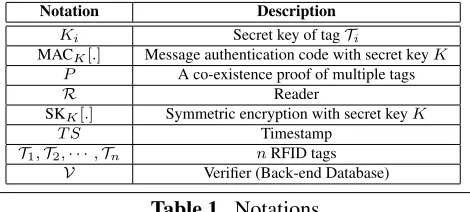
In this section, we briefly review existing grouping-proof protocols. We will use the notations summarized in Table 1.
2.1 Yoking-Proof for RFID Tags
Notation Description
Ki Secret key of tagTi
MACK[.] Message authentication code with secret keyK P A co-existence proof of multiple tags
R Reader
SKK[.] Symmetric encryption with secret keyK
T S Timestamp
T1,T2,· · ·,Tn nRFID tags
V Verifier (Back-end Database) Table 1. Notations
short) algorithm can be used as a signing mechanism. The reader is in charge of forwarding the random num-bers and collecting the MACs to form a proof of co-existence. The resulting co-existence proof can be veri-fied by checking the validity of the MACs. The protocol proceeds as follows:
1.R → T1: request.
2.T1 → R:T1, r1wherer1is chosen at random.
3.R → T2:r1.
4.T2 → R: T2, r2, m2 =MACK2[r1] where r2 is chosen at random.
5.R → T1:r2.
6.T1 → R:m1=MACK1[r2].
7.R → V:P = (T1, r1, m1,T2, r2, m2).
2.2 Saitoh-Sakurai’s Grouping-Proof for RFID Tags
Saitoh and Sakurai [5] showed that yoking-proof is vul-nerable to replay attack. The reason is that the two mes-sages m1 andm2 are not guaranteed to be generated in the same session. As a result, an attacker can reuse
m2 in another session which results in a forged proof. To prevent the attack, Saitoh and Sakurai proposed a timestamp-based yoking-proof which requires an on-line verifier to issue a timestamp TS for each session. TS is included in each co-existence proof and needs to be signed by both T1 andT2. The online verifier ac-cepts a proof only if it is received within the expected lifespan of one interrogation session.
In [5], the authors also proposed another protocol which allows the simultaneous scanning of more than two tags. The protocol is called grouping-proof and requires an additional entity called pallet tag. The pallet tag has more computational resource than an RFID tag and acts as a representative of all RFID tags that are in the same package with the pallet tag.
1. V → R: TS.
2. R → T1,T1,· · · Tn: TS.
3. Ti→ R:mi =MACKi[TS], fori= 1,2,· · · , n.
4. R →Pallet Tag: TS,m1, m2,· · · , mn.
5. Pallet Tag→ R: CP = SKK[TS,m1, m2,· · · , mn].
6. R → V:P =(TS, CP,T1,T2,· · · ,Tn).
The proofP is subject to timestamp verification by the online verifier in order to prevent replay attacks. Then, the co-existence proof is verified by checking the validity of eachmi.
2.3 Other Variants of Yoking-Proof
Piramuthu proposed another variant of yoking-proof which does not use timestamp to prevent replay attack [7]. The main idea is to let the tagT1sign both its own random number r1 and the tag T2’s MAC m2. As a result, neither of two MACsm1 norm2 can be reused in another session.
Lin et al. pointed out that Piramuthu’s protocol may suffer from interference problem when multiple readers are represent. More specifically, when a tag is queried by two readers at the same time, the tag might have problem determining what messages to sign if no proper session management is present. Linet al. also showed that the timestamp-based yoking-proof pre-sented in [5] is indeed not secure against replay attack. An attacker can query the tagT1 with many different timestamp values in the future. Then, the responses fromT1 can be used to query the tagT1 which is in a different location and at different times. To counter the problem, Lin et al. proposed another variant of timestamp-based yoking proof in which the verifier en-crypts a timestamp value before sending to a reader. Lin
et al. also proposed another grouping-proof protocol for any number of tags but without using a pallet tag. The protocol uses a method called timestamp-chaining. That is, to produce a co-existence proof ofntags, the first tag signs the hashed timestamp value TS1from the reader and thei-th tag signs the hash of timestamp TSi
and the(i−1)-th tag’s MAC. The reader is in charge of forwarding the hashes and assigning proper values for each timestamp.
Burmester et al.’s protocols, a tag does not use MAC to sign its challenge. However, in order to produce a co-existence proof of two tags, Burmesteret al.’s pro-tocols assume that the two tags share a group id (de-noted as gid) and a common secret key (denoted as
Kg). Each tag also maintains a counter variablecsuch
thatcis increased by 1 after each successful protocol session. We describe below only one protocol in [10]. The other protocol has the same design but provides tag anonymity by updating the group id after each session.
1.R → T1,T2:rsyschosen at random.
2.T1,T2→ R:gid.
3.R → T1,T2:T1andT2 are linked.
4.T1 → R:c, r1wherer1||s1=f(rsys, c, Kg).
5.R → T2:r1, c.
6.T2 → R: t2, s2 if r1 = r2 where r2||s2 =
f(rsys, c, Kg) and t2 = f(r2, c, K2). If r1 6= r2, T2 terminates the protocol.
7.R → T1:s2.
8.T1 → R:t1ifs1 =s2 wheret1 =f(r1, c, K1).T1 also update its counter valuec =c+ 1. Ifs1 6=s2, T1 terminates the protocol.
9.R → V:P = (rsys, gid, c, r1, t1, r2, t2).
3. Scalability Issue of Previous Grouping-Proof Protocols
The design of yoking-proof and timestamp-based yok-ing proof suffers from a serious scalability issue. The reason is that a reader needs to relay messages from one tag to another so that a tag can sign the random num-bers that were generated by the other tags. As a result, if the reader wants to produce a co-existence proof ofn
tags, it will need to relayn(n−1)messages amongn
tags. The number of relaying messages can be reduced to(n−1)if a proof is constructed in a chaining fashion. That is, the first tag signs the second tag’s random ber. The second tag signs the third tag’s random num-ber and so on. However, this approach might be sub-ject to replay attack if a protocol is not designed care-fully. Let’s assume that a tagTiappears in two chaining proofs. Using Ti as a connector, an attacker might try
to connect the first half of the first proof with the sec-ond half of the secsec-ond proof to produce a forged proof. Nevertheless, this is a significant communication over-head compared to the traditional method of scanning
one tag at a time which requires no message to be re-layed by the reader. This same problem also appears in other variations of yoking-proof and in [7, 8, 10].
The grouping-proof protocol by Saitoh and Sakurai does not use the same design of yoking-proof. How-ever, it requires a pallet tag which is capable of per-forming symmetric encryption. This increases the cost of multiple scanning of tags and might not be flexible in practice. For example, in a retail store, items that are scanned at a point-of-sale usually do not have an accompanying pallet tag. In addition, the reader still needs to relay messages from all tags to the pallet tag. In order to to scanntags at once, the reader needs to relaynmessages to the pallet tag.
As we pointed out earlier, the lifespan of one pro-tocol session may affect the resilience of a grouping-proof protocol against mafia fraud attack. We think that it is important to solve the scalability problem of previ-ous grouping-proof protocols, not only for the sake of only performance but also security.
4. Security Model for A Secure Grouping-Proof Protocol
It is important that before designing a protocol to se-cure certain cryptographic tasks, one should clearly de-fine the meaning of the termsecure. In this paper, we present a security model for a secure grouping-proof protocol for RFID tags which addresses mafia fraud attack and the level of trust on an RFID reader. We then define what a secure grouping-proof protocol for RFID tags is. Our security model is a conventional se-curity model in a sense that the adversary is given ac-cess to a set of oracles and the termsecure is defined via a game between a challenger and the adversary. In [10], the authors proposed another security model for secure grouping-proof protocol in theUniversal Com-posable Framework(UC framework for short). A pro-tocol which is secure in UC framework is guaranteed to remain secure even when running as a component of a large system. The most important part of a secu-rity model in the UC framework is theideal functional-itywhich is a trusted party implementing the required cryptographic task. The ideal functionality defined in [10] is calledFgroup which interacts with different
interface. The problem with Fgroup is that there is no
condition for a tag to callFgroup’sinitiate. Indeed, only
tags within the communication range of a reader are qualified to make the initiate calls to Fgroup.
Unfor-tunately, the communication range of a reader is not modeled inFgroup. That is probably why the full secu-rity proofs for two protocols in [10] are not yet avail-able. Note that, this does not mean security proofs for lightweight authentication protocols for RFID are in-valid. In case of an authentication protocol, the goal of the adversary is to impersonate a tag. Simply relaying message between a legitimate tag and a reader does not qualify as impersonation. It is also worth mentioning that most of previous grouping-proof protocols employ timestamp which makes it difficult to rigorously ana-lyze their security. We think that it is better to avoid using a physical object in the description of a protocol but embed it in the security model or assumption.
We now describe our security model for a secure grouping-proof protocol. First of all, we realize that that for a grouping-proof for RFID tags protocol, the primary goal of an adversary is to inject some tags (pos-sibly genuine) into a valid co-existence proof while the tags are not actually in the communication range of the reader. In addition, the adversary might also want re-move some tags from a valid co-existence proof. It is also assumed that the reader can behave maliciously but does execute the protocol correctly. When reporting a co-existence proof to the verifier, a malicious reader may try to replace some tags in the proof with differ-ent tags, add a tag to the proof or remove a tag from the proof. One can obtain a stronger security notion by allowing a malicious reader to deviate from the proto-col in any fashion. However, it is impossible to achieve security because the verifier has no knowledge of what and how many tags are actually in the communication range of the reader. The malicious reader can violate the security by deliberately not scanning some tags. This issue also appears in all of the previous protocols in [2, 5, 7, 8, 10]. Indeed, the timestamp-chaining pro-tocol by Linet al.is vulnerable to malicious behaviors of a reader even if the reader is trusted to execute the protocol correctly. The reason is that before reporting a co-existence proof ofntags to the verifier, the mali-cious reader can remove some tags at the end of the timestamp chain from the proof without invalidating the proof. We now define a set of oracles that provide information to the adversary:
• Thereader(.)oracle: This oracle simulates a reader
during a protocol session. That it, it returns the reader’s challenge to a tag.
• The corrupt-reader(.) oracle: This oracle corrupts a reader and returns the current state of the reader. The adversary is also allowed to control the reader after this oracle is called.
• The tag(.) oracle: This oracle simulates a tag
dur-ing a protocol session. That is, it returns the tag’s response given a challenge from a reader.
• Theverify(.)oracle: This oracle takes a co-existence
proofPas input and returns 1 ifPis valid and 0 oth-erwise.
We now define the security notion for a secure grouping-proof protocol via the following game be-tween a challenger and an adversary.
1. The challenger first sets the verifier and a reader and tags up to prepare for the game.
2. In the first phase of the game, the adversary collects information via 4 oracles:reader(.),tag(.), corrupt-reader(.)andverify(.). These oracles are simulated by the challenger.
3. In the second phase of the game, the challenger gives the adversary a valid proof P of ntags as a challenge. The adversary’s goal is to either remove a tag fromPor add a new tag toPor replace a tag in
P with a different one. In this phase, the adversary is also given access to thecorrupt-reader(.)oracle after the challenge proofPis constructed. However, thetag(.)oracle is not provided to the adversary af-ter the adversary has seenP. This is to reflect our assumption that relay attack is not possible. The ad-versary should output a new proofP0which satisfies one of its goals.
Definition 1. A grouping-proof protocol is said to be secure if the winning probability of the adversary in the above game is negligible.
5. Our Proposed Grouping-Proof Protocol
We now propose our grouping-proof protocol for mul-tiple RFID tags which does not suffer from the scal-ability problem. In order to avoid relaying messages among tags, we use a (n, n)-secret sharing scheme in an uncoventional way. A(n, n)-secret sharing scheme allows one to split one secret x into n of so called shared secrets such that x can only be reconstructed from the shared secrets only if all ofnshared secrets are provided. This property is used in our proposed pro-tocol so that each tag can sign its own random number to prove its existence. The random numbers are shared secrets generated by a secret sharing scheme. If the original secret generated by a verifier can be recovered from signed shared secrets that were backscattered by tags, then the proof of co-existence of tags is verified. A(n, n)-secret sharing scheme can be implemented as follows:
•Given a secretx, a dealer chooses(n−1)random numbersy1, y2,· · · , yn−1as the first(n−1)shared secrets.
•The last shared secret yn is computed by yn = x⊕y1⊕y2⊕ · · · ⊕yn−1.
It is easy to see that the above protocol achieves per-fect security since it is impossible to recover x with-out any ofy1, y2,· · · oryn. In addition, for each
ran-domly chosenx, a shared secret ofx is also random. This property is important to prevent replay attack as a shared secret is used as a challenge in our proposed protocol. We now describe our grouping-proof protocol below.
1.V → R: x chosen at random. The verifier also sets a time-to-live on x such that a co-existence proof associated withxmust be received within the lifespan of x (which should be approximately the time taken by one interrogation session of a reader).
2.R → Ti:x, yifori= 1,2,· · ·, nwherey1, y2,· · ·, andynarenshared secrets ofx.
3.Ti → R:Ti, mi =MACKi[yi, x], fori= 1,2,· · ·, n.
4. R → V:P = (T1, y1, m1,T2, y2, m2,· · · ,Tn, yn, mn).
5. V: The verifier verifies a proofPby checking ifPis received within the lifespan ofx=y1⊕y2⊕· · ·⊕yn and eachmiis valid MAC of the tagTion(x, yi).
Remark 1. Note that, it is important to stress that we do use timestamp in our protocol to prevent a mali-cious reader from abusingx(i.e., the malicious reader can take x and use shared secrets of x on different tags at different locations and times). However, the way which timestamp is used in our protocol is very differ-ent from in previous protocols. More specifically, we do not use timestamp as a challenge to a tag. Instead, only the verifier maintains timestamp for each interrogation session. This allows us to leave “time-to-live ofx” to the security model. Indeed, the fact that a co-existence proof must be received within the lifespan ofxfits in the assumption that a reader always executes the protocol correctly until reporting a proof to the verifier. There-fore, we can ignore the use of timestamp in the security proof of our protocol.
We now analyze the success probability of an ad-versary attacking our protocol. The probability is mea-sured in terms of the success probabilities of adver-saries attacking the underlying MAC and secret sharing schemes in the following theorem.
Theorem 1. Letαbe success probability of an adver-sary attacking the underlying MAC scheme. Let be the success probability of an adversary that attacks our proposed grouping-proof protocol, we have:
=O
α+ 2−2l
wherelis the bit lengthxanddis the number of tags in the tag database.
Proof.Let A be the adversary that attacks our pro-posed grouping-proof protocol. Given a challengeP = (T1, y1, m1,T2, y2, m2,· · ·,Tn, yn, mn) and let x = y1⊕y2⊕ · · · ⊕yn,Awants to achieve one of the
fol-lowing goals:
• Construct a co-existence proofP0 = (T∗
1 , y∗1, m∗1,T2∗,
y2∗, m∗2,· · ·,T∗
n, yn∗, m∗n)such that{T1,T2,· · · ,Tn}
6
={T1∗,T2∗,· · · ,Tn∗};y1∗⊕y∗2⊕ · · · ⊕yn∗ =x; and
m∗1, m∗2,· · · andmn∗ are valid MACs ofT1∗,T2∗,· · · andT∗
n on (y1∗, x),(y2∗, x),· · · and(yn∗, x),
commu-nication range of the reader by another tag. We call this type of adversary Type-I adversary.
•Construct a co-existence proofP0= (T∗
1, y1∗, m∗1,T2∗,
y2∗, m∗2,· · · ,T∗
n−1, y∗n−1, m∗n−1)such that the cardi-nality of{T1,T2,· · ·,Tn} \ {T1∗,T2∗,· · ·,Tn∗−1}is 1;y∗1⊕y2∗⊕ · · · ⊕y∗n−1 =x; andm∗1, m∗2,· · · and
m∗n−1 are valid MACs ofT∗
1,T2∗,· · · andTn∗−1 on
(y∗1, x),(y2∗, x),· · · and (y∗n−1, x), respectively. In other words, the adversary can remove a tag from
P. We call this type of adversary Type-II adversary.
•Construct a co-existence proofP0= (T1, y1∗, m∗1,T2,
y2∗, m∗2,· · · ,Tn, y∗n, m∗n,Tn∗+1, yn∗+1, m∗n+1)suchy1∗
⊕y∗2⊕ · · · ⊕yn∗⊕yn∗+1 =x; andm∗1, m∗2,· · · , m∗n
and m∗n+1 are valid MACs of T1,T2,· · ·,Tn and
Tn∗+1on(y1∗, x),(y∗2, x),· · ·,(y∗n, x)and(y∗n+1, x), respectively. In other words, the adversary can add the tag T∗
n+1 to P. We call this type of adversary Type-III adversary.
In the first phase of the attack, A are given access to three oracles: thetag(.)oracle, thereader(.) oracle and theverify(.)oracle. Thecorrupt-reader(.)oracle is not needed asAcan eavesdropxitself from challenges sent to tags (except thatAcan control the reader after seeing the challengeP, however this does not affect the analysis here). Thetag(.)oracle is essentially a MAC oracle as it outputs MAC on an input value together with a tag ID. In the second phase of the attack, the adversary can only control the reader after seeing the challenge P. No oracle access is given in this phase. As usual, we limit the number of calls to oracles and running time of the adversary to be polynomial in se-curity parameters. We analyze the success probability of each type of the adversary below.
Type-I Adversary: We distinguish two cases of Type-I adversary as follows:
•Case 1: none of(y∗
i, x)fori= 1,2,· · ·, nhas not
been asked to thetag(.)oracle. In this case,Ais es-sentially a MAC forger withm∗i is a forged MAC. Indeed, if A can forge a MAC, then it is obvious to attack the proposed grouping-proof protocol by constructing a forged MAC on one of (yi, x) for i= 1,2,· · ·, nsuch that the forged MAC is a valid MAC of a tag not in {T1,T2,· · · ,Tn}. Therefore,
the success probability ofAis bounded by the suc-cess probability of the MAC adversary.
• Case 2: at least one of (y∗
i, x) for i = 1,2,· · ·, n
has been asked to the tag oracle. We only consider the case that the adversary try to replace one tag in P with another tag. But it can be easily gener-alized to the case of replacing more than one tag. Since A is not supposed to forge a MAC (other-wise, it is easier to attack by executing the scenario of the adversary in the first case) and thetag(.) or-acle is not provided in the second phase of the at-tack, A can only hope that its query to the tag or-acle with (y∗i, x) results in (Ti∗, m∗i) such that Ti∗ is not among (T1,T2,· · · ,Tn)andyi∗ constitutes a valid shared secret. However, because the underly-ing(n, n)-secret sharing scheme is perfectly secure andxis randomly chosen for each session,y∗i has to be one ofy1, y2,· · ·, yn. In other words,Asucceeds only if one of the pairs(yi, x) for i = 1,2,· · ·, n
has been queried to thetag(.)oracle in the querying phase such that the returned tuple(Ti∗, m∗i)satisfies the adversary’s goal. As shared secrets are randomly distributed and there are(d−n) candidate tags for T∗, the success probability ofAis d−dn2−2l.
Type-II Adversary: Using the same analysis for Type-I adversary, we can see that the best option that adversary can succeed is to forge a MAC. For exam-ple, if the adversary wants to removeTnfromP, it can
forge a MAC ofTn−1on(yn−1⊕yn, x). The resulting
proofP0is(T1, y1, m1,T2, y2, m2,· · · ,Tn−1, yn∗−1, m∗n−1) where y∗n−1 = yn−1 ⊕ yn and m∗n−1 is the forged MAC. Otherwise, the adversary would have to hope that(yn−1⊕yn, x)was queried to thetag(.)oracle
dur-ing the querydur-ing phase. To conclude, the success prob-ability of Type-II adversary is bounded byα+ nd2−2l.
Type-III Adversary: The success probability of Type-III adversary can also be analyzed similarly. In particular, if the adversary can forge a MAC, he can add a tag Tn∗+1 to P by forging two MACs of Tn and T∗
n+1 on (y∗n, x) and (y∗n+1, x), respectively, such that y∗n ⊕yn∗+1 = yn. The forged proof P0 is (T1, y1, m1,T2, y2, m2,· · ·,Tn, yn∗, m∗n,Tn∗+1, y∗n+1, m∗n+1) which should be correctly verified by the verifier. Therefore, we can obtain the success probability of Type-III adversary as 12α+d−dn2−2l.
Theorem 1 suggests that if the underlying MAC scheme is secure, i.e., α is negligible, and l is long enough, then the success probability of an adversary attacking our proposed grouping-proof for RFID tags protocol is negligible. We conclude that our scheme is secure.
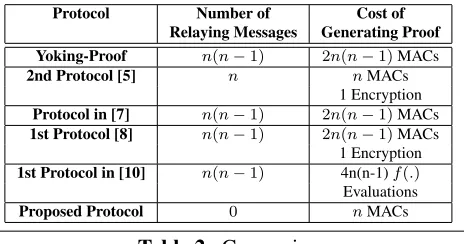
We now compare our proposed scheme with previ-ous protocols with respects performance and security assuming that we want to produce a co-existence proof ofntags.
Protocol Number of Cost of Relaying Messages Generating Proof Yoking-Proof n(n−1) 2n(n−1)MACs 2nd Protocol [5] n nMACs
1 Encryption Protocol in [7] n(n−1) 2n(n−1)MACs 1st Protocol [8] n(n−1) 2n(n−1)MACs 1 Encryption 1st Protocol in [10] n(n−1) 4n(n-1)f(.) Evaluations Proposed Protocol 0 nMACs
Table 2. Comparison
6. Conclusion
In this paper, we present a grouping-proof for RFID tags protocol based on secret sharing. Our protocol solves the scalability issue of previous protocols by avoiding relaying messages among tags by a reader. We also define a security model for a secure grouping-proof protocol. Our security model deals with the case of un-trusted readers in a proper way. In particular, we cannot assume that a reader is totally un-trusted. In-stead, we assume that a reader is trusted to execute a grouping-proof protocol correctly but may behave ma-liciously when reporting a co-existence proof of tags to the verifier. We also address the impact of mafia fraud attack on the security of a grouping-proof protocol. Fi-nally, we show that our proposed grouping-proof proto-col satisfies the security notion defined within the pro-posed security model.
For future work, it would be interesting to construct a secure grouping-proof protocol that does not require an online verifier. We suspect that this kind of protocol might be impossible.
References
[1] Yvo Desmedt, Major security problems with the Unforgeable (Feige)-Fiat-Shamir proofs of identiy and how to overcome them, In SecureCom’88, pp. 15-17, 1988.
[2] Ari Juels, Yoking-Proofs for RFID Tags, In the Pro-ceedings of First International Workshop on Pervasive Computing and Communication Security, IEEE Press, pp.138-143, 2004.
[3] S. Brands and D. Chaum,Distance-Bounding Proto-cols, In Advances in Cryptology EUROCRYPT’93, Volume 765 of Lecture Notes in Computer Science, Springer-Verlag, pp. 344-359, 1994.
[4] G. Hancke and M. Kuhn,An RFID distance bounding protocol, In the 1st International Conference on Secu-rity and Privacy for Emergin Areas in Communications Networks (SECURECOMM’05), IEEE Computer So-ciety, pp. 67-73, 2005.
[5] Junichiro Saitoh and Kouichi Sakurai, Grouping-Proofs for RFID Tags, In the Proceedings of AINA International Conference, IEEE Computer Society, pp. 621-624, 2005.
[6] Ari Juels, RFID Security and Privacy: A Research Survey, In the Journal of Selected Areas in Communi-cation (J-SAC), 24(2):381-395, February 2006.
[7] Selwyn Piramuthu,On Existence Proofs for Multiple RFID Tags, In the Proceedings of ACS/IEEE Interna-tional Conference on Pervasive Services, IEEE Com-puter Society, pp. 317-320, 2006.
[8] Chih-Chung Lin, Yuan-Cheng Lai, J. D. Tygar, Chuan-Kai Yang and Chi-Lung Chiang,Coexistence Proof using Chain of Timestamps for Multiple RFID Tags, In the Proceedings of APWeb/WAIM International Workshop, Springer-Verlag LNCS 5189, pp. 634-643, 2007.
[9] Serge Vaudenay,On privacy models for RFID, In the Proceedings of Advances in Cryptology – Asiacrypt 2007, LNCS 4833, Springer-Verlag, pp. 68–87, De-cember 2007.
[10] Mike Burmester, Breno de Medeiros, and Rossana Motta, Provably Secure Grouping-Proofs for RFID Tags, In the Proceedings of CARDIS International Conference, Springer-Verlag LNCS 5189, pp. 176-190, 2008.
[11] Selwyn Piramuthu, Lightweight Cryptographic Au-thentication in Passive RFID-Tagged Systems, IEEE Transactions on Systems, Manegement and Cybernet-ics, Part C 38(3), pp. 360-376, 2008.
[12] Nishanth Chandran, Vipul Goyal, Ryan Moriarty and RafailOstrovsky,Position Based Cryptography, In the Proceedings of CRYPTO’09, Springer-Verlag LNCS 5677, pp. 391-407, 2009.