McOE: A Family of Almost Foolproof
On-Line Authenticated Encryption Schemes
– Full and Updated Version 2013-12-05 –
Ewan Fleischmann, Christian Forler, Stefan Lucks, and Jakob Wenzel
Bauhaus-University Weimar, Germany
{Ewan.Fleischmann, Christian.Forler, Stefan.Lucks, Jakob.Wenzel}@uni-weimar.de
Abstract. On-Line Authenticated Encryption (OAE) combines privacy with data integrity and is on-line computable. Most block-cipher-based schemes for Authenticated Encryption can be run on-line and are provably secure againstnonce-respecting adversaries. But they fail badly for more general adversaries. This is not a theoretical observation only – in practice, the reuse of nonces is a frequent issue1.
In recent years, cryptographers developedmisuse-resistant schemes for Authenticated Encryption. These guarantee excellent security even against general adversaries which are allowed to reuse nonces. But they can not perfom on-line encryption.
This work introduces a new family of OAE schemes –called McOE– dealing both with nonce-respecting and with general adversaries. Furthermore, we present two block-cipher-based family members,i.e., McOE-XandMcOE-G. In contrast to other published OAE, they provably guar-antee reasonable security against general adversaries as well as standard security against nonce-respecting adversaries.
Keywords: authenticated encryption, on-line encryption, provable security, misuse-resistant
1
Table of Contents
I Construction
1 Introduction . . . 4
2 Practical On-Line Authenticated Encryption using AES and Threefish . . . 6
2.1 Generic Construction of theMcOE Family (without Tag-splitting) . . . 6
2.2 Generic Construction of theMcOE Family (Tag-Splitting) . . . 7
2.3 McOE-X. . . 8
2.4 McOE-G. . . 10
2.5 Benchmarking . . . 10
3 On-Line Authenticated Encryption and Related Notions . . . 11
3.1 Definitions . . . 11
3.2 Block Ciphers and On-Line Permutations . . . 12
3.3 Authenticated Encryption (With Associated Data) . . . 13
II Security 4 Security Notions for On-Line Authenticated Encryption . . . 16
4.1 Privacy and Integrity Notions for Authenticated Encryption Schemes. . . 17
4.2 CCA3 is equal toINT-CTXT plus CPA-security. . . 17
4.3 Relations between PRP and OPRP. . . 17
5 Security of the GenericMcOE Scheme . . . 18
5.1 Security Analysis of McOE without Tag-Splitting . . . 18
5.2 Security Analysis of McOE with Tag-Splitting . . . 22
6 The On-Line Authenticated Encryption SchemeMcOE-X . . . 28
7 The On-Line Authenticated-Encryption SchemeMcOE-G . . . 29
8 Discussion . . . 30
III Appendices A Misuse-Attacks: The Weak Point of Current Authenticated Encryption (AE) Schemes. 34 A.1 Attacking Schemes without Claimed Resistance Against Nonce-Reuse . . . 34
A.2 Dedicated Online Ciphers and Authenticated Encryption . . . 36
A.3 Offline Schemes, Defeating Nonce-Reuse (SIV [41], HBS [25], BTM [24]) . . . 37
1 Introduction
On-Line Authenticated Encryption (OAE). Application software often requires a network chan-nel that guarantees both privacy and authenticity of the data being communicated between two parties. Cryptographic schemes able to meet twofold these goals are commonly referred to as Authenticated Encryption (AE) schemes.
The ISO/IEC 19772:2009 standard for AE [21] defines generic composition (Encrypt-then-MAC [3]) and five dedicated AE schemes: OCB2 [38], SIV [41] (denoted as “Key Wrap” in [21]), CCM [14], EAX [7], and GCM [34]. To integrate an AE-secure channel most seamlessly into a typical software architecture, application developers expect it to encrypt in anon-line manner,
i.e.,thei-th ciphertext block can be written before the (i+1)-th plaintext block is read. Whereas off-line encryption, where either the entire plaintext must be known in advance or read more than once, is an encumbrance to software architects.
Nonces and their reuse. Goldwasser and Micali [18] formalized encryption schemes as stateful or probabilistic, because otherwise important security properties are lost. Rogaway [37,39,40] proposed a unified point of view by always defining a cryptographic scheme as a deterministic algorithm that takes user-supplied nonce (a number used once). Then the application program-mer – and not the encryption scheme – is responsible for flipping coins or maintaining state. This reflects cryptographic practice since the algorithm itself is often implemented by a multi-purpose cryptographic library which is more or less application-agnostic.
In theory, the concept of nonces is simple. In practice, it is challenging to ensure that a nonce isnever reused. Flawed implementations of nonces are ubiquitous [10,20,28,44,45]. Apart from implementation failures, there are fundamental reasons why software developers cannot always prevent nonce-reuse. A persistently stored counter, which is increased and written back each time a new nonce is needed, may be reset by a backup – usually after a previous data loss. Similarly, the internal and persistent state of an application may be duplicated when a virtual machine is cloned, etc.
Related Work and Our Contribution. We aim to achievesimultaneously: security against nonce-reusing adversaries (sometimes also called nonce-misusing adversaries) and support for on-line-encryption in terms of an AE scheme. Apart from generic composition (Encrypt-then-Mac, EtM), none of the ISO/IEC 19772:2009 schemes – in fact, no previously published AE scheme at all – achieves both goals, (cf. Table 1). In this table, we classify a variety of provably secure block-cipher-based AE schemes with respect to their on-line-ability and against which adversaries (nonce-respecting versus -reusing) they are proven secure.
Since EtM is not a concrete scheme but a generic construction technique, there are some challenges left in order to make it fully on-line secure: First, an appropriate on-line cipher has to be chosen. Second, a suitable, on-line-computable, secure, and deterministic MAC must be selected. And, third, the EtM scheme requires at least twoindependent keys to be secure. Since two schemes are used in parallel, it is likely to squander resources in terms of run time and – important for hardware designers – in terms of space. Since EtM first has to be turned into an OAE scheme by making the appropriate choices, we do not include it in our analysis.
As it turned out, we actually found nonce-reuse attacks forall of those schemes, cf. Table 2 and Appendix A.
secure ... against nonce-respecting adversaries ag. nonce-reusing adversaries
on-line CCFB[33] CHM[22] CIP[23] CWC[29] EAX[7] GCM[34] McOE-X(this paper) IACBC[26] IAPM[26]McOE-G McOE-X McOE-G(this paper) OCB1-3 [40,38,30] RPC[11] TAE[31] XCBC[17]
off-line BTM[24] CCM[14] HBS[25] SIV[41] SSH-CTR[36] BTM[24] HBS[25] SIV[41]
Table 1.Classification of provably secure block-cipher-based AE Schemes. CCM and SSH-CTR are considered off-line because encryption requires prior knowledge of the message length. Note that the family of McOEschemes, because of being on-line, satisfies a slightly weaker security definition against nonce-reusing adversaries than SIV, HBS, and BTM.
privacy authenticity attack workload attack workload CCFB [33] O(1) O(1) CCM [14] O(1) 2(n/2)[15] CHM [22] O(1) O(1) CIP [23] O(1) O(1) CWC [29] O(1) O(1) EAX [7] O(1) O(1) GCM [34] O(1) O(1) IACBC [26] O(1) O(1)
privacy authenticity attack workload attack workload IAPM [26] O(1) O(1) OCB1 [40] O(1) O(1) OCB2 [38] O(1) O(1) OCB3 [30] O(1) O(1) RPC [11] O(1) O(1) TAE [?] O(1) O(1) XCBC [17] O(2n/4) ?
Table 2.Overview of ournonce-reuseattacks on published AE schemes, excluding SIV, HBS and BTM, which have been explicitly designed to resist nonce-reuse. Almost all attacks achieve an advantage close to 1. The “attack workload” covers the computational effort, amount of needed memory as well as the time complexity. Details are given in Appendix A.
the upper-right poistion of Table 1. We argue that closing this gap is both practically relevant and theoretically interesting.
Initial Value (IV)-based AE schemes which provide security against repeated IV’s have been addressed by Rogaway and Shrimpton in [41]. Furthermore, the authors shaped the notion of
misuse-resistance and they proposed SIV as a solution. SIV and related schemes (HBS [25] and BTM [24]) actually provide excellent security against nonce-reusing adversaries, though, there are other potential cases of misuse (cf. Appendix A.3). Their major disadvantage is that they are inherently off-line: For encryption, one must either keep the entire plaintext in memory, or read the plaintext twice.
Ideally, an adversary seeing the encryptions of two (equal-length) plaintextsP1andP2cannot
even decide if P1 =P2 or not. When using a nonce more than once, deciding aboutP1 =P2 is
easy. SIV and its relatives ensure that nothing else is feasible for nonce-reusing adversaries. In the case of on-line encryption, where the first few bits of the encryption of a lengthy message must not depend on the last few bits of that message, there unavoidably is something beyond
P1 =P2. The adversary can compare any two ciphertexts for their longest common prefix, and
then conclude about common prefixes of the secret plaintexts. Our notion of misuse-resistance
means that this is all the adversary can gain. Even in the case of a nonce-reuse:
1. The adversary cannot do anything beyond determining the length of common plaintext prefixes and
2. the scheme still provides the usual level of authenticity for AE (INT-CTXT).
EK IV
V
T K
EK M1
C1
EK M2
C2
EK M3
C3
EK TM
CT
K K K K
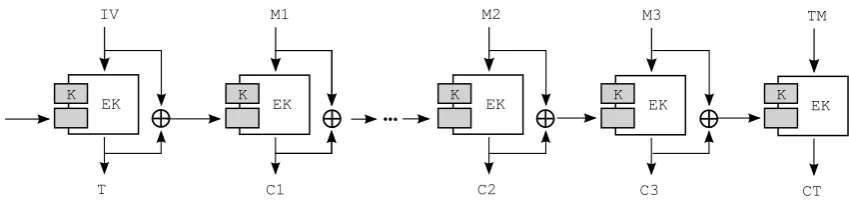
Fig. 1.The genericMcOEconstruction, whereEedenotes a tweakable block cipher.
approach, especially to TC3. In contrast to the McOEfamily, the constructions from [43] pro-vide no authentication.
Design Principles for AE Schemes. The question of how to provide authenticated encryption (without stating that name) when given a secure on-line cipher is studied in [2], the revised and full version of [1]. The first approach in [2] only provides security if all messages are of the same length. The second approach repairs that by prepending the message’s length to the message, at the cost of being off-line since the message length must be known at the beginning of the encryption process. Their approach is to prepend and append a random W to a messageM and then to perform the on-line encryption of (W||M||W). This looks promising, but the same W is used for two different purposes, putting different constraints on the generation ofW. For privacy, it suffices that W behaves like a nonce, not requiring secrecy or unpredictability. Even ifW is not a nonce, but the sameW is used for the encryption of several messages, all the adversary can determine are the lengths of common plaintexts prefixes, as we required for nonce-reuse. On the other hand, authenticity actually assumes a secret or unpredictable W rather than a nonce. If the adversary can guessW before choosing a message, she asks for the authenticated encryption of (M||W). Then, she can predict the authenticated encryption of M without actually asking for it.
TheMcOE family replaces the “random”W by a proper nonce and thekey-dependent tag computation value τ, performing a nonce-dependent on-line encryption of (M||τ). The encryp-tion can also depend on some associated data, which turns McOEinto a family of schemes for OAEAD (On-Line Authenticated Encryption with Associated Data).
Roadmap. In Section 2 we describe the basic design principle of McOE. Then, we present the members of the McOE family. Furthermore, we introduce its concrete instances, and provide performance data when instantiated with either AES-128 or Threefish-512 as underlying block cipher. Section 3 deals with general notions and definitions, and Section 4 defines the security of OAE. The main result of the paper, the security proof of the generic McOEscheme and its analysis is presented in Section 5. In Sections 6 and 7 we show the security of McOE-X and McOE-G, respectively.
The discussion in Section 8 concludes the paper. The appendix deals with misuse-attacks against published AE schemes, and provides proof supplements.
2 Practical On-Line Authenticated Encryption using AES and Threefish
2.1 Generic Construction of the McOE Family (without Tag-splitting)
McOEstructure (see Figure 1) is based on TC3, which is an on-line encryption scheme presented by Rogaway and Zhan in [43]. Like TC3, our scheme is based on a tweakable block cipher – called
e
EK – but is stateful regarding to the usage of a nonce. Additionally, we expanded it to a full-fledged authenticated encryption scheme with an additional effort of only two tweakable block cipher calls.
We also introduce the tag-splitting (TS) method for processing messages whose length is not a multiple of the block length. Without TS, we would have to pad such messages and then encrypt the padded messages – resulting in an expanded ciphertext. TS is similar to a well-known length-preserving method called ciphertext stealing (CTS), e.g., [13]. Note, that CTS requires to process the final block before its predecessors, which is not possible for McOE.
The encryption and decryption of the generic construction of McOE without TS can be described by the following two algorithms.
Definition 1 (Generic McOE Scheme without Tag-Splitting). Let Π={K,E,D} be an authenticated-encryption scheme, whereK denotes the key-derivation function,E the encryption function, and D the decryption function. Let Ee ∈ Block(n, n, n) be a tweakable block cipher. Furthermore, let H be the header with H ∈ DnLH, M be the message with M ∈ DLn for some integer L, T be the authentication tag with T ∈ Dn, and C be the ciphertext with C ∈ DLn.
Then E and D of the McOE family are given by the algorithms EncryptAuthenticate and
DecryptAuthenticate, respectively. Here, the encryption function takes a header H and a message M returning a ciphertext C and a tagT. The decryption function takes a header H, a ciphertext C, and a tag T, and returns either a plaintext M or the fail symbol ⊥.
EncryptAuthenticate(H, M)
1. U ←0n
2. for i= 1, . . . , LH −1 do
U ←EeK(U, Hi)⊕Hi 3. τ ←EeK(U, HLH) 4. U ←τ ⊕HLH
5. for i= 1, . . . , L loop
Ci ←EeK(U, Mi) U ←Mi⊕Ci
6. T ←EeK(U, τ)
7. return (C1, . . . , CL, T)
DecryptAuthenticate(H, C, T)
1. U ←0n
2. for i= 1, . . . , LH−1 do
U ←EeK(U, Hi)⊕Hi 3. τ ←EeK(U, HLH) 4. U ←τ⊕HLH
5. for i= 1, . . . , L loop
Mi ←EeK−1(U, Ci) U ←Mi⊕Ci
6. if T =EeK(U, τ) then
return (M1, . . . , ML)
else return ⊥
In the case when the header or the message length is not a multiple of the block size n, we recommend to use the secure 10∗-padding. Furthermore, the header has to consist of at least one block, since the tag computation valueτ depends on it. Hence, the whole header can be seen as a nonce. To fulfill the requirement of length-preserving encryption, we introduce the generic McOE scheme using the TS method in the next section.
2.2 Generic Construction of the McOE Family (Tag-Splitting)
Definition 2 (Generic McOE Scheme with Tag-Splitting). Let Π = {K,E,D} be an authenticated-encryption scheme, whereK denotes the key-derivation function,E the encryption function, and D the decryption function. Let Ee ∈ Block(n, n, n) be a tweakable block cipher. Furthermore, let H be the header with H ∈DLHn , M be the message with M ∈DnL||{0,1}l∗ for
some integers L and l∗, 0 < l∗ < n, T be the authentication tag with T ∈ Dn, and C be the
ciphertext with C ∈ DnL||{0,1}l∗
. Then, the tag-splitting variants of E and D are given by the algorithmsEAST andDAST, respectively. Here, the encryption function takes a headerH and a messageM, returning a ciphertextC and a tag T. The decryption function takes a header H, a ciphertext C, and a tag T and returns either a plaintext M or the fail symbol ⊥.
EAST(H, M)
1. U ←0n
2. for i= 1, . . . , LH −1 do
U ←EeK(U, Hi)⊕Hi 3. τ ←EeK(U, HLH) 4. U ←τ ⊕HLH
5. for i= 1, . . . , L−1 loop
Ci←EeK(U, Mi) U ←Mi⊕Ci
6. M∗ ←(ML||τ[0. . . n−l∗−1])
7. M∗ ←M∗⊕EeK(1n,|ML|) 8. C∗←EeK(U, M∗)
9. Parse CL||T[0. . . n−l∗−1]←C∗
10. U ←M∗⊕C∗ 11. C∗∗←EeK(U, τ)
12. T[n−l∗. . . n−1]←C∗∗[0. . . l∗−1]
13. return (C1, . . . , CL−1, CL∗, T)
DAST(H, C, T)
1. U ←0n
2. for i= 1, . . . , LH −1 do
U ←EeK(U, Hi)⊕Hi 3. τ ←EeK(U, HLH) 4. U ←τ ⊕HLH
5. for i= 1, . . . , L−1 loop
Mi ←EeK−1(U, Ci) U ←Mi⊕Ci
6. C∗←CL||T[0. . . n−l∗−1]
7. M∗ ←EeK−1(U, C∗) 8. U ←M∗⊕C∗
9. M∗ ←M∗⊕EeK(1n,|CL|)
10. ParseML||τ0[0. . . n−l∗−1]←M∗
11. T0=EeK(U, τ)
12. if τ0[0. . . n−l∗−1] =τ[0. . . n−l∗−1]
and T0[0. . . l∗−1] =T[n−l∗. . . n−1]
then return (M1, . . . , ML) else return ⊥
Both schemes, with and without tag-splitting, are secure in the common CCA-setting, assuming a nonce-respecting adversary. In addition, they guarantee a certain amount of security in the nonce-misuse scenario,i.e.,indistinguishability from an on-line permutation and security against existential forgery attacks.
2.3 McOE-X
The first instance presented in this paper is calledMcOE-X, where the ’X’ indicates the way of handling the tweak. This scheme uses an ordinary block cipher which is converted to a tweakable block cipher by XORing the tweak (i.e.,the chaining value) to the key K. A depiction of this instance is given in Figure 3.
The none-tag-splitting and tag-splitting modes of McOE-X can be described by the algo-rithms introduced in Section 2.1 (see Definition 1 and 2), where the tweakable block cipherEeK
is defined by
e
EK(U, M) :=EK⊕U(M),
EK IV
V
T K
EK M1
C1
EK M2
C2
EK TM
CT
K K K
M4 EK ML
EK
C3 K K
X
Fig. 2.The genericMcOEconstruction, whereEedenotes a tweakable block cipher. For simple reference, we denote
Tα as the (n− |CL|)-bit string T[0...n− |CL| −1] andTβ as the |CL|-bit stringT[n− |CL|, ..., n]. Additionally, we denote the corresponding stringsτα=τ[0, . . . ,|C
L| −1] andτβ =τ[|CL|, . . . , n−1], respectively.
EK IV
V
T K
EK M1
C1 K
EK M2
C2 K
EK TMts
CTts K EK
M4
C4 K
EK M3
C3 K
EK TM
CT K EK
ML
K 1
Fig. 3. TheMcOE-X encryption process. In case that the message length is not a multiple of the block size,
McOE-Xperforms tag-splitting (upper variant). Otherwise, the tag can be computed without splitting (lower
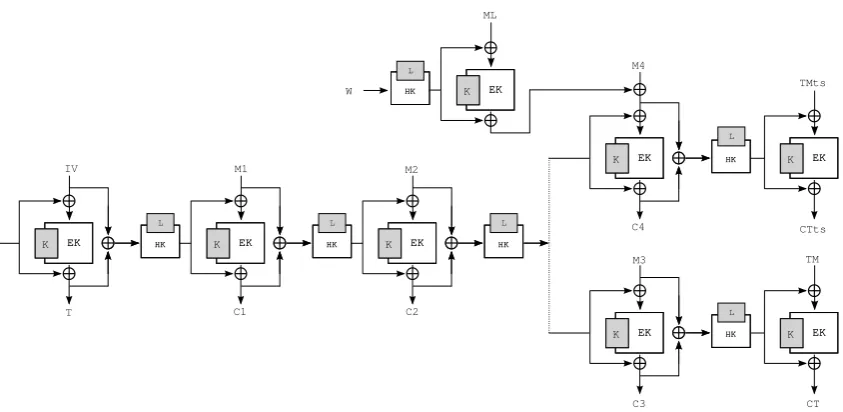
variant). The key used for the block cipher E is computed by the injective function K⊕U which is given the secret key Kand the chaining value inputU. The returned tag is then-bit valueT. The (n−l)-bit valueZ is discarded. The decryption process works in a similar way from ’left to right’, only the block cipher componentE
is replaced by its counterpartE−1 apart from one exception: the first call computesτ.
easily extended to smoothly handle associated data, i.e., data that is not encrypted but only authenticated. The security proofs considering associated data are given in Section 6.
The choice of Threefish-512 is based on two facts. First, it contains an agile key scheduler since it is optimized for hashing messages in the MMO (Matyas-Meyer-Oseas) mode. Second, it processes message blocks of 512 bit size, which results in less incovations of the block cipherEK.
EK IV
V
T K
M1
C1
M2
C2
TMts
CTts M4
C4
M3
C3
TM
CT HK
EK
K HK
L
EK
K EK HK
K HK KK EKEK HKHK
EK
K EK HK
K HK KK EKEK
EK
K EK HK
K HK KK EKEK ML
HK
HK KK EKEK W
L L
L
L
L
Fig. 4. TheMcOE-G encryption process. If the message length is not a multiple of the block size, McOE-G
performs tag-splitting (upper variant), whereTαdenotesT[0, . . . , n−l∗−
1] andTβ denotesT[n−l∗
, . . . , n−1]. Otherwise, the tag is computed without splitting (lower variant). The key used for the block cipherEis the same for every encryption. Hence, it can be precomputed. The returned tag is then-bit valueT. The (n−l)-bit valueZ
is discarded. The decryption process works in a similar way from ’left to right’, only the block cipher component
E is replaced by its counterpartE−1 apart from one exception: the first call computesτ.
2.4 McOE-G
The third and last member of the McOEfamily presented in this paper is given by McOE-G. This version updates the chaining value by applying an almost XOR-universal hash function to the XOR result of the previous message block and ciphertext block (see Figure 4). In our practical implementation, we use the Galois-Field multiplication forH,i.e.,the keyK2is multiplied with
the chaining value over GF(2128) defined by the low- weight irreducible polynomial g(x) =
x128+x7+x2+x+ 1 as used in OCB [40] and GCM [34]. The tweakable block cipherEeK is then defined as follows
e
EK(U, M) :=EK1(M⊕HK2(U))⊕HK2(U),
where EK denotes a common block cipher, M the message, and U (chaining value) the tweak. The keyK is denoted by the concatenation ofK1 and K2,i.e.,K=K1||K2.
ForMcOE-Gwe also present a version with thetag-splitting approach, which was introduced before (see Section 6). Here, an additional key K2 is requiered for the XOR-universal hash
function HK2 as shown in Figure 4. McOE-G can be easily extended to smoothly handle
associated data, i.e., data that is not encrypted but only authenticated. The security proofs considering associated data are given in Section 7.
2.5 Benchmarking
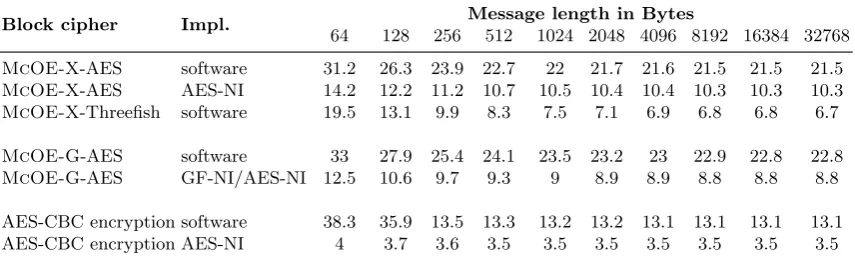
Block cipher Impl. Message length in Bytes
64 128 256 512 1024 2048 4096 8192 16384 32768
McOE-X-AES software 31.2 26.3 23.9 22.7 22 21.7 21.6 21.5 21.5 21.5
McOE-X-AES AES-NI 14.2 12.2 11.2 10.7 10.5 10.4 10.4 10.3 10.3 10.3
McOE-X-Threefish software 19.5 13.1 9.9 8.3 7.5 7.1 6.9 6.8 6.8 6.7
McOE-G-AES software 33 27.9 25.4 24.1 23.5 23.2 23 22.9 22.8 22.8
McOE-G-AES GF-NI/AES-NI 12.5 10.6 9.7 9.3 9 8.9 8.9 8.8 8.8 8.8
AES-CBC encryption software 38.3 35.9 13.5 13.3 13.2 13.2 13.1 13.1 13.1 13.1 AES-CBC encryption AES-NI 4 3.7 3.6 3.5 3.5 3.5 3.5 3.5 3.5 3.5
Table 3. Performance values (cycles-per-byte, single core), measured on a Core i5 540M for AES-128 and Threefish-512. McOE-Xis the main contribution in the current paper,McOE-G is a variant using Galois field arithmetic. For comparsion, we also provide the performance of unauthenticated AES-CBC. The AES software implementation is based on Gladman [16], whereas the hardware implementation is based on the Intel AES-NI Sample Library[12]. The Threefish implementation is based on the NIST/SHA-3 reference source as provided by the Skein authors [35]. Finally, the implementation of Galois-Field NI multiplication (GF-NI) is based on the example code from [19].
3 On-Line Authenticated Encryption and Related Notions
3.1 Definitions
Length of Longest Common Prefix (LLCPn). The length of a string x ∈ {0,1}n is denoted by |x| := n. For integers n, `, d ≥ 1, set Ddn = ({0,1}n)d, and D∗
n :=
S
d≥0Dnd, and
D`,n = S0≤d≤`Dnd. Note that Dn0 only contains the empty string. For M ∈ Dnd; we write
M = (M1, . . . , Md) withM1, . . . , Md∈Dn. ForP, R∈Dn∗, say,P ∈D p
n and R∈Dnr, we define thelength of the longest common n-prefix of P and R as
LLCPn(P, R) = max
i {P1 =R1, . . . , Pi=Ri}.
For a non-empty setQ of strings inD∗n we define LLCPn(Q, P) as max
q∈Q{LLCPn(q, P)}. For
example, if P ∈ Q, then LLCPn(Q, P) =|P|/n.
For convenience, we introduce a notation for a restriction on a set. LetQ={0,1}a× {0,1}b× {0,1}c, then we denote byQ
|b,c ={(B, C)| ∃A: (A, B, C)∈ Q}as the restriction of Qto B and C. This generalizes in the obvious way.
Game Based Proofs. Most of the proofs in this paper use the concept ofgame-playing proofs. The presented games in this paper are written in a language heavily based on L, that was introduced by Bellare and Rogaway in [5]. A game has three kinds of functions: An initialization function Initialize, a finalization functionFinalize, and oracle functions. Any adversaryA
that is playing a game calls at first the Initialize function. In the following, A makes some oracle queries and finally it ends the game by invoking Finalize. For adversaries, a function of a game is a black box. They have no access to any local or global variable of any game. An adversary wins the game if and only if Finalize returns true. We denote Pr[AG ⇒ 1] as the probability that the adversary wins the game G.
3.2 Block Ciphers and On-Line Permutations
Block Cipher. A (k, n)-block cipher is a keyed family of permutations consisting of two paired algorithms E :Dk×Dn → Dn and E−1 :Dk×Dn → Dn, accepting a k-bit key and an input from Dn for somek, n >0. For n >0,Block(k, n) is the set of all (k, n)-block ciphers. For any
E ∈ Block(k, n) and fixed key K ∈ Dk, the decryption EK−1(Y) := E−1(K, Y) is the inverse function of enryption EK(X) :=E(K, X), so that EK−1(EK(X)) =X holds for any X∈Dn.
We follow the usual convention to write oracles, that are provided to an algorithm, as super-scripts. We define the related-key PRP-security of a block cipher E by the success probability of an adversary trying to distinguish between the block cipher and a random permutation.
Definition 3. Let E ∈Block(k, n) and let denote E−1 its corresponding inverse. Let ϕ:Dk×
Dn→Dk. A fixed related key adversary A has access to an oracle E with two parameters such
that she can query either Eϕ(K,·)(·) or Eϕ−1(K,·)(·).
Let Perm(n, n) be the set of n-bit permutations, such that the first parameter models the
permutation and the second parameter the value that is to be permuted, i.e., for π∈Perm(n, n)
it holds that π(Z,·) is a random permutation for any given value ofZ.
The related-key (RK) advantage [32] of A in breaking E is then defined by
AdvRK-CPA-PRP
E (A) =|Pr[K
$
←DkAEϕ(K,·)(·)⇒1]−Pr[π
$
←Perm(n,n):Aπ(·,·)⇒1]|
AdvRK-CCA-PRP
E,E−1 (A) =|Pr[K $
←Dk:A
Eϕ(K,·)(·),Eϕ−(1K,·)(·)⇒1]
−Pr[π←$ Perm(n,n):Aπ(·,·),π−1(·,·)⇒1]|.
Tweakable Block Cipher. The concept of tweakable block ciphers was introduced by Liskovet al.in [31]. The design is based on a common block cipher, which is extended by a so-called tweak. A tweakable (k, v, n) block cipher is a family of functions consisting of two paired algorithms
e
E :Dk×Dv×Dn→DnandEe−1 :Dk×Dv×Dn→Dn, accepting a keyK ∈Dk, a tweakV ∈Dv,
and an input fromDnfor somek, v, n >0.Block(k, v, n) is the set of all (k, v, n)-tweakable block ciphers. For any Ee ∈Block(k, v, n) and two fixed values K ∈Dk and V ∈ Dv, the decryption
e
EK−1(V, Y) :=E−1(K, V, Y) is the inverse function of the encryptionEeK(V, X) :=Ee(K, V, X), i.e.,EeK(K, V,·) is a permutation.
Definition 4. Let Ee ∈ Block(k, v, n) and denote by Ee−1 the corresponding inverse. A fixed adversary A has access to an Ee oracle with three parameters such that she can query either
e
EK(·,·) or EeK−1(·,·).
Let TPerm(v, n) be the set of n-bit permutations such that the first parameter models the
permutation and the second parameter the value that is to be permuted,i.e.,forπ ∈TPerm(v, n)
it holds that π(Z,·) is a random permutation for any given value ofZ.
The advantage for an adversary A to distinguish Ee from a randomly chosen permutation from TPerm(v, n) is defined as
AdvT-IND-CPA
e
E (A) =|Pr[K
$
←Dk:AEKe (·,·)⇒1]−Pr[π←$ TPerm(v, n) :Aπ(·,·)⇒1]|
AdvT-IND-CCA
e
E,Ee−1 (A) =
|Pr[K←$ Dk:AEeK(·,·),Ee
−1
K (·,·)⇒1]
1 OPerm(V, M)
2 (j, p)←LLCP∗n(Q|V,M,(V, M)) ;
3 Q ← Q ∪ {(V, M, C)}; 4 f o r i= 1, . . . , p do
5 Ci←Cij;
6 f o r i=p+ 1, . . . ,|M|/n do
7 Ci←$ Dn\D[V||M1||. . .||Mi−1] ;
8 D[V||M1||. . .||Mi−1]←D[V||M1||. . .||Mi−1]∪Ci; 9 return C;
Fig. 5. Lazy-sampling implementation of a stateful (n-)on-line permutation. In Line 2, the Oracle LLCP∗n is invoked returning (j, p) wherepdenotes the length of the prefixndetermined via LLCPnandjdenotes the index inQ|V,M. In line 5, we denote byC
j
i thei-thn-bit block of thej-th entry inQ|C.
On-Line Permutation (OPerm). We aim for larger permutations that not only permute single but multiple-block messages. We say a permutationP :D∗n→Dn∗ is (n-)on-lineiff thei -th output block is determined completely by -the firstiblocks of the input. Let denote OPermn,∗
the set of allD∗non-line permutations. It is easy to extend the definition with a state spaceDv. Let OPermvn,∗ denote the set of all functions fromDv×D∗ntoD∗n. Then for each f ∈OPermvn,∗
and V ∈ Dv, the function f(V,·) is an (n-)on-line permutation. Figure 5 illustrates a lazy sampling implementation of OPermvn,∗.
Next, we introduce the formal definition of a family of (n-)on-line functions which is the basic design principle of the McOEfamily.
Definition 5. Let n, k, v≥0,K ∈Dk, V ∈Dv. A family of functionsF :Dk×Dv×D∗n→Dn∗
is (n-)on-line if for any instance of this family determined by K, V,F(K, V,·) is a permutation and for any message M = (M1, M2, . . . , M`) there exists a family of functions fi :Dk×(Dv×
Din−1)×Dn→Dn, i= 1, . . . , ` such that
Π(K, V, M) = fK1((V,∅), M1)||fK2((V, M1), M2)
||. . .||
fK`−1((V, M1||. . .||M`−2), M`−1)||fK` ((V, M1||. . .||M`−1), M`),
where “||” is the concatenation of strings.
An encryption scheme is (n-)on-line if the encryption function is (n-)on-line. A thorough dis-cussion of on-line encryption and its properties can be found in [1].
Proposition 1. Let F be an (n-)on-line function as defined in Definition 5. Then, allfKi (V,·)
are n-bit permutations.
The proof is similar to Proposition 3.4 of [1].
Let F be a family of (n-)on-line functions. Assume that for each uniform randomly chosen FK from F, each fKi (V,·) is a PRP. Then, it is easy to see that FK is indistinguishable from the OPerm oracle as shown in Figure 5. We call such a a family of (n-)on-line functions on-line pseudo random permutations (OPRP).
3.3 Authenticated Encryption (With Associated Data)
An authenticated-encryption scheme is a tupleΠ = (K,E,D) whose aim is to provide privacy and data integrity. The key generation functionK takes no input and returns a randomly chosen key
of V and a value from D∗n: H ⊂ D+n. For sake of convenience, we usually write EH
K(M) for E(K, H, M) and DH
K(M) for D(K, H, M), where the message M is chosen from D
∗
n, H ∈D+n, and a key from the key space. We require DH
K(EKH(M)) = M for any possible K, M, H, and define the tag size for a messageM ∈Dn∗ and header H∈Dn+astag(H, M) :=|EKH(M)| − |M|. We denote an authenticated-encryption scheme with the requirement that the initial vector V
GameGCPA, GCCA3
1 I n i t i a l i z e(ω, ν)
2 b ← {0$ ,1}; 3 i f( b=1) then
4 K ← K() ;
5 F i n a l i z e(d) 6 return (b=d) ;
10 Encrypt(H, M)
11 i f (ν=nr and V ∈B) then
12 return ⊥; 13 i f( b=1) then
14 C← EK(H, M) ;
15 e l s e
16 C←$ω(H, M) ; 17 B←B∪ {V}; 18 Q ← Q ∪ {(H, C)}; 19 return C ;
20 Decrypt(H, C)
21 i f ((H, C)∈Q) then
22 return ⊥; 23 i f( b=1) then
24 M← DK(H, C) ;
25 e l s e
26 M← ⊥(H, C) ; 27 return M;
Fig. 6. GCPA(ω, ν) is the CPA(Πω,ν)-Game and GCCA3(ω, ν) the CCA3(Πω,ν)-Game where Π = (K,E,D). Game
GCCA3 contains the code in the box whileGCPA does not. The oracle $ae(H, M) returns a string of length|M|+ tag(H, M).V denotes the last block of the header representing the nonce/initial value.
4 Security Notions for On-Line Authenticated Encryption
The security notions and their relations for nonce-based authenticated-encryption schemes are introduced in [3,4,27,37,40]. Furthermore, Rogaway and Shrimpton introduced in [42] notions for deterministic authenticated-encryption sechemes. In order to have one convenient toolset of notions, we adopt the notion of CCA3-security suggested in [42] as a natural strengthening of CCA2-security.
We parameterize our definition in order to define different – but closely related – notions by explicitly stating whether we mean an on-line or off-line scheme,ω∈ {ae,oae}, and stating the adversary behavior as either nonce-respecting or nonce-ignoring, ν∈ {nr,ni}.
Definition 6 (CCA3(ω, ν)). Let Π = (K,E,D) be an authenticated encryption scheme with header space Dn+ and message space Dn∗, and fix an adversaryA. The advantage of A to break Π is defined as
AdvCCA3Π (ω,ν)(A) =
Pr
h
K← K$ :AEK(·,·),DK(·,·)⇒1
i
−Pr
h
A$ω(·,·),⊥(·,·)⇒1
i .
The adversary’s random-bits oracle, $ae(·,·) or $oae(·,·), returns on a query with header H ∈
D+n and plaintext X ∈ D∗n a random string of length |EK(M)| which is either on-line or not, depending on the variable ω. The oracle⊥(·,·) returns ⊥on every input. Wlog, we assume that the adversaryAnever asks a query which the answer is already known. It is easy to see that we can rewrite the term given in Definition 6 by
AdvCCA3Π (ω,ν)(A) =
Pr
h
K ← K$ :AEK(·,·),DK(·,·)⇒1i−PrhK ← K$ :AEK(·,·),⊥(·,·)⇒1i (1)
+ PrhK ← K$ :AEK(·,·),⊥(·,·)⇒1
i
−PrhA$ω(·,·),⊥(·,·)⇒1i
. (2)
One can interpret (1) as the advantage that an adversary can generate an existencial forgery (2) as the advantage that an CPA adversary can distinguish the ciphertext from a random bit string. Using this decomposition as a starting point, we now define ciphertext integrity and what we mean by a CPA adversary on authenticated-encryption schemes. From now on, our definitions are based on the game playing methodology. For example, we can restate Definition 6 using the game GCCA3 given in Figure 6 as
AdvCCA3Π (ω,ν)(A) = 2
Pr[A
GCCA3(ω,ν)⇒1]−0.5 .
GameGIN T−CT XT
1 I n i t i a l i z e(ν) 2 K← K();
3 F i n a l i z e( ) 4 return win ;
10 Encrypt(H,M)
11 i f (ν=nr and V ∈B) then
12 return ⊥; 13 C← EK(H,M) ;
14 B←B∪ {V}; 15 Q ← Q ∪ {(H, C)}; 16 return C;
20 Verify(H, C) 21 M ← DK(H, C ) ;
22 i f ((H, C)6∈Q and M6=⊥) then
23 win ← true; 24 return (M6=⊥) ;
Fig. 7.GameGIN T−CT XT(ν) is theINT-CTXTΠω,ν game whereΠ = (K,E,D).V denotes the last block of the header representing the nonce/initial value.
.
4.1 Privacy and Integrity Notions for Authenticated Encryption Schemes.
Similarly, we define the privacy and integrity of an (on-line) authenticated encryption scheme
Π = (K,E,D) with header spaceD+n, message space D∗n, and tag-size function tag(H, M) as follows.
Definition 7. Let GCP A(ω, ν) be the CPAω,νΠ game given in Figure 6. Fix an adversary A. Then, the advantage of A breaking Π is defined as
AdvCP AΠ (ω,ν)(A)≤2
Pr[A
GCP A(ω,ν)⇒1]−0.5 .
Definition 8. Let GINT-CTXT(ν) be the INT-CTXTνΠ-game given in Figure 7. Fix an
adver-sary A. The advantage of A breaking Π is defined as
AdvINT-CTXTΠ (ν)(A)≤Pr[AGINT-CTXT(ν)⇒1].
We denoteAdvCP AΠ (ω,ν)(q, t, `) andAdvINT-CTXTΠ (ν)(q, t, `) as the maximum advantage over all
CP A(ω, ν) resp. INT-CTXT(ν) adversaries that run in time at most t, ask a total maximum of q queries toE and D, and query at most` blocks.
4.2 CCA3 is equal to INT-CTXT plus CPA-security.
Now we generalize Theorem 3.2 from Bellare and Namprempre [3]. It simply states the equiva-lence of a scheme which isCCA3secure and both INT-CTXTand CPA secure (often denoted as IND-CPA secure). These statements hold in the on-line and off-line case.
Theorem 1. LetΠ = (K,E,D)be an authenticated-encryption scheme. Fix ω∈ {ae,oae} and
ν ∈ {nr,ni}. Let A be an CCA3(ω, ν)Π-adversary running in time at most t, making at most
q queries with a total length of at most ` blocks. Then, there exists a CPA(ω, ν)-adversary Ap
and an INT-CTXT(ω, ν)-adversary Ac such that
AdvΠCCA3(ω,ν)(A)≤AdvΠCPA(ω,ν)(Ap) +AdvINT-CTXTΠ (ω,ν)(Ac).
Furthermore, Ac and Ap run in time O(t) and both make at mostq queries in each case.
The proof is given in Appendix B.
4.3 Relations between PRP and OPRP.
Let us proceed from on-line authenticated-encryption schemes in a common case, where we consider an adversary A to be nonce-respecting and the regarded scheme to be CCA3ae,nr secure. For such schemes, it is desirable to obtain a certain level of security, even in a misuse-scenario. Due to the nature of this scenario, an on-line authenticated encryption scheme can
Lemma 1. Let F be an OPRP, introduced in Section 3.2, and A be a nonce-respecting adver-sary. Then
AdvPRP(F nr)(A) =|Pr[K← K$ :AFK ⇒1]−Pr[p←$ PRP:Ap ⇒1]|= 0.
Proof (Sketch). Let (Vi, Mi) denote the i-th encryption query. For each Vi, Vj, with i 6= j, it holds true that Vi 6=Vj since we assume a nonce-respecting adversary. Consequently, FK(Vi,·) and FK(Vj,·) are two independent PRPs due to the fact that allfk`(V||X,·) with X∈D`n−1 are
PRPs. This implies thatFK(V, .) is a PRP. ut
This Lemma shows that a CCA3oae,ni-secure on-line authenticated encryption scheme is also CCA3ae,nr-secure against nonce-respecting adversaries.
5 Security of the Generic McOE Scheme
In this section, we analyze the security of the generic McOEscheme, which was introduced by Definition 1 and 2 (cf.Section 2). We show that McOE achieves our two-fold goal, by proofing that it guarantees a certain minimum, well-defined security against a nonce-ignoring adversary. More formally, we show that McOE is CCA3oae,ni secure, which implies that McOE is also fully secure against a nonce-respecting adversary, i.e.,CCA3ae,nr-secure (cf. Section 4.3).
5.1 Security Analysis of McOE without Tag-Splitting
Now we proceed to show the security of McOE. Therefore, this we use the results of Theorem 1 and show the INT-CTXT- andRK-CPA-PRP-security separately.
Theorem 2. Let Π = (K,E,D) be a McOE scheme as in Definition 1, i.e., K is the
key-derivation function, E =EncryptAuthenticate, and D=DecryptAuthenticate. Then
AdvCCA3Π (oae,ni)(q, `, t)≤ 3(q+`)(q+`+ 1) + 4q+ 3`
2n−(q+`) + 3Adv
T-IND-CCA
e
E,Ee−1 (q+`, O(t)).
Proof. The proof follows from Theorem 1 together with Lemmas 2 and 3. ut
For the sake of simplification, we provide an upper bound which is much easier to grasp than the original bound, but not as tight as the original bound given in the theorem above.
Corollary 1. Assume that ` ≥ 7, ` ≥ q and the T-IND-CCA-advantage is at most δ for an
adversary whose amount of queries is at most q+` and its running time is O(t). Then, the following bound holds:
AdvCCA3Π (oae,ni)(q, `, t)≤ 14`
2
2n−(2`) +δ.
Lemma 2. Let Π = (K,E,D) be a McOE scheme as in Definition 1. Let q be the number of
total queries an adversary A is allowed to ask and ` be an integer representing the total length in blocks of the queries to E and D. Then,
AdvINT-CTXTΠ (ni)(q, `, t)≤ (q+`)(q+`+ 1) 2n−(q+`) +
2q+`
2n−(q+`) +Adv
T-IND-CCA
e
1 I n i t i a l i z e( ) 2 K← K() ;$ 3 B1← {0n};
4 F i n a l i z e( ) 5 return win ;
100 Encrypt(H, M) Game G1 101 LH← |H|/n; L← |M|/n; 102 U←0n;
103 f o r i= 1, ..., LH do
104 τ←EKe (U, Hi) ;
105 U←Hi⊕τ; 106 f o r i= 1, ..., L do
107 Ci←EKe (U, Mi) ;
108 U←Ci⊕Mi; 109 T←EKe (U, τ) ;
110 Q ← Q ∪ {(H, M, C, T)}; 111 return (C1, . . . , CL, T) ;
112 Verify(H, C, T) Game G1 113 LH← |H|/n; L← |C|/n; 114 U←0n;
115 f o r i= 1, ..., LH do
116 τ←EeK(U, Hi) ;
117 U←Hi⊕τ; 118 f o r i= 1, ..., L do
119 Mi←Ee
−1
K (U, Ci) ;
120 U←Ci⊕Mi;
121 i f (T =EKe (U, τ) and (H, C)6∈ Q|H,C) then
122 win ← true; 123 Q ← Q ∪(H,⊥, C,⊥) ; 124 return (T=EKe (U, τ))
200 Encrypt(H, M) Game G2, G3 201 LH← |H|/n; L← |M|/n; 202 B2←B2∪ {H};
203 p←LLCPn(Q|H,M,(H, M)) ;
204 U←0n;
205 f o r i= 1, . . . , LH do
206 τ←EKe (U, Hi) ;
207 U←Hi⊕τ;
208 i f (U∈B1 and i > p) then
209 bad ← true; U← {0$ ,1}n\B
1;
210 B1←B1∪ {U}; 211 f o r i= 1, . . . , L do
212 Ci←EKe (U, Mi) ;
213 U←Ci⊕Mi;
214 i f (U∈B1 and i+LH> p) then
215 bad ← true; U← {0$ ,1}n\B1; 216 B1←B1∪ {U};
217 T←EKe (U, τ) ;
218 Q ← Q ∪ {(H, M, C, T)}; 219 return (C1, . . . , CL, T) ;
220 Verify(H, C, T) Game G2, G3 221 LH← |H|/n; L← |C|/n; 222 p←LLCPn(Q|H,M,(H, M)) ;
223 U←0n;
224 f o r i= 1, . . . , LH do
225 τ←EKe (U, Hi) ;
226 U←Hi⊕τ;
227 i f (U∈B1 and i > p) then
228 bad ← true; U← {0$ ,1}n\B1; 229 B1←B1∪ {U};
230 f o r i= 1, . . . , L−1 do
231 Mi←Ee−1 K (U, Ci) ;
232 U←Ci⊕Mi;
233 i f (U∈B1 and i+LH> p) then
234 bad ← true; U← {0$ ,1}n\B
1;
235 B1←B1∪ {U}; 236 ML←Ee−1
K (U, CL) ;
237 U←CL⊕ML;
238 i f (U∈B1 and H6∈B2) then
239 bad ← true; U← {0$ ,1}n\B
1;
240 i f (T =EKe (U, τ) and (H, C, T)6∈ Q|H,C,T) then
241 win ← true; 242 Q ← Q ∪ {(H,⊥, C,⊥)}; 243 B←B∪ {U};
244 return (T=EKe (U, τ)) ;
Proof. Our bound is derived from game-playing arguments. Consider gamesG1-G3 of Figure 8
and a fixed adversary A asking at most q queries with a total length of at most ` blocks. The functionsInitializeand Finalizeare identical for all games in this proof. Let denoteG0 as the
Game INT-CTXT(ni) as defined in Figure 7. Definition 8 states that
AdvINT-CTXTΠ (ni)(A)≤Pr[AG0 ⇒1].
InG1, the encryption and verify placeholders are replaced by their genericMcOEcounterparts from Definition 1. Clearly, Pr[AG0 ⇒ 1] = Pr[AG1 ⇒ 1]. In the following, we discuss the
differences betweenG1 and G2. The set B1 is initialized with 0n and then collects all new
key-input values U, which are computed during the encryption or verification process (in lines 204, 207, 213, 223, 226, 232 and 237).
In lines 203 and 222, the LLCPnoracle is inquired. Finally, the variablebadis set totrueif one of the if-conditions in lines 208, 214, 227, 233, or 238 is true.None of these modifications affect the values returned to the adversary and therefore
Pr[AG1 ⇒1] = Pr[AG2 ⇒1].
For our further discussion we require another game G4 which is explained in more detail later
in this proof2. It follows that
Pr[AG2 ⇒1] = Pr[AG3 ⇒1] +|Pr[AG2 ⇒1]−Pr[AG3 ⇒1|
≤Pr[AG3 ⇒1] + Pr[AG3sets bad]
≤Pr[AG4 ⇒1] +|Pr[AG3 ⇒1]−Pr[AG4 ⇒1]|+ Pr[AG3sets
bad]. (3)
Now we proceed to upper bound the three terms contained in (3) – in right-to-left order. The success probability of game G3 does not differ from the success probability of G2 unless a
chaining valueU occurs twice. In this case, the adversary must (1) either have ’found’ a collision for EeK(X, Y)⊕Y, i.e., she stumbles over (X, Y) and (X0, Y0) such that EeK(X, Y)⊕Y =
e
EK(X0, Y0)⊕Y0, or (2), must have found a preimage of 0n, which is always the starting point of our chain. Note, the value 0n is initially stored in the set B1. In both cases, the variablebad
would have been set to true, and it follows by [9] that
Pr[AG3sets bad]≤ (q+`)(q+`+ 1)
2n−(q+`) +
q+`
2n−(q+`).
Next, we describe the new game G4. It is equal toG3 except that the tweakable block cipher Ee
and its inverse Ee−1 are replaced by the functions EncryptBlock and DecryptBlock, which
are modeled as a set of pseudo random permutations, where the index is given by the tweak. We assume that they are implemented via lazy sampling. More precisely, the call EeK(X, Y) is
replaced by an invocation of EncryptBlockK(X, Y) and the call Ee −1
K (X, Y) is replaced by an invocation of DecryptBlockK(X, Y). We now upper bound the difference betweenG3 andG4.
So, by definition ofG4, we have
|Pr[AG3 ⇒1]−Pr[AG4 ⇒1]| ≤AdvT-IND-CCA
e
E,Ee−1 (q+`, O(t)).
Finally, we have to upper bound the advantage for the adversary Ato win the game G4.A can
only win this game if the condition in Line 238 (resp. 438 for game G4) is true. As usual, we
assume wlog.that Adoes not ask a question if the answer is already known which implies that (H, C, T) 6∈ Q|H,C,T. For our analysis, we distinguish between three cases. There, we formally adjust Line 240 (i.e.,choose as the tag computation operation either Ee or Ee−1) such that we
always have enough randomness left for our result.
2
Case 1: H ∈B2 and U ∈B.
Since we already have computed τ in the past, the chance of success is at most by the probability Pr[Ee−1K (U, T) =τ] which can be upper bounded by 1/(2n−(q+`)).
Case 2: H 6∈B2, andU 6∈B1.
Then, the tagging operation uses a new tweak and therefore, the output of EeK(U, τ) is
uniformly distributed and the success probability is≤1/2n.
Case 3: H ∈B2 and U 6∈B1.
In this case, the chance of success is at most Pr[EeK−1(U, T) =τ] which can be upper bounded
by 1/2n.
Note, the ’missing’ fourth case has been explicitly excluded by Line 240 (resp. 440). Since these three cases are mutually exclusive, we can upper bound the success probability forq queries by
Pr[AG4 ⇒1]≤ q
2n−(q+`).
Our claim follows by adding up the individual bounds. ut
Lemma 3. Let Π = (K,E,D) be a McOE scheme as in Definition 1 (i). Let q be the number
of total queries an adversaryA is allowed to ask and`be an integer representing the total length of the queries to E and D. Then,
AdvCPA(aoe,ni)Π (q, `, t)≤ 2
(q+`)(q+`+ 1) 2n−(q+`) +
q+`
2n−(q+`) +Adv
T-IND-CPA
e
E (q+`)
.
Proof. Our bound is derived by game-playing arguments. Consider gamesG1 andG2 of Figure
11. The functions Initializeand Finalize are identical for any of them.
First we investigate the differences between the CP A(aoe,ni)-game from Figure 6 and G1
from Figure 11. In G1 we have replaced E by its definition of McOE, and $w by an on-line
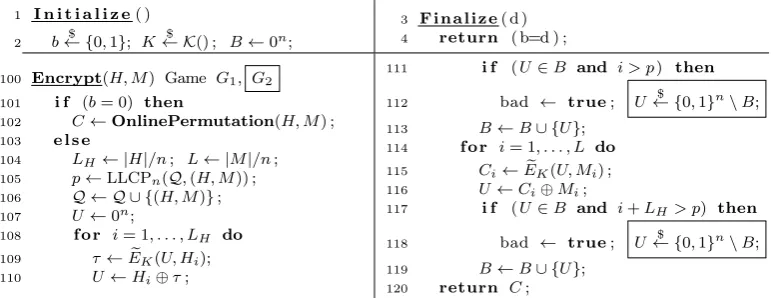
encryption oracleOnlinePermutation (Line 102) that just models a ’perfect’OPRP,i.e.,for two plaintexts with an equal prefix it returns two ciphertexts that also share a prefix of the same length. Again we assume this oracle to be implemented by lazy sampling. Then, setB collects all chaining values (lines 113 and 119) in order to intercept the occurrence of two identical chaining values which would lead to two identical tweaks for the encryption of a block.
In Line 105, the oracle LLCPn is invoked returning the length of the longest common prefix of (H, M) and Q|H,M.
Finally, the variablebadis set totrueif (one of) the conditions of lines 111/211 or 117/217 holds. These changes do not affect the success probability of an adversary because the output of the oracle remains unchanged. More precisely, the distribution of the output does not change. This means that
AdvCPA(aoe, ni)Π (A) = 2· |Pr[AG1 ⇒1]−0.5|,
and therefore, by common game-playing arguments – using a new gameG3 described shortly –,
Pr[AG1 ⇒1]≤Pr[AG2 ⇒1] +|Pr[AG1 ⇒1]−Pr[AG2 ⇒1]|
≤Pr[AG2 ⇒1] + Pr[AG2sets bad]
≤Pr[AG3 ⇒1] +|Pr[AG2 ⇒1]−Pr[AG3 ⇒1]|+ Pr[AG2sets bad].
The success probability of game G2 does not differ from the success probability of G1 unless a
chaining valueU occurs twice. In this case, the adversary must either have found a collision for
e
1 I n i t i a l i z e( )
2 b← {0$ ,1}; K← K() ;$ B←0n;
3 F i n a l i z e( d ) 4 return ( b=d ) ;
100 Encrypt(H, M) Game G1, G2 101 i f (b= 0) then
102 C←OnlinePermutation(H, M) ; 103 e l s e
104 LH← |H|/n; L← |M|/n; 105 p←LLCPn(Q,(H, M)) ;
106 Q ← Q ∪ {(H, M)}; 107 U←0n;
108 f o r i= 1, . . . , LH do
109 τ←EKe (U, Hi);
110 U←Hi⊕τ;
111 i f (U∈B and i > p) then
112 bad ← true; U← {0$ ,1}n\B; 113 B←B∪ {U};
114 f o r i= 1, . . . , L do
115 Ci←EeK(U, Mi) ;
116 U←Ci⊕Mi;
117 i f (U∈B and i+LH> p) then
118 bad ← true; U← {0$ ,1}n\B;
119 B←B∪ {U}; 120 return C;
Fig. 9.GamesG1 andG2 for the proof of Lemma 3. GameG2 contains the code in the box whileG1does not.
or must have found a preimage of 0n. In both cases, the variable bad would have been set to
true, and it follows again by [9] that
Pr[AG2sets
bad]≤ (q+`)(q+`+ 1) 2n−(q+`) +
q+`
2n−(q+`).
The aforementioned new gameG3 is equal to the gameG2 exceptthat the tweakable block cipher
e
E and its inverseEe−1 are replaced by the functionsEncryptBlockandDecryptBlock, which
are modeled as set of pseudo random permutations, where the index is given by the tweak. We assume that they are implemented via lazy sampling. More precisely, the call of EeK(X, Y) is
replaced by an invocation of EncryptBlockK(X, Y) and the call of Ee −1
K (X, Y) is replaced by an invocation of DecryptBlockK(X, Y). Now we upper bound the difference between G2 and G3. So, by definition of G4, we have
|Pr[AG2 ⇒1]−Pr[AG3 ⇒1]| ≤AdvT-IND-CPA
e
E (q+`, O(t)).
Finally, we have to upper bound the advantage of an adversary A to win the game G3. Since U cannot collide and it is not possible to compute a preimage for any query, the algorithm for
b = 0 is an OPRP, and therefore, the success probability to win G3 for any adversary is 0.5, i.e.,she has no advantage in winning this game.
Our claim follows by adding up the individual bounds. ut
5.2 Security Analysis of McOE with Tag-Splitting
Theorem 3. Let Π = (K,E,D) be a McOE scheme as in Definition 2, i.e., K is the key
generation function, E=EAST andD=DAST. Forq ≤2n/2−2 we have
AdvCCA3Π (oae,ni)(q, `, t)≤ 4(q+`+ 2)(q+`+ 3) + 6(2q+`) 2n−(q+`) +
3q(q+ 1) 2n−q
+ q
2n/2−q + 3Adv
T-IND-CCA
E,E−1 (2q+`, O(t)).
Proof. The proof follows from Theorem 1 together with Lemmas 4 and 6. ut
Corollary 2. Let assume that `≥35, `≥q and the T-IND-CCA-advantage is at most δ for
an adversary which amount of queries is at most q+` and its running time is O(t). Then the following bound holds
AdvCCA3Π (oae,ni)(q, `, t)≤ 21`
2+`
2n−(2`) +
`
2n/2−` +δ.
Lemma 4. Let Π = (K,E,D) be a McOE scheme as in Definition 1 (ii). Let q ≤ 2n/2−2 be the number of total queries an adversary A is allowed to ask and ` be an integer representing the total length in blocks of the queries to E and D. Then,
AdvINT-CTXTΠ (ni)(q, `, t)≤ (2q+`+ 2)(2q+`+ 3) 2n−(q+`) +
2(2q+`) 2n−(q+`) +
q(q+ 1) 2n−q
+ q
2n/2−q +Adv
T-IND-CCA
e
E,Ee−1 (2q+`, O(t)).
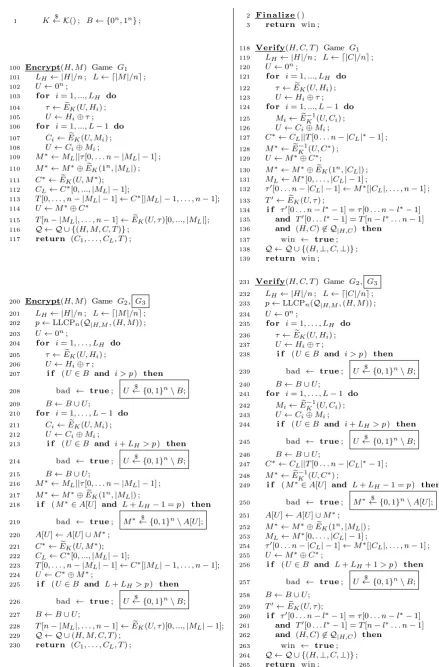
Proof. Our bound is derived by game playing arguments. Consider games G1-G3 of Figure 10
and a fixed adversary A asking at most q queries with a total length of at most ` blocks. The functions Initialize and Finalize are identical for all games in this proof. Lets denote G0 as
the Game INT-CTXT(ni) as defined in Figure 7. Definition 8 states that
AdvINT-CTXTΠ (ni)(A)≤Pr[AG0 ⇒1].
InG1, the encryption and verify placeholders are replaced by their genericMcOEcounterparts
as of Definition 1. We now discuss the differences between G1 and G2. The set B is initialized
with {0n,1n} and then collects all new key-input values U which are computed during the encryption or verification process (in lines 209, 215, 227, 240, 246, and 258). Furthermore, the setsA[U] collect the masked values of M∗ (cf. lines 220 and 252) for a certain prefix.
In lines 202 and 233, the LLCPn oracle is inquired. Finally, the variable bad is set to true if one of the if-conditions in lines 207, 213, 218, 225, 238, 244, 249 or 256 hold. None of these modifications affect the values returned to the adversary and therefore
Pr[AG1 ⇒1] = Pr[AG2 ⇒1].
For our further discussion we require another game G4 which is explained in more detail later
in this proof3. It follows that
Pr[AG2 ⇒1]≤Pr[AG3 ⇒1] +|Pr[AG2 ⇒1]−Pr[AG3 ⇒1]|
≤Pr[AG3 ⇒1] + Pr[AG3sets bad]
≤Pr[AG4 ⇒1] +|Pr[AG3 ⇒1]−Pr[AG4 ⇒1]|+ Pr[AG3sets
bad]. (4)
We now proceed to upper bound any of the three terms contained in (4) – in right to left order. The success probability of game G3 does not differ from the success probability of G2 unless a
chaining valueU occurs twice. In this case, the adversary must (1) either have ’found’ a collision for EeK(X, Y)⊕Y, i.e., she stumbles over (X, Y) and (X0, Y0) such that EeK(X, Y)⊕Y =
e
EK(X0, Y0)⊕Y0 or, (2), must have found a preimage of 0n or 1n, which is always the starting point of our chain. Note, the values 0n and 1n are initially stored in the set B. In both cases, the variable badwould have been set to true. From [9] follows as upper bound
(2q+`+ 2)(2q+`+ 3) 2n−(q+`) +
2(2q+`) 2n−(q+`).
3
1 K← K() ;$ B← {0n,1n}; 2 F i n a l i z e( )
3 return win ;
100 Encrypt(H, M) Game G1 101 LH← |H|/n; L← d|M|/ne; 102 U←0n;
103 f o r i= 1, ..., LH do
104 τ←EKe (U, Hi) ;
105 U←Hi⊕τ; 106 f o r i= 1, ..., L−1 do
107 Ci←EKe (U, Mi) ;
108 U←Ci⊕Mi;
109 M∗←ML||τ[0, . . . n− |ML| −1] ;
110 M∗←M∗⊕EKe (1n,|ML|) ;
111 C∗←EKe (U, M∗);
112 CL←C∗[0, ...,|ML| −1];
113 T[0, . . . , n− |ML| −1]←C∗[|ML| −1, . . . , n−1];
114 U←M∗⊕C∗
115 T[n− |ML|, . . . , n−1]←EKe (U, τ)[0, ...,|ML|];
116 Q ← Q ∪ {(H, M, C, T)}; 117 return (C1, . . . , CL, T) ;
118 Verify(H, C, T) Game G1 119 LH← |H|/n; L← d|C|/ne; 120 U←0n;
121 f o r i= 1, ..., LH do
122 τ←EKe (U, Hi) ;
123 U←Hi⊕τ; 124 f o r i= 1, ..., L−1 do
125 Mi←Ee−1 K (U, Ci) ;
126 U←Ci⊕Mi;
127 C∗←CL||T[0. . . n− |CL|∗−1] ;
128 M∗←
e
E−K1(U, C∗) ;
129 U←M∗⊕C∗;
130 M∗←M∗⊕EKe (1n,|CL|) ;
131 ML←M∗[0, . . . ,|CL| −1] ;
132 τ0[0. . . n− |CL| −1]←M∗[|CL|, . . . , n−1] ;
133 T0←EKe (U, τ) ;
134 i f τ0[0. . . n−l∗−1] =τ[0. . . n−l∗−1] 135 and T0[0. . . l∗−1] =T[n−l∗. . . n−1] 136 and (H, C)6∈ Q|H,C) then
137 win ← true; 138 Q ← Q ∪ {(H,⊥, C,⊥)}; 139 return win ;
200 Encrypt(H, M) Game G2, G3 201 LH← |H|/n; L← d|M|/ne; 202 p←LLCPn(Q|H,M,(H, M)) ;
203 U←0n;
204 f o r i= 1, . . . , LH do
205 τ←EeK(U, Hi) ;
206 U←Hi⊕τ;
207 i f (U∈B and i > p) then
208 bad ← true; U← {0$ ,1}n\B;
209 B←B∪U;
210 f o r i= 1, . . . , L−1 do 211 Ci←EKe (U, Mi) ;
212 U←Ci⊕Mi;
213 i f (U∈B and i+LH> p) then
214 bad ← true; U← {0$ ,1}n\B; 215 B←B∪U;
216 M∗←ML||τ[0, . . . n− |ML| −1] ; 217 M∗←M∗⊕
e
EK(1n,|ML|) ;
218 i f (M∗∈A[U] and L+LH−1 =p) then
219 bad ← true; M∗← {0$ ,1}n\A[U];
220 A[U]←A[U]∪M∗; 221 C∗←
e
EK(U, M∗);
222 CL←C∗[0, ...,|ML| −1];
223 T[0, . . . , n− |ML| −1]←C∗[|ML| −1, . . . , n−1]; 224 U←C∗⊕M∗;
225 i f (U∈B and L+LH> p) then
226 bad ← true; U← {0$ ,1}n\B; 227 B←B∪U;
228 T[n− |ML|, . . . , n−1]←EKe (U, τ)[0, ...,|ML| −1];
229 Q ← Q ∪(H, M, C, T) ; 230 return (C1, . . . , CL, T) ;
231 Verify(H, C, T) Game G2, G3 232 LH← |H|/n; L← d|C|/ne; 233 p←LLCPn(Q|H,M,(H, M)) ;
234 U←0n;
235 f o r i= 1, . . . , LH do
236 τ←EKe (U, Hi) ;
237 U←Hi⊕τ;
238 i f (U∈B and i > p) then
239 bad ← true; U← {0$ ,1}n\B; 240 B←B∪U;
241 f o r i= 1, . . . , L−1 do
242 Mi←Ee−1 K (U, Ci) ;
243 U←Ci⊕Mi;
244 i f (U∈B and i+LH> p) then
245 bad ← true; U← {0$ ,1}n\B;
246 B←B∪U;
247 C∗←CL||T[0. . . n− |CL|∗−1] ;
248 M∗←Ee
−1
K (U, C
∗) ;
249 i f (M∗∈A[U] and L+LH−1 =p) then
250 bad ← true; M∗← {0$ ,1}n\A[U];
251 A[U]←A[U]∪M∗; 252 M∗←M∗⊕EKe (1n,|ML|) ;
253 ML←M∗[0, . . . ,|CL| −1] ;
254 τ0[0. . . n− |CL| −1]←M∗[|CL|, . . . , n−1] ;
255 U←M∗⊕C∗;
256 i f (U∈B and L+LH+ 1> p) then
257 bad ← true; U← {0$ ,1}n\B;
258 B←B∪U; 259 T0←EKe (U, τ);
260 i f τ0[0. . . n−l∗−1] =τ[0. . . n−l∗−1] 261 and T0[0. . . l∗−1] =T[n−l∗. . . n−1] 262 and (H, C)6∈ Q|H,C) then
263 win ← true; 264 Q ← Q ∪ {(H,⊥, C,⊥)}; 265 return win ;
Furthermore, we have to consider the case when a collision occurs between the masked value of
M∗ and the set A[U]. As an adversary can ask q queries, it follows that the probability of the flag bad is set totruein lines 219 and 250 can be upper bounded by
q(q+ 1) 2n−q .
By adding up both bounds it follows that
Pr[AG3sets bad]≤ (2q+`+ 2)(2q+`+ 3)
2n−(q+`) +
2(2q+`) 2n−(q+`)+
q(q+ 1) 2n−q .
Now we describe the new game G4, which is equal to G3 except that the block cipher Ee and
its inverse Ee−1 are replaced by the functions EncryptBlock and DecryptBlock. These are
modeled as a set of pseudorandom permutations, where the index is given by the tweak. We assume that they are implemented via lazy sampling. More precisely, the call EeK(X, Y) is
replaced by an invocation of EncryptBlockK(X, Y) and the call EeK−1(X, Y) by an invocation
of DecryptBlockK(X, Y). In the following, we upper bound the difference betweenG3 and G4
by
|Pr[AG3 ⇒1]−Pr[AG4 ⇒1]| ≤AdvT-IND-CCA
e E,Ee−1
(2q+`, O(t)).
Finally, we have to upper bound the advantage for the adversary Ato win the game G4.A can
win this game only if the condition in lines 260-262 (resp. 460-462 for gameG4) holds. As usual,
we assume wlog. that A does not ask a question if the answer is already known. This implies that (H, C, T)6∈ Q|H,C,T. We formally adjust lines 260-262 (i.e.,choose as the tag computation operation eitherEe orEe−1) such that we always have enough randomness left for our result. For
the sake of simplicity, we denote the two final chaining values byULandUL+1. For our analysis,
we distinguish between two main cases: the case when|ML|=n,i.e.,the size of the last message block is equal to the block sizen, and is opposite case.
Case 1: In this case we first consider thatUL∈B. This implies that (C1, . . . , CL) must be part
of a common prefix of a previous query. The adversary can win only if T is new, i.e.,not a part of a previously occured prefix. The upper bound is then given by
PrhEeK−1(UL+1, T) =τ i
= 0
sinceEe−1 is a PRP.
IfUL∈/ B, we can upper bound the success probability for one query by 1/(2n−q). Hence, forq queries, we can upper bound the success probability by q/(2n−q).
Case 2: Now, we consider the case |ML| 6= n. It can be upper bounded by Lemma 5. The success probability is at mostq/(2n/2−q).
Since both cases are mutually exclusive, we can upper bound the success probability forqqueries by
q
2n/2−q.
Our claim follows by adding up the individual bounds. ut
Lemma 5. Let Π = (K,E,D) be a McOE scheme as in Definition 2 and q be the number of
Proof. In this proof, we denote the two final chaining values as UL and UL+1. Furthermore,
we denote by Tα the (n− |CL|)-bit string T[0...n− |CL| −1] and by Tβ the |CL|-bit string
T[n− |CL|, ..., n]. Additionally, we denote the corresponding strings τα=τ[0, . . . ,|CL| −1] and
τβ =τ[|CL|, . . . , n−1], respectively.
Case 1: UL+1 ∈B:
This case implies that (C1, ..., CL, Tα) must be part of a common prefix from a previous query, otherwise, this would imply a collison of the chaining value. But this event is already handled by setting the flag bad to true in game G2 (cf. Line 248 of Figure 4). Hence, the
adversary can only win if Tβ is new, i.e., not a part of a previously occured prefix. The upper bound is given by
max Z
n
Pr[Ee−1K,(UL+1Tβ||Z) =τ] o
= 0
sinceEe−1 is a PRP.
Case 2: UL+1 ∈/ B:
This case implies that CL||Tα must be new. The probability that the condition from Line 260 holds – forq queries – can be upper bounded by
Prα= max ML
n
Pr
h e
EK−1(UL, CL||Tα) = (ML||τα)⊕EeK(1n,|ML|) io
≤ 2
2(n−|CL|)−2q.
Hence, the probability forq queries can be upper bounded by 2q
2(n−|CL|)−2q.
From the assumptionUL+1 ∈/ B follows that UL+1 is new. Since Ee is a PRP, we can upper
bound the probability that the condition from Line 452 holds by
Prβ = max Z
n
P r[EeK(UL+1τ) =Tβ||Z] o
≤ 1 2|CL|−q.
Then, the probability forq queries can be upper bound by q/(2|CL|−q).
The success probability of this case depends on the length of |CL|. So we can distinguish between the following three subcases:
Subcase 2.1: |CL|< n/2:
In this case, we can upper bound Prα by 2n/12−q and Prβ by 1. Hence, the total success
probability for q queries is at most 2n/q2−q.
Subcase 2.2: |CL|=n/2:
In this case, we can upper bound Prα by 2n/22−2q and Prβ by 1
2n/2−q. Hence, the total
success probability for q queries is at most 2n−21q−2q2.
Subcase 2.3: |CL|> n/2:
In this case, we can upper bound Prα by 1 and Prβ by 2n/2+11 −q. Hence, the total success
probability for q queries is at most 2n/2+1q −q.
Since all three subcases are mutually exclusive, we can upper bound the success probability forq≤2n/2−2 queries by
max
q
2n/2−q,
2q2
2n−1−q2, q
2n/2+1−q
≤ q 2n/2−q.
Due to the fact that Case 1 and Case 2 are mutually exclusive, we can upper bound the success probability for q queries by
max
0, q
2n/2−q
≤ q 2n/2−q.

![Fig. 2. The generic McOE construction, where E� denotes a tweakable block cipher. For simple reference, we denoteT α as the (n − |CL|)-bit string T[0...n − |CL| − 1] and Tβ as the |CL|-bit string T[n − |CL|, ..., n]](https://thumb-us.123doks.com/thumbv2/123dok_us/1875666.1244225/9.595.83.513.315.531/generic-construction-denotes-tweakable-simple-reference-denotet-string.webp)