Available Online atwww.ijcsmc.com
International Journal of Computer Science and Mobile Computing
A Monthly Journal of Computer Science and Information Technology
ISSN 2320–088X
IJCSMC, Vol. 4, Issue. 6, June 2015, pg.106 – 113
RESEARCH ARTICLE
CLOUD SECURITY USING SAP- SHARED
AUTHENTICATION PROTOCOL
Dr. Mohammed Abdul Waheed, Anupama Hanamgond
Associate Professor, Department of Computer Science and Engineering, Visvesvaraya Technological University, India Student (M.Tech) CSE, Department of Computer Science and Engineering, Visvesvaraya Technological University, India
[email protected]; [email protected]
Abstract—In the cloud computing users (information owners host their information on cloud servers and other users (data consumers) will access the information from cloud servers. During such data accessing, the data sharing between different users is significant to have business or commercial productive benefits. In providing such sharing existing security solutions mainly focus on authentication so as prevent unauthorized access to users’ private data, but concerns nothing about the privacy of user when user challenges the cloud server for other user’s data. The challenged request itself may reveal user identity irrespective of whether or not user gets the data access permission. To address this privacy issue we propose shared authentication (SAP) protocol. Using SAP 1) shared access authority is achieved with authentication, data anonymity, user privacy and forward security. 2) Attribute based access control is provided. 3) Proxy re-encryption is applied by cloud server to provide data sharing among different users.
Keywords— Cloud computing, authentication protocol, privacy preservation, shared authority, data confidentiality.
I. INTRODUCTION
Cloud computing provides a novel computing paradigm for both individuals and enterprises to store programs and data in the cloud in a transparent manner with advantages such as ubiquitous network access, resource pooling with no infrastructure limitations etc. In cloud computing typical architecture is anything as a service (Xaas) in which software and computing resources are provided with ubiquitous interconnections. Cloud computing is the use of internet for the tasks performed on local machines with hardware and software demands maintained at a users‟ local machine, which poses new privacy and security challenges. The conventional security approaches focus mainly on strong authentication where a user can access its own authorized data fields and users‟ private data are not unauthorized accessed by any one.
Along with diversity of cloud services users may want to access and share each others‟ private authorized data fields to achieve some productive benefits which bring new privacy and security challenges for cloud storage.
To this end we propose a protocol to support shared authority based access while preserving privacy. Any security protocol in cloud should achieve following needs
1) Authentication: Any legal user can only access authorized partial or entire data fields but not any forged or tampered data
3) User privacy: Any adversary cannot guess the user‟s access desire which can breach the privacy of the user with interest in another user‟s data fields, if and only if both users want to mutually share each others data only then the cloud server will inform the two users the permission to access each other data.
4) Forward security: When an adversary captures messages between two users he cannot be able to discover the prior
interrogations from the communication sessions.
Many researches on cloud application focus mainly on strong authentication and ignores the case of users want to share and access each others‟ data fields. When a user challenges the cloud server to request other users for data sharing, the challenged request itself may reveal the user‟s privacy no matter whether the user gets the data access permission.
In this paper we address users‟ sensitive access desire and design a security scheme to achieve data access control, access authority sharing and privacy preservation.
We address the privacy issue to propose a shared authentication protocol (SAP) to realize authentication and authorization while preserving privacy. The main contributions of this work are
1) Address a privacy issue whenever a user requests the cloud server for data sharing. The challenged request itself
should not reveal the user‟s privacy irrespective of whether or not the user gets the data access permissions.
2) Enhance the user‟s access request privacy with an authentication protocol and shared access authority is achieved by
anonymous request matching mechanism.
3) Attribute based access control is provided so the user can only access its authorized data fields. Proxy re-encryption is
applied by cloud server to provide confidential data sharing among different users over the cloud.
II. RELATED WORK
Security architectures proposed by K. Hwang et al. [1] and J. Chen et al. [2] attempt to give security for trusted cloud computing. Data coloring and software water marking techniques protect shared data objects and massively distributed software modules. The techniques are limited by only the focus on multi-way authentication and tighten access control for confidential data in cloud.
Data public auditing protocols proposed by:
1) K. Yang et al. [3] supports batch auditing for each multi-owner and multiple clouds.
2) Q. Wang et al. [4] proposed an auditing protocol that ensures integrity of data storage in cloud computing and supports both public data auditing through the involvement of trusted third party and dynamic data operations.
Secure data sharing data storage protocols proposed by:
1) Dunning et al. [5] uses AIDA algorithm to assign each user a unique ID in a multi-user cloud over a distributed computing environment. These IDs can be used as a part procedure for sharing of data storage, communication and any computing resources over a cloud environment.
2) Liu et al. [6] proposed a multi-owner data sharing secure scheme (MONA) for the cloud which supports dynamic groups. In this users can share data securely with un-trusted cloud and any user can decrypt owner files directly without owner‟s permission. Access control is applied to keep track of any malicious use of cloud resource by any user.
3) Nabeel et al. [7] proposed a broadcast group management (BGKM) which overcomes the drawbacks of symmetric key cryptosystem in public clouds, BGKM also realizes that a user need not utilize public key cryptography and can dynamically derive the symmetric keys during decryption. The algorithm uses access control vector (ACV) for assigning secrets to users based on the identity attributes so that users are allowed to derive actual symmetric keys based on their own secrets and public information
4) Sundareswaran et al. [8] proposed a decentralized answerability framework to trace the users‟ overall actual data usage in cloud. The framework uses auto-logging and auditing of sharing and accessing performed by any user at any cloud service provider and at any point in time. This also uses JAR to aid an additional concept of security to the platform.
Privacy preserving schemes proposed by Xiao et al. [9] aims at improving privacy preserving authentication, information integrity and public-subscribe confidentiality using ZNP and homo-morphic cryptography.
III.SYSTEM MODEL
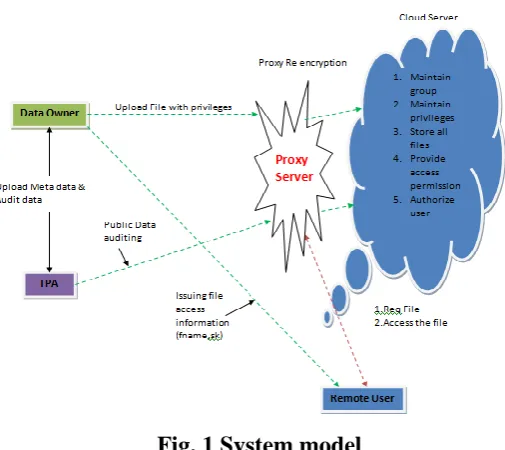
Fig. 1 System model
Fig. 1 illustrates the system model for storage, access and sharing of cloud data with the main entities user ( ), cloud server
( ), Third party authenticator (TPA).
User: user is any individual person or entity or any group of persons who owns data that are stored in the cloud storage for computing services. Different users are provided with different authorities and privileges on cloud data.
Cloud server: it is the main server of computing resources and data storage. It is maintained by a cloud service provider. The cloud server is an entity with unlimited cloud storage and computing resources. The cloud server‟s main services include maintain group, maintain privileges, store all files, provide access permissions and authorize users.
Third party authenticator: an entity which performs public auditing of data on behalf of users through the proxy server.
Cloud storage is a great upcoming platform for user to store data remotely and to operate it in the internet of services including both distributed and parallel mode of services.
Each user is provided with independent access authority on its own data and users‟ data are never unauthorized accessed by any other users in cloud.
It is important to maintain privacy of user in data access desire. There are cases such as electronic health record (EHR) system used is by hospitals where there are many users with different attributes and authorities. Any user may want to access other user‟s private data. This challenged access request must be kept private so as hide the user‟s identity.
Towards the trust model, this model considers no trust relationships between user ( ) and cloud server ( )
S is semi-honest and curious: in this the server S is maintained by a cloud service provider but may want to know
about users‟ private information. In passive but honest model S cannot be supposed to forge the users‟ data fields.
is rational but sensitive: by being rational user want to obtain other user‟s private data with negative or selfish
interest. By being sensitive want to keep its sensitive data confidential but want to purposely obtain others users‟
privacy.
Towards the threat model, this considers all security related at attacks during the data storage and access. There exist two types of attacks
Internal attacks: refer to entities and . want to obtain other users‟ data with malicious interests.
External attacks: with these attacks attackers can breach the confidentiality, integrity and availability and can modify
IV.METHODOLOGY
Protocol steps: System Initialization:
The cloud storage system includes a cloud server , and users { } ( {1,…, }, ). Thereinto , and are
two users, which have independent access authorities on their own data fields. It means that a user has an access permission for particular data fields stored by , and the user cannot exceed its authority access to obtain other user‟s data fields. Here we
consider and { , } to present the protocol phases for data access control and sharing of authority access with privacy
concern.
Let = ( be a pairing group, in which is a large prime, { are of prime order
, and is a collision-resistant hash function. The bilinear map satisfies the
bilinear non-degenerate properties: i.e., for all and it turns out that , ) = , and
Meanwhile, can be efficiently obtained for all and it is a generator of .
Let and respectively own the pairwise keys {p } and {p . Besides, is assigned with all users‟ public
keys {p and is assigned with p . Here the public key = (mod and the
corresponding privacy key are defined according to the generator
Let = describe the algebraic relation of { ), which are mutually inverse access
requests challenged by { and is a constant. Here collision-resistant function, for any randomized
polynomial time algorithm , there is a negligible function for a sufficiently large value
The Proposed Protocol Descriptions
Fig. 1. Shows the interactions among the users , and TPA.
{ , }‟s Access Challenges and ‟s Responses:
{ , } respectively generate the session identifiers { extract the token identifiers { , and transmits
{ to as an access query to initiate a new session. Accordingly we take the interactions of
and as an example to introduce the following authentication phase. Upon receiving ‟s challenge, first generates a session
identifier and establishes the master public key and master privacy key
. Thereinto randomly chooses , and computes and = ( }∈
randomly chooses , and extracts ‟s access authority policy and
are assigned with the access authority on its own data fields within ‟s permission. further defines a polynomial
according to and .
computes a set of values { , } to establish the ciphertext ,
}, and transmits to
Similarly, performs the corresponding operations for including that randomly chooses α‟∈ and ,
establishes { , extracts { , and defines and computes , } to
establish a ciphertext for transaction.
{ , }‟s Data Access Control:
q)
It turns out that satisfies the equation.
= .
Afterwards, randomly chooses and the decryption key for can be obtained.
)
further computes a set of values {
Here, is used to represent s co-efficient in , and is used to represent s co-efficient in
),
It turns out that satisfies the equation.
For the right side of (1), we have,
=
= ,
=
=
=
=
= ,
=
locally re-computes { derives its own authorized data fields , and checks whether the ciphertext is
encrypted or not by . If this holds then will be the legal user to decrypt otherwise the protocol will terminate.
⨁
⨁
further extracts its pseudonym a session sensitive access request and the public key Here, is
authorized data fields ; 2) will also agree to share its temp authorized data fields with in the case that grants its request.
Afterwards, randomly chooses , computes a set of values { , } to establish a
ciphertext and transmits to for further request matching.
= ∥ ,
,
Similarly, performs the corresponding operations, including that extracts , and determines
{ further randomly chooses and computes the value { ,
to derive its own data fields also extracts its pseudonym and an access request to establish
with the elements { , }.
{ , Access Request Matching Data Access Authority Sharing
Upon receiving the ciphertexts { within an allowable time interval, and extracts { to derive the
access requests {
∥
= ∥
checks whether { satisfy = = . If it holds, will learn that both and have
the access desires to access each other‟s authorized data, and to share its authorized data fields with each other. extracts the
keys { to establish the aggregated keys { by the Diffie-Hellman key agreement and computes the
available re-encryption key for
.
performs re-encryption to obtain . Towards extracts ‟s temp authorized data fields to
compute / .
( ,
( .
Thereafter, establishes the re-structured ciphertext and respectively transmits
{ ∥ ∥ } to { for access authority sharing. Upon receiving the messages, computes
and performs verification by comparing the following equation.
, h) )
For the left side of (2), we have,
, h)=e(
For the right side of (2), we have,
)= , )
derives ‟s temp authorized data fields .
(
Similarly, performs the corresponding operations, including that contains the keys { , }, checks ‟s validity,
and derives the temp authorized data field .
In SAP, acts as a semi-trusted proxy to realize { „s access authority sharing. During the proxy re-encryption,
{ respectively establish ciphertexts { by their public keys { and generates the
corresponding re-encryption keys { for { . Based on the re-encryption keys, the ciphertexts
{ are re-encrypted into { , , and { can decrypt the re-structured ciphertexts { ,
by their own private key { without revealing any sensitive information.
V. RESULTS AND DISCUSSION
The expected results are as follows: Data owner
In this module, the data owner should register by providing user name, password, email and group, after registering owner has to Login by using valid user name and password. The Data owner browses and uploads their data to the cloud server. For the security purpose the data provider encrypts the data file and then stores in the cloud server via proxy server. The Owner is also responsible for uploading metadata to the Third Party Authenticator (TPA). The Data owner can be capable of manipulating the encrypted data file.
Proxy Server
The Proxy server is a proxy-based design that interconnects cloud repositories, as shown in this system. The proxy serves as an interface between client applications and the cloud. The attribute based access control and proxy re-encryption mechanisms are jointly applied for authentication and authorization in proxy server. Proxy server is also acts as an intermediate to perform cloud functions so as keep the cloud server from overwhelmed requests.
Cloud Server
The cloud server is responsible for data storage and file authorization for an end user. The data file will be stored in cloud server with their tags such as Owner, file name, secret key, mac and private key, can also view the registered Owners and End-users in the cloud server. The data file will be sending based on the privileges. If the privilege is correct then the data will be sent to the corresponding user and also will check the file name, end user name and secret key. If all are true then it will send to the corresponding user or he will be captured as attacker.
Data Consumer(End User)
The data consumer is nothing but the end user who will request and gets file contents response from the corresponding cloud servers. If the file name and secret key, access permission (.java, .txt, .log) is correct then the end user is getting the file response from the cloud or else he will be considered as an attacker and also he will be blocked in corresponding cloud. If he wants to access the file after blocking he wants to unblock from the cloud.
Attacker
Threat model is one who is integrating the cloud file by adding fake key to the file in the cloud. The attacker may be within a cloud or from outside the cloud. If attacker is from inside the cloud then those attackers are called as internal attackers. If the attacker is from outside the cloud then those attackers are called as external attackers.
VI.CONCLUSIONS
REFERENCES
[1] P. Mell and T. Grance, “Draft NIST working Definition of Cloud Computing,” National Institute of Standards and Technology, USA, 2009. [2] A. Mishra, R. Jain, and A. Durresi, “Cloud Computing: Networking and Communication challenges,” IEEE Communications Magzines, vol.
50, no. 9, pp, 24-25, 2012 .
[3] K. HWang and D. Li, “Trusted Cloud Computing with Secure Resources and Data Coloring,” IEEE Internet Computing, vol. 14, no. 5,pp.14-22,2010 .
[4] J. Chen, Y. Wang, and X. Wang, “On Demand Security Architecture for Cloud Computing,” computer, vol. 45, no. 7,pp.73-78,2012. [5] Q. Wang, C. Wang, K. Ren, W. Lou, and J. Li, “Enabling Public Auditability and Data Dynamics for Storage Security in Cloud Computing,”
IEEE Transactions on Parallel and Distributed Systems, vol. 22, no. 5, pp. 847-859, 2011. .
[6] L. A. Dunning and R. Kresman, “Privacy Preserving Data Sharing With Anonymous ID Assignment,” IEEE Transactions on Information Forensics and Security, vol. 8, no. 2, pp. 402-413,2013.
[7] S. Sandareswaran, A. C. Squicciarini, and D. Lin, “Ensuring Distributed Accountability for Data Sharing in the Cloud,” IEEE Transactions on Dependable and Secure Computing, vol. 9, no. 4, pp. 556-568, 2012.
[8] C. Wang, Q. Wang, K. Ren, N. Cao, and W. Lou, “Towards Secure and Dependable Storage Services in Cloud Computing,” IEEE Transactions on Services Computing, vol. 5, no. 2, pp.220-232,2012.
[9] S. Grzonkowski and P. M. Corcoran, “Sharing Cloud Services:User Authentication for Social Enhancement of Home Networking,” IEEE Transactions on Consumer Electronics, vol. 57, no. 3, pp. 1424-1432,2011.
[10] Y. Xiao, C. Lin, Y. Jiang, X. Chu, and F. Liu, “An Efficient Privacy-Preserving Publish Subscribe Service Scheme for Cloud Computing,” in Proceedings of Global Telecommunications Conference (GLOBECOM 2010), December 6-10, 2010.
[11] H. Wang, “Proxy Provable Data Possession in Public Clouds,” IEEE Transactions on Services Computing, [online] ieeexplore.ieee.org/stamp/stamp.jsp?tp=&arnumber=6357181,2012.
[12] C. Wang, K. Ren, W. Lou, J, Lou,” Toward Publically Auditable Secure Cloud Data Storage Services,” IEEE Network, vol. 24, no. 4, pp. 19-24,2010.
[13] Y. Zhu, H. Hu, G. Ahn, D. Huang, and S. Wang, “Towards Temporal Access Control in Cloud Computing,” in Proceedings of the 32st Annual IEEE International Conference on Computer Communications (IEEE INFOCOM 2012), pp. 2576-2580, March 25-30,2012. [14] H. Zhuo, S. Zhong, and N. Yu, “A Privacy-Preserving Remote Data Integrity Checking Protocol with Data Dynamics and Public
Verifiability,” IEEE Transactions on Knowledge and Data Engineering, vol. 23, no. 9, pp. 1432-1437,2011.