UC-Secure Source Routing Protocol
Tao Feng
1, Xian Guo
1, 3, Jianfeng Ma
2, Xinghua Li
21
School of Computer and Communication, Lanzhou University of Technology, China.
2Ministry of Education Key Laboratory of Computer Networks and Information Security, Xidian
University, China.
3
School of Computer and Math, Gansu Lianhe University, China
Abstract: The multi-path routing scheme provides reliable guarantee for mobile ad hoc network. A new method is
proposed that is using to analyze the security of multi-path routing protocol within the framework of Universally Composable (UC) security. Based on the topological model that there exist adversarial nodes, the concept of plausible route is extended and the definition of plausible-route set is presented. Plausible-route set is used in description of the multi-path routing for Ad hoc network, and a formal security definition based on UC-RP is given. A provably Security Multiple Node-Disjoint Paths source routing (SMNDP) is proposed and address secure fault issue of MNDP in the active adversary model. The new approach shows that the security of SMNDP can be reduced to the security of the message authentication code and the digital signature. SMNDP implements the correctness of route discovery process, the authentication of nodes identifier and the integrality of route information.
Keywords: MANET, plausible route, UC-secure, SMNDP.
1. Introduction
Routing is one of the most basic networking functions in mobile ad hoc networks (MANET). These networks are decentralized, which nodes act both as hosts and routers, forwarding packets for nodes that are not in transmission range of each other. Further, movement of nodes makes topology of the network to be dynamic. As a result, routing is one of the important issues in MANET. Routing in MANET can be accomplished through either single path or multiple paths. There are different types of the single-path routing protocols. One can distinguish reactive (e.g., DSR [1] and AODV [2]) and proactive (e.g., OLSR [3]). Protocols of the former category are also called on-demand protocols. Another type of classification distinguishes routing table-based protocols (e.g., AODV) and source routing protocols (e.g., DSR). Most of existing multi-path routing protocols are based on the single-path routing protocol. The single-path routing protocol is more simple, manageable and configurable than the multi-path routing protocol. In comparison with the single path routing, multi-path routing protocol has advantages in fault-tolerance, route-reliability, load-balancing and Quality-of-Service (QoS). Recently, multi-path routing attracts attention widely [4-6].
On the basis of disjointness, multiple paths can be the following categories: (1) node-disjoint; (2) link-disjoint; (3) neither node-disjoint nor link-disjoint. In this paper, we are mainly concerned with node-disjoint paths because using them one can best address the issues of fault-tolerance as well as load-sharing.
A new framework to identify node-disjoint paths is proposed in [7]. Based on the framework, Liu et al. proposed a routing protocol called Multiple Node-Disjoint Paths (MNDP) routing. In [8], Ash et al. presented a protocol that called Multiple Attempt Multi-path Routing (MAMR). MAMR is based on MNDP. In MAMR, the authors try to discover as many paths as possible in the first route discovery. Subsequent route discoveries identify paths in an incremental fashion using the approach of MNDP. However, MNDP and MAMR focus mainly on efficiency issues rather than security issues, we has found that they can’t defend against active-n-m attack [9].
Foundation item: Supported by the National Natural Science General Foundation of China under Grant No. 60573036, 60702059, Chinese National Programs for High Technology Research and Development (863), No. 2007AA01Z429, the Natural Science Grand Foundation of Gansu, China, No. 2007GS04823, the Ph.D. Programs Foundation of Lanzhou University of Technology No.BS14200901.
It is necessary to advocate a systematic approach for analyzing the security of ad hoc routing protocols, which is based on a rigorous mathematical model, in which precise definitions of security can be given and sound-proof techniques can be developed. The formal methods proposed in [10-11] have faults. Recently, a formal security framework for source routing of MANET is presented by Acs, Buttyan and Vajda [12-13], in which the concepts of reactive systems proposed by
Pfitzmann and Waidner [14] are adopted, we call this framework ABV security model. In ABV, the description for the secure requirement of routing protocol is similar to the security definition of reactive systems. The definition of plausible route is proposed in network model where there exists adversarial nodes, and based on this definition and the computationally complex theory, the formal security definition for Ad hoc networks of routing protocol is presented. However, the security of single-path routing protocol is only concerned in ABV, and the composable security of routing protocols can’t be described in asynchronous and concurrent networks environment. For example, multiple instances of routing protocol concurrently run in unpredictable environment of Internet.
Based on the computation model of interactive Turing machine, Canetti [15] proposed a framework of security defining for Universally Composable (UC) cryptographic protocols. To discuss the security of routing protocol, we advocate a security framework and call it UC-RP, in which UC security framework is adopted for MANET applications, and the security of the concurrent and composable routing protocols can be defined precisely. The security requirement of routing protocol is described by ideal functionality, the simulation paradigm is adopted when defining the security of routing protocol, and the universally composable security property can be realized by the composable operation theory in UC-RP. The routing protocol satisfied the security definition in UC-RP is called UC- secure routing protocol.
In this paper, based on the network-topology model where there exist the adversarial nodes, the concept of plausible route is extended. We proposed the concept of plausible-route set and the formal security definition of multiple node-disjoint paths routing protocol. And then, a UC-Secure Multiple Node-disjoint Paths (SMNDP) source routing protocol based on MNDP is proposed.
The main difference between MNDP and SMNDP is as follows: (1) In SMNDP, the error-check scheme is introduced in the transmission strategy of route quest for computing a new auxiliary path. (2) The cryptographic mechanisms, such as the digital signature and Message Authentication Code (MAC), are adopted in route reply message of SMNDP. The security of SMNDP can be reduced to the security of message authentication and signature schemes.
The work is the full version of [15].
2. Definition of Security for Routing
2.1. The Adversary Model
By controlling the adversarial node, the adversary can prevent the routing protocol from establishing multiple node-disjoint paths. Regarding the capabilities of the adversary, the followings is assumed:
1. Nodes are identified by identifiers in the neighbor discovery protocol and in the routing protocol. The identifiers are authenticated during neighbor discovery and therefore, the possibility of a Sybil attack [16] is excluded.
2. Wormholes [17] are detected at the neighbor discovery level, which means that nodes that are not within each other’s radio range are not able to run the neighbor discovery protocol successfully.
3. The source and the destination of a route discovery process are not corrupted, and the adversary cannot modify or control all communications of the honest participants.
4. The adversary launches its attacks from a few adversarial nodes and can use all cryptographic keys that are necessary to authenticate those identifiers of adversarial nodes.
5. When the adversarial nodes are neighboring, the adversary is present at any compromised identifier.
2.2. The Network Model
vertex. The set of adversarial vertices is denoted by V*, and V*⊂ V. There is an edge between two non-adversarial
vertices if the corresponding non-adversarial nodes established a wireless link between themselves by successfully running the neighbor discovery protocol. Furthermore, there is an edge between a non-adversarial vertex u and an adversarial vertex v* if the non-adversarial node that corresponds to u established a wireless link with at least one of
the adversarial nodes that correspond to v*. Finally, there is no edge between two adversarial vertices in G. The
rationale is that edges represent direct wireless links, and if two adversarial vertices u* and v* were connected, then
there would be at least two adversarial nodes, one corresponding to u* and the other corresponding to v*, that could
communicate with each other directly. That would mean that the adversarial nodes in u* and v* could share
information via those two connected nodes, and thus, they should belong to a single vertex in G.
The set of all identifiers is denoted by L and the set of the compromised identifiers is denoted by L*. The
following is a labeling function D: V→2L(2L is a family of subset of set L) that assigns a set of identifiers to each
vertex in V:
∀v∈V, D(v)= l* v V
L v
⎧ ∈
⎪ ⎨
∈ ⎪⎩
*
*
\V
V , where l∈L\L
*
2.3. Configuration and Plausible-Route Set
Fig.1 A configuration of network
A configuration (conf) of MANET based on the above network model is a triplet (G(V, E), V*, D). Fig.1
illustrates a configuration, in which the solid black dots are the vertices in V* and each vertex is labeled with the set
of identifiers that D assigns to it. Note that the vertices in V*are not neighboring. It is assumed that a conf is static.
Thus, we view the routing protocol as a distributed algorithm that operates on this static configuration. In fact, the securely minimum requirement that we require from the route discovery part of a multi-path secure source routing protocol is that it returns a set of multiple vertex-disjoint paths on this configuration.
In Fig.1. {A, B, C, D} is an existence route between the vertices a and d. If there is no adversary, then a sequence l1,
l2, …, lnof identifiers is an existence route such that:
(1) each of identifiers l1, l2, …, ln is different,
(2) there exists a sequence v1, v2, …, vn of vertices in V such that (vi, vi+1) E ∈ for all 1≤i<n and D(vi)=li for all
1≤i≤n.
In Fig.1. {A,X,E,D}, {A,X,Y,E,D} and {A,X,Y,Z,E,D} are the same path route {a, u*, e, d} between the vertices a and d. The adversary can use all compromised identifiers in V*, so a route indicated by a sequence of identifiers is not consistent
with a route indicated by a sequence of vertices. To address the issue, a definition of plausible route is proposed in ABV. In this paper, the definition of plausible route is extended and the concept of plausible-route set is given.
Definition 1 (plausible route): Let conf =(G(V, E), V* ,D) be a configuration, a sequence l1, l2, …, lnof identifiers is
a plausible route with respect to conf if there exists a sequence v1, v2, …, vk (2≤k≤n) of vertices in V and a sequence
j1, j2, …, jk of positive integers such that:
(1) j1+j2+…+jk=n,
(2) { i
J +1
l
, iJ + 2
l
, …,i i
J + j
l
}⊆D(Vi) (1≤i≤k), where Ji= j1+j2+…+ji-1 if i>1 and Ji=0, if i=1,and(3) (vi, vi+1)∈E (1≤i≤k).
u*
v*
g h {F}
f e
d c
b
a
{H} {G}
{E} {A}
{B} {C}
{D}
As an example, let us consider again the configuration in Fig.1. It is easy to verify that {l1, l2, l3, l4, l5, l6}={A,
X,Y,Z,E,D}is a plausible route, because it can be partitioned into four partitions {A}, {X, Y, Z }, {E} and {D}, such that {A}
⊆
D(a), {X, Y, Z }⊆
D(u*),{E}⊆
D(e), {D}⊆
D(d) and vertices a, u*, e and d form a simplepath on the conf. In this example, k= 4, j1=1, j2=3, j3=1, and j4=1; furthermore, J1= 0, J2= j1=1, J3= j1 + j2=4, and
J4= j1 +j2 + j3=5.
Definition 2 (plausible-route set): Let conf=(G(V, E), V* ,D)be a configuration, P is a plausible-route set between a
given pair of vertices u and v, if P: (1) each p P∈ , p is a plausible route,
(2) any pi, pj∈P (i≠j), piand pj respectively correspond to sets of vertices sequence Vi and Vj, and (Vi∩Vj)\{u,
v}=Φ.
It is also easy to verify that {{A, G, H, X, Y, F, D}, {A, X, Y, Z, E, D}, {A, B, C, D}} is a plausible-route set between the vertices a and d, because {A, G, H, X, Y, F, D}, {A, X, Y, Z, E, D},and {A, B, C, D} are plausible routes in this setand this set corresponds to a set of simple paths {{a, g, h, v*, f, d}, {a, u*, e, d}, {a, b, c, d}}.
To facilitate description, we call the two routes such as non-plausible route and non-auxiliary path error routes.
2.4. UC-RP Security Framework for Routing Protocol
It is a primary task of designing a secure routing protocol that the protocol can identify and establish an existence path route. A rigorous mathematic model represented a routing protocol is necessary, in which the formal definition of the secure requirement for routing protocol can be described. Based on the computationally complex theory, Goldwasser and Levin proposed a definition of security for cryptographic protocols. This definition is based on the indistinguishability of two families of binary random variable that one family of them represents a cryptographic protocol running in real-world model and another family of them represents cryptographic protocol in ideal-world model. The realization of “computational indistinguishability” is often called “cryptographic protocol simulation”.
Based on the extension of the concepts of the computational indistinguishability, the security definition of routing protocol is proposed in ABV. Based on the concept of reactive systems, the running process of routing protocol and the security requirement of routing protocol is described. The mathematic model of reactive systems comes from the I/O automata model, but no scheme can represent the capability of the adversary and the randomicity of the running process for protocol in the I/O automata model.
A new paradigm for defining the security of cryptographic protocols called Universally Composable security is proposed by Canetti. The salient properties of universally composable definitions of security are that they provide security guarantees even when a secure protocol are composed with an arbitrary set of protocols, or more generally when the protocol is used as a component of an arbitrary system. This is an essential property for maintaining security of cryptographic protocols in complicated and unpredictable communication network environment such as the Internet. In particular, universally composable definitions guarantee security even when an unbounded number of protocol instances are executed concurrently in an adversarially controlled manner. They guarantee non-malleability with respect to arbitrary protocols and more.
In UC, the model of computation based on “interactive Turing machines (ITMs)” denotes a system of cryptographic protocol. The security requirement of a protocol is expressed by “an ideal functionality”. The security definition of a protocol is described by “a simulation paradigm” and the universally composable security is implemented by “the composable operation theory” of protocols. A protocol that satisfies the security definition in UC is called a UC-secure protocol. Any n-party protocol π can be described by an interactive Turing machine system that consists of n interactive Turing machines pi(0<i<n), in which an ITM stands for an honest participant
of a protocol and the adversary entity is also modeled into an interactive Turing machine. In addition, an environment Z that a special ITM represents an external environment of a running protocol is defined in UC. Introduction of an environment Z can better describe this general case that protocols run asynchronously and concurrently. Z can arbitrarily interact with the adversary and the participants and Z’s view acquired in running process of this protocol is an output of the protocol.
Both of the models contain adversaries. The protocol is said to be secure if the real-world and the ideal-world model are equivalent, where the equivalence is defined as some form of indistinguishability (e.g. computational or statistical) from the point of view of the environmental machines Z. Namely, the effect of any real-world adversary in the real-world model can be simulated by an ideal-world adversary in the ideal-world model. Thus, the routing protocol running in real-world model is secure in UC-RP. Below, the provable-security theory of routing protocol is described in details:
1. Protocol specification, a protocol is a set of interactive Turing machines, and both the adversary and the environment Z are interactive Turing machines.
2. Defining the adversary model.
3. The computational model represents the possible executions of a real protocol. If a protocol π is a n-party, the protocol consists of a set of n interactive Turing machines and two entities such as the environment Z and the adversary A.
4. The model of running protocol under the ideal state. The ideal process consists of the ideal functionality F, the environment Z and the adversary S. In addition, there are n dummy parties that they send their inputs to the ideal functionality F and accept data coming from the ideal functionality F, if a protocol is an n-party protocol. 5. Defining of the security, we say that a protocol π securely realizes an ideal functionality F if the protocol π can
emulate the ideal process that realize the ideal functionality F. That is to say, the routing protocol is secure if the two models are indistinguishable from the view of the environment Z.
2.4.1 The Real-World Model
The real-world model is denoted by REALconf,π, A,Z(k, z, r), where conf=(G(V, E), V* ,D), π is a routing protocol that run in real-world model, A is a real-world adversary, k is security parameter, z is an input of the environment Z
and r={rZ, rA, r1, r2,…, rn} is a set of random input for the system. REALconf,π,A,Z (k, z, r) consists of a set {M1, M2, …,
Mn, A1, …, Am, Z} of interacting Turing machines, where the interaction is realized via common tapes. Each Mi
represents a non-adversarial vertex in V\V*, and each A
j represents an adversarial vertex in V*. All machines are
probabilistic and they are activated by a hypothetic scheduler in rounds. The detailed behaviors of all machines are determined by the routing protocol under investigation.
The output of routing protocol is denoted by OUT Real,conf,π,A,Z(k, z, r), where r is initial parameters. In addition, let
X ={OUT Real,conf,π,A,Z(k, z, r)}k∈N,Z∈{0,1}* denote the routing information ensemble when r is chosen uniformly at random. Let OUT Real,conf,π,A,Z denote {OUT Real,conf,π, A,Z(k, z, r)}k∈N,Z∈{0,1}*.
2.4.2 The Ideal-World Model
The ideal-world model is denoted by IDEALconf,F,S,Z(k, z, r), where conf=(G(V, E), V* ,D), S is a ideal-world adversary, k is security parameter, z is an input of the environment Z and r={rZ, rA, r1, r2,…,rn}is a set of random
input of the system. IDEALconf,F,S,Z(k, z, r) also consists of a set {M’1, M’2, …, M’n, S, Z } of interacting Turing
machines and these machines work in the same way as they do in the real-world model. It is the main difference that the construction of the ideal functionality F in the ideal-world model can capture the requirement of routing protocol. In this paper, the minimum that we require from the routing protocol is that it returns only non-error route (plausible route and auxiliary path). In the ideal-world model, the ideal functionality Fcan easily identify and mark those route reply messages that contain error route. A marked route reply is processed by each machine M’
iin the same
way as a non-marked one (i.e. the machines ignore the marker) except for the machine that initiated the route discovery process to which the marked route reply belongs. The initiator first performs all the verifications on the route reply that the routing protocol requires and if the message passes all these verifications, then it also checks if the message is marked as error route. If so, then it drops the message; otherwise, it continues processing (e.g., returns the received route). This definition of the ideal functionality F ensures that, in the ideal-world model, every route reply that contains an error route is caught and filtered out by the initiator of the route discovery. That is to say, the requirement that the routing protocol only returns non-error route is captured. We will denote the output of routing protocol by OUT Ideal,conf,F,S,Z(k, z, r). In
addition, let X={OUT Ideal,conf,F,S,Z(k, z, r)}k∈N,Z∈{0,1}*denote the routing information ensemble when r is chosen uniformly at random. Let OUT Ideal,conf,F,S,Z denote {OUT Ideal,conf,F,S,Z(k, z, r)}k∈N,Z∈{0,1}*.
The main steps of multi-path routing that identify the maximal set of node-disjoint paths in multiple route discoveries in an incremental fashion are as follows: in the first route discovery, the protocol identifies a reference path (rp) using a single path routing. In the second route discovery, the intermediate nodes corporately compute an auxiliary path (ap) according to the given transmission strategy of route request RREQ and the first reference path. And then, the reference path and the auxiliary path at the source node B are inspected and reorganized to generate two node-disjoint paths. In subsequent route discovery, node-disjoint paths acquired in the last route discovery are used as the reference paths in next route discovery. After the source node B gets a new auxiliary path, the reference paths and this new auxiliary path are again inspected and reorganized to generate a new set of multiple node-disjoint paths. Before the route discovery can find an auxiliary path, it will repeatedly do as the above route discovery. Finally, the set of multiple paths is a maximal set of node-disjoint paths.
The message format of the participant is (sndr, rcvr, (msg, erf)), sndr is the identifier of the sender, rcvr is the identifier of the receiver and msg is the actual protocol message. erf∈{undef, true, false} is the error-route flag, and
Mini, Mtar are the identifiers of the initiator and the destination of the route discovery respectively. The details of the
ideal functionality Frouting for the routing protocol is showed in Fig.3.
Fig.3 Ideal Functionality of Routing Protocol FRouting
Before copying a message (sndr, rcvr, msg) on any tape of any participant, Frouting attaches a error-route flag erf
to msg. This is done as the following way:
- If msg is a route request, then Frouting sets erf to undef.
- If msg is a route reply and all routes carried by msg are non-error routes with respect to the configuration, then
Frouting sets erf to true.
- Otherwise, Frouting sets erf to false.
When machine M’
ireads (sndr, rcvr, (msg, erf)) from itself tape, it verifies:
(1) sndr is its neighbor and rcvr∈{D(M’
i),*} (* meaning a broadcast message). If these verifications are
successful, then it performs the operations required by Frouting .
(2) msg is a route reply that belongs to a route discovery that was initiated by M’
i , then M’i also checks if
erf=false. If so, then M’
i performs the operations required by Frouting and drops msg; otherwise, it continues
processing it.
(3) If msg is not a route reply or M’
i is not the initiator, then erf is ignored. The messages generated by M’i
have no error-route flag attached to them, and they are placed in output tap of Mi.
Definition 3: (the routing protocol securely realizes the ideal functionality Frouting) Let Frouting is an ideal functionality
of a routing protocol and π is an n-party routing protocol. We say that π securely realizes Frouting if for any
real-world adversary A there exists an ideal-world adversary S such that two ensembles OUTIdeal,conf,F,S,Z and
OUTReal,conf,π,A,Z is computational indistinguishability from a view of any environment Z, we have:
Ideal Functionality FRouting of Routing Protocol
1. Upon receiving a startup message <RREQ, lB, lE > from protocol initiator Mini, generates a unique
subsession identifier ssid, and saves a record Startup (ssid, RREQ,lB,lE), sends < ssid, RREQ, lB, lE, rp,
ap> to the adversary S,
2. Upon receiving a message (ssid, RREQ, lB, lE, rp, ap)from the adversary S, if rp=Φ(this is a first route
discovery), player Mi generates a route request message msg and sends this message msg to all neighbors of
Mi; if rp≠Φ (several paths have been found before this route discovery), verifies that ap is a correctly
auxiliary path. If this verification successes, player Mi generates a route request message msg and sends this
message msg to all neighbors of Mi according to the transmission strategy of route request.
3. Upon receiving a message (ssid, RREQ, lB, lE, rp, ap)from the adversary S, if rp=Φ(this is a first route
discovery), player Mtar generates a route reply message msg and unicasts this message msg to a neighbor of
Mi on ap; if rp≠Φ (several paths have been found before this route discovery), player Mtar generates a route
reply message msg and unicasts this message msg to a neighbor of Mi on ap.
4. Upon receiving a message (ssid, RREP, lB, lE, ap,msg) from the adversary S, the initiator Mini verifies:
a) rp=Φ, verifies that ap is a plausible route. If this verification successes, accepts this ap and generates the reference paths rp;
OUTIdeal,conf,F,S,Z≈OUTReal,conf,π,A,Z (2.1)
A routing protocol that can securely realize the ideal functionality FRouting is called a secure routing protocol in
UC-RP security framework. Namely, there exists an ideal-world adversary S (also be called simulator) for any real-world adversary A. The adversary S should simulate this route if a routing protocol running in the real-world model returns a route. That is to say, the effect of any real-world adversary in the real-world model can be simulated by an ideal-world adversary in the ideal-world model. Because of the existence of the ideal functionality FRouting, no
ideal-world adversary can achieve that a error route is accepted in the ideal-ideal-world model, it follows that no real-ideal-world adversary can exist that can achieve that a error route is accepted with non-negligible probability in the real-world model because, if such a real-world adversary existed, then no ideal-world adversary could simulate it. In other words, if a routing protocol is secure in UC-RP, then it can return an error route only with negligible probability in the real-world model. This negligible probability is related to the fact that the adversary can always forge the cryptographic primitives (e.g., generate a valid digital signature etc.) with a very small probability.
2.6. Proof Technique
In order to prove the security of SMNDP, we have to find the appropriate ideal-world adversary S for any configuration conf and any real-world adversary A such that Definition 3.1 is satisfied. Due to the constructions of ABV, a natural candidate is A=S. Suppose that the initial parameters k and r of the two models are identical, then the operation of REALconf,π, A,Z(k, z, r) can easily be simulated by the operation of IDEALconf,F,S,Z(k, z, r). The following two cases can illustrate this fact:
(1) Let us assume that no message is dropped due to its error-route flag being false in IDEALconf,F,S,Z(k, z, r). In this case, REALconf,π, A,Z(k, z, r) and IDEALconf,F,S,Z(k, z, r) are essentially identical, meaning that, in each step, the state of the corresponding machines and the content of the corresponding tapes are the same (apart from the error-route flags attached to the messages in IDEALconf,F,S,Z(k, z, r)). Namely,
OUT Ideal,conf,F, S,Z = OUTReal,conf,π,A,Z
(2) Suppose that some route reply messages are dropped in IDEALconf,F,S,Z(k, z, r) due to their error-route flags being set to false, then REALconf,π, A,Z(k, z, r) and IDEALconf,F,S,Z(k, z, r) may end up in different states and their further steps may not match each other, since those messages are not dropped in REALconf,π, A,Z(k, z, r). We call this situation a simulation failure. In case of a simulation failure, it might be that OUT Ideal,conf,F, S,Z
≠OUTReal,conf,π,A,Z. Nevertheless, the definition of security can still be satisfied, if simulation failures occur only
with negligible probability.
Hence, when trying to prove the security of routing protocol, we must try to prove that for any configuration
conf and adversary A, the event of dropping a route reply in IDEALconf,F,S,Z(k, z, r) due to its error-route flag being set to false can occur only with negligible probability.
3. MNDP and the Security of MNDP
3.1. Overview of MNDP
Identifying a maximal set of node-disjoint paths between a given source and destination is a challenging task in MANET. A graph theoretic framework to identify node-disjoint paths is proposed by Liu et al. in [7]. The main idea of this framework is that a undirected graph G(V, E) denoted an ad hoc network is transformed to a corresponding unit capacity flow network GF(VF, EF). It is proved that the problem of finding the maximum number of
node-disjoint paths in original network G(V, E) is equivalent to the problem of finding the maximum flow in flow network GF(VF, EF). This equivalence provides guarantee to compute a maximal set of node-disjoint paths. Based on
the framework, Liu proposed a routing protocol called Multiple Node-Disjoint Path (MNDP). Liu have used MNDP to discover two node-disjoint paths. However, it can potentially be extended to find all node-disjoint paths that exist between a given pair of nodes. Furthermore, the fact that MNDP is guaranteed to discover multiple node-disjoint paths has been proved in [7] using concepts of flow networks.
Suppose that the source node of the route discovery is B and the destination node of the route discovery is E. The main steps of MNDP are as follows: In the first route discovery, the protocol identifies a reference path using a single path routing such as Dynamic Source Routing (DSR) [1]. In the second route discovery, based on the
corporately compute an auxiliary path according to the transmission strategy of MNDP for RREQ and the first reference path. And then, the reference path and the auxiliary path at the source node B are inspected and reorganized to generate two node-disjoint paths. In subsequent route discovery, node-disjoint paths acquired in the last route discovery are used as the reference paths by MNDP. The source node B gets a new auxiliary path. Again, the reference paths and this new auxiliary path are inspected and reorganized to generate a new set of multiple node-disjoint paths. Before the route discovery can find an auxiliary path, it will repeatedly do as the above route discovery. Now, the set of multiple paths is a maximal set of node-disjoint paths according to Liu’s conclusion.
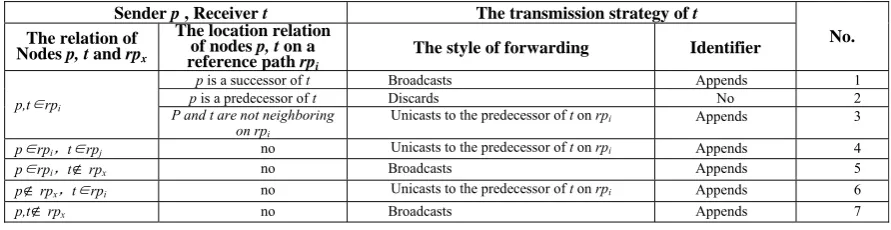
The transmission strategy for the route request of the intermediate nodes is the crucial part of MNDP. We make assumption as follows: The source node of the route discovery is B and the destination node of the route discovery is E. If the node p (p may be the source node) is the sender of the route request RREQ and the node t (t may be the destination node) is the receiver of the route request RREQ, the node t perform the corresponding transmission strategy according to whether the node t is present on the reference path rpi (1≤i≤n, n is the number of paths in the
reference paths rp) when the node t receives the route request RREQ from the node p. The details of the transmission strategy are shown in table 1.
Sender p , Receiver t The transmission strategy of t The relation of
Nodes p, t and rpx
The location relation of nodes p, t on a reference path rpi
The style of forwarding Identifier No.
p is a successor of t Broadcasts Appends 1
p is a predecessor of t Discards No 2
p,t∈rpi
P and t are not neighboring on rpi
Unicasts to the predecessor of t on rpi Appends 3
p∈rpi,t∈rpj no Unicasts to the predecessor of t on rpi Appends 4
p∈rpi,t∉rpx no Broadcasts Appends 5
p∉rpx,t∈rpi no Unicasts to the predecessor of t on rpi Appends 6
p,t∉rpx no Broadcasts Appends 7
Table 1:The transmission scheme of route quest for computing the auxiliary path in MNDP
In table 1, rpx (1≤x≤n, n is the number of paths in the reference paths rp) is some reference path in the reference
paths rp. The transmission strategy is described as follows:
(1) If the identifier of the node t is present on the reference path rpi (1≤i≤n), it checks whether the node p from
which it received RREQ is its successor or predecessor on rpi. The node t acts as follows.
(1.1) If the node p is neither a successor nor a predecessor of node t on rpi (1≤i≤n), it appends its own
identifier on the auxiliary path ap and unicasts it to its predecessor on rpi.
(1.2) If the node p is successor of the node t on the reference path rpi (1≤i≤n), it appends its own identifier
on the auxiliary ap and broadcasts the RREQ to its neighbors.
(1.3) If the node p is predecessor of the node t on the reference path rpi (1≤i≤n), the node i then drops the
RREQ.
(2) If identifier of the node t is not present on any reference path, it appends its own identifier on the auxiliary path and broadcasts the RREQ to its neighbors.
3.2. Analysis of the Security for MNDP
The attack against Ad hoc networks is classified into two main classes: passive and active [9]. The passive attacker only eavesdrops on the network. It mainly threats against the privacy or anonymity of communication, rather than against the functioning of the network or its routing protocol. An active attacker can inject packets into the network and generally also eavesdrop. In the attacker model Active-n-m, n represents the number of nodes the attacker has compromised, and m is the number of the nodes the attacker owned. MNDP cannot defend against
active-n-m attack.
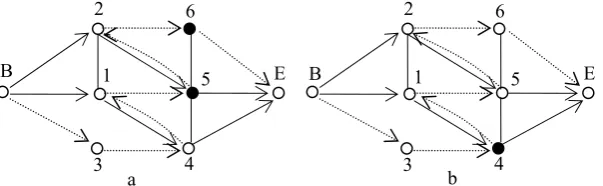
node 1. Similarly, the node 2 appends its identifiers in ap and broadcast the RREQ to its all neighbors (the rule 1 in table 5) when it receives the RREQ that contains ap={3, 4, 1, 5} from the node 5. As a result,
Fig.2 Scenario where attacks against MNDP. Adversarial nodes are represented by solid black dots. The labels assigned to nodes are identifiers that used to identify node. A route between a given pair of nodes is denoted by a sequence of identifiers.
a new auxiliary path ap={3, 4, 1, 5, 2, 6} is returned by the destination node E. Finally, the reorganization of ap and
rp at the source node B generates a new set of node-disjoint paths {{1, 5}, {2, 6}, {3, 4}}.
Because not any cryptographic mechanism and error-check scheme are adopted in MNDP, the active adversary easily damages the route discovery process for MNDP of the auxiliary path via compromising the intermediate node. For example, the active adversary attacks against MNDP by violating the transmission strategy for MNDP of the route request or modifying the message of the reference path and the auxiliary path on adversarial node. As a result, the task of establishing multiple node-disjoint paths can’t be accomplished. Namely, the reorganization of the reference path and the auxiliary path acquired in a route discovery can’t generate a new set of multiple node-disjoint paths. In this paper, we view the path as a non-auxiliary path when the above case occurs. Below, we will illustrate the secure flaws of MNDP.
Attack scenario 1: Fig.2a, we assume that rp={{1, 4}, {2, 5}} is a set of reference paths found between a given source B and destination E in the first two route discovery. In the third route discovery, after the adversary appends the compromised identifier 5 in ap, it doesn’t unicast the route request RREQ to the node 2 rather than to the node E
such that ap={3, 4, 1, 5} when the adversary receives the route request RREQ that contains ap={3, 4, 1} from the node 1 on the compromised node 5. Clearly, the adversary violates the transmission rule 6 in table 1. And then, the destination node E generates a route reply RREP that contains ap={3, 4, 1, 5} and sends the RREP back to the source node B on the reverse of ap. Therefore, the reorganization of rp and ap found in this route discovery generates a set of routes {{1, 5}, {2, 5}, {3, 4}} when the source node B receives this RREP. Apparently, there exist node-intersecting routes {1, 5} and {2, 5} in this set, MNDP can’t defend against this simple active-1-1 attack.
Attack scenario 2: Fig.2a, we still assume that rp={{1, 4}, {2, 5}} is a set of reference paths found between the given source B and the destination E in the first two route discovery, and ap={3, 4, 1, 5, 2, 6} is an auxiliary path found in this route discovery. The adversary modifies ap={3, 4, 1, 5, 2, 6} into ap={3, 4, 1, 5} and unicasts the RREP that contains ap={3, 4, 1, 5} to the node 1, when the adversary receives the RREP that contains ap={3, 4, 1, 5, 2, 6} on the compromised node 5. And then, when the source node B receives this RREP, that is, ap={3, 4, 1, 5}, the reorganization of rp and ap found in this route discovery generates a set of routes {{1, 5}, {2, 5}, {3, 4}}. There also exist two node-intersecting routes in this route set. Therefore, MNDP can’t defend against this active-2-2 attack.
Attack scenario 3: Fig.2b, we again assume that rp={{1, 4}, {2, 5}} is a set of reference paths found between a given source B and destination E in the first two route discovery. When the adversary receives a route request RREQ that contains rp={{1, 4}, {2, 5}} and ap={3} on an adversarial node 4, rp={{1, 4}, {2, 5}} that contains in the RREQ is modified into rp={{1, 4}, {2, 6}} by the adversary on adversarial node 4, and then the adversary appends 4 in ap and unicasts this RREQ to the node 1. The node 1 and 5 respectively append 1 and 5 in ap and broadcast this request to their all neighbors when they receive this RREQ (the transmission rule 1 and 5 in table 1). And then, the destination node E generates a route reply RREP that contains ap={3, 4, 1, 5} and sends the RREP back to the source node B on the reverse of ap. A new route set {{3, 4}, {1, 5}, {2, 5}} is generated when the reference paths rp={{1, 4}, {2, 5}} and the auxiliary path ap={3, 4, 1, 5} are inspected and reorganized at the
B 1
3
2 6
5 E
4
B 1
3
2 6
5 E
4
source node B. Clearly, this active-1-2 attack against MNDP is easily and successfully implemented by the adversary.
4. Solution of SMNDP
The relation
of nodes lm-1,lm,lm+1 and rp* The transmission strategy of lm+1
Receiver
lm+1
The last two nodes lm-1,lm in ap
The relation of nodes lm-1,lm,lm+1
and rpx
The relation of nodes lm-1,lm,lm+1
on some path rpx The style of forwarding Identifier No.
lm-1∉rp*,lm∉rp* No No Broadcasts Appends 1
lm-1∈rp*,lm∉rp* lm-1∈rpi; No Broadcasts Appends 2
lm-1∉rp*,lm∈rp* lm∈rpi; No Drops (7) No 3
lm-1∈rpi;
lm∈rpj No Drops (5) No 4
lm-1is a successor of lm Broadcast Appends 5
lm-1 is a predecessor of
lm Drops (3) No 6
lm+1∉rp*
lm-1∈rp*,lm∈rp*
lm-1,lm∈rpi
lm-1 is not a neighbor
of lm Drops (4) No 7
lm-1∉rp*,lm∉rp* lm+1∈rpi; No
Unicasts to the predecessor of lm+1
on rpi
Appends 8
lm-1∈rp*,lm∉rp* lm+1∈rpi Doesn’t consider
Unicasts to the predecessor of lm+1
on rpi
Appends 9
lm∈rpi;
lm+1∈rpj No Drops (7) No 10
lm is a successor of
lm+1 Broadcast Appends 11
lm is a predecessor of
lm+1 Drops (7) No 12
lm-1∉rp*,lm∈rp*
lm,lm+1∈rpi
lm,lm+1 are not
neighboring Drops (7) No 13
lm-1 is a successor of
lm
Unicasts to the predecessor of lm+1
on rpj
Appends 14
lm-1 is a predecessor
of lm Drops (3) No 15
lm-1,lm∈rpi,
lm+1∈rpj
lm-1,lm are not
neighboring Drops (4) No 16
lm is a successor of
lm+1 Broadcast Appends 17
lm is a predecessor of
lm+1 Drops (5) No 18
lm-1∈rpi,
lm,lm+1∈rpj
lm,lm+1 are not
neighboring Drops (5) No 19
lm-1,lm+1∈rpi,
lm∈rpj Doesn’t consider Drops (5) No 20
lm-1 is a successor of
lm
lm is a successor of
lm+1
Broadcast Appends 21
lm-1 is a predecessor
of lm or lm is a
predecessor of lm+1
Drops (3) No 22
lm-1,lm,lm+1∈rpi
lm-1,lm are not
neighboring or lm,
lm+1 are not
neighboring
Drops (4) No 23
lm+1∈rp*
lm-1∈rp*,lm∈rp*
lm-1∈rpi,lm∈rpj,
lm+1∈rpk No Drops (5) No 24
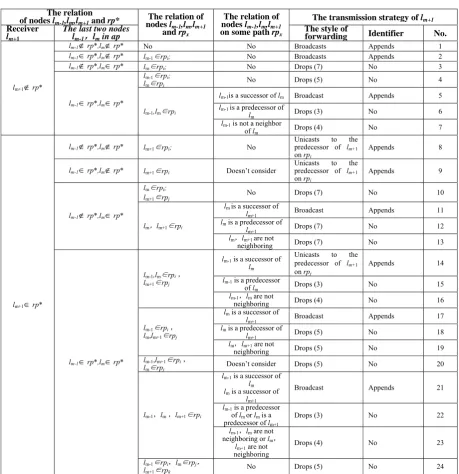
Table 2. The transmission strategy of route request for computing the auxiliary path in SMNDP
modifying the reference paths and the route list in the route request message and the route reply message for computing a new auxiliary path.
The main differences between MNDP and SMNDP: (1) based on the network model in section 2 and the fact that the adversarial vertices are non-neighboring on conf, the error-check scheme is introduced in the transmission strategy of route request for computing a new auxiliary path. We extend the transmission strategy of the route request for two nodes in MNDP into the transmission strategy of the route request for three nodes. The error-check scheme can check out the faulty behavior that the adversary violates the transmission strategy of the route request for SMNDP. (2) In the algorithm of the route reply for SMNDP, the two cryptographic mechanisms such as the digital signature and Message Authentication Code (MAC) are adopted. The digital signature provides guarantee to return a plausible route, and the attack that modifies the reference paths in route request message can be found by verifying MAC.
The protocol SMNDP mainly consists of three parts: the algorithm of route request for SMNDP, the algorithm of route reply for SMNDP and the algorithm of reorganization at the source node. The algorithm of reorganization is similar to that of MNDP, so we don’t discuss it in this paper. Below, we will describe the first two parts in detail.
4.1 The Algorithm of Route Request for SMNDP
The algorithm of route request for SMNDP includes two parts such as the algorithm of route request for the first reference path and the algorithm of route request for computing the auxiliary path. It is similar to MNDP that SMNDP identifies a reference path using a singe path routing such as DSR [1] in the first route discover. You can see [7]. We mainly illustrate the transmission strategy of route request for SMNDP.
The strategy that the intermediate node forwards the route request RREQ for computing an auxiliary path is a crucial part of SMNDP. We assume that B is the source node of the route discovery and E is the destination node of the route discovery. Let us further assume that the intermediate node lm+1 has received a route request RREQ that
contains the auxiliary path ap=(l1, …, lm-1, lm) . Likely, here lm is a source node B and lm+1 is a destination node E.
The node lm+1 performances the corresponding transmission strategy according to the location relationship of this
three nodes such as lm-1, lm , lm+1 on the reference paths. The transmission strategy of RREQ is showed in Table 2. In
table 2, rp* is any path in the reference paths rp and rp
x denotes the path that indexed by x (1≤x≤n, n is the
number of the paths in the reference paths rp) in the reference paths rp. The no. n in the bracket indicates that the error-check scheme of SMNDP checks out the node lm violates the rule n of MNDP.
4.2. The Algorithm of Route Reply for SMNDP
Let us suppose that the current reference paths are rp, the algorithm of route reply for SMNDP is shown in Fig.4.
4.3. The Algorithm of Route Discovery for SMNDP
The route discovery process of SMNDP is shown in Fig.5.
5. The Security Analysis of SMNDP
Lemma 1: Based on the network model that there exists adversary nodes, if the signature scheme used by SMNDP
is secure, SMNDP returns a non-plausible route on any configuration conf only with negligible probability in ideal-world model of UC-RP.
Proof: Let us suppose that the route ap={l1, l2,…,ln} returned by SMNDP is a non-plausible route on any
configuration conf. The route reply message that contains the route ap is the following:
msg=<ssid, RREP, lB, lE, ap, MACKB E, (ssid rp, ), SiglE, Sigln , …, Sigl1 >
Further, let us suppose that msg passes all the verifications required by SMNDP at the source node B, which means that all signatures in msg is correct, the source node B has a neighbor that uses the identifier l1. Recalling that,
The Algorithm of Route Reply for SMNDP
a) The destination node E processes the route request RREQ: when the destination node E receives the
route request RREQ
<sid, RREQ, lB, lE, rp, ap=(l1, …, li, …, ln) >
The destination node E generates a signature SiglE on lB, lE, and ap and generates a message
authentication code MACKB E, (sid rp, ) on sid, rp withprivate key KB,E shared by the destination node E
and the source node B. And then it generates a route reply message RREP < sid, RREP, lB, lE, ap, MACKB E, (sid rp, ), SiglE>
Finally, the destination node E unicasts the RREP to the last node ln, and the destination E drops the
other copies of the RREQ.
b) The intermediate node i processes the route reply RREP: when the intermediate node i receives the
route reply RREP, it verifies that its identifier li is in node list ap, and that the preceding identifier (or that
of the initiator, if there is no preceding identifier in the node list ap) and the following identifier (or that of the target, if there is no following identifier in the node list ap) belongs to neighboring nodes of the node i. The node i also verifies that the digital signatures in the reply are valid and that they correspond to the following identifiers in the node list ap and to the target. If these verifications fail, then the route reply RREP is dropped. Otherwise, the intermediate node i generates a signature on lB, lE, ap and a new route
reply message.
<sid, RREP, lB, lE, ap, MACKB E, (sid rp, ), SiglE, Sigln,…, Sigli>
c) The source node B processes a route reply message RREP:
< sid, RREP, lB, lE, ap, MACKB E, (sid rp, ), SiglE, Sigln , …, Sigl1 >
(1) rp=Φ, the source node B verifies that the first node in the node list is its neighbor, and verifies all of signatures in RREP. If these verifications success, the source node B accepts this ap as the first reference path; otherwise, it drops RREP and initiates a new route discovery.
(2) rp≠Φ, the source node B verifies that the first node in the node list is its neighbor, and verifies all
of signatures in RREP. In addition, the source node B verifies the message authentication code
, ( , )
B E K
MAC sid rp according to the current reference paths rp. If these verifications success, the source node B accepts ap as a new auxiliary path; otherwise, it drops the RREP and initiates a new route discovery.
Fig.4. The Algorithm of Route Reply for SMNDP
The Algorithm of Route Discovery for SMNDP
a) The source node B broadcasts a route request RREQ:
<sid, RREQ, lB, lE, rp, ap>
Here, lB, lE are respectively identifiers of the source node B and the destination node E. sid is identifier of
route discovery, rp is a set of multiple node-disjoint paths found before this route discovery in route cache.
ap=Φ, it will be used to record the first reference path and the auxiliary path in route discovery process. b) The intermediate node i processes the route request RREQ:
<sid, RREQ, lB, lE, rp, ap=(l1, …, lm-1, lm)>
The intermediate node i drops the RREQ if it has processed the RREQ. Otherwise, if rp=Φ , the intermediate node i forwards the RREQ to the destination node Eaccording to the algorithm of the route request for DSR. If rp≠Φ, the intermediate node i forwards the RREQ to the destination node E according to the transmission strategy of route request in table 2.
c) The algorithm that the destination node E generates a route reply RREP, and that the intermediate node i
processes route reply RREP is shown in Fig.4.
d) The source node B processes the route reply RREP and performs the algorithm of reorganization: The algorithm that the source node B processes the RREP is shown in Fig.4. The algorithm of reorganization at the source node is similar to that of MNDP. You can see [7].
e) Repeat (a)-(d), until k paths that protocol need have been found or no new auxiliary path can be found.
vertex has a single and unique non-compromised identifier assigned to it. It follows that every route, including (lB,
l1, …, ln, lE), has a unique meaningful partitioning, which is the following: Each non-compromised identifier, as well
as each sequence of consecutive compromised identifiers,should form a partition. Let P1, P2, …,Pk be the unique
meaningful partitioning of the route (lB, l1, …, ln, lE).The fact that this route is non-plausible implies that at least
one of the following two statements holds:
z Case 1. There exist two partitions Pi={lj} and Pi+1={lj+1} such that both lj and lj+1 are non-compromised
identifiers and the corresponding non-adversarial vertices are not neighbors.
z Case 2. There exist three partitions Pi={lj}, Pi+1={lj+1, …, lj+q}, and Pi+2={lj+q+1} such that lj and lj+q+1 are
non-compromised and lj+1, …, lj+q are compromised identifiers, and the non-adversarial vertices that
correspond to lj and lj+q+1, respectively, have no common adversarial neighbor.
We show that in both cases, the adversary must have forged the digital signature of a non-adversarial machine. In Case 1, machine lj+1 does not sign the route reply, since it is non-adversarial and it detects that the identifier
that precedes its own identifier in the route does not belong to a neighboring machine. Hence, the adversary must have forged Siglj+1in msg.
In Case 2, the situation is more complicated. Let us assume that the adversary has not forged the signature of any of the non-adversarial machines. Machine lj must have received
msg’=<ssid, RREP, lB, lE, ap, MACKB E, (ssid rp, ), SiglE, Sigln, …, Siglj+1>
from an adversarial neighbor, say, A, since lj+1 is compromised and thus a non-adversarial machine would not send
out a route reply message with Siglj+1. In order to generate msg’, machine A must have received
msg’’=<ssid, RREP, lB, lE, ap, MACKB E, (ssid rp, ), SiglE, Sigln, …, Siglj q+ +1>
because, by assumption, the adversary has not forged the signature of lj+q+1, which is non-compromised. Since A has
no adversarial neighbor, it could have received msg’’ only from a adversarial machine. However, the only non-adversarial machine that would send out msg’’ is lj+q+1. This would mean that A is a common adversarial neighbor
of lj and lj+q+1, which contradicts the assumption of case 2. This means that our original assumption cannot be true,
and hence, the adversary must have forged the signature of a non-adversarial machine.
However, the adversary can forge the signature of a non-adversarial machine only with negligible probability in both cases, if the digital signature used by SMNDP is secure. So, SMNDP returns a non-plausible route only with
negligible probability in ideal-world model of UC-RP.
Lemma 2: Based on the network model that there exists adversary nodes, if Message Authentication Code (MAC)
used by SMNDP is secure, SMNDP returns a non-auxiliary path on any configuration conf only with negligible probability in ideal-world model of UC-RP.
Proof: We assume that ap is a non-auxiliary path found in some route discovery of SMNDP, and ap=(…, li, li+1 , …,
li+q, li+q+1, …), in which li and li+q+1are identifiers of adversarial nodes, they respectively correspond to
non-adversarial vertices u and w in V, and li+1, …, li+qis a successive sequence of compromised identifiers used by the
adversary A on an adversarial vertex v*in V (Note that the neighbors of the adversarial vertex are non-adversarial
vertices). To compute ap, the node that identifier is li+q+1 receives the following route quest RREQ from the
adversarial vertex v* on the corresponding non-adversarial vertex w:
<ssid, RREQ, lB, lE, rp, ap=(…li, li+1,…,li+q)>
When the node li+q+1receives this RREQ during this route discovery, for every reference path path∈rp , if: zvertex v*is present on a path
From the transmission strategy of the route request for computing the auxiliary path, we learn that the node
li+q+1forwards or discards the RREQ according the location relationship of vertices u, v*and w on the reference
paths rather than directly according to the RREQ that the adversary forwarded to it on the vertex v* in SMNDP.
Therefore, if an adversarial vertex v*, from which the adversary has forwarded the RREQ to vertex w, is present
on a path in the reference paths rp, the node li+q+1can check out the faulty behavior that the adversary doesn’t
follow the requirement of SMNDP on the vertex v*, and the node l
i+q+1discards the RREQ received from the
vertex v*.
As an example, let us consider the transmission rule 3 of SMNDP. We assume that vertices u and w are not present on any path of the reference paths rp, but the vertex v* is present on a path rp
i of rp. The adversary
forwards the RREQ to w on the vertex v* when it receives the RREQ from u. The node l
i+q+1 will discard the
RREQ to the predecessor of v* on the route rp
iinstead of w according to the location relationship of vertices u, v*
and w on the reference paths rp. The error-check scheme in SMNDP checks out this attack.
So, the uniquely possible cause made ap a non-auxiliary path is that the adversary modifies the reference paths
rp during the course of computing the path ap.
However, the source node B can check out this attack and delete the route reply message RREP according to the reference paths in route cache and the Message Authentication Code (MAC) that contains in route reply message RREP. The case that the adversary modifies rp can occur only with negligible probability if the message authentication scheme used in SMNDP is secure.
zthe vertex v*is not present on any path
In this situation, according to the algorithm and its own location relationship on the reference paths, the node
li+q+1 directly forwards the RREQ from the adversarial vertex v*. To make the algorithm simple and efficient we
do so, because without the help of the node li-1, the node li+q+1 cannot determine whether the adversary has
forwarded the RREQ according to the requirement of SMNDP. However, if the vertex v* is not present on the
reference path, even if the adversary doesn’t follow the requirement of SMNDP, the reorganization of ap found in this route discovery and a plausible-route set in route cache cannot generate vertex-intersecting routes. Therefore, we still consider this ap as a auxiliary path in this case.
So, SMNDP returns a non-auxiliary path on any configuration conf only with negligible probability in ideal-world model of UC-RP.
Theorem 1:SMNDP is a UC-secure multiple node-disjoint paths source routing protocol in UC-RP, if the signature
scheme and the message authentication scheme used by SMNDP are secure.
Proof: Firstly, we apply the simulator technology to design all kinds of stimulant scenarios, and then show that definition 3 can be satisfied. Let A is an active adversary, we construct a ideal process adversary S (a “simulator”) for ideal functionality Frouting in ideal process. In ideal process, S interacts with ideal functionality Frouting and the
environment Z. S is invoked by à that it is a copy of A. à interacts with real-model adversary A. The interaction of the simulator S is classified into outside interaction and inside interaction. Outside interaction is interactive behavior of the simulator S in ideal process, and inside interaction is interaction between the adversary A and Ã. The simulator S runs as follows:
(1) S simulates the first route discovery process:
Based on any configuration conf, there exists an active adversary A. The simulator S gets a message <ssid=1, RREQ, lB, lE, rp=Φ, ap1> from real-model player Mi (A has compromised the player Mi) via a copy à of A in
inside-interaction simulation. In outside-interaction simulation, the simulator S mimics the behavior of real-model player Mi (A has compromised the player Mi) and gets a message < ssid=1, RREP, lB, lE, rp=Φ, ap1,
E l
Sig , Sigln, …, Sigli−1> that the ideal functionality Frouting forwards to dummy player M ’
i.
(2) S simulates the x route discovery process:
Based on any configuration conf, there exists an active adversary A. In inside-interaction simulator, the simulator S gets a message <ssid=x, RREQ, lB, lE, rp, apx> from real-model player Mi via a copy à of A. In
outside-interaction simulation, the simulator S mimics the behavior of real-model player Mi and gets a message
< ssid=x, RREP, lB, lE, apx,MACKB E, (ssid rp, ),SiglE , Sigln , …, Sigli−1> that the ideal functionality Frouting forwards to dummy player M’
i.
Now, all of states that the simulator S simulates route discovery process are described as above.
The proof of definition 3 is shown as follows. View that get from the interaction of the environment Z, the adversary A and the player in UC-RP and view that get from the interaction of the environment Z, the ideal-model adversary S and a copy à in inside-interaction simulation of the simulator S is equal. So, the indistinguishable proof of these two views can be transformed into the indistinguishable proof of inside-interaction simulation and outside-interaction simulation of the simulator S. For any configuration conf=(G(V, E), V*, F)and any adversary A, SMNDP
(1) ap found in each route discovery of SMNDP is a non-plausible route on any configuration conf only with negligible probability.
The signature scheme is used when the destination node and the intermediate node return a route reply message. So, if the signature scheme used in SMNDP is secure, ap found in this route discovery is a non-plausible route only with negligible probability in ideal-world model of UC-RP. The details of the proof are shown in the proof of lemma 1.
(2) ap found in this route discovery of SMNDP is a non-auxiliary path on any configuration conf only with negligible probability.
The Message Authentication Code (MAC) on the current reference paths is used when the destination node return a route reply message. So, if MAC used by SMNDP on the reference paths rp is secure, ap found in this route discovery is a non-auxiliary path only with negligible probability in ideal-world model of UC-RP. The details of the proof are shown in the proof of lemma 2.
From what is discussed above (1) and (2), the probability that SMNDP returns a error route (non-plausible route and non-auxiliary path) is negligible in ideal-world model of UC-RP. So, the reorganization at the source S
generates a nonplausible-route set only with negligible probability. SMNDP is a provably secure multiple node-disjoint paths secure source routing protocol in UC-RP.■
6. Efficiency Analysis of Relative Solutions
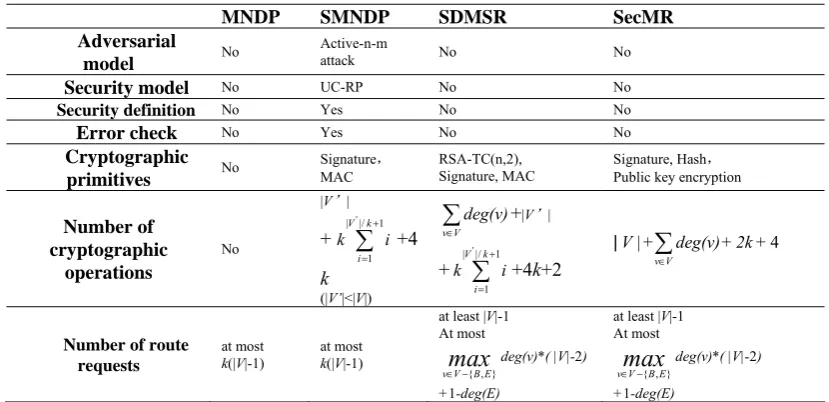
Some of existing multi-path routing protocols (e.g. SDMSR[21], SecMR[22]) also address the security issues. However, the security of these protocols is analyzed by informal methods only or with formal methods that have never been intended for the analysis of this kind of protocol (e.g., BAN logic). In this paper, the adversary model (active-n-m attacker) firstly is introduced, and then UC-RP security framework for routing protocol and the security definition of multiple node-disjoint paths routing based on this framework are proposed. Finally, the security of SMNDP is discussed in UC-RP.
Existing multi-path routing protocols such as SDMSR, SecMR etc. has no any error-check scheme, however, the adversarial nodes in the network don’t possibly follow the requirement of protocol when they forward the route request. The error-check scheme is used in the algorithm of route discovery for SMNDP. We extend the transmission strategy of the route request for two nodes in MNDP into the transmission strategy of the route request for three nodes. The scheme can check out the faulty behavior that the adversary violates the transmission strategy of the route request for SMNDP. In comparison with the algorithm of route discovery for MNDP, the error-check scheme only adds the computation cost that the intermediate node received the route request judges the location relationship of three relative nodes on the reference paths. But no any cryptography operation is used in this scheme. In addition, besides being provably secure, SMNDP has another significant advantage over similar protocols (e.g. SDMSR, SecMR etc.): it is more efficient, because it requires less cryptographic computation overall from the nodes. This is because in SMNDP, only the processing of the route reply messages involves cryptographic
MNDP SMNDP SDMSR SecMR
Adversarial
model No
Active-n-m
attack No No
Security model No UC-RP No No
Security definition No Yes No No
Error check No Yes No No
Cryptographic primitives No
Signature, MAC
RSA-TC(n,2), Signature, MAC
Signature, Hash, Public key encryption
Number of cryptographic
operations
No
|V’|
+ ' | |/ 1
1
V k
i
k +i
=
∑
+4k
(|V’|<|V|)
v V deg(v)
∈
∑
+|V’|+ ' | |/ 1
1
V k
i
k +i
=
∑
+4k+24
v V
V |+ deg(v)+ 2k +
∈
∑
|Number of route requests
at most
k(|V|-1)
at most
k(|V|-1)
at least |V|-1 At most
{ , }
v V∈ −
max
B Edeg(v)*( |V|-2)
+1-deg(E)
at least |V|-1 At most
{ , }
v V∈ −
max
B Edeg(v)*( |V|-2)
+1-deg(E)