Available Online atwww.ijcsmc.com
International Journal of Computer Science and Mobile Computing
A Monthly Journal of Computer Science and Information Technology
ISSN 2320–088X
IJCSMC, Vol. 4, Issue. 11, November 2015, pg.1 – 5
RESEARCH ARTICLE
Overview on Load Balanced
Data Aggregation Tree in
Wireless Sensor Network
Ms. Amruta A. Rasal
1, Prof. Pravin U. Dere
21P.G Student: Electronics and Telecommunication Alamuri Ratnamala Institute of Engineering & Technology, Mumbai 2Assistant Prof: Electronics and Telecommunication, Terna Engineering College, Nerul, Navi Mumbai
1e-mail: [email protected] , 2 e-mail: [email protected]
Abstract- In Wireless Sensor Networks (WSN), the sensor nodes sense the same kind of data and forward it to the sink node. This redundant information sustains the reliability; but at the same time, sink node wastes its energy in processing the redundant data. So there is a need to eliminate the redundancy in sensed data up to adequate level in order to maintain the tradeoff between energy conservation and reliability. Data Gathering is a crucial technique in Wireless Sensor Networks (WSNs). Data gathering trees capable of performing aggregation operations are also referred to as Data Aggregation Trees (DATs). Most of the current literatures investigate the construction problem under Deterministic Network Model (DNM), whereas the proposed work is suitable for Probabilistic Network Model (PNM) due to any lossy links in WSN’s). Moreover, the load-balance factor is neglected when constructing DATs in current literatures. Therefore, this paper focuses on constructing a Load-Balanced Data Aggregation Tree (LBDAT) under the PNM considering balancing the traffic load among all the nodes in a DAT. For continuous monitoring applications with a periodical traffic pattern, a tree-based topology is adopted to gather and aggregate sensing data because of its simplicity.
I. Introduction
A WSN consists of nodes with sensing, computing and communication capability connected according to some topology and a sink to communicate with the outside world. A common scenario of sensor networks involves deployment of hundreds or thousands of low-cost, low-power sensor nodes to a region from where information will be collected periodically. Hence, sensor nodes will periodically sense their nearby environment and send the information to a sink which is not energy limited. The collected information can be further processed at the sink for end-user queries. In order to reduce the communication overhead and energy consumption of sensors while gathering, the received data can be combined to reduce message size. A simple way of doing that is aggregating the data. A different way is data fusion which can be defined as producing a more accurate signal by combining several unreliable data measurements. the load-balance factor when they construct a DAT. Without considering balancing the traffic load among the nodes in a DAT, some heavy-loaded nodes may quickly exhaust their energy, which might cause network partitions or malfunctions. For instance, for aggregating the sensing data from v8 different nodes to the sink node v0, a shortest-path-based DAT for the probabilistic WSN. The intermediate node v4 aggregates the sensing data from four different nodes, whereas, v7 only aggregates one sensing data from v8. For simplicity, if every link is always there and every node has the same amount of data to be transferred through the intermediate nodes with a fixed data rate, heavy-loaded v4 must deplete its energy much faster than v7.
II. Related Work
sensor node having sensing, processing and communication capabilities. These nodes are resource constraint. That’s why lifetime of the network is limited so the various approaches or protocol has been proposed for increasing the lifetime of the wireless sensor network.
III.Load Balanced Data Aggregation Tree (LBDAT)
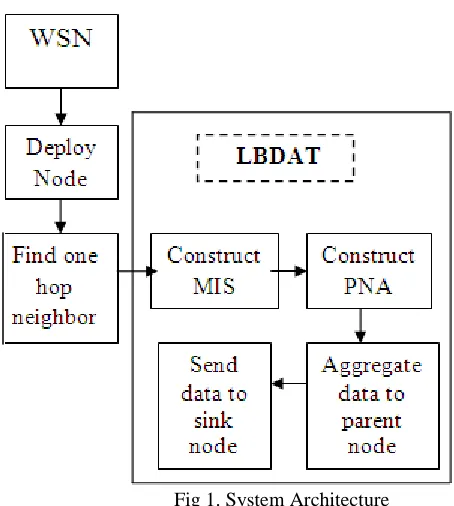
In the tree-based approach aggregation is done by constructing an aggregation tree. The tree has branches (nodes) on both sides, rooted at sink and source nodes are considered as leaves. Each node has a parent node to forward its data. Flow of data starts from leaves nodes up to the sink and the aggregation done by parent nodes. Load-Balanced Parent Node Assignment (LBPNA) is produced, which comprises LBPNA for non-leaf nodes and leaf nodes. By assigning a direction of each link in the constructed tree from the children node to the parent node, an LBDAT is achieved. First, LBPNA for leaf nodes is formulated and then, an algorithm is applied and an LBDAT is build.
Fig 1. System Architecture
Identify and highlight the use of lossy links when constructing a DAT, moreover, in order to measure the load-balance of the nodes in a DAT under the PNM, two new metrics potential load, and actual load are defined. The “load” associated with a given sensor node represents the amount of data periodically generated by that sensor node. Load balanced trees can be classified into different categories. We define the “level” to be the distance from a node to the base station. A load-balanced tree could be fully balanced, top-level balanced or hierarchy-balanced. A fully balanced tree is a tree in which the branches on the same level carry the same total amount of load. A top level balanced tree is a tree such that each branch at the top level closest to the base station carries the same amount of load. Both fully balanced trees and top-balanced trees are extreme cases of hierarchy-balanced trees, i.e. a tree in which the branches in certain levels carry the same total amount of load.
Start
Network Configuration (Topology Creation)
Node Network Creation
Routing and scheduling and path selection based on shortest distance algorithm
LBDAT
Display network Topology animation
Display graph, Energy Consumption, Analyze Traffic, hop count and end to end delay
Fig2. Proposed Flow
Constructing data aggregation consists of two steps. The first step is to construct the data aggregation tree distributive and the second step is to reduce the data traffic by adjusting the routing path locally. In this section, we will introduce the two options to construct the data aggregation tree and the local minimization to reduce the data traffic. If we consider nodes in a WSN as vertices and each wireless link between two neighboring nodes as an edge, the WSN can be naturally regarded as a graph. Its Shortest Path Tree (SPT) is composed of shortest paths from the sink to all nodes in a WSN.
After the shortest path distance of all nodes is found, we can assign a parent to each non sink vertex such that parent node is connected to sink vertex. In the case that multiple choices for parent node exist, choose the node for which there exists a shortest path from the sink to parent node with the smallest number of edges. After the parent of all non- sink nodes is determined, the short path tree consists of edges between all nodes and their parent.
Load-Balanced Maximal Independent Set (LBMIS)
All aggregated data are reported to the sink node, hence the sink node is deliberately set to be an independent node. Since an MIS is also a DS, we should formulate the DS constraint for the LBMIS problem first. The DS property states that each non independent node must reside within the 1-hop neighborhood of at least one independent node. Taking the load-balance factor into consideration, we are seeking an MIS in which the minimum potential load of the nodes in the constructed LBMIS is maximized. In other words, the potential traffic load on each node in the LBMIS is as balance as possible.
Step 1: Sort sensor nodes by the wi value (where 1 <= i <=n) in the decreasing order.
Step 2: Set the sink node to be the independent node, i.e., w0=1.
Step 3: Set all wi to be 0.
Conclusion
There are various aggregation techniques. Based on the nature of the network, data aggregation can be done in two ways i) data aggregation tree or by ii) a clustering approach for hierarchical networks. A very frequent architecture used for data aggregation in flat networks is data aggregation trees (DAT). Data aggregation has been put forward as an essential paradigm for wireless routing in sensor networks. This paper proposes a node-centric load balancing strategy considering the cumulative load of data traffic from child nodes in a routing tree on their parent candidate nodes. The WSN routing tree is linked to the sink. The load of child sensor nodes includes to the load of each top parent in the data aggregation tree. Hence, the sensor nodes near to the sink or base station will be the most heavily loaded. The goal of node-centric load balancing is to evenly distribute packet traffic generated by sensor nodes across the different branches of the routing tree.
REFERENCES
[1]“Constructing Load-Balanced Data Aggregation Trees in Probabilistic Wireless Sensor Networks”, IEEE Transactions On Parallel And Distributed Systems, Vol. 25, No. 7, July 2014.
[2] “Load Balanced Data Aggregation Methods for Virtual Backbone in Wireless Sensor Networks”, Miss.Vrishali Popat Wagaj, Prof.Vinayak,, Prof.Prakash R.Gadekar, (IJCSIT) International Journal of Computer Science and Information Technologies, Vol. 6 (1) , 2015, 500-502.
[3] “Power Efficient Data Gathering and Aggregation in Wireless Sensor Networks, Hu¨seyin O¨ zgu¨r Tan and I˙brahim Ko¨rpeogˇlu, Department of Computer Engineering, Bilkent University 06800 Ankara, Turkey, vol. 22, no. 3,pp. 489-500, Mar. 2011
[4] “Data Aggregation Techniques to Remove Redundancy in Wireless Sensor Networks: Brief Overview”, Samarth Anavatti, Sumedha Sirsikar, Maharashtra Institute of Technology, Pune University, Pune 411038, International Journal of Advance Foundation and Research in Computer (IJAFRC) Volume 1, Issue 12, December 2014. ISSN 2348 – 4853 10.
[5] “Energy Efficient Routing for Wireless Sensor Network through Event-Based Clustering Mechanism”, Amandeep Kaur, Rupinder Kaur, CT Group of Institutions, Jalandhar, India, Volume 4, Issue 6, June 2014 ISSN: 2277 128X International Journal of Advanced Research in Computer Science and Software Engineering
[6] Meng, Jin-Tao, Jian-Rui Yuan, Sheng-Zhong Feng, and Yan-Jie Wei. "An Energy Efficient Clustering Scheme for Data Aggregation in Wireless Sensor Networks." Journal of Computer Science and Technology 28, no. 3 (2013): 564-573.
[7] N. Jain, S. Gupta, and P. Sinha, “Clustering Protocols in Wireless Sensor Networks: A Survey,” Int. J. Appl. Inf. Syst., vol. 5, no. 2, pp. 41–50, 2013. [8] S. Gupta, N. Jain, and P. Sinha, “Node Degree based Clustering for WSN.,” Int. J. Comput. Appl., vol. 40, no. 16, pp. 49–55, 2012.
[9] Samarth . A, S. Sirsikar Data Aggregation Techniques to Remove Redundancy in Wireless Sensor Networks: Brief Overview Volume 1, Issue 12, December
2014. ISSN 2348 – 485310.
[10] K. Khedo, R. Doomun and S. Aucharuz, “READA: Re- dundancy Elimination for Accurate Data Aggregation in Wireless Sensor Networks,” Wireless Sensor Network, Vol. 2, No. 4, 2010, pp. 302-308.
[11] T. Banerjee, K. Choudhury and D. P. Agrawal, “Using Polynomial Regression for Data Representation in Wireless Sensor Networks,” in Special Issue of Wiley International Journal of Communication Systems on Energy-Efficient Network Protocols and Algorithms for Wireless Sensor Networks, 2006.