Polynomial Runtime and Composability
Dennis Hofheinz, Dominique Unruh, and J¨orn M¨uller-Quade
CWI, Saarland University, and Universit¨at Karlsruhe
January 12, 2009
Abstract. To prove security of a multi-party cryptographic protocol, one often reduces attacks on the protocol to attacks on a suitable computational problem. Thus, if the com-putational problem is hard, then the protocol is secure. But to allow for a security reduc-tion, the protocol itself and the attack on the protocol must be efficient, i.e., polynomial-time. Of course, the obvious way to enforce an overall polynomial runtime of the protocol is to require each individual protocol machine and adversarial entity to be polynomial-time. However, as the specific case of zero-knowledge protocols demonstrates, an a priori polynomial-time bound on all entities may not be an optimal choice because the running time of some machines needs to depend on that of others. As we want to be able to model arbitrary protocol tasks, we work in the Universal Composability framework (UC). This framework additionally provides strong composability guarantees. We will point out that in the UC setting, finding a useful notion of polynomial-time for the analysis of general protocols is a highly non-trivial task.
Our goal in this work is to find a good and useful definition of polynomial-time for multi-party protocols in the UC setting that matches the intuition of what is feasible. A good definition should have the following properties:
Flexibility: All “intuitively feasible” protocols and protocol tasks should be considered polynomial-time.
Soundness: All “intuitively feasible” attacks (i.e., adversaries) should be considered polynomial-time.
Completeness: Only“intuitively feasible” attacks should be considered polynomial-time. In particular, this implies that the security of protocols can be reduced to computational hardness assumptions.
Composability: The induced security notion should support secure (universal) composition of protocols.
Simplicity: The notion should be easy to formulate, and for all practical cases, it should be easy to decide whether a protocol or attack runs in polynomial time.
The problem of finding a good definition of polynomial time in the UC framework has been considered in a number of works, but no definition satisfying the five above criteria had been found so far. This seemingly simple problem is surprisingly elusive and it is hard to come up with a definition that does not involve many technical artifacts.
In this contribution, we give a definition of polynomial time for cryptographic protocols in the UC model, called reactively polynomial, that satisfies all five properties. Our notion is simple and easy to verify. We argue for itsflexibility, completenessand soundnesswith practical examples that are problematic with previous approaches. We give a very general composition theoremforreactively polynomialprotocols. The theorem states that arbitrarily many instances of a secure protocol can be used in any larger protocol without sacrific-ing security. Our proof istechnically different from andsubstantially more involved than proofs for previous protocol composition theorems (for previous definitions of polynomial runtime). We believe that it is precisely this additional proof complexity, which appears only once and for all in the proof of the composition theorem, that makes a useful definition as simple as ours possible.
Table of Contents
1 Introduction . . . 2
1.1 Introduction to the problem . . . 2
1.2 Straightforward approaches and why they fail . . . 4
1.3 Previous work . . . 7
1.4 Some problematic use cases . . . 9
1.5 Our work . . . 10
1.6 Organization . . . 12
1.7 Notation . . . 13
2 The UC framework . . . 13
2.1 The Composition Theorem . . . 14
3 Difficulties with prior notions . . . 17
4 Our definition of polynomial runtime . . . 22
5 Basic properties . . . 26
6 Dummy Adversary . . . 28
7 Universal Composition Theorem . . . 31
8 Example: Secure Message Transmission . . . 45
9 Variants of our approach . . . 46
9.1 Strong reactive polynomial time . . . 47
9.2 Uniform reactive polynomial time . . . 50
10 Relation to classical notions . . . 53
1 Introduction
1.1 Introduction to the problem
The security of cryptographic protocols is often based on the hardness of certain compu-tational problems, such as, e.g., inverting a given trapdoor one-way permutation. Break-ing the protocol security then requires solvBreak-ing the underlyBreak-ing computational problem. To prove this, one generally considers reductions, i.e., one translates a successful cryp-tographic attack on the protocol security into an algorithm that solves the underlying computational problem. For such a reduction to work, it is necessary that the complexity of protocol runs is bounded, so that the protocol situation can be translated into the setting in which the computational assumption is formulated. Typically, computational assumptions are formulated against algorithms which are probabilistic polynomial time. That means, one usually assumes that an arbitrary but fixed polynomial upper-bounds the runtime of the algorithm.
So it is not merely of aesthetic interest to find a notion that captures the notion of polynomial time complexity for cryptographic protocols. It is also a practical necessity to conduct security proofs.
feasible. In particular, the induced security notion should be useful when analyzing the composition of protocols.
More specifically, we endeavor to find a notion of polynomial-time together with a variant of the UC security notion such that the following requirements are fulfilled:
Flexibility: All “intuitively feasible” protocols and protocol tasks should be considered polynomial-time. In particular, natural protocol tasks like secure channels should be polynomial-time and not be excluded for formal reasons.
Soundness: All “intuitively feasible” attacks (i.e., adversaries) should be considered polynomial-time. Otherwise, we would have no guarantee that a secure protocol indeed with-stands real-world attacks. In particular, in the context of universal composability the very important “dummy adversary” should be polynomial-time.
Completeness: Only“intuitively feasible” attacks should be considered polynomial-time. Otherwise, the resulting security notion would be too strong and the security of protocols could not be reduced to computational hardness assumptions.
Composability: The security notion should support secure composition of an arbitrary number of concurrent protocol instances in arbitrary contexts (universal composi-tion).
Simplicity: the notion should be easy to formulate, and for all practical cases, it should be easy to decide whether a protocol or attack runs in polynomial time.
The UC framework. Since we strive forcomposability, we work in the protocol frame-work of universal composability (UC) [Can01, Can05a].1 The UC framework [Can01, Can05a] defines the security of a protocol (often called the real protocol) by comparison with an ideal protocol. The ideal protocol usually comprises only a single trusted ma-chine, a so-called ideal functionality, which is secure by construction. The ideal protocol can be thought of as the specification of the protocol task that should be achieved by the real protocol. In the UC framework, the real protocol is considered to be a secure imple-mentation of the ideal protocol if only those attacks are possible in the real protocol that are also possible in the ideal protocol. More precisely, for any adversary that interacts with (attacks) the real protocol, there is a corresponding adversary (the simulator) that interacts with the ideal protocol such that no protocol environment interacting with both the protocol and the adversary can distinguish between an execution of the real and an execution of the ideal protocol. In this case we say that the real protocol emulates the ideal protocol. To be able to use computational assumptions in the protocol design, one usually requires the adversary, the simulator, the environment, and both the ideal and the real protocol to be polynomial-time.
Since ideal functionalities can model very different protocol tasks, the UC framework is very versatile. Furthermore, it gives very strong composability guarantees: If a protocol
π emulates a protocolρ, and a protocolσ that uses the ideal protocolρas a subprotocol
1We stress that our observations and results apply as well in any other protocol framework in which
emulates some ideal functionalityF, then after replacing ρ by its implementation π,σ
still emulatesF. This enables the modular design of security protocols. We give a detailed overview over the UC framework in Section 2.
1.2 Straightforward approaches and why they fail
An a priori polynomial bound on the overall runtime. Probably the most obvious approach is to allow only machines of polynomial (time) complexity as entities in a protocol run. That is, there is a fixed polynomialqM, so that machineM halts and
cannot be activated again after at mostqM(k) overall steps. (Here and in the following,
k∈Ndenotes the security parameter, that intuitively measures the “amount of desired security.”) We assume that this bound is an a priori runtime bound; that is, we assume that qM only depends on the machine M, but not on the context M is run in (in
particular, not on the runtime of the machines M interacts with). This bound applies to honest protocol parties as well as to adversarial entities. In the UC setting, these are the adversary, the simulator, and the environment.
This approach has several disadvantages. First, it becomes impossible to formulate natural protocol tasks with an (a priori) unbounded number of activations. For instance, already a public key encryption system cannot be expressed, since it should permit an unbounded number of encryptions. This is a violation of flexibility.
An obvious workaround (extensively used, e.g., in the“cryptographic library”[BPW03]) would be to artificially bound in advance the number and size of inputs to a crypto-graphic system. For instance, a secure channel might shut down after a certain (fixed in advance) number of transmitted bits. We do not recommend this workaround: it might not be clear in advance how often, say, a secure channel will be used. Furthermore, this workaround creates the additional (intuitively unneccessary) hassle of fixing and keeping track of all concrete running time bounds. Strictly speaking, even the finally deployed protocol implementation would need to keep track of the number of its activations and stop working after a given time.
But there is a second, very severe technical drawback that becomes apparent when considering the composition of cryptographic protocols. Recall that in the UC security definition, the environment that represents the a larger protocol context, is chosen last. But if all protocol machines have a priori runtime bounds, there is an environment that can “exhaust” all protocol machines and even a given adversary, e.g., by sending them useless messages and force them to waste their limited runtime by processing them. This has been shown not only to cause severe technical artifacts. It actually renders many natural protocol tasks formally impossible when allowing only machines with a priori polynomial runtime bounds, cf. [HMQU05, K¨us06].
However, it allows two machines (e.g., in the UC context, this could be the adversary and the environment) to effectively run infinitely by activating each other over and over again. This not only causescompletenessproblems (and thus makes reductions to compu-tational assumptions difficult). It also prevents securecompositionof protocols, since the combination of two polynomial-time machines into one machine (a standard technical tool used during the proof of composition theorems) may no longer be polynomial, see [HMQU05].
Learning from zero-knowledge. The above problems with a priori runtime bounds arise because of a dependency problem: an entity that is chosen later in the security definition might have a larger polynomial runtime bound than any entity that was cho-sen earlier on. Hence, any entity can in principle “exhaust” all previously chocho-sen entities. (For instance, an environment machine can exhaust a protocol machine or even an ad-versary.) This unwanted effect occurs also in the more specific setting of (black-box) zero-knowledge simulators (e.g., [Gol07]): a black-box zero-knowledge simulator should be efficient (in a reasonable sense), yet it interacts with an adversary that is chosen after that (black-box) simulator.
And while a zero-knowledge adversary cannot directly exhaust a simulator by too many queries (in black-box zero-knowledge, the adversary is only queried by the simula-tor, not the other way around), theconceptual difficulties that arise from this dependence are similar to our case. Namely, for successful simulation, a zero-knowledge simulator may require time complexity that depends on the adversary’s time complexity.
So while for a given polynomial-time adversary, the simulator’s complexity will always be polynomial-time, there may not be an a priori bound on the simulator’s runtime.
An a posteriori polynomial bound on overall runtime. This gives reason to con-sider machines that are polynomial-timefor any given machine (of arbitrary complexity) they interact with. (For zero-knowledge, several such notions appear in the literature; an explicit discussion and analysis has been conducted in [Gol07].) We claim that, while an a posteriori runtime bound is useful in the zero-knowledge context, it does not constitute a good definition of polynomial runtime for general protocols.
For general protocols, by a posteriori runtime we mean that every protocol machine and the adversary run in polynomial time in every given (but arbitrary) context.
For instance, consider a trivial repeater R, i.e., a machine that outputs all incoming data. Since we did not fix an a priori upper bound on the size of the incoming data,
R repeats incoming data of arbitrary length. In particular, R runs in exponential time when interacting with a machineM that sends 12k toR. Hence a repeater would also not satisfy the a posteriori polynomial runtime definitions from the zero-knowledge case.2,3
2There is a subtlety here: by “polynomial,” we mean polynomial in the (global) security parameter,
whereas in the zero-knowledge case, it is customary to assume that “polynomial” means polynomial in the size of the input. However, in the context of general protocols, the former interpretation of “polynomial” is preferred, since it allows for a meaningful analysis of composed and nested protocols
as well as protocols with constant input size like oblivious transfer.
3In fact, a priori and a posteriori polynomial runtime coincide when arbitrary, unbounded contexts
As above, this violates flexibility and, when also enforcing an a posteriori polynomial runtime bound for adversaries, it might endanger soundness. In fact, in the context of UC, the dummy adversary, which basically is a repeater, would not be allowed by an a posteriori polynomial runtime bound. The dummy adversary is an essential technical tool to prove composition theorems, cf. also Section 6. Hence, we also cannot guarantee composability.
A natural way to relax the a posteriori runtime bounds definition would be the following: one could allow machines M that have polynomial time complexity when running with any (a priori)polynomial-time machineM0.
Let us call this modified a posteriori notion a posteriori polynomial-time in bounded contexts (APPT-BC). Note that the repeater R from above is indeed APPT-BC. How-ever, we are now faced with a different problem: two APPT-BC machinesM1 and M2,
running together, may result in an exponential-time network. (For instance, on input
x, M1 might send xx to M2 and vice versa. This would not contradict the APPT-BC
property of M1 and M2 individually, but would lead to a clearly exponential network {M1, M2} whereM1 and M2 send a growing message back and forth.) This lack of
com-posability of the APPT-BC notion itself can lead to problems in the UC composition theorem, in which the combination of several machines into one is an integral operation (see Section 1.5 for a detailed explanation). Basically, our approach will be not to try to overcome the problem completely, but to prove that all composition operations in (our variant of) the composition theorem lead to polynomially bounded networks.
We stress, however, that we will not use the APPT-BC notion exactly as described above, since there is a second problem with APPT-BC runtime bounds. Namely, if we demand that a machineM always meets the APPT-BC runtime bounds (and not, say, with overwhelming probability only), then the induced security notion does not even allow for secure composition of one protocol instance with a larger protocol. We prove this in Section 9.1.4
Further remarks concerning expected polynomial time. In the above, we have oversimplified our presentation of polynomial runtime in zero-knowledge definitions. For zero-knowledge, there are a number of subtleties and additional complications. These are mostly due to the fact that in zero-knowledge, a simulator may rewind the adver-sary. Most notably, specifically for black-box zero-knowledge, it is preferable to allow
whereq=qC(k) is a polynomial (in the security parameter) that may depend onC. Then, there is a
contextC∗
thatmaximizesM’s runtime by, for each security parameterk, acting like argmaxCqC(k).
By definition,qC∗(k)≥qC(k) for all contextsC, and henceqC∗(k) is asinglepolynomial that bounds M’s runtime in arbitrary contexts. Thus,M’s runtime is already a priori polynomially bounded. (Note that argmaxCqC(k) exists. Otherwise would could construct a contextC∗ with qC∗(k) ≥2k which
would be a contradiction.) We conclude that we do not gain on generality by allowing a posteriori runtime bounds, at least when we consider arbitrary,unboundedcontexts.
4The intuitive reason is that real and ideal protocol might behave identically only up to a small
prob-ability. Hence, real and ideal protocol might give slightly different (runtime) guarantees to adversary and environment. Now a larger protocol that uses the real, resp. ideal protocol as a subprotocol might
simulators that run in expected polynomial time rather than strict polynomial time. However, since rewinding is not allowed in UC (essentially since a rewinding simulator may not behave well under concurrent composition), these additional issues do not affect us. For additional discussion and definitions connected to zero-knowledge, we refer to [Gol01, Chapter 4] and, in particular, to [Gol07]. We also remark that some of our results might not hold when substituting (strict) polynomial-time in our results with expected polynomial-time, see Section 9.1.
Acyclic runtime dependencies. One reason why definitions of polynomial runtime can be difficult is that two machines (e.g., repeaters) can be combined such that they send messages back and forth and consume an unlimited amount of runtime. This problem can be solved by the following approach: In a network of machines, one defines an acyclic directed graph on the set of machines. If there is an edge fromM0 to M, we callM0 the parent ofM. Then we call a machineM polynomial-time if its running time is bounded by an fixed (a priori) polynomial in the total length and number of incoming messages sent by the parents of M . Incoming messages not coming from the parents of M are allowed, but do not increase the allowed running time ofM.
Although this approach allows for more protocols than a priori polynomial-time (bet-ter flexibility), many protocols will still be rejected by such a definition as there is not distinguished direction in which messages flow. For example, a database functionality (described in Section 1.4 below) would not be considered polynomial-time because in some cases the database would need running time from the parties retrieving data from the database, and in some cases the parties retrieving the data would need running time from the database.
Another problem is that it is not clear which running time dependency should hold between the protocol, the environment, and the adversary or simulator. If the protocol gets running time from the adversary or simulator, the latter may be forced to terminate before the protocol run is complete, leading to soundness or completeness issues. If the adversary or simulator gets running time from the protocol, the protocol may be unable to react to messages arriving over the insecure network (that is controlled by the ad-versary), and hence some natural protocols will be disallowed (flexibility deficits). (The latest version of the UC framework [Can05a] uses a variant of this approach. Much of the complexity of the definition of polynomial-time there is due to the necessity to clarify which machine gets running time from which.)
1.3 Previous work
(that allows an unbounded number of encryptions) still cannot be expressed. Besides, length functions are a rather technical tool, that resulted from a technical artifact, and are intuitively not easily explainable.
Continuously polynomial time. In this situation, Hofheinz et al. [HMQU05] sug-gested to allow protocols that are, as a whole, polynomial time in their input size. This achieves flexibility. With a specific, dedicated restriction on allowed attacks, they could also achieve (and demonstrate with examples) completeness and soundness of their def-inition. Namely, in their setting, neither protocols nor adversaries are required to ever terminate; however, the “relative computation speed” of adversary and protocol has to be polynomially related, and only polynomial execution prefixes are considered. However, they do not give a universal composition theorem that would allow for the composition of more than a constant number of protocol instances. Furthermore, their restriction of allowed attacks is somewhat unintuitive and lackssimplicity.
In the UC framework. In the Universal Composability (UC) framework [Can01, Can05a] of Canetti, there are a number of approaches to define polynomial runtime. In the initial formulation [Can01], an a priori polynomial overall bound on the number of computational steps of each protocol entity was mandated. When the technical artifacts of this became clear, several definitions were proposed [Can04a, Can04b, Can05b]. The most recent version [Can05a] of the UC framework uses a definition in which machines may be activated in principle infinitely often. However, at any point in time, a certain con-dition must be fulfilled that relates the runtime so far with the input/output behavior of that machine. In particular, the input which a machineM gives to other (sub-)machines must be smaller in size than the overall inputM gets. This means that a protocol has to take care that its own input is large enough in size such that all necessary subprotocol invocations are allowed. In many cases, padding of the “top-level inputs” is necessary, which complicates the specification of natural tasks (see Section 3 for more details). In Section 3, we also show thatcomposability might be a problem, since the technical tool of a (complete) dummy adversary is not available which however is used in the proof of the Universal Composition Theorem. Besides, the current UC notion of polynomial runtime is arguably somewhat complicated and notsimple.
Other frameworks. Two notions of polynomial runtime for protocols are proposed in [K¨us06], both specific to the specific nature of protocols used. In both cases, the specific flow of messages determines whether a protocol setting is polynomial-time or not. In [Gol07], it is investigated whether the notion of expected polynomial time allows for composability. Although this question is answered positively, their approach does not allow machines to run in polynomial time in the length of theincoming communication. (It must be stated that allowing such protocols was not the aim of [Gol07], their goal was to give the simulator additional power which is needed in some settings.)
Summarizing, all notions except for [HMQU05] only allow us to formalize a very limited class of protocols (excluding, e.g., the database example described below), causing flexibility deficits. And [HMQU05] only gives a limited composability result, and their notion is notsimple.
1.4 Some problematic use cases
To illustrate the kind of natural protocols that may be rejected by too restrictive a definition of polynomial time, we give two simple and natural examples of problematic protocol tasks. Recall that, since we strive for composability, we work in the UC frame-work. Hence, protocol tasks are specified as ideal functionalities (that reflect the ideally desired behavior).
Secure channels. A natural protocol functionality is that of a secure channel, again modeled as a single machine. For simplicity, let us say that the machine accepts only inputs of the form (send,receiver,message), and gives outputs of the form (message,
sender,message) (where the semantics should be clear).
We stress that this ideal functionality may be activated arbitrarily often, with arbi-trarily largemessageinputs. Hence, this functionality does not satisfy a polynomial-time notion that bounds the number of activations or the size of allowed inputs a priori. This eliminates most so far presented polynomial-time notions, except for (a) the variation on a posteriori polynomial-time bounds, (b) the notion from [HMQU05], (c) and the most recent polynomial-time definition of the UC model. In particular, all polynomial-time definitions that enforce an a priori runtime bound on machines do not allow to model a simple secure channel.
A database functionality. Consider a publicly available centralized database, for-malized as an ideal functionality, i.e., as a single database machine. The database machine accepts inputs of the form (store,key,data) and (retrieve,key), with the obvious se-mantics (namely, an input (store,key,data) storesdata under key, and (retrieve,key) retrieves that data again).
instruction itself is short, although the corresponding output may become arbitrarily large. This latter property prevents a modeling in the most recent version of the UC framework.5
The same problems as with the database functionality also occur when considering an anonymous bulletin-board (as often used in remote voting protocols, e.g., [JCJ05, MCC08]). Here every user can post messages (which corresponds to storing an entry in the database), and every user can read the bulletin-board (which corresponds to retrieving an entry from the database).
On the inapplicability of input padding. Furthermore, the database example also illustrates why padding, a solution often advocated to circumvent the runtime restrictions in the UC framework [Can05a] is not always applicable. By padding we mean that a protocol specification or functionality expects inputs that are padded to a suitable length such that the machine receiving these inputs is allowed to run longer. In the case of the database functionality however, padding does not solve the problem, since a party retrieving an entry does not know in advance what the length of the data returned from the database will be, and thus that party cannot know how long a padding has to be used. Also the party storing the entry cannot add sufficient padding because it cannot know how many times the entry will be retrieved. (More details on this problem are given in Section 3 which also gives further examples of problems that might occur with too restrictive notions of polynomial time.)
1.5 Our work
Our approach: reactively polynomial protocols. We propose a new notion of polynomial runtime for cryptographic protocols. Our notion, calledreactively polynomial, treats a protocol as polynomial-time, iff the following holds:
In all protocol contexts that terminate after an a priori fixed poly-nomial number of steps,
the whole protocol runs only a polynomial number of steps with overwhelming probability.
Note that this notion is a variation on the a posteriori polynomial runtime bounds from Section 1.2. The most notable difference is the relaxation of only demanding a polynomial number of stepswith overwhelming probability. We stress that this relaxation is essential to allow for a composition theorem; see Section 9.1 for a detailed explanation and proof. (We remark, however, that it is not essential whether the considered protocolcontext is
polynomial-time or only polynomial-time with overwhelming probability; see Section 4, page 25 for an explanation.)
5Technically speaking, [Can05a] allows the database as afunctionality, however it does not allow a
It should also be noted that being reactively polynomial is a property of the pro-tocol as a whole, not of the individual machines (unlike the property of being a priori polynomial).
Flexibility. We claim that the notion of a reactively polynomial protocol captures all intuitively feasible protocol tasks. We admit that such a claim is hard to formally substantiate, since the set of intuitively feasible protocol tasks is not formally defined. However, it is clear that reactively polynomial generalizes a priori and a posteriori poly-nomial runtime bounds as discussed above. Furthermore, it is easily verified that the problematic use cases from Section 1.4 can be modeled as reactively polynomial proto-cols (resp. ideal functionalities). (For instance, consider the database example: in any given a priori polynomial-time protocol context, only a fixed polynomial number of
retrieve queries can happen, each retrieving only a polynomially-sized piece of data. Hence, the database functionalityisreactively polynomial.) Summarizing, we claim that our notion isflexible.
Soundness and completeness. We call an adversary for a given reactively polyno-mial protocol valid (i.e., allowed), if the adversary, together with the protocol, is reac-tively polynomial. We argue that this (together with the precise definition of security) achievessoundnessandcompleteness, as none of the discussed technical artifacts occur. In particular, neither adversaries nor protocol machines can be “exhausted,” while all intu-itively polynomial-time attacks are still valid. Additionally, in our notion the important “dummy adversary” is valid, which is important both forcomposabilityandsoundness. On the other hand, the notion of reactively polynomial protocols and adversaries induces a security notion that lies (strictly) in between the traditional UC security notion and a relaxation of UC discussed in [Lin03]. Thus, our new notion still provides a reasonable and useful definition of security.
Protocol composition. We demonstrate that our notion induces a composable secu-rity notion by proving a universal composition theorem. This proof is considerably more complex than proofs of composability for previous notions of polynomial runtime (such as, e.g., the proofs from [Can01, BPW04a, Can05a, DKMR05]). Ironically, this complex-ity seems to result from thesimplicityof our notion: in the proof, it is necessary to prove that certain combinations of protocol pieces are still reactively polynomial. The good news is that these results do not have to be proven during the design of the protocol. As a consequence, our composition theorem needs only relatively few assumptions, which might come in very handy during protocol design. We now provide further details.
[Can01, BPW04a]) is conceptually simple:S∞ is the combination of multiple instances of S.6 To prove security, one must show that
1. the constructed simulator S∞ is valid (in the sense that S∞ fulfils the respective polynomial-time notion), and
2. S∞ achieves a successful simulation (in the sense of the UC security definition). The first of these properties is usually trivially verified, while the second property is shown using a hybrid argument.
The obstacle with reactively polynomial simulators. In the case of reactively polynomial protocols and adversaries, however, the first property (S∞ is a valid adver-sary) is not trivially verified. Concretely, as hinted above, the composition of several reactively polynomial machines may no longer be reactively polynomal. As an example, consider a “double-repeater”R that resends every incoming message twice (i.e., on in-coming messagex, it sendsxx). Any single such machine is clearly reactively polynomial. However,pipelining ksuch machinesR yields a machine R0 which, e.g., sends 12k when receiving 1. Thus,R0 is exponential-time and not reactively polynomial. We stress that we consider this property of our reactively polynomial notion not to be an artifact, but a necessity. The lack of composability of the notion itself is simply the price we have to pay forcompleteness, i.e., for the ability to model natural functionalities such as secure channels or (double-)repeaters. If we want to model such machines (and this is the design decision we made), then we have to deal with the technical consequences.
Our techniques to overcome the obstacle. Hence, we have to explicitly prove that the combined simulator S∞ constructed in the composition is, together with the composed protocol, reactively polynomial. To this end, we use not only that one simu-lator instance S is reactively polynomial. We also employ the fact that S achieves UC indistinguishability. More concretely, we show that ifS∞was not reactively polynomial, then we could distinguish a simulation by S from a real attack on a single protocol instance.
We stress that in order to make the preceding argument work, we have to tweak the original construction of S∞ from S. Namely, in order to prove statements about
S∞’s time complexity, we provide runtime bounds for eachS-instance insideS∞. These runtime bounds are derived via a hybrid argument, through a reduction toS’s security property (i.e., to the assumption thatSprovides a good simulation). However, this hybrid argument requires a highly symmetric ordering ofS-instances insideS∞. We hence have to rearrange and randomize the order of S-instances inside S∞. This leads to a highly symmetric, but more complex proof argument. We emphasize that the main part of the proof now lies in proving thatS∞is a valid (i.e., reactively polynomial) simulator. That
S∞ achieves a good simulation follows as a byproduct of our argument.
1.6 Organization
After introducing some notation, we review the Universal Composability framework (in which our work takes place) and the UC composition theorem in Section 2. We motivate
our work by highlighting the problematic aspects of previous polynomial runtime notions in Section 3. Our own polynomial runtime notion is presented in Section 4. In Section 5 and Section 6, we prove some basic but important properties of our notion, which will turn out useful in the proof of the composition theorem in Section 7. Section 8 gives an example of our notion in action. In Section 9, we discuss two variations of our notion. Finally, Section 10 relates our notion to the standard UC definitions.
1.7 Notation
We say an algorithm A is polynomial-time if A’s runtime is bounded by a polynomial in the length of A’s first input (assuming that A’s input is a tuple of bitstrings). This notation facilitates the use of a security parameter k, since we will usually pass 1k as the first argument. Two ensembles{X(k, z)}k∈N,z∈{0,1}
∗ and {Y(k, z)}k∈
N,z∈{0,1} ∗ of probability distributions are statistically indistinguishable, if there is a negligible function
µsuch that for allk∈N,z∈ {0,1}
∗, the statistical distance betweenX(k, z) andY(k, z)
is bounded by µ(k). Two ensembles {X(k, z)}k∈N,z∈{0,1}
∗ and {Y(k, z)}k∈
N,z∈{0,1} ∗ are computationally indistinguishable (written X(k, z) ≈ Y(k, z)) if for every nonuniform probabilistic polynomial-time algorithmC there exists a negligible function µsuch that for allk∈N,z∈ {0,1}
∗ we have thatPr[D(1k, z, X(k, z)) = 1]−Pr[D(1k, z, Y(k, z)) =
1]≤µ(k).
2 The UC framework
We briefly review the framework proposed by [Can01]. An interactive Turing machine (ITM) is a Turing machine that has additional tapes for incoming and for outgoing
com-munication.7 An ITM may be activated by a message on an incoming communication tape. At the end of an activation, the ITM may send a message on an outgoing com-munication tape to another ITM. The recipient of a message is addressed by the unique ID of that ITM. The actions of an ITM may depend on a global parameter k∈N, the so-called security parameter.
A network is modeled as a (possibly infinite) system of ITMs.8 We call a system S
of ITMs executable if it contains an ITMZ with a distinguished input and output tape. An execution of S with inputz∈ {0,1}∗ and security parameterk∈N is the following random process: First, Z is activated with the message z on its input tape. Whenever an ITMM1 ∈S finishes an activation with an outgoing messagemaddressed to another
7Actually, the UC framework distinguishes various types of incoming and outgoing communication
tapes, namely tapes for input, output, subroutine invocation, subroutine results, incoming messages and outgoing messages. These distinctions are necessary to formulate the notion of polynomial-time given in [Can05a]. However, these distinctions are immaterial for our definition of polynomial time, thus we will only consider incoming and outgoing communication tapes in this exposition.
8Infinite systems are necessary to allow e.g., for systems where an arbitrary number of instances of
ITM M2 ∈ S on its outgoing communication tape, the other ITM M2 is invoked with
incoming messagemon its incoming communication tape. If an ITM terminates its acti-vation without an outgoing message the ITMZ is activated. If an ITM sends a message to a non-existing ITM, Z is activated with that message. Z may send messages in the name of any non-existing machine.9When the ITMZsends a message on its output tape,
the execution ofSterminates. The output ofZwe denote by EXECS(k, z) (where we set
EXECS(k, z) := 0 if the execution does not terminate).10 Furthermore, by TIMES(k, z)
we denote the total number of steps executed by all ITMs in S. If the execution does not terminate, we set TIMES(k, z) :=∞. Further we write TIMES(k, z, M) for the total
number of steps executed by the ITMM ∈S. Given a system of ITMsπ (representing a protocol) and two ITMs Z (environment) and A (adversary) we will usually write EXECπ,A,Z(k, z) and TIMEπ,A,Z(k, z) for EXECπ∪{A,Z}(k, z) and TIMEπ∪{A,Z}(k, z).
A network without the machineZ and without an adversary (the adversary is simply defined as being an ITM with a special id) is called a protocol.
Using the above network model, security is usually defined by comparison. We define an ideal protocolρ(formally a system of ITMs) that usually consists only of one machine, a so-called ideal functionality. Then we define what it means that another protocol π
(securely) emulates ρ.
Definition 1 (UC – classical definition).Let π andρbe systems of polynomial-time ITMs. We say that π emulates ρ if for any polynomial-time ITM A (the adversary) there exists a polynomial-time ITM S (the simulator) such that for any polynomial-time ITMZ (the environment) the following families of random variables are computationally indistinguishable:
n
EXECπ,A,Z(k, z)
o
k∈N,z∈{0,1}
∗ and
n
EXECρ,S,Z(k, z)
o
k∈N,z∈{0,1} ∗
Note that for this definition to be complete, we have to specify what we mean by polynomial-time machines. In classical definitions of UC [Can01], polynomial-time ma-chines are assumed to run a polynomial number of steps in the security parameter (we call thisa priori polynomial-time; cf. Definition 5 below). Other approaches define other meanings of polynomial-time, see e.g., [Can05a].
For a complete definition of the UC framework, many more details must be specified, e.g., how secure and insecure channels are modeled, how messages are scheduled, how the adversary can corrupt parties, etc. Since these aspects are orthogonal to the results in this paper, we refer the interested reader to [Can05a].
2.1 The Composition Theorem
Arguably, one of the most important properties of the UC framework is its universal composition theorem. The composition theorem guarantees that whenever a protocol π
9We allowZto impersonate non-existing ITMs to simplify the formulation of Definition 7 below. 10Since our modeling will guarantee that all valid systems will terminate with overwhelming probability,
the value of EXECS(k, z) in the case of non-termination is unimportant. We arbitrarily fix 0 for
emulates some ideal functionality F, we can useπ instead of F in any larger protocol context without losing security.
We will illustrate this with a small example. Assume that FCOM is a functionality
for commitments (it is not necessary for this example to know how this functionality is designed). Assume further that we are given some protocol π that emulatesFCOM. Now
we design a protocolσFCOM that uses the ideal commitmentFCOMand implements some
more complex functionalityG. Since FCOM is an ideal commitment, no cryptography is
involved in using FCOM (in particular, we have perfect hiding and binding properties).
This greatly simplifies the proof thatσFCOM implementsG. In some cases,σFCOM might
not use any cryptography at all, and the security proof can be done by an information theoretical argument. Unfortunately, since FCOM is an ideal assumption,σFCOM cannot
be implemented in a real life setting. Instead one has to replace all calls toFCOMby calls to the protocol π. The question arises whether the resulting protocol σπ still securely emulates G.
Here the universal composition theorem of the UC framework comes into play. It guarantees that if π emulates F, then σπ emulates σF. Since we also know that σF
emulatesG, it follows thatσπ implementsG(using the transitivity of the security notion)
and henceσπ is a secure protocol for the task described by G.
Note that without the composition theorem, we would have had to analyzeσπ in one go instead of analyzing the simpler protocols π and σF individually.
In order to state the universal composition theorem, one first needs to define the operation of composing, i.e., one needs to specify the meaning of constructions of the form σπ. We will one give an informal definition and refer to [Can05a] for details.
Definition 2 (Composition – informal). Let a protocol π and a protocol σ be given. Assume that the machines in σ send messages to the machines in π. Then let σπ be
the protocol that contains the machines from π and from σ. In σπ, the machines in
π are modified such that instead of expecting messages from the environment Z and sending messages to Z, they expect messages from machines in σ and send the answers to machines in σ. (That is, π plays the role of the environment for σ.) Furthermore, σ
can call invoke arbitrarily many instances ofπ. We assume that the invocations of π are tagged with a session id that identifies the instance of π, and that the answers produced by an instance of π carry the same session id. New instances of π spring into existence whenever a new session id is used for the first time (by σ or by the adversary).11
This definition also specifies the meaning of σF for an ideal functionality F since a functionality is just a special case of a protocol.
Note that σ is allowed to invoke arbitrarily many instances of π. In our example above, this would mean that σ is allowed to use an arbitrary number of commitments instead of just a single one.
Using this notation, we can formulate the universal composition theorem from [Can05a].
11Formally, all possible instances ofπare already present from the beginning and are only activated if
Theorem 3 (Universal composition theorem). Let π, ρ, andσ be a priori polyno-mial protocols. Assume that π emulates ρ. Then σπ emulates σρ.
There is also a weaker variant of the universal composition theorem, which we call the simple composition theorem. Here we require thatσ invokes only one instance of π
orρ, respectively.
Note the restriction thatπ,ρ, andσ have to be a priori polynomial. It is easy to see that the composition theorem does not hold if no computational restriction is put on these protocols.12 Yet, the restriction to strict polynomial time is a strong one; one of
the goals of this paper is to find a variant of the UC definition where this restriction is relaxed.
We give a short proof sketch of the universal composition theorem from [Can05a] to enable comparisons with our proof of the universal composition theorem in the case of reactive polynomial time (Section 7).
Proof sketch (of Theorem 3). Assume π, ρ, and σ as in Theorem 3, and let A
denote thedummy adversary, i.e., an adversary that only executes orders from the envi-ronmentZ, and reports its own view to Z. By assumption,π emulates ρ, so that there exists a simulatorS such that
EXECπ,A,Z ≈EXECρ,S,Z (1)
for all a priori polynomial environments Z. (Here ≈ denotes computational indistin-guishability.) Hence, informally,Semulates attacks on (one instance of)π, while actually running with (one instance of)ρ.
Our goal is to show that σπ emulates σρ. The dummy adversary is complete in the sense that without loss of generality, it is the only adversary that needs to be considered (see Section 6 for a detailed discussion). Hence it suffices to construct a simulator S∞ with
EXECσπ,A,Z ≈EXECρ,S∞,Z (2)
for any a priori polynomialZ.
Recall that the dummy adversary A only collects information and executes orders. Hence, the dummy adversary A attacking σπ can be seen as a combination of several
dummy adversaries, namely dummy adversariesAi that only attack one instance of
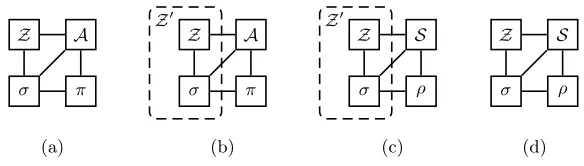
sub-protocolπeach, and a dummy adversaryAσ that only attacksσ itself. (See Figure 1(a).)
Each Ai is “responsible” for messages from one π-instance.
We will construct S∞ as a combination of A
σ and several S-instances, one for each
invoked instance of subprotocol ρ. Similarly to protocol σπ, each Si is responsible for
messages from one ρ-instance in σρ. (See Figure 1(b).) Since each S-instance by as-sumption simulates attacks performed on one π-instance, while running together with oneρ-instance, this intuitively achieves thatS∞ simulates attacks onmany π-instances, while running together with many ρ-instances.
12Even if π emulates ρ, the protocols might be distinguishable by an unbounded machine. Then an
Now the only difference betweenσπandσρis precisely that inσπ, allρ-instances ofσρ
have been replaced withπ-instances. Hence,S∞ simulates attacks on σπ, while actually
running withσρ. To formally show that this holds, we have toreduce the fact thatS∞ is a good simulator to our assumption, namely the fact thatS is a good simulator.
To this end, let us assume thatS∞ is not a good simulator, i.e., that there exists an environmentZ such that
EXECσπ,A,Z 6≈EXECρ,S∞,Z. (3)
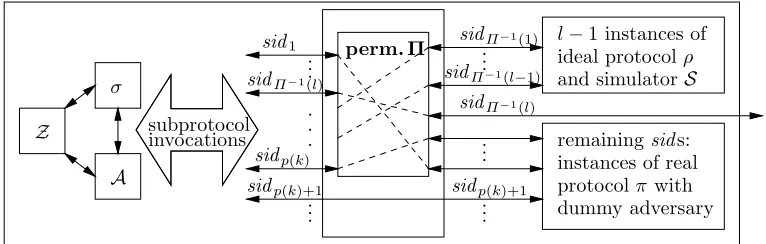
We apply a hybrid argument. Namely, consider the hybrid network Hl which is a “mix”
of real and ideal network in the following sense. Hl consists of Z and σ, where the first
l of σ’s subprotocol invocations are connected to an instance of ρ (with simulator Si),
and the remaining subprotocol instances are connected to an instance ofπ(with dummy adversaryAi). The situation is depicted in Figure 1(c). In this notation, (3) is equivalent
to
EXECH0 6≈EXECHp(k),
where p(k) is the number of subprotocol instances that σ invokes. A hybrid argument shows that there is an indexl=l(k) such that
EXECHl 6≈EXECHl+1. (4)
Informally, this means that “changing one subprotocol instance from π to ρ makes a difference.” However, our assumption that π emulates ρ guarantees that changing a single subprotocol instance fromπ to ρ does not make a difference. All that remains is to formalize this contradiction.
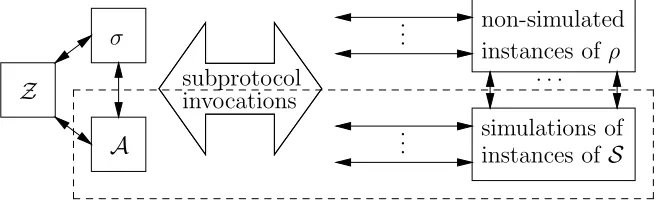
We thus build an environment Zl∗ that encompasses the whole hybrid networkHl,
only without the (l+ 1)-th subprotocol instance (the part of Figure 1(c) enclosed by a dashed line). Hence, running Zl∗ with π and A yields an execution of Hl, and running
Zl∗ withρand Syields an execution of Hl+1. Our assumption (1) onS hence guarantees
that
EXECHl = EXECπ,A,Z∗
l ≈EXECρ,S,Z
∗
l = EXECHl+1,
which contradicts (4). Hence (3) cannot hold, which means that we have proved our goal (2).
Finally, we also have to prove that our constructed simulator S∞ is allowed in the sense that S∞ is time as required by Definition 1. For a priori polynomial-time notions this is usually easy to verify, since the combination of polynomially many polynomial-time machines always yields a polynomial-time machine.
3 Difficulties with prior notions
π1 A1
π2 A2
b
b
b
πsid Asid
b
b
b
πf(k) Af(k)
m σ
Aσ
Z (
sid,m)
(a)
ρ1 S1
ρ2 S2
b
b
b
ρsid Ssid
b
b
b
ρf(k) Sf(k)
m σ
Aσ
Z (
sid,m)
(b)
ρ1 S1
b
b
b
ρl Sl
πl+1 Al+1
πl+2 Al+2
b
b
b
πf(k) Af(k)
σ
Aσ
Z
(c)
Fig. 1. Relevant networks for the proof of Theorem 3. (a) depicts environment Z, run-ning with protocol σπ and dummy adversary A. For presentation, A is split up into
dummy adversaries Aσ and Ai for protocol σ and all respective π-instances. (b)
illus-trates Z running together with σρ and the simulatorS∞ constructed during the proof. For presentation, S∞ is split up into adversaries Aσ and Si for σ and the respective
[Can05a]. However, we stress that we simply chose this example since [Can05a] is the most well-known and popular model. E.g., in the Reactive Simulatability (RSIM) frame-work [BPW04b] the issue is solved using so-called length-functions which are also known to lead to difficulties (see, e.g., [HMQU05]).
Network model. We first sketch very roughly how polynomial time is modeled in [Can05a]. Our description is far from complete but it should be sufficient to understand the examples below. The ITMs in a network are arranged in a hierarchy of invocation. The top level contains the environmentZ. The second level contains the machines directly invoked by Z, namely the adversary (or simulator) and the protocol machines. Further levels might include subroutines of the protocol machines (these subroutines may, e.g., result from the composition, in this case they are the ITMs comprising the subprotocol). Finally, the lowest level will usually contain the functionalities, which are modeled as subroutines shared by different ITMs. There are two kinds of communication in the network. We have vertical communication between a machine and its subroutines, called subroutine input and subroutine output. And we have horizontal communication between different machines, which represents messages sent over the network. Commonly, these messages will be sent between machines on the same level or between machines on any level and the adversary. The adversary communicates with the environment using vertical communication (since protocol and adversary are considered subroutines of the environment), and with protocol machines using horizontal communication (since this represents communication over the network). The auxiliary input of Z is considered a subroutine input forZ.
Polynomial time definition. In this setting, we model polynomial time by requiring the following property of any ITM in the network (cf. Definition 3 in [Can05a] for details and motivation):
Definition 4 (Canetti-PPT). An ITM M is PPT in the sense of [Can05a] (short: Canetti-PPT) if and only ifM runs in time which is polynomial inn:=k+nI−nO−k·nN.
(That is, there is a fixed polynomial p such that the number of M’s computational steps taken so far never exceeds p(n).) Here k is the security parameter, nI the total length
of the subroutine inputs received from a higher level, nO the total length of subroutine
outputs passed to a lower level, andnN the number of ITMs that M communicates with.
Note that we will always have nI≤nO (since otherwisen <0), i.e., we cannot send
longer inputs to subroutines than we get from a higher level. This is why it is necessary thatZ gets some initial subroutine input, namely the auxiliary input.
like to use to implementF. Although an explicit treatment of this padding can be cum-bersome in some cases, it at least allows to write protocols without an a-priori bound on their runtime.
However, an example for a protocol where the use of padding meets its limits is the case of the database functionalityDdescribed in Section 1. This functionality represents a publicly available centralized database. The functionality D accepts queries of the form (store,key,data) and (retrieve,key). Uponretrieve, thedata previously stored with keyis returned. As a functionality, this machine is Canetti-PPT even without any padding (it does not invoke subroutines, sonO= 0, and thus the functionality is allowed
to run in polynomial time in the total length of the queries).
However, even simple protocol machines thatusethe databaseDmay not be polynomial-time any more. For instance, consider a party P1 that wants to copy the entry stored
at key1 to key2. With the current specification of the database functionality, this is only possible by retrieving the data data stored at key1 and then storing data under key key2. However, to do so, P1 needs to runΩ(|data|) steps. Thus theinput (e.g., from the
protocol environmentZ) ofP1 needs a padding whose length is dependent onl:=|data|.
For one, this lengthl might not be known in advance (it depends on the inputs of other protocol parties), so it is unclear how to specify the length of the padding P1 expects.
It seems possible to interactively let P1 ask its own environment for a suitably long
padding depending on the size l of the database entry. However, these solutions are (seemingly unnecessarily) cumbersome and might make the analysis more complicated.
Furthermore, even if we would model P1 to have an interactive protocol interface that,
e.g., first requests additional padding of sufficient length and then copies the data, this might have implications on the simulatability of the protocol: in some cases, whether and to what extent the database is used might have to be hidden from the environment; for example, if in the real and the ideal model, a different number of queries to the database is performed by some larger protocol.
Dummy adversary and composition. A very instructive case is the question whether the dummy adversary is complete. Intuitively, the dummy adversary is an ad-versary that simply does what it is told by the environment and forwards all messages received from the protocol to the environment. By completeness of the dummy adversary we mean that it is sufficient to consider only the dummy adversary as a real adversary
A in the UC security definition Definition 1. (See Section 6 for a detailed exposition.) Validity13 and completeness of such a dummy adversary is crucial for the proof of the Universal Composition Theorem. Unfortunately, a machine as in Definition 12 that just forwards messages in both directions is not Canetti-PPT (i.e., it is not valid) since it may have to forward messages that come from the protocol, i.e., via horizontal communica-tion. In order to handle this problem, [Can05a] proposes to define the dummy adversary
˜
Aas follows:
13We say that an adversaryAis valid ifAis considered in the (UC) security definition, i.e., ifAis in
– When asked by the environmentZto send a messagemto the protocol, that message
m is sent. (SinceA is a subroutine ofZ, this is permitted.)
– When receiving a message mfrom the protocol, the adversary ˜A first sendsl:=|m|
to Z. If it then receives 1l fromZ, it sends mto Z.
This definition now allows to forward arbitrary messages, however, it raises the following difficulties: First, it is very sensitive to the machine and network model. In particular, for ˜A to compute l =|m|, it is necessary that messages are always prefixed with their length (otherwise ˜Awill take timeΩ(l) for measuringl). Further, it is necessary thatm
is still accessible when 1l is received from the environment, although ˜Adid not have the
runtime to copymto some working tape. However, assuming a suitable machine model, these problems are easily solvable. More problematic is the second difficulty: The dummy adversary is not complete, i.e., security with respect to the dummy adversary does not imply security with respect to arbitrary Canetti-PPT adversaries.14Note that this poses a problem for two reasons: First, the dummy adversary is a very useful construct when proving the security of concrete protocols, allowing to consider only a single adversary, and second, the proof of the Universal Composition Theorem in [Can05a] uses the dummy adversary in an integral way (however, we do not know whether only the proof or the theorem itself is invalidated).
To see that the dummy adversary from [Can05a] is really not complete (in contrad-ication to [Can05a, Claim 10]), assume a function f with the following property: We have |f(t, x)|=|x|, and f(t, x) can be computed in time polynomial in t+|x|, but for any polynomialp, there is a polynomial ˜psuch thatf(˜p(k), x) cannot be computed prob-abilistically in time p(k) given a uniformly chosen x ∈ {0,1}k. (more exactly, in time
p(k), the probability of guessingf(˜p(k), x) is negligible). A candidate for such a function would be, e.g., applying some suitable hash functiont-times tox.
We then define the protocolπto expect a message (1t, x) with|x|,2t≤kfromZ and then to send (1t, f(t, x)) to the adversary.15 Further, we define the protocolρ to expect a message (1t, x) with |x|,2t ≤k from Z and then to send (t, x) to the adversary. Note
that bothπ and ρ are Canetti-PPT.
First, we show thatπ emulatesρ with respect to the dummy adversary. The dummy adversary first sends the number t+|f(t, x)| = t+|x| to the environment and only when receiving 1t+|x|, it sends (1t, f(t, x)) to the environment. Thus the corresponding simulator also sendst+|x| to the environment, and when receiving 1t+|x|, it computes
f(t, x) and sends (1t, f(t, x)) to the environment. The simulator is Canetti-PPT since computingf(t, x) and sending (1t, f(t, x)) takes time polynomial in the length of 1t+|x|.
Now, we show that π does not emulate ρ with respect to arbitrary Canetti-PPT adversaries. For a polynomial ˜p, let Zp˜ be an environment that chooses a random x ∈ {0,1}k and sends (1p˜(k), x) to the protocol. LetA be an adversary, that upon receipt of (1t, f(t, x)) forwardsf(t, x) to the environment. Now a suitable simulator has to compute
14This contradicts Claim 10 on page 45 of [Can05a]. The mistake in their proof was the assumption that
the simulatorS constructed there is always Canetti-PPT.
15Depending on the exact machine model, we might also send 1t and
f(t, x) from (t, x). Since the simulator has a fixed runtime polynomialp, there is a ˜psuch that f(˜p(k), x) cannot be computed in timep(k). Thus, in an interaction withZp˜, that
simulator will returnf(t, x) =f(˜p(k), x) only with negligible probability, allowing Z to distinguish real and ideal model. Thusπ does not emulate ρ.
Dummy parties. A useful construct in UC-like security definitions is that of a dummy party. Such a dummy-party is used when considering a single ideal functionality as the protocol, for each player we then introduce a dummy-party that forwards the messages between the functionality and the environment. These parties are very useful, e.g., for modeling corruptions (in particular in the adaptive case) in the ideal model. (In [Can05a] such dummy-parties are introduced on page 51 under the caption “Ideal protocols”.) However, since dummy-parties have to forward messages from the functionality to the environment, they are not Canetti-PPT. An interactive padding convention would have to be introduced similar to those used with the dummy adversary, but in this case the same padding convention would have to be followed by the parties in the real protocol since otherwise the environment could trivially distinguish the real and the ideal model.
Summary. We want to stress again that the problems mentioned in this section do not compromise the essence of the results of [Can05a]. E.g., probably no “reasonable” cryptographic protocol will fail to compose because of quirks in the modeling of polyno-mial time; most results in the UC setting are robust with respect to the details of the modeling. However, to put these results on exact and rigorous foundations, it is necessary to develop a model of polynomial time that does not lead to any formal inconsistencies.
4 Our definition of polynomial runtime
In order to define a computational security notion, we first have to fix a definition of polynomial time. Classically, an ITM is considered to be polynomial-time if it runs in polynomial time in the security parameter. This notion we will call a priori polynomial time:
Definition 5 (A priori polynomial time). An ITMM runs in a priori polynomial timeif there is a polynomialpsuch that for any sequence of incoming messages, M runs at most p(k) steps with probability 1 upon security parameter k.
However, as seen in the introduction, this definition is far from being flexible enough. Many protocols that are intuitively considered to be polynomial-time are rejected by this definition, e.g., a secure channel functionality or a database. Investigating these examples, we see that what we intuitively expect from a polynomial-time protocol is that when the protocol is used in an a priori polynomial-time context, the whole system still runs in polynomial time. For example, although a channel is not a priori polynomial-time (cf. Section 1.4), a channel can be implemented in polynomial polynomial-time if the messages sent through it are generated by a a priori polynomial time machine.
To capture even more protocols, we can slightly relax the condition, and only require that the whole system runs in polynomial time with overwhelming probability.16 The
resulting notion is maybe the weakest notion of polynomial time that still makes sense. Any weaker definition would allow for protocols that interact with an a priori polynomial environment and run a superpolynomial number of steps with non-negligible probability. We call this notion reactive polynomial time, and it is formalised by the following two definitions.
Definition 6 (Polynomial time with overwhelming probability). An executable systemSof ITMs runs inpolynomial time with overwhelming probability(short: polynomial-time w.o.p.) if there is a polynomial p and a negligible function µ such that for all
k∈N, z∈ {0,1}
∗ we have TIME
S(k, z)> p(k) with probability at most µ(k).
Definition 7 (Reactive polynomial time). A system S of ITMs runs in reactive polynomial timeif for any a priori polynomial-time ITM Z the systemS∪ {Z} runs in polynomial time with overwhelming probability.
We remark that in this definition, S can impersonate any machine that the machines in S could ever run with (cf. footnote 9). For example, if S is a protocol and does not contain an adversary, then Z also controls messages that are sent over the (insecure) network (by impersonating the adversary). And ifS already contains an adversary, then
Z can only control the protocol inputs and outputs. In particular, Definition 7 makes sense both for protocolsS without adversary, and systemsSthat include a protocoland an adversary.
Is the notion too permissive? At a first glance, this notion might seem too weak. One might argue that the system S is allowed a running time k2c, where kc is the running time ofZ for some constantc. It might seem that such constructions lead to too powerful a systemS of possibly exponential runtime. However, this is not the case, since our definition guarantees that the overall network, and thus in particular S, will always run in polynomial time ink (Lemma 9 below). The seeming power only stems from the fact that the polynomial that bounds the running time may depend onZ, thus there is no polynomialpindependent ofZ such thatS runs in polynomial time inp(k+t) where
tis the running time of Z.
We remark that this absence of a uniform polynomial boundp reflects the modeling of existing notions of zero-knowledge and simulatability. For example, in [Gol01], the definition of (non black-box) zero-knowledge is—roughly—formulated as follows: for any polynomial-time verifier there is a polynomial-time simulator such that the verifier’s and the simulator’s output is indistinguishable. In particular, the running time of the simulator does not have to be polynomially bounded in the running time of the verifier. Instead, it is only required that if the verifier runs in polynomial time, so does the simulator. In particular, the simulator might run, e.g.,tlogktsteps17wheretis the running
time of the (simulated) verifier andkthe length of the common inputx. This is analogous to our modeling if we identify the verifier’s runtime with that ofZ and the length of the common input with the security parameter.
However, if a uniform bound on the running time of S is needed, it is possible to strengthen the notion in a way that disallows anarbitrary dependency onZ’s complexity. Namely, a stricter definition, calleduniform reactive polynomial time, is also conceivable: The runtime of S has to be bounded by p(k+q) w.o.p. where q is the runtime of Z
andpis a polynomialindependent of Z.(In contrast, Definition 7 allowspto depend on
Z.) Indeed, uniform reactive polynomial time is as suitable a notion of polynomial time as reactive polynomial time, and we show in Section 9.2 that the results of this paper also hold for that notion. We have chosen Definition 7 as our main notion because— although this may not be obvious at a first glance—it better reflects how polynomial-time is classically modeled in cryptography. We want to stress however, that this is just a design choice and that we prove all our results for both notions.
Why allow a negligible error? In Definition 7 we have introduced the notion of a reactively polynomial networkSroughly as follows: For any ITMZ, the networkS∪{Z}
is polynomial w.o.p. However, the reader might question whether the additional gener-ality of allowing networks that run in superpolynomial time with negligible probability is not offset by the added complexity. Instead, we could require S∪ {Z} to be a pri-ori polynomial; the resulting notion we call strong reactive polynomial time. Replacing reactive polynomial time by strong reactive polynomial time in Definition 8, we get a seemingly simpler security definition. Unfortunately, it can be shown that the resulting security definition does not fulfil the Universal Composition Theorem (Theorem 16). See Section 9.1 for additional details and proofs.
Security notion. Equipped with the notion of reactive polynomial time, we can now look for a variant of the UC notion that can handle arbitrary reactively polynomial protocols (i.e., we want that all the usual properties like the composition theorem hold for reactively polynomial protocols). To design such a UC variant, we first have to specify what machines should be considered valid adversaries and simulators. With classical notions, a valid adversary/simulator would run in a priori polynomial time. However, this is not sufficient in our context, since in this case the adversary/simulator might have to terminate before the protocol. In this case the real protocol might continue to work without adversary, whereas the ideal protocol might rely on a simulator, making a successful simulation impossible (examples for such ideal protocol tasks are the public-key encryption functionalityFPKE and the signature functionalityFSIG, cf. [Can01]). Hence,
such that the real and the ideal protocol can be distinguished within timep. Combining these observations into a single definition, we propose the following variant of the UC definition that can handle reactively polynomial protocols:
Definition 8 (UC with respect to reactive polynomial time). We say an ITM
M is valid for π (or ρ) if π∪ {M} (orρ∪ {M}) runs in reactive polynomial time. Then π emulates ρ (with respect to reactive polynomial time) if for any ITM A
that is valid for π, there is an ITM S that is valid for ρ such that for every a priori polynomial-time ITM Z the following families of random variables are computationally indistinguishable:
n
EXECπ,A,Z(k, z)
o
k∈N,z∈{0,1}
∗ and
n
EXECρ,S,Z(k, z)
o
k∈N,z∈{0,1} ∗
In the following, we will simply say “UC” and “emulate” instead of “UC/emulate with respect to reactive polynomial time”.
Note that there might be other possibilities how to model a UC definition that can handle reactively polynomial protocols (e.g., one could define that an adversary A is valid if for all reactively polynomial protocols π, the network π ∪ {A} is reactively polynomial). However, all other variants the authors have considered seem to break at least one of the properties that we minimally expect from a viable UC variant (i.e., the composition theorem holds, the relation is transitive and reflexive, and no networks running in superpolynomial time with non-negligible probability occur).
Note further that we only claim that our security definition makes sense when consid-ering reactively polynomial protocols. If we apply the definition to unbounded protocols, unexpected effects may occur (e.g., the set of valid adversaries may be empty).
Why not allow a negligible error for the runtime bounds of the protocol context? Given that it is essential to allow a negligible error for the runtime bounds of protocol and adversary, the question arises why the runtime bound for the protocol contextZ in Definition 8 has to hold with probability 1 (by Definition 5). Alternatively, one could allow environments Z that run in polynomial time only with overwhelming probability. We do not pursue this variation further because it leads to an equivalent Definition 8: Any Z that runs in a priori polynomial-time except with negligible proba-bility µ(k) can be substituted with an a priori polynomial-timeZ0 that behaves like Z, except with probability µ(k). Hence Z0 distinguishes real and ideal protocol whenever
Z does.
Similarly, one might allowZto run in a posteriori polynomial time (see page 5). This would lead to an equivalent Definition 8, too, by an argument analogous to that given in footnote 3.
And if we instead quantify over environments Z that are APPT-BC (cf. page 6), then we might loosecompletenessas no guarantees can be made about the running time of Z when running withπ∪ {A}or ρ∪ {S}(since these networks are not necessarily a priori polynomial time).