Available online: https://journals.pen2print.org/index.php/ijr/ P a g e | 545
High secured E-Voting System
K .N V P S B Ramesh , Vasideddy narasimham , T V L Srinivas
Asst. Professsor,Dept. of CSE , BVC Engineering College ,Odalarevu
Abstract:
In any developing country democracy plays an important role where a leader for a country is elected by the citizen. One of the main issues in the conventional voting system is that it consumes lots of man-power as well as resources and the preparation have been started many days before the commencement of the election. During this preparation some people may involve in illegal arrangement with each other or try to replace with their henchmen in this process to win the election. It is a confidential process so it must be transparent, Meddle-Proof, Usable, Authenticated, Accurate, Verifiability and Mobility. There are some drawbacks in conventional voting system such as damage of machines, chances of violence, dummy voting and problem of proper monitoring. Manual voting system has been followed in many parts of our country so people could not poll their vote because it is place oriented and there is region wise distribution, voters need to reach the place of voting. To overcome these problems a new confidential E-Voting system is introduced which provides security to the election system by detection and recognising voter’s face who is going to cast his/her vote. In this system the voter’s face is detected, captured and stored in the database then match the captured image with the image already stored on database to recognise the person. If match occurs then the person is allow to cast their vote once the vote is casted the same person will not be permitted to cast votes this provide security against duplicate vote and fraudulent and make the system more efficient and user friendly.
Keywords — Accurate, Authentication, Eigen
face , Viola Jones algorithm.
I. Introduction
Emphasize Biometric detection and recognition suggests chronic recognition of a people in light of a Highlight vector(s) gotten from their physiological or potentially behavioural trademark. Biometric recognition frameworks ought to give a solid individual acknowledgment plans to either confirm or to decide the character of a person. Uses of such a framework incorporate PC Frameworks security, secure electronic keeping money, cell phones, credit cards, secure access to Structures, wellbeing and social administrations. By utilizing biometrics a man could be distinguished based on "who she/he is" somewhat then "what she/he has" (card, token, scratch) or she/he knows"(secret key, Stick). This proposed system we construct a secure biometric system for E-Voting using face detection and recognition. Here we used two algorithms for face detection and recognition namely (viola Jones and Eigen face).
A. Face Detection Algorithm
Face detection is one of the most difficult and demanding crisis in the pasture of computer revelation, owing to the huge differences produced by the difference in the facial advent, illumination, and facial expression. So that the division of each part of the face looks to be extremely nonlinear and difficult in
any space which is direct to the first picture space. In the constant applications like reconnaissance and biometric, the camera restrictions and posture varieties make the appropriation of human faces in highlight space more
entangled than that of frontal countenances. It additionally confounds the issue of strong face discovery.
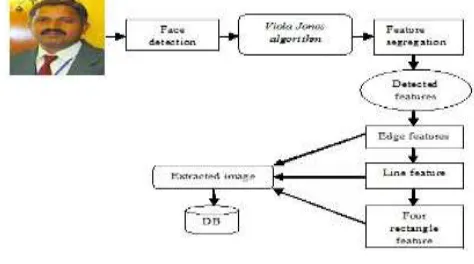
Fig 1. Face Detection Process
Available online: https://journals.pen2print.org/index.php/ijr/ P a g e | 546
Calculation Viola and Jones' calculation is utilized as the premise of our outline. Probably aware there is a few similitude’s in every single human face, we utilized this idea as a Haar highlight to recognize confront in picture. Haar like element which is utilized to recognize human face from the picture and spare it as the primary coordinating point. We actualize calculation to perceive the prepared pictures put away in the database. The objective is to execute the framework display for a specific face and recognize it from an expansive number of put away faces with some recent varieties too. It gives us effective approach to discover the lower dimensional space. Picking the limit esteem is an extremely huge element for execution of face distinguishing proof in this approach. Other than that, the dimensional diminishment of face space endless supply of confronts taken. In this exploration paper, an improved answer for face acknowledgment is given by taking the upgraded estimation of limit esteem and number of countenances.
B.Face Recognition Algorithm
The human face is an amazingly perplexing and dynamic structure with attributes that can rapidly and altogether change with time. It is the essential concentration of consideration in social connections and assumes a noteworthy part in the transmission of character and feelings. Subsequently, confront acknowledgment is connected in numerous essential regions, for example, security frameworks, distinguishing proof of culprits, and confirmation of charge cards et cetera. Shockingly, many face highlights make improvement of facial acknowledgment frameworks troublesome. This issue is tackled by the technique called Essential Part Examination. PCA is a projection method that finds an arrangement of projection vectors planned with the end goal that the anticipated information holds the most data about the first information. The most illustrative vectors are eigenvectors comparing to most noteworthy Eigen estimations of the covariance lattice. This technique lessens the dimensionality of information space by anticipating information from M-dimensional space to P-M-dimensional space, where P and M. One of the least complex and best PCA approaches utilized as a part of face acknowledgment frameworks is the purported Eigen confront approach. This approach changes face into a little arrangement of fundamental qualities, Eigenfaces, which are the primary segments of the underlying arrangement of learning pictures (preparing set). Acknowledgment is finished by anticipating another picture in the Eigen confront subspace, after which the individual is ordered by looking at its position in Eigen confront space with the position of known people. The benefit of this approach over other face acknowledgment frameworks is in its straightforwardness, speed and heartlessness to little or continuous changes on the face. The issue is constrained to records that can be utilized to perceive the face. In particular, the pictures must be vertical frontal perspectives of human countenances. The plan depends on a data hypothesis technique that breaks down face pictures turn into a moment set of trademark highlight pictures are called Eigen faces, which are in reality the chief parts of the essential preparing set of face pictures.
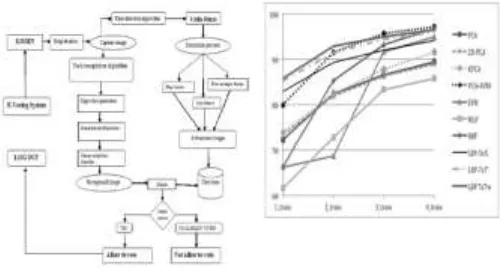
Fig 2. Face recognition process
The Eigen confront strategy is a standout amongst the most effective and easiest methodologies in building up a framework for Face Acknowledgment. The acknowledgment is performed by anticipating new picture into the subspace reached out by the Eigen confronts ("confront space‟) and after that arranging the face by differentiating its position into the face space with the places of the distinguished people In Eigen confront strategy, the separation is measured between couples of pictures for acknowledgment after the dimensional decrease of the face space. On the off chance that the separation is not as much as specific limit esteem, then it is considered as a distinguished face else it is a unidentified face. In the figure, we have two arrangements of picture pieces preparing set picture square and test set picture piece. In preparing set picture square, right off the bat the Eigen face of picture in the database (prepared picture) is acquired. At that point the weight W1 is figured by utilizing the Eigen confronts and the preparation set. In the testing set picture square, input obscure picture X which is the caught picture is taken. The weight W2 is figured utilizing the info picture and the Eigen confront. Estimation of D is figured by finding the normal of separations amongst W1 and W2.
II. LITERATURE REVIEW
Firas.I.Hazzaa et.al [12] proposed a “Web Based Voting
System Using Fingerprint Design and Implementation”, to
facilitate enhanced performance with more secure voting system and also implement web technology to compose the voting system more useful. The projected EVS permits the electorate to scrutinize their fingerprint that is coordinated with the existing copy stored in the database. This Web-based Voting System using Fingerprint identification and provide acompetent way to transmit votes, liberated deception and construct the scheme highly reliable, financial and rapid and also use Minutiae-based fingerprint recognition and related with higher precision.
Available online: https://journals.pen2print.org/index.php/ijr/ P a g e | 548
the forward votes to client server and send the encoding votes to voting server through internet and decode the vote prior to computation of votes. Asymmetric key are used to afford protection from active interloper who can change vote that is casted while it is transferred from client server to voting server, for this purpose to avoid fraudulent digital signature is used during casting of vote and the digital signature is verified on the server side with the accurate digital signature of the electorate that is known openly. For this reason each and every electorate must have their personal digital signature and a communal digital signature identifier. This is a long term process which increases time and cost complexity.
Patilrahul et.al [7] suggest a system for E-Voting using face detection and finger print recognition which uses various algorithms and techniques such as Eigen face, AES, and besian classifier for providing highly reliable and secure system of voting. In this system the voting is done by identifying the face image and finger prints of the electorate who is going to cast their votes. The electorate information are verified by capturing the face image through web camera along with finger print and the electorate is allow to cast their vote after checking the details with database information. The votes are stored and later the result is declared.
Neha Gandhi [13] designs a secure online voting system using biometrics and stenography to give biometric security as well as password security to electorate account. In this model a secret key is used along with voter image as key image to produce a new image to perform electorate authentication and to minimize risk factors such as hacking. It also provides protection against fraudulent behaviours. The main drawback is that process of encoding the image along with key is a long term process. Ratnaprabha et.al [11] build an E-/voting system using “Auduino Software” to capture the face and finger print of an individual and match the finger print and face image to the details in the “Aadhar” which are already stored in database using Lab view and compare the details which are already stored in PC and the casted vote is done but not the accurate result is dispatched. This system just avoids duplication of votes but it is not the robust one.
Priyataneja et.al [9] anticipated an online voting system by face detection. In this system various algorithms such as Gabor filter technique, Eigen face technique, Gold ratio technique and Line Edge Map (LEM) techniques to detect the face of an individual without any noise. This system is embedded with mobile phones and the electorate is permit to cast their votes through their mobile phone at their mobility and convenience. This system obtains information from the database which stores details of the particular voter through Aadhar database. Due to usage of more number of techniques leads to complexity of the system and also the voter should aware of their availability of network they use because the voting is done through their mobile phone these are the main issues in this system. This system uses front camera of the mobile to capture the face of the electorate so the phones without front camera is not suitable for this approach.
Fugatashlesha et.al [8] projected a secure online voting system using face recognition. In this system they propose online voting system use face recognition to secure the system
by capturing the face image and make their shares and compare the shares with the shares already stored in database. If the shares coincides with the previous shares in the database then the person is allow to cast their votes otherwise they are not permitted to cast their votes. There is no transparency and security to the system.
Niranjanmalwade et.al [10] proposed smart voting system with face recognition. In this system the electorate use android applications which are downloaded from internet and the authentication will be done using system configuration and face recognition. The main drawback or issues in this system is that it can be used only in android mobiles i.e., this system is applicable only for android platform.
III. Existing System
Current voting system is the conventional voting system built on ballot machine where the voter are allow to cast their vote by pressing the button along with the symbol on the voting machine. So there arise some security risks that the person may cast their votes more than one time, fraudulent, breakage of the system, theft may happen. In this conventional system ballot begin before a week and the voters are go to the polling booth to cast their vote. In order to provide security huge manpower is required to avoid mal practices, to avoid such security issues and malpractices a new E-voting system have been introduced using biometric technology which use face detection and recognition to cast their vote on their place without moving to polling booth they can cast their votes through online. By using face as their identity which avoid the security issues on conventional system.
IV.Proposed System
In this proposed system we generate an idea of E-voting system using biometrics face detection and recognition. In this system two algorithms have been use for face recognition and detection such as viola Jones and Eigen face algorithms.
Fig 3. System Architecture
Available online: https://journals.pen2print.org/index.php/ijr/ P a g e | 549
or coincides with the face in the database the voter is allow to
declare their votes to the candidate whom they wished to elect otherwise the voter is not allow to elect their leader by voting. By this way we can avoid the duplication of votes and frauds and also this can avoid malpractice and minimize the time taken to cast the vote by moving to the polling booth.
V. Result and Discussion
The investigational consequences are proved in this paper to confirm the feasibility of the suggested face recognition technique. Also only 15% of Eigen faces with the largest Eigen values are adequate for the recognition of a person. The best optimized solution for face recognition is provided when both the features are combined i.e. 15% of Eigen faces with largest Eigen values are chosen and threshold value is chosen 0.8 times maximum of minimum the Euclidean distances from all other images of each image, it will wholly improve the recognition performance of the human face up to 97%.
VI. Conclusion
Several online voting system and methods are studied related to E-Voting using biometrics. From the study we proposed a secure Electronic voting system using biometrics technique with face detection and recognition. This provide robust and reliable user friendly encoded secure system for E-Voting which allow the recognized voter to cast their votes through mobile phone as well as through PC connected in network. Here Eigen face algorithm and viola jones are suggested to provide highly secured, more reliable and robust E-Voting System. It also improves efficiency of the system and to provide user friendly environment for voters to cast their valuable votes.
VII. Acknowledgement
Here I would like to express my appreciation to Prof.Dr.V.palanisamy for his guidance during the research work without his valuable assistance this research work cannot be completed. I am also indeed to the college where I carried out my research at Alagappa University in the department of computer science and engineering Principal and staff for their support cooperation. Finally I would thank my management for the valuable assistance during the course of my study.
References
[1]. Pandit, Varad, Prathamesh Majgaonkar, Pratik Meher, Shashank Sapaliga, and Sachin Bojewar. "Intelligent security lock." In Trends in Electronics and Informatics (ICEI), 2017 International Conference on, pp. 713-716. IEEE, 2017.
[2]. Chauhan, C. U., Abhishek Kalnawat, Akshay Aswale, Ujwal Gautam, and Roshan Nemad. "Survey Paper on a Novel Approach: Web Based Technique for Vote Casting." International Journal of Engineering and Management Research (IJEMR) 7, no. 5 (2017): 71GER, BARRY. "CONTENTIOUS POLITICS AND URBAN DESIGN: TOWARD A NEW ARCHITECTURAL THEORY." International Journal of Architecture and Urban Studies (2017): 18
[3]. Sundaram, Ravi. "The Postcolonial City in India. From Planning to Information?." Techniques & Culture. Revue semestrielle d’anthropologie des techniques (2017).
[4]. 6. Ahonen T, Hadid A, Pietika¨inen M, ‗‘Face recognition with local binary patternsǁ. In Proceeding of European conference on computer vision (ECCV2004), LNCS 3021, pp 469–481,2004
[5]. 7. Patil rahul.H, Tarte babita.B, Wadekar sapana.S, Zurunge Bakti.S, Prof .Phursule Rajesh, “A Secure E-Voting System Using Face Recognition And Dactylogram”, International Engineering Research Journal (IERJ), Vol. 2, Issue .2,pp. 758-762, 2016,ISSN 2395-1621.
[6]. 8. Fugatashlesha, Gaikward Shital,Gangurde
jyoti,swaaishwarya,“Secured Online Voting System Using Face Recognition”, Internatonal Journal of Advanced Research In Science Management And Technology, Vol.2, Issue.6,Jun 2016.
[7]. 9. Priya taneja, Rajender kumar trivaedi, Rajani Sharma,“A
[8]. Proposed Method Of Online Voting By Face
[9]. 10. Warghade, Shrikant Subhash, and B. Karthikeyan. "Voting System for India." In Intelligent Embedded Systems, pp. 59-65. Springer, Singapore, 2018.
[10]. 11. Shah, Syed Afaq Ali, Uzair Nadeem, Mohammed Bennamoun, Ferdous Sohel, and Roberto Togneri. "Efficient image set classification using linear regression based image reconstruction." arXiv preprint arXiv:1701.02485 (2017).
[11]. 12. Bhimanwar, Chinmay, Rupesh Biradar, Nikhil Bhole, and Milind Rane. "Face Identification." International Journal of Engineering Science 11923 (2017).