Available online: https://edupediapublications.org/journals/index.php/IJR/ P a g e | 456
Phase-change materials (PCM) for automotive applications
Sampath kumar.T
M.TECH(Part-time) Thermal Engineering, Prist University, Vallam, Thanjavur
Abstract
In this paper, an extensive review of battery thermal management systems (BTMSs) such as phase-change materials (PCMs) in the state of art is proposed. Nowadays, PCMs are particularly attractive and chosen as one of the most interesting cooling system in terms of high-energy storage density. In addition, they are less bulky, complex and expensive than traditional cooling methods such as forced-air cooling or liquid cooling. Nonetheless, the integration of PCMs in a battery application calls for an analysis that will enable the researcher to proposed optimized BTMSs. Indeed, due to the lack of literature in this domain, the paper proposed to review all the
existing studies on battery applications
involving PCMs. Numerical analysis
description, heat transfer theory along with the classification of the existing components for PCMs are also presented. This paper is based on previous reviews to help to update the thin number of references, which is considered by the authors as the major contribution.
Keywords: Phase-change material, automotive application, cooling system, battery system.
1. Introduction
Dwindling natural resources and global climate change are currently two of the most important challenges in the world. They drastically our way of living, thinking and working to make more eco-friendly changes. In this regard, fingers have been pointed toward automobile manufacturers because the current way of transport with the internal combustion engine (ICE) has to innovate
even more related to a clean environment [1]. Thus, under the pressure of energy short age and environment pollution, hybrid vehicles (HEVs) and electric vehicles (EVs) have emerged as the first step and make nowadays the transition possible to the fully electrification of the automotive sector in the future [2, 3, 4, 5]. However, EVs and HEVs meet today still some restrictions related to autonomy [6], price [7], charge time [8] , local charge possibilities [9], lifetime battery [10], comfort aspects related to the cabin [11],... The majority of the problems are related to the battery system, which is the most crucial and expensive component of BEVs [12]. Accordingly, one crucial aspect for market penetration is the improvement of the power performance and lifetime of the battery system. To help the market penetration, large-scale battery system and endurable high-current rate are required to improve the power the energy embedded in EVs HEVs.
Nonetheless, at high-current levels, these batteries produce much heat during operation such as quick ac- celeration, long-discharge cycles or rapid charge [13, 14, 15]. Then, the safety risks, overheating ,and explosions become critical as they increase with the amount of thermal energy contained within the battery or whole system [16, 17]. In a less drastic way, uneven temperature distribute reduces the battery or pack’s cycle life excessively [18, 19]. In brief, the batteries must operate between certain boundaries for optimal performance, lifetime and safety considerations. Therefore, a battery thermal management
Available online: https://edupediapublications.org/journals/index.php/IJR/ P a g e | 457
management system (BMS) needs to be implemented to maintain the
operation temperature of the batteries between those limited boundaries. Depending on the application area and the type of battery, cooling and or heating are is required to work in the right temperature operation range. Two traditional BTMSs have been extensively investigated for automotive applications:
1. Forced air cooling [20, 21, 22, 23]
1. Direct indirect cooling fluid media [20, 24, 25, 26, 27].
Natural air-cooling is always indirect and natural convection is generally not adequate for a sufficient battery cooling [28] This is the reason that a fan is typically used for air cooling to create forced convection. Around the year 2000, preconditioned cabin air is used for heating cooling the HEVs, for example, Honda Insight and Toyota Prius [29]. In 2012, Nissan LEAF owners in Arizona were less enthusiasm for their electric vehicle [30]. The Leaf’s power system relying only on air-cooling was losing battery capacity at a faster rate than advertised. The battery system uses essentially a single fan to distribute heat evenly throughout the interior of the sys-
tem. In severe conditions, (about 50-60✍ C in Arizona), due to the lacking of an optimized thermal management system, the region’s heat is draining the EVs’ battery capacity and the driving range is nearly cut in half.
Fluid cooling with direct contact uses the coolant as media against the surface of the cell. This method is commonly applied when the thermal management has to be more elaborated. However, both methods intro- duce some disadvantages such as a level of complexity for the design because of the additional spaces in the vehicle used by the cooling system (i,e. fans and pumps) [28]. As proposed in this work,
novel thermal management system (TMS) can be achieved by overcoming the disadvantages of the traditional techniques. One of them is passive cooling with phase-change material (PCMs).
PCMs introduce a less complex level of the battery design [28]. Indeed, the cells of the battery system are surrounded by this material and they use latent heat storage to regulate the temperature. Latent heat substances are systems that can capture and release the generated heat during the melting and solidification of the PCMs [31, 32].
Extensive reviews on the application of PCM types have been published by [33, 34, 35, 36, 37, 38]. Nonetheless, it may be mentioned that in the literatures that there are less than few comprehensive reviews on PCMs for battery applications. Therefore, the objective of this paper is to propose an elaborated review of passive cooling heating for battery applications. The paper is built on previous reviews [32, 31, 11, 39] to update the references.
First, in Section 2, it presents the fundamental classification of PCMs with their thermal properties and definitions. Then, it provides in Section 3, considered by the authors as the major contribution, overall review of all the automotive applications that combine PCMs and battery pack with a description of the modeling is- sues regarding PCM in a battery pack. At the end, a synthesis is provided in Section 4 to form a conclusion on these topics.
2. Phase-change materials
2.1. Thermal energy storage system overview
Available online: https://edupediapublications.org/journals/index.php/IJR/ P a g e | 458
This classification, together with some other classification given by Zalba [33] gave good insights on the substances used for TES, as illustrated in Fig.1. According to Abha’s classification, energy storage may be in the form of sensible heat in a liquid or solid medium, as chemical energy or products in a reversible chemical reaction, or as heat of fusion (latent heat).
Figure 1: Classification of thermal energy storage systems and com- parison of the PCM latent heat with various materials [12].
The first class called sensible heat uses the specific heat capacity to store thermal energy. Un- fortunately, because the specific heat capacity of most materials is generally of two orders of magnitude lower than its latent heat, sensible heat storage is obsolete in a thermal management system. In deed, studies compar- ing the sensible heat and latent heat storage have con- clude that a larger storage volume is required employing sensible compared to latent heat [4]. For example, in Morrison and Abdel-Khalik [5], the authors showed that seven times the storage volume of Paraffin 116 Wax is required compared to rock (sensible heat storage element)
Chemical reactions. The second class of TES is the
en- ergy storage in chemical reactions. This class has been investigated by Yan et al. [6]. They gave an interest- ing comparison between the advantages and disadvan- tages of chemical heat storage and the other TES. Ac- cording to them, energy storage through chemical pro- cesses possesses a long-duration potential ability as well as high energy storage density. Unfortunately, the setup is rather bulky and complex because it requires one or two reaction chamber for the di☛erent reactant which is the reason why chemical energy storage has not as yet been used in practical applications.
Latent heat. The last class are phase change
materials. One of the most obvious benefits is the constant tem- perature (for pure substances) at which these processes occur. Phase change typically refers to the solid, liq- uid or gas phases. The energy utilized to change from one to the other phase is referred to as latent energy and many material have been studied as potential phase- change element, they are referred to PCMs. PCMs are of great use to store energy or to control the temperature of an element swings within a specific range. Basically, PCMs absorb heat in an endothermic process when the temperature rises, and changes phase from solid to liq- uid. Hence, PCMs have a great potential for heating and cooling in battery applications [7]. Depending on the targeted application, different initial states of PCMs are selected, namely: liquid-gas, gas, solid-solid and solid-solid-liquid.To illustrate their thermal storage potential Fig. 1 shows the heat store
capacity compared to sensi- ble heat (over 15o C difference).
Available online: https://edupediapublications.org/journals/index.php/IJR/ P a g e | 459
volumetric expansion. The liquid-gas transition is mainly used for heat extrac- tion with heat pipes The solid-gas phase change requires a large amount of latent energy but is not always practical to apply in the application of battery thermal management.
The third class utilizing latent energy storage are the solid-solid TES. Since a solid is defined as a material with a crystalline structure and many crystalline struc- tures exist, it is not di✍cult to
imagine a phase change from one to another structure [45].
The last class of PCM is the solid-liquid PCM, one of the most widely-used latent heat storage system used in many applications [8] specially in automotive application. For this reason, this paper focuses on the review of solid-liquid PCMs as shown in Fig. 2 and they are explained deeply in the next subsection.
2.2. PCM classification
Nowadays, solid-liquid PCMs show the highest po- tential in battery thermal management applications [47, 28]. As it can been seen in Fig. 2, where a classification of PCM is displayed, three main classes of PCMs can be dierentiated: organic, inorganic and eutectic.
Figure 2: Classification of PCMs
2.2.1. Organic PCMs
Organic PCMs can be paeans and non-pagan, the former involves fatty acids, alcohols, ester, glycols, etc [39]. They are rather stable, safe, have a high latent heat of fusion (✕ 180 kJ\kg [12]) and also they are avail- able in large
temperature range (15-45✍ C [10]) which makes them compatible with most construction materials [31]. However, these PCMs are also
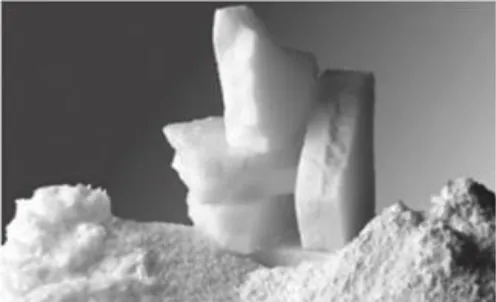
flammable [39], can be toxic and have low thermal conductivity (0.1-0.35 W (m.K) [11]. Examples of organic PCMs are paraffin wax and fatty acid. Fig. 3 shows an organic PCM from Rubitherm Technologies GmbH.
Figure 3: Picture of an organic PCM
Parafinn
Available online: https://edupediapublications.org/journals/index.php/IJR/ P a g e | 460
applications. Nonetheless, parafinn
Inorganic PCMs
Inorganic PCMs are by name composed of inorganic molecules, the typical examples are hydrated salts and metallic PCMs. Inorganic materials have attractive characteristics, not only they propose a wide melting temperature range (5-130 C)[53], they are also therwax has been used in the battery field [48, 49]. In mally safe and have a high latent heat rate[50], Babapoor et al., proposed an organic PCM for Li-ion battery in a battery system on order to uni- form the gradient temperature among the cells. A parafinn-based
was chosen as phase-change mate- rial and the of PCM fiber length was investi- gated. Results showed that using 2-mm long fibers leads to the best thermal performance. Longer fiber lengths cannot reject the in a uniform way. Additionally, in order to show possible enhance- ment of thermal properties of Paraffin wax, Goli et al., demonstrated the combination of the mix- ture between Paraffin and graphene (carbon fibers) [51]. A micro-Raman spectroscopy (Renishaw In- Via) was used for the intercalation of graphene into parafinn matrix, as it is shown in Fig. 4. Exper- imental data showed that the initial parafinn-PCM increased its thermal conductivity by more than two orders of magnitude while preserving its latent heat storage ability. The improvement was done by the mixture of graphene fiber to Paraffin hy- drocarbones which results in a enhanced thermal binding. At the end , the described heat storage systems using Paraffin approach can lead to a inno- vative change in thermal management of Li-ion.
Figure 4: (a) Optical image of the resulting molded disks of the hybrid graphene-PCMcomposite.(b)Correspond scanning
Figure 5: Battery pack design (a) using the copper foam-paraffinn composite.
Since eutectic mixtures are becoming po- tentially innovant PCMs, less than few studies report the use of this blend for automotive applications
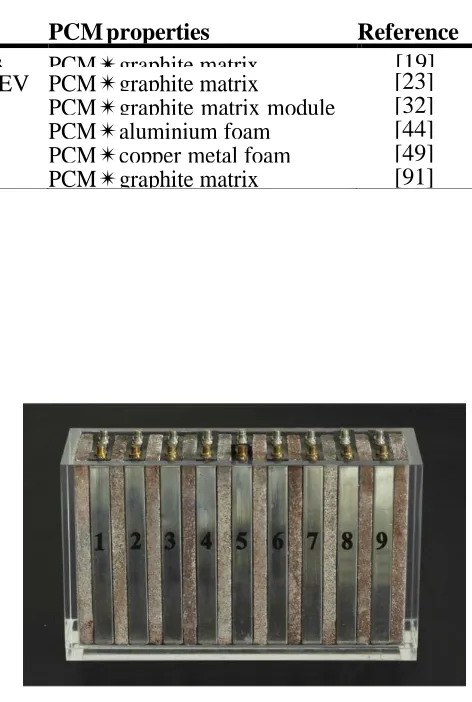
Applications PCM properties Reference
Cylindrical NiMH and rectangular lithium-ion batteries PCM✴graphite matrix [19] For a large lithium-ion battery pack targeting at HEV✴EV
application
PCM✴graphite matrix [23]
PCM✴graphite matrix module [32]
PCM✴aluminium foam [44]
PCM✴copper metal foam [49]
Available online: https://edupediapublications.org/journals/index.php/IJR/ P a g e | 461
Figure 6: Picture of a hydrated salts
Table 3: State-of the-art of PCM cooling systems for batte
ry appl icati ons
.
.
1. High latent heat, high specific heat and high ther- mal conductivity;
2. Melting point in the desired
operating temperature range.;
3. Little or no subcooling during
freezing;.
4. Small volume changes during phase transition;
5. Stability, non-poisonous, non-flammable and non- explosive; Available in large quantities at low cost
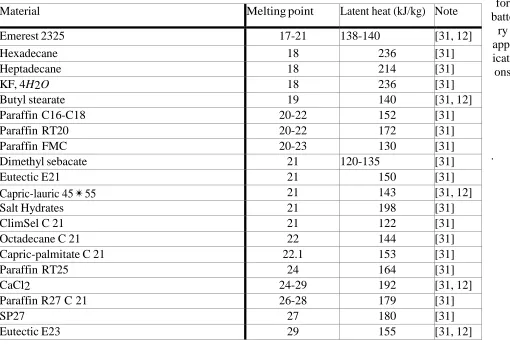
Material Melting point Latent heat (kJ/kg) Note
Emerest 2325 17-21 138-140 [31, 12]
Hexadecane 18 236 [31]
Heptadecane 18 214 [31]
KF, 4H2O 18 236 [31]
Butyl stearate 19 140 [31, 12]
Paraffin C16-C18 20-22 152 [31]
Paraffin RT20 20-22 172 [31]
Paraffin FMC 20-23 130 [31]
Dimethyl sebacate 21 120-135 [31]
Eutectic E21 21 150 [31]
Capric-lauric 45✴55 21 143 [31, 12]
Salt Hydrates 21 198 [31]
ClimSel C 21 21 122 [31]
Octadecane C 21 22 144 [31]
Capric-palmitate C 21 22.1 153 [31]
Paraffin RT25 24 164 [31]
CaCl2 24-29 192 [31, 12]
Paraffin R27 C 21 26-28 179 [31]
SP27 27 180 [31]
Available online: https://edupediapublications.org/journals/index.php/IJR/ P a g e | 462
Figure 7: Battery system prototype with the passive TMS
Figure 8: 18650 Li-ion cells embedded in phase-change composite
4. Conclusion
An extensive review of passive battery thermal man- agement systems in the state of art revealed the impor- tance to control the temperature for large-scale
battery system in HEVs✴EVs. BTMS is very crucial to en- hance the battery operation, indeed, when the temper- ature variable is involved, the premature failure of the battery system (thermal runaways) and possible safety
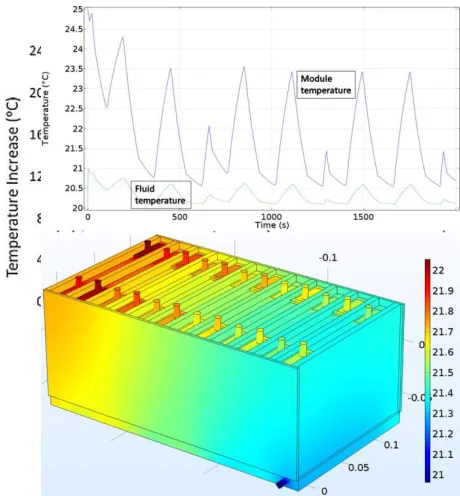
Figure 10: Temperature evolutions of the module and the water- cooling liquid with the associated 3D representation
Figure 9: Geometry representation of the cooling plate
Referances
[1] R. D. O. Neto, C. A. R. Sotomonte, C. J. R. Coronado, M. A. R. Nascimento, Technical and economic analyses of waste heat energy recovery from internal combustion engines by the Or- ganic Rankine Cycle, Energy Conversion and Management 129 (2016) 168–179.
Available online: https://edupediapublications.org/journals/index.php/IJR/ P a g e | 463
development and deployment of plug-in hybrid electric vehicles, Renewable and Sustainable Energy Reviews 14 (2010) 1104–1110.
[3] M. Wada, Research and development of electric vehicles for clean transportation, Journal of Environmental Sciences 21 (2009) 745–749.
[4] S. J. Skerlos, J. J. Winebrake, Targeting plug-in hybrid electric vehicle policies to increase social benefits, Energy Policy 38 (2010) 705–708.
[5] P. Baptista, M. Toma´s, C. Silva, Plug-in hybrid fuel cell vehicles market penetration scenarios, International Journal of Hydrogen
Energy 35 (2010) 10024–10030.
[6] F. Martel, S. Kelouwani, Y. Dube´, K. Agbossou, Optimal economy-based battery degradation management dynamics for fuel-cell plug-in hybrid electric vehicles, Journal of Power Sources 274 (2015) 367– 381.
[7] D. L. Wood, J. Li, C. Daniel, Prospects for reducing the pro- cessing cost of lithium ion batteries, Journal of Power Sources 275 (2015) 234–242.
[8] A. Abdollahi, X. Han, G. Avvari, N. Raghunathan, B. Bal- asingam, K. Pattipati, Y. Bar-Shalom, Optimal battery charg- ing, Part I: Minimizing time-to-charge, energy loss, and temper- ature rise for OCV-resistance battery model, Journal of Power Sources (2015) 1–11.
[9] J. Dong, C. Liu, Z. Lin, Charging infrastructure planning for promoting battery electric vehicles: An activity-based approach using multiday travel data, Transportation Research Part C: Emerging Technologies 38 (2014) 44–55.
[10] A. Barre´, B. Deguilhem, S. Grolleau, M. Ge´rard, F. Suard,
D. Riu, A review on lithium-ion battery ageing mechanisms and estimations for automotive applications, Journal of Power Sources 241 (2013) 680–689.
[11] N. R. Jankowski, F. P. McCluskey, A review of phase change
materials for vehicle component thermal bu☛ering, Applied En- ergy 113 (2014) 1525–1561.
[12] I. Dincer, H. S. Hamut, J. Nader, Thermal Management of Elec- tric Vehicle Battery Systems, wiley edition, 2017.
[13] J. D. Dogger, B. Roossien, F. D. J. Nieuwenhout, Character- ization of Li-Ion Batteries for Intelligent Management of Dis- tributed Grid-Connected Storage, IEEE Transaction on Energy Conversion 26 (2011) 256–263.
[14] G. Ning, B. Haran, B. N. Popov, Capacity fade study of lithium- ion batteries cycled at high discharge rates, Journal of Power Sources 117 (2003) 160–169.
[15] J. Shim, K. A. Striebel, Characterization of high-power lithium- ion cells during constant current cycling, Journal of Power Sources 122 (2003) 188– 194.
[16] C. Paolo, G. Michele, L. Daniele, M. Marco, Virtual prototyping approach to evaluate the thermal management of Li-ion batter- ies, IEEE Vehicle Power and Propulsion Conference (2014).
[17] K. Yu, X. Yang, Y. Cheng, C. Li, Thermal analysis and two- directional air flow thermal management for lithium-ion battery pack, Journal of Power Sources 270 (2014) 193–200.
[18] T. M. Bandhauer, S. Garimella, T. F. Fuller, A Critical Review of Thermal Issues in Lithium-Ion Batteries, Journal of The Elec- trochemical Society 158 (2011) R1.
![Figure 1: Classification of thermal energy storage systems and com- parison of the PCM latent heat with various materials [12]](https://thumb-us.123doks.com/thumbv2/123dok_us/1923007.1252432/3.596.41.280.244.452/figure-classification-thermal-storage-systems-parison-various-materials.webp)