Recent diffractive results from HERA
Alice Valkárová1
on behalf of H1 and ZEUS Collaborations,e-mail: [email protected]
1Institute of Particle and Nuclear Physics of the Faculty of Mathematics and Physics of Charles University, V
Holešoviˇckách 2, 180 00 Praha 8, Czech Republic
Abstract.The diffractive dijet cross sections for photoproduction and deep inelastic scat-tering were studied and compared with theoretical NLO QCD predictions. The results of exclusive dijet production were compared to predictions from models which are based on different assumptions about the nature of diffractive exchange. Isolated prompt photons in diffractive photoproduction produced inclusively or together with a jet were studied for the first time.
1 Introduction
The first observation of diffractive electron-proton deep-inelastic scattering (DIS) at HERA in 1993 has renewed the interest in understanding such processes. Indeed at HERA a substantial part of the epcross section (up to 10%) is represented by diffractive scattering processes initiated by a virtual photon. The diffractive deep inelastic scattering processep → eXY factorises in QCD and it was proven to hold for inclusive and dijet diffractive processes, assuming high enough photon virtuality such that higher twist effects can be neglected. Diffractive parton distribution functions (DPDFs) have to be determined from QCD fits to the measured inclusive DIS diffractive cross sections. The concept of DPDFs plays an important role in the study of diffractive reactions in DIS and can be an essential input to calculations of hard diffractive processes at the LHC.
1
2 4 < Q2 < 10 GeV2
H1
1
2 4 < Q2 < 10 GeV2
H1
1
2 10 < Q2 < 20 GeV2
1
2 10 < Q2 < 20 GeV2
1
2 20 < Q2 < 40 GeV2
1
2 20 < Q2 < 40 GeV2
IP
z
0 0.2 0.4 0.6 0.8 1
0 1
2 40 < Q2 < 100 GeV2
IP
z
0 0.2 0.4 0.6 0.8 1
0 1
2 40 < Q2 < 100 GeV2
Data/NLO H1 Data ) had δ (1+ × H12006 Fit-B ⊗ NLO 0.5 1 1.5
2
H1
4 < Q2 < 6 GeV2 6 < Q2 < 10 GeV20.5 1 1.5 2
2 < 18 GeV 2 10 < Q
[GeV] T,1 p*
6 8 10 12 14
2 < 34 GeV 2 18 < Q 0.5
1 1.5
2
H1
4 < Q2 < 6 GeV20.5 1 1.5 2
2 < 18 GeV 2 10 < Q
[GeV] p*
6 8 10 12 14
0.5 1 1.5 2
2 < 100 GeV 2 34 < Q
2 < 10 GeV 2 6 < Q
[GeV] T,1 p*
6 8 10 12 14
2 < 34 GeV 2 18 < Q
[GeV] p*
6 8 10 12 14
0.5 1 1.5 2
2 < 100 GeV 2 34 < Q
[GeV] p*
6 8 10 12 14
0.5 1 1.5 2
2 < 100 GeV 2 34 < Q
H1 Data ) had δ (1+ × H12006 Fit-B ⊗ NLO Data/NLO
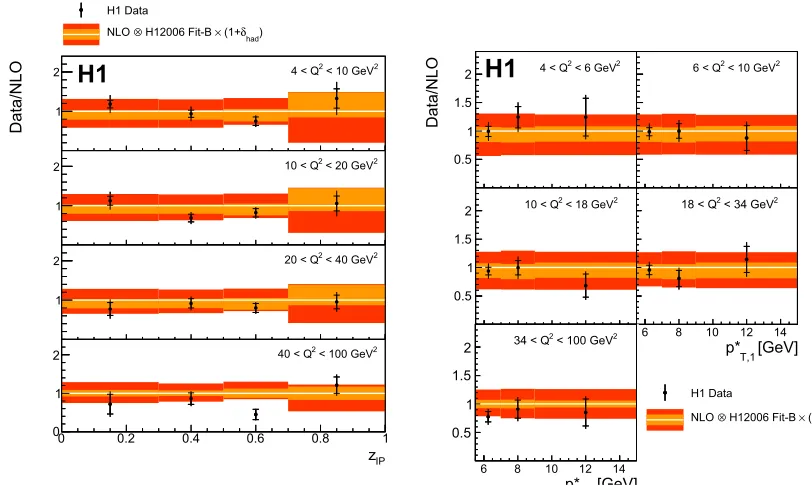
Figure 1.a) Ratio of the double-differential cross section to the NLO QCD predictions as a function ofzIPand
Q2and b)p∗
T,1andQ
2. The inner error bars on the data points represent the statistical uncertainties, outer error
bars with systematic uncertainties added in quadrature.
2 Diffractive dijets in DIS and photoproduction
A new measurement with about six times higher statistics than previous measurements was provided by H1 using the data of HERA II and LRG method of selection of diffractive events. The measure-ment was performed forxIP <0.03, 4<Q2 <80 GeV2and events with jets with transverse momenta p∗
T,1>5.5 GeV andp∗T,2>4 GeV [1]. The cross sections are determined using a regularised unfolding procedure which fully accounts for efficiencies, migrations and correlations among the measurements. The integrated diffractive dijet cross section is found to be well described by the NLO QCD predic-tions using the H1 2006 Fit-B DPDF set. Both shapes and normalisation of the single-differential cross sections are reproduced by the theory within the experimental and theory uncertainties, as shown in Fig. 1. The measured dijet cross sections are used to extract the strong coupling constant in diffractive DIS processes for the first time. The resultαs=0.119±0.004(exp)±0.012(DPDF,theo) is consistent within the uncertainties with the world average.
IP
z 0 0.2 0.4 0.6 0.8
ratio to NLO
0.5 1 1.5
[pb]
IP
/dz
σ
d
50
100
H1
DIS H1 VFPS data
) hadr
δ
(1+
×
0.83
×
NLO H12006 Fit-B
IP
z 0 0.2 0.4 0.6 0.8
ratio to NLO
0.5 1 1.5
[pb]
IP
/dz
σ
d
500 1000
H1
pγ
H1 VFPS data
) hadr
δ
(1+
×
0.83
×
NLO H12006 Fit-B
γ
AFG
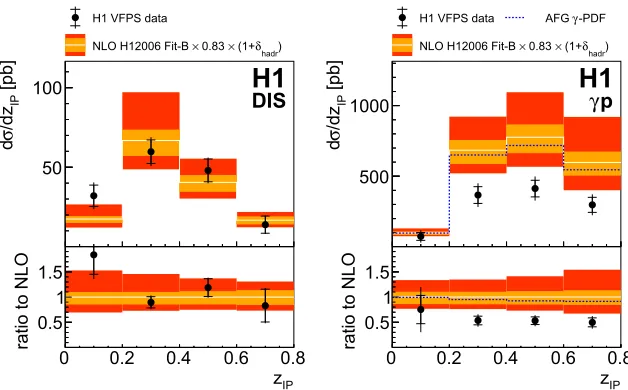
Figure 2. Diffractive dijet a) DIS and b) photoproduction cross sections differential inzIP compared to NLO QCD predictions. The inner error bars represent the statistical errors, outer error bars statistical and systematic uncertainties added in quadrature.
momentum participating in the production of the dijet system. The resolved (direct) processes domi-nate at low (high)xγ values, respectively. Due to hadronisation, detector resolution and acceptances the unambiguous separation between direct and resolved components of photoproduction is one of the limiting factors in studies of possible factorisation breaking in photoproduction.
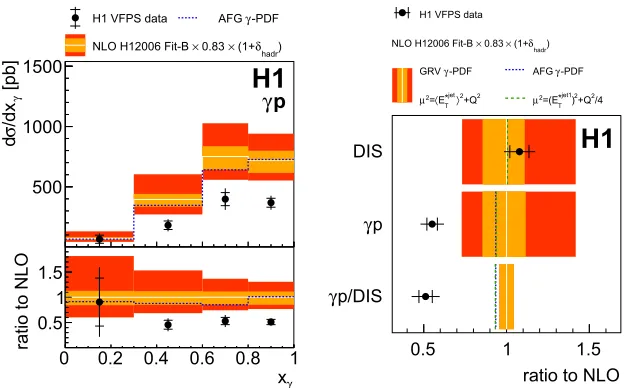
Previous H1 measurements [5, 6] suggested a suppression of the dijet photoproduction cross sec-tion by a factor of around 0.5-0.6 relative to NLO QCD predicsec-tions. ZEUS results [7] correspond to a smaller suppression and are within uncertainties consistent with no suppression whatsoever. Neither collaboration sees any evidence for the expectedxγ dependence of the survival probability.
γ
x 0 0.2 0.4 0.6 0.8 1
ratio to NLO
0.5 1 1.5 [pb]γ
/dx
σ
d
500 1000 1500
H1
pγ
H1 VFPS data
) hadr
δ
(1+
×
0.83
×
NLO H12006 Fit-B
γ
AFG
ratio to NLO 0.5 1 1.5 DIS
p
γ
/DIS p
γ
H1
H1 VFPS data
)
hadr δ
(1+
×
0.83
×
NLO H12006 Fit-B
γ
GRV -PDFAFGγ
2
+Q
2 〉 jet T
* E
〈
=
2
μ 2/4
+Q
2
)
jet1 T
* =(E
2 μ
Figure 3. a) Diffractive dijetepcross section in photoproduction differential inxγ compared to NLO QCD predictions. b) Diffractive dijet DIS and photoproduction cross sections normalised to NLO QCD calculation and double ratio of photoproduction to DIS cross sections, normalised to the corresponding ratio of NLO QCD predictions.
by the corresponding cross sections in DIS. In such ratios most of the data and theoretical systematic uncertainties are reduced. The double-ratio of photoproduction to DIS, data to NLO QCD, is shown in Figure 3 b). The observation of factorisation breaking by factor of about 0.5 is in agreement with previous H1 measurements [5, 6], where complementary experimental methods of diffraction selection were used.
Figure 4. a) Definition of lepton and jet planes, angleΦis the angle between these two planes. b) The shape parameterAas a function ofβin comparison with two models, the bands in model predictions represent statistical uncertainties. The normalisation uncertainty originating from the proton-dissociation background (∼27%) is not shown.
3 Hard photons in diffraction
Prompt photon emission in hadronic interactions is a sensitive probe of QCD dynamics and partonic structure, providing additional information to the study of jet production. Although cross sections are small in this case, an isolated photon at large transvers energy can be related directly to the partonic event structure. This is in contrast with jet measurements, where the partonic structure is obscured by hadronization effects.
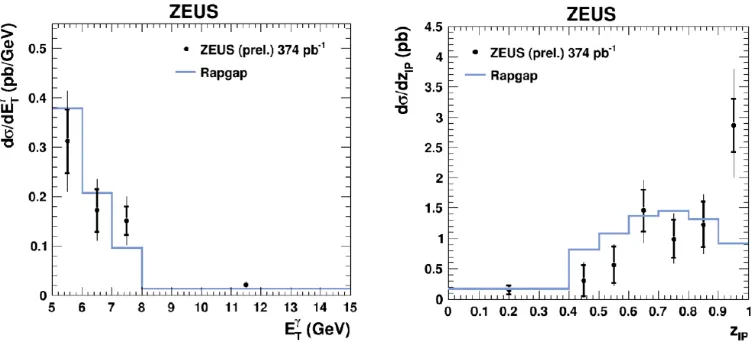
A new measurement was provided by ZEUS collaboration for diffractive photoproduction ep events in which a hard isolated prompt photon is detected in the central region of the ZEUS de-tector and may be accompanied by a jet [15]. Cross sections are evaluated in the photon transverse energy range 5 < ETγ < 15 GeV, inclusively and with a jet with transverse-energy in the range 4 < ETjet < 35 GeV. In Fig. 5a) differential cross sections are shown as a function of the photon transverse energyEγT for the photon+jet configuration. The shape of this distribution and also other distributions of inclusive and photon+jet configurations, see [15], are satisfactorily described by the Rapgap Monte Carlo model, normalised to the data. The shape of thezIP distribution, see Fig. 5b), however is not well described. In particular, a prominent peak nearzIP=1 is seen and requires further study. In future, comparison with NLO QCD calculations would give another handle on factorisation inepdiffractive photoproduction.
References
[1] V. Andreevet al., H1 Collab.JHEP1503, 092 (2015).
[2] T. Affolderet al., CDF Collab.,Phys. Rev. Lett.84, 5043 (2000). [3] S. Chatrchyan et al., CMS Collab.,Phys.Rev.D87012006, (2013).
[4] A. Kaidalov, V. Khoze, A. Martin and M. Ryskin,Eur. Phys.J.C66, 373 (2010). [5] A. Aktaset al., the H1 Collab.Eur. Phys. J.C51, 549 (2007).
[6] F.D. Aaronet al., H1 Collab.Eur.Phys.J.C70, 15 (2010). [7] S. Chekanovet al., ZEUS Collab.Eur.Phys. J.C55, 177 (2008). [8] V. Andreevet al., H1 Collab.,JHEP1505, 056 (2015).
[9] A. Astvatsatourov, K. Cerny, J. Delvax, L. Favart, T. Hreus,et al.,Nucl.Instrum.Meth.,A736, 46 (2014).
[10] H. Abramowiczet al., ZEUS Collab. DESY-15-070 (May 2015), submitted to EPJ. [11] G. Ingelman and P.E. Schlein,Phys. Lett.B152, 256 (1985).
[12] J. Bartels, H. Jung and M. Wuesthoff,Eur.Phys. J.C11, 111 (1999). [13] J. Bartels et al.,Phys. Lett.B 386, 389 (1996).
[14] H. Jung, RAPGAP version 3.1,Comput. Phys. Commun.86, (1995) 147.