HARYANA: APROFILE
Annapurna Sharma*
Moti Lal Nehru College, Delhi University, Delhi Email: [email protected]
1.1HistoricalBackground
In order to understand the present Haryana it becomes necessary for us to have glimpses of its past though briefly as this work is focusing more on political dimensions of the state rather than historical. For this purpose I have divided political history of Haryana in three parts. The times from Indus Valley and the Vedic civilization to medival times, the British period up to the present times. The attempts is to analyse the malaise in the present Haryana as a consequence of its pastlegacy.
The Haryana is a land of ancient civilization. Excavation work was first of all undertaken by General Cunnigham in 1862. Since then many more attempts in this direction have been made by the Archeology Departments of Punjab & Haryana governments. The Departments of Ancient Indian History and Archeology of Punjab and Kurukshetra Universities have undertaken excavationworkat Banawali in Fatehabd district, Siswal in Hissar district Mitathal in Bhaiwani, Rakhi Garhiin Jind and Balu in Kaithal district. Excavations at Agroha in Hissar district shows that the town was well planned. In papular belief it is held that it was the capital of Maharaja Aggrasen the only ruler form the Aggarwal Community. Ashoka set up a stupa in Topra in Ambala district which was shifted to Kotla in Delhi by Ferozeshah Tuglaq in 1356. Proof of rice cultivation in Indus Valley Civilization in claimed to have been found in Daultpur village in Kurukshetradistrict.
the most remarkable positions that I have seen during the whole course of my research.‖
Panipat is another town of antiquity in Haryana. Three most decisive battles of northern India known as ―Battles of Panipat‖ were fought here.
Delhi being the capital of the country, could not permit a powerful state to emerge on its periphery Bharatpur state being the only exception. In the composite Punjab, the Punjab region had a number of comparatively viable states which Haryana region had a few ‗nawabis‘, petty fiefdoms euphemisticallydescribe as states in the gazatteers of the British times. In 1901 Patiala, the Kapurthala and Faridkot in the Punjab region had the annual revenue of Rs. 57,11,549, Rs. 1,31,000 and Rs. 4,23,000 respectivelywhile the corresponding figures for three states in Haryana region Patudi, Loharu and Dujana were Rs. 60,359, Rs. 66,000 and Rs. 77,170 respectively. The rules of three states were in a state of perpetualcrisis.
Every horde of invaders was bound to pass through a part of Haryana region on the way to the battle ground of India at Panipat, with Delhi as the ultimate goal. Placed in the path of successive invasions the people suffered endlessly. Thanesar was sacked by Mohammed of Ghazni in 1014 A.D. Timur entered into Haryana region from the side of Rajasthan. This March lay thorough Fatehabad, Tohana, across the Ghaggar, through Kaithal & Panipat to Delhi which he sacked on Dec 26, 1398. (the Imperial Gazetteer ofIndia).
In 1738 Nadir Shah‘s invading horde swept over the area and defeated the Mughal army at
Karnal in 1739 and sacked Delhi. During the 18th century, a part of the region was held by Mohammedan tribes of whom the chief were the Johias around Hanumangarh and Bhattis around Rania, Sirsa and Fatehabad. The Bikaner annals tell of the struggle between the Hindu Raiputs with the Johias & Bhattis for the possession of the tract aroundSirsa.
uprising. After the uprising was quelled, there followed a period of severe repression. A number of people were put to death in the region. The nawab of Jhajjar and Raja of Ballabhgarh were executed for organising resistance against the British Rao Tula Ram of Mahendergarh emerged as a new during the revolt. He escaped to Kabul where he breathed his last. Villages which participated in the uprising was heavily fined. The entire region was terrorised. Worse still, the region was detached from the Delhi province and tagged to the Punjab region. Thus, Haryana region became as socio- cultural backyard of Punjab region and was severely discriminated against in matter of development till it acquired statehood in 1966. This explains Haryana‘s backward nature in terms of its socio-politico-culturaldimensions.
The region, which is now known as Haryana was captured by the East India Company on 30th December 1803 from Daulat Rao Scindhia1.During the first war of independence in 1857, people of Haryana played a very significant role. After the revolt was crushed and the British Empire was re-established, the Nawab of Jhajjar, the Raja of Ballabhgarh, and the Rao Tula Ram of Rewari was deprived of their territories and the territories were handed over to rulers of Nabha, Jind and Patiala of Punjab as a reward of their loyalty to the British Empire. Consequently, Haryana was separated from the north-western frontier province and tagged with Punjab in February 1858 as a political punishment for the participation of its people in revolt of 1857. As a result, Haryana remained a part of Punjab from 1858 to November 1966 till Punjab was reorganized on linguisticbasis.
was consistently neglected in terms of development as compared to the region of Punjab2.
The colonial administration systematically neglected agriculture in the region in the sense that the irrigation facilities were provided in other parts of Punjab through the development of network of canals but the region of Haryana was neglected because the south western part of the state is almost a desert and considered beneficial for raising good quality cattle and also for a ensured continuous supply of soldiers to the British Army from a backward agriculture based economy3.
Initially the demand for separate state of Haryana was supported mainly by the political elites of Delhi. Pirzada Mohammad Hussein of Muslim League from Delhi was among the first who advocated the demand. It was further supported by Congress,
Although its support for linguistic reorganization of provinces was further motivated by it s desire to weaken the support base of Unionist party in Punjab.
Lala Deshbandhu Das Gupta, a Delhi based lawyer and Sir Chhotu Ram also supported the demand, although the latter‘s stance kept changing. It was Sir Chhotu Ram who gave the idea
of“Vishal Haryana‖ during the early phase of 20th century. According to him, Hindi speaking
region was never a part of Punjab because from the day of its inclusion in Punjab, the region is lagging behind in political, economic and cultural terms. So, it was essential for the region to be recognized as a separate entity in the sense of a separate state. In a way if one goes by chronologically, the demand of a separate state for Hindi speaking areas was older than the demand for Punjabi Subaitself.4
the separate statehood even then by the Congress, so they took recourse to the demand for a separate Suba in the name of the Punjabi speaking people. Although, the genesis of the demand for Vishal Haryana dates back to pre-Independence period, but it gathered momentum only in the post-independence period and it was the acceptance of the demand of Punjabi Suba backed by strong mass movement that led to the creation of Haryana. There was no strong massmovement for the demand of Haryana Prant and whatever support it had was mainly confined 10 articulate sections of peasantry and educated classes. These classes considered it essential for the advancement of their interest. It was, however, opposed by Jan Sangh and some factions of Congress who drew their support from the urban areas. Urban leadership considered the demand as detrimental for their interests. Thus, they supported the demand of Maha Punjab or enlarged state consisting of Punjab, PEPSU and HimachalPradesh.
The state of Haryana was constituted on the recommendation of the Sardar Hukum Singh Parliamentary Committee formed on 23rd September 1965. Acting on the recommendations of the Hukum Singh Committee the government of India on 23rd April, 1966 set up the Shah Commission under the chairmanship of Justice J. C. Shah, to divide and set up the boundaries of Punjab and Haryana. The Commission submitted its report on 31st May, 1966. According to the report the districts of Hisar, Mahendergarh, Gurgaon, Rohtak, and Karnal were to be a part of the new state of Haryana. Further, the tehsils of Jind (district Sangrur), Narwana (district Sangrur), Naraingarh, Ambala and Jagadhari were also included. The Commission recommended that Kharar tehsil including Chandigarh should also be a part of Haryana5. On the basis of Shah Commission report, the Indian government passed Punjab reorganization Act, 1966 on 18th September, 1966. According to the Act, thearea of the Haryana was to be as follows6:
The districts of Hisar, Rohtak, Gurgaon, Karnal and Mahendergarh The Jind and Narwana
tehsils of Sangrur district
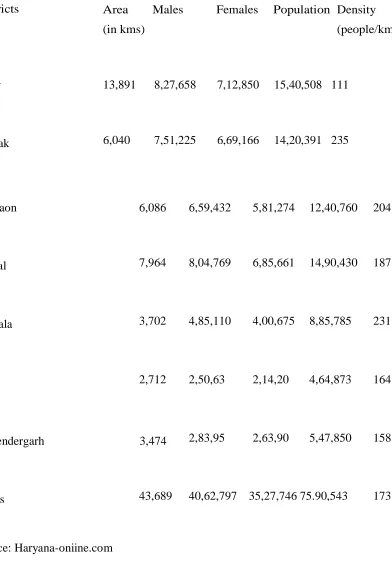
Table No. 1:1
Haryana‘s Area & Population in 1966
Districts
Hisar 13,891 8,27,658 7,12,850 15,40,508 111
Rohtak 6,040 7,51,225 6,69,166 14,20,391 235
Gurgaon 6,086 6,59,432 5,81,274 12,40,760 204
Kamal 7,964 8,04,769 6,85,661 14,90,430 187
Ambala 3,702 4,85,110 4,00,675 8,85,785 231
Jind 2,712 2,50,63 2,14,20 4,64,873 164
Mahendergarh 3,474 2,83,95 2,63,90 5,47,850 158
Totals 43,689 40,62,797 35,27,746 75.90,543 173
Source: Haryana-oniine.com
Area Males Females Population Density
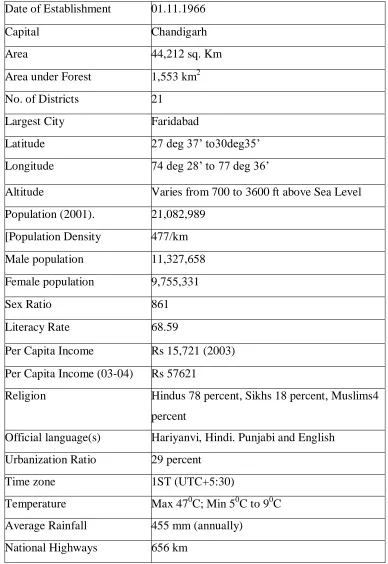
Table No. 1:2
Basic Information about the State
Date of Establishment 01.11.1966
Capital Chandigarh
Area 44,212 sq. Km
Area under Forest 1,553 km2
No. of Districts 21
Largest City Faridabad
Latitude 27 deg 37‘ to30deg35‘
Longitude 74 deg 28‘ to 77 deg 36‘
Altitude Varies from 700 to 3600 ft above Sea Level
Population (2001). 21,082,989
[Population Density 477/km
Male population 11,327,658
Female population 9,755,331
Sex Ratio 861
Literacy Rate 68.59
Per Capita Income Rs 15,721 (2003)
Per Capita Income (03-04) Rs 57621
Religion Hindus 78 percent, Sikhs 18 percent, Muslims4 percent
Official language(s) Hariyanvi, Hindi. Punjabi and English
Urbanization Ratio 29 percent
Time zone 1ST (UTC+5:30)
Haryana was finally carved out on the linguistic basis after bifurcation of Punjab state on 1 November, 1966 under the State Reorganization Act of 1956. The Hindi- speaking eastern region of Punjab state was declared as Haryana Prant and Punjabi speaking western portion remained as Punjab. Chandigarh has been declared as Union Territory and the capital of both the states. Although Kharar tehsil and Chandigarh was given to Haryana by Shah Commission, constituted to demarcate the boundaries of Punjab and Haryana. But, the than Prime Minister under pressure from Akali leaders who were not ready for the transfer of Chandigarh to Haryana was declared the joint capital of both the states. Again under pressure of Akali leaders according to Indira Gandhi Award, Chandigarh was rewarded to Punjab and Abhohar and Fazilka to be transferred to Haryana .Chandigarh was due for transfer to state of Punjab in 1986, according to Rajiv-Longowal Accord, but the transfer has been delayed, and pending. On the basis of the agreement, the parts of the Hindi speaking areas of Abohar and Fazilka which are currently the parts of Ferozpur district of Punjab to be transferred in Haryana in lieu of Chandigarh7. The issue of capital was left unsettled by the union government in a way, which still continues as a bone of contention between both the states. Many commissions, awards and Punjab Accord followed by three commissions have proved almost futile to sort out theproblem.
1.2Economy
Haryana‘s economy has a significant agrarian component. Haryana is one of the largest
tones every year, which is the second largest in the country8. Its 73.9 percent of the net sown area is under irrigation.
About 86 percent of the total geographical area of the state is cultivable, and out of which 96 percent has already been brought under plough. The cropping intensity in the state is nearly 170 percent.9 Haryana has Asia‘s biggest Agricultural University, known as Chaudhary Charan Singh Haryana Agricultural University (HAU) at Hisar. The institute has made immense contribution for the advent of ‗Green Revolution‘.Haryana, along with Punjab being called the ‗Grain Bowl‘ ofIndia.10
The major crops of Haryana are wheat, rice, sugarcane, cotton, oilseeds, gram, barley, com and millet. There are two main types of crops in Haryana, known as: Rabi and Kharif. The major Kharif crops of Haryana include rice, jowar, bajra, maize, cotton, jute, sugarcane, sesame and groundnut. For kharif crops the ground is prepared in April and May and the seeds are sown at the beginning of rains in June and harvested by the beginning of November. The major Rabi crops include wheat, tobacco gram, linseed, rapeseed and mustard. The ground for these crops being prepared by the end of October or the beginning of November and the crops are harvested by March.
and Sirsa. The total area which is irrigated by canal water is 21.40 lakh hectares.12 Irrigation facilities in the state have been amplified by the government while providing subsidies on minor irrigation works. The number of tube wells and pumping sets has also increased; besides, sprinkler irrigation system has also been encouraged.13
Dairy fanning forms an essential part of Haryana‘s rural economy. Haryana has been known as the ‗milk pail‘ of India. Dairy products are a major part of the routine diet of Haryana‘s
people. Animal husbandry is an integral constituent of diversified agriculture. In the state, a vast network of milk producer‘s societies has been set up in order to provide farmers a good
price for their dairy products and to help them in marketing. About 1500 milk societies are currently working along with seven milk plants in the co-operative sector situated in Jind, Bhiwani, Ambala, Rohtak, Hisar, Ballabhgarh and Sirsa. Asia‘s best dairy research institute known as the National Dairy Research Institute (NDRI) is in Karnal and which has been upgraded to the status of ‗Deemed University‘.14
Haryana is the habitat of the world famous ‗Murrah‘ buffaloes. Buffaloes constitute 45 percent of the total livestock and contribute for 80.5 percent of the total milk production. Further the new breeds of ‗Haryana‘ cow and ‗Murrah‘ buffaloes are being developed by NDRI, Karnal and Central Institute for Research on
Buffaloes, Hisar. Besides, the horticulture and vegetable farming are also beingencouraged.
According to 2001 census the state has shown a marked trend towards urbanization as totalpercentageofurbanpopulationhasgoneupto29percentby2001,whichwas
highways passing through the state and the modern infrastructure available at the industrial estates contributes to make Haryana the first choice of entrepreneurs for their development projects .One third of state‘s area falls under the national capital region and even the farthest
spot in Haryana is only 7 hours drive from capital. With its rapidly increasing population, Delhi has become a major consumption canter of industrial products coming from Haryana. Haryana‘s economy is developing at a very fast pace. The structural composition of state
economy has witnessed significant changes since the formation of Haryana as a separate state. There has been a considerable improvement in manufacturing sector which occupies the second important place in its economy after agriculture and allied sector.15
With 1.4 % of the total area and less than 2 % of the country‘s population,Haryana is one of the leading states in terms of per capita income.16 Haryana‘s economy is constantly gaining strength and heading towards new heights of development. The structural composition of state economy has witnessed significant changes. Since its inception, there has been a considerable improvement in manufacturing sector which constitute the second important component of the state economy after agriculture and allied sector. Haryana has become one of the three most progressive states of India with an impressive track of achievements in the field of agriculture, business, tourism, information technology, automobile industry and overall development. Though it is a small state in geographical terms, and its compact size has also contributed in itsdevelopment.
The state also ranks first in all-over India regarding the production of passenger cars, motor cycles, tractors, sanitary wares, GI pipes, gas stoves and scientific instruments. Further, Haryana has been able to attract sizable investment from multinational companies, large business houses, foreign investors, non-resident Indians (NRIs) etc. The state already has more than 530 projects with foreign technical/financial collaborations. To mention only a few Maruti Udyog, Escorts, Hero Honda, Alcatel, Sony India, Whirlpool India, Proagro PGS India, Bharti Telecom, Perfetti India, TDT Copper, Carrier Aircon etc. Some major units in the public sector are HMT Ltd., National Fertilizers Ltd., Bharat Electronics Ltd., IDPL, among others.
Since the beginning of economic liberalization and de-licensing policy of government of India during 1991, as many as 2313 industrial entrepreneur memorandums (IEMs) have been filed for setting up of industrial units in Haryana. Haryana is at sixth place in the country regarding filing of IEMs. Only five states namely Maharashtra, Gujarat, Uttar Pradesh, Tamil Nadu and Andhra Pradesh which are very big in size and have plenty of natural resources are ahead of Haryana. The percentage of implementation of IEMs in Haryana is about 48 per cent against an all India average of about 35 per cent.17
1.3SocialDemography
2001 in this group are: Ahirs 5%, Gujjars 3%, and Rajputs 4% of the non-agriculturist castes, Punjabis are also in considerable strength. Punjabis, the so called refugees, who migrated from Pakistan due to communal tension at the time of partition, constitute a major chunk of urban population. They are seven per cent of total population and are too perceived as a caste group of the non- agriculturist cases. Punjabis are also in considerablestrength.19
Besides, as per the 1991 Census, the state has 5.8 % Sikh population. The total Sikh population in the state is 11, 70,662 as per 2001 Census, including 6, 18,558 men and 5, 52,104 women, and is largely concentrated in areas contiguous to Punjab. The Sikh population lived mainly in Dabwali, Rori, Ellenabad, Sirsa, Ratia, Fatehabad, Safidon, Jundla, Jagadhari, Yamunanagar, Sahabad, Pchowa, Naggal, Ghula, Assandh, Ambala City, Naraingarh, Nilokheri, Tohana, Kalayat, Indri and Thanesar. Political observers believe that Sikhs in the state are largely divided in to two groups—the older lot which is anti-Congress and therefore pro-lNLD and the younger generation that is willing to go with anyone who helps in the creation of a separate Gurudwara Management Committee in thestate.20
In caste terms, the scheduled castes constituted 19.75 % of the total population in Haryana as per 1991 census. 37 castes come under the category of SCs in Haryana and Chamars are the most numerous, Balmikis, Dhanaks, Mazhabi and Khatiks are the other constituent groups in the category. It has been observed that Chamars among SCs in Haryana dominate the scene because they have captured the number of seats in state assemblies. Their numerical strength, benefits drawn from government affirmative action and the subsequent better economic condition allowed them access to modem education and opportunities for mobilization andpoliticization.
Territory wise Haryana is a small state. For administrative purposes, the state is divided into four divisions-Ambala, Rohtak, Gurgaon and Hisar and 47 sub-divisions. There are 21 districts, 70 tehsils, 43 sub-tehsils, 119 blocks, 81 cities, 94 towns and 6764 villages. Haryana is a landlocked state of north India and is surrounded by Uttar Pradesh (UP) from eastern side, by Punjab on its western side. Besides, Uttrakhand, Himachal Pradesh and Shivalik hills on located its northern side along with Delhi. Rajasthan and Aravali hills on its southern side. The 1,553 sq. km of its area is covered by forest. Geographically Haryana has four key features namely:
• Shivalik hills are located to the northeast of the state and are source of the rivers like Saraswati, Ghaggar, Tangri andMarkanda.
• Ghaggar Yamuna plains are divided in 2 parts – the higher one is called „Bangar‘ and the lower one is called ‗Khadcir‘. These plains constitute the largest part of thestate.
• Semi-desert sandy plains are located in the southwest of the state and comprises the districts of
Sirsa and parts of Hisar, Mahendergarh, Fatehabad, Bhiwani and also shared border withRajasthan.
• Aravali hills are located in the south of thestate.23
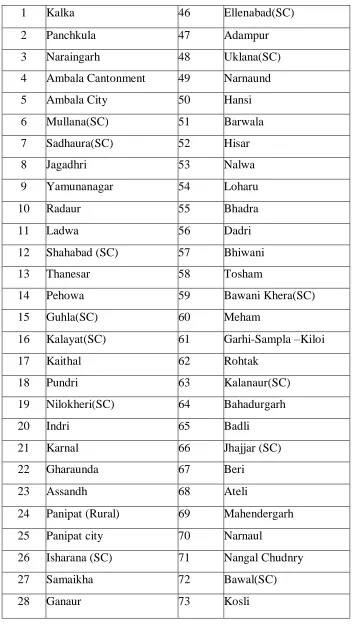
The state has 15 parliamentary seats namely 10 Lok Sabha and five Rajya Sabha along with 90 assembly constituencies. Out of which 2 Lok Sabha and 17 assembly constituencies are reserved for SCs. Earlier the state used to have nine parliamentary and 81 assembly constituencies but their number was raised to the current level by the Delimitation Order of1976.
Assembly Seats: 90
Lok Sabha Seats: 10
Table No.1:3 Assembly Constituencies
1 Kalka 46 Ellenabad(SC)
2 Panchkula 47 Adampur
3 Naraingarh 48 Uklana(SC)
4 Ambala Cantonment 49 Narnaund
5 Ambala City 50 Hansi
6 Mullana(SC) 51 Barwala
7 Sadhaura(SC) 52 Hisar
8 Jagadhri 53 Nalwa
9 Yamunanagar 54 Loharu
10 Radaur 55 Bhadra
11 Ladwa 56 Dadri
12 Shahabad (SC) 57 Bhiwani
13 Thanesar 58 Tosham
14 Pehowa 59 Bawani Khera(SC)
15 Guhla(SC) 60 Meham
16 Kalayat(SC) 61 Garhi-Sampla –Kiloi
17 Kaithal 62 Rohtak
18 Pundri 63 Kalanaur(SC)
19 Nilokheri(SC) 64 Bahadurgarh
20 Indri 65 Badli
21 Karnal 66 Jhajjar (SC)
22 Gharaunda 67 Beri
23 Assandh 68 Ateli
24 Panipat (Rural) 69 Mahendergarh
25 Panipat city 70 Narnaul
26 Isharana (SC) 71 Nangal Chudnry
27 Samaikha 72 Bawal(SC)
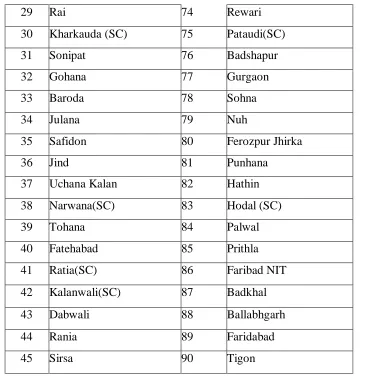
29 Rai 74 Rewari 30 Kharkauda (SC) 75 Pataudi(SC)
31 Sonipat 76 Badshapur
32 Gohana 77 Gurgaon
33 Baroda 78 Sohna
34 Julana 79 Nuh
35 Safidon 80 Ferozpur Jhirka
36 Jind 81 Punhana
37 Uchana Kalan 82 Hathin
38 Narwana(SC) 83 Hodal (SC)
39 Tohana 84 Palwal
40 Fatehabad 85 Prithla
41 Ratia(SC) 86 Faribad NIT
42 Kalanwali(SC) 87 Badkhal
43 Dabwali 88 Ballabhgarh
44 Rania 89 Faridabad
45 Sirsa 90 Tigon
Source: Haryana-online.com
Table No. 1:4
Lok Sabha Constituencies24
Ambala Faridabad
Kurukshetra Mahendragarh-Bhiwani
Sonepat Hisar
Rohtak Sirsa
Source: Haryana-online.com
In Haryana, it is difficult to divide the entire state into geographically contiguous and politically meaningfulregions. So, the administrative regions have been used to analyze the patterns of voting behaviour by the scholars. Haryana has 21 districts and four administrative regions and roughly five electoral belts. Mewat is 20th district of Haryana, which was created from Gurgaon on 4th April 2005 in Haryana. It is bounded by Gurgaon on the North, Rewari on the West and Faridabad on the East. Mewat is populated by the Meo an agriculturalist caste. Palwal became 21st district of Haryana which was a part of Faridabad district and earlier of Gurgaon district. Palwal has been declared 21stdistrict of Haryana on 30th march2008.
Four administrative regions are as following:
1. Rohtak 2. Ambala 3. Hisar 4. Gurgaon
1. Rohtak Region – Jat Belt: This region or division consists of Rohtak, Sonipat,Panipat, Karnal and Jhajjar (Jatland)districts.
2. Ambala Region i.e. Urban Region: This region or division consists of Ambala, Kurukshetra, Panchkula, Yamunanagar and Kaithal districts. The second belt or administrative region consists of the advanced areas along with grand trunk road (GT road) from Ambala to Faridabad, parts of Karnal. In terms of caste configuration it consists of Banias, Brahmins, Rors, Ahirs, Sikhs and refugees from Panjab (Pakistan).25
62 % of population is composed of Muslims. The Muslim dominated constituencies are located in Faridabad and Gurgaon districts.
4. Gurgaon Region: The regions or divisions consist of Faridabad, Palwal, Gurgaon, Mewat, Mahendergarh and Rewari Districts. The forth belt or administrative region is known as Ahirwal dominated by Ahirs or Yadavas are middle level agricultural caste, which dominates in the Ahirwal region. The belt comprises Rewari, Mahendergarh and parts of Gurgaondistricts.
1.5Politicalpeculiarities
Haryana politics has certain peculiar characteristic features. During four decades of its electoral history, the state has not been able to develop the attributes of a coherent party system. In Haryana, be it the electorate or the politicians, nobody seems committed to a particular party. The electorates of the state lack a developed political culture in terms of their political choices and affiliations to different political parties.26 It‘s not the ideology which is important for their political alignments but the personality cult along with caste cleavage, rural urban divide and so on.
1.5.1 Exta-party Alliances or Cross PartyLinkages:
The most significant peculiar feature of the state party system in Haryana is the―Extra PartyAlliances‖ or Cross Party Linkages in which leaders of different political parties serve each other‘s interests. Under Extra-Party alliances two patterns of alliances emerge-the formal
alliances and the real alliances. Formal alliances are made at Party level to gain political strength, but real alliances surpass formal alliances in order to gain individual interest.In 1996 the formal alliance was between HVP (under the leadership of Bansi Lal) and BJP on the one hand and between INLD (under the leadership of Chautala) and BSP on the other. But the real alliance was between Congress‘s Hooda & HVP‘sBansi Lal. This informal alliance was so
strongly felt that in 1996 Rohtak assembly elections the sloagan was ―Neeche Ganja Uppar
Gangja referred to S. Ram. It meant vote for S. Ram in assembly elections and Uppar
Panjareferred to Congress which meant vote for Parliamentary elections.
1.5.2 Factionalism:
The Politics of defection has always remained a defining feature of electoral politics inHaryana.Although,itisuniversalphenomenoninIndianpolitics,butHaryana
Politicshasgivennewmagnitudetothepoliticsoffactionalism,andthestateis
widely considerable as the cradle of politics of„Aya Ram Gaya Ram‟.27After the
reorganization of the state in 1966, the then Congress President of Punjab Bhagwat Dayal Sharma was made its Chief \Minister. Soon after the first assembly elections of state held in March 1967, B.D. Sharma became the Chief Minister. While selecting the Council of Ministers, although, Congress high command tried to provide fair representation to almost all dominant castes but their leaders like Chaudhary Devi Lal (a jat), Rao Barinder Singh (an Ahir) and Chand Ram (a Scheduled Caste) were neglected. So, they defected from Congress and formed United Front. Their defection let to fall of 13 days old B.D. Sharma headed Congress government and Rao Birender Singh became the chief minister from the United Front. Rao Birender Singh also has to submit his resignation twice in the eight months rule. During November 1967, defections and counter-defections took place almosteveryday.28
Rao Barinder Singh (Haryana Vishal Party leader) led government also developed cracks very soon. Devi Lal faction defected from the government and joined group led by B. D. Sharam, in the effort to ensure the downfall of Rao‘s government, as he dropped Devi Lal‘s main
supporters Chand Ram and Mani Ram Godhara from his Cabinet. Politics of defections ultimately led to the imposition of President Rule on 22 November, 1967 as a result of dismissal of Rao‘sgovernment.29
Sharma along with his 15 supporters defected from Bansi Lal led government, which forced him to form a large size Cabinet.30 Besides, in 1977, when Janata party won with a landslide majority, the chief minister Devi Lal was asked twice to seek the vote of confidence.31 Above all, during 1980, Haryana state politics set new paradigms to defection phenomenon of electoral politics due to overnight defection of Bhajan Lal led Janata party government to Congress party which converted the Janata ministry into Congress ministry .
Even during February 2005 and 2009 assembly polls, factionalism was on the forefront especially in Congress. Every district was having its own chief ministerial candidate. After 2009 assembly polls five of the six PIJC MLAs defected to Congress unconditionally and helped it to form government on its own.32 The politics of ―Aya Ram and Gaya Ram‘ was initially seen as corrupt practice and mere electoral opportunism for gaining office. In the opinion of the defectors, this was in fact not mere opportunism, but the course of electoral politics taking its natural shape in Haryana politics. And there seemed nothing wrong in it, if everybody wanted its share in political cake in terms of representation especially in Haryana.33
1.5.3 Significance of theCaste:
Next to Bihar caste exercise the single most important influence on politics of Haryana. Politics of Haryana has always been dominated by middle level dominant peasant castes, especially the Jats. Jats constitute majority of the total population in the state they are largest owners of agricultural land. All the chief ministers, except two, of Haryana hailed from this caste. Jats are numerically, large, economically strong, culturally confident and politically most powerful. Caste is the real player which determines the electoral behavior of the people.
There is a local saying, „„Jat ki
Caste considerations are very strong and are deeply rooted. Political organization are formed around the major castes.
Caste cleavage is a dominant factor in the politics of Haryana, which is comparable with Bihar.34 The main influences have always been of personality, caste and military service along with the sense of class-consciousness on the people, due to its being essentially a land of soldiers.35 These influences can be explained in terms of their alignments with army and the importance attached to the caste in recruitment process. Jats and Ahirs have provided excellent soldiers and have developed a respect for strong/macho personality and caste solidarity. Despite being middle in the Varna system or caste hierarchy36 the Jats would qualify as the dominant caste as they are numerically strong and are land owners. Caste factor plays such an important role in the politics of the state. The same can also explain the reason why Mrs. Sonia Gandhi‘s foreign origin does not hold much importance for them because according to them ―Jat Ke Aye To Jatni Ho Gayi‖,37
means that when a women get married to men belonging to a particular caste she ultimately becomes a member of that particular caste irrespective of her own caste or community before themarriage.
1.5.4 Lack of a coherent partysystem
The state has not experienced a stable party competition and a long term or stable alignment of voters to their particular parties, despite the high rate of electoral participation. Congress has been perceived as a weak force in the region especially during pre-independence period. However, Congress has ruled the state more than any other party.Haryana has witnessed 12 legislative assembly elections. Congress has formed the government in the state as many as seven times***, whereas only five times the state has been ruled by the coalitions of various political parties especially from the period 1996 to 2005. If one came out to find a reason according to Prem Choudhary, it is due to legacy of Sir Chhotu Ram‘s Unionist party, which had a pro-British outlook kept the Haryana alienated from mainstream political culture and resulted in lacking of a strong ideological basis. This is against this backdrop that in Haryana people keep changing their political loyalties and affiliations in almost every election. It can be attributed to changing alignments of the social groups as well as the political class in the state.
Politics in Haryana has not seen many new political entrants since its early phase. The game of electoral politics in Haryana more or less has remained in privilege of Congress on the one side and the peasant parties like Unionist party, Zamindara League, Lok Dal or INLD and BJP on the other side. There have been some other parties which have, from time to time, beed floated by discontented individuals from major parties like Congress when they left the party. These parties have proved vote splinters for their parent party rather than marking their won electoral presence. Besides, these parties also have proved the short spell in the politics of the state, but at times have enjoyed short stints in power politics like Vishal Haryana Party, Haryana Vikas Party. Haryana Janhit Congress is the most political entrant of Haryana politics.
major distinction of the committed support base of the two main political players namely Congress and INLD are no more as distinct as they were. Now, both of these parties are deriving their electoral support both from rural and urban areas. At present, BJP, BSP and HJC are the minor players in Haryana politics. The left parties do not occupy much space in political arena of the state. Apart from the lack of a coherent party system, anti-incumbency factor has been very strong in politics of Haryana. No single government except Congress has enjoyed two consecutive terms except Congress from 1968 to 1975 and now from 2005 and 2009 onwards. In the words of Pratap Bhanu Mehta, anti-incumbency factor can be explained in two context, ‗first people expect a lot from the government and secondly they expect very
less and can easily afford the cost of changing leadership time and again.*** But at times it is also important to note that people are not left with another option but to choose one or the lesser evil. For the people if Haryana identity politics matters much than party politics.
1.5.5 Emergence of PeasantBourgeoise:
Like Punjab, the state of Haryana is different in many respect from the other states of the Indian union. On the one hand it represent a fusion of primordial loyalties of caste with politics whereas on the other hand it is the vanguard of the ‗Green Revolution‘ due to which its per
capita income has also gone up far ahead of most of the other states. In fact the state has taken a big lead over most other states in the production of food grains and its contribution to the central pool has become highest.
However, the ‗Green Revolution‘ has not been entirely without its quota of problems, while it
The tremendous increase in agricultural production isthe state is attributed generally to the Green Revolution. The term Green Revolution refers to the improved methods of cultivation based on the use of new high yielding verities of seeds, fertilizers & agriculturalmachinery.
Green Revolution has not evolved the entire state. It is mainly restricted to the districts o Karnal, Kurukshetra& parts of Ambala. Farm income rose sharply in this region. The number of agricultural labours in this region is much more than elsewhere in the state of Haryana. Therefore, it was here that the spark of Haryana. Therefore, it was here that the spark of radical politics should have appeared. However, it was in this region that industry & other developmental projects were encouraged by the State, thereby counterbalancing government could not stop the emergence of ‗peasant bourgeois‘.
Concentration of Green Revolution in certain areas is of crucial importance to us in order to understand the role of ‗peasant bourgeois‘ is state politics of Haryana.
Peasant Bourgeois as a phenomenon to GREEN REVOLUTION. This phenomenon has determined the political pattern & electoral behaviour of the state.
Undoubtedly, there has been a tremendous increase in the agricultural yield but the peasants have not been benefited proportionally While a handful of rich farmers have become richer, the large mass of peasantry increase debt-ridden.
1.5.6 Agricultural and Non-AgriculturalDivide:
Among the rural based agriculturist castes the Jats constitute about one fifth of the total population and is the major caste. Jats have been mobilized by Sir Chhotu Ram against Congress and in favour of Unionist party. Traditionally Jats perceived Congress as anti-rural, anti-agriculturist and anti-Jats party as well as pro-urban, high caste, backward castes and scheduled castes party on the other side. Out of the remaining agriculturist castes the Gujjars, Kambojs, Sainis, Rors and Rajputs have usually supported the Lok Dal due to the same reasons except when the Congress field a candidate belonging to thesecastes.
Besides, Ahirs and Bishnois are the other agriculturist castes. Ahirs have been voting for Congress since the merger of Vishal Haryana Party in Congress in 1978. The Bishnois have been voting for Congress since 1980 after the defection of their leader Bhajan Lal into Congress from Janata party as he had been successful in projecting himself as a leader of non-Jats and served as chief minister from 1979 to 1986 and 1991 to 1996. Now they have his HJC (BL) to support.
In agrarian socio economic environment of Punjab and Haryana, the socio-political and cultural trends were determined and decided by peasant land owning classes commonly known
as Zamindars .The word Zamindar in Punjab and Haryana implies for any land owner however
small even as the term in its literal meaning connotes the owners of very large estate. ―The
British administrators provided a constitutional basis for this usage and also enlarged the scope of its definition in 1900 by the enactment of the Punjab Alienation of Land Act which created
‗statutory casteism‟by designating certain castes as ‗agricultural tribes‘, with the result, that
The agricultural and non-agricultural divide is mainly seen as a contribution or legacy of Sir Chhotu Ram40 and the party led by him namely the Unionist Party, which mobilized peasantry. That is why the agriculturist castes especially Jats and Ahirs for long remained anti-Congress. Initially peasant castes (especially the Jats) have beenled by the Sir Chhotu Ram through Unionist Party. After reorganization of state, these peasant castes initially supported the Congress because they lacked in terms of a viable alternative. After the emergence of Lok Dal during 80‘s and its leader Chaudhary Devi Lal in context of protest against Rajiv-Longowal
Accord41 through Haryana Sangarsh Samiti in the name of Nyaya Yudh, the peasant castes got an alternative and start supporting it which led the decline of Congress. In Haryana, almost every caste has its own set pattern of voting behaviour and political affiliations. A good example can be the slogan ―Jat Ke Beti Jat Ko and Jat Ka Vote Jat Ko‖ signifies that a voter in
Haryana is first a member of a particular caste than anythingelse.42
It has been observed that the dominance of agriculturist castes elite in power structure of the state since its inception and even before could be attributed to their economic power, numerical strength, demographic distribution, political awareness and social status in rural caste hierarchy. Consequently, their dominant position in village social power structure has bestowed them with the capacity to exert influence upon the decision-making process to promote their own interests.
Dominance of middle class peasantry has remained a distinct feature of politics of Haryana. Peasant classes have always been dominant in the state. Caste configuration always has played an important role in politics of India. Before 1967. Upper castes have dominated the Indian political scene. After 1967 there were middle classes / castes but during the decade of 1990s and onwards it‘s the turn of lower castes which have assumed the central role and now it is
state there are no sharp lines between upper castes and lower middle castes unlike the other Hindi speaking north Indian states.
The politics of state is never characterized by upper caste dominance of Brahmins and Rajputs. Due to socio-economic reasons there have been conflicts between Brahmins and peasant castes (especially Jats) as none of them were ready to accept thesuperiority or dominance of each other.43 Besides, whatever status the Brahmins enjoyed earlier went down further with the spread of Arya Samaj Movement especially among Jats during 1920s, which took them away from Brahminical roots. This particular aspect can explain for the weak basis of Brahmanical ideology and less appeal for the ideology of BJP to people of Haryana. The BJP or its earlier incarnation Bharatiya Jan Sangh have always been viewed as a parry of upper caste urban Hindus and that explains as to why the party finds itself unable to expand its base in the state despite the fact that majority population of Haryana is Hindu. The Mandir factor has also never worked in the state. Haryana remained unaffected even during early 1990‖s when there was a pro-BJP wave in Hindu Heartland. Rath Yatra undertaken by BJP related to Ram Janambhumi issue did not appeal to the people of Haryana. BJP is seen as a National party in Haryana and it needs to be regionalized in order to expand itself.
Agriculturist castes have adopted the strategy of entering different political parties in general and Congress in particular, which have enabled them to gain dominance in power structure. It has been further observed that these castes during pre- reorganization period happened to be satisfied with one or two seats in Punjab government/cabinet have started struggling 10 attain number one position in every sphere especially alter the formation of state. In fact, the political game of‘ Aya Ram- Gaya Ram‘ along with drama of defections and counter defections can be
explained in the light of this struggle of caste forces to occupy maximum share of political power.
The agriculturist versus non-agriculturist castes divide for a considerable period of time was a major poll plank in Haryana politics. Due to emergence of inter-caste contradiction, however, it has lost its salience. Jats versus non-Jats divide has become
1.5.7 Dominance of Jats as DominantCaste:
Jats are the most dominant caste in the state. The community is scattered throughout the state but the main concentration is in districts of Hisar, Rohtak and Kaithal the area referred as Jatland. Jats are politically dominant and the dominance isestablished mainly due to the ownership of land. The concept of Dominant caste illustratedby
M.N. Srinivas44 suits well to the Jats of Haryana in the given context, as they are not only numerically and economically stronger than any other caste and also live up to another criterion of the dominance i.e. position in the social hierarchy as they do not correspond to a low ritual status. As for their numerical strength, Jats constitute about 20 % of total population and also are the largest owner of the agricultural land. This caste has provided the state with maximum number of the chief ministers and MLA‘s. Besides, they are the biggest
beneficiaries of the Green Revolution and implementation of the land reforms.
In Punjab and Haryana which are mainly the agrarian states the category of dominant caste is being seen in relation to the amount of agricultural land possessed by a particular community. The other peasant lower ranked castes were ―seen in relation of servitude to the land owning
Table No. 1.5
Numerical Strength of different Castes in various Districts of Haryana in Terms of Percentage Population of the Total Population in 1931
District Jat Rajput Chamar Brahmin Bania Meo Ahir Hisar 28.48 16.82 9.55 5.62 7.46 0.07 1.36
Rohtak 36.80 7.10 9.15 9.67 5.95 0.02 2.68
Gurgaon 11.45 6.72 12.73 7.95 4.38 19.54 12.80 Karnal 15.20 13.22 9.00 8.58 6.32 0.08 0.27
Ambala 16.28 10.81 11.48 5.57 2.24 0.29 0.24
Source: Prem Chaudhary, Veiled Women: Shifting Gender Equations in Haryana, 1880-1990, OUP.
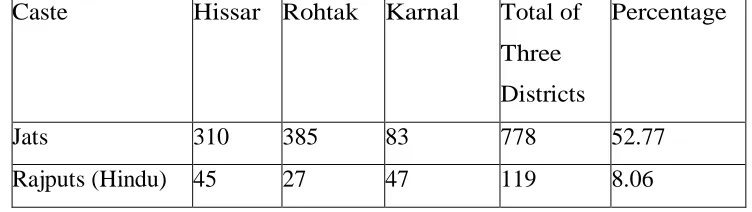
The table demonstrates that Jats constituted the single largest caste group in Haryana region as a whole except one district i.e. Gurgaon which is a Meo and Ahir (both peasant Castes) dominated region. The peasant landless or small land holding castes have an allegiance to Jats except Rajputs who have followed different social ethos in social and economic relationships.47
Table No. 1:6
TheCaste-WiseBreakupoftheVillageProprietorshipfortheDistrictsof Hissar, Rohtak
andKarnal
Caste Hissar Rohtak Karnal Total of Three Districts
Percentage
Jats 310 385 83 778 52.77
Rajputs (Muslim)
58 25 - 83 5.62
Christian 68 - 18 86 5.83
Gujjars 8 7 49 64 4.33
Brahmins 15 27 12 54 3.66
Banias 37 3 - 40 2.71
Ruchadas 30 - - 30 2.03
Rors 29 1 - 30 2.03
Ahirs - 25 - 25 1.69
Pathans 16 - - 16 1.08
Sayyads 5 3 6 14 0.94
Bishnois 10 - - 10 0.67
Sheikhs 4 3 - 7 0.47
Miscellaneous 53 24 42 119 8.06
Total 659 530 286 1475 100
Source: Prem Chaudhary, Veiled Women: Shifting Gender Equations in Haryana, 880-1990, OUP.
The table shows the categorization of different districts of Haryana according to the caste of majority of proprietors. The table depicts the caste-wise break-up of the village proprietorship for the districts Rohtak, Karnal and Hisar whereas the record of Gurgaon and Ambala is not specified. Prem Chaudhary has provided Tehsil-wise data for Gurgaon (for 1903-1909) regarding proprietorship of different caste group‘s.
there were two or three large agricultural groups in tehsils and villages but they did not enjoy over-all dominance throughout thedistrict.49
In Haryana, the socio-religious superiority of Brahmins did not exist as they were not as strong in Haryana as they were in other regions of India. The caste system in Haryana and Punjab is very complex. Peasantry especially the Jats perceive themselves as occupying the position of a giver, the one who provides grain to other communities and does not render any service in return.50 It was in this backdrop that middle class peasantry rejected to accept the Brahmanical superiority and project and perceive themselves as superior than every caste in the village hierarchy. Due to the weak position of Brahmins and the subsequent lesser influence o f Brahmanical Hinduism,51 the socio-cultural ethos in the state created ample space for the evolution of its own kind in terms of its socio-cultural norms, practices and attitudes which were different from other regions of the country.52 The relatively weak status of Brahmins thus explains in a way predominance of the peasant castes like Jats.
The remark in 1901 census that ―there is no caste above Jat‖53
retains its significance in rural Haryana even now. Such unique position enjoyed by a single caste i.e. Jats defined and shaped the attitudes and patterns practiced in rural Haryana. The customs (hegemony) followed by dominant castes has been adopted by almost all the castes and have acquired the acceptance and projection of being the customary practices of the region. Although there existed and continues to exist the difference of attitudes as dominant peasant culture was not a homogeneous one.
equality (roti-beti ka rista)54 in the sense that they eat and smoke collectively. Thus, such ethos prevalent in the social set up of the state has created a distinctive dominant peasant culture. The acceptance of this culture as popular culture has accorded it a dominant position.
Table No. 1.7 Caste Profile of Chief Ministers of Haryana
Name Party Tenure Caste
B.D.Sharma INC 1.11.1966 - 23.3.1967 BRAHMIN
Rao Birender Singh VHP 24.3.1967- 20.11.1967AHIR
Bansi Lal INC 22.5.1968-30.1 1.1975 J AT
Banarsi Das Gupta INC 1.12.1975-30.4.1977 BANIA
Devi Lal JP 22.6.1977-28.6.1979 JAT
Bhajan Lal JP 29.6.1979-5.7.1985 BISHNOl
Bansi Lal INC 5.7.1985-19.6.1987 JAT
Devi Lal LOK DAL 17:7.1987-2.12.1989 JAT
O.P. Chautala JD 2.12.1989-22.5.1990 JAT
B.D.Gupta JD 22.5.1990-12.7.1990 BANIA
O.P. Chautala JD 12.7.1990-17.7.1990 JAT
Hukum Singh JD 17.7.1990-2.3.1991 JAT
O.P. Chautala JP 22.3.1991-6.4.1991 JAT
Bhajan Lal INC 23.7.1991-9.5.1996 BISHNOl
Bansi Lal HVP 1 1.5.1996-23.7.1999 JAT
O.P. Chautala INLD 24.7.1999-5.3.2005 JAT
B.S.Hooda INC 5.3.2005-2009 JAT
B.S. Hooda INC 5.3.2009 onwards JAT
Source: Vivek Yadav, (2003),‘Haryana: Social Coalitions, Political Strategies, Journal of Indian
During 4 decades of electoral politics, non-Jat chief ministers of the state hardly have completed their term, Bhajan Lal being a significant exception who remained the chief minister for 11 years despite coming from a small community of Bishnois, primarily confined to some pockets in Hisar, Fatehabad and Sirsa. Bhajan Lal was successful in cashing on an anti-Jat sentiments and rallying non-Jats around him. No surprise then that he and his family have won from Adampur segment repeatedly despite Jats being the dominant caste in Hisar. Besides, after Bansi Lal, B.S. Hooda is the only chief Minister holding the office for the second consecutiveterm.
The significance of caste as a determinant factor in the electoral choice makes it imperative for parties to assess caste patterns before deciding a candidate. Aware of the factor caste groups drive a hard bargain.55 Then there are sub-caste khaps who wield a lot of influence among the Jats and voting patterns hence have a bearing on electoral decisions.
Not surprising, there are a sizeable number of assembly seats that see a particular community getting tickets in elections after elections. For instance, in 73 general category assembly constituencies in the state, the Jats usually have been candidates for all the parties in the fray for 25 to 35 constituency including Pai, Naultha, Kiloi, Meham, Badli, Naggal, Bahadurgarh, Kilana, Badhra, Rohat, Julana, Narwana, Uchhana kalan, Dadri,Tosham, Loharu, Bhattu Kaian, Ghirai,Dharba Kalan and Rori. Ahir candidates have been preferred in Jatusana, Rewari, Ateli, Salhawas and Mahendergarh constituencies. Meo candidates have been put up from Nuh, Ferozpur Jhirka, Taouru and Hathin. The Ror candidates have been contesting from Nilokheri and Pundri, the Gujjars from Mewla Maharajpur and Samalakha and at times from Narnaul and Sohna aswell.
have been exceptions when a minority candidate has scraped through due to divisionin dominant caste votes or of coming together of sundry minorities.56 There was a time when Jats constituting one fourth of the state‘s population in the state exploited the number to emerge as
a powerful political entity which they continue to be but not solely on the basis of numbers. Haryanavi society, which is highly divided also have certain other divisions too, which defines the politics of thestate.57
1.5.8 Rural-UrbanCleavage:
leadership composition of Congress has changed along with the political thinking and attitude of the people of the regiontowards the party. Congress is no longer known as the Brahmin-Bania and pro-Urban and pro-upper caste party and so the region is no more seems to be anti-Congress bastion at least for the ongoing decade.
Congress has done well in the state before 1977 than in 1991, again in Lok Sabha polls of 2004 and 2009 and assembly polls of February 2005 and 2009. The majority of Congress can be explained either as a result of anti-incumbency, due to misrule of a particular government or the absence of viable alternative. Jatland can be seen as the newly acquired support base of the Congress. Because during pre-independence period Jats have been led by Unionist Party of Sir Chhotu Ram and afterwards by Lok Dal under the leadership of Ch. Devi Lal. This belt although placed centrally in terms of the availability of water and land resources but is very much awakened in terms of political participation and providing leadership to the state since pre-independence days.61
The Rural-North or the third region consists of 23 assembly constituencies and has a relatively higher concentration of scheduled caste population. In some of the constituencies there is significant number of Sikhs. Besides, there are castes like Rajputs, Rors which are also influential in the region.64
The fourth administrative region or urban area consists of the advanced areas along with Grand Trunk Road from Ambala to Faridabad, parts of Kamai. In terms of caste configuration or social demography consists of Banias, Brahmins, Rors, Ahirs, Sikhs and refugees from Panjab (Pakistan). It is traditionally a pro-Congress bastion.65
In a way all these clusters /Zones/electoral belts /administrative regions differ from each other in one way or another.
The quest for power in Haryana is still restricted to those representing the rural elite, even if they are not living in rural areas but their identification still remains with the rural castes and communities. These castes and communities also do not disown them as their leaders. The antagonism between urban and rural population have reduced to great extent these days, which used to be a major electoral plank, on which Sir Chhotu Ram had emerged as an undisputed leader of peasantry in composite Punjab. The reason for the reduced antagonism can be explained in terms of expansion of urban sector and more and more rural masses migrating to the urban areas.66 The antagonism with time came to be represented by the opposition between the Congress and the Unionist party in Punjab. The Unionist party emerged as a strong political player in the politics of Punjab with its supporters mainly consisted of peasants both big and small. Ch.Chhotu Ram floated the idea of AJGAR, a united force of peasant castes combining Ahirs, Jats, Gujjars and Rajputs.67
always higher by three percent from its rural vote. INLD case is different as along with its noteworthy presence in both urban and rural, it draws more support from the rural areas.68 As far as BJP is concerned, its base is more prominent in urban areas than the rural areas and draws its support mainly from uppercastes.
Although in Haryana, as mentioned above, there is lack of strong sense of party identification but amongst the available political outfits INLD or Lok Dal is mainly considered pro- rural, pro-Jat, pro-poor party and Jats are considered as its main supporters. The recent trends are somewhat different as a significant segment of Jat community are changing their alignments- TNLD always gets more support from ruralareas.69
Indian National Lok Dal (INLD) is essentially a regional political party of the landowning Jats of Haryana in particular and of agricultural castes in general. There was a time when it was presumed in the state that if someone was a ‗true jat‘, he/she always have to be a supporter of the INLD. But if a Jat supported the Congress, there was something wrong with the person.70
The above mentioned shift was first visible in February 2005 assembly elections. It is important to note that Congress drew its support cutting across the boundaries of caste cleavage, rural-urban and agricultural and non-agricultural divisions. Strong emergence of Bhajan Lal (a Bishnoi), provided Haryana with Jat versus Non Jat divide, who has served the state with his three terms of Chief Ministership. The Congress high command‘s decision
1.5.9 Absencc of Assertion of Weaker Sections of Society or Absence of ‗Mandaliszation‘:
Assertion of dormant identities, which has been a defining feature of Indian politics during the decade of 1990‘s, is one of the aspect which distinguishes the politics of Haryana especially
when compared with its neighbouring states namely Uttar Pradesh and Bihar as it has been absent in the state. Despite the sizeable population of scheduled castes i.e. 19.75, according to Census 1991, they are not dominant in the state, especially when compared with the peasant middle castes. The proportion of SCs in Jhajjar district is about 17.77 %. A large majority of them i.e. 82.29 % lived in ruralareas.71
When compared with their counterparts elsewhere, fewer Dalits in Haryana have owned land. As compared to the national average of 28.17 % only 11.86 per cent of them were registered as cultivators in 1981. By 1991, this figure further came down to 8.07 %.72Understandably, even those who own land are owners of small and marginal holdings. A large majority of them are landless and work as agricultural labourers. Invariably, they are also indebted to their upper caste employer farmers. Though, older structures of dependency, such as the jajmani system, have declined, but their dependence on the locally dominant castes still has not seen any radicalchange.73
particularly under-developed until the separate state of Haryana was formed in 1966 there were few opportunities of employment outside the villages.
Reformist movements like the Arya Samaj too did virtually nothing for them. Unlike in Punjab where the Arya Samaj is opened schools for Dalit children, the Arya Samaj movement in Haryana almost completely remained a Jat affair. Most of those, who espoused the cause of Arya Samaj in the area, were among the Jat peasantry, who had an experience of working with the Indian army or could get some education/ employment outside the villages.
SCs have been considered the vote-bank of Congress for long but the elite of SCs have been persuaded by other political parties too in the recent years. The SCs are not a united force as they are sharply divided and demographically dispersed. Wherever they are in minority, the y are prone to atrocities and exploitation of upper castes, especially of peasant castes. No single instance can be explained more nicely the situation than the carnage on October 15, 2002 or Dulina episode in which five Dalits were lynched to death in front of police post. Apart from this incident, there has been a series ofinstances.
Ethnic identities are more complex in the state due to stratified nature of caste system with its castes and sub-castes. The group constitutes a sizeable population of the state. Their numerical strength is large enough to exercise considerable political clout and can influence the decision making at various occasions in the political process. However, due to certain socio-economic forces they are not able to do the same. Socially and politically they are marginalized and prone to exploitation and discrimination from so called upper castes especially the middle class peasantry.
BSP does not make very much presence in politics of the state and haven‘t been able to
decades and it is not easy to take Dalit voters for granted, rural life in most pockets of rural Haryana continues to be visibly Jat dominated.
Dalit politics continues to be rather weak in the region. The BSP currently has one MLA (Deputy Speaker) in the state assembly and also had one MLA in the last assembly. Besides in 1998 it was able to get one of its candidates elected to parliament as well. However, the party has been able to perform well only in thoseconstituencies where Jat domination is comparatively weak. For example, despite it being a reserved constituency, the performance of BSP has never been noteworthy in Jhajjar or the neighbouring districts, which fall in what is locally known as the Jat belt along with other 16 reserved assembly constituencies. And it seems that BSP is more interested in its electoral gains rather than providing a qualitative change to their lives74 BSP needs to opt for a more rigorous approach. The backward castes here as elsewhere are landless, oppressed and target of attack by the privileged sections of society, along with machinery of state. In a way, one can say that the state of Haryana has not experienced what Yogendra Yadav calls the second democratic upsurge or the impact of Mandal commission on thepolitics.
There arise an important question, why could not even a single family of SCs or BCs, the second largest community of the state after Jats, attain the status of a noted family of Haryana, provided there being senior leaders from these communities and some of them being the contemporaries of these Lal‘s too. None of the Dalit leaders could make it to top position of
the chief minister, even though, they had long political careers, had been the members of both the state assembly and parliament and also became cabinet ministers both in the centre and in the state.77
Besides, these senior politician, there are other politicians from the community who could not even attain the status of strong Dalit leaders. Except Ch. Dalbir Singh, whose next generation is in politics, none other single leader could gain prominencein the politics of the state.78 These leaders have the credentials of elite education and long political experience. However, they also reached at the top position in party organization but for a short while. But none of them had been in position to seize top position in the state or dominate state politics.79
1.5.10 Electoral Participation ofWomen:
Women are enfranchised members of the political system, yet they have remained second class citizens in terms of political participation and as holders of power. They exercise voting right in large number, bdf when it comes to enjoying power positions or occupying prestigious political offices; they lag far behind the men. Women‘s representation in parliament and in the state legislative assemblies has never gone beyond 8 % to 10 % respectively. They are at a great disadvantage in power politics. Their numerical strength is also marginal in decision-making. It is in this backdrop that the studies of political participation of women and factors which have relegated them to the marginalized position in political arena have become relevant.
progress as there is still the tradition of Purdah Partha (veil system) and child marriage along with the prevalence of Khap Panchayats and honour killings.80 One explanation can be given in terms of adverse effect of repeated attacks of invaders on the region due to which the state have developed a different kind of socio-culture pattern like the degraded status of women due to their confinement mainly in the four walls of house. The reason can explain to an extent the limited role of women in electoral politics. Haryana was a backward region and continues to be a culturally backward society despite the tremendous economic development. The society is caste ridden and of feudalistic character.
PS Verma81 is of the view that in Haryana politics the participation of women is very little. The Congress is the only national party along with some regional parties which have given tickets to female candidates but CPI and CPI (M) have never sponsoredthem movement is limited only to some pockets of the state and has always remained weak. He further maintains that although the number of female political participants have increased over time but their entry and position in politics of the state still largely dependent and proceeded by the male members of the family. The study undertaken by Ranbir Singh82 entitled as ‗Women Politics and Developing Nations–A Case Study of An Indian State Haryana‘ shows that a very small number of women have come forward to become members of political parties and very few of them have shown the active involvement in active politics in terms of being office bearers and participating in public meetings and addressing them. Although, some of them have been able to become office bearers of women cells which exists mostly on paper.
remained limited and localized. The agitations on social and political issues of general concern have been supported actively by the large number of women both from urban and rural areas. In some pockets of Kurukshetra, Bhiwani and Rohtak district women have supported actively the anti-liquor agitations launched in 1993 by Bhartiya Kishan Union, Arya Samaj, Khap and Sarvakhap Panchayats. But the movement failed to make an impact on decision-making due to lack of organizational and popular support and insensitivity (lack of political will) on the part of government. The pressure, however, made the Haryana HVP-BJP led government to impose complete prohibition in the state after 1996elections.83
In 2005 also women especially from rural areas of Jind and Sonipat have participated in incidents/agitations and dharna (picketing) followed by Kandela (A village in Jind district) episode (in which people were agitating regarding the relaxation of electricity bills of farmers led by Bhartiya Kisan Union) and also in Bandh related to Gohana Sugar Mill (2005) they have participated with great zeal. But one thing was common and apparent in case of majority of women that whatever they were doing just doing on the guidelines given by their husbands or the elder male members of the family.
Earlier also women had participated in a significant manner when Haryana Sangarsh Samiti under the leadership of Chaudhary Devi Lal being launched during 1985-87 against Punjab Accord as it was being considered the injustice done to Haryana.Further, women constitute the least politicized and mobilized group. The state has one of the worst sex ratio in the country where males are buying brides for themselves from poorer states and it seems that the day is not more far when there would be „Panchalis‟ (A wife with more than one husband) in their homes as they are in parts ofPunjab.84
A state where women Sarpanch acts as mere rubber stamps having their Sarpanch Patis
government institutions has mostly remained confined to voting actually. Moreover, females themselves too have been reluctant to contest elections.
The situation seems to be changing in urban areas but in rural areas, they (women) still act as signing authority and everything else being taken care of by their husbands. Very less number of women could have headed the Gram Panchayats and Municipal Councils. However, the provision of 73rd a*id 74th Amendment Acts have enabled them to get 2/3 representation in the local bodies but could not made them to translate the representation in real empowerment in the sense that they hardly play any significant role in decision-making. The role of women Sarpanch in majority of cases remains confined to voting in the elections of members of Panchayat Samiti and that of the women members of Panchayat Samiti and Municipalities to voting in the elections of office bearers of these bodies. They hardly participate in deliberations and decision-makingprocess.
The participation of women in assembly elections has increased in a significant way in spite of the reluctance of political parties to allot them party ticket due to perceived notion of lack of win ability of female candidates.85 Only a few women from politically influential families and those having linkages with influential politicalleaders at the national and state level could manage to get partytickets.86