DOI: Abstr for re There Tech Clock opera perfo over Keyw Di The cons appli comm comp elect surro prop elect throu cons pred comp redu basic amou varia distr seen meth and divid sleep energ for e netw techn traffi Whe k is t
: http://dx.doi.
A SURV
K Dep Babasahe Vidaya Vihract: In recent y esearch in netw e is a differen hniques (DPMT k Gating techn ations. There a ormance must b the lifetime. In
words: Energy C
istributed Com application sumption is in
ication throu munication n puters and nu trical applicat ounding. The posed due to
tromechanical ughput the straint makes dicted areas a puting networ ucing energy
cally to traffic unt of energy able in wire ributed netwo n in Dataware
hod for reduc matrices fou ded into main p mode appr gy to save ex energy minimi works. The cu niques, which fic load. The e
Po or Powe
ere C is the ca the load factor
.org/10.26483/
Interna
VEY OF R
D
Kamlesh Kum
artment of Co eb Bhimrao A har, Raebareli
years many tech works. There ar
nt device attach T) like as Dynam nique is also a are two major be less energy d n this paper the r
Consumption; R
I. INTROD
mputing is an of distributed creasing day b ughout the w
network incl umber of popu
tion that gat se devices ar
their uses li l devices and information energy con among researc
rks, there hav Consumption c Load. The n
consumption ed networks
rks. The high e center and cing energy c und for energ
categories (1 roach. These xtra energy. T
ization or redu urrent work is h minimizatio nergy perform
ower CV2×f er = k CV2 ×
apacitance, V r. /ijarcs.v9i1.552
Volu
ational Jou
Av
RECENT
DISTRIB
mar Verma omputer Scien Ambedkar Uni Road, Lucknhniques have b re various techn
hed to the dis mic Voltage Sc a methodology metrics for red during throughp recent techniqu
Routing Algorit
DUCTION
n emerging a d computing
by day in all a world. The br luding the ular devices a thered inform re highly En ike Motherbo d HDD in th
processing. nsumption on
cher and scie e been variou n in previou networks cons n which is obs with a hu hest energy c IP backbone consumption i gy-related of ) Network wo
two solution Therefore, a te ucing is the re s focussed on on the extra mance formula
f f
is voltage, f i 22
ume 9, No.
urnal of Ad
RESE
vailable On
TECHNI
BUTED C
nce iversity ow, Indiaeen computed f niques for comp stribution syste caling (DVS), D
but it is very ducing energy put packet and ues used for ene
thm; Dynamic V
area of researc devices pow areas of netwo roadband wir
home person are based on t mation from t nergy Efficien oard, process he computer f
The propos ne of the mo
entists. In the us techniques f us and depe sume the larg served to fix a uge number onsumption h e networks. T is various typ f networks. I
orkload. (2) T ns can find t echnique to fi esearch region n computation energy due ates as, ( (
is frequency a
1, January
dvanced Re
EARCH PA
nline at ww
IQUES F
COMPUT
for energy cons puting energy c em for differen Dynamic Frequ y expensive an
consumption i transmission d ergy optimizatio Voltage Freque ch. wer ork red nal the the ncy or, for sed ost ese for end est and of has The pes It’s The the ind n in nal to (1) (2) and de pe Pe D sp po en En or ar Th sa de of ne as So st co m po in 80 gi re H sc da co si m
y-February
esearch in C
APER
ww.ijarcs.in
OR ENER
ING NET
Depa Babas Vidya Vsumption. The E consumption in nt electrical op ency Scaling (D nd effective. T
n networks as, delivery. Energy on in distributed
ency Scaling (D
Performance ecades. Com erformance. T eta flops spe Dawning Nebu
In the comp peed, memory ower consump nergy consu nvironmental rganization an
Hammadi e rchitectures an he survey of aving and gr escribed the te f Computing etworks. They s resource allo ong et al. [3] ations and F omputing. M multiple object ower consump n wireless acc 02.11 (ii) LTE iven a mode eliability to th Hassan A. et al
caling, comm atacenter. In th ommunication ze. Agostini management
y 2018
Computer
nfo
RGY CO
TWORKS
Rajartment of Inf saheb Bhimrao Vihar Raebare
Energy Consum n distributed co peration. They
DFC), and Rou hey consume , power and tim y Consumption d computing. DVFS); Dynami e-driven comp mputers hav Three superco
eed such as ulae, and IBM
puting hardwa y/storage capa ption an expo umption in Impact, nd Science an
II. METH
et al. [1] h nd energy effi f existing tech reen data cen echniques to i
and Network y had describe ocation, netwo have propose Femto-access Moety Farah tive optimizat ption. The min cess networks
E network tec l for minimi he distributed l. [6] have pro munication,
his experimen n performance et al. [7] ha of network
Science
ISSNOMPUTAT
S
j Shree formation Tec o Ambedkar U eli Road, Luckmption is a very omputing as des are Dynamic uting algorithm. very highly el me. So any r n is a valuable c
ic Power Manag
puter develo ve been d omputers have supercompu Roadrunner are characteris acity, and netw onential speed n areas, I
Research nd Technologi
HODOLOGY
have describ ficiency in dat hniques appro nters. Orgeri improve the en ks devices in
ed the solutio ork traffic, an ed an algorith points statio et al. [4] ha tion methods
nimization of s used two te chnology. Hua izing the dat d computing oposed a meth and perform nts, they found e between no ave proposed
and netw
N No. 0976-56
TION IN
hnology University know, India
y big challengin scribed in this p
Power Manag . In these techn lectricity worki eliable network cost of any netw
gement.
pment has l developed h e achieved Te uter: Cray Ja
stics as proce work capacity , and the incr Industry Im
& Develop cal Impact.
Y
ed a survey ta center netw oaches for en ie et al [2] nergy perform wired or wir on to improve nd scheduling hm for macro on for distrib
ave proposed is used in net transmission echniques (i) ang et al. [5] ta redundancy or cloud sto hod for findin mance for c
Kamlesh Kumar Verma et al, International Journal of Advanced Research in Computer Science, 9 (1), Jan-Feb 2018,939-944
technique for strategic multiplier networks. Alonso et al [8] have given a novel methodology for reducing power consumption in fat tree networks types. They have given a latency, routing algorithms methods. Zdraveski et al. [9] have proposed an algorithm for power saving by dynamic intelligent load balancing technique in distributed networks. Walkowiak [10] have developed the methodology for power saving. They have proposed for power saving two methods (i) elastic optical network (ii) operating expenditures for finding cost and power consumption in big data. Al-Ayyoub et al [11] have developed a model for power reducing in data centers. In this model, they have described the model in service like as (i) operational cost and (ii) service level agreement. Bilal et al [12] have described the various methods for finding the energy saving in the data center. Rengarajan et al. [13] have investigated the sleep modes technique for wireless access networks to the finding energy optimization. The fixed computing component in network utilization for finding the energy reduction. O’Neill et al. [14] have described the role of energy consumption for gaming system during the time of playing the game of the networking. The gaming architecture and designed in large-scale distribution networks. Qiu et al. [15] have given a greedy model-based algorithm for improving the network robustness and energy reduction technique in networks. Cholda et al. [16] have described a solution to the find a state of art between energy efficiency and resilience in communication networks. A numerical algorithm is designed for finding the energy performance by iterative methods. Tang et al. [17] have given a particle swarm based optimization algorithm for finding the energy optimization. Jiang et al [18] have described a probability method for designing a reliable cloud data. In this method the securing the data and reliable to storage and re-outsourcing. Mershad et al [19] have given a mathematical model for analyzing the best result of power reducing in cloud data. They have good explained for power consumption in various computers hardware devices like CPU, Memory, and bandwidth. Alkhanak et al. [20] have described a review and classifications of t Cost optimization scheme for scheduling in the cloud and distributed computing. He Li et al. [21] have discussed an algorithm for an interconnection network of high-performance computers. They have experimented algorithm through folded hypercube. Banditwattanawong et al. [22] have proposed a method for power optimization of intelligent cloud data centers networks. A. Lynch et al. [23] are designed to solve different kinds of distributed algorithms covered in this book. The algorithms that arise, the problems that telecommunications, information distribution, scientific computing and real-time process distribution. Elavarasan et al. [24] have proposed an algorithm for energy consumption in network infrastructure of the distributed data center. Lange et al [25] have discovered the method for reducing energy consumption in backbone networks data server. They have studied the improvements methods for the energy consumptions of all network operators. Bolla et al. [26] have studied the energy efficiency in future networks and energy aware of stable network architecture. Tseng and Chung et al. [27] have given the methods for energy consumption in IP network the energy consumption of mixed integer non-linear network optimization problem. Baliga et al [28] have analyzed of network distribution. They have described the energy
consumption in wired, wireless, HFC networks, passive optical networks, WiMAX, and optical access networks. Gaona et al. [29] have proposed a model energy optimization on the design of hardware transactional memory systems. They have described the lazy-lazy network systems energy consumption. Chiaraviglio et al [30] have given a mathematical model for energy consumption in distributed networks. They have described the methodology in sleep mode, wake up and active mode. Castane et al. [31] have examined the experimental formula i.e. E-mc2 the framework model for energy modeling in cloud networks. Schien et al [32] have developed a mathematical model for energy consumption of online multimedia services at the time of variability. Lin et al. [33] have described mathematical model and algorithms for NP complete problem. They have solved NP problem by the method of Dijkstra’s algorithm and Yen’s k-shortest paths algorithm.
A. Energy Saving Measurement
Simulator based power estimation likes NS2, OMNET++, OPNET, GloMoSim etc.
Direct Measurement i.e. consolidated hardware devices.
Event based estimation i.e. discrete time interval.
B. Energy Computation in Hardware Devices of Distributed Networks
The energy consumption consolidated hardware devices in data centre is shown figure 1.
Hard Disk: depend on different speed.
Internet Card: it’s depending on different speed.
CPU: it’s depending on different frequency and voltage.
Motherboard: It’s depending on voltage.
RAM: It’s depending on voltage
Fan: It’s depending on voltage.
Processor Controller Board (PCB): It controls all process over voltage and power regulation.
Kamlesh Kumar Verma et al, International Journal of Advanced Research in Computer Science, 9 (1), Jan-Feb 2018,939-944
III.MODE OF ENERGY CONSUMPTION IN DISTRIBUTED
NETWORKS
A. A Fixed Part or Static Mode Energy Consumption
In this part depends on system size and computing type such as data storage, computing, and supporting networks elements. In that part the energy consumption occurs in leakage currents.
B. A Variable or Dynamic Mode Energy Consumption
[image:3.595.39.286.253.510.2]In this part the works defining the results from the usage of computing, storage and network devices caused by system action. The energy consumption of a large scale distributed networks is a big challenge.
Figure 2. Energy Reduction Methodology in Distributed Computing.
3.1 Computing Devices for Energy Efficiency
Energy is defined as the rate of distributed system consumes electrical power during operation, Energy computations of the large scale distributed systems are as following techniques.
C. DVS (Dynamic Voltage Scaling )
Its method is used to conserve energy in a data centre that each processing elements like as,
Processing Peripheral Devices
∑ PDi = PD1 + PD2………PDm (3)
Where peripheral devices like Motherboard, CPU, Hard Disk Drives (HDD). In that given all devices computes the formula. Like CPU energy consumption by Equation 2, here, supply voltage V can be scaled to a discrete number of voltage levels. Frequency reducing power consumption will increase the execution time of a task on a processing
element. There are more useful for energy computation technique because the DVS approaches are (1) approximately solution of real problems (2) it has no switching (3) it has close relationship among voltage, power, and energy.
D. DFS (Dynamic Frequency Scaling)
DFS can be used for energy conservation by lowering the heat produced in a processor by the low frequency. The low frequency will increase the amount of time a PE needs to complete a task. Energy is conserved with DFS because the PE consumes less power when running at low frequency.
3.2 Energy for Traffic Signal or Flow Data Packets
The packet throughput of the transportation data for processing occurs energy signal exhibits. The energy of the signal in data transmission. The energy equation of every packet frames in data transmission is given below:
0
( t )
n NN
E
x
d t
(4)the stationary equation of the data forwarding as given Equation 5.
yx(t)a (sin
t
) (5)Where x (t) is linear time with distance node from vertices or destination point. a is the amplitude of the transmission time, ω is an angular frequency which depends on cycle per
second ω = 2πf ,
f
1
T
, and during data sending , φ is thephase difference between from the packet source to destination packet. If x (t) is the voltage applied across a load resistor, then x (t) is the power estimation. The integration of power over time is total energy of the signal is called energy E that can be extracted from the signal continuous time T and the total energy depending on the time interval.
IV. POWER COMPUTATION TECHNIQUES
Figure 3: Energy Efficiency Computing Model
A. Distributed and Data Centre Power Mnagement
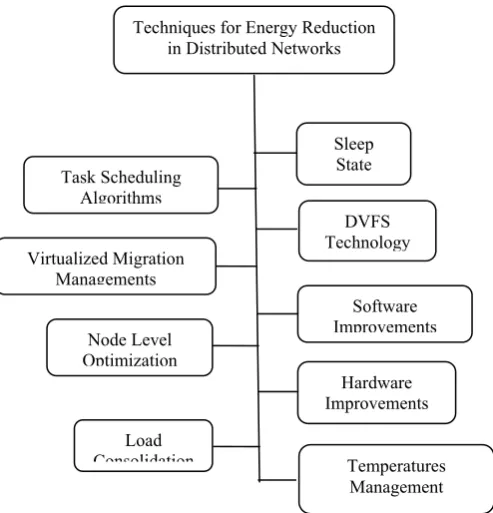
The Following diagram represented in given below: Sleep
State
DVFS Technology
Software Improvements
Hardware Improvements Task Scheduling
Algorithms
Virtualized Migration Managements
Node Level Optimization
Techniques for Energy Reduction in Distributed Networks
Load
Kamlesh Kumar Verma et al, International Journal of Advanced Research in Computer Science, 9 (1), Jan-Feb 2018,939-944
Temperature Control by Data Centre Air Condition (DCAC)
Energy aware of task scheduling.
Load estimation.
System configuration energy
Energy emits with CO2.
Load balancing through data centres.
V. ENERGY COMPUTATION BY ROUTING A LGORITHMS
There are various methods for finding the energy consumption by the method of routing algorithms.
A. Bellman- Ford Algorithm.
Its algorithms solve the single source shortest paths problem. The graphs where the edge-weights may be negative, but no negative weight cycle exists in dynamic programming. The Bellman-ford equation is
d
x( ) min { ( , )
y
vc x v
d y
v( )}
(6)dx(y), be the cost of the least-cost path from node x to node y. where the min v, in the equation, is taken over all of x is the neighbors traveling from x to v, if we take the least-cost path from v to y, the path cost will be c(x,v) + dv (y) . It begin by traveling to some adjacent v, the minimum cost from x to y is of c (x,v)+ dv (y) across whole near vertices v.
B. Optimization Scheduling Algorithms for Energy
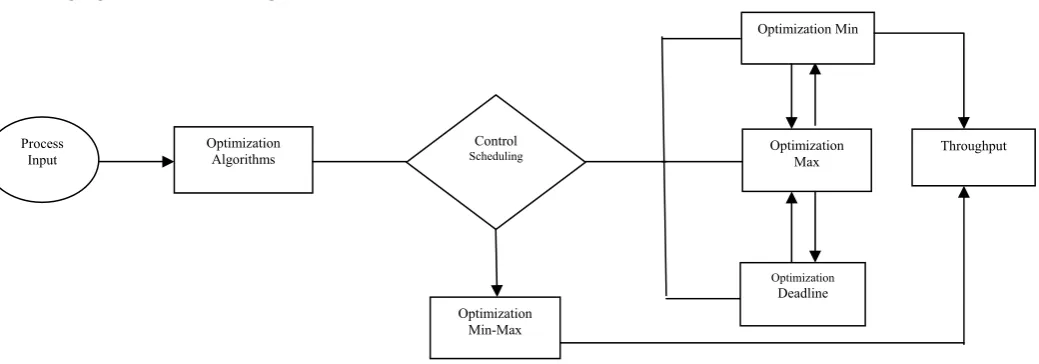
Efficient Networks The optimization algorithms are used to find solutions for the energy consumption through task scheduling allocation problem in the following figure 4. is represented:
Optimization Scheduling Algorithms –
The routing algorithms in scheduling as
(1) Link sates routing (2) Distance vector routing
(3) Minimum, Maximum and Mini-Max Scheduling
C. Dijkstra’s Algorithm
In this algorithm shortest path from a single source to all destinations i.e. vertices on a graph with non-negative weights. The algorithm is used for single source shortest path but no negative cycles. In this algorithms divide the nodes into two sets (a) Provisional Method (b) Permanent Method. It finds the neighbors of a current node makes them provisinal and examines if they pass the criteria makes them permanent. Dijkstra's algorithm requires processing time proportional to the number of links in the graph i.e. n * k links and describes by the log of the number of nodes in the net, it defines the originated term as O (n * k log n).
VI. CONCLUSIONS
Energy consumption is one of the most important roles in the wired and wireless sensor networks. The main objective of energy consumption computing is two types (i) Software- based energy consumption techniques (ii) Hardware-based energy consumption techniques. The DVFS techniques to reduce power consumption of CPU during communication, The routing scheduling techniques and algorithms are methods of finding energy consumption as an important computational method in networks. The Energy saving in wire or distributed networks having a lot of challenges across the world. In this paper, the energy consumption not only for energy consumption but it is also used for energy balance to increase and lifetime for futuristic.
[image:4.595.44.564.540.722.2]
Figure 4. Flowchart of Optimization Scheduling Algorithms in Networks Optimization
Algorithms
Optimization Min
Optimization Max
Optimization Deadline Control
Scheduling
Optimization Min-Max
Throughput Process
Kamlesh Kumar Verma et al, International Journal of Advanced Research in Computer Science, 9 (1), Jan-Feb 2018,939-944
VII.REFERENCES
[1] Hammadi, Ali., and Mhamdi, Lofti., “ A Survey On Architectures and Energy Efficiency in Data Center Networks”,Computer Comm, Science Direct, Elsevier
https://doi.org/10.1016/j.comcom.2013.11.005, pp. 1-21, 2014.
[2] Orgerie, Anne-Cecile., De Assuncao, Marcos Dias., et al.“A Survey on Techniques for Improving The Energy Efficiency of Large Scale Distributed Systems”, ACM Computing Surveys, pp. 1-35, 2014.
[3] Hn, Song. Li., Xin, bin., Liu, Zhixin., and Guan, Xinping.,“ Distributed Hierarchical Game-Based Algorithm for Downlink Power Allocation in OFDMA Femto Cell Networks”.Computer Networks, pp 1–13, 2015.
[4] Moety,Farah., Lahoud, Samer., Cousin,Bernard., and Khawam, Kinda.,“ Optimization Models for the Joint Power – Delay Minimization Problem in Green Wireless Access Networks.” Computer Networks 92 148167,http://dx.doi.org/10.1016/j.comnet.09.032, 2015. [5] Huang, Zhen., Chen, Jinbang., Lin, Yisong., You, Pengfei.,
and Peng, Yuxing.,“Minimizing Data Redundancy for High Reliable Cloud Storage Systems”. Computer Networks pp. 164– 177, 2015.
[6] A.,Hassan., Hanan, A., Mohamed, Shimaa., M Sheta, Walaa.,“Scalability and Communication Performance of HPC on Azure Cloud”. Egyptian Informatics Journal, 2015. [7] Agostini n, Lara. Filippini, Roberto. Nosella, Anna., “Management and Performance of Strategic Multipartner SME Networks”. International Journal Production Eco. pp. 376–390, 2015.
[8] Alonso,M., Coll, S., Martínez ,J.M., Santonja,V.,P, López.,“ Power Consumption Management in Fat-Tree inter Connection Networks”. Parallel Computing pp. 59– 80, 2015.
[9] Zdraveski, Vladimir., Todorovski, Mirko., Kocarev, Ljupco., “ Dynamic Intelligent Load Balancing in Power Distribution Networks”. Electrical Power and Energy Systems pp 157–162, 2015.
[10] Krzysztof, Walkowiak., Michał, Woźniak., Mirosław, Klinkowski., Wojciech, Kmiecik., “Optical Networks for Cost-Efficient and Scalable Provisioning of Big Data Traffic”. Inter J. of Parallel, Emergent and Distributed Systems,Vol. 30, No. 1, pp. 15–28, 2015.
[11] Al-Ayyoub, Mahmoud., et al.“Optimizing Expansion Strategies for Ultrascale Cloud Computing Data Centers.” Simulation Modelling Practice and Theory pp. 15–29, 2015.
[12] Bilal,Kashif.,Khalid,Osman.,Alvarez,Enrique.,ameed,Abdu l., et, al., “A Taxonomy and Survey On Green Data Center Networks”. Future Generation Computer Systems, pp. 189– 208, 2014.
[13] Rengarajan, Balaji., Rizzo, Gianluca., Ajmone Marsan, Marco.,“Energy-Optimal Base station Density in Cellular Access Networks with Sleep Modes”. Computer Networks, pp. 152–163, 2015.
[14] O’Neill, Danielle, and Hook, Alan., “Future Energy Networks and the Role of Interactive Gaming As Simulation”. Computer Networks, pp. 01-11, 2016.
[15] Qiu, Tie., Luo, Diansong., Xia, Feng., et. al. “A Greedy Model with Small World for Improving the Robustness of Heterogeneous Internet of Things”,Computer networks, pp. 01-17, 2016.
[16] Chołda, Piotr., and Jaglarz, Piotr., “Optimization Simulation - Based Risk Mitigation in Resilient Green Communication Networks”, Journal of Network and Computer Applications 59 pp. 134–157, 2016.
[17] Tang, Meiqin., and Xin, Yalin., “Energy Efficient Power Allocation In Cognitive Radio Network Using Coevolution Chaotic Particle Swarm Optimization”. Computer Networks, pp. 1–11, 2016.
[18] Jiang, Tao., et al. “Towards Secure and Reliable Cloud Storage against Data Re-Outsourcing”. Future Generation Computer Systems, pp 86–94, 2015.
[19] Mershad N, Khaleel., Artail, Hassan., Saghir, Mazen., Hajj, Hazem., Awad, Mariette.,“A Mathematical Model to Analyze the Utilization of a Cloud Data Center Middleware”,Journal of Network and Computer Applications, pp. 399–415, 2016. [20] Alkhanak, EhabNabie., Peck Lee,Sai., Rezaei, Reza., Parizi,
Reza Meimandi., “Cost Optimization Approaches for Scientific Work Flow Scheduling in Cloud and Grid Computing : A Review, Classifications and Open Issues”. The Journal of Systems. and Software, pp. 1–26, 2016. [21] He, Li., and Li, Furong., “A Fast Diagnosis Algorithm for
Interconnection Network in High Performance Computers”. International Journal of Parallel, Emergent and Distributed Systems, pp. 34-46, 2016.
[22] Bandit wattanawong, Thepparit. ,Masdisornchote, Masawee., thayopas, Putchong., “Multi-Provider Cloud Computing Network Infrastructure Optimization”. Future Generation Computer Systems, pp. 116–128, 2016.
[23] A. Lynch, Nancy.,“Distributed Algorithms(The Morgan Kaufmann Series in Data Management Systems)”, publisher: Morgan Kaufmann, ISBN:1558603484, 9781558603486, 1996.
[24] Elavarasan, R., and Steffi, Perpectual A.,“Energy Efficient Data Collections Structure for Wireless Sensor Networks”. International Journal of Science and Research (IJSR), ISSN 2319-7064, Volume 3, Issue 4, April 2014.
[25] Lange,C.,Kosiankowski, D., Weidmann, R., Gladisch, A., “Energy Consumption of Telecomm Networks and Related Improvement Options”.IEEE Journal of Selected Topics in Quantum Electronics, 17(2), pp.285- 295, 2011. [26] Bolla, R.,et al. “Energy Efficiency In The Future Internet a
Survey of Existing Approaches and Trends In Energy- Aware Fixed Network Infrastructures”. IEEE Comm. Surveys & Tutorials, 13(2), pp.223- 244, 2011.
[27] Tseng, Po-Kai., and Chung, Wei-Ho., “Near Optimal Link On/Off Scheduling and Weight Assignment for Minimizing IP Network Energy Consumption”. Computer Communications 35.6:729-737, 2012.
[28] Baliga, Jayant., Ayre, Robert., Hinton, Kerry., and S.Tucker, Rodney., “Energy Consumption In Wired and Wireless Access Networks”, Energy Efficiency in Communication”.IEEE Communication Magazine 49.6 : pp.70-77, 2011.
Kamlesh Kumar Verma et al, International Journal of Advanced Research in Computer Science, 9 (1), Jan-Feb 2018,939-944
Fernández , J., “ On The Design of Energy Efficient Hardware Transactional Memory Systems”, Concurrency and Computation: Practice and Experience, Published, 2012.
[30] Chiaraviglio, Luca., et al. “Modelling Sleep Mode Gains In Energy-Aware Networks”. pp. 051– 3066, Computer Networks, 2013.
[31] Castañé, Gabriel G., Llopis, Pablo., and Carretero,Jesús., “ E-Mc2: A Formal Framework For Energy Modelling In Cloud Computing”. Simulation Modelling Practice and Theory”, pp. 56– 75, 2013.
[32] Schien, Daniel., Shabajee, Paul., et al., “Modelling and Assessing Variability in Energy Consumption During the Use Stage of Online Multimedia Services”. Journal of Industrial Ecology Information and Communication Technology (ICT), 2013.
[33] Lin, Gongqi., Soh, Sieteng., Chin, Kwan-Wu., Lazarescu, Mihai., “Efficient Heuristics For Energy-Aware Routing In Networks with Bundled Link”. Computer Networks pp. 1774–1788, 2013.