Volume 8, No. 3, March – April 2017
International Journal of Advanced Research in Computer Science RESEARCH PAPER
Available Online at www.ijarcs.info
Optimisation of ETL Process Using Partitioning and Parallelization Techniques
Kumari Deepika
M.Tech(Computer Science and Technology) Central University of Punjab,Bhatinda,India
Abstract:The key asset of an organization is organized data in a proper format which helps the decision makers to take critical business decisions. Organizations have multiple business functions that are generating data and it is increasingly important for decision makers to analyze and act on these data. Extract-Transformation-Loading (ETL) is a process in data warehousing which converts the structure of data and enables decision makers as well as other applications to access it. As the volume of data is growing so quickly, ETL processes have to deal with a large amount of data and manage workloads through many different data flows, they consume a significant amount of time in order to move data from source to target system. However in most of the systems the effectiveness of the decisions matters on how quickly the decision has been made. In this work, we have analyzed the behaviour of various operations to extract, transform and load the data. Since ETL processes have to complete their execution within a specified time window in order to meet SLA given by the organization. In this paper, we delve into the optimization methods of ETL processes in order to minimize the execution time of ETL jobs. We identify the bottlenecks which cause the delay in execution of ETL process. We provide the techniques using partition, parallelization, and multi-threading which will help us to optimize the execution of ETL process.
Keywords: ETL; Dataflow Partitioning; Parallelization; Optimization.
I. INTRODUCTION
Data is scattered throughout the different systems within the organizations and proven useless because of not stored in centralized manner in proper schema and format. Extract, Transform, and Load (ETL) is the method used nowadays for transferring data from a source system to a data warehouse. It involves fetching data from many outside sources, transforming it to fit the operational needs (sometimes using intermediate tables), then loading it into the target Database (DB) or data warehouse. In Data extraction process, data is retrieved from distinct data sources for further processing or data storage. Data transformation activities are responsible to convert a set of data values from the data format of a source data system into the data format of a destination data system according to business logic given by client in the form of business requirement document (BRD).[1]
ETL process in data warehousing technologies performs the following tasks for pulling data out of the source systems and placing it into a data warehouse:
- extracting the data from source systems, data from different source systems is converted into one consolidated data warehouse format which is ready for transformation processing.
-Transforming the data may involve the following tasks
- Applying required business rules - Cleaning columns
- Filtering rows
- Splitting column into multiple columns and vice versa
- Joining data together from multiple sources - Transposing rows and columns
- Applying any kind of simple or complex data validation
- Loading the data into a data warehouse or data repository other reporting applications.
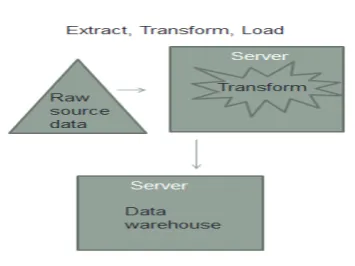
[image:1.595.350.528.385.518.2]As shown in figure 1, in view of large data volume and to speed up the process a spate server can be used to perform ETL.
FIGURE 1: ETL PROCESS FLOW
The main objective of ETL process is to provide the right information to the right people at right time. ETL process has to be completed its execution within a specified-time period. Several optimization methods have been proposed to optimize the ETL performance. Partitioning and parallelization method is based on execution of multiple dataflow simultaneously proves useful in optimizing ETL performance by multithreading and optimal resource utilization. However this approach is limited to ETL dataflow itself. Partitioning and parallelization concepts can be extended to source and target side as well improve the ETL process performance. Pushdown logic i.e. part of ETL logic pushed to the database side can also produce the better performance.[10]
invest in enhancing storage and processing capabilities in order to improve the pace of ETL process execution. ETL developers therefore tend to improve ETL poor performance to make data warehousing systems efficient enough to cater the timely data needs of enterprises. The Performance is assessed either on DB level or ETL levels. The process of achieving good performance improvement in designing new ETL mapping and also fine tune the performance of existing ETL mapping ETL loads needs the performance assessments on all the ETL constructs levels i.e. source and target database levels as well as ETL processing levels.
1. DB LEVEL TUNING
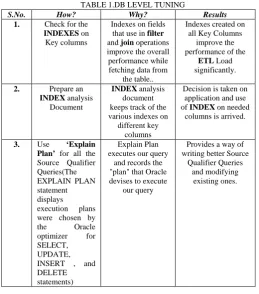
To achieve good performance, it is first need to ensure that all the bottlenecks on the DB side are removed which ensures that the sources are in synchronized and hence full utilization of the source system is achieved. The details of how to overcome the DB side bottlenecks and its’ effects are mentioned in table-1
[image:2.595.29.289.296.591.2]
TABLE 1.DB LEVEL TUNING
S.No. How? Why? Results
1. Check for the
INDEXES on Key columns
Indexes on fields that use in filter
and join operations improve the overall performance while fetching data from
the table..
Indexes created on all Key Columns
improve the performance of the
ETL Load significantly.
2. Prepare an
INDEX analysis Document
INDEX analysis document keeps track of the various indexes on different key
columns
Decision is taken on application and use of INDEX on needed
columns is arrived.
3. Use ‘Explain Plan’ for all the Source Qualifier Queries(The EXPLAIN PLAN statement displays
execution plans were chosen by the Oracle optimizer for SELECT,
UPDATE, INSERT , and DELETE
statements)
Explain Plan executes our query
and records the "plan" that Oracle devises to execute
our query
Provides a way of writing better Source
Qualifier Queries and modifying
existing ones.
2. INFORMATICA LEVEL TUNING
Once the DB level tunings are completed and now all the sources are fully tuned, we start looking at the Informatica level tuning. The details of how to overcome the Informatica side bottlenecks and it’s effects are mentioned in table-2.
TABLE 2.INFORMATICA LEVEL TUNING
S.No. How? Why? Results
1. Removal of unwanted fields.
The Source Qualifier Query should have a select statement with only the fields that are required and which get loaded into the Target table.
This will bring down the running time of the SQL queries and this means the data will be fetched quickly from the database.
2. Avoid constraints in
The usage of WHERE..IN..clause
Instead use WHERE
WHERE Clause.
in the SQL Query should be avoided since it consumes more time in the query completion.
…EXISTS…clause which will results in better performance.
3. LOOK UP & FILTER transformation
The Lookup and transformations combination always work very effectively in order to achieve good performance while handling huge data loads in the ETL process.
This result in faster load operations and hence the performance improves.
It is also required to establish a balance between these two levels by way of shifting the constraints according to the need and adopt a right method for testing the performance.
The paper is organized as follows. In section 2 describes literature review. In section 3 presents the experimental approach, and the optimizations applied to the data flows. In section 4 presents the implementation and the evaluation. In section 5 concludes the paper.
II. LITERATUREREVIEW
[image:2.595.30.269.663.786.2]pre-process data, to improve the efficiency of queries, and to accelerate changed data capture CDC. CDC method uses MD5 algorithm to combine values of multiple columns into a single generated hash value and compares the hash values of columns from different sources in one pass to capture changes in data. If any change is found then update operation takes place. In [4] author has guided us to provide sorted data to aggregator and joiner in order to enhance their performance. In [5] author focuses to be kept on managing the metadata of ETL process in order to optimize ETL performance but since metadata is heart of an ETL process so developers can’t be given access to metadata. He proposed ETL management through metadata management. A metadata management system with good design can highly improve the ETL efficiency. However, the large amount and the wide distribution of metadata in ETL processes cause the mismanagement of metadata. To deal with this problem, they suggest intensively manage ETL by metadata repository. Metadata repository is the data storage which can show DBAs the data about ETL objects in a simple, and centered way, and enables them to understand metadata more easily, therefore metadata management becomes simpler, and more centered. Compared with the common one, ETL processes based on metadata repository have a much better optimization effect. Lacking of effective management for the complex metadata leads to the inefficient ETL processes. To deal with this defect, it is suggested that DW designer can adopt Metadata Repository to manage metadata efficiently for the realization of a standardized and efficient ETL processes. All kinds of ETL modifications can be made conveniently in Metadata Repository such as modification of the source tables or the target data model both can be controlled by Metadata Repository. Once developers have Metadata Repository, they can see the relations between tables or attributes clearly, get a clear view to modify and maintain the ETL processes intensively, and realize the ETL processes optimization. Metadata repository stores execution plans , technical metadata, and business metadata. Business metadata should include dimensionality model and the dependency relationship between dimensional model and data source. Dimensional model mainly involves what kinds of dimensions, the differences among the dimensions, data cube and some rules in data mart. The key of metadata repository construction lies in technical metadata construction which needs the guide of material ETL process and business metadata repository. To Design a framework with reasonable structure and effective operation, and to create a metadata model for the unsystematic metadata through data extract, classifying and modeling, composing a metadata repository with distinct metadata views. Intensive management of metadata through the operation towards metadata repository, optimizing ETL. In [5], author has guided us to enable/disable constraints at the time of loading would help to optimize the performance of ETL process. In [6], author focuses to be kept on using relational algebra as a modeling language that is pushed logic towards the database in case of relational sources. He proposed the application of Relational Algebra as a modeling language of an ETL system as an effort to standardize operations and provide a basis for ETL execution platforms. As the volume of information to be processed periodically increases, an ETL task consumes more time and more resources. An ETL system is comprised of several tasks that gather data from source systems transforms it, and finally loading it into a DW. As already stated
can make the process more efficient and better performance could be achieved.
III. METHODOLOGY
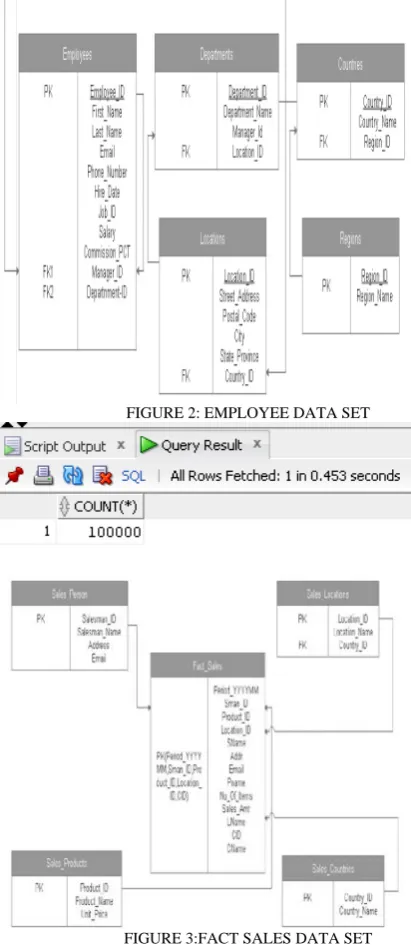
[image:4.595.38.244.163.637.2]In this work, we are taking two data sets: employee data set and fact sales data set.
[image:4.595.301.521.453.636.2]FIGURE 2: EMPLOYEE DATA SET
FIGURE 3:FACT SALES DATA SET
In this work, we will perform the activities of 6 cases as mentioned below:
1. w/o and with ETL source partition
An ETL job running with a single dataflow takes t time units to complete its execution. If multiple data flows are created instead of single data flow and data transformation task is handled in a parallel mode simultaneously in multiple flows then execution time will be reduced significantly by n times.
2.w/o and with pushdown logic in ETL mapping
Operations performed on the database side are faster than operations performed on ETL side. So pushdown logic will
optimize the overall performance of ETL process. Operations on Database side are compared with the operations on ETL side on the basis of execution time.
3.w/o and with disable/enable Primary Key constraints When load happens in a table integrity of data is to be checked because of constraints defined on a table and it makes the load operations slow. If constraints are disabled before loading these integrity checks won’t be performed at the time of loading and load operations will be faster.
4.Join operation for unsorted and sorted data
More number of iterations is required to perform join operations if sorted data is not coming from the downstream sources and operations will be slower. If sorted data will be passed from downstream sources join operations will be faster.
5.Aggregate operation for unsorted and sorted data
To perform aggregate operations data is grouped on the basis of GROUP BY columns and if sorted data is not coming from downstream sources the full table scan is performed to group data. If sorted data will be passed from downstream sources only partial scan will be performed and aggregate operations will be faster.
6.w/o and with ETL target partition
If parallelization and partition techniques are applied on source and target systems as well then fetching and loading (Insert as well as Delete) operations of an ETL job will be tuned well and there is a significant performance gain.
IV. RESULTSANDDISCUSSION
TABLE 3.PERFORMANCE EVALUATION IN ETL TOOL
Performance Evaluation Chart
Performance Analysis (Time in Sec)
Data Analysis (Y/N)
For Employee Data Set and # records = 100000.
w/o source Partition logic
35 Y
With source Partition logic
09 Y
w/o Pushdown logic 39 Y
With Pushdown logic 33 Y
w/o Target Partition Logic
748 Y
With Target Partition Logic
FIGURE 2. GRAPHICAL REPRESENTATION OF PERFORMANCE EVALUATION OF ETL JOBS
Analysis:
In [10], author takes into account the characteristics of ETL components, and based on the characteristics to do partitioning and optimizations. Using of the shared caches of transferring data that can’t only reduce memory usage but also minimize I/O usage. Pipelining and multi threading both are used as well in order to optimize the performance of ETL flows. This approach has shown 4.7 times faster than usual approach. By analyzing this approach we have got the idea of implementation of partitioning at source as well as target side in order to improve the insert, update, and delete operation. In the approach of partitioning source table and implementing multiple ETL flows has shown 4 times faster than usual approach . In the approach of partitioning target table and implementing insert operation through bulk load and instead of deleting one row at a time , bulk delete operation is performed by dropping a particular partition operation has shown 5.6 times faster than usual approach.
In [6], author takes into account the application of the RA language as a modeling language of an ETL system in an effort to standardize operations and provide a basis for uncommon ETL execution platforms. Data transformations usually appear in any regular ETL system may be implemented using procedural representation for the description and validation of data based operations. By analyzing this approach we have got the idea of pushing ETL logic towards database. Some blocking and complex transformations consume a significant amount of memory and other resources, block the data and use separate space in memory to do their processing. These transformation logic can be pushed to the database side (either source or target), the optimizer of the database prepares the optimal plan and processes the logic so that execution time is reduced significantly. In the approach of implementation of push down logic has shown 1.2 times faster than the usual approach. If some query optimization technique is applied along with pushdown logic might produce the more optimal solution.
TABLE 4 .PERFORMANCE EVALUATION IN DB PROCEDURE
Approac h Disable/Enable Primary Key Constraint Aggregate Operation on unsorted and sorted Operation Join Operation on unsorted and sorted operation
# records Time taken w/o approac h (in sec) Time taken with approach(i n sec) Time taken for unsorte d data(in sec) Time taken for sorted data(i n sec) Time taken for unsorte d data(in sec) Time taken for sorte d data (in sec)
1100000 64 26 9 3 67 52
2200000 124 54 17 9 142 120
3300000 167 104 25 12 209 180
4400000 290 110 35 17 284 254
5500000 301 119 45 24 349 307
6600000 387 162 54 29 401 378
[image:5.595.302.566.53.252.2]7700000 463 240 68 31 578 465
FIGURE 3. GRAPHICAL REPRESENTATION OF PERFORMANCE EVALUATION OF DISABLE/ENABLE PRIMARY_KEY CONSTRAINT
[image:5.595.308.552.408.659.2]In [5], author takes into account the methods of managing the metadata in ETL process intensively by using the ETL metadata repository, properly analyzed metadata would speed up the pace of ETL. By analyzing this approach we have got an idea of disabling and enabling constraints by modifying the metadata of the target table before and after loading that table. We have performed the experiment on seven distinct set of records (1100000-7700000) and observed that the performance of these experiments have ranged from 1.6 to 2.6 times(2.25 times on average) faster than the usual approach.
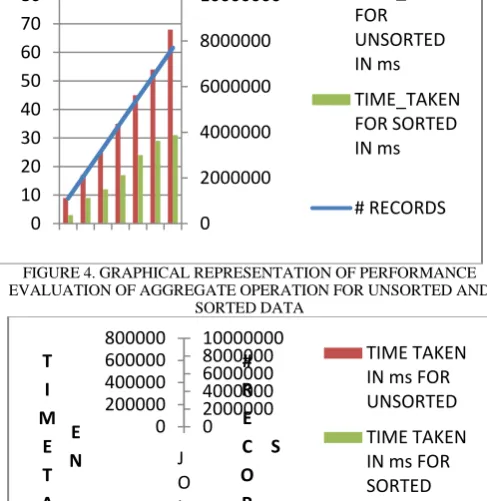
FIGURE 4. GRAPHICAL REPRESENTATION OF PERFORMANCE EVALUATION OF AGGREGATE OPERATION FOR UNSORTED AND
SORTED DATA
FIGURE 5. GRAPHICAL REPRESENTATION OF PERFORMANCE EVALUATION OF JOIN OPERATION FOR UNSORTED AND SORTED
DATA
In [4], author takes into account that aggregation and join are very common operation in ETL processing of every industrial 0 20000 40000 60000 80000 100000 120000 0 200 400 600 800 S O U R # R E C O R D S T I M E T A K E N JOB_NAME TIME TAKEN IN sec w/o TIME TAKEN IN sec WITH RECORD
COUNT 020000004000000
sector where large volumes of data is processed. To optimize aggregate and join operation speeds up the pace of ETL process. By analyzing this approach we have got an idea of passing sorted data to aggregate and join operations. Sorted data will reduce the number of comparisons in joins and the waiting time of aggregate operation. We have performed the experiment of aggregate operation on seven distinct set of records (1100000-7700000) and observed that the performance of these experiments have ranged from 1.9 to 3 times (2.13 times on average) faster than the usual approach. We have again performed the experiment of join operation on seven distinct set of records (1100000-7700000) and observed that the performance of these experiments have ranged from 1.06 to 1.28 times (1.16 times on average) faster than the usual approach.
V. CONCLUSION
An ETL job running with a single data flow takes t time units to complete its execution. If multiple data flows are created instead of single data flow and data transformation tasks are handled in a parallel mode simultaneously in multiple flows then execution time will be reduced significantly. A huge volume of data has to be loaded into the target table and Data load rate is slow because of constraints on the target table. To disable constraints before load and to enable them after load can improve the ETL job performance significantly. In ETL scenarios, Join and aggregate operations cause degradation in performance. Passing sorted data to joiner and aggregator can improve the performance of join and aggregate operations. Since ETL applies the transformations step by step and can be time-consuming in some scenarios like joining many tables. Such logic can be pushed to database side to make the ETL job’s execution faster. The reasons of performance degradation may be found in ETL transformation operations as well as fetching and loading operations. In some scenarios, ETL jobs have to perform Insert as well as delete and update operations. Instead of performing delete and update operation on row level, these operations can be performed on the whole set of data in one go by using table partition and temporary table concepts. Deleting data using drop a partition of a table is faster and it will produce a significant performance gain.
VI. ACKNOWLEDGMENT
I would like to thank Er. Surinder Singh Khurana (Assistant Professor) for continuously providing me support and guide me to do my work and also to the academic sources and environment provided to the students in the Central University of Punjab.
VII. REFERENCES
[1]. M.Kumar, N. A. (4-6 July 2013). Modeling and optimization of extraction-transformation-loading (ETL) processes in data warehouse: An overview. Computing, Communications and Networking Technologies (ICCCNT),2013 Fourth International Conference on (pp. 1 - 5). Tiruchengode: IEEE.
[2]. Vassiliadis, A. S., & Sellis, T. (5-8 April 2005). Optimizing ETL processes in data warehouses. Data Engineering, 2005. ICDE 2005. Proceedings. 21st International Conference on (pp. 564 - 575). Athens, Greece : IEEE.
[3]. A. Simitsis, P. V., & Sellis, T. (Oct. 2005). State-space optimization of ETL workflows. IEEE Transactions on Knowledge and Data Engineering (Volume:17 , Issue: 10 ) (pp. 1404 - 1419). Greece: IEEE.
[4]. Tank, D. M., Ganatra, A., Kosta, Y. P., & Bhensdadia, C. K. (16-17 Oct. 2010). Speeding ETL Processing in Data Warehouses Using High-Performance Joins for Changed Data Capture (CDC). Advances in Recent Technologies in Communication and Computing (ARTCom), 2010 International Conference on (pp. 365 - 368). Kottayam: IEEE.
[5].cLi, L. (16-18 April 2010). A framework study of ETL processes optimization based on metadata repository. Computer Engineering and Technology (ICCET), 2010 2nd International Conference on (Volume:6 ) (pp. V6-125 - V6-129). Chengdu: IEEE
[6]. Belo, V. S. (26-28 Oct. 2015). Using Relational Algebra on the Specification of Real World ETL Processes. Computer and Information Technology; Ubiquitous Computing and Communications; Dependable, Autonomic and Secure Computing; Pervasive Intelligence and Computing (CIT/IUCC/DASC/PICOM), 2015 IEEE International Conference on (pp. 861 - 866). Liverpool: IEEE.
[7]. R. Wijaya, B. P. (27-29 May 2015). An overview and implementation of extraction-transformation-loading (ETL) process in data warehouse (Case study: Department of agriculture).
Information and Communication Technology (ICoICT ), 2015 3rd International Conference on (pp. 70 - 74). Nusa Dua: IEEE
[8]. Yingying Tu, C. G. (29-31 Oct. 2010). An intelligent ETL workflow framework based on data partition. Intelligent Computing and Intelligent Systems (ICIS), 2010 IEEE International Conference on (Volume:3 ) (pp. 358 - 363). Xiamen: IEEE.
[9]. Gupta, C., Wang, S., & U. Dayal, A. S. (1-6 March 2010). Partitioning real-time ETL workflows. Data Engineering Workshops (ICDEW), 2010 IEEE 26th International Conference on (pp. 159 - 162). Long Beach, CA: IEEE.
[10]. Iftikhar, X. L. (2015-04-13 ). An ETL optimization framework using partitioning and parallelization. SAC '15 Proceedings of the 30th Annual ACM Symposium on Applied Computing (pp. 1015-1022). USA: ACM New York, NY, USA ©2015.