Proceedings of the Workshop on Cognitive Aspects of Computational Language Acquisition, pages 9–16,
Using Classifier Features for Studying the Effect of Native Language on the
Choice of Written Second Language Words
Oren Tsur
Institute of Computer Science The Hebrew University
Jerusalem, Israel
Ari Rappoport
Institute of Computer Science The Hebrew University
Jerusalem, Israel
www.cs.huji.ac.il/∼arir
Abstract
We apply machine learning techniques to study language transfer, a major topic in the theory of Second Language Acquisition (SLA). Using an SVM for the problem of native language classification, we show that a careful analysis of the effects of various features can lead to scientific insights. In particular, we demonstrate that character bi-grams alone allow classification levels of about 66% for a 5-class task, even when con-tent and function word differences are ac-counted for. This may show that native lan-guage has a strong effect on the word choice of people writing in a second language.
1 Introduction
While advances in NLP achieve improved results for NLP applications such as machine translation, ques-tion answering and document summarizaques-tion, there are other fields of research that can benefit from the methods used by the NLP community. Second Lan-guage Acquisition (SLA), a major area in Applied Linguistics and Cognitive Science, is one such field. In this paper we demonstrate how modern machine learning tools can contribute to SLA theory. In par-ticular, we address the major SLA topic of language transfer, the effect of native language on second lan-guage learners. Using an SVM for the computa-tional problem of native language classification, we study in detail the effects of various SVM features. Surprisingly, character bi-grams alone lead to a clas-sification accuracy of about 66% in a 5-class task,
even when accounting for differences in content and function words.
This result leads us to form a novel hypothesis on the role of language transfer in SLA: that the choice of words people make when writing in a second lan-guage is strongly influenced by the phonology of their native language.
As far as we know, this is the first time that such a hypothesis has beed formulated. Moreover, this is the first statistical learning-supported hypothesis in language transfer. Our results should be further sub-stantiated by additional psycholinguistic and com-putational experiments; nonetheless, we provide a strong starting point.
The next section provides some essential back-ground. In Section 3 we describe our experimen-tal setup and feature selection, and in Section 4 we detail an array of variations of experiments for rul-ing out some possible types of bias that might have affected the results. In Section 5 we discuss our hy-pothesis in the context of psycho-linguistic theory. We conclude with directions for future research.
2 Background
Our hypothesis is tested within an algorithm ad-dressing the practical problem of determining the native language of an anonymous writer writing in a foreign language. The problem is applicable to dif-ferent fields, such as language instructing, tailored error correction, security applications and psycho-linguistic research.
As background, we start from the somewhat re-lated problem of authorship attribution. The au-thorship attribution problem was addressed by
guists and other literary experts trying to pinpoint an anonymous author, such as that of The Federalist Papers (Holmes and Forsyth, 1995). Traditionally, authorship experts analyzed topics, stylistic idiosyn-crasies and personal information about the possible candidates in order to determine an author.
While authorship is usually addressed with deep human inspection of the texts in question, it has al-ready been shown that automatic text analysis based on various stylistic features can identify the gender of an anonymous author with accuracy above 80% (Argamon et al, 2003). Various papers (Diedrich et al, 2003; Koppel and Schler, 2003; Koppel et al, 2005a; Stamatatos et al, 2004) report relative suc-cess in machine based authorship attribution tasks for small sets of known candidates.
Native language detection is a harder problem than the authorship attribution problem, since we wish to characterize the writing style of a set of writers rather than the unique style of a single person. There are several works presenting non-native speech recognition and dialect analysis sys-tems (Bouselmi et al, 2005; Bouselmi et al, 2006; Hansen et al, 2004). However, all those works are based on acoustic signals, not on written texts.
Koppel et al (2005a) report an accuracy of 80% in the task of determining a writer’s native language. To the best of our knowledge, this is the only pub-lished work on automated classification of an au-thor’s native language (along with another version of the paper by the same authors (Koppel et al, 2005b)). Koppel et al used an SVM (Sch¨olkopf and Smola, 2002) and a combination of features in their system (such as errors analysis and POS-error co-occurrences, as described in section 2.2), but sur-prisingly, it appears that a very naive set of features achieves a relatively high accuracy. The charac-ter bi-gram frequencies feature performs rather well, and definitely outperforms the intuitive contribution of frequent bigrams in this type of task.
3 Experimental Setting
3.1 The Corpus
The corpus that served for all of the experiments described in this paper is the International Corpus of Learner English (ICLE) (Granger et al, 2002), which was also the one used by Koppel et al (2005a;
2005b). The corpus was compiled for the purpose of studying the English writing of non-native speakers. All contributors to the corpus are advanced English students and are roughly the same age. The corpus is combined from a number of sub-corpora, each con-taining one native language. The corpus was assem-bled in ten years of international collaboration be-tween a number of universities and it contains more than 2 million words of writing by students from 19 different native language backgrounds. We followed Koppel et al (2005a) and worked on 5 sub-corpora, each containing 238 randomly selected essays by na-tive speakers of the following languages: Bulgarian, Czech, French, Russian and Spanish. Each of the texts in the corpus was written by a different author and is of length between 500 to 1,000 words. Each of the sub corpora contains about 180,000 (unique) types, for a total of 886,677 tokens.
Essays in the corpus are of two types: argumen-tative essays and literature examination papers. De-scriptive, narrative or technical subjects were not in-cluded in the corpus. The literature examination es-says were restricted to no more than 25% of each sub-corpus. Each contributor was requested to fill a learner profile that was used to fine-proof the corpus as needed.
In order to verify our results we used another con-trol corpus containing the Dutch and Italian sub-corpora contained in the ICLE instead of the Bul-garian and French ones.
3.2 Document Representation
In the original experiment by Koppel et al (2005a) each document was represented by a numerical vec-tor of 1,035 dimensions. Each vector entry rep-resented the frequency (relative to the document’s length) of a given feature. The features were of 4 types:
• 400 function words
• 200 most frequent letter n-grams
• 250 rare POS bi-gram
• 185 error types
representation is described in detail in (Koppel et al, 2005a; Koppel et al, 2005b).
A multi-class SVM (Witten and Frank, 2005) was employed for learning and evaluating the classifica-tion model. The experiment was run in a 10-fold cross validation manner in order to test the effec-tiveness of the model.
3.3 Previous Results
Koppel et al (2005a) report that when all features types were used in tandem, an accuracy of 80.2% was achieved. In the discussion section they an-alyze the frequency of a few function words, ror types, the co-occurrences of POS tags and er-rors, and the co-occurrences of POS tags and certain function words that seem to have significance in the support vectors learnt by the SVM.
The goal of their research was to obtain the best classification, therefore the results obtained by us-ing only bi-grams of characters were not particularly noted, although, surprisingly, representing each doc-ument by only using the relative frequency of the top 200 characters bi-grams achieves an accuracy of about 66%. We believe that this surprising fact ex-poses some fundamental phenomenon of human lan-guage behavior. In the next section we describe a set of experiments designed to isolate the causes of this phenomenon.
4 Experimental Variations and Results
Intuitively, we do not expect the most frequent char-acter n-grams to serve as good native language pre-dictors, expecting that these will only reflect the most frequent English words (and characters se-quences). Accordingly, without language transfer effects, a naive baseline classifier based on an n-gram model is expected to achieve about 20% ac-curacy in a 5 native languages classification task. However, using classification based on the relative frequency of top 200 bi-grams achieves about 66%1 in all experiments, substantially higher than the ran-dom baseline. These results are so surprising that they suggest that the characters bi-grams classifi-cation masks some other bias or noise in the cor-pus, or, conversely, that it mirrors other
simple-to-1
Koppel et al did not report these results explicitly. How-ever, they can be roughly estimated from their graph.
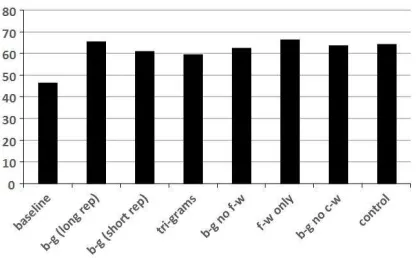
Figure 1: Classification accuracy of the different variations of document representation. b-g: bi-grams, f-w: function words, c-w: content words.
explain phenomena such as shallow language trans-fer through the use of function words, or content bias. The following sub-sections describe different variations of the experiment, ruling out the effect of these different types of bias.
4.1 Unigram Baseline
We first implemented a naive baseline classifier. We represented each document by the normalized fre-quencies of the (de-capitalized) letters it contains2. These frequencies are simply a unigram model of the sub-corpora. Using the multi-class SVM (Wit-ten and Frank, 2005) we obtained 46.78% accu-racy. This accuracy is more than twice the ran-dom baseline accuracy. This result is in accordance with our bi-grams results. Our discussion focuses on bi-grams rather than unigrams because the former’s results are much higher and because bi-grams are much closer to the phonology of the language (for alphabetic scripts, of course).
4.2 Bi-grams Based Classification
Choosing the 200 most frequent character bi-grams in the corpus, we used a vector of the same dimen-sion. Each vector entry contained the normalized frequency of one of the bi-grams. Using a multi-class SVM in a 10-fold cross validation manner we
2
Bulg. Czech French Russian Spanish
dr 170 183 n/a 195 n/a
am 117 135 142 140 152
m 121 120 133 119 139
iv 104 138 144 148 148
y 161 181 196 183 166
la 122 123 122 142 105
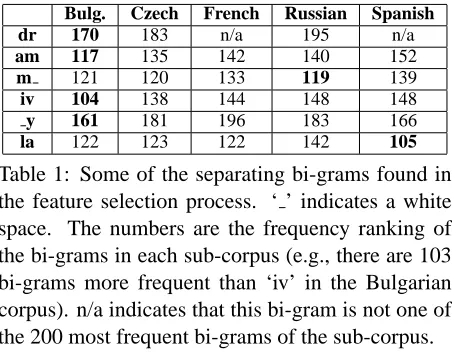
Table 1: Some of the separating bi-grams found in the feature selection process. ‘ ’ indicates a white space. The numbers are the frequency ranking of the bi-grams in each sub-corpus (e.g., there are 103 bi-grams more frequent than ‘iv’ in the Bulgarian corpus). n/a indicates that this bi-gram is not one of the 200 most frequent bi-grams of the sub-corpus.
achieved 65.60% accuracy with standard deviation of 3.99.
The bi-grams features in the 200 dimensional vec-tor are the 200 most frequent bi-grams in the whole corpus, regardless of their frequency in each sub-corpus. We note that the effect of misspelled words on the 200 most frequent bi-grams is negligible.
A more sophisticated feature selection could re-duce the dimension of the representation vector without detracting from the results. Careful fea-ture selection can also give a better intuition regard-ing the support vectors. We performed feature se-lection in the following manner: we chose the top 200 bi-grams of each sub-corpus, getting 245 unique bi-grams in total. We then chose all the bi-grams that were ranked significantly higher or significantly lower in one language than in at least one other language, assuming that those bi-grams have strong separating power. With the threshold of significance set to 20 we obtained 84 separating bi-grams. Table 1 shows some of the separating bi-grams thus found. For example, ‘la’ is a good separator between Rus-sian and Spanish (its rank in the Spanish corpus is much higher than that in the Russian corpus), but not between other pairs.
Using only those 84 bigrams we obtained clas-sification accuracy of 61.38%, a drop of only 4% compared to the results achieved with the 200 di-mensional vectors. These results show that increas-ing the dimension of the representation vector usincreas-ing additional bi-grams contribute a marginal improve-ment while it does not introduce substantial noise.
4.3 Using Tri-gram Frequencies as Features
Repeating the same experiment with the top 200 tri-grams, we obtained an accuracy of 59.67%, which is 40% higher than the expected baseline and 15% higher than the uni-grams baseline. These results show that the texts in our corpus can be classified by only using naive n-gram models, while the op-timal n of the n-gram is a different question that might be addressed in a different work (and might be language-dependent).
4.4 Function Words Based Classification
Function words are words that have a little lexical meaning but instead serve to express grammatical relations within a sentence or specify the attitude of the speaker (function words should not be confused with stopwords, although the lists of most frequent function words and the stopword list share a large subset). We used the same list of 460 function words used by Koppel et al (2005a). A partial list includes:
{a, afterward, although, because, cannot, do, enter, eventually, fifteenth, hither, hath, hence, lastly, oc-casionally, presumable, said, seldom, undoubtedly, was}.
In this variation of the experiment, we represented each document only by the relative frequencies of the function words it contained. Using the same experimental setup as before, we achieved an ac-curacy of 66.7%. These results are less surprising than the results obtained by the character n-grams vectors, since we do expect native speakers of a cer-tain language to use, misuse or ignore cercer-tain func-tion words as a result from language transfer mech-anisms (Odlin, 1989). For example, it is well known that native speakers of Russian tend to omit English articles.
4.5 Function Words Bias
These results, obtained on the function words-free corpus, clearly show that n-gram based classification is not a mere artifact masking the use of function words.
4.6 Content Bias
Bi-gram frequencies could also reflect content bias rather than language use. By content bias we mean that the subject matter of the documents in the dif-ferent sub-corpora could exhibit internal sub-corpus uniformity and external sub-corpus disparity. In or-der to rule this out, we employed a variation on the Term Frequency – Inverted Document Frequency (tf-idf ) content analysis metric.
The tf-idf measure is a statistical measure that is used in information retrieval tasks to evaluate how important a word/term is to a document in a collec-tion or corpus (Salton and Buckley, 1988). Given a collection of documentsD, the tf-idf weight of term
tin a documentd∈Dis computed as follows:
tf idft=ft,d×log |D| ft,D
where ft,d is the frequency of term t in document d, andft,D is the number of documents in whicht
appears. Therefore, the weight of termt∈dis max-imal if it is a common term indwhile the number of documents it appears in is relatively low.
We used the tf-idf weights in the information re-trieval sense in order to discover the dominant con-tent words of each corpus. We treated each sub-corpus (set of documents by writers who share a native language) as a single document and calcu-lated the tf-idf of each word. In order to determine whether there is a content bias or not, we set a domi-nance threshold, and removed all words such that the difference between their tf-idf score in two different sub-corpora is higher than the dominance threshold. Given a threshold t, the dominanceDw,t, of a token wis given by:
Dw,t=maxi,j|tf idfw,i−tf idfw,j|
where tf idfw,k is the tf-idf score of token w in
sub-corpusk. Changing the threshold in 0.0005 in-tervals, we removed from 1 to 340 unique content words (between 1,545 and 84,725 word tokens in to-tal). However, the classification accuracy was essen-tially the same (see Figure 2), with a slight drop of
Word Bulg. Czech Fr. Rus. Spa. europe 0 0.3 2.7 0.2 0.2
european 0 0.3 3 0.1 0.5
imagination 4.3 2 0.8 1 0.8
television 0 3.6 1.9 3.1 0.3
women 0.4 1.7 1.2 5.5 2.6
Table 2: The tf-idf score of some of the most domi-nant words, multiplied by 1,000 for easier reading.
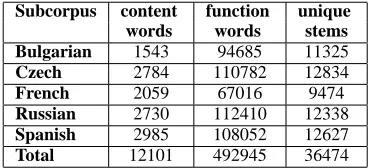
Subcorpus content function unique words words stems Bulgarian 1543 94685 11325
Czech 2784 110782 12834
French 2059 67016 9474
Russian 2730 112410 12338
Spanish 2985 108052 12627
Total 12101 492945 36474
Table 3: Numbers of dominant content words (with a threshold of 0.0025) and function words that were removed from each sub-corpus. The unique stems column indicates the number of unique stems (types) that remained after removal of c-w and f-w.
only 2% after removing 51 content words (by using a threshold of 0.0015).
We calculated the tf-idf weights after stop-words removal and stemming (using a Porter stemmer (Porter, 1980)), trying to pinpoint dominant stems. The results were similar to the word’s tf-idf and no significantly dominant stem was found in either of the sub-corpora.
A drop of only 3% in accuracy was noticed after removing both dominant content words and function words. These results show that if a content bias ex-ists in the corpus it has only a minor effect on the SVM classification, and that the n-grams based
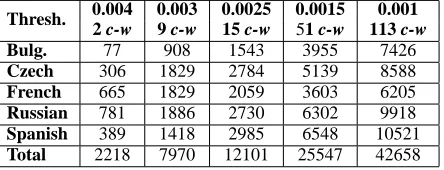
Thresh. 0.004 0.003 0.0025 0.0015 0.001 2 c-w 9 c-w 15 c-w 51 c-w 113 c-w Bulg. 77 908 1543 3955 7426
Czech 306 1829 2784 5139 8588
French 665 1829 2059 3603 6205
Russian 781 1886 2730 6302 9918
Spanish 389 1418 2985 6548 10521
Total 2218 7970 12101 25547 42658
Table 4: Number of occurrences of content words that were removed from each sub-corpus for some of the thresholds. The numbers in the top row indi-cate the threshold and the number of unique content words that were found with this threshold.
sification is not an artifact of a content bias.
We ran the same experiment five more times, each time on 4 sub-corpora instead of 5, removing one (different) language each time. The results in all 5 4-class experiments were essentially the same, and similar to those of the 5 language task (beyond the fact that the random baseline for the former is 25% rather than 20%).
4.7 Suffix Bias
Bias might also be attributed to the use of suf-fixes. There are numerous types of English suf-fixes, which, roughly speaking, may be categorized as derivational or inflectional. It is reasonable to ex-pect that just like a use of function words, use or mis-use of certain suffixes might occur due to language transfer. Frequent use of a certain suffix or avoid-ance of the use of a certain suffix may influence the bi-grams statistics and thus the bi-grams classifica-tion may be only an artifact of the suffixes usage.
Checking the use of the 50 most productive suf-fixes taken from a standard list (e.g. ing, ed, less, able, most, en) we have found that only a small num-ber of suffixes are not equally used by speakers of all 5 languages. Most notable are the differences in the use of ing between native French speakers and na-tive Czech speakers and the differences of use of less between Bulgarian and Spanish speakers (Table 5). However, no real bias can be attributed to the use of any of the suffixes because their relative aggregate effect on the values in the support vector entries is very small.
Suffix Bulg. Czech French Russian Spanish ing 872 719 932 903 759
less 47 36 39 45 32
Table 5: Counts of two of the suffixes whose fre-quency of use differs the most between sub-corpora.
4.8 Control Corpus
Finally, we have also ran the experiment on a differ-ent corpus replacing the French and the Spanish sub-corpora by the Dutch and Italian ones, introducing a new Roman language and a new Germanic language to the corpus. We obtained 64.66% accuracy, essen-tially the same as in the original 5-language setting. The corpus was compiled from works of advanced English students of the same level who write essays of approximately the same length, on a set of ran-domly and roughly equally distributed topics. We expected that these students will use roughly the same n-grams distribution. However, the results de-scribed above suggest that there exists some mecha-nism that influences the authors’ choice of words. In the next section we present a computational psycho-linguistic framework that might explain our results.
5 Statistical Learning and Language Transfer in SLA
5.1 Statistical Learning by Infants
Psychologists, linguists, and cognitive science re-searchers try to understand the process of language learning by infants. Many models for language learning and cognitive language modeling were sug-gested (Clark, 2003).
exam-ined 8 month-old to one year-old infants who were stimulated by speech sequences. The infants showed a significant discrimination between word and non-word stimuli. In a different experimental setup in-fants showed a significant discrimination between frequent syllable n-grams and non frequent sylla-ble n-grams, heard as part of a gibberish speech se-quence generated by a computer according to var-ious statistical language models. In a third experi-mental setup infants showed a significant discrimi-nation in favor of English-like gibberish speech quences upon non-English-like gibberish speech se-quences. These findings along with the established finding (Jusczyk, 1997) that infants prefer the sound of their native tongue suggest that humans learn ba-sic language units in a statistical manner and that they store some statistical parameters pertaining to these units. We should note that some researchers doubt these conclusions (Yang, 2004).
5.2 Language Transfer in SLA
The role of the first language in second language ac-quisition is under a continuous debate (Ellis, 1999). Language Transfer between L1 and L2 is the pro-cess in which a language learner of L2 whose na-tive language is L1, is influenced by L1 when using L2 (actually, when building his/her inter-language). This influence might appear helpful when L2 is rel-atively close to L1, but it interferes with the learn-ing process due to over- and under-generalization or other problems. Although there is clear evidence that language learners use constructs of their first language when learning a foreign language (James, 1980; Odlin, 1989), it is not clear that the majority of learner errors can be attributed to the L1 transfer (Ellis, 1999).
5.3 Sound Transfer Hypothesis
For alphabetic scripts, character bi-grams reflect ba-sic sounds and sound sequences of the language3. We have shown that native language strongly corre-lates with character bi-grams when people write in English as a second language. After ruling out usage of function words, content bias, and morphology-related influences, the most plausible explanation is
3
Note that for English, they do not directly correspond to phonemes or syllables. Nonetheless, they do reflect English phonology to some extent.
that these are language transfer effects related to L1 sounds.
We hypothesize that there are language transfer effects related to L1 sounds and manifested by the words that people choose to use when writing in a second language. (We say ‘writing’ because we have only experimented with written texts; a more gen-eral hypothesis covering speaking and writing can be formulated as well.)
Furthermore, since the acquisition and represen-tation of phonology is strongly influenced by statis-tical considerations (Section 5.1), we speculate that the general language transfer phenomenon might be related to frequency. This does not directly follow from our findings, of course, but is an exciting direc-tion to investigate, and it is in accordance with the growing body of work on the effects of frequency on language learning and the emergence of syntax (Ellis, 2002; Bybee, 2006).
We note that there is one obvious and well-known lexical transfer effect: the usage of cognates (words that have similar form (sound) and meaning in two different languages). However, the languages we used in our experiments contain radically differing amounts of cognates of English words (just consider French vs. Bulgarian, for example), while the clas-sification results were about the same for all 5 lan-guages. Hence, cognates might play a role, but they do not constitute a single major explaining factor for our findings.
We note that the hypothesis put forward in the present paper is the first that attributes a language transfer phenomenon to a cognitive representation (phonology) whose statistical nature has been seri-ously substantiated.
6 Conclusion
writing in a second language. In other words, we hypothesize that use of L2 words is strongly influ-enced by L1 sounds and sound patterns.
As noted above, further experiments (psycholog-ical and computational) must be conducted for vali-dating our hypothesis. In particular, construction of a wide-scale learners’ corpus with tight control over content bias is essential for reaching stronger con-clusions.
Additional future work should address sound se-quences vs. the orthographic sese-quences that were used in this work. If our hypothesis is correct, then using spoken language corpora should produce even stronger results, since (1) writing systems rarely show a 1-1 correspondence with how words are at the phonological level; and (2) writing allows more conscious thinking that speaking, thus potentially re-duces transfer effects. Our eventual goal is creating a unified model of statistical transfer mechanisms.
References
Argamon S., Koppel M. and Shimoni A. 2003. Gender,
Genre, and Writing Style in Formal Written Texts. Text
23(3).
Bouselmi G., Fohr D., Illina, I., and Haton J.P. 2005. Fully Automated Non-Native Speech Recog-nition Using Confusion-Based Acoustic Model.
Eu-rospeech/Interspeech ’05.
Bouselmi G., Fohr D., Illina I., and Haton J.P. 2006.
Fully Automated Non-Native Speech Recognition Us-ing Confusion-Based Acoustic Model Integration and Graphemic Constraints. IEEE International
Confer-ence on Acoustics, Speech and Signal Processing, 2006.
Bybee J. 2006. Frequency of Use and the Organization
of Language. Oxford University Press.
Clark, E. 2003. First Language Acquisition. Cambridge University Press.
Diederich J., Kindermann J., Leopold E. and Paass G. 2004. Authorship Attribution with Support Vector
Ma-chines. Applied Intelligence, 109–123.
Ellis N. 2002. Frequency Effects in Language Pro-cessing. Studies in Second Language Acquisition, 24(2):143–188.
Ellis R. 1999. Understanding Second Language
Acqui-sition. Oxford University Press.
Granger S., Dagneaux E. and Meunier F. 2002.
Inter-national Corpus of Learner English. Presses
universi-taires de Louvain.
Hansen J. H., Yapanel U., Huang, R. and Ikeno A. 2004.
Dialect Analysis and Modeling for Automatic Classi-fication. Interspeech-2004/ICSLP-2004: International
Conference Spoken Language Processing. Jeju Island, South Korea.
Holmes D. and Forsyth R. 1995. The Federalist
Revis-ited: New Directions in Authorship Attribution.
Liter-ary and Linguistic Computing, pp. 111–127.
James C. E. 1980. Contrastive Analysis. New York: Longman.
Jusczyk P. W. 1997. The Discovery of Spoken Language. MIT Press.
Koppel M. and Schler J. 2003. Exploiting Stylistic
Id-iosyncrasies for Authorship Attribution. In
Proceed-ings of IJCAI ’03 Workshop on Computational Ap-proaches to Style Analysis and Synthesis. Acapulco, Mexico.
Koppel M., Schler J. and Zigdon K. 2005(a).
Determin-ing an Author’s Native Language by MinDetermin-ing a Text for Errors. Proceedings of KDD ’05. Chicago IL.
Koppel M., Schler J. and Zigdon K. 2005(b).
Auto-matically Determining an Anonymous Author’s Native Language. In Intelligence and Security Informatics
(pp. 209–217). Berlin / Heidelberg: Springer.
Odlin T. 1989. Language Transfer: Cross-Linguistic
In-fluence in Language Learning. Cambridge University
Press.
Porter F. M. 1980. An Algorithm for Suffix Stripping. Program, 14(3):130–137.
Saffran J. R. 2001. Words in a Sea of Sounds: The Output
of Statistical Learning. Cognition, 81, 149–169.
Saffran J. R. 2002. Constraints on Statistical Language
Learning. Journal of Memory and Language, 47, 172–
196.
Saffran J. R., Aslin R. N. and Newport E. N. 1996.
Sta-tistical Learning by 8-month Old Infants. Science,
is-sue 5294, 1926–1928.
Salton G. and Buckley C. 1988. Term Weighing
Ap-proaches in Automatic Text Retrieval. Information Processing and Management, 24(5):513–523.
Sch¨olkopf B,. Smola A 2002. Learning with Kernels. MIT Press.
Stamatatos E,. Fakotakis N. and Kokkinakis G. 2004.
Computer-Based Authorship Attribution Without Lex-ical Measures. Computers and the Humanities, 193–
214.
Witten I. H. and Frank E. 2005. Data Mining: Practical
Machine Learning Tools and Techniques. San
Fran-cisco: Morgan Kaufmann.