3803
Effect of Diffusion Thermo and Radiation Absorption
on Micropolar Fluid with Hall Current in a Rotating
Frame of Reference
S. Aiswarya
1and S. Saravanapriya
2Department of Mathematics1,2, PSGR Krishnammal College for Women1,2, Coimbatore Email: [email protected], [email protected]
Abstract- In this paper, the effect of Dufour on heat and mass transfer of an electrically conducting micropolar fluid bounded by an infinite vertical porous plate in the presence of Hall current and radiation absorption is investigated. The fluid is considered to be rotating with an angular velocity Ω. Asymptotic solutions are obtained for velocity, angular momentum, temperature and concentration profile. The effect of various non-dimensional parameters on velocity, angular momentum, temperature, concentration, skin friction, Nusselt number and Sherwood number were analyzed graphically.
Index Terms - Dufour Effect; Hall current; MHD; Micropolar Fluid; Radiation Absorption; Rotation;
1. INTRODUCTION
In recent years study on Non-Newtonian fluid has been explored rapidly due to its tremendous applications. Especially micropolar fluid is applicable in many industrial and biological areas such as lubricants, polymer solutions, blood flow in human bodies etc. Hence some of the earlier contribution has been summarized. Micropolar fluids consist of microstructures. Physically, a micropolar fluid represents a class of fluids which exhibit microscopic effect and it contains suspension of rigid macro particles which undergoes rotation. Also it supports shear and it is influenced by spin inertia. To describe the behaviour of this fluids exactly, a theory is required that takes into consideration geometry, alternation in shape, inherent movement of discrete material particles. The pioneering work of Eringen [4] was the initial origin of micro fluids which describes the fluid which exhibit microrotation due to micro-movement of fluid particles and a new type of fluid which exhibits both microrotation and inertial effect was derived called micropolar fluids. Ahmadi [1] discussed about the self-similar solution of low concentrate suspension micropolar fluids in a semi-infinite flat plate. Rees and Pop [12] examined numerically heat transfer of micropolar fluid bounded by a vertical flat plate. Rahman et al. [8] has analyzed mixed convection on a steady incompressible micropolar fluid in the presence of heat generation and variable suction. Das [3] has investigated the effect of chemical reaction and thermal radiation on an unsteady electrically conducting micropolar fluid embedded in a porous medium in presence of rotating frame of reference. Ramesh Babu et al. [9] observed the influence of
radiation absorption and chemical reaction on combined heat and mass transfer enclosed by a porous medium with varying temperature and concentration at the walls. Olajuwon et al. [7] investigated the influence of hall current and radiation on heat and mass transfer of an unsteady free convective flow of a viscoelastic micropolar fluid. They found that effect of hall current increases both momentum and thermal boundary layer flow. Bhagya Lakshmi et al. [2] have analyzed the influence of chemical reaction and radiation absorption on magnetohydrodynamic viscous incompressible micropolar fluid bounded by a semi-infinite vertical plate in the presence of thermal radiation and heat generation. Khan et al.
[5] calculated analytically the influence of off centered rotating disk on micropolar fluid using modified Darcy law. Reddy and Krishna [11] have examined thermo diffusion and diffusion thermo effects on electrically conducting micropolar fluid flow through a non-Darcy porous medium over a stretching sheet numerically.Ravi Chandra Babu et al. [10] has numerically investigated the influence of Dufour and Soret on magnetohydrodynamic unsteady viscous micropolar fluid over a stretching sheet in the presence of radiation.
Motivated by various applications of combined effect of heat and mass transfer in an electrically conducting viscous incompressible micropolar fluid with Hall current, we have extended the work of Oahimire [6] to incorporate the effects of rotation, Dufour and radiation absorption.
2. MATHEMATICAL FORMULATION
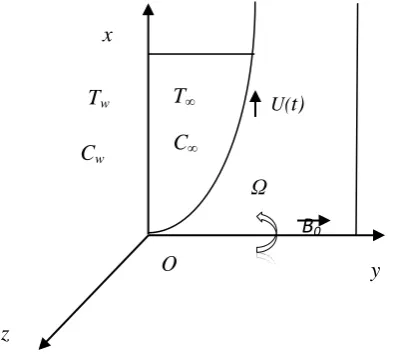
3804 medium subject to constant magnetic field B0. The
[image:2.595.43.242.251.432.2]flow is assumed to be along the x-axis in the upward direction and y-axis perpendicular to it. The fluid rotates with angular velocity Ω along the y-axis. The induced magnetic field is neglected compared with applied magnetic field. Since the plate is of infinite extent, the flow variables are assumed to be functions of y* and t*.The fluid is considered to be grey, absorbing - emitting but non scattering medium. Also the plate is considered to be electrically non- conducting and is subjected to constant suction velocity V0.
Figure 1. Geometrical Description of the problem
Under the above flow assumptions, the governing equations of rotating micropolar fluid in presence of Dufour and radiation absorption becomes,
(1) ( ) ( ) ( ) ( ) ( ) (2) ( ) ( )
( ) (3) (
) (4)
(
) (5)
( ) (6)
( ) (7)
The suitable boundary conditions are,
( ), , ( ), ( ), ( ), ( ) , (
) at
, , , , ,
, as (8) where, ( ), , , , , , , , , , , , Ω, k, , , m, D, , , h, , , and
denotes respectively velocity component along
direction, microrotation component along direction, microrotation component along direction, concentration of the solute at the plate, concentration of solute away from the plate, temperature at the plate, temperature far away from the plate, micro inertia density, characteristic length, acceleration due to gravity, radiative heat flux, kinematic viscosity, rotational angular velocity, thermal conductivity, density, electrical conductivity, Hall current parameter, molecular diffusivity, permeability of the porous medium, rate of chemical reaction, slip parameter, spin gradient viscosity, coefficient of thermal expansion, coefficient of concentration expansion and kinematic microrotation viscosity.
The radiative heat flux is obtained by applying Rosseland approximation,
(9)
where is the Stefan- Boltzman constant and is expanded using Taylor series and after omitting the higher order term, we get
(10)
Using (10) and differentiating equation (9) with respect to y*, we get
(11) Using (11), equation (6) can be expressed as
( ) (12)
Introducing the non-dimensional quantities
B0
z
y
x
C
wT
wT
C
U(
t)
Ω
3805 (13)
Using equation (13), the equations (1) - (12) is transformed into dimensionless governing equations, represented as ( ) ( ) (14)
( ) ( ) (15)
(16) (17) ( ) (18) (19)
The transformed boundary conditions are, at as (20)
where, (Dimensionless viscosity ratio) (Thermal radiation parameter) (Magnetic field parameter) ( ) (Grashof number) ( ) (Modified Grashof number) (Prandtl number) (Schmidt number) (Material parameter) (Permeability of the porous medium parameter) (Rotational parameter) ( ) ( )(Radiation absorption parameter) ( ) ( ) (Dufour number) (Chemical reaction parameter) Equations (14) – (17) are simplified by assuming and , then governing equations are modified as follows, ( ) ( ) (21)
(22) ( ) (23) (24)
The corresponding boundary conditions are, , at , , , as (25)
3. METHOD OF SOLUTION To solve the above partial differential equations (21) – (25), perturbation of the following form is assumed ( ) ( ) ( ) ( ) (26)
Substituting equation (26) into equation (21) – (25), we get the system of equations as follows, (27)
(28)
(29)
(30)
The boundary conditions are at , as . (31) The solution of the equations (27) - (30) using the
boundary condition (31) are obtained as follows,
( )
3806
( ( ) )
The physical quantities such as local skin friction coefficient, couple stress coefficient, Nusselt number and Sherwood number are calculated as follows. The skin friction coefficient (Cf) at the wall is defined as
( ( ) ) ( )
( ( ) )(
)
where is the skin friction.
The couple stress coefficient at the plate is defined as
( )
,
where is the wall couple stress.
The rate of heat transfer coefficient in terms of Nusselt number (Nu) is denoted as
( )
( )
( ) ( ( ) ) ,
where
The rate of mass transfer coefficient in terms of Sherwood number (Sh) is defined as
( )
( )
4. RESULTS AND DISCUSSION
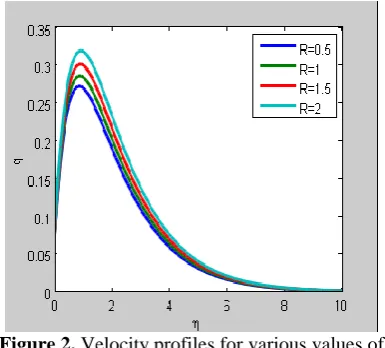
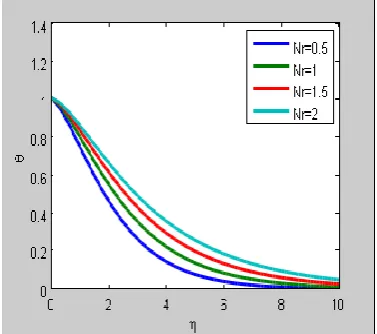
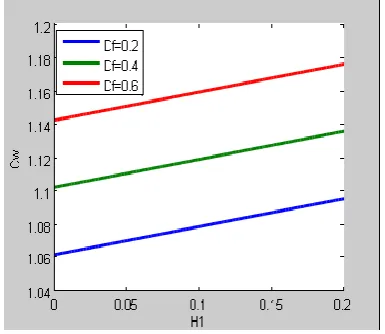
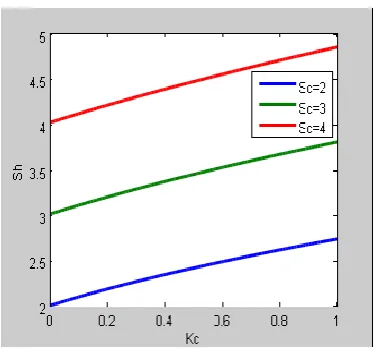
To get physical insight into the problem, various non-dimensional parameters such Dufour number (Df), Rotation parameter (R), Radiation parameter (H1), Hall parameter (m), Magnetic field parameter (M), Prandtl number (Pr), Grashof number (Gr), Modified Grashof number (Gc), Schmidt number (Sc), Permeability parameter (K), Thermal radiation parameter (Nr), Chemical reaction parameter (Kc), on velocity, microrotation, temperature, concentration, skin friction, couple stress, Nusslet number and Sherwood number has been illustrated in figures (2) – (27).
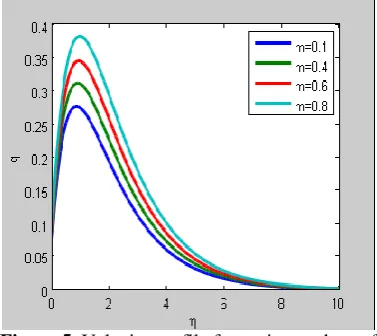
Figures (2) – (8) depicts the effect of rotation parameter, Dufour number, radiation absorption, Hall parameter, permeability of porous medium, Grashof number and magnetic field parameter on
velocity profile. It is observed that velocity increases due to increase in rotation parameter, Dufour number, radiation absorption, Hall parameter, permeability of porous medium and Grashof number. It also found that increase in magnetic parameter decreases velocity profile.
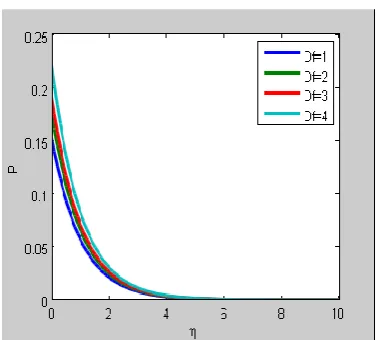
In Figures (9) – (14) illustrates the influence of rotation parameter, Dufour number, radiation absorption parameter, Hall parameter, permeability of porous medium parameter and modified Grashof number on microrotation. It is found that microrotation increases due to increase in the parameters.
Figures (15) – (18) shows the effect of Dufour number, radiation absorption parameter, thermal radiation parameter and Prandtl number on temperature profiles and it is found that increase in Dufour number, radiation absorption parameter and thermal radiation parameter increases the temperature profile, whereas increase in Prandtl number decreases the temperature field.
Increasing chemical reaction parameter and Schmidt number increases concentration profile as depicted in figures (19) and (20).
In figures (21) and (22), the effect of rotation parameter and Dufour number on skin friction has been plotted and it is observed that increase in rotation and Dufour number increases the skin friction.
Increase in Rotation parameter and Dufour number, increases couple stress coefficient as shown in figures (23) and (24). Figures (25) and (26) illustrate that increase in Dufour number and radiation absorption parameter decreases the coefficient of heat transfer.
[image:4.595.326.519.557.731.2]Increase in Schmidt number, increases the coefficient of mass transfer as shown in figure (27).
3807 Figure 3. Velocity profiles for various values
[image:5.595.83.275.98.474.2]of Dufour number (Df)
Figure 4. Velocity profiles for various values of radiation absorption parameter (H1)
[image:5.595.336.525.139.310.2]Figure 5. Velocity profile for various values of Hall current parameter (m)
[image:5.595.329.516.356.526.2]Figure 6: Velocity profile for various values of permeability of porous medium (K)
Figure 7. Velocity profile for various values of Grashof number (Gr)
[image:5.595.82.271.497.665.2] [image:5.595.317.506.578.744.2]3808 Magnetic field parameter (M)
[image:6.595.67.258.104.280.2]Figure 9. Micro rotation profile for various values of Rotation parameter (R)
Figure 10. Micro rotation profile for various values of Dufour number (Df)
[image:6.595.71.260.304.474.2]Figure 11. Micro rotation profile for various values of Radiation absorption parameter (H1)
Figure 12. Micro rotation profile for various values of Hall current parameter (m)
Figure 13. Micro rotation profile for various values of permeability of porous medium (K)
[image:6.595.317.504.305.468.2] [image:6.595.316.506.517.675.2] [image:6.595.72.259.521.685.2]3809 Figure 15. Temperature profile for various values
[image:7.595.72.262.102.270.2]of Dufour number (Df)
[image:7.595.70.261.103.440.2]Figure 16. Temperature profiles for various values of Radiation absorption parameter (H1)
Figure 17. Temperature profile for various values of thermal radiation parameter (Nr)
[image:7.595.317.505.290.463.2]Figure 18. Temperature profiles for various values of Prandtl number (Pr)
Figure 19. Concentration profiles for various values of Chemical reaction parameter (Kc)
[image:7.595.71.260.511.678.2] [image:7.595.316.505.537.705.2]3810 Figure 21. Skin friction coefficient for various
[image:8.595.329.522.107.274.2]values of Rotation number (R)
Figure 22. Skin friction coefficient for various values of Dufour number (Df)
[image:8.595.71.262.109.486.2]Figure 23. Couple stress coefficient for various values of Rotation number (R)
[image:8.595.315.522.318.483.2]Figure 24. Couple stress coefficient for various values of Dufour number (Df)
[image:8.595.79.269.515.688.2]Figure 25.Nusselt number for various values of Dufour number (Df)
[image:8.595.319.506.584.739.2]3811 Radiation absorption parameter (H1)
Figure 27. Sherwood number for various values of Schmidt number (Sc)
5. CONCLUSION
Motivated by various applications of micropolar fluid, we have extended the work of Olajuwon et al.
(2014) to analyze the unsteady flow of electrically conducting viscous incompressible rotating micropolar fluid with Hall current under the influence of Dufour effect and radiation absorption. Asymptotic solutions of velocity, microrotation, temperature and concentration profile has been obtained by using regular perturbation techniques. Some of the important findings are as follows,
Dufour number, rotation parameter and radiation absorption plays a vital role in enhancing velocity, temperature and microrotation profiles.
Increase in Schmidt number and chemical reaction parameter increases concentration profile.
Increase in Dufour number and radiation absorption parameter decrease the coefficient of heat transfer.
Coefficient of mass transfer increases with increase in Schmidt number.
REFERENCES
[1] G. Ahmadi. “Self-similar solution of incompressible micropolar boundary layer flow over a semi-infinite plate”. International Journal of Engineering Science. 14 (7),639-646, 1976.
[2] K. Bhagya Lakshmi, P.V. Satya Narayana, and N.V.R.V. Prasad. “Thermal radiation and heat transfer effects on MHD micropolar fluid flow past a vertical plate with chemical reaction”. IOSR- Journal of Mechanical and Civil Engineering. 07-14, 2016.
[3] K. Das. “Effect of chemical reaction and thermal radiation on heat and mass transfer flow of MHD micropolar fluid in a rotating frame of reference”. International Journal of Heat and Mass transfer, 54(16), 3505-3513, 2011.
[4] A. C. Eringen. “Theory of micropolar fluids”. Journal of Mathematics and Mechanics. 16, 1-18, 1966.
[5]
N. A. Khan, S. Khan and Ara, A. “Flow of micropolar fluid over an off centered rotating disk with modified Darcy’s law”. Population and Power Research. 6(4), 285-295, 2017.
[6] J.I. Oahimire and B.I. Olajuwon. “Effect of Hall current and thermal radiation on heat and mass transfer of a chemically reacting MHD flow of a micropolar fluid through a porous medium”. Journal of King Saud University-Engineering Sciences. 26(2), 112-121, 2014. [7] B.I.Olajuwon, J.I.Oahimire, and M. Ferdow.
“Effect of thermal radiation and Hall current on heat and mass transfer of unsteady MHD flow of a viscoelastic micropolar fluid through a porous medium”. Engineering Science and Technology, an International Journal. 17(4), 185-193, 2014.
[8] M. Rahman, Ibrahim A. Mohammad Eltayeb, and Sheikh Mohammad M. Rahman. “Thermo-micropolar fluid flow along a vertical permeable plate with uniform surface heat flux in the presence of heat generation”, Thermal Science. 13(1), 23-36, 2009.
[9] K. Ramesh Babu, B. Venkteswarlu and P.V. Satyanarayana. “Effect of chemical reaction and radiation absorption on mixed convective flow in a circular annulus at constant heat and mass flux”. Advances in Applied Science Research. 5(5), 122-138, 2014.
[10] S.R. Ravi Chandra babu, S.Venkateswarlu, and K.Jaya Lakshmi. “Effect of magnetic field and radiation on mhd heat and mass transfer of micropolar fluid over stretching sheet with soret and dufour effects”. International Journal of Applied Engineering Research. 13(12), 10991-11000, 2018.
[11] G.V.R. Reddy and Y.H. Krishna. “Soret and Dufour Effects on MHD micropolar fluid flow over a linearly stretching sheet through a non – Darcy porous medium”. International Journal of Applied Mechanics and Engineering. 23(2), 485-502, 2018.