3711
Vibration Analysis of Simply Supported
Parallelogram Plate with Bi-Dimensional Thickness
and Temperature Deviation
Ashish Kumar Sharma
1, Manoj Kumar Dhiman
1*Dept. of Mathematics1,1*, IEC University 1,1*, HP, India
Email : [email protected], [email protected]*
Abstract- In present paper authors represented a simple model to study the effect of non-homogeneity on vibration of parallelogram plate with linear thickness variation. Thermal induced vibration of these plates has been assumed as bi-linear temperature circulation. For non-homogeneity of the plate material density is taken to be bi-linearly varying. The governing differential equation has been solved with the help of variables separation method. The approximated frequency equation is derived by using Rayleigh-Ritz method by two term deflection function. The frequency values for the first two modes of vibration have been calculated for a simply supported parallelogram plate for various values of aspect ratio, thermal gradient, skew angle and taper constants.
Index Terms-Vibration, linear thickness, orthotropic, non-homogeneity, parallelogram plate, thermal gradient.
1. INTRODUCTION
In the engineering, the entire machines and engineering structures experiences vibrations so we cannot move further without taking into consideration the effect of vibration. The requirement to know the effect of temperature on visco-elastic plates of variable thickness has become crucial with the development of technology. Tapered Plates with uniform and non-uniform thickness and temperature are widely used in automobile sector, aeronautical field, power plants and marine structure etc. Various researchers analyzed the vibration of different plates homogeneous or non-homogeneous having variable thickness and taking into account or not the temperature effect.
An extensive review on linear vibration of plates has been given by Leissa [1] in his monograph and a series of review articles [2] .Tomar and Gupta [3] considered the effect of taper gradient in two dimensions on elastic plates, but not on visco-elastic plates. Tomar and Gupta [4] studied temperature effect on frequency of an rectangular orthotropic plate with variable thickness in one direction. Gupta and Khanna [5] analyzed vibration
of a visco-elastic rectangular plate under the effect of linearly varying thickness in both directions. Gupta ,Kumar and Gupta [6] studied the effect of parabolic thickness variations on vibration of visco-elastic orthotropic parallelogram plate. Bhatnagar and Gupta [7] analyzed Vibration analysis of visco-elastic circular plate subjected to thermal gradient. Khanna and Sharma [8] studied the vibration of visco-elastic square plate with variable thickness and thermal gradient. Gupta and Kumar [9] studied thermal effect on vibration of parallelogram plate of bi-direction linearly varying thickness. Singh and Saxena, [10] studied transverse vibration of rectangular
plate with bi-dimensional thickness variation. Khanna [11] analyzed a computational calculation of vibrations of square plate by variable thickness with thermal effect in both direction.
Sobotka [12] represented free vibration of visco-elastic orthotropic rectangular plates. Sharma and Sharma [13] presented the mathematical study on vibration of visco-elastic parallelogram plate. Khanna, Arora and Kaur [14] considered the vibrations of visco-elastic non-homogeneous plate with variable thickness and density. In present paper, the authors have analyzed the bi-linear temperature deviation effect on the vibrations of non-homogeneous parallelogram plates with inconsistent linear thickness in two dimensions. Also, it is supposed that the plate is simply supported (SSSS). Due to temperature deviation, we suppose that non homogeneity occurs in modulus of elasticity. Frequency for the first and second mode of vibration is obtained for various numerical values of tapering constant, non-homogeneity, thermal gradient and aspect ratio. Results are presented in form of graphs and tables.
2. ANALYSIS OF THE MODEL AND SOLUTION
2.1 Material
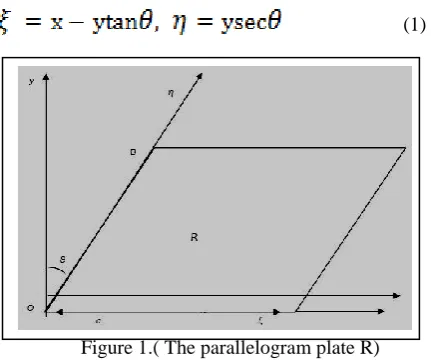
The parallelogram plate R with skew angle θ and sides a,b be shown in figure 1. Since it is a special case of rectangular plate, we take θ = 0o
3712 (1)
Figure 1.( The parallelogram plate R)
Displacement for free vibration of the parallelogram plate is given by
(2)
Here is the maximum displacement at time t and T(t) is the time function.
The plate considered here is subjected to linear temperature distribution along - and - directions, then
(3)
where ‘a’ represents length, ‘ b’ represents breadth and τ0 is temperature at origin of the plate.
For orthotropic material, the temperature dependent modulus of elasticity is taken as
,
,
(4)
where and are Young’s moduli in - and -
directions respectively, is shear modulus
and is taken as slope variation of moduli with temperature. Using eqn. (3) in eqn. (4) one has
(5)
is a thermal gradient.
The plate’s thickness variation for the present study is to be assumed linearly in - and - directions which is represented by
(6)
Here β1 and β2 are known as tapering constants in - and - directions respectively and
at
The flexural rigidities ( ) and torsional rigidity
( ) of the plate are taken as
(7) Where are Poisson’s ratio.
Using eqns. (5) and (6) in eqn. (7), we have
(8) For non-homogeneous material, linear variation taken in density is
(9)
Where c1 ( ) is non-homogeneity constant.
2.2 Frequency equation and boundary condition
Boundary conditions for a non-homogeneous orthotropic (SSSS) parallelogram plate
[image:2.595.58.274.118.298.2]3713
(10)
Two-term deflection function, satisfying the boundary conditions, can be taken as
(11)
where A1, A2 are constants to satisfy boundary conditions.
Now, unit less variables having no dimension are using for our convince as
(12)
(13)
Components of , , and are , secθ, and respectively in - and - directions.
The expressions for strain energy (VE) and kinetic energy (TE) are taken as
(14) and
(15)
2.2 Solution by Rayleigh-Ritz Method
Rayleigh – Ritz method is used to find an appropriate vibrational frequency. This method works on the phenomena that the maximum strain energy (VE) must equal to maximum kinetic energy (TE). An equation in the following form is obtained as
(16) Using eqns. (8), (12), (13) in eqn. (14) and (15), then substituting the values of VE and TE in
Eqn. (16), we obtained
0 (17)
Here,
(19)
Now, the value of A1 & A2 is to be determined from (17) as
,for s = 1, 2 (20)
On solving equation (20), we have
ms1A1 + ms2A2 = 0, for s = 1, 2 (21)
Here ms1, ms2 (s = 1,2) comprises parametric constant and the frequency parameter.
The determinant of the co-efficient of equation (21) must be zero, for non-trivial solution,
we get the equation of frequency as follows
(22)
With the help of equation (22), we get quadratic equation in λ2
3714 constants, thermal gradient and aspect ratio for a simply
supported plate.
3. RESULT AND DISCUSSION
The frequency (λ) for 1st
and 2nd mode of vibration of an orthotropic (simply supported) parallelogram plate has been calculated for various values of thermal constant (α), tapering constant (β1 and β2), aspect ratio (a/b) and non-homogeneity constant (c1). All the results are obtained by using MATLAB / MAPPLE software. Following parameters are used for these calculations [6]:
The results are given in tables [1-5].
Table-1 represents thermal gradient (α) versus frequency (λ) with fixed value of aspect ratio (a/b = 1) and different values of taper constants and non-homogeneity constant (β1 = β2 = c1 = 0,
0.4, 0.8). It is evident from Table-1 that as value of thermal gradient (α) increases from 0 to 0.8 corresponding frequency value (λ) for 1st and 2nd mode of vibration decreases.
Table-2 represents taper constant (β1) versus Frequency (λ)with fixed value of aspect ratio (a/b = 1) and different values of thermal gradient, tapering constant and non-homogeneity (α = β2 = c1 = 0, 0.4, 0.8). From Table-2 it is
clear that as value of tapering constant (β1) varies from 0 to 0.8 corresponding frequency value (λ) also increases for 1st and 2nd mode of vibration.
Table-3 represents taper constant (β2) versus Frequency (λ) with fixed value of aspect ratio (a/b = 1) and three different values of thermal gradient, tapering constants and non-homogeneity (α = β1 = c1 = 0, 0.4, 0.8). From Table-3 it is clear that as the value of tapering constant (β2) varies from 0 to 0.8 Corresponding value of frequency (λ) also increases for 1st and 2nd mode of vibration.
Table-4 represents non-homogeneity constant (c1) versus frequency (λ) with fixed value of aspect ratio (a/b = 1) and different values of tapering constants and thermal constant (β1 = β2 = α = 0, 0.4, 0.8). It is evident from Table-4 that as value of non-homogeneity constant (c1) varies from 0 to 0.8 corresponding value of frequency (λ) also increases for 1st and 2nd mode
of vibration.
3715
Table-1. Thermal Gradient (α) vs Frequency (λ)
Table-2. Taper Constant (β1) vs Frequency(λ)
Table-3. Taper Constant (β2) vs Frequency (λ)
Table-4. Non-homogeneity constant (c1) vs Frequency (λ)
α β1 = β2 = C1=0, θ = 300 β1 = β2 = C1=0.4, θ = 450 β1 = β2 = C1=0.8, θ = 600
1 2 1 2 1 2
0.0 6.61 36.04 8.68 50.90 9.99 68.83
0.2 6.45 34.93 8.52 50.58 9.84 68.64
0.4 6.27 33.78 8.36 50.28 9.69 68.43
0.6 6.11 32.61 8.19 49.98 9.52 68.23
0.8 5.93 31.36 8.01 49.67 9.33 68.04
β1 α = β2 = C1=0, θ = 300 α = β2 = C1=0.4, θ = 450 α = β2 = C1=0.8, θ = 600
1 2 1 2 1 2
0.0 6.61 36.04 6.73 36.10 6.97 38.63
0.2 7.32 40.45 7.52 42.64 7.83 46.81
0.4 8.09 46.14 8.37 50.29 8.54 55.73
0.6 8.89 52.71 9.22 58.66 9.47 64.12
0.8 9.67 59.85 10.05 67.51 10.63 74.83
β2 α = β1 = C1=0, θ = 300 α = β1 = C1=0.4, θ = 450 α = β1 = C1=0.8, θ = 600
1 2 1 2 1 2
0.0 6.61 36.04 6.97 39.61 6.67 41.97
0.2 7.28 39.78 7.66 44.84 7.32 48.49
0.4 7.96 43.75 8.37 50.29 7.98 55.16
0.6 8.65 47.90 9.08 55.90 8.66 61.95
3716
Table-5. Aspect ratio (a/b) vs Frequency (λ)
4. COMPARISON & CONCLUSION
Authors compared the frequency values of present paper (non-homogeneous and SSSS plate) with [13] (homogeneous and CCCC plate) at c1= 0 (non-homogeneity constant). Authors observed that the frequency values are less in present paper than [13] for same parameters. Comparison tables (Table-6 and Table-6)are given below:
Table-6. Skew angle (θ) vs Frequency (λ)
Table-7. Thermal Gradient (α) vs Frequency (λ)
C1 α = β1 = β2=0, θ = 300 α = β1 = β2=0.4, θ = 450 α = β1 = β2=0.8, θ = 600
1 2 1 2 1 2
0.0 6.61 36.04 7.47 44.70 12.44 91.46
0.2 6.96 37.99 7.88 47.25 13.13 96.86
0.4 7.39 40.30 8.37 50.29 13.95 103.34
0.6 7.90 43.08 8.96 54.01 14.95 111.32
0.8 8.53 46.53 9.69 58.68 16.21 121.51
a/b
α = β1=β2= C1=0, θ = 300 α =β1=β2=C1=0.4, θ=450 α =β1=β2=C1=0.8, θ=600
1 2 1 2 1 2
0.2 128.43 1018.60 153.14 1352.62 275.53 3057.90
0.4 34.04 250.88 41.21 335.62 75.11 766.60
0.6 16.32 108.74 20.07 146.88 37.12 340.44
0.8 9.87 59.02 12.31 80.79 23.16 190.83
1.0 6.61 36.04 8.36 50.29 16.21 121.51
θ
a/b = 1, β1 = β2= 0, C1 = 0, α = 0 a/b = 1, β1= β2= 0.4, C1 = 0, α = 0.4
1 2 1 2
0o 7.83 (34.01)
43.53 (139.01)
11.03 (40.01)
66.73 (160.99) 30o 6.60
(48.99)
36.04 (192.93)
9.33 (56.77)
56.77 (222.93) 45o 5.24
(78.11)
28.04 (301.01 )
7.70 (90.03)
3717 Here, values of [13] are given in brackets. In Table-6 it is evident that as skew angle increases frequency for both modes increases for [13] but decreases for present paper. The present paper describes the behavior of frequencies for 1st and 2nd mode of vibration corresponding to the thermal gradient, tapering constants, aspect ratio and non-homogeneity of the material. The objective of the study is to deliver certain substantial data for frequency modes. The frequency can be optimize by taking suitable variation in parameters. Therefore engineers are advised to analyze the results of present problem and develop the plate’s structure in such a way to facilitate the basic requirements.
REFERENCES
[1]. Leissa A.W.( 1969) : Vibration of plates. NASA SP-160.
[2]. Leissa A.W.( 1987) : Recent studies in plate vibration 1981-1985, Part II, complicating effects. The Shock and Vibration Dig., 19, pp. 10-24. [3]. Tomar J.S. ; Gupta A.K. (1985) : Effect of thermal
gradient on frequencies of an orthotropic rectangular plate whose thickness varies in two directions. J.Sound and Vibration, 98, pp. 257-262.
[4]. Tomar J.S.; Gupta A.K.(1983) : Thermal effect on frequencies of an orthotropic rectangular plate of linearly varying thickness. J.Sound and Vibration,
90, pp. 325-331.
[5]. Gupta A.K.; Khanna A.( 2007) : Vibration of visco-elastic rectangular plate with linearly thickness variations in both directions. J. Sound and Vibration, 301, pp. 450-457.
[6]. Gupta A.K. ; Kumar A. ; Gupta D.V. (2012) : Vibration of visco-elastic orthotropic parallelogram plate with parabolic thickness variations. International Journal of Engineering, 8 (2), pp. 61-70.
[7]. Bhatnagar N.S.; Gupta A.K.( 1988) : Vibration analysis of visco-elastic circular plate subjected to thermal gradient. Modelling, Simulation and control, AMSE Press, 15, pp.17-31.
[8]. Khanna A. ; Sharma A.K.( 2013) : Natural vibration of visco-elastic plate of varying thickness with thermal effect. Journal of Applied Science and Engineering, 16 (2), pp.135-140.
[9]. Gupta A.K. ; Kumar M.(2011) : Thermal effect on vibration of parallelogram plate of bi-direction linearly varying thickness. Applied Mathematics, 2
(2), pp. 33-38.
[10]. Singh B. ; Saxena V.(1996) : Transverse vibration of rectangular plate with bi-dimensional thickness variation. J.Sound and Vibration, 198, pp.51-65. [11]. Khanna A. (2011) : Study of Free Vibration of
Visco-Elastic Square Plate of Variable Thickness with Thermal Effect. Innovative System Design and Engineering, U.S.A.2 (4).
[12]. Sobotka Z. (1978) : Free vibration of visco-elastic orthotropic rectangular plates. Acta Technica CSAV, 678-705.
[13]. Sharma S.K. ; Sharma A.K.( 2015) : Mathematical study on vibration of visco-elastic parallelogram plate. Mathematical Models in Engineering, 1(1), pp.12-19.
[14]. Khanna A. ; Arora P. ; Kaur N.( 2012) : Vibrations of non-homogeneous visco-elastic plate with Varying thickness and density. International journal of emerging trends in engineering and
Development, 4(2), pp.363-370.
α a/b = 1, β1 = β2
= 0.4, C1 = 0, θ = 0o a/b = 1, β1= β2= 0.4, C1 = 0, θ = 60o
1 2 1 2
0.0 11.52 (40.58) 67.45 (160.98) 5.39 (213.89) 31.02 (804.12) 0.2 11.28
(38.68) 67.28 (154.26) 5.31 (204.62) 30.83 (769.99) 0.4 11.03
(36.92) 66.73 (146.86) 5.23 (194.92) 30.67 (732.62) 0.6 10.77
(34.89) 66.36 (139.87) 5.14 (184.64) 30.50 (692.95) 0.8 10.55