SemEval-2010 Task 9: The Interpretation of Noun Compounds
Using Paraphrasing Verbs and Prepositions
Cristina Butnariu University College Dublin
Su Nam Kim University of Melbourne
Preslav Nakov
National University of Singapore
Diarmuid ´O S´eaghdha University of Cambridge
Stan Szpakowicz University of Ottawa Polish Academy of Sciences
Tony Veale
University College Dublin
Abstract
We present a brief overview of the main challenges in understanding the semantics of noun compounds and consider some known methods. We introduce a new task to be part of SemEval-2010: the interpretation of noun compounds using paraphrasing verbs and prepositions. The task is meant to provide a standard testbed for future research on noun compound semantics. It should also promote paraphrase-based approaches to the problem, which can benefit many NLP applications.
1 Introduction
Noun compounds (NCs) – sequences of two or more nouns acting as a single noun,1 e.g., colon cancer tumor suppressor protein– are abundant in English and pose a major challenge to the automatic anal-ysis of written text. Baldwin and Tanaka (2004) calculated that 3.9% and 2.6% of the tokens in theReuters corpusand theBritish National Corpus
(BNC), respectively, are part of a noun compound. Compounding is also an extremely productive pro-cess in English. The frequency spectrum of com-pound types follows a Zipfian or power-law distribu-tion ( ´O S´eaghdha, 2008), so in practice many com-pound tokens encountered belong to a “long tail” of low-frequency types. For example, over half of the two-noun NC types in the BNC occur just once (Lapata and Lascarides, 2003). Even for relatively frequent NCs that occur ten or more times in the BNC, static English dictionaries give only 27% cov-erage (Tanaka and Baldwin, 2003). Taken together,
1We follow the definition in (Downing, 1977).
the factors of high frequency and high productiv-ity mean that achieving robust NC interpretation is an important goal for broad-coverage semantic pro-cessing. NCs provide a concise means of evoking a relationship between two or more nouns, and natu-ral language processing (NLP) systems that do not try to recover these implicit relations from NCs are effectively discarding valuable semantic informa-tion. Broad coverage should therefore be achieved by post-hoc interpretation rather than pre-hoc enu-meration, since it is impossible to build a lexicon of all NCs likely to be encountered.
The challenges presented by NCs and their se-mantics have generated significant ongoing interest in NC interpretation in the NLP community. Repre-sentative publications include (Butnariu and Veale, 2008; Girju, 2007; Kim and Baldwin, 2006; Nakov, 2008b; Nastase and Szpakowicz, 2003; ´O S´eaghdha and Copestake, 2007). Applications that have been suggested include Question Answering, Machine Translation, Information Retrieval and Information Extraction. For example, a question-answering sys-tem may need to determine whetherheadaches in-duced by caffeine withdrawalis a good paraphrase for caffeine headaches when answering questions about the causes of headaches, while an information extraction system may need to decide whether caf-feine withdrawal headache and caffeine headache
refer to the same concept when used in the same document. Similarly, a machine translation system facing the unknown NCWTO Geneva headquarters
might benefit from the ability to paraphrase it as
Geneva headquarters of the WTOor asWTO head-quarters located in Geneva. Given a query like
cer treatment, an information retrieval system could use suitable paraphrasing verbs likerelieveand pre-ventfor page ranking and query refinement.
In this paper, we introduce a new task, which will be part of the SemEval-2010 competition: NC inter-pretation using paraphrasing verbs and prepositions. The task is intended to provide a standard testbed for future research on noun compound semantics. We also hope that it will promote paraphrase-based approaches to the problem, which can benefit many NLP applications.
The remainder of the paper is organized as fol-lows: Section 2 presents a brief overview of the existing approaches to NC semantic interpretation and introduces the one we will adopt for SemEval-2010 Task 9; Section 3 provides a general descrip-tion of the task, the data collecdescrip-tion, and the evalua-tion methodology; Secevalua-tion 4 offers a conclusion.
2 Models of Relational Semantics in NCs
2.1 Inventory-Based Semantics
The prevalent view in theoretical and computational linguistics holds that the semantic relations that im-plicitly link the nouns of an NC can be adequately enumerated via a small inventory of abstract re-lational categories. In this view, mountain hut,
field mouse and village feast all express ‘location in space’, while the relation implicit inhistory book
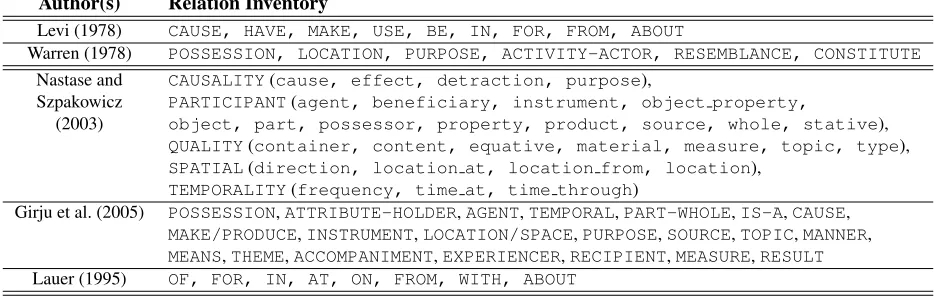
andnativity playcan be characterized as ‘topicality’ or ‘aboutness’. A sample of some of the most influ-ential relation inventories appears in Table 1.
Levi (1978) proposes that complex nominals – a general concept grouping together nominal com-pounds (e.g., peanut butter), nominalizations (e.g.,
dream analysis) and non-predicative noun phrases (e.g.,electric shock) – are derived through the com-plementary processes ofrecoverable predicate dele-tion andnominalization; each process is associated with its own inventory of semantic categories. Table 1 lists the categories for the former.
Warren (1978) posits a hierarchical classifica-tion scheme derived from a large-scale corpus study of NCs. The top-level relations in her hierar-chy are listed in Table 1, while the next level subdividesCONSTITUTEintoSOURCE-RESULT, RESULT-SOURCEandCOPULA;COPULA is then further subdivided at two additional levels.
In computational linguistics, popular invento-ries of semantic relations have been proposed by Nastase and Szpakowicz (2003) and Girju et al. (2005), among others. The former groups 30 fine-grained relations into five coarse-fine-grained super-categories, while the latter is a flat list of 21 re-lations. Both schemes are intended to be suit-able for broad-coverage analysis of text. For spe-cialized applications, however, it is often useful to use domain-specific relations. For example, Rosario and Hearst (2001) propose 18 abstract rela-tions for interpreting NCs in biomedical text, e.g., DEFECT, MATERIAL, PERSON AFFILIATED, ATTRIBUTE OF CLINICAL STUDY.
Inventory-based analyses offer significant advan-tages. Abstract relations such as ‘location’ and ‘pos-session’ capture valuable generalizations about NC semantics in a parsimonious framework. Unlike paraphrase-based analyses (Section 2.2), they are not tied to specific lexical items, which may them-selves be semantically ambiguous. They also lend themselves particularly well to automatic interpreta-tion methods based on multi-class classificainterpreta-tion.
On the other hand, relation inventories have been criticized on a number of fronts, most influentially by Downing (1977). She argues that the great vari-ety of NC relations makes listing them all impos-sible; creative NCs like plate length (‘what your hair is when it drags in your food’) are intuitively compositional, but cannot be assigned to any stan-dard inventory category. A second criticism is that restricted inventories are too impoverished a repre-sentation scheme for NC semantics, e.g., headache pills and sleeping pills would both be analyzed as FORin Levi’s classification, but express very differ-ent (indeed, contrary) relationships. Downing writes (p. 826): “These interpretations are at best reducible to underlying relationships. . . , but only with the loss of much of the semantic material considered by sub-jects to be relevant or essential to the definitions.” A further drawback associated with sets of abstract relations is that it is difficult to identify the “correct” inventory or to decide whether one proposed classi-fication scheme should be favored over another.
2.2 Interpretation Using Verbal Paraphrases
para-Author(s) Relation Inventory
Levi (1978) CAUSE, HAVE, MAKE, USE, BE, IN, FOR, FROM, ABOUT
Warren (1978) POSSESSION, LOCATION, PURPOSE, ACTIVITY-ACTOR, RESEMBLANCE, CONSTITUTE Nastase and CAUSALITY(cause, effect, detraction, purpose),
Szpakowicz PARTICIPANT(agent, beneficiary, instrument, object property,
(2003) object, part, possessor, property, product, source, whole, stative), QUALITY(container, content, equative, material, measure, topic, type), SPATIAL(direction, location at, location from, location),
TEMPORALITY(frequency, time at, time through)
[image:3.612.72.539.58.206.2]Girju et al. (2005) POSSESSION,ATTRIBUTE-HOLDER,AGENT,TEMPORAL,PART-WHOLE,IS-A,CAUSE, MAKE/PRODUCE,INSTRUMENT,LOCATION/SPACE,PURPOSE,SOURCE,TOPIC,MANNER, MEANS,THEME,ACCOMPANIMENT,EXPERIENCER,RECIPIENT,MEASURE,RESULT Lauer (1995) OF, FOR, IN, AT, ON, FROM, WITH, ABOUT
Table 1: Previously proposed inventories of semantic relations for noun compound interpretation. The first two come from linguistic theories; the rest have been proposed in computational linguistics.
phrase. Thus,cheese knifeandkitchen knifecan be expanded as a knife for cutting cheese and a knife used in a kitchen, respectively. In the paraphrase-based paradigm, semantic relations need not come from a small set; it is possible to have many sub-tle distinctions afforded by the vocabulary of the paraphrasing language (in our case, English). This paradigm avoids the problems of coverage and rep-resentational poverty, which Downing (1977) ob-served in inventory-based approaches. It also re-flects cognitive-linguistic theories of NC semantics, in which compounds are held to express underlying
event framesand whose constituents are held to de-note event participants (Ryder, 1994).
Lauer (1995) associates NC semantics with prepositional paraphrases. As Lauer only consid-ers a handful of prepositions (about, at, for, from, in, of, on, with), his model is es-sentially inventory-based. On the other hand, noun-preposition co-occurrences can easily be identified in a corpus, so an automatic interpretation can be implemented through simple unsupervised methods. The disadvantage of this approach is the absence of a one-to-one mapping from prepositions to meanings; prepositions can be ambiguous (ofindicates many different relations) or synonymous (at, inandon all express ‘location’). This concern arises with all paraphrasing models, but it is exacerbated by the re-stricted nature of prepositions. Furthermore, many NCs cannot be paraphrased adequately with prepo-sitions, e.g.,woman driver,honey bee.
A richer, more flexible paraphrasing model is af-forded by the use of verbs. In such a model, ahoney
bee is a bee that produces honey, a sleeping pill
is a pill that induces sleeping and a headache pill
is apill that relieves headaches. In some previous computational work on NC interpretation, manually constructed dictionaries provided typical activities or functions associated with nouns (Finin, 1980; Is-abelle, 1984; Johnston and Busa, 1996). It is, how-ever, impractical to build large structured lexicons for broad-coverage systems; these methods can only be applied to specialized domains. On the other hand, we expect that the ready availability of large text corpora should facilitate the automatic mining of rich paraphrase information.
The SemEval-2010 task we present here builds on the work of Nakov (Nakov and Hearst, 2006; Nakov, 2007; Nakov, 2008b), where NCs are paraphrased by combinations of verbs and prepositions. Given the problem of synonymy, we do not provide a sin-gle correct paraphrase for a given NC but a prob-ability distribution over a range of candidates. For example, highly probable paraphrases forchocolate bar are bar made of chocolate and bar that tastes like chocolate, whilebar that eats chocolateis very unlikely. As described in Section 3.3, a set of gold-standard paraphrase distributions can be constructed by collating responses from a large number of hu-man subjects.
SemEval-2010 Task 9 will further develop suitable techniques for this problem. Paraphrases of this kind have been shown to be useful in applications such as machine translation (Nakov, 2008a) and as an inter-mediate step in inventory-based classification of ab-stract relations (Kim and Baldwin, 2006; Nakov and Hearst, 2008). Progress in paraphrasing is therefore likely to have follow-on benefits in many areas.
3 Task Description
The description of the task we present below is pre-liminary. We invite the interested reader to visit the official Website of SemEval-2010 Task 9, where up-to-date information will be published; there is also a discussion group and a mailing list.2
3.1 Preliminary Study
In a preliminary study, we asked 25-30 human sub-jects to paraphrase 250 noun-noun compounds us-ing suitable paraphrasus-ing verbs. This is the Levi-250dataset (Levi, 1978); see (Nakov, 2008b) for de-tails.3 The most popular paraphrases tend to be quite apt, while some less frequent choices are question-able. For example, for chocolate bar we obtained the following paraphrases (the number of subjects who proposed each one is shown in parentheses):
contain (17); be made of (16); be made from (10); taste like (7); be composed of (7); consist of (5); be (3); have (2); smell of (2); be manufactured from (2); be formed from (2); melt into (2); serve (1); sell (1); incorporate (1); be made with (1); be comprised of (1); be constituted by (1); be solidified from (1); be flavored with (1); store (1); be flavored with (1); be created from (1); taste of (1)
3.2 Objective
We propose a task in which participating systems must estimate the quality of paraphrases for a test set of NCs. A list of verb/preposition paraphrases will be provided for each NC, and for each list a participating system will be asked to provide aptness
2Please follow the Task #9 link at the SemEval-2010 home-pagehttp://semeval2.fbk.eu
3This dataset is available fromhttp://sourceforge.
net/projects/multiword/
scores that correlate well (in terms of frequency dis-tribution) with the human judgments collated from our test subjects.
3.3 Datasets
Trial/Development Data. As trial/development data, we will release the previously collected para-phrase sets for the Levi-250 dataset (after further review and cleaning). This dataset consists of 250 noun-noun compounds, each paraphrased by 25-30 human subjects (Nakov, 2008b).
Test Data. The test data will consist of approx-imately 300 NCs, each accompanied by a set of paraphrasing verbs and prepositions. Following the methodology of Nakov (2008b), we will use the
Amazon Mechanical Turk Web service4 to recruit human subjects. This service offers an inexpensive way to recruit subjects for tasks that require human intelligence, and provides an API which allows a computer program to easily run tasks and collate the responses from human subjects. The Mechanical Turk is becoming a popular means to elicit and col-lect linguistic intuitions for NLP research; see Snow et al. (2008) for an overview and a discussion of is-sues that arise.
We intend to recruit 100 annotators for each NC, and we will require each annotator to paraphrase at least five NCs. Annotators will be given clear instructions and will be asked to produce one or more paraphrases for a given NC. To help us filter out subjects with an insufficient grasp of English or an insufficient interest in the task, annotators will be asked to complete a short and simple multiple-choice pretest on NC comprehension before pro-ceeding to the paraphrasing step.
Post-processing. We will manually check the trial/development data and the test data. Depending on the quality of the paraphrases, we may decide to drop the least frequent verbs.
License. All data will be released under the Cre-ative Commons Attribution 3.0 Unported license5.
3.4 Evaluation
Single-NC Scores. For each NC, we will compare human scores (our gold standard) with those pro-posed by each participating system. We have
con-4http://www.mturk.com
sidered three scores: (1) Pearson’s correlation, (2) cosine similarity, and (3) Spearman’s rank correla-tion.
Pearson’s correlation coefficient is a standard measure of the correlation strength between two dis-tributions; it can be calculated as follows:
ρ= p E(XY)−E(X)E(Y)
E(X2)−[E(X)]2pE(Y2)−[E(Y)]2
(1) whereX = (x1, . . . , xn)andY = (y1, . . . , yn)are
vectors of numerical scores for each paraphrase pro-vided by the humans and the competing systems, re-spectively,nis the number of paraphrases to score,
andE(X)is the expectation ofX.
Cosine correlation coefficient is another popu-lar alternative and was used by Nakov and Hearst (2008); it can be seen as an uncentered version of Pearson’s correlation coefficient:
ρ= X.Y
kXkkYk (2)
Spearman’s rank correlation coefficient is suit-able for comparing rankings of sets of items; it is a special case of Pearson’s correlation, derived by considering rank indices (1,2,. . . ) as item scores . It is defined as follows:
ρ= n
P
xiyi−(Pxi)(Pyi) q
nPx2i −(Pxi)2 q
nPy2i −(Pyi)2
(3)
One problem with using Spearman’s rank coef-ficient for the current task is the assumption that swapping any two ranks has the same effect. The often-skewed nature of paraphrase frequency distri-butions means that swapping some ranks is intu-itively less “wrong” than swapping others. Consider, for example, the following list of human-proposed paraphrasing verbs forchild actor, which is given in Nakov (2007):
be (22); look like (4); portray (3); start as (1); include (1); play (1); have (1); involve (1); act like (1); star as (1); work as (1); mimic (1); pass as (1); resemble (1); be classified as (1); substitute for (1); qualify as (1); act as (1)
Clearly, a system that swaps the positions for
be (22) and look like (4) for child actor will have made a significant error, while swapping con-tain (17)andbe made of (16)forchocolate bar(see Section 3.1) would be less inappropriate. However, Spearman’s coefficient treats both alterations iden-tically since it only looks at ranks; thus, we do not plan to use it for official evaluation, though it may be useful for post-hoc analysis.
Final Score. A participating system’s final score will be the average of the scores it achieves over all test examples.
Scoring Tool.We will provide an automatic eval-uation tool that participants can use when train-ing/tuning/testing their systems. We will use the same tool for the official evaluation.
4 Conclusion
We have presented a noun compound paraphrasing task that will run as part of SemEval-2010. The goal of the task is to promote and explore the feasibility of paraphrase-based methods for compound inter-pretation. We believe paraphrasing holds some key advantages over more traditional inventory-based approaches, such as the ability of paraphrases to rep-resent fine-grained and overlapping meanings, and the utility of the resulting paraphrases for other ap-plications such as Question Answering, Information Extraction/Retrieval and Machine Translation.
References
Timothy Baldwin and Takaaki Tanaka. 2004. Transla-tion by machine of compound nominals: Getting it right. InProceedings of the ACL 2004 Workshop on Multiword Expressions: Integrating Processing, pages 24–31.
Cristina Butnariu and Tony Veale. 2008. A concept-centered approach to noun-compound interpretation. In Proceedings of the 22nd International Conference on Computational Linguistics (COLING 2008), pages 81–88.
Pamela Downing. 1977. On the creation and use of En-glish compound nouns. Language, 53(4):810–842. Timothy Finin. 1980. The Semantic Interpretation of
Compound Nominals. Ph.D. Dissertation, University of Illinois, Urbana, Illinois.
Roxana Girju, Dan Moldovan, Marta Tatu, and Daniel Antohe. 2005. On the semantics of noun compounds.
Journal of Computer Speech and Language - Special Issue on Multiword Expressions, 4(19):479–496. Roxana Girju. 2007. Improving the interpretation of
noun phrases with cross-linguistic information. In
Proceedings of the 45th Annual Meeting of the Associ-ation of ComputAssoci-ational Linguistics (ACL 2007), pages 568–575.
Pierre Isabelle. 1984. Another look at nominal com-pounds. InProceedings of the 10th International Con-ference on Computational Linguistics, pages 509–516. Michael Johnston and Frederica Busa. 1996. Qualia structure and the compositional interpretation of com-pounds. InProceedings of the ACL 1996 Workshop on Breadth and Depth of Semantic Lexicons, pages 77– 88.
Su Nam Kim and Timothy Baldwin. 2006. Interpret-ing semantic relations in noun compounds via verb semantics. InProceedings of the 45th Annual Meet-ing of the Association of Computational LMeet-inguistics (COLING/ACL 2006) Main Conference Poster Ses-sions, pages 491–498.
Mirella Lapata and Alex Lascarides. 2003. Detecting novel compounds: the role of distributional evidence. InProceedings of the 10th conference of the European chapter of the Association for Computational Linguis-tics (EACL 2003), pages 235–242.
Mark Lauer. 1995. Designing Statistical Language Learners: Experiments on Noun Compounds. Ph.D. thesis, Dept. of Computing, Macquarie University, Australia.
Judith Levi. 1978. The Syntax and Semantics of Complex Nominals. Academic Press, New York.
Preslav Nakov and Marti A. Hearst. 2006. Using verbs to characterize noun-noun relations. InLNCS vol. 4183: Proceedings of the 12th international conference on
Artificial Intelligence: Methodology, Systems and Ap-plications (AIMSA 2006), pages 233–244. Springer. Preslav Nakov and Marti A. Hearst. 2008. Solving
re-lational similarity problems using the web as a cor-pus. InProceedings of the 46th Annual Meeting of the Association of Computational Linguistics (ACL 2008), pages 452–460.
Preslav Nakov. 2007. Using the Web as an Implicit Training Set: Application to Noun Compound Syntax and Semantics. Ph.D. thesis, EECS Department, Uni-versity of California, Berkeley, UCB/EECS-2007-173. Preslav Nakov. 2008a. Improved statistical machine translation using monolingual paraphrases. In Pro-ceedings of the 18th European Conference on Artificial Intelligence (ECAI’2008), pages 338–342.
Preslav Nakov. 2008b. Noun compound interpretation using paraphrasing verbs: Feasibility study. InLNAI vol. 5253: Proceedings of the 13th international con-ference on Artificial Intelligence: Methodology, Sys-tems and Applications (AIMSA 2008), pages 103–117. Springer.
Vivi Nastase and Stan Szpakowicz. 2003. Exploring noun-modifier semantic relations. InProceedings of the 5th International Workshop on Computational Se-mantics, pages 285–301.
Diarmuid ´O S´eaghdha and Ann Copestake. 2007. Co-occurrence contexts for noun compound interpreta-tion. In Proceedings of the Workshop on A Broader Perspective on Multiword Expressions, pages 57–64. Diarmuid ´O S´eaghdha. 2008. Learning Compound Noun
Semantics. Ph.D. thesis, University of Cambridge. Barbara Rosario and Marti Hearst. 2001.
Classify-ing the semantic relations in noun compounds via a domain-specific lexical hierarchy. InProceedings of the 2001 Conference on Empirical Methods in Natural Language Processing (EMNLP 2005), pages 82–90. Mary Ellen Ryder. 1994. Ordered Chaos: The
Interpre-tation of English Noun-Noun Compounds. University of California Press, Berkeley, CA.
Rion Snow, Brendan O’Connor, Daniel Jurafsky, and An-drew Ng. 2008. Cheap and fast – but is it good? evaluating non-expert annotations for natural language tasks. In Proceedings of the 2008 Conference on Empirical Methods in Natural Language Processing (EMNLP 2008), pages 254–263.
Takaaki Tanaka and Timothy Baldwin. 2003. Noun-noun compound machine translation: a feasibility study on shallow processing. In Proceedings of the ACL 2003 workshop on Multiword expressions, pages 17–24.