Volume 2, No. 6, Nov-Dec 2011
International Journal of Advanced Research in Computer Science
RESEARCH PAPER
Available Online at www.ijarcs.info
ISSN No. 0976-5697
FishDoc Expert System- Diagnosis of Fish Diseases Using ABC Algorithm & PSO
Algorithms
Prof. M. Surendra Prasad Babu* Ph. D.Department of C S & S E Andhra University, Visakhapatnam, AP, India.
Dara Vikram, M.Tech, (Ph. D.)
Research Scholar, Department of C S & S E Andhra University Visakhapatnam, AP, India
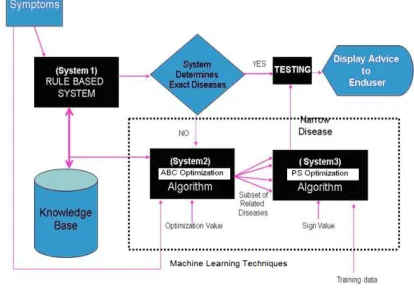
Abstract:FishDoc is one of the important expert system in Animal Health Science web portal proposed by the authors. The FishDoc gives a clear and detailed diagnosis of fish diseases and treatments to them to create disease free zone in fish farming. Artificial Intelligence and Machine learning techniques are used to develop a system to provide medical treats for prevention and curing methodologies to the disease effected fishes. This implementation includes both the collection of prominent data from the relevant experts and development of the expert advisory system. FishDoc Expert System is developed using JSP as front end and MYSQL database as back end. Both rule based and machine learning algorithms are used in inference mechanism. The system analyses the different symptoms entered by the user dynamically. If the user entered data is sufficient for analysis with the available data in the knowledge base provided by the expert, it displays directly the actual disease & corresponding treatment. Otherwise it displays that the knowledge is insufficient and calls ABC algorithm & Particle Swarm Optimization and displays the probable diseases with some certainty factor for possible treatments.
Key words: FishDoc, Rule Based, ABC Algorithm, PSO Algorithm, Expert System, Diseases, Preventions, Cure, JSP, MYSQL.
I. INTRODUCTION
A. About FishDoc:
Fish are the oldest vertebrates of the world. The first fish is supposed to be found about 500 million years ago. These are the aquatic vertebrates, typically ectothermic (cold-blooded). Their body is covered with scales and provided with two sets of paired fins and many unpaired fins. Most fish have a bony skeleton, except rays and sharks have cartilaginous skeleton. Fish breathe using the gills, which perform an exchange of gases between the fish‟s blood and water. Most fish feed on small plants, while some fish such as shark feed on other fish. Disease in fish is a complex matter. However, over 90% of all health problems can be resolved with a combination of good
husbandry, early diagnosis and accurate treatments.
Sometimes an individual expert, how good he may be in the subject, may not be able to diagnose the fish diseases. Sometimes the expert may not be within the reach of the field. In order to provide timely advice it is necessary to develop an intelligent interactive computer program using the available knowledge. It is in this context a „FishDoc Expert System‟ is developed to serve the above purpose.
The system is developed by conducting interviews & acquiring the knowledge from prominent Fish farm experts & growers, all the stakeholders may also fine tune their skills. Marketing agencies may also be the indirect beneficiaries for the system as their disease free products will be consumed in a larger way. The suggestions made by the system may be reviewed by a human expert/committee of experts for further analysis. This fishdoc system gives a comprehensive view of common diseases including typical signs of disease and how to systematically diagnosis both health problems and their causes. This system may be operated by the persons employed
in village knowledge centres at their villages on problems in the day to day disease activity.
II. PROPOSED FISHDOC EXPERT SYSTEM
An expert system is software that attempts to provide an answer to a problem, or clarify uncertainties where normally one or more human experts would need to be consulted. Expert systems are most common in a specific problem domain, and are traditional application. The proposed expert system [4] contains a knowledge base, an inference engine, and a man-machine interface. The knowledge base consists of the data base and the rule base.
Figure 1: Proposed Architecture of FishDoc Expert system
a. Inference Engine: The inference engine derives the new knowledge from the existing knowledge.
b. Experts: Experts are Scientists and doctors in Veterinary Universities & Experienced Fish farmers. c. Knowledge Engineer: Knowledge engineer collects
into rules and facts. The Knowledge Engineer is responsible for updating the changes made by the experts according to their research findings.
d. User: User may be a Fishery expert, Fish hatcheries developer, Fish Doctor.
e. User Interface: The user interface is exchanging information between the user and the inference engine.
f. Knowledge Base: Knowledge Base consists of facts and rules as text files.
III. FISHDOC KNOWLEDGE BASE
There is a huge variety of fish, differing in size, shape and color. Their sizes highly range from 8 mm long stout infant fish to 16 m whale shark. There are over 28,000 known species of fish found throughout the world. Out of them, almost 27,000 species include bony fish. Remaining 970 species include rays, sharks and chimeras and 108 lampreys and hag fishes. Fish are found in all types of water bodies all over the globe. Fish can be kept in an aquarium as the pets or used to prepare wonderful recipes. There are various types of fish, depending upon their habitats and characteristics. Some major types of fish are freshwater fish, tropical fish, marine fish, cold water fish, aquarium fish, etc. Fish disease can be both highly distressing and in many cases costly both in treatment and replacement costs. Fish keepers need to be able to recognize the signs of ill-health in their fishy changes. The key aim is encourage prevention via regular water testing and husbandry. This is particularly important with ponds and their often-high stocking levels and reliance on biological filtration for good water quality. In general diseases are often oversimplified, which in turn leads to misunderstanding about diagnosis and treatments. The first diagnostic approach in fish diseases is by observation of changes in behavior, such as flashing, not eating, clamped fins, heavy respiration, self isolation and jumping. The second approach is by water testing and inspection of system to determine water quality.
The third approach is by Physical examination. This can be carried out in the pond or tank or the patient can be placed in a shallow bowl and examined for fin erosion, cuts, lesions, redding of the skin, raised scales, larger parasites and swollen gills or damaged gills. The last approach is by surgical examination. It is also extremely rare and at present, has a poor success rate. The following information is collected from „Fish experts‟ by conducting several interviews to develop the expert system. Some major Fish diseases and corresponding treatments are given in the following table:
S NO
Disease Disease Type Symptoms Cure
1.
2 Saprolegnia Freshwater Fis h Diseases S2= Fish swim normally, but breathe heavily
S3= The body cavity is filled with fluid S4= The fish's colors fade, they appear light S5= Cottony white growth over lens of eye
S7= The fins fray and the skin fades until it is whitish S8= Protozoan are rapidly swimming around in the bile S9= The gill filaments are light, having lost color
S10= The intestines contain opaque worms possessing a retractable proboscis or trunk completely
S11=Small motile protozoan are found in a squash mount of kidney tissue
S12= The liver is discolored brown or yellow.
S13= The fish ocassionally become shy & jerk their fins S14=The body of one or more of the fish distorted by a curvature of the spinal column
S15=Red dots on the fish,
S16= The fish whirl or wobble around the aquarium
1- Yes and 0-No
Sample Rules:
Rule 1: If Symptoms are
S1=1,S2=0,S3=0,S4=1,S5=1,S6=0,S7=0,S8=1,S9=0,S10=0,S
11=0,S12=0, S13=0,S14=1, 15=1,S16=1, then Diagnose: Bacterial Disorders
Treatment: Use: Doxycycline -or- Oxytetracycline.
Kanamycin may also be effective in marine tanks Causes:
If they move fast in a living mount, probably Bacteria of the genus Vibrio are involved
Rule 2: If Symptoms are
S1=1, S2=0, S3=1, S4=0, S5=1, S6=1, S7=0, S8=1, S9=0, S10=0,
S11=1, S12=0 S13=0, S14=1 S15=1 S16=1 then Diagnose: Gill Disorders
Treatment: Establish optimum water values. Check pH, and Chlorine. Use Aqua Gold.
Causes: Has the pH changed? Is chlorine in the water? Is ammonia in the water?
IV. RULE BASED SYSTEM
Rule - Based knowledge representation centers on the use of IF condition THEN action statement. For FishDoc Expert Advisory expert system the facts & rules are Disease identification and causes, Implementing Diagnosis, Giving Health Advice. The inference engine uses both forward and backward chaining for inferring the diagnosis from the knowledge base
A. Forward Chaining:
In forward chaining [5], the administrator defines premise-conclusions or symptoms, or problem, rather than a goal, in hierarchy and moves to the goals. For Example, a patient comes to the expert to know about the disease and diagnosis, then an expert may put many questions or premise before the patient out of whom the patient may select few premises and so it ultimately leads to a single, goal (disease) about which they give the information.
B. Backward Chaining:
The expert system processes symbolic representations of reality by means of heuristic rules, usually by the technique of backward chaining [5]. In this technique, the conclusion begins with the definition of a specific goal, or output
behavior. For example a physician might ask an expert medical system to: confirm inputs.
V. ABC OPTIMIZATION
Artificial Bee Colony (ABC)[1] is one of the most recently defined algorithms by Dervis Karaboga in 2005[2], motivated by the intelligent behavior of honey bees. A population-based search procedure in which individuals called foods positions are modified by the artificial bees. ABC system combines local search methods, carried out by employed and onlooker bees, with global search methods, managed by onlookers and scouts, attempting to balance exploration and exploitation process.
A. ABC Optimization
Bees – Symptoms Entered Food Sources – Desired Disease Hive – Search Space
Employed Bees – pbest gives the accurate disease Onlookers – gbest, which gives you the neighbor disease Scouts – worst, where there is no matching symptoms in base This ABC Algorithm is a technique in swarming Algorithms and it is also used for solving discrete and constraint oriented problems.
Steps:
Step1: Initialize the food source to employed bees. Supply symptoms to obtain the major disease Step 2: Repeat
Step 3: Each employed bee gets its food source, and dances in its hive.
Check any exact matching for the entered symptoms and display
Step 4: Onlookers identify the employed bee positions and takes the nearest positions which are empty.
If matching disease is not there, go with the neighbor disease and display
Step 5: Scouts are the bees where they don‟t have a single match of food sources in hive
If not even single symptom doesn‟t match with the symptoms in the knowledge base then it displays knowledge is insufficient
Step 6: Display the best food source which shows the place in the hive.
Step 7: Until our requirement is satisfied, loop is to be run
VI. PARTICLE SWARM OPTIMIZATION (PSO)
James Kennedy[1], proposed the PSO algorithm in 1995[5]. It uses a number of agents (particles) that constitute a swarm moving around in the search space looking for the best solution. Each particle is treated as a point in an N-dimensional space which adjusts its “flying” according to its own flying experience as well as the flying experience of other particles. PSO is direct search method used to find an optimal solution to optimization problems in a search space or model and predict social behavior in the presence of objectives. Objectives: Symptoms
Group: Rules Obtained from Symptoms
a. Each particle (or agent) evaluates the function to optimize at each point in search space, it visits.
b. Each particle remembers the best value of the function
found so far by it (pbest) and its co-ordinates.
c. Secondly, each particle finds the global best position among the swarm, and its value (gbest).
d. Each particle tries to modify its position using the current positions, the current velocities, the distance between the current positions and pbest, the distance between the current position and the gbest, the modification of the particle‟s position can be mathematically modeled according the following equation,
Vik+1=wVik+c1 rand1 (…) * (pbesti-sik) + c2 rand2(…) *
(gbest-sik) is the velocity of agent I at position k. Cj is weighing factor
Sik is current position of agent I at iteration k, Pbesti is pbest of agent i Best is gbest of the group. Rand is uniformly distributed random number 0 and 1.
In the present system, the Diseases are the particles and symptoms are considered with some position and weight. Initially some common symptoms are chosen and after some iterations local best disease is recognized. In the next level (position), disease at first level is compared with the remaining symptoms for further convergence of the local best, which leads to global best solution. „Larger W‟ means „greater global search ability‟ whereas „Smaller W‟ means „greater local search ability‟. In this way the disease is diagnosed by the PSO Algorithm.
VII. IMPLEMENTATION & RESULTS
The Fishdoc system is implemented through online by any user. The user submits the observed symptoms of their fish through the well developed user interface. The system first checks for the rule based system according to the symptoms submitted by the user. If it finds the diseases and cure from the available knowledge provided by the expert, the system diagnize that particular disease. If the rule based system is unable to find the appropriate disease according to the symptoms submitted by the user, the system goes for the machine learning system. The machine learning system uses two algorithms Artificial Bee Colony and Particle Swam Optimization Algorithms to find the appropriate diseases to the symptoms submitted by the user. In this case the fishdoc system displays the predicted disease with an appropriate cure and treatment.
Figure 6.1: Displaying disorders of Fish
Contents of the screen shot:
Your Fish is effected with: “Fin Disorders” Treatment:
The PH can be too high, do several water changes, if this does not help, lower the PH value with Sodium BiSulphur.
Symptoms:
The fins fray and the skin fades until it fades whitish Causes:
The pH can be too high
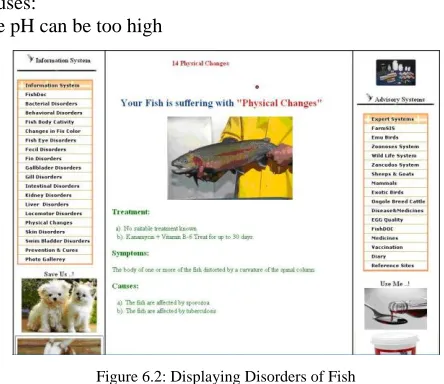
Figure 6.2: Displaying Disorders of Fish
Contents:The above screen shot contains the details of the fish disorders. The fish is suffering with “Physical Changes” and the treatment to the disease is “Kanamycin + Vitamin B-6 Treat for up to 6 Months”. The symptoms are fish may be affected with Sporozoa and the affected with tuberculosis”.
Figure 6.3: Displaying questions for expert system
Contents of the above screen shot: The contents of the screen shot can be seen at the Rule Based System.
Contents of the screen shot:
“Welcome to FishDoc Output Screen” According to the symptoms submitted ABC Optimization Solution
Resultant String 1000110001110011111 Optimization Level is 60 %
Bacterial Disorders…….>> 0.878788 Gill Disorders………..>> 0.878788
You May be Affected with Bacterial Disorders
VIII. CONCLUSIONS
The “FishDoc Expert Advisory System” is a web enabled application developed using java server pages (JSP) and MySQL database is used as backend. It is a well designed interface for giving health related advices and suggestions. Diagnose the diseases, prediction of medicines and Drug Target networks analysis, finding the right drug to cure the disease. By the thorough interaction with the users and beneficiaries the functionality of the System can be extended further to many more areas in and around the world.
IX. REFERENCES
[1]. B.Basturk, Dervis Karaboga, An Artificial Bee Colony (ABC) Algorithm for Numeric function Optimization, IEEE Swarm Intelligence Symposium 2006, May 12-14, 2006, Indianapolis, Indiana, USA.
[2]. D. Karaboga, B. Basturk, A Powerful and Efficient Algorithm for Numerical Function Optimization: Artificial Bee Colony (ABC) Algorithm, Journal of Global Optimization, Volume: 39, Issue: 3, pp: 459-471.
[3]. D. Karaboga, B. Basturk, Artificial Bee Colony (ABC) Optimization Algorithm for Solving Constrained Optimization Problems, LNCS: Advances in Soft Computing: Foundations of Fuzzy Logic and Soft Computing, Vol: 4529/2007, pp: 789-798, Springer- Verlag, 2007, IFSA07.doi: 10.1007/978-3-540-72950 1_77.
[4]. Kennedy J.; Eberhart, R. (1995). "Particle Swarm Optimization". Proceedings of IEEE International Conference on Neural Networks. IV. pp. 1942–1948.
[5]. Shi, Y.; Eberhart, R.C. (1998). "A modified particle swarm optimizer". Proceedings of IEEE International Conference on Evolutionary Computation. pp. 69–73.
[6]. Kennedy, J. (1997). "The particle swarm: social adaptation of knowledge". Proceedings of IEEE International Conference on Evolutionary Computation. pp. 303–308.
[7]. Implementation of Parallel Optimized ABC Algorithm with SMA Technique for Garlic Expert Advisory System-Prof.M.S.Prasad Babu, N.Thirupathi Rao-International Journal of Computer Sciences, Engineering and Technology (IJCSET), pp 45-49, Volume 1, Issue 3, October 2010. [8]. Implementation of Web-Based Chilli Expert Advisory
System Using ABC Optimization Algorithm"-Prof.M.S.Prasad Babu, DVPR Sridhar, M.Parimala, N.Thirupathi Rao-International Journal on Computer Science and Engineering (IJCSE), Vol.02, No.06, 2010, 2141-2144. [9]. Implementation of Artificial Bee Colony Algorithm on Garlic
Expert Advisory System- Prof.M.S.Prasad Babu, N.Thirupathi Rao – International Journal of Computer Science and Research (IJCSR), Vol.1, Issue 1, 2010. [10]. www.bharathgramavikas.net
[11]. www.bharathanimalscience.net
[12]. Nelson, Joseph S. (2006). Fishes of the World. John Wiley & Sons, Inc., 2. ISBN 0471250317.
[13]. Helfman G., Collette B., & Facey D.: The Diversity of Fishes, Blackwell Publishing, p 3, 1997, ISBN 0-86542-256-7
[14]. Tree of life web project - Chordates
[15]. Froese, R. and D. Pauly. Editors: FishBase. Retrieved on 2006-11-26.
[16]. Planet Catfish. Cat-eLog: Planet Catfish. Retrieved on 2006-11-26.
[17]. Jr.Cleveland P Hickman, Larry S. Roberts, Allan L. Larson: Integrated Principles of Zoology, McGraw-Hill Publishing Co, 2001, ISBN 0–07–290961–7
[18]. Nelson, J. S.: Fishes of the World, John Wiley & Sons, Inc., p 4-5, 2006 ISBN 0471250317.
[19]. Albert, J.S., and W.G.R. Crampton. 2005. Electroreception and electrogenesis. Pp. 431-472 in The Physiology of Fishes, 3rd Edition. D.H. Evans and J.B. Claiborne (eds.). CRC Press.