Volume
International Journal
Available
EFFECTS OF HUMAN AND
APPROACHES ON
Efeosasere Moibi Okoro
Department of Computer Science National Institute of Construction Technology
Uromi, Nigeria
Aneyelewa Alan-Ajonye
Department of Social Science National Institute of Construction Technology
Uromi, Nigeria
National
Abstract: The detection of fake news is a relevant problem news; based, Machine-based and the Human-in detectHuman-ing fake news. In this study, we test the effects Machine approach. Participants performed a small classification study used two levels of a within-subject design; where Performance and User experience were the dependent fake news detection effectiveness by 26%. The results detection.
Keywords: Fake news detection; Human-Machine Collaboration;
I. INTRODUCTION
This present study aims to test the impact that fake news detection approaches have on performance user experience in determining the likelihood article is fake.
The detection of fake news is a relevant problem mechanism. Social media platforms over the been the main means used in spreading misinformation Research has shown that over 60 percent of American rely on the news they read on social media [2] a problem that prompted this work and even recognize that there are the possibilities of fake social media, they still consider social media like Facebook as their source for reliable news traditional media like newspaper.
II.REVIEW OF LITERATURE
Literature presents us with a range of detection approaches to help users distinguish between and real news. These detection approaches can into a human approach, a machine approach and machine (hybrid) approach. But, there are questions which approach are more effective and provides
Volume 10, No. 1, January-February 2019
Journal of Advanced Research in Computer Science
RESEARCH PAPER
Available Online at www.ijarcs.info
AND HUMAN-MACHINE FAKE NEWS DETECTION
ON USER DETECTION PERFORMANCE
Technology
Benjamin Abara
Department of Computer National Institute of Construction
Uromi, Nigeria
Zayyad
Department of Computer Technology National Institute of Construction
Uromi, Nigeria
Alex Umagba
Department of Computer Science National Institute of Construction Technology
Uromi, Nigeria
problem-solving mechanism. Literature presents us with three -Machine (hybrid) method. There are questions about which detection effects of using two existing methods to detect fake news: Human classification task where they were asked to determine if a news where each participant used both the human-based approach and the dependent variables. Results of the study show that the Human-Machine
results suggest that augmenting human intelligence with machines
Collaboration; Detection Performance; Fake news; Human Factor.
that different performance and that a news
problem-solving years have misinformation [1]. American adults which posed when users fake news on applications compared to
fake news between fake can be divided and a human-questions about provides the best
result in determining the likelihood fake.
A. The Human Detection Approach
The human detection approach without the aid of a tool if a news article is usually a fast method of classification of this approach are; humans cannot between real and fake news. Research are only 54% effective at doing so because of a wide range of reasons compute the information, the lack on the subject matter, the lack of material and illusory-truth effect.
1)Time to Compute the Information
Humans cannot fact-check the information that is generated online
2)Lack of Relevant Information Available
Fake news are persuasive and the
information involves absorbing, interpreting information [7] and people do not information.
ISSN No. 0976-5697
Science
DETECTION
PERFORMANCE
Abara
Computer Science Construction Technology
Nigeria
Zayyad Isa
Computer Science Construction Technology
Nigeria
three methods of detecting fake detection approach may be best based and the article was fake or not. The the human-machine approach. Machine approach improved user machines has benefits in fake news
Factor.
likelihood that a news article is
Approach
approach is humans deciding article is fake or not. This classification but, the limitations cannot adequately discern Research shows that humans so [3] and these could be reasons such as the time to of information available of understanding of the
Information
the enormous volume of online [4 - 6].
Available
Efeosasere Okoro et al, International Journal of Advanced Research in Computer Science, 10 (1), Jan-Feb 2019,26-32
© 2015-19, IJARCS All Rights Reserved 27
3)Comprehension
Humans often lack the required literacy skills to critically examine and discern if a news article is fake or not [8].
4)Virality
Humans have the illusory-truth effect meaning that the more the visibility of a news article, the more its believability [9 - 10].
Studies have shown that there are two methods in which humans process persuasive information: systemic and heuristic processing [7].
The systematic processing or central route method involves careful consideration and scrutiny of the content of the information and the idea or motive behind it. When humans have ample knowledge on the subject matter coupled with much time and motivation to ascertain the validity of a news article, they tend to perform better in producing more accurate discernment of the information [11-12]. Although this route proves somewhat effective in detecting fake news, however it is rather time consuming and requires more information processing capability.
The heuristic processing or peripheral route method, relies on the use of mental shortcuts or cues to discern the validity of an information. This uses simple rules of thumb such as the belief that professionals or respected people do not lie and their information is authentic and can be trusted or simply because the idea behind the information makes one feel good, the information has to be true. This method although a very fast approach, but according to the Elaboration Likelihood Model theory, this approach sometimes relates to the fact that the user may have little information on the subject matter or lacks motivation to conduct a more cognitive processing and this often leads to a biased judgement.
B. The Machine-based approach
To solve the drawbacks of the human-based approach, the based solutions were employed. The machine-based detection approach has broadly been categorized into two; Corpora / Linguistic method and the Network analysis approach [4].
1)Linguistic approach
This can also be called the corpora method. This approach considers the textual content of the news article. The content is extracted and analyzed to associate language patterns with deception. This method has proven effective according to [13]. But the limitation of this approach is predicting sentiments, the prediction of sarcasm and the analysis of unknown words.
2)Network Analysis Approach
This method relies on the examination of existing body of collective human knowledge to assess the likelihood of new statements to be false [4]. The method goes beyond the analysis of the questionable content itself to collect and compare a wide range of similar and related statement from various sources (network) such as metatags like URL and social network behaviour to ascertain the likelihood of the content being false.
The drawback of the URL based detection approach is that there are no definitive list of fake news websites, no
standardized fake news database or a large-scale benchmark dataset [14-15] and there might be disagreements on the inclusions or exclusions of some websites. The corpora-based method also has its limitations as they require a pre-existing knowledge-base to perform.
C. The Human-Machine Approach to Fake News Detection
With the limitation of the existing approaches discussed in sections 2 and 3 (human-based and machine-based approach), studies and observations by [4] [13] [16-18] have shown that there are benefits to the usage of a hybrid approach that combines the strengths of the human-approach and machine human-approach for fake news detection.
[16] theorized a novel approach for fake news detection on Facebook that combines the efforts of machines and the human based social media news literacy education tool. The approach generates a fake news likelihood score from 0% to 100% based on the 10 factors outlined by the social media news literacy education tool by [19]: heading, URL, source, formatting, photo, date, evidence etc. with inputs involving both machine approach such as database checking, URL analysis etc. 0% meaning no likelihood of a news article to be fake and 100% meaning certainly that the news article is fake. Other interesting human-machine approach are those provided by [20] and [18] for detecting fake news on twitter using crowd sourcing.
D. Hypothesis
From sections 2 and 3, we predict that given the benefit of the Human-Machine approach to fake news detection, humans will exhibit better performance and experience using the hybrid approach as opposed to working solely on their own (table 1).
In order to test the hypothesis, a study was set up with fake news detection approach as the independent variable (with two levels; human approach and hybrid approach) and performance and experience as the dependent variables. Because this is basically a classification task, the performance measures were effectiveness (classification accuracy) and efficiency (time taken), while the user experience measures were cognitive load and confidence. Participants performed a small information classification task with a “ground truth” collection of fake news where they were asked to determine how likely a news article is fake while working solely on their own (H) and with a prototype of the [16] human-machine model (HM).
Variable
type Dependent variable Predicted hypothesis direction *HM
**H
Performance Effectiveness
HM > H
Efficiency
HM > H
User experience
Cognitive load
HM > H
Table 1: Shows the hypothesis and its direction.
* HM stands for human/machine approach ** H stands for the human approach.
III. METHOD
A. Study design
The study used an independent measure design with one independent variable: fake news detection approach (with two levels: human-based approach or human-machine approach). Participants were asked to determine if a news article is fake. A within-subject (or related sample) design was used; where each participant used both the human based approach and the hybrid approach. The order of approach presented to the participant was allocated randomly to reduce order effect. The dependent variable was a set of performance and user experience variables. Since it is basically a classification task, the performance measure were effectiveness and efficiency while the user experience measure was cognitive load and confidence.
B. Study setting
The study was done in a section of the Information and Communication Technology (ICT) office in National Institute of Construction Technology. Participants were secluded in a conducive environment and were presented with the material for the study (a laptop). The researcher was also in the secluded room sitting adjacent to the participant’s right.
C. Means of Measurement 1)Effectiveness
Here, performance is measured as the effectiveness (or accuracy) of the classifier. Accuracy is described as the proportion of correctly classified items [21]. It is the percentage proportion of the correctly classified news items and the total document available in the document population (equation 1). At the end of the task, the classifier effectiveness is calculated and recorded.
𝐴𝑐𝑐𝑢𝑟𝑎𝑐𝑦 = ∑𝐶𝑐𝑖 ∑𝐷𝑑𝑝
∑𝐶𝑐𝑖 = Total number of correctly classified items ∑𝐷𝑑𝑝 = Total number of documents in the document population
Equation 1: Formulae for measuring classifier accuracy
2)Efficiency
Measured as the time it takes the participant to complete the task. At the end of the task, the time taken to complete each task is recorded.
3)Cognitive Load
The amount of mental workload or effort demanded by a task during a specific time duration [22]. Measured as the ratio of the participant’s subjective perception of time (estimated time to complete the task) against the actual time taken to complete the task.
Subjective duration is defined as the subjective evaluation of time [23] and objective duration is the objective evaluation of time. In order to access this, a person is asked to verbally estimate the duration of an activity or task [23]. For this study, participants were asked to make a retrospective subjective estimate i.e. they were not informed they will be making a subjective duration estimate till the task was completed. For the duration judgement involving the retrospective paradigm, a value greater than one represents a temporal overestimate which indicates higher cognitive load and a value lower than one represents a temporal underestimate which indicates lower cognitive load [23].
C𝑜𝑔𝑛𝑖𝑡𝑖𝑣𝑒𝑙𝑜𝑎𝑑 = (𝑆𝑢𝑏𝑗𝑒𝑐𝑡𝑖𝑣𝑒𝑑𝑢𝑟𝑎𝑡𝑖𝑜𝑛) ⁄ (𝑂𝑏𝑗𝑒𝑐𝑡𝑖𝑣𝑒𝑑𝑢𝑟𝑎𝑡𝑖𝑜𝑛) Equation 2: Formulae to calculation duration judgment
4)Confidence
The confidence participants place on an answer is measured by asking them how confident they are in their answers. At the end of the study, the user is asked how confident they are of their classifications using a 7-point confidence Likert scale ranging from absolutely confident to not confident at all. A 7-point confidence Likert scale was used instead of a 5-point confidence Likert scale because according to [24], the 7-point Likert scale provides a more accurate measure of a participant’s true evaluation. Also, each unit increase in the number of scale point produced an increase of .2 units in the observed standard deviation [25].
D. Instrument
Efeosasere Okoro et al, International Journal of Advanced Research in Computer Science, 10 (1), Jan-Feb 2019,26-32
[image:4.612.87.528.58.222.2]© 2015-19, IJARCS All Rights Reserved 29
Figure 1: The interface for the human-based interface on the left and hybrid-based approach interface on the right
E. Participants
41 participants volunteered for the study. They were all civil servants associated with the National Institute of Construction Technology. All participants voluntarily accepted to take part in the study. 3 were female and 38 were male with an age range of 18 to 45. 10% had their highest qualification as MSc. (Masters), 28% had BSc. (Bachelors), 15% had ONDs (Ordinary National Diploma) and 48% had Senior School leaving certificates (SSCE). 69% read news through social media platforms more than ones a day, 18% at least ones a day, 8% ones a week and 5% ones a month. The language used in the study was English language.
F. Procedure
41 participants volunteered for the study but 10 were purposively sampled. They were purposively sampled based on the frequency they read online news through social media, their age and their degree. The condition for being purposively sampled was that a participant (1) read news via social media at least once a week, (2) were at least 25 years old and (3) had at least a Bachelor’s degree.
Participants were given a general training to familiarize them with the news reading platform and the human-machine system. The general training took 2-3 minutes and was done in the same setting as the study.
Participants were then randomly given their first fake news detection approach (either human approach or human-machine approach). For both approaches, the participants were asked to read the news and classify them as fake or real and also determine the percentage likelihood that the news article is fake and how confident they were on their individual news article classification decision. In the hybrid approach, they were told the computer calculate the falsehood likelihood for each individual article.
After the task, they are asked their subjective perception of time (how long they spent on each approach of the study) and they are interviewed to find out reasons for their classifications.
Participants were urged not to discuss the study with fellow participants waiting to take part in the study.
IV. FINDINGS
A. Descriptive Statistics
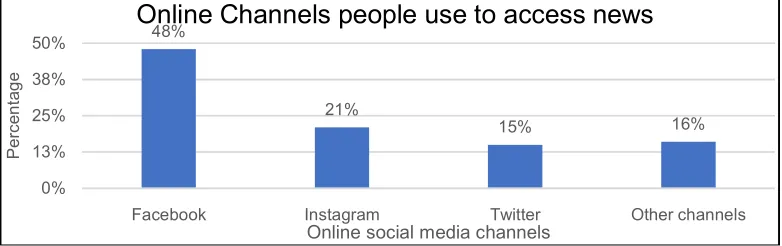
Here we show the results of the questionnaire analysis. The questionnaire responses showed that 86% of the participants used social media as their source of news: Facebook 48%, Instagram 21% and Twitter 15% while 16% used other online channels for their source of news such as traditional newspaper websites (Figure 2).
Figure 2 The interface for the human-based interface on the left and hybrid-based approach interface on the right 48%
21%
15% 16%
0% 13% 25% 38% 50%
Facebook Instagram Twitter Other channels
P
e
rc
en
ta
g
e
Online social media channels
[image:4.612.111.502.559.682.2]B. Inferential Statistics
Here we show the finding of the study aimed the effects of using different fake news detection on user classification performance and experience. in the method section, we are measuring this effect a number of performance and user experience effectiveness, efficiency, cognitive load and confidence.
[image:5.612.137.481.163.376.2]After the study, A within-subject ANOVA performed to test for significance with a 0.05 level.
Figure 3: A box and whiskers plot showing the
2)Efficiency
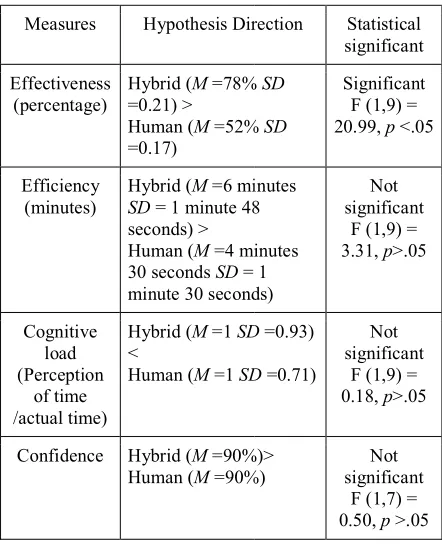
Efficiency is measured as the time taken to complete task. The effect of efficiency on participants human-machine detection approach (M=6 minutes minute 48 seconds) and those using the human (M=4 minutes 30 seconds SD = 1 minute 30 seconds) statistically insignificant, F (1,9) = 3.31, p >.05 (Table
3)Cognitive load
Cognitive load is measured as the ratio of the subjective perception of time and their objective to complete the task. A value greater than 1 higher cognitive load and a value less than 1 represent cognitive load. The effect of cognitive load on using the human-machine detection approach =0.93) and those using the human approach =0.71) were statistically insignificant, F (1,9) = (Table 3)
4)Confidence
Confidence is measured using a 7-point scale how confident the participants are of the classification made from “Absolutely confident” to “Not confident The effect of confidence on participants using machine detection approach (M =90%) and those
human approach (M =90%) were statistically insignificant, F (1,9) = 0.18, p >.05 (Table 3)
aimed at testing detection approaches experience. As stated effect based on experience measures:
confidence. ANOVA test was
significance
1)Effectiveness
[image:5.612.329.550.417.689.2]Effectiveness is measured as the accuracy Participants using the human-machine (M=74% SD =0.21) were significantly classifying news articles as fake than approach (M =52% SD =0.17), F (Figure 3).
the distribution of the effectiveness measure for the human and hybrid detection
complete the participants using the minutes SD =1 human approach seconds) were
(Table 3)
the participants objective time taken represents a represent lower on participants approach (M=1 SD approach (M=1 SD 0.18, p >.05
scale to indicant classification they confident at all”. using the
human-those using the insignificant,
Measures Hypothesis Direction
Effectiveness
(percentage) Hybrid (=0.21) > M =78% Human (M =52% =0.17)
Efficiency
(minutes) Hybrid (SD = 1 minute 48M =6 minutes seconds) >
Human (M =4 minutes 30 seconds SD = minute 30 seconds)
Cognitive load (Perception
of time /actual time)
Hybrid (M =1 SD
<
Human (M =1 SD
Confidence Hybrid (M =90%)> Human (M =90%)
Table 3: Showing the hypothesis direction and measure of experiment
accuracy of the classifier. machine detection approach significantly more effective at than those using the human F (1,9) = 20.99, p < .05
detection approaches.
Direction Statistical significant
=78% SD
=52% SD
Significant F (1,9) = 20.99, p <.05
minutes 48
minutes 1 seconds)
Not significant
F (1,9) = 3.31, p>.05
SD =0.93)
SD =0.71)
Not significant
F (1,9) = 0.18, p>.05
=90%)>
=90%) significant Not F (1,7) = 0.50, p >.05
Efeosasere Okoro et al, International Journal of Advanced Research in Computer Science, 10 (1), Jan-Feb 2019,26-32
© 2015-19, IJARCS All Rights Reserved 31
V.DISCUSSION AND CONCLUSION
The aim of this work was to test the effects of human-based (H) and human-machine (HM) human-based fake news detection approaches on user performance and experience.
Based on the limitations of the human-based and the machine-based approaches, we predicted that users will perform better in terms of performance and experience using a human-machine approach as opposed to a human-based one.
However, the outcome of the study indicated that, the effects of fake news detection approaches on performance (effectiveness) was 26% significantly higher when participants used the human-machine approach as oppose to working on their own. While on the other hand, the effects of fake news detection approaches on user experience (cognitive load and confidence) were not different compared to when they worked on their own.
A. Increase in fake news detection effectiveness
The 52% detection score by participants using the human-approach confirms [8] study findings that shows that humans are only a little better than chance (50%) at fake news detection. However, the increase in human effectiveness in fake news detection by augmenting human detection skills with machine is a significant finding. According to [17] and [27] humans can perform better when their skills are augmented that of a machine.
B. Social Media News Readability
We observed that about 70% of the participants visited social media for news daily and 86% of participants rely on the news they read on social media of which the most predominately used channel was Facebook. This finding is inline with [2] research that showed that over 60% of adults rely on social media for their news.
C. Limitation of the Study
We recognize that there are potential limitations to the study which may have influenced the results. For example (1) the news items were not randomized with real news as the problem set was only made up of collection of fake news. (2) The study participants were asked to pick if news items were fake or not. The method presented them with two choices. During the debrief session. The participants suggested that it would have been ideal if they had a third option (i.e. a maybe option).
In conclusion, this works aim was to test the effects of human-based and human-machine fake news detection approaches on user performance and experience. The study suggested that the fake news detection performance of frequent social media news readers will increase when their efforts and skills are augmented with that of machine-based methods.
VI. REFERENCES
[1]C. J. Bond and B. M. DePaulo, "Accuracy of deception judgments.,"Personality and Social Psychology Review, vol. 10, no. 3, pp. 214-234, 2006.
[2] D. Mrowca, E. Wang and A. Kosson, "Stance Detection for Fake News Identifcation," Stanford University, 2016. [3] E. Mustafaraj and P. T. Metaxas, "The Fake News
Spreading Plague:Was it Preventable?," in Proceedings of
ACM Web Science Conference, Troy, NY, USA, 2017.
[4] A. Halimeh, P. Pourghomi and F. Safieddine, "The Impact of Facebook’s News Fact-Checking on Information Quality (IQ) Shared on Social Media,"MIT International
Conference on Information Quality, 2017.
[5] N. J. Conroy, V. L. Rubin and Y. Chen, "Automatic Deception Detection: Methods for Finding Fake News," in ASIS&T Annual Meeting: Information Science with Impact:
Research in and for the Community, St. Louis, MO, USA.,
2015.
[6] H. Allcott and M. Gentzkow, "Social Media and Fake News in the 2016,"Journal of Economic Perspectives, vol. 31, no. 2, pp. 211-236, 2017.
[7] G. L. Ciampaglia, P. Shiralkar, L. M. Rocha, J. Bollen, F. Menczer and A. Flammini, "Correction: Computational Fact Checking from Knowledge Networks,"PLoS ONE, vol. 10, no. 6, 2015.
[8] R. A. Baron and D. Bryne, Social Psychology, London: Allyn and Bacon, 2000.
[9] M. Gabielkov, A. Ramachandran, A. Chaintreau and A. Legout, "Social Clicks: What and Who Gets Read on Twitter?,"Proceedings of the 2016 ACM SIGMETRICS International Conference on Measurement and Modeling of
Computer Science, pp. 179-192 , 2016.
[10]M. Anderson, "Social media causes some users to rethink their views on an issue," 7 November 2016. [Online]. Available: http://www.pewresearch.org/fact- tank/2016/11/07/social-media-causes-some-users-to-rethink-their-views-on-an-issue/.
[11]D. Goodwin-Ortiz, "Fake News on Social Media: Illusory Truth and the 2016 Presidential Election," Thomas Edison State University, New Jersey, 2017.
[12]Maheswaran and S. Chalken, "Promoting Systematic Processing in Low Motivation Settings: Effect of Incongruent Information on Processing and Judgement,"Journal of Personality and Social Psychology, pp. 1762 - 1776, 1991.
[13]R. E. Petty and J. T. Cacioppo, "Involvement and Persuasion; Tradiction Versus Integration,"Psychological
Bulletin, pp. 367 - 374, 1990.
[14]K. Shu, S. Amy, W. Suhang, T. Jiliang and L. Huan, "Fake News Detection on Social Media: A Date Mining Perspective,"ACM SIGKDD Explorations Newsletter, vol. 19, no. 1, pp. 22-36, 2017.
[15]W. Hango, "University graduates with lower levels of literacy and numeracy skills," Statistics Canada: Insights on Canadian Society, 2014.
[16]Okoro, B. Abara, A. Umagba, A. Ajonye and Z. Isa, "A Hybrid Approach to Fake News Detection on Social Media,"Nigerian Journal of Technology (NIJOTECH), vol. 37, no. 2, April 2018.
[17]D. Rus, "More Evidence That Humans and Machines Are Better When They Team Up,"MIT Technology Review:
Intelligent Machines, 8 November 2017.
[18]S. Karodia, "Annotating theVeracity of Tweets through Mobile Crowdsourcing," University of Cape Town, Cape Town, 2017.
[19]Facebook, "Tips to Spot False News," 2017. [Online]. Available:
https://web.facebook.com/help/188118808357379?_rdc=1 &_rdr.
[21]S. Teufel, "AN OVERVIEW OF EVALUATION METHODS IN TREC AD HOC INFORMATION RETRIEVAL AND TREC QUESTION ANSWERING," in
Evaluation of Text and Speech System, Dordrecht, The
Netherlands, Springer, 2007, pp. 168-186.
[22]R. A. Block, P. A. Hancock and D. Zakay, "How cognitive load affects duration,"A meta-analytic review. Acta
psychologica, vol. 134, no. 3, pp. 330 - 343, 2010.
[23]M. Sucala, B. Scheckner and D. David, "Psychological Time: Interval Length Judgments and Subjective Passage of Time Judgments,"Current psychology letters: Behaviour, brain & cognition, vol. 26, no. 2, 2010.
[24]K. Finstad, "Response Interpolation and Scale Sensirivity: Evidence Aganist 5-Point Scales,"Journal of Usability
Studies, vol. 5, no. 3, pp. 104-110, 2010.
[25]R. Peterson, "A Quantitative Analysis of Rating-scale Response Variability,"Marketing Letters, vol. 8, pp. 9-21, 1997.
[26]Snopes, "Snopes," Urban Legends Reference Pages, 2017. [Online]. Available: www.snopes.com. [Accessed 31 October 2017].