DOI: http://dx.doi.org/10.26483/ijarcs.v9i6.6342
Volume 9, No. 6, November-December 2018
International Journal of Advanced Research in Computer Science RESEARCH PAPER
Available Online at www.ijarcs.info
ISSN No. 0976-5697 ISSN No. 0976-5697
A NEW HIGHER ORDER SECOND DERIVATIVE BLENDED BLOCK LINEAR
MULTISTEP METHODS FOR THE SOLUTIONS STIFF INITIAL VALUE
PROBLEMS
Omagwu Samson*
Department of Mathematics & Statistics Kaduna Polytechnics,
Kaduna, Nigeria
Joshua Kyaharnan Victor
Department of Mathematics University of Jos
Jos, Nigeria
Muhammad Shakur Ndayawo
Department of Mathematics & Statistics Kaduna Polytechnics,
Kaduna, Nigeria
Abstract:This paper is concerned with the accuracy and efficiency of a higher order second derivative blended block linear multistep method for the approximate solution of stiff initial value problems. The main methods were derived by blending of two linear multistep methods using continuous collocation approach. These methods are of uniform order ten. The stability analysis of the block methods indicates that the methods are A–stable, consistent and zero stable hence convergent. Numerical results obtained using the proposed new block methods were compared with those obtained by the well known ODE solver ODE 15s to illustrate the accuracy and effectiveness. The proposed block method is found to be efficient and accurate hence recommended for the solution of stiff initial value problems.
Keywords: Blended Block, Linear multistep methods, Stiff ODEs, continuous collocation.
INTRODUCTION
Mathematical modeling of many problems in real life, Science, Medicine, Engineering and the like gave rise to systems of linear and non linear Differential Equations. In some cases, the differential equations could be solved analytically while in other case like the Holling Tanner equations and the Van Der Pol equations they are too complicated to be solved by analytical methods. Thus solving such problems becomes an uphill task hence the application of numerical methods for approximate solutions to these differential equations.
In this paper, the application of the nine step order ten blended block linear multistep method for the numerical solutions of stiff initial value problems (1) was considered. A potentially good numerical method for the solution of stiff system of ordinary differential equations (ODEs) must have good accuracy and some wide region of absolute stability. One of the first and most important stability requirements for linear multistep methods is A-stability as proposed by Enright (1974). The nine step blended block linear multistep methods is of a high order and A stable hence the application of the method here which makes it suitable for the solution of non linear ODEs.
The solution of stiff system of ODEs has been considered by Chollom et al (2011) where a block hybrid Adams Moulton Method was used and Kumleng et al (2013) where ten step block generalized Adams method was used. Many has discussed the solution of linear and non linear ODEs from different basis functions, among them are Onumanyi et al(1994), Sirisena et al (2004), Kumleng (2012) and so on.
THE NINE STEP BLENDED LINEAR MULTISTEP METHOD
The nine step blended linear multistep method is constructed based on the continuous finite difference approximation approach using the interpolation and collocation criteria described by Lie and Norsett (1981) called multistep collocation (MC) and block multistep methods by Onumanyi et al. (1994,1999). We define based on the interpolation and collocation methods the continuous form of the k- step 2nd derivative new method as
and
1 , 1 0
( )
t m i,
0,1, 2,...,
1
k k i
i
x
x
j
m
l
+ -l
+=
=
å
=
from Onumanyi et- al (1994), we obtain our matrices D and C = D-1 by the imposed conditions expressed as DC=I, where
respectively. In this case, k=9, t=1 and m=11 and it continuous form expressed in the form of (6) is
1
8 8
0
2
( )
( )
( )
9
( ) ''
9
(9)
m
n j n j
j
y x
a
x y
h
b
x f
h
l
x y n
-+ +
=
=
+
å
+
+
0 1 1 2 2 3 3 4 4 2
9 8 8 9 9
5 5 6 6 7 7 8 8 9 9
''
( )
( )
( )
( )
( )
(
)
( )
( )
(3.78)
( )
( )
( )
( )
( )
n n n n n
n n n
n n n n n
x f
x f
x f
x f
x f
y x
x y
h
h
x y
x f
x f
x f
x f
x f
b
b
b
b
b
a
l
b
b
b
b
b
+ + + +
+ + +
+ + + + +
é
+
+
+
+
ù
ê
ú
=
+
ê
ú
+
+
+
+
+
+
ë
û
%
using the approach of Onumanyi et al (1999). The matrix form of
Using the Maple software, the inverse of the matrix in (10) is obtained and its elements are used in obtaining the continuous coefficients and substituting these continuous coefficients into
(9) yields the continuous form of our new method. The continuous form as:
2 1
2 1
1 1 1
2 1
1 1 1
2
0 0
2
1 1
3 0
3 1
1 ...
1 ...
1
0 1 2 ... ( 1)
0 1 2 ... ( 1)
0 0 2 ( 2)( 1)
0 0 2 ... ( 2)( 1)
t m
n n n
t m
n n n
t m n k n k n k
t m
t m
m m
t m
t m m
x x x
x x x
x x x
x t m x
D
x t m x
t m t m x
t m t m x
M M
M
M L
L
M M M L M
L
M M M L M
(7)
01 11 1,1 01 01 1,1
02 12 1,2 02 02 1,2
1
0, 1, 1, 0, 0, 1,
...
...
...
...
.
. ...
.
.
.
.
.
(8)
.
. ...
.
.
.
.
.
.
. ...
.
.
.
.
.
...
...
t m
t m
t m t m t t m t m t m m t m
h
h
h
h
h
h
C
D
h
h
h
a
a
a
b
l
l
a
a
a
b
l
l
a
a
a
b
l
l
-
--
-+ + - + + + - +
æ
ö÷
ç
÷
ç
÷
ç
÷
ç
÷
ç
÷
ç
÷
ç
÷÷
ç
÷
ç
=
ç
÷
÷
=
ç
÷
ç
÷
ç
÷
ç
÷÷
ç
÷
ç
÷
ç
÷
ç
÷
2 3 4 5
1861τ 2677τ 348107τ 71957τ
τ- + 2- 3+ 4
1260h 2240h 580608h 362880h
6 7 8 9
36929τ 6613τ 547τ 41τ
y(τ+x ) =yn n+8+ - 5+ 6- 7- 8
829440h 967680h 774144h 870912h
10 11
53τ 53τ 127588h
- 9-
-10 467775 29030400h 29030400h
æ
ö
çç
çç
çç
çç
çç
çç
çç
çç
ççè
ø
%
fn2 3 4 5 6 7
36τ 4924τ 32887τ 556603τ 23281τ 17663τ
- 2- 3- 4+ 5- 6+
7h 735h 7840h 352800h 60480h 282240h
+ f
8 9 10 11
17τ 589τ 13τ τ 1884544h
- + -
-7 8 9 10 1091475
2520h 270080h 705600h 3104640h
÷÷÷
÷÷÷
÷÷÷
÷÷÷
÷÷÷
÷÷÷
÷÷
æ
ö÷
ç
÷
ç
÷
ç
÷
ç
÷
ç
÷
ç
÷
ç
÷÷
ç
÷
ç
÷
ç
÷
çè
ø
n+12 3 4 5 6 7
-12τ 6184τ 47543τ 884761τ 26399τ 117τ
+ 2- 3+ 4- 5+ 6
h 315h 3360h 151200h 17280h 448h
+ fn+2
8 9 10 11
337τ 47τ 17τ τ 88192h
- 7+ 8- 9+ +
10 155925
11520h 22680h 201600h 665280h
2 3
112τ 26416τ 328
- 2 +
5h 675h +
æ
ö÷
ç
÷
ç
÷
ç
÷
ç
÷
ç
÷
ç
÷
ç
÷÷
ç
÷
ç
÷
ç
÷
çè
ø
4 5 6 7
01τ 72301τ 7957τ 33121τ
- + 5
-3 4 2160h 6
1080h 5400h 50400h f
n+3
8 9 10 11
439τ τ τ τ 22016h
+ 7- 8+ 9+
-10 5775
5760h 180h 4320h 237600h
æ
ö÷
ç
÷
ç
÷
ç
÷
ç
÷
ç
÷
ç
÷
ç
÷÷
ç
÷
ç
÷
ç
÷
çè
ø
2 3 4 5 6
2 3 4 5
7 8 9 10 11
4
6 7 8 9 10
2
63
3407
58651
303169
416401
2
60
1280
14400
69120
89777
6137
517
49
80640
46080
51840
115200
126720
17936
6237
168
2
5
n
h
h
h
h
h
f
h
h
h
h
h
h
h
t
t
t
t
t
t
t
t
t
t
t
+
æ
-
ö
÷
ç
+
-
+
-
+
÷
ç
÷
ç
÷
ç
÷
ç
÷
ç
÷
ç
÷÷
ç
+
ç
ç
-
+
-
+
÷
÷
÷
ç
÷
ç
÷
ç
÷
ç
÷÷
ç+
÷
ç
÷÷
çè
ø
-+
3 4 5 6 7
2 3 4 5 6
5
8 9 10 11
7 8 9 10
2 3 4 5
2 3 4
776
2447
52003
30637
27191
45
48
2160
4320
20160
191
11
264448
1152
864
1800
95040
51975
28
7024
188741
454351
135
4320
21600
n
h
h
h
h
h f
h
h
h
h
h
h
h
h
h
t
t
t
t
t
t
t
t
t
t
t
t
t
+
æ
ö÷
ç
+
-
+
-
÷
ç
÷
ç
÷
ç
÷
ç
÷
ç
÷
ç
÷÷
ç+
-
+
-
-
÷
ç
÷
çè
ø
-+
-
+
-+
6 57 8 9 10 11
6
6 7 8 9 10
2 3 4 5 6
2 3 4
109421
17280
24827
1787
79
47
20160
11520
6480
86400
95040
372352
155925
144
4048
9169
201493
10573
7
105
280
12600
2160
n
h
f
h
h
h
h
h
h
h
h
h
h
h
t
t
t
t
t
t
t
t
t
t
t
+
æ
ö÷
ç
÷
ç
÷
ç
÷
ç
÷
ç
÷
ç
÷
ç
÷÷
ç+
-
+
-
-
÷
ç
÷
ç
÷
ç
÷
ç
÷
ç
÷
ç
÷÷
ç+
÷
ç
÷÷
çè
ø
-
+
-
+
+
57 8 9 10 11
7
6 7 8 9 10
1957
5027
227
23
2016
40320
22680
50400
110880
543232
155925
n
f
h
h
h
h
h
h
t
t
t
t
t
+
æ
ö÷
ç
-
÷
ç
÷
ç
÷
ç
÷
ç
÷
ç
÷
ç
÷÷
ç
+
-
+
-
÷
ç
÷
ç
÷
ç
÷
ç
÷
ç
÷
ç
÷÷
ç-
÷
ç
÷÷
çè
ø
2 3 4 5
2 3 4
6 7 8 9
5 6 7 8
10 11
9 10
1161
1222513
3337891
3073541
140
78400
250880
470400
3896567
4542079
67231
42883
1935360
11289600
1290240
10160640
877
481
549644
4515840
124185600
1091475
h
h
h
h
h
h
h
h
h
h
h
t
t
t
t
t
t
t
t
t
t
æ-ç
+
-
+
-çç
çç
çç
ç
+
ç
+
-
+
--
+
è
8 nf
+ö÷
÷÷÷
÷÷÷
÷÷÷
÷
ç
÷
ç
÷
ç
÷
ç
÷
ç
÷÷
ç
÷
ç
÷÷
ç
ø
2 3 4 5 6 7
2 3 4 5 6
9
8 9 10 11
7 8 9 10
3 4
2
4
796
65911
164099
2939
2797
9
945
90720
453600
25920
120960
53
139
11
4736
17280
544320
907200
3991680
93555
9
7129
6515
2
840
896
n
h
h
h
h
h
h f
h
h
h
h
h
h
h
t
t
t
t
t
t
t
t
t
t
t
t
t
+
æ
-
ö
÷
ç
+
-
+
-
+
÷
ç
÷
ç
÷
ç
÷
+ç
ç
÷
÷
ç
÷÷
ç-
+
-
-
+
÷
ç
÷
çè
ø
-
-+
5 6 7 8
2 3 4 5 7
9
9 10 11 2
8 8 10
4523
285
3013
15
1260
256
13440
512
29
4736
12096
8960
443520
10395
n
h
h
h
h g
h
h
h
h
t
t
t
t
t
t
t
+æ
ö÷
ç
-
+
-
+
÷
ç
÷
ç
÷
ç
÷
ç
÷
ç
÷
ç
÷÷
ç-
+
-
-
÷
ç
÷
çè
ø
---(11)
Evaluating the continues scheme (11) at
gives the nine discrete methods which constitute the nine step blended block linear multistep method.
0, ,2 ,3 ,4 ,5 ,6 ,7 ,9
h h h h h h h h
STABILITYANALYSISOFTHENEWMETHODS
In this section, we consider the analysis of the newly constructed methods. Their convergence is determined and their regions of absolute stability plotted.
Convergence
The convergence of the new block methods is determined using the approach by Fatunla (1991) and Chollom et.al
(2007) for linear multistep methods, where the block methods are represented in a single block, r point multistep method of the form
Zero Stability of the BBLMM for k=9
To determine the zero stability of the BBLMM we use the approach of Ehigie (2007) for linear multistep methods where he expressed the methods in the matrix form as shown below. Following the work of Ehigie and Okunuga (2014), we observed that the seven step block method is zero stable as the
roots of the equation
are less than or equal to 1. Since the block method is consistent and zero-stable, the method is convergent (Henrici 1962).
seen in figure 1. The new ten step discrete methods that constitute the block method have the following orders and error constants as shown below.
The nine step blended block multistep methods has uniform order of
and error constants of
REGIONS OF ABSOLUTE STABILITY OF THE
METHODS
The absolute stability regions of the newly constructed blended block linear multistep methods (8) and (12) are plotted using Ehigie (2007) by reformulating the methods into a characteristic equation of the form
0 0.5 1 1.5 2 2.5
-2.5 -2 -1.5 -1 -0.5 0 0.5 1 1.5 2 2.5
[image:5.612.327.567.49.275.2]im(z),z=lambda*h
Fig 1: Absolute Stability Region For BBLMM For K=9.
[image:5.612.61.273.238.388.2]This absolute stability region is A –stable since it consist of the set of points in the complex plane outside the enclosed figure.
NUMERICALEXAMPLES
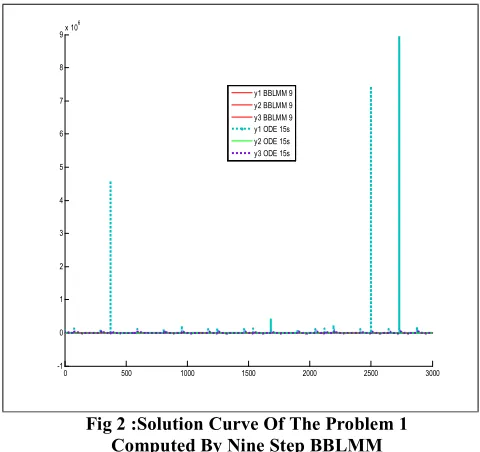
We report here a numerical example on stiff problem taken from the literature using the solution curve. In comparison, we also report the performance of the new blended block linear multistep methods and the well-known Matlab stiff ODE solver ODE15S on the same problems and on the same axes.
Problem1 Oregonator (Chemical Reaction) Problem
The oregonator chemical reaction model is a theoretical model of autocatalytic reaction.
It is a chemical dynamics of the oscillatory reaction. It is a reaction between
HBrO
2,
Br
andCe
(
IV
)
described byNoyes and Field (1974). The Oregonator model is expressed mathematically by the following
0 500 1000 1500 2000 2500 3000
-1 0 1 2 3 4 5 6 7 8 9x 10
6
y1 BBLMM 9 y2 BBLMM 9 y3 BBLMM 9 y1 ODE 15s y2 ODE 15s y3 ODE 15s
Fig 2 :Solution Curve Of The Problem 1 Computed By Nine Step BBLMM
Problem 2: Irregular Heartbeat and Lidocaine Model
The irregular heartbeat and Lidocaine model is expressed mathematically by the following
0
x
700,
h
0 1
.
0 100 200 300 400 500 600 700 0
0.5 1 1.5 2 2.5 3 3.5
x-axis
y
a
xi
s
y1 BBLMM 9 y2 BBLMM 9 y1 ODE 15s y2 ODE 15s
Fig 3 : Solution Curve Of The Problem 2 Computed By Nine Step BBLMM
CONCLUSION
Problem 1 which is a famous chemical reaction with periodic solutions and a highly stiff Ordinary Differential Equation whose solutions change rapidly over many orders of magnitudes. The solution curves in Figures 3 plotted within the range of with step size of 0.1 shows active oscillatory regime for different values. The solution curves using the BBLMM compare favourably with results obtained using the variable step size code ODE (15s).
(10,10,10,10,10,10,10,10,10)
T12
855 285 934 293 514 352 645 788 801
, , , , , , , ,
100000 1000000 1000000 100000 1000000 10000000 1000000 1000000 100000
T
[image:5.612.321.544.318.612.2]Problem 2 is a model of the relationship between Lidocaine and Irregular Heart beat. Lidocaine belong to a group of drugs known as anti-arrhythmic which work by preventing sodium from being pumped out on the cells of the heart to help the heart beat normally. From our solution curves, it was observed that normalcy in the heart beat can be attained with the use of Lidocaine within the correct dosage. Our solution curves coincide with the solutions of ODE 15s.
The numerical results from figures 2 and 3 reveal the accuracy of the newly constructed higher order blended block linear multistep methods (BBLMM) for step numbers 9. It can be seen clearly from the curve that our new methods perform favourably better than the well known ODE15S for the problems solved in problem 1and 2. It was also observed that the new methods have better stability regions than the conventional Adams Moulton method for step number 9.
RECOMMENDATIONS
This method is recommended for the solution of stiff system of ODEs since they are A-stable which implies a wider range of stability for effective performance.
REFERENCES
[1]. Butcher, J.C., (1966). On the Convergence of Numerical Solutions to Ordinary Differential Equations. Math. Comp. 20, 1 -10.
[2]. Chollom J.P., (2005): A study of Block Hybrid Methods with link of two-step Runge Kutta Methods for first order Ordinary Differential Equations. PhD Thesis (Unpublished) University of Jos,Jos Nigeria.
[3]. Chollom J.P., Ndam, J.N.and Kumleng G.M., (2007):some properties of block linear multistep methods. Science world journal, 2(3), 11-17.
[4]. Chollom J.P., Olatunbusin I.O. and Omagwu S., (2012): A Class of A-Stable Block Explicit Methods for the Solution of Ordinary Differential Equations. Research Journal of Mathematics and Statistics, 4(2), 52-56.
[5]. Ehigie, J.O., Okunuga, S.A., Sofoluwe, A.B. & Akanbi, M. A. (2010). Generalized 2-step Continuous Linear Multistep Method of Hybrid Type for the Integration of Second Order Ordinary Differential Equations. Scholars Research Library (Archives of Applied Science Research),
2(6), 362–372.
[6]. Enright, W. H. (1972). Numerical Solution of Stiff Differential Equations (pp. 321–331). Dept of Computer Science, University of Toronto, Toronto, Canada,.
[7] Enright, W.H (1974). Second Derivative Multistep Methods for Stiff Ordinary Differential Equations. SIAM Journals on Numerical Analysis, 11 (2), 376-391. [8] Ezzeddine, A.K. and Hojjati, G., (2012). Third derivative
multistep methods for stiff systems,International journal of nonlinear science, 14, 443-450.
[9] Gamal, A.F., Ismail, K. & Iman, H. I. (1999). A New Efficient Second Derivative multistep Method for Stiff System. Applied Mathematical Modeling, 23, 279–288. [10] Henrici, P. (1962). Discrete variable methods in Ordinary
Differential Equations (p. 407).John Willey, New York. [11]. Kumleng, G.M., Sirisena, U.W., & Chollon, J. P. (2012).
A Class of A-Stable Order Four and Six linear Multistep Methods for Stiff Initial Value Problems. Mathematical Theory and Modeling, 3(11), 94–102.
[12]. Kumleng, G.M., Sirisena, U.W.W, Dang, B. C. (2013). A Ten Step Block Generalized Adams Method for the Solution of the Holling Tanner and Lorenz Models.
African Journal of Natural Sciences, 16, 63–70. [13]. Lie, I. & Norset, R. (1989). Super convergence for
multistep collocation. Mathematics of Computation,
52(185), 65–79.
[14].Lotka a. j. (1925) element of physical biology. Baltimore, Williams and wilkins company
[15]. Mehdizadeh, M., Khalsarai, N., Nasehi, O. & Hojjati, G. (2012). A Class of Second Derivative multistep methods for stiff systems. Journal of Acta, 15(2012), 209–222. [16]. Onumanyi, P., Awoyemi, D.O., Jator, S.N.& Sirisena,
U. W. (1994). New Linear Multistep Methods with continuous coefficients for first order IVPs. Journal of NMS, 31(1), 37–51.
[17]. Onumanyi, P., Sirisena, U.W. & Jator, S. N. (1999). Continuous finite difference approximations for solving differential equations. International Journal of Computer and Mathematics, 72(1), 15–27.
[18]. Rosenzweng M. L. and MacArthur R. H. (1963) Graphical representatation and stability conditions of pradator-prey interactions. A.M. Nat. 97, 209-223 [19]. Sahi, R.K., Jator, S.N. & Khan, N. A. (2012). A