DOI: http://dx.doi.org/10.26483/ijarcs.v9i1.5256
Volume 9, No. 1, January-February 2018
International Journal of Advanced Research in Computer Science
RESEARCH PAPER
Available Online at www.ijarcs.info
ISSN No. 0976-5697
DESIGN AND DEVELOPMENT OF SIMULATION TOOL FOR TESTING SEO
COMPLIANCE OF A WEB PAGE – A CASE STUDY
Dr. P.G. Naik
Professor
Dept. of Computer Studies CSIBER, Kolhapur, India
Dr. R.S. Kamath
Associate Professor Dept. of Computer Studies
CSIBER, Kolhapur, India
Dr. S.S. Jamsandekar
Assistant Professor Dept. of Computer Studies
CSIBER, Kolhapur, India
Abstract: Efficient search engines enable the end user to avail the target information as early as and as accurately as possible. Search engine optimization conforms to the act of optimizing the webpage in particular and a website in general so as to acquire a highest ranking in search engine results. The ranking is based on some pre-defined criteria which SEO encapsulates for generating right signal to the search engine. The basic methodology adopted for this purpose primarily focuses on enriching the website content and improving readability by making the web pages more search engine friendly. Several optimization tools exist for rendering the website search engine friendly. But all these tools operate like a black box where the internal details are not immediately revealed to an end user. To facilitate this, in the current work the authors have designed and developed a simulation tool for testing w3C compliance which is a necessary condition for making a webpage search engine friendly. The browsers do not complain against the violation of W3C compliance rules, however such violations do result in rendering the web page invisible to the search engine which in turn results less network traffic flow to the website. Among other things W3C and CSS compliance are the most basic rules which a website designer cannot afford to ignore. In the current work, the tool is designed and developed for the purpose which accepts an HTML document and computes its W3C compliance score. The tool meticulously analyzes the HTML code and generates several reports conforming to violation of rules, if any. Further, the tool has the provision for converting the document into W3C compliance document based on the specified ruleset.Finally, the tool has been tested by applying it to the case study of a hypothetical organization.
Keywords: CSS, Digital Marketing, HTML, JavaScript, Off-site Optimization, On-site Optimization, W3C Compliance
1. INTRODUCTION
In the era of Internet and worldwide web, digital marketing has emerged as the most promising and powerful trend in marketing which focuses on retaining the existing customers and acquiring the new customers based on the digital content. Academic institutions are not an exception to this. Due to the extensive competition among educational institutions for acquiring quality students, institutions are also adopting these advanced cutting edge technologies in establishing their brand names and reaching the aspirants across the globe. There is vast amount of digital content already present on Internet and more content is constantly generated at an exponential rate. Due to an intense competition, every organization intends to see itself at the top of the content generated by the search engines. It has been predicted that in the coming decade, in this entire competition only those organizations which quickly adopt themselves to these cutting edge technologies will survive which gives them an upper hand over their competitors and will consequently be the emerging winners conforming to the Darwinian principle of survival of the fittest. Currently most of the academic institutions are adopting Search Engine Optimization (SEO) for rendering their sites search engine friendly thereby sailing up to higher positions in search engine results.
Search engine optimization is a digital marketing
renders the website search engine friendly. There exist a fistful of freelancing companies providing these facilities. SEO focuses on improving web visibility through a set of specific keywords. SEO in essence is a guiding theory for increasing web traffic. Keyword is the most crucial factor which plays a key role in influencing search engine results to a large extent. The generic optimization principle namely, early termination technique is employed by majority of search engines which involves computation of results based on indexing and employing pruning techniques which reduces the huge computational task involved in exhaustive traversal.
The most challenging task for the search engine is the tremendous workload to be handled by it and on an average the typical search engine needs to address hundreds of millions of queries on per-day basis involving billions of documents. Search engine addresses this issue by involving millions of machines distributed over multiple data centers with an intention to reduce query processing cost.The SEO techniques primarily fall into two distinct categories
• On-site optimization
• Off-site optimization
is Click-Through-Rate (CTR) of a website which is computed by dividing the number of times the page containing the link is displayed by number of times the link is clicked. For example if the page containing the link is clicked 10,000 times and the link is clicked 100 times, then CTR for the page is (100/10000)*100 % = 1%.
SEO optimization is based on four optimization techniques: structure optimization, keyword optimization, content optimization and link optimization. In the current work, authors focus on content optimization based on few key rules and validate the HTML document against those rules. Based on the validation process a compliance score is assigned to the document. The tool also contains the provision for converting invalid HTML documents into their valid counterparts. Currently, the tool operates only with a few set of rules which can easily be extended to incorporate additional rules.
2. LITERATURE REVIEW
With the rapid evolution of information technology and explosion in the number of websites, SEO technology is continuously gaining a tremendous importance and is catching the attention of every website developer. SEO techniques focus on few parameters pertaining to keyword selection, back linking, rich dynamic content and target towards gaining a better ranking in the search engine results [1, 2]. Website promotion is just a single application of SEO technology. The application of search engine optimization is many fold. Apart from improving the page ranking, there are numerous applications which exploit search engine optimization techniques such as spamming application, six sigma management application for which SEO provides a conceptual background [2 -4]. The guidelines for building search engine friendly websites resulting in optimization of search queries have been presented [5-7]. Further, the authors present a review of search engine optimization tool as a part of digital marketing regime. Different categories of SEO tools are highlighted to aid website promotion. Search engine filtering system based on two-tier link extractor is presented to decrease the traffic of irrelevant pages in search result [8]. Search engine optimization based on soft computing technique is presented by Wang et.al [9] where a back propagation learning method of a neural network is employed for speedy retrieval of data from the web. Web caching based on semantic web technique is employed for designing a cluster of search engines with a goal to reduce load on the web server and latency time [10]. The different algorithms, lowest relative value algorithm, LUV algorithm and least weighted usage algorithm are employed to study
only the partial content optimization. The paper provides the first hand information for new researchers in this area.
3. CONCEPTUAL MODEL DESIGN
A. Problem Definition
XYZ institute is a leading management institute in south western Maharashtra accredited by NACC with “A” grade. The institute has in-house website development team which is actively involved in maintenance of the website. The management of the institute is interested in improving the website ranking in search engine queries.
B. Proposed Solution
The problem can be addressed at two levels. As a first alternative, hiring a freelancer, who works for 25% cheaper than SEO company. But at the same time it can be risky and time consuming as freelancer many not be aware of the specificwebsite strategy and may struggle to understand the exact needs. Finding a good freelancer is time consuming and is more often a trial and error process.
Current Status
There are plethora of free and open source tools available on Internet which enable the analysis of the website content and give SEO ranking of the website. The tools generate the report pertaining to
• W3C Compliance Test
• CSS Compliance Test
• Keyword Analysis
• Broken links analysis
and suggest improvements for making the website SEO affine.
As a second alternative, the in-house tool can be designed and developed for verifying W3C and CSS Compliance which can then be input to available tools for improving it further. This enables the website to rank top in search engine results thereby improving the volume of traffic towards website by search engine. This demands the technical expertise which may be expected from XYZ institution due to the availability of in-house website development team.
In a simpler manner, at a first level search engine optimization can be achieved by targeting search terms which commonly include title, description, keywords, headings and alternate text. Few prominent rules for SEO are listed below:
C. Few Prominent Rules for SEO
Dr. P.G. Naik et al, International Journal of Advanced Research in Computer Science, 9 (1), Jan-Feb 2018,323-340
• Using Meta tag with the attribute “name” set to
“description” and the “content” attribute listing about 150 characters.
• Limiting title size to maximum 9 words or 60
characters.
• Adding title to anchor element.
D. W3C Compliance Test
Browsers do not consider any violation against W3C compliance but search engines do. On useful link to validate the webpage is
validator.w3.org
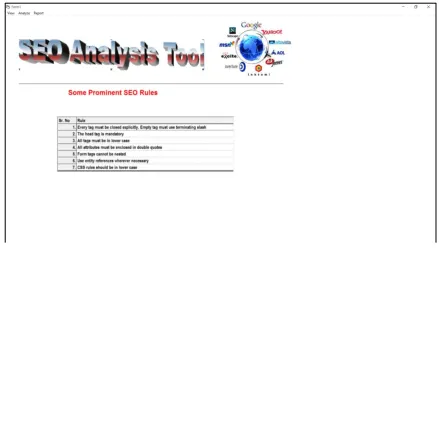
Rules of W3C Compliance
1. Every tag must be closed explicitly. Empty tag
must use terminating slash.
2. The head tag is mandatory.
3. All tags must be in lower case.
4. All attributes must be enclosed in double quotes.
5. Form tags cannot be nested.
6. Use entity references wherever necessary.
7. CSS rules should be in lower case.
E. Application Architecture
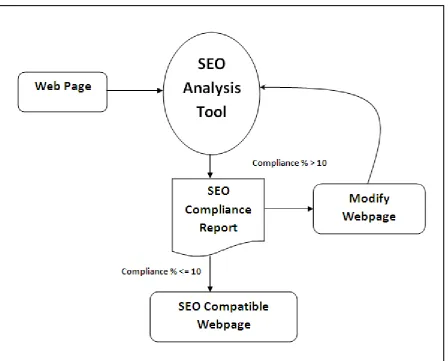
[image:3.595.77.526.247.608.2]The application architecture and operation of SEO analysis tool is presented in Figure 1.
Figure 1. Application Architecture of SEO Analysis Tool
The various steps involved in testing SEO compliance are depicted below:
1. Accept a webpage from the end user.
2. Check no. of significant rules ( A rule is considered to be significant if the corresponding element exists in an input web page)
3. Distribute the percentage among the significant rules equally.
primary focus is in locating un-terminated tags, unquoted attributes, missing head element etc. The score is equally distributed among the tags present and finally the SEO compliance score for the current ruleset is computed.
F. Implementation of Rules
All the seven rules carry equal priority and the percentage score reserved for each rule is given by, Percentage = 100 / N
where, N is the number of significance rules. The net score is computed using the formula
∑ Si where 1 <= i <= N
The computation of a score for first four rules is depicted below:
Implementation of Rule 1:
The rule for the matching tags (un-terminated tags) is, S = E + T
where, S, E and T refer to the no of start tags, end tags and terminating tags, respectively.
The score awarded after testing rule 1 is Score1 = (Percentage) * (E+T) / S
Implementation of Rule 2:
Implementation of rule 2 is trivial since the full/zero score is awarded based on the presence/absence of a head node.
Implementation of Rule 3:
Score3= (Percentage) * L / T
where T has the same meaning as above and L is the number of tags in lower case.
Implementation of Rule 4:
Score4= (Percentage) * Q / A
where Q is the total number of quoted attributes and A is the total number of attributes. The final SEO compliance score is then given by,
S = S1 + S2 + . . . +S7
4. RESULTS AND DISCUSSIONS
Figure 2(a)-2(d) Reports Generated by W3C Validator Tool
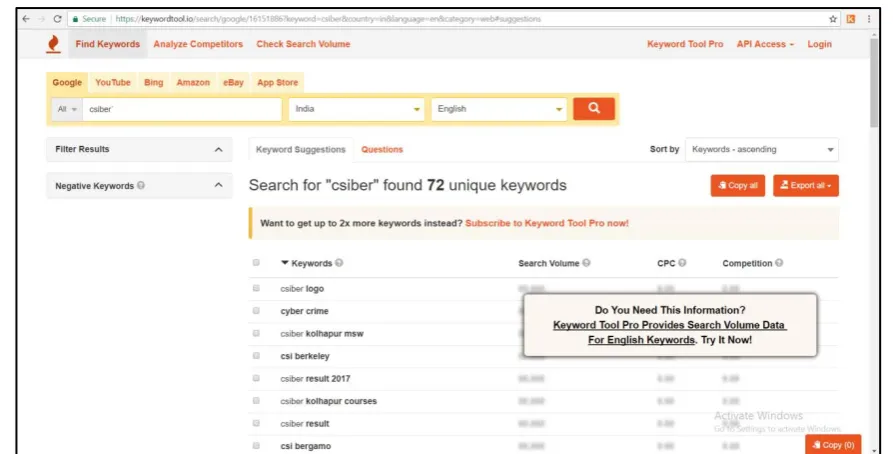
Figure 3and 4 shows the keyword analysis and SEO score computed by employing open source SEO tools freely available on Internet.
[image:6.595.73.520.333.560.2]Dr. P.G. Naik et al, International Journal of Advanced Research in Computer Science, 9 (1), Jan-Feb 2018,323-340
Figure 4. Open Source Software for Computation of SEO Score
[image:7.595.78.518.359.789.2]Dr. P.G. Naik et al, International Journal of Advanced Research in Computer Science, 9 (1), Jan-Feb 2018,323-340
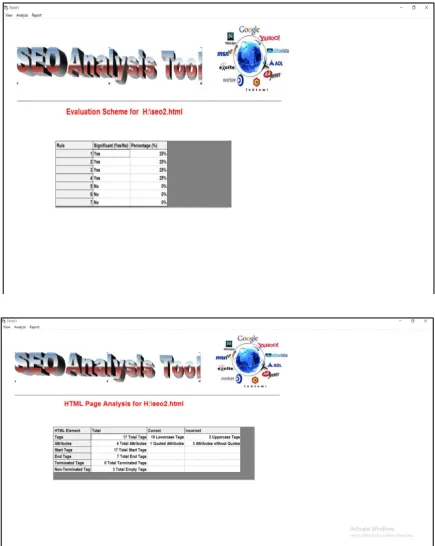
Figure 6(a)-6(b) SEO Compliance Score Computed by Custom W3C Validator Tool
Dr. P.G. Naik et al, International Journal of Advanced Research in Computer Science, 9 (1), Jan-Feb 2018,323-340
Figure 8. Report Generated by the W3C Validation Tool in Text Format
Converting the Invalid HTML document in to Valid HTML Document.
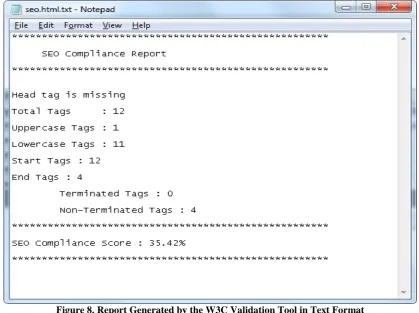
[image:11.595.92.505.414.578.2]The structure of HTML document, “seo.html” input to the tool is shown in Figure 9. As revealed from the HTML content head tag is missing, some tags (hr and html end tag) are in uppercase. Br tags are not terminated.
Figure 9. Structure of HTML Document
Figure 10(a)-(b). Report Generated by the W3C Validation Tool on Performing Tag Analysis
[image:12.595.81.511.57.580.2]Dr. P.G. Naik et al, International Journal of Advanced Research in Computer Science, 9 (1), Jan-Feb 2018,323-340
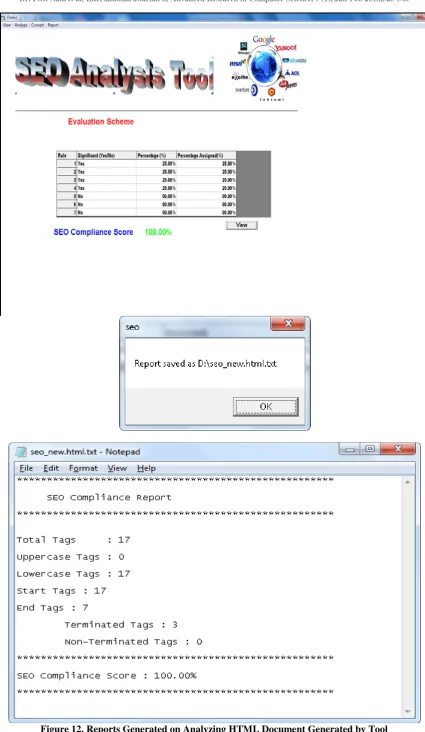
Figure 11. Structure of the Valid HTML Document Generated by the Tool
Dr. P.G. Naik et al, International Journal of Advanced Research in Computer Science, 9 (1), Jan-Feb 2018,323-340
5. CONCLUSIONS AND SCOPE FOR FUTURE WORK
Search engine optimization conforms to the act of optimizing the website so as to acquire a highest ranking in search engine results. The ranking is based on some pre-defined criteria which SEO encapsulates for generating right signal to the search engine. Hence knowledge of these criteria enables in rendering the website visible to most of the search engines and being listed at the top of the search results generated by a search engine. In the current research, the authors have considered a set of validation rules for W3C compliance and a tool is designed and implemented to generate a W3C Compliance score for a web page. The tool also enables converting an invalid HTML document to its valid counterpart by incorporating the necessary changes to the document by referring to the rule set. The tool acts as a first-hand simulation tool to understand search engine optimization issues. The scope of the tool can be further broadened to incorporate few more rules corresponding to page ranking, back linking, keyword density calculation etc. to widen its scope.
REFERENCES
1. Constantinos Dimopoulos, Sergey Nepomnyachiy, TorstenSuel, “Optimizing Top-k Document Retrieval Strategies for Block-Max Indexes”, IEEE Conference, ACM, 2013, 113-122.
2. Lihong Zhang, Jianwei Zhang, YanbinJu, in ” The Research on Search Engine Optimization Based on Six Sigma Management”, in IEEE conference 2011, 101-103
3. Antriksha Somani, Ugrasen Suman , “Counter Measures against Evolving Search Engine Spamming Techniques”, IEEE Conference, 2011 , 214-217.
4. H. L. Hsing, H. J. Chen, L. Me. Huang and H. H. Yi, “The application of search engine optimization for internet marketing: An example of the motel web sites”, ICCAE Chung Hua University Taiwan, vol. 1, (2010), pp. 380-383. 5. P. T. Chung, S. H. Chung and C. K. Hui, “A web server
design using search engine optimization techniques for web intelligence for small organizations”, LISAT IEEE Long Island University Brooklyn NY USA, (2012), pp. 1-6. 6. M. Cui and S. Hu, “Search Engine Optimization Research for
Website promotion”, ICM Transp. Manage., China, vol. 4, (2011), pp. 100-103.
7. Killoran, J.B. ,”How to Use Search Engine Optimization Techniques to Increase Website Visibility”, Professional Communication, IEEE Transactions on (Volume:56 , Issue: 1 )
8. S. M. Kumar, P. Revathy and K. Vijayalakshmi, “Implementation of two-tier link extractor in optimized search engine filtering system”, IEEE IMSAA IT Dept. Hyderabad, India, (2009), pp. 1-4.
9. S. Wang, K. Xu, Y. Zhang and F. Lie, “Search Engine Optimization based on Algorithm of BP Neural networks”, CIS Inst. of Eng. & Tech., China, (2011), pp. 390-394
10. M. Rajaram and S. L. S. Vadivu, “Web caching in Semantic Web based multiple search engines”, ICCIC IEEE Dept. of EEE Tirunelveli, India, (2010), pp.1-7.
Appendix A
Partial Source Code for Implementation of SEO Compliance Test Tool in Visual Basic 6
head = False form1 = False css = False Tagupper = False uppercnt = 0 cattr = 0 tattr = 0 total = 0
mnuEvaluation_Click
If (head = True) Then total = total + percentage End If
Open filename For Input As #1 While (EOF(1) = False)
Input #1, Line1 n = InStr(1, Line1, "<") m = InStr(1, Line1, ">")
While (n > 0 And m > 0)
Tag = Mid(Line1, n + 1, m - 2)
Wend Wend
Close #1
Open filename For Input As #1 While (EOF(1) = False)
Input #1, Line1 n = InStr(1, Line1, "=") While (n > 0)
n = InStr(n + 1, Line1, "=") tattr = tattr + 1
Wend Wend
Close #1
Open filename For Input As #1 While (EOF(1) = False)
Input #1, Line1 n = InStr(1, Line1, "=") m = Mid(Line1, n + 1, 1)
count = 4
Open filename For Input As #1 While (EOF(1) = False)
Input #1, Line1
n = InStr(1, "<head>", Line1) If (n > 0) Then
head = True End If
n = InStr(1, "form", Line1) If (n > 0) Then
form1 = True count = count + 1 End If
n = InStr(1, "style", Line1) If (n > 0) Then
css = True count = count + 1 End If
n = InStr(1, "&", Line1) If (n > 0) Then
entity = True count = count + 1 End If
Wend Close #1
percentage = 100 / count
n = countstarttags m = countemptyendtags x = n - m
y = countendtags lowercnt = n - uppercnt totalcnt = n
score1 = lowercnt / totalcnt * percentage
If (x = 2 * y) Then MsgBox "Tags match.." Else
MsgBox Abs(x - 2 * y) &" Tag(s) of " & (x - y + m) & " total tags do not match.."
End If
diff = (x - y + m) - Abs(x - 2 * y)
Else
MSFlexGrid1.TextMatrix(3, 3) = Format(CStr(percentage), "##.00") & "%"
End If
End Sub
Private Sub mnuConvert_Click() Dim Line1 As String
fname = Left(filename, Len(filename) - 5) fname = fname& "_new.html"
Open fname For Output As #2 Open filename For Input As #3 While (EOF(3) = False) Input #3, Line1 n = InStr(1, Line1, "=")
If (Trim(LCase(Line1)) = "<html>") Then Print #2, Line1
If (head = False) Then Print #2, "<head>"
Print #2, vbTab& "<title>" & filename & "</title>" Print #2, "</head>"
End If
ElseIf (Trim(LCase(Line1)) = "<hr>") Then Print #2, "<hr/>"
ElseIf (Trim(LCase(Line1)) = "<br>") Then Print #2, "<br/>"
ElseIf (n > 0) Then
m = Mid(Line1, n + 1, 1) While (n > 0 And m > 0) If (m <> """") Then s1 = InStr(n, Line1, " ") s2 = InStr(n, Line1, ">") If (s1 > s2) Then Min = s2 Else Min = s1 End If
newline = Mid(Line1, 1, n) & """" & Mid(Line1, n + 1, (Min - n - 1)) & """" & Mid(Line1,
(Min), Len(Line1) - Min + 1) Line1 = newline
End If
n = InStr(n + 1, Line1, "=") m = Mid(Line1, n + 1, 1) Wend
Dr. P.G. Naik et al, International Journal of Advanced Research in Computer Science, 9 (1), Jan-Feb 2018,323-340
Dim Line1 As String
Label1.Visible = False MSFlexGrid1.Visible = False
CommonDialog1.Action = 1
filename = CommonDialog1.filename count = 4
Open filename For Input As #1
While (EOF(1) = False) Input #1, Line1
n = InStr(1, "<head>", Line1)
If (n > 0) Then head = True End If
n = InStr(1, "form", Line1) If (n > 0) Then
form1 = True count = count + 1 End If
n = InStr(1, "style", Line1) If (n > 0) Then
css = True count = count + 1 End If
n = InStr(1, "&", Line1) If (n > 0) Then
entity = True count = count + 1 End If
Wend Close #1
percentage = 100 / count= End If
End If End If End Sub
Private Sub mnuSeoCompliance_Click()
Label1.Caption = "HTML Page Analysis for "& filename
uppercnt = totalcnt - lowercnt wattr = tattr - cattr
n = countemptyendtags t = n
n = countstarttags - 2 * countendtags - countemptyendtags
Open filename & ".txt" For Output As #2
Print #2,
Print #2, "***********************************************
******" &vbCrLf&vbCrLf If (head = False) Then
Print #2, "Head tag is missing" &vbCrLf End If
Print #2, "Total Tags : " &totalcnt&vbCrLf Print #2, "Uppercase Tags : " &uppercnt&vbCrLf Print #2, "Lowercase Tags : " &lowercnt&vbCrLf Print #2, "Start Tags : " &countstarttags&vbCrLf Print #2, "End Tags : " &countendtags&vbCrLf Print #2, vbTab& "Terminated Tags : " & t &vbCrLf Print #2, vbTab& "Non-Terminated Tags : " & n &vbCrLf
Print #2, "***********************************************
******" &vbCrLf
Print #2, "SEO Compliance Score : " & Label3.Caption &vbCrLf
Print #2, "***********************************************
******" &vbCrLf Close #2
MsgBox "Report saved as "& filename & ".txt" End Sub
Public Function countstarttags() As Integer Dim Line1 As String
Dim cnt As Integer cnt = 0
Close #1
Open filename For Input As #1 While EOF(1) = False
Input #1, Line1 n = InStr(1, Line1, "<") While (n > 0)
cnt = cnt + 1
n = InStr(n + 1, Line1, "<") Wend
Wend Close #1
countstarttags = cnt End Function
Public Function countemptyendtags() As Integer Dim Line1 As String
Dim cnt As Integer
Open filename For Input As #1 cnt = 0
While EOF(1) = False Input #1, Line1
m = InStr(1, Line1, "/>") While (m > 0)
cnt = cnt + 1
m = InStr(m + 1, Line1, "/>") Wend
Wend Close #1
cnt = 0
Open filename For Input As #1 While EOF(1) = False
Input #1, Line1
n = InStr(1, Line1, "</") While (n > 0)
cnt = cnt + 1
n = InStr(n + 1, Line1, "</") Wend
Wend Close #1