International
Journal
of
Advanced
Research
in
Computer
Science
RESEARCH
PAPER
Available Online at www.ijarcs.info
AN APPLIED RESEARCH BASED ON ROUGH SET FOR DISCOVERING AND
IMPROVING THE QUALITY OF THE ASSOCIATION RULES SET ON THE
TEACHING AND LEARNING DATABASE AT NHA TRANG UNIVERSITY
Nguyen Xuan Dat
Researcher in Information Technology Nha Trang City, Khanh Hoa Province, Viet Nam
E-mail: [email protected]
Nguyen Duc Thuan
Information Technology dept., Nha Trang University Nha Trang City, Khanh Hoa Province, Viet Nam
E-mail: [email protected]
Abstract: One of the important problems in rule-induction methods is how to extract interesting, relevant and novel rules. This paper presents an application of an evaluation technique based on Rough set theory which can help not only to reduce the number of rules, but also to extract higher quality rules. Rules generated from our Apriori-DT algorithm are evaluated for reducing and extracting higher quality rule set by applying a fertile method introduced by Jiye Lee et al. Experimental results on the teaching and learning database at Nha Trang University (TLNTU) illustrates the potential usefulness of this application in the education field.
Keywords: Rough Set; data mining; association rules; evaluation; rules-as-attributes measure; quality of teaching
I. INTRODUCTION
A challenging problem in rule generation is that an extensive number of rules are extracted by data mining algorithms over large data sets, and it is infeasible for human beings to select important, useful, and interesting rules manually. There are many different approaches for reducing the number of the association rules. In those approaches, only rules that satisfy some criteria are generated. Jiye Lee et al. [1] introduced a new method to discover important rules by considering rules as attributes, the Rules-As-Attributes Measure. This method is based on Rough set theory. A new decision table is constructed by considering all the original rules as condition attributes. Reducts generated from this new decision table contain essential attributes, which are the rules. Only important rules are contained in the reducts
.
Based on the algorithm of Jiye Lee et al. and our hybird algorithm Apriori-DT [4], we implemented applied software which extracts high quality association rules. The experimental results on TLNTU dataset demonstrate the effectiveness of this applied software and they also support analyzing survey results of the quality of teaching at Nha Trang University.
This paper is organized as follows. In section 2, some basic concepts about association rules, rough set and reduct generation algorithms are summarized. An overview of rules extracting and evaluating procedure is presented in Section 3. In Section 4, experiment on TLNTU dataset is demonstrated in details. Finally, Section 5 provides the conclusions and acknowledgement.
II. PRELIMINARIES
A. Rough Set theory
Rough Set is approximative description of sets that can be achieved using equivalences (or partitions). This idea was first introduced by the Polish mathematician Z. Pawlak [7]. Reduct and core are two important concepts in this theory. A reduct is a subset of attributes that are sufficient to describe the decision attributes. The reduct of an information system
is not unique: there may be many subsets of attributes which preserve the equivalence-class structure (i.e., the knowledge) expressed in the information system. Finding all the reduct sets for a data set is a NP-hard problem [2]. All reducts contain core. The core is the set of attributes which is possessed by every legitimate reduct. Core represents the most important information of the original data set.
B. The hybrid association rules mining algorithm: Apriori-DT
Association rule algorithms often generate an excessive number of rules, many of which are not significant. It is difficult to determine which rules are more useful, interesting and important. In order to improve the efficiency of association rules discovery on large data sets, we proposed a hybrid algorithm which is implemented by combining traditional apriori algorithm [5] with the forms of interesting rules called “Rule templates”. This algorithm is called Apriori-DT [4].
There are two main improvements in Apriori-DT algorithm:
• Using “Rule Template”: The concept of “Rule Template” was first presented by Klemettinen et al. in 1994 [3]. Rule templates describe patterns for those items that appear both in the antecedent and in the consequent of association rules. By defining appropriate rule templates, we are able to extract interesting rules for various users in certain application domains.
• Using SQL query: In order to calculate absolute support measure on decision table structure. By taking advantage of SQL data management system, this technique helps to improve the performance of rules mining process.
C. Rules-As-Attributes measure
decision attributes. Therefore, a reduct of such a decision table represents the essential attributes, which are the most important rules that fully describe the decision. These rules are called Reduct Rules. Only important rules are contained in the reducts. We call such rules “Reduct Rules”.
Based on this intuition, the new decision table is constructed as follows.
Let us consider a decision table T = (U,C,D), where U = {u0, u1, ..., um−1} is a set of records in the table, C = {c0, c1, ..., cp−1} is a set of the condition attributes and D is a set of
the decision attributes. Let us consider decision tables with one decision attribute. A set of rules R is generated from this table T, where R = {Rule0, Rule1, Rulen−1}.
We construct a new decision table Am× (n+1), where each
record from the original decision table u0, u1, um−1is the row, and the columns of this new table consists of Rule0, Rule1, Rulen−1and the decision attribute. We say a rule can applied to a record in the decision table if both the antecedent and the consequent of the rule appear together in the record, which can also be interpreted as whether a rule can classify the
record correctly. For each Rulej (j [0, ..., n − 1]), we assign
1 to cell A[i, j] (i [0, ...,m − 1]) if the rule Rulej can be
applied to the record ui. We set 0 to A[i, j] otherwise. The
decision attribute A[i, n] (i [0, ...,m− 1]) remains the same
as the original values of the decision attribute in the original decision table. (1) shows the conditions for the value assignments of the new decision table.
1, if j<n and can be applied to
0, if j<n and cannot be applied to (1)
, if j=n and is the correspondingdecision attributes for
[ , ]
j i
j i
i d i
Rule u
Rule u
d d
A i j =
⎧
⎪
⎨
⎪⎩
uThe output of rules evaluation procedure with the Rules-As-Attributes Measure approach is sets of important rules, which are subset of the original rule sets generated from the original data. These outputs are Reduct Rule Set and Core Rule Set, and defined as follow.
a) Definition 1[1]: Reduct Rule Set.
We define a reduct generated from the new decision table A as the Reduct Rule Set. A Reduct Rule Set contains Reduct Rules.
The Reduct Rules are representative rules that can fully describe the decision attribute.
b) Definition 2[1]: Core Rule Set.
We define the intersection of all the Reduct Rule Sets generated from this new decision table A as the Core Rule Set. A Core Rule Set contains Core Rules. The Core Rules are contained in every Reduct Rule Set.
By considering rules as attributes, reducts generated from the new decision table contain all the important attributes, which represent the important rules generated from the original data set; and it excludes the less important attributes. Core attributes from the new decision table A contain the
most important attributes, which represent the most important rules.
D. Hu’s Reduct and Core generation algorithms
Hu et al. [6] proposed a new rough set model based on database operations such as cardinality and projection. By combining a relational algebra with the rough sets theory, the approach is designed to increase the efficiency of the core and reduct computation. A reduct is redefined based on the database operations.
Let K(REDU,D) be the proportion of the data instances in the decision table that can be classified. K is also defined to be the degree of dependency between REDU and the decision attribute D, and is the stopping criteria for the algorithm, as shown in (2). Card denotes the count operation in databases, and
∏
denotes the projection operation in databases.(
)
(
)
( )
( , )
( )
(2)
Card REDU D
K REDU D
Card C D
+ =
+
∏
∏
A measure of merit value is defined to evaluate the effect of each condition attribute on the decision attribute D. For a
condition attribute Ci C, the merit of Ci can be calculated
by
{ }
(
)
(
)
(
)
(
)
( , , ) 1 i
(3)
i
Card C C D
Merir C C D
Card C D
− +
= −
+
∏
∏
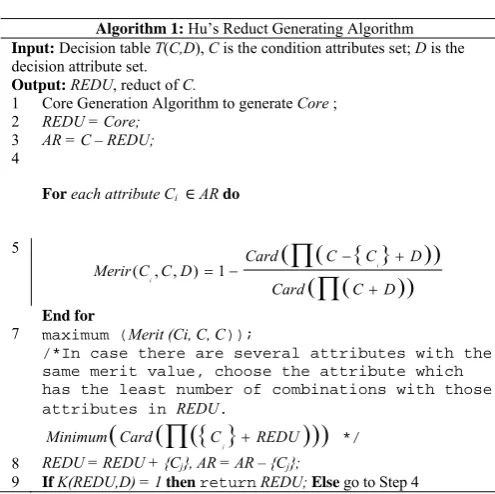
During the reduct generation, the condition attribute with the highest merit value at the moment is included in the reduct. In case multiple highest merit values exist, the condition attribute with the least combination with other attributes in the current reduct is selected. The algorithm iterates until the minimum set of attributes which is as representative as the entire condition attributes is obtained. The reduct generation algorithm is shown in Algorithm 1. The reduct generation is designed to guarantee that the generated reduct will have the minimum number of attributes.
Algorithm 1: Hu’s Reduct Generating Algorithm Input: Decision table T(C,D), C is the condition attributes set; D is the decision attribute set.
Output:REDU, reduct of C.
1 Core Generation Algorithm to generate Core ;
2 REDU = Core;
3 AR = C – REDU;
4
For each attribute Ci AR do
5
(
(
{ }
)
)
(
)
(
)
( , , ) 1 i
i
Card C C D
Merir C C D
Card C D
− +
= −
+
∏
∏
End for7 maximum (Merit (Ci, C, C));
/*In case there are several attributes with the same merit value, choose the attribute which has the least number of combinations with those
attributes in REDU.
{ }
(
)
(
)
(
j)
Minimum Card
∏
C +REDU */8 REDU = REDU + {Cj}, AR = AR – {Cj};
[image:2.595.310.558.519.766.2]Recall that the core represents the most important information of the original dataset; all reducts contain the core. Since it is infeasible to obtain the core attributes by intersecting all the possible reducts, other approaches are proposed to generate the core attributes. Hu et al. [6] introduced a core generation algorithm based on rough sets theory and efficient database operations, without generating all reducts. The algorithm is shown in Algorithm 2.
Algorithm 2: Hu’s Core Generating Algorithm Input: Decision table T(C,D), C is the condition attributes set; D is the decision attribute set.
Output:Core, Core attributes set. 1
Core ← ;
2
For each condition attribute A C do
3
If Card(Π(C-{A}+D)) ≠Card(Π(C-{A})) then
4 Core=Core+
{ }
A ;5 End if 6 End for 7 Return Core;
This algorithm is developed to consider the effect of each condition attribute on the decision attribute. The intuition is that, if the core attribute is removed from the decision table, the rest of the attributes will bring different information to the decision making. A theoretical proof of this algorithm is provided in [6].
III. DISCOVERY OF HIGH QUALITY ASSOCIATION RULES PROCEDURE
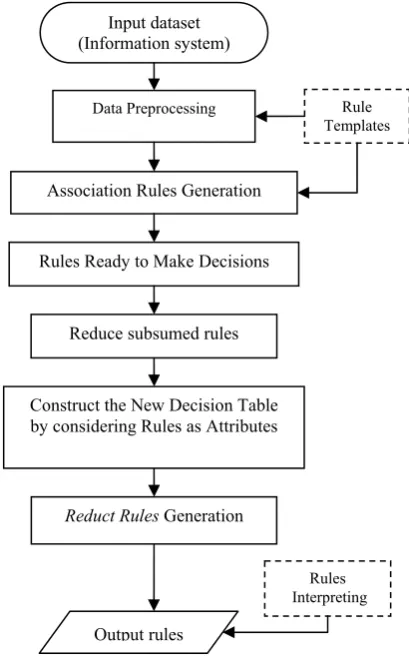
Fig. 1 illustrates our experimental application procedure. A. Stage 1: Data preprocessing
In our experimental application, we consider each data set (in decision table structure) as a transaction set.
First during the data preprocessing step, the inconsistent data instances and the data instances containing missing attribute values are processed.
The core algorithms require a consistent data set. Therefore in our experiments, the inconsistent data instances are considered as noise and are removed during the data preprocessing stage.
B. Stage 2: Association Rules mining with Apriori–DT algorithm
The Apriori-DT association rule algorithm is then applied to improve the performance of association rules generation over large data set. Further details about Apriori–DT algorithm and its comparative benchmark which demonstrates the effectiveness of this algorithm can be found in [4].
C. Stage 3: Reduct subsumed rules
During this stage, we find and remove subsumed rule. Suppose, there are two rules with same decision item and their only difference is the set of condition items. The condition itemset of rule no 1 is a subset of the condition
itemset of rule no 2 and the confidence value of rule no 2 is less than the confidence value of rule no 1. In this special case, rule no 2 is redundant and can be deleted.
This step helps not only to reduce the number of rules, but also to decrease the computation cost in the next stage. Rules set after reduced subsumed rules are now ready to make decisions.
D. Stage 4: Rules evaluating and reducing with Rough Set based approach
In this stage, we apply Rules-As-Attributes measure proposed by Jiye Lee et al. (II.C) for evaluating rule set and use Hu’s algorithms (II.D) for extracting Reduct Rule set and Core rule set.
The results of this stage are rule setswhich contain most representative rules.
E. Stage 5: Rules interpreting
At the end of this procedure, this output might be interpreted by using Metadata file which contains details information of the correlative dataset to help rules analyzing process is more efficient and easily understandable.
Input dataset (Information system)
Data Preprocessing
Association Rules Generation
Rules Ready to Make Decisions
Construct the New Decision Table by considering Rules as Attributes
Reduct Rules Generation
Rule Templates
Reduce subsumed rules
Rules Interpreting
[image:3.595.350.555.312.646.2]Output rules
Figure 1 Experimental application procedure
IV. EXPERIMENT &RESULTS
A. Dataset overview
in the questionnaire approved by the institution are based on the criteria features of teaching effectiveness recommended by the education experts group. Survey results are then recognized and transformed from text form into computerized data by the Software Engineering Research & Development Center of Nha Trang University (stored in *. mdb1 file format).
Applied information system in our experimental application is obtained after the data preprocessing stage. In this stage, the underlying dataset, in *.mdb format, is firstly integrated to Database Management System2. Then its data
schema is transformed in order to select necessary values and construct needed decision table which contains only attribute represent for critical features which concerns directly teaching effectiveness ranking. Inconsistent data in this applied information system is removed during this stage. This Information System contains the following characteristics.
• 15 condition attributes: each attribute in this set represents a critical feature used in the teaching effectiveness survey at Nha Trang University. The domain of this attributes set is {1; 2; 3; 5} represents for Disagree, No Idea, Fairly Agree, and Agree respectively.
• 1 decision attribute: contains ranking results of teaching effectiveness. The ranking results set is Failed, Fair, Good, Excellent and represented by 1; 2; 3 and 4 respectively.
• 13,434 records: each record is a set of answers of student through the survey.
• 2,217 missing values distribute on 1,047 records and only exist in the domain of the condition attributes set.
• There is no inconsistent data existing in this information system.
[image:4.595.314.562.312.785.2]• Its attributes set are listed in TABLE I.
Table I. Critical features of the survey of teaching effectiveness at Nha Trang University
Id. Features
1 [Lecturer explains the subjects clearly and
intelligible]
2 [Lecturer often raises topics to encourage
students’ discussions]
3 [Lecturer cares about organizing activities for
developing creative thinking of students]
4 [Lecture demonstrates comprehensive and updated
knowledge in his/her subject]
5 [Lecturer uses teaching equipments (writing board,
multi-media projector, etc…) effectively]
6 [Lecturer gives lessons punctually and observes
teaching plan strictly]
7 [Lecturer has good working style and behavior]
8 [Lecturer is fair and reasonable in evaluating
students]
9 [Lecturer is enthusiastic and responsible in
teaching]
10 [Lecturer introduces sufficient textbooks,
lectures, and reference materials to students]
11 [I felt interested during this course’s class
hours]
12 [I understood the purpose and requirements of the
course]
13 [I gained useful and valuable knowledge from the
course]
14 [My questions on the subject were explained fully
and clearly by lecturer]
15 [Lecturer helps students to improve generic skills
(in learning, communication, presentation, teamwork, etc…]
16 [Teaching Effectiveness Ranking (TER)]
B. Experimental process and results
In our experiments on underlying real world dataset, we focus on association rules which are important and high representative knowledge of original dataset. Therefore, the minimum support and minimum confidence of 30% and 81% are chosen respectively.
These thresholds were applied in rules mining stage with Apriori–DT algorithm. Rule Template wasn’t applied in rules generation process to obtain comprehensive correlation relations among various combination of features and between them and the teaching effectiveness ranking result. After this mining stage, there are 25 association rules generated. The original output rules set is listed (with original generated order) in Table II with their own support and confidence.
Table II. Original output rules set
Rule Id.
Association Rule Sup port (%)
Conf idenc e (%)
1 If [Lecturer explains the subjects
clearly and intelligible] = Agree then [Lecturer has good working style and behavior] = Agree
33.1 9481 81.66019
2 If [Lecturer uses teaching equipments
(writing board, multi-media projector, etc…) effectively] = Agree then [Lecturer gives lessons punctually and observes teaching plan strictly] = Agree
33.3 4441 81.86084
3 If [Lecturer is fair and reasonable
in evaluating students] = Agree then [Lecturer has good working style and behavior] = Agree
41.7 2207 83.45802
4 If [Lecturer is enthusiastic and
responsible in teaching] = Agree then [Lecturer has good working style and behavior] = Agree
54.1 8052 84.12698
5 If [My questions on the subject were
explained fully and clearly by lecturer] = Agree [Lecturer has good working style and behavior] = Agree
35.6 5492 83.09123
6 If [Teaching Effectiveness Ranking
(TER)] = Good then [Lecturer has good working style and behavior] = Agree
30.8 012 89.19374
7 If [Teaching Effectiveness Ranking
(TER)] = Good then [Lecturer is enthusiastic and responsible in teaching] = Agree
30.9 7573 89.69916
8 If [Lecture demonstrates
comprehensive and updated knowledge in his/her subject] = Agree and [Lecturer gives lessons punctually and observes teaching plan strictly] = Agree then [Lecturer has good working style and behavior] = Agree
30.3 9395 82.71884
9 If [Lecture demonstrates
comprehensive and updated knowledge in his/her subject] = Agree and [Lecturer is enthusiastic and responsible in teaching] = Agree then [Lecturer has good working style and behavior] = Agree
30.1 4461 85.60302
10 If [Lecturer gives lessons punctually
and observes teaching plan strictly] = Agree and [Lecturer is fair and reasonable in evaluating students] = Agree then [Lecturer has good working style and behavior] = Agree
34.0 4225 86.0685
11 If [Lecturer has good working style
and behavior] = Agree and [Lecturer is fair and reasonable in evaluating students] = Agree then If [Lecturer gives lessons punctually and observes teaching plan strictly] = Agree
34.0 4225 81.59363
12
1 Microsoft Access’ file format.
2 Microsoft SQL server 2005 was used in our experimental
[image:4.595.31.284.518.762.2]and observes teaching plan strictly] = Agree and [Lecturer is enthusiastic and responsible in teaching] = Agree then [Lecturer has good working style and behavior] = Agree
7148 093
13 If [Lecturer has good working style
and behavior] = Agree and [Lecturer is enthusiastic and responsible in teaching] = Agree then If [Lecturer gives lessons punctually and observes teaching plan strictly] = Agree
45.0 7148 83.18761
14 If [Lecturer is fair and reasonable
in evaluating students] = Agree and [Lecturer is enthusiastic and responsible in teaching] = Agree then [Lecturer gives lessons punctually and observes teaching plan strictly] = Agree
31.2 7493 81.23921
15 If [Lecturer is fair and reasonable
in evaluating students] = Agree and [Lecturer is enthusiastic and responsible in teaching] = Agree then [Lecturer has good working style and behavior] = Agree
33.5 5219 87.15458
16 If [Lecturer introduces sufficient
textbooks, lectures, and reference materials to students] = Agree and [Lecturer gives lessons punctually and observes teaching plan strictly] = Agree then [Lecturer has good working style and behavior] = Agree
38.1 2334 82.75302
17 If [Lecturer introduces sufficient
textbooks, lectures, and reference materials to students] = Agree and [Lecturer has good working style and behavior] = Agree then [Lecturer gives lessons punctually and observes teaching plan strictly] = Agree
38.1 2334 82.24852
18 If [Lecturer introduces sufficient
textbooks, lectures, and reference materials to students] = Agree and [Lecturer is enthusiastic and responsible in teaching] = Agree then [Lecturer gives lessons punctually and observes teaching plan strictly] = Agree
35.8 5439 81.15124
19 If [Lecturer introduces sufficient
textbooks, lectures, and reference materials to students] = Agree and [Lecturer is enthusiastic and responsible in teaching] = Agree then [Lecturer has good working style and behavior] = Agree
37.3 7533 84.59368
20 If [I felt interested during this
course’s class hours] = Fairly Agree and [Lecturer has good working style and behavior] = Agree then [Lecturer gives lessons punctually and observes teaching plan strictly] = Agree
30.6 6822 81.61911
21 If [My questions on the subject were
explained fully and clearly by lecturer] = Agree and [Lecturer has good working style and behavior] = Agree then [Lecturer is enthusiastic and responsible in teaching] = Agree
30.0 4488 84.26573
22 If [My questions on the subject were
explained fully and clearly by lecturer] = Agree and [Lecturer is enthusiastic and responsible in teaching] = Agree then [Lecturer has good working style and behavior] = Agree
30.0 4488 86.69065
23 If [Lecturer introduces sufficient
textbooks, lectures, and reference materials to students] = Agree and [Lecturer gives lessons punctually and observes teaching plan strictly] = Agree and [Lecturer has good working style and behavior] = Agree then [Lecturer is enthusiastic and responsible in teaching] = Agree
31.1 9182 81.81818
24 If [Lecturer introduces sufficient
textbooks, lectures, and reference materials to students] = Agree and [Lecturer gives lessons punctually and observes teaching plan strictly] = Agree and [Lecturer is enthusiastic and responsible in teaching] = Agree then [Lecturer has good working style and behavior] = Agree
31.1 9182 86.99583
25 If [Lecturer introduces sufficient
textbooks, lectures, and reference 31.1 9182 83.45564
materials to students] = Agree and [Lecturer has good working style and behavior] = Agree and [Lecturer is enthusiastic and responsible in teaching] = Agree then [Lecturer gives lessons punctually and observes teaching plan strictly] = Agree
There is no subsumed rule exists in this set. For evaluating rules set, the new decision table A13.434x26 is
constructed by using these 25 rules as condition attributes and the original decision attribute as the new decision attribute.
[image:5.595.45.287.54.796.2]Note that after reconstructing the new decision table, we must check for inconsistency data again before generating reduct rules for this table. After removing the inconsistent data records, there are 360 records left in the new decision table. Then Hu’s reduct algorithms were used on this table and the results of this evaluation procedure obtained as follow.
• The Core rule set is {Rule1; Rule2; Rule6}
• The Reduct rule set is {Rule1; Rule2; Rule3;Rule4; Rule5;
Rule6; Rule7;Rule8; Rule9; Rule10; Rule11;Rule12; Rule13;
Rule14; Rule15; Rule16; Rule18; Rule19; Rule20; Rule21;
Rule22; Rule23; Rule24;Rule25}
• Rule eliminated by Hu’s reduct algorithm is rule No.17 • The computing time of the rules mining (include data pre
– processing and rules interpreting with underlying MetaData) was 5.622,32 milliseconds and the computing time of the rules reducting process was 2.961,17 milliseconds3
C. Observations
From the Reduct and Core rules generation results in previous section, we make the following observations.
The Reduct rule set contains 24 rules from 25 original rules. Since the Reduct rules are based on Rough Set theory, these rules are sufficient to describe the decision attribute in the original decision table. Therefore, the absent rule No. 17 is not as important or as representative. According to Information Theory, rule No.17 is also considered that it does not bring potentially useful and significant information.
Reasoning based on facts by using a comparison between rule No.17 and rule No.25 can explain the reason why rule No.17 should be removed.
Table III. Rule No.25
Rule Id.
Association Rule Support (%)
Confidence (%)
25 If [Lecturer introduces
sufficient textbooks, lectures, and reference materials to students] = Agree and [Lecturer has good working style and behavior] = Agree and [Lecturer is enthusiastic and responsible in teaching] = Agree then [Lecturer gives lessons punctually and observes teaching plan strictly] = Agree
31.19182 83.45564
These two rules have the same decision item in consequent part and the condition items set in the antecedent part of rule No.17 is the subset of the condition items set in
3 All experiment rule extracting and evaluating procedures were
[image:5.595.308.565.577.698.2]the antecedent part of rule No.25. It’s noticeable that rule No.25 has a higher confidence degree than rule No.17.
These two rules indicate similar correlation about which features of a lecturer are most salient and important to determine whether he (or she)”gives lessons punctually and observes teaching plan strictly” or not.
The remarkable difference between these two rules is that rule No.25 contains feature [Lecturer is enthusiastic and responsible in teaching] in its antecedent part in addition to two features [Lecturer introduces sufficient textbooks, lectures,
and reference materials to students] and
[Lecturer has good working style and behavior]in the antecedent part of rule No.17. Generally, the feature [Lecturer is enthusiastic and
responsible in teaching] does affect lecturer’s
teaching schedules more than other two features. When a lecturer has interests in teaching, he (or she) normally wants to give the lesson punctually and with his (or her) high responsibility which is admitted by students, the lecturer would observe teaching plan strictly. This useful and interesting attribute helps rule No.25 could perceive real world knowledge more precisely.
Base on this practical examination, rule No.25 can be considered to be more important and contains more relevant information than rule No.17. It makes the present of rule No.17 in original rule set to become redundant and rule No.17 can be removed to create Reduct rule set. This elimination not only does not cause lost decision performance, but also increases the significance of output rule set.
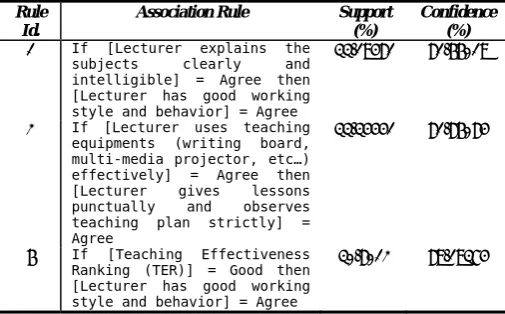
[image:6.595.31.284.453.610.2]As mentioned in section B, the Core rule set includes 3 rules. These rules are listed as below.
Table IV. Core rule set
Rule Id.
Association Rule Support (%)
Confidence (%)
1 If [Lecturer explains the
subjects clearly and intelligible] = Agree then [Lecturer has good working style and behavior] = Agree
33.19481 81.66019
2 If [Lecturer uses teaching
equipments (writing board, multi-media projector, etc…) effectively] = Agree then [Lecturer gives lessons punctually and observes teaching plan strictly] = Agree
33.34441 81.86084
6 If [Teaching Effectiveness
Ranking (TER)] = Good then [Lecturer has good working style and behavior] = Agree
30.8012 89.19374
The core rules are judged to be most important since they are archived in all Reduct sets and each rule in this set is considered to contain essential knowledge of the input data. For example, consider rule No.6 which has confidence degree of 89.19374%. According to this rule, a lecturer who has good working style and behavior, also often has a good ranking result from students. This useful knowledge can help to improve teaching quality by focusing on the enhancement of good moral values of lecturers.
We notice that this rule also has higher confidence than 22 over 24 rules in the Reduct rule set, normally it can be considered to be the most interesting rule. But two remaining rules in the Core rule set show that what the confidence measure considers to be interesting is not always important. Rule No.1 and No.2 in this core rule set have similar
confidence. With their low confidence (they are ranked at 4th
and 6th respectively in ascending order of confidence), these
rules are commonly considered to be not interesting as most of the rules in the Reduct rule set. However, a good presentation skill is the most typical manifestation in lecturer’s working style and whether he (or she) can use teaching equipments effectively plays important part to ensure his (or her) teaching plan since it can help the lecturer to save much teaching time. This useful knowledge cannot be ignored.
In certain applications, such as our experimental application with the goal is to make recommendation for improving teaching quality, when the focus of knowledge discovery is on the important features, our solution can indeed help facilitate evaluating important knowledge.
V. CONCLUSION
In this paper, an application for discovering important rules is presented. The hybrid algorithm Apriori–DT is used for mining association rules for certain domains. And a Rough set based method, Rules-As-Attributes measure, is used for finding Reduct and Core rule set, which contain most representative rules from original dataset. Our method is realized from various approaches in this solution, not only provides an efficiency way for extracting and ranking rules but also for improving the quality of the output knowledge.
The results from the experiment performed on the real-world dataset, the Teaching and Learning database at Nha Trang University, are reliable and exciting. They also illustrate the potential usefulness of the presented solution in recommender systems for the education field.
VI. ACKNOWLEDGMENTS
We would like to thank Dr. Le Van Hao, Director, Educational Quality Assurance and Testing Department, Nha Trang University for his valuable comments and suggestions to improve this paper.
VII. REFERENCES
[1] Jiye Li. “Rough Set Based Rule Evaluations and Their
Applications”. PhD thesis, University of Waterloo, Ontario, Canada, pp.41-111, 2007.
[2] Marzena Kryszkiewicz and Henryk Rybinski. “Finding
reducts in composed information systems”. In RSKD, pages 261–273, 1993.
[3] Mika Klemettinen, Heikki Mannila, Pirjo Ronkainen,
Hannu Toivonen, and A. Inkeri Verkamo. “Finding interesting rules from large sets of discovered association rules”. In Nabil R. Adam, Bharat K. Bhargava, and Yelena Yesha, editors, Third International Conference on Information and Knowledge Management (CIKM’94), pages 401–407. ACM Press, 1994.
[4] Nguyen Xuan Dat. “Apriori-DT (Aprori Decision
Table) – A hybrid algorithm and experimental results”, Da Nang University Science & Technology Magazine, Vol. 3(38), 2010.
[5] Rakesh Agrawal and Ramakrishnan Srikant. “Fast
[6] Xiaohua Hu, T. Y. Lin, and Jianchao Han. “A new rough sets model based on database systems”. Fundam. Inf., 59(2-3):135–152, 2004.