hp
Comparative Study of 1g, 2g, 3g and 4g Technologies
Nitish Aggarwal ; Rachit Gupta & Pallavi Saxena
Department of ECE, Dronacharya College of engineering, Khentawas, Farrukhnagar, Gurgaon-123506, India
Email: [email protected]; [email protected]; [email protected]
ABSTRACT
Today we live in a fast changing world. The fast changing world has its own demands of communicating, connecting with people as fast as possible therefore It is the need of hour to get ourselves acquainted with the communication technology. Mobile communication is continuously one of the hottest areas that are developing at a booming speed. Mobile and wireless networks have made tremendous growth in the last fifteen years. Mobile communication is an important technology in this regard and mobile phone has become the most common tool of communication over the recent years. As several innovative improvements regarding mobile communication technologies have been made by developing various multiple-access schemes used for wireless communication (such as TDMA, FDMA, CDMA, WCDMA, EDGE etc) but a big challenge is to select the right technology for the applications .Today 3G mobile systems are on the ground providing IP connectivity for real-time and non-real time services. The purpose of this paper is to study the fundamental shift in the mobile networking philosophy compared from 1G to existing 3G and near-soon 4G in a tabular form to have a better knowledge and understanding in the advancement of mobile communication systems.
KEYWORDS:- 1G, 2G, 3G, 4G
1. INTRODUCTION
The continuous demands and requirements for wireless communication systems have led to the need for a better understanding of fundamental
issues in communication theory and
electromagnetic spectrum and the implications for the design of highly-capable wireless systems. Devices continue to shrink in size while growing in processing power. Consumers are demanding more advanced and useful applications. There is need of capacity improvements in wireless communications. The past few years have witnessed a phenomenal growth in the wireless industry, both in terms of mobile technology and subscribers. The first-generation mobile systems were the analogue (or semi-analogue) systems, which came in the early 1980s - they were also called NMT (Nordic Mobile Telephone). They offered mainly speech and related services and were highly incompatible with each other. 1G refers to analog cellular technologies; it became available in the 1980s. 2G denotes initial digital systems, introducing services such as short messaging and lower speed data. CDMA2000 1xRTT and GSM are the primary 2G technologies, although CDMA2000 1xRTT is sometimes called a 3G technology because it
meets the 144 kbps mobile throughput
hp
pedestrian speeds, and 2 Mbps in indoor environments. The 4G is a new generation of wireless that replaces the 3G systems. The key features of the 4G infrastructures are accessing information anywhere, anytime, with a seamless connection to a wide range of information and services, and receiving a large volume of information, data, pictures, video, and so on. The Internet is the network of large-scale group of connected computers around the world that sends out data using packet switching technique based on the TCP/IP stack. (Wright and Steven, 1995). The Internet has achieved the massive success and popularity. Over the time with the growing and accelerating progresses in communication patterns (wired and wireless) and wildly demands for spare capacity and connectivity, the Internet in almost every aspect frequently experiences modifications and changes in order to bring up – to-date. Along with the requirements supporting the Internet has been an implausible progress in the field of wire-less and mobile technologies. Since during the last few years, a countless fast improvements have been observed in the area of mobile and wireless technologies, and these two drastically rising user-driven service demands have significantly and intensely revolutionized
the spirit and nature of worldwide
telecommunications.
2. FIRST GENERATION (1G)
1-G is the first generation for wireless communication. The analog communication standards of 1-G introduced in 80’s and continues up to the evolution of second generation (2G). They were called AMPS --- Advanced Mobile Phone System which was released in 1983.
2.1 Features of 1G Systems
Base station Tx band 869 – 894
M Hz
M U Tx band 824 – 849
M Hz
Channel Bandwidth 30 k hz
No of voice channels 790
No of control channels 42
M U max power 3 W
Cell size radius 2 –20 km
Modulation voice channels FM
Modulation control channels FSK
2.2 Limitations of 1G Systems
Limited capacity
No room for spectrum growth
Minimal privacy
There are no encryption The sound quality is poor
The speed of transfer is only at 9.6kbps.
3. SECOND GENERATION (2G)
The 2G technology was present in 1990’s. 2G technology use the concept of digital modulation i.e. it convert the voice into digital codes in mobile and then into analog signals. 2G introduced various data services for mobile such as SMS(short message Service), MMS(Multi media messages) and picture messages. All the messages sent over 2G is digitally encrypted and hence only the desired receiver will receive the data. 2G technology based on multiplexing is divided as TDMA and CDMA. The main 2G standards are: - 1. GSM (Global System for Mobile) which is TDMA based. Today 80% subscribers are using GSM.2. IS-95 is based on CDMA used in America and parts of Asia. Today 17% subscribers are using thing this technology. 3. PDC which is TDMA based and used exclusively in Japan. 4. IDEN which is TDMA based and used by Nextel in the US and Telus mobility in Canada .5. IS-136 is TDMA based and simply refer as simple TDMA in the US.
hp
3.1 Features of 2G systems
It is based on CODEC.
Emits less radio power.
In GSM
o Carrier bit rate is 270.8 kbps & speech coding bit rate is 13kbps
o Channel Bandwidth 200 k Hz in GSM
o 8 users per channel
o Mobile Unit max power is 20 W
4. THIRD GENERATION (3G)
3G network support services that has data rates at least 200kbps and also known as tri-band 3G. The others versions of 3G includes 3.5G and 3.75G. It can be used for wireless mobile telephony, video calls, mobile internet, fixed wireless services and mobile TV technologies. This technology was introduced in 1998 and is currently in use.
4.1 Features of 3G system
Uses WCDMA/CDMA 2000 access
technology.
Bandwidth 5-10 Mbps
Has both circuit and packet switching International roaming capability
Frequency band 15-25 GHZ.
Routing flexibility Better security
Applications include
· Still photography
· video
· data transmission service · file transfer from internet
· multimedia e-mail
· Web Browsing
· on-line services
· time schedules
· global positioning services /
geographical information system
· benefits in education include · live video lectures can be cast to
the learner
· two way video conferencing
becomes possible
· faster downloads of assignments
5. FOURTH GENERATION (4G)
4G first come in existence in 2008 and also
known as IMT-Advance. Some of the
applications of 4G are amended mobile
web access, IP telephony, gaming services, high-definitionmobile TV, video conferencing,3D television, and cloud computing. 4G is described as MAGIC which means
M Mobile Multimedia
A Anytime Any-Where
G Global Mobility
I Integrated Wireless Solution
C Customized personal Service
5.1 Features of 4G system
It has data bandwidth of 200Mbps.
Flexible bandwidth
Low cost than 3G
Frequency band of 2-8 GHz
Peak download rate of 1 Gbps
High QoS
It provide HD video access to the user It provides virtual navigation
hp
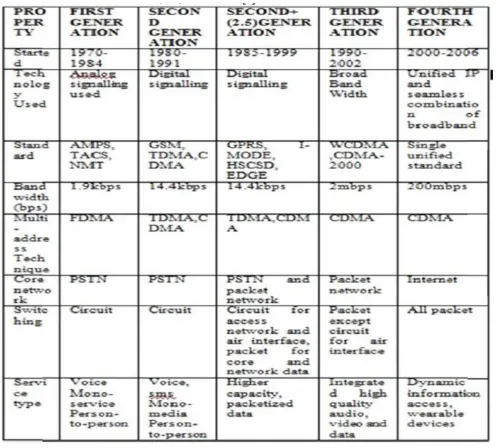
6. COMPARISON BETWEEN 1G, 2G, 3G AND 4G
TABLE 1 : COMPARISON BETWEEN 1G, 2G, 3G AND 4G
7.
CONCLUSION
There are lots of improvements from 1G, 2G, 3G to 4G. In this research work, we have compared four wireless mobile technologies or generations namely 1G, 2G, 3G and 4G and concluded that it is the need of the hour for development of
hp
the adoption of 3G services that, in turn, lead to the demand for even more advanced services. At last it can be said that constant need of technology was the cause of 4G technology birth and development but 4G can be improved by providing it gigabyte speed. In this research work, we have tried to gather as much information as possible and assemble it in such a manner that the reader can gain maximum knowledge of the topic.
References:-
1). http://en.wikipedia.org/wiki/4G
2). http://en.wikipedia.org/wiki/3G
3). http://en.wikipedia.org/wiki/2G
4). http://en.wikipedia.org/wiki/1G
5).http://borjournals.com/Research_papers/Ap_2 013/1248IT.pdf
6). http://www.blogsolve.com/difference-between-1g-2g-2-5g-3g-pre-4g-and-4g
7).http://www.ijarcsse.com/docs/papers/Volume_ 3/3_March2013/V3I3-0383.pdf
8).http://research.ijcaonline.org/icacact/number3/ icacact1016.pdf
9).http://ggnindia.dronacharya.info/Downloads/R