ISSN (Print) : 2320 – 3765 ISSN (Online): 2278 – 8875
I
nternational
J
ournal of
A
dvanced
R
esearch in
E
lectrical,
E
lectronics and
I
nstrumentation
E
ngineering
(An ISO 3297: 2007 Certified Organization)
Vol. 4, Issue 4, April 2015
Design of Area and Power Efficient Arithmetic
and Logic unit
S.Rambabu
1, T.Mani pravallika
2, G.Divya
3, S.Karthik
4, K.Anil kumar reddy
5, B.Dineshgandhi
6Assistant Professor, Dept of E.C.E, Santhiram Engineering College, Nandyal, AP, India1 IV-B.Tech Student, Dept of E.C.E, Santhiram Engineering College, Nandyal, AP, India2 IV-B.Tech Student, Dept of E.C.E, Santhiram Engineering College, Nandyal, AP, India3 IV-B.Tech Student, Dept of E.C.E, Santhiram Engineering College, Nandyal, AP, India4 IV-B.Tech Student, Dept of E.C.E, Santhiram Engineering College, Nandyal, AP, India5 IV-B.Tech Student, Dept of E.C.E, Santhiram Engineering College, Nandyal, AP, India6
ABSTRACT: In this paper we presents a implementation of area and power efficient 4 bit Arithmetic And Logic unit
(ALU) through concept of gate diffusion input (GDI) technique.ALU is most important and core component of CPU.ALU is also used as core component of number of embedded and micro processor systems.ALU consists of 4x1 multiplexer, 2x1 multiplexer, full adder .These are designed to implement different logical and arithmetic operations such as AND, OR, ADD, SUBTRACT etc. The 4x1 multiplexer, 2x1 multiplexer, full adder are implemented through GDI cells. These are associated to realize 4 bit ALU. The simulation is carried out based on MENTOR GRAPHICS 130nm technologies and compared with pass transistor and CMOS logic realization. The simulation gives that design of ALU through GDI is more efficient with low power consumption, occupies less surface area and faster compared with pass transistor and CMOS logic.
KEYWORDS: CMOS, Full adder, Mux, Power dissipations, ALU, Gate Diffusion Input logic
I.INTRODUCTION
Low power and High speed are the design trade-offs in VLSI industry. Power consumption, area, speed,
noise immunity has emerged as a primary design constraints for integrated circuits (ICs).The VLSI designers always
targets on three basic design goals such as minimizing the transistor count, minimizing the power consumption and increasing the speed. Most of the Very Large Scale IC (VLSI) applications, Full adder circuit is functional building block and most critical component of complex arithmetic circuits like microprocessors, digital signal processors or any ALUs. Almost every complex computational circuit requires full adder circuitry. The entire computational block power consumption can be reduced by implementing low power techniques on full adder circuitry. In this paper, from different existed base papers several full adder circuits based on different low power techniques have been proposed targeting Static CMOS gates are very power efficient because they dissipate nearly zero power when idle. Earlier, the power consumption of CMOS devices was not the major concern while designing chips. Factors like speed and area dominated the design parameters. As the CMOS technology moved below sub-micron levels the power consumption per unit area of the chip has risen tremendously.
InCMOS circuits, the power dissipation classified into dynamic power dissipation, static power
dissipation. The dynamic power dissipation occurs when charging or discharging of load capacitances and establish
ISSN (Print) : 2320 – 3765 ISSN (Online): 2278 – 8875
I
nternational
J
ournal of
A
dvanced
R
esearch in
E
lectrical,
E
lectronics and
I
nstrumentation
E
ngineering
(An ISO 3297: 2007 Certified Organization)
Vol. 4, Issue 4, April 2015
A. Proposed GDI Technique:
GATE DIFFUSION INPUT is a new existing method to reduce power dissipation, propagation delay with less area proposed by Vivechana Dubey and Ravimohan Sairam (Refer page NO.6, IEEE2014). The GDI approach allows implementation of a wide range of complex logic functions using only two transistors. This method is suitable for design of fast, low-power circuits, using a reduced number of transistors shown in below
Fig: Basic GDI Cell Table1: Instruction of Basic GDI Cell
In which, full adder is designed with2- 4T XOR Gates and 2to 1 MUX .The simulation is carried out
MENTORGRAPHICS on 130nm technologies. An important feature of GDI cell is that the source of the PMOS in a
GDI cell is not connected to VDD and the source of the NMOS is not connected to GND. Therefore GDI cell gives two extra input pins for use which makes the GDI design more flexible than CMOS design. But it adds noise in output logic levels by effect off delivered leakage power when transistor is off and degrades the performance of the system.
II. IMPLEMENTATION AND COMPARISON OFCMOS2:1MUXAND GDI 2:1MUX
The below fig(a)shows the CMOS based 2:1MUX that having 12T and it provide the power dissipation 296.59uw
Fig(a) CMOS based 2:1MUXand
The below fig (b) shows the GDI based 2:1MUX that having 2T and it provide the power dissipation 2pw
ISSN (Print) : 2320 – 3765 ISSN (Online): 2278 – 8875
I
nternational
J
ournal of
A
dvanced
R
esearch in
E
lectrical,
E
lectronics and
I
nstrumentation
E
ngineering
(An ISO 3297: 2007 Certified Organization)
Vol. 4, Issue 4, April 2015
III. IMPLEMENTATION AND COMPARISON OFCMOS4:1MUXAND GDI 4:1MUX
The below fig(a)shows the CMOS based 4:1MUX that having 24T and it provide the power dissipation 1.4mw
Fig(a) CMOS based 4:1MUXand
The below fig(b)shows the GDI based 4:1MUX that having 6T and it provide the power dissipation 6pw
Fig(b)GDI based 4:1MUXand
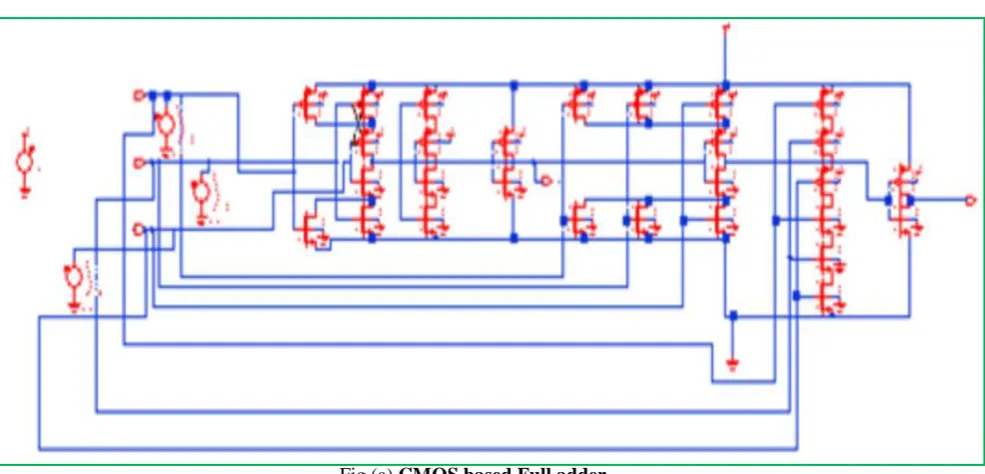
IV. IMPLEMENTATION AND COMPARISON OF CMOS AND GDI FULL ADDER
ISSN (Print) : 2320 – 3765 ISSN (Online): 2278 – 8875
I
nternational
J
ournal of
A
dvanced
R
esearch in
E
lectrical,
E
lectronics and
I
nstrumentation
E
ngineering
(An ISO 3297: 2007 Certified Organization)
Vol. 4, Issue 4, April 2015
Fig (a) CMOS based Full adder
The below fig (b) shows the GDI based Full adder that having 10T and it provide the power dissipation 3.7nw
Fig (b) GDI based Full adder
V.GDI BASED ALU
ISSN (Print) : 2320 – 3765 ISSN (Online): 2278 – 8875
I
nternational
J
ournal of
A
dvanced
R
esearch in
E
lectrical,
E
lectronics and
I
nstrumentation
E
ngineering
(An ISO 3297: 2007 Certified Organization)
Vol. 4, Issue 4, April 2015
Fig(a): General structure of 4-bit ALU
The abow structure is 4-bit arithmetic logic unit implemented based on GDI technique. It provide very low power dissipation and occupied very less area compared to conventional based CMOS ALU shown in below comparison table
Fig(b): Implementation of 4-bit ALU based on GDI
VI. SIMULATONS RESULTS AND ANALYSIS
ISSN (Print) : 2320 – 3765 ISSN (Online): 2278 – 8875
I
nternational
J
ournal of
A
dvanced
R
esearch in
E
lectrical,
E
lectronics and
I
nstrumentation
E
ngineering
(An ISO 3297: 2007 Certified Organization)
Vol. 4, Issue 4, April 2015
TABLE II. ANALYSIS RESULT OF DIFFERENT BLOCK OF ALU
DESIGN CELL POWER No Of Transistors
CMOS
2:1 MUX 0.7mw 12 4:1 MUX 1.4mw 24 Full adder 29.3nm 28 ALU 4204µw 592
GDI
2:1 MUX 2pw 2 4:1 MUX 6pw 6 Full adder 3.75nw 10 ALU 1030.5 µw 232
VII. CONCLUSION
Power consumption in CMOS circuit is classified in two categorize: static power dissipation and dynamic power dissipation. In today’s CMOS circuits static power dissipation is negligible thus not considered as compared to dynamic power dissipation. Dynamic Power dissipation in a CMOS circuit is given by P = CLf VDD2. The power supply is directly related to dynamic power. The numbers of power supply to ground connections are reduced in GDI implementation which reduces the dynamic power consumption. This work presents a 4-bit ALU designed in MENTORGRAPHICS on 130nm technology for low power and minimum area with GDI technique. The 2x1 multiplexer, 4x1 multiplexer, 1-bit full adder with 10- transistors designed using GDI technique is chosen for lowering power consumption and minimum possible area. Power dissipation, propagation delay and the number of transistors of ALU were compared using CMOS and GDI techniques. GDI technique proved to have best result in terms of performance characteristics among all the design techniques.
REFERENCES
[1]. R. Shalem, E. John, and L.K.John, “A novel low-power energy recovery full adder cell,” in Proc. Great Lakes Symp. VLSI, Feb. 1999, pp.380– 383.
[2]. A.Sharma, R Singh and R. Mehra, “Low Power TG Full Adder Design Using CMOS Nano Technology,”
[3]. L.Bisdounis, D.Gouvetas and O.Koufopavlou, “A comparative study of CMOS circuit design styles for low power high-speed VLSI circuits” Int. J. of Electronics, Vol.84, No.6, pp 599- 613,1998. Anu Gupta, Design Explorations of VLSI Arithmetic Circuits, Ph.D. Thesis, BITS, Pilani, India, 2003.
[4]. Saradindu Panda, N. Mohan Kumar, C.K. Sarkar., “Transistor Count Optimization of Conventional CMOS Full Adder & Optimization of Power and Delay of New Implementation of 18 Transistor Full Adder by Dual Threshold Node Design with Submicron Channel Length" in Computers and Devices for Communication, 2009. CODEC 2009. 4th International Conference on pp: I – 4
[5]. T. Vigneswaran, B. Mukundhan, and P. Subbarami Reddy," A Novel Low Power, High Speed 14 Transistor CMOS Full Adder Cell with 50% Improvement in Threshold Loss Problem" in World Academy of Science, Engineering and Technology 13 2006 pp: I-7.
[6]. T. Esther Rani, M. Asha Rani, Dr. Rameshwar rao, “AREA OPTIMIZED LOW POWER ARITHMETIC AND LOGIC UNIT” 978-1-4244-8679-3/11/$26.00 ©2011 IEEE.