ISSN 2286-4822
www.euacademic.org DRJI Value: 5.9 (B+)
Evaluating the change in the phase difference
between the generators of a two-machine system on
the short-circuit level grid
SEYED SAJJAD SALEHI GHALEHSEFID Regional Electricity Company of Khuzestan Province The Northeast Region Exploitation Affairs Masjed Soleiman, Iran
Abstract:
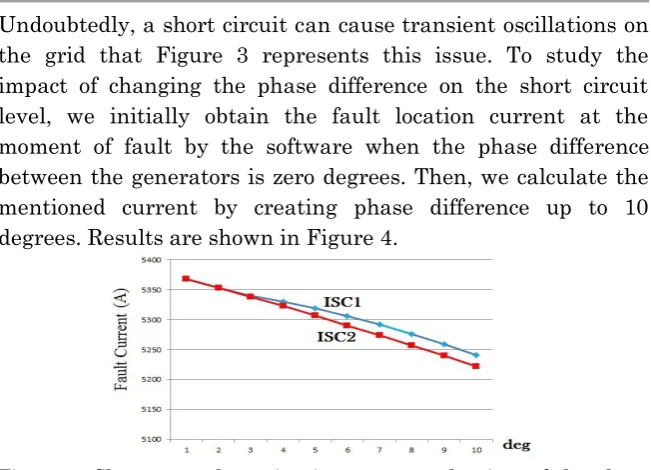
The main goal of regional power companies is transferring the stable and reliable energy. Short circuit is the main threat to a power grid that can lead to instability. Necessary measures have been considered in the generator site to deal with this threat. In this paper, initially a permanent single-phase short circuit to ground fault was created in the mentioned system. Then, the phase angle between the generators was increased. The results showed that 0.3% of the short-circuit level in the power grid decreased for increasing every degree phase angle.
Key words: energy transfer - short circuit - instability – Generator - phase angle
1. INTRODUCTION
conducted on the behavior of the electrical parameters of power plants at the moment of short circuit whose aim was reducing the impact of this problem on generators. Jie et al. (2012) have analyzed the double-fed induction generator's short circuit currents [1], while previously it was done in wind power plants [2-3]. Short circuit in synchronous generators was not excluded for these studies. In these researches, the transient behavior of two and three-phase of a salient pole generator was measured and compared exactly with the help of Fluke 435 laser device in addition to being simulated in MATHCAD software [4]. Some of researchers used the results of the short circuit in generators to achieve other parameters. Thermoelectric generators power point tracking (Maximum Power Point Tracking) (MPPT) by sampling the open circuit voltage and short circuit current of generators are some of them [5].
In countries power grids, power plants work in parallel because of the increased stability with the phase difference (δ). This phase difference, which is dependent on the consumption current, should be limited to a defined value so that generators do not reach an unstable state. At the time of short circuit, the mentioned phase difference increases slightly then returns to its original state after fixing. In this paper, the short-circuit level of two synchronous generators were evaluated and compared in two phase difference states of zero and 10 degrees, which were in parallel by a short transmission line of 400 kV. The purpose will be achieving the impact of the phase difference between the generators on the short circuit level, while phase angel changes do not lead to instability.
2. TRANSIENT STABILITY IN TWO-MACHINE SYSTEMS [6]
disruptions with the grid. Studies of power system stability according to the type and scope of the disorder are divided into three categories of steady, dynamic and transient stability. In transient stability, which is caused by sudden and severe disorders in the system such as short circuit, load departure, sudden opening of the transmission line, speed, electric power, and power angle of the machine change severely in different parts of the system. If this disorder to be controlled resolved in a timely manner, the system will be stable, and if it was not resolved timely, the machine gets of synchronization mode and the system becomes unstable. This instability depends on its severity and location.
Equation 1 is the oscillator equation of a transient system, which helps to evaluate the transient stability in a two-machine system along with level criteria.
(1)
In which,
Here, it is assumed that:
This means that all generators' rotor at the power plant oscillate together.
In the above equation (Pe) is the electric power of generators, (Pm) is the mechanical power of generators, (δ) is power angle, (H) is inertia constant, and (S) nominal power of generators.
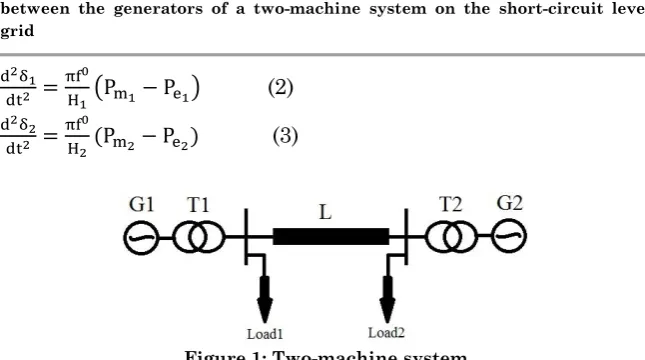
( ) (2)
(3)
Figure 1: Two-machine system
By subtracting the recent equations from each other, we have:
(4)
Both sides of the equation are multiplied by
and then,
equation (5) is obtained after sorting.
(5) In which,
is variable and the mechanical parameters of the system such as power angle (δ) and the rotor angular velocity (ω) oscillate according to the equation (5) if the disorder was not removed in enough time. Solving the mentioned equation determines the possibility of stability and (δ) changes. If (δ) began to decline after reaching the maximum value and has oscillation, the system remains stable and that oscillations will be amortized.
3. EVALUATING THE IMPACT OF THE PHASE DIFFERENCE BETWEEN THE GENERATORS OF A TWO-MACHINE SYSTEM ON THE GRID SHORT CIRCUIT LEVEL
Consider Figure (1). In this system, two synchronous generators are in parallel with the nominal voltage of 11 kV by 11 to 400 kV transformers with 200 megavolt ampere and 11% impedance by a transmission line with the electrical specifications of (
،
،
). The consumed load of each generator directly is
feed from the Shin connected to power transformers. Each time, it absorbs about 50% of the nominal capacity of the active power of transformers with the power factor of 0.9.
To evaluate the impact of changing the phase difference between the generators on the grid short circuit, initially, we create a permanent single-phase short circuit to ground fault (phase C) in the middle of the transmission line. Figure 2 shows the circuit diagram of a typical two-machine system.
Figure 2: Equivalent circuit of two-machine system
In which: ‖ ‖ ‖
If we assume that in the transmission line , in
transformers , and for generators ,
then:
As a result:
{
If the phase difference between the generators is zero ( ), then the short-circuit current in the fault:
-88.06
And if the phase difference between the generators is 10 degrees ( ), then short circuit current is:
4. THE TWO-MACHINE SYSTEM SIMULATION
Undoubtedly, a short circuit can cause transient oscillations on the grid that Figure 3 represents this issue. To study the impact of changing the phase difference on the short circuit level, we initially obtain the fault location current at the moment of fault by the software when the phase difference between the generators is zero degrees. Then, we calculate the mentioned current by creating phase difference up to 10 degrees. Results are shown in Figure 4.
Figure 4: Changes to short circuit current at the time of the phase difference between the generators
5. CONCLUSION
REFERENCES
[1] Ma, Jie. Huang, Debin. Tang, Yi. Wu, Changjing. "Short circuit current calculation of Doubly Fed Induction Generator", International Conference Developments in Power Systems Protection, pp. 23-26, 2012.
[2] Li, D.D. "Analysis and calculation of short circuit current of doubly fed induction generator", Transmission and Distribution Conference and Exposition, pp. 21-24, 2008.
[3] Xiong , XiaoFu, Ouyang. Jinxin. Jin. Jing, "Calculation of steady-state short-circuit current of wind turbines with doubly fed induction generator", International Conference Advanced Power System Automation and Protection (APAP), pp. 16-20, 2011.
[4] Chiver, O. Neamt, L. Matei, O. "Comparative study on sudden short-circuit currents of a synchronous generator",
International Conference Environment and Electrical
Engineering (EEEIC), pp. 10-13, 2015.
[5] Dalala, Z.M. Zahid, Z.U. "New MPPT algorithm based on indirect open circuit voltage and short circuit current detection for thermoelectric generators", Energy Conversion Congress and Exposition (ECCE), pp. 20-24, 2015.
[6] Ahad, Kazemi. "Electric Power System Book", vol. 2, pp. 347-350. 2007.