ZONING OF ORE DEPOSITS IN THE PRECAMBRIANS OF ANDHRA PRADESH by N. Ramana Rao and Ashok Ballurkar, (Department of Geology, Osmt;lnia University, Hyderabad)
A large number of metallic and nonmetallic mineral deposits are found to occur in the Archaean and Cuddapah formations of Peninsular India. There might be different orogenic periods for their mineralization each having its own set or sets of mineral deposits. It is quite possible that there might be certain regularities in their distribution in time and space giving rise to zoning of ore deposits. ' Zoning in ore deposits is any regular pattern in the distribution of mineI:als or elements in space; it may be shown in a single ore body, in a mineral district, or in a large region '-(Park, 1965). One such zoning of ore deposits appears to be present in the area comprising parts of Archaean, Cuddapah and Pakhal formations of Andhra Pradesh.
The area under consideration extends in north-south direction from the southern end of main Pakhal basin to the south-western periphery of Cuddapah basin. From the western boundary of Cuddapah basin to a little beyond the eastern boundary into the Archaeans, is the east-west extent of the area. The deposits here, are copper, lead and barite; and considering their extent and distribution they may be classified under' regional zoning'. The following is a brief discription of these deposits.
Copper: A number of copper occurrences have been reported by several previous workers like Newbold, Bruce Foote, Heyne, Crookshank and others (Mahadevan, 1940, Chatterjee, 1963-64). Among the important occurrences are Agnigundala, Gani, Ka)va, Chelma and Garimanipenta.
Lead: Important lead occurrences have been roported from Niradu, Karampudi, Chelma, Gazulapalli, Jangamarajupalli and KoilkuntIa.
Barite,' Barite comprises the largest deposits in the area under review. Intensive barite mineralization is seen in the southern extreme of Pakhal basin (Cheruvupuram), in the Shernawala-outIier (Balapet, Kodamur and Velugumetla) and a number of deposits along the south-western periphery of the Cuddapah basin.
When these mineral occurrences are plotted on a map (Fig. I) it is seen that the major copper deposits are towards the centre of the area followed by lead in the middle and barite at the peripheries. On the basis of such observations the follow-ing zonal arrangement can be made:
1. Inner zone of copper mineriilization. 2. Middle zone of lead mineralization. 3. Outer zone of barite mineralization.
It is interesting to note that such arrangement is commonly seen in hydro-thermal zoning. There are several other factors in support of the presence of SUGh zoning in the area as:
1. These deposits have a common type of origin i.e. hydrothermal type, (Coulson 1933, Appavadhanulu 1962, Ziauddin 1964).
2. A majority of these deposits are favoured by structural controls, (Appa-vadhanulu 1962, Ramana Rao et al 1968).
3. The mineralogy of these deposits shows a common source for their minerliza-tion, (Coulson 1933, Ramana Rao & Ashok Ballurkar 1967).
188 SHORTER COMMUNICATIONS
These aspects however, have not been studied in detail and it is quite possible that the presence of such a regional zoning of ore deposits in the area under considera-tion would be proved more strongly as and when mOre data are available.
tOPPEA, lEAD AND BARilE NINERALIZAtlON 1M TM' PRi.-tA ... 'AHS 0' "NDHR" PRADtSN, INDIA
I'~
.-H'
tL'
".~EX
~
.s' INl~J
,.'
."""ITI
i CHlRlNuPUlu.,.,. % ",Ll.'f.l
J.VlWOUMln" 4-KOOot.MUR
5 V·"UJl"M~ ~7 cuto.\HJl ... T1
DUOS"S
Figure 1.
In case the existence of such regional zoning is established, it is interesting that
the central portion of the area is barren, around which forms the inner zone of copper mineralization. This so called batren zone, therefore, requires further extensive exploration for mineral deposits. It is further interesting to note that in case of an ideal hydrothermal zoning, the innermost portion would consist of certain high temperature minerals of gold, tin, nickel etc., as seen in the Southeastern Piedmont Province of the United States, where the following arrangement of mineralization is seen (Park & MacDiarmid, 1964).
t
I. Central zone 2. Towards west 3. Further west 4. Westernmost
-pyrite and gold.
pyrrhotite and chalcopyrite. lead-zinc.
barite.
Althougb, there are no hard and fast rules for the invariable presence of such mineralogy in every hydrothermal zoning" the possibility of such minerals being present in the area under review appears very likey indeed.
Acknowledgement: The authors are very grateful to Dr. M. S. Krishnan for his interest and helpful suggestions.
REFERENCES
CHATTERJEE, P. K., (1963-1964) Annotated index of Indian mineral occurrences, G.S.I. publica-tion.
COULSON, A. L., (1933) Barytes and Asbestos in the ceded districts of Madras Presidency, G.S.I. Memoir, v. 64.
KRISHNAI", M. S., (1953) The structural and tectonic history of India, .
.p.S.I.
Memoir, v. 81.MAHADEVAN, C, (1940) An outline of mineral resources of Andhra Desa, Andhra University, Series no. 22.
PARK, C. F. JR., (1965) Definition of zoning, Symposium Problems of post magmatic mineral deposition, Praha, p. 595.
PARK, C. F. JR. and MACDIARMID, R. A., (1964) Ore Deposits, W. H. Freeman & Co., pp. 163-164.
RAMANA RAO, Nand ASHOK BALLURKAR, (1967) Mineragraphic studies of Barytes deposits of Garia, Khammam Dist., A.P., Jour. Min. Met. & Fuels, Nov., pp. 341-343.
RAMANA RAo, N., VENKATESWARA RAo, M. & ASAOK BALLURKAR, (1968) Barytes deposits of Garla, Khammam dis!., A.P., Met. & Min. Rev., v. 7, no. 2, pp. 21-24.
ZIAUODIN MOHO., (1964) Origin of Agnigundal1 ore deposits, Jour. Ind. Geo-Sci. Assn, v.4, pp.107-112.
EFFECT OF ROCK TYPE ON STREAM SLOPES AROUND lAWAI BANDH, S. W. RAJASTHAN by Deepawati Sen, (Loreto College, Calcutta)
The influence of rock type on longitudinal profiles of streams was studied in a small drainage basin, tributary to the Jawai River in S. W. Rajasthan. Slopes of head ward sections of first order channels, developed upon a few different rock units, were measured in the field by Abney Level, and slopes were generalized over distances varying from 50 feet to 200 feet. About 50 measurements were taken.
The country rock is Erinpura granite which comprises mainly of two varieties, a coarse textured porphyritic granite and a grey, fine grained, nearly aplitic granite, with some inclusions of amphibolite and other older metasediments. Slopes of gullies were measured on the massive coarsely jointed granite, and on the highly compacted mylonized quartzites both of which offer high resistance to erosion; on amphibolite which is easily weathered as well as on weathered sections of porphyritic granite and on unconsolidated materials. They yield the following data:
Rock type and material
Massive granite
Mylonized quartzites
Sheared granite
Deeply weathered granite
Amphibolite
Unconsolidated coarse rubble
Median slope of headward extending gully
20°
18°
15°
llo
9°
2°
Only ~hree samples of slope were measured on mylonized quartzites and two on amphibolites. Although median values are not likely to be representative, neverthe-less they indicate an approximate relationship to rock type.
190
The data clearly show that slopes of streams developed on massive, poorly jointed rocks are steep, while weathered sections of the same rocks produce less steep slopes, and unconsolidated materials give rise to very gentle slopes. In massive granite the coarse texture of joints and lack of well defined foliation or any other plane of weakness makes it difficult to erode. Most channels formed on this as bed rock are a confused jumble of gigantic boulders detatched by stream erosion and little affected by subsequent weathering. Strearri slopes are therefore steep, but where these cross broad bands of amphibolite inclusions there is an abrupt flattening of profiles. Where the granite is sheared, it is more friable than massive g~anite, and slopes are less steep. Channels developed on mylonized quartzites have bare bed rock surfaces with few detatched boulders. Gullies developed on unconsolidated rubble are slightly incised on the surrounding plain and often enlarge into an amphi-theatre like hollow at their head. All channels remain dry for the greater part of the year and serve only to carry off the immediate storm waters during infrequent showers of the monsoon season. They have been observed to be dry even after short spells of rain.
In an extending drainage network, small headcut gullies form the head ward sections of fingertip tributaries, and they are the youngest segments of the system. Choice of such segments for study ensures that the selected samples are all in the youthful stage of development, and excludes channels where, through the years, flat-tening of profiles has proceeded to different extents. Therefore all other things being equal, the factors that control the slopes of such gullies are the channel resistance to flow and the tractive force of the stream. Among other factors such as depth and shape of channel, resistance to flow depends in a large measure upon rock type, and the tractive force depends on the velocity of the stream. (Hack, 1957; Leopold, Wolman and Miller, 1963). In a small area of approximately uniform lithology and rainfall, the actual slopes may however vary within limits, owing to variations in the tractive force of the stream brought about by changes in stream velocity and dis-charge.
Stream velocity is a function of its depth, slope, and channel roughness, as shown by the Manning equation,
sidi-v= 1.49 (n)
where v is mean velocity, s the slope of the energy grade line, d the depth and n the roughness factor. For given values of velocity the quantity sl dijn is constant; but in a channel developed on massive resistant rocks, the factor di-jn is small for dis
small owing to the resistance offered to down-cutting by these rocks and n is high as detached blocks along the channel will break down with difficulty and their average size will remain high. By similar reasoning, the factor dfjn will be larger for channels developod on less resistant rocks. Therefore s must be proportionally large for resistant bed rock channels than for weaker ones.
REFERENCES
HACK, J. T., (1957) Studies of longitudinal stream profiles in Virginia and Marryland. U. S.G. S. Prof. Paper, no. 294-B.
LEOPOLD, L. B. and MADDOCK, T., JR. (1953) The hydraulic geometry of Stream channels and some physiographic implications, U.S.G.S. Prof. Paper no. 252, pp. 48-52.
LEOPOLD, L. B., WOLMAN, M. G. and MILLER, J. P., (1963) Fluvial Processes in Geomorpho-logy, Freeman and Co., N.Y. and London, pp. 151-195.
ON STILBITE FROM RANAKPUR by M. W. Chaudhari and B. L. ~harma,
(Department of Geology, Rajasthan University, Udaipur)
During recent geological field work, an unusual occurrence of stilbite was dis-covered near Ranakpur (Ranapur) in Mewar. The occurrence and mineralogy of this mineral are described in the following paper.
0'
INDEX
D
AllUV!U"'.-~ ERINPURA GRANITE AND PEGMATITE
I,:':::::::':"J EPIDIOR!TE AND HORNBLENDE - SCHISTS,
•
: BIOTlT.!C LIMESTONES AND CALC GNEISSES
WITH' ERINPURA GRANITE, SILLS. AND SHEET _
BIOTITIC LIMESTONES AND CALC-GNEISSES
~ CALC SCHIST WITH ERINPU
~ GRANITE. SILLS, AND S
o 2 MILES
.
Figure 1.
7 30
The rock formations in the neighbourhood of Ranakpur belong to the Ajabgarh Series of Heron and predominantly consist of calc schists, calc gneisses and other calcareous rocks. They are, at places, profusely permeated by the porphyritic Erin-pura granite (Fig. 1). In this granite occur numerous bands of nickeliferous serpen-tine belonging to the Post-Delhi ultrabasic activity. One of the mo.st prominent exposures of serpentine occurs about 1 km NE of the famous Ranakpur temple. This band runs for over a mile with the thickness varying from 20 to 70 feet. This rock is almost entirely made of nickelian antigoritic serpentine with only occasional
192 SHORTER COMMUNICATIONS
relics of enstatite and accessory oJe minerals. The nickel content of serpentine varies from 0.25 to 0.89 per cent. Stilbite occurs as irregular bands in this serpentine; the maximum width of these stilbite bands found in this area is about 1 metre. The stilbite is of red colour and shows extremely coarse crystalIization. These bands of stilbite are in their turn, invariably bisected lengthwise by narrow veins of calcite.
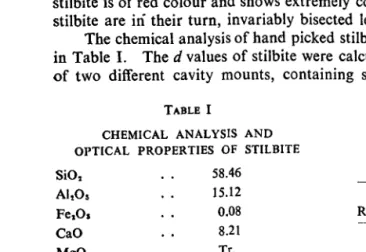
The chemical analysis of hand picked stilbite and its optical properties are given in Table 1. The d values of stilbite were calculated from the diffractometer charts of two different cavity mounts, containing silicon as an internal standard. The
TABLE I
CHEMICAL ANALYSIS AND TABLE II
OPTICAL PROPERTIES OF STILBITE X-RAY DATA OF STILBITE
SiO. 58.46 Radiation: Cu K
----~-15.12
AltO, d of Stilbite
0.08 Ranakpur A.S.T.M. hkl
Fe.O.
-~--- ~
8.21 CaO
Tr. 9.14 9.1 001,020,
MgO
Na.O 0.37 5.34 5.4 221,202,200
K.O 0.09 4.67 4.68 220,222
H.O 7.43 4.26 4.30 311,312
H.O 10.86 4.07 4.08 041, 132
IO().62 3.73 3.74 203
3.50 3.41 113,402
a ].484
#
1.493 (calc) 3.37 3.20 403"I 1.495 3.18 3.03 422, 152
2Ya 43° 3.04 2.79 314,351
x /\a 1° 2.77 2.69 202
--- - - -~
-
---~-(Analyst-S. C. Gupta)
average 20 values of these charts were taken to calculate the d values. It will be seen that the d values of Ranakpur stilbite show small differences from the A.S.T.M. data of the Brazilian stilbite found in the cavities in basalt (Table II). However, in view of the large compositional variations in the heulandite, stilbite and epistilbite group such variance is to be expected.