ISSN 2348 – 7968
Design & Development of a REST based
Web service platform for mobile applications integration on Cloud
Ritesh Sinha1, Manisha Khatkar2, Subhash Chand Gupta3
1
Computer Science, Amity University, Noida, Uttar Pradesh, India [email protected]
2
Computer Science, Amity University, Noida, Uttar Pradesh, India
3
Computer Science, Amity University, Noida, Uttar Pradesh, India
Abstract
Web services applications are extremely distributed applications which will be accessed remotely to attain business goals by execution of services offered by many different heterogeneous partners. A web service provides a way of communication over the net or the cloud, it work as a utility service that's continuously accessible. Its system structure support interoperable, scalable and versatile machine to machine interaction over a network. A classical approach to the current subject is use of SOAP and WSDL messages to exchange the structured info or data. They usually conveyed using HTTP in conjunction with XML serialisation and alternative web related standards.
This paper explores a comparatively advanced alternative approach to the SOAP/WSDL stack i.e. REST primarily based web services specifically on Cloud. The word form REST stands for representational state transfer, this primarily implies that every unique universal resource locator is a illustration of some object. The Web service uses HTTP protocols like GET methods to fetch data from web server. When client executes a query, the server responds the query with the resource that is requested by the client. You then may use a POST, PUT or DELETE to change the object.
Keywords: Web Service, SOAP, WSDL, HTTP, XML, REST, GET, PUT, DELETE, POST.
1. Introduction
The use of internet has grown in recent years and has evolved over time, also its users have grown over time. Initially the internet used to provide static contents but now because of the massive expansion of its users, many companies are attracted who have tried to create services to move their businesses online.
Because of the increasing users, many companies created portals or platform for single point access to its users by
means of internet. The integration was done to provide users with all the resources or thing needed just at one place that is on demand services.
Several companies are now involved in delievering web services over cloud. The web services are now being used in several domains as given below:
Medical Care: Health services are highly benifited from web services over cloud. Having all the information about patients at one place can become a matter of life and death. Tourism Sector: The customers can be benefited from the use of web services over cloud, planning a holiday trip usually involve Hotel accommodation, Flights and hiring a vehicle, having all these information at one place and by integrating different service providers at one place by means of building an intelligent system using cloud and web services.
Banking Services: Web service integration is being carried out and implemented by many secure web sites for online banking.
Software Development: Web services and cloud are now being used by software developers to develop many applications and software by using cloud platform of service providers.
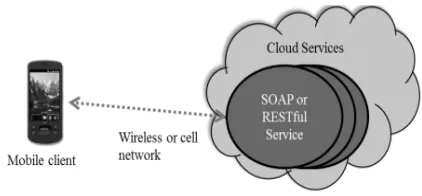
In Mobile Cloud Computing, the mobile client consumes web service or cloud services with the help of internet as a communication medium for interaction.
2. Study and Review of Literature
Some literatures are reviewed for the purpose of
ISSN 2348 – 7968 (especially RESTful Web Services) with their objectives.
These details are compiled in the following manner:
The Importance of Web Services using the RPC and
REST Architecture[1], According to the author this paper
describes the difference between the architecture of RPC
and REST Web Services. This paper explains that by using
XML languages, Web Service software application can be
accessed. It shows how the applications can communicate
with each other using remote procedure calls and
asynchronous messages with the help of web services over
cloud using XML and JSON languages.
Using REST Web-Services Architecture for
Distributed Simulation[2], According to the authors,
Web Services technologies using XML are used in
distributed simulation software and provide scalability and
flexibility in many applications. By using services as
Uniform Resource Locator(URIs), The RESTful-CD++
simulation Server provides Web Services. Hence, it can be
combined or mixed together with other applications and
simulation software. On the contrary by using many
Remote Procedure Calls(RPCs) and URIs, SOAP uses
internet as a communication medium for data or
information transfer. RESTful-CD++ is the only existing
RESTful system. Further, The paper also explains our web
service objectives are better fulfilled by REST than SOAP.
The Architecture of the Apex Platform,
Salesforce.com’s Platform for Building On-Demand
Applications[3], According to the author, increasing users
of cloud and customers in recent years and its success and
adoption of cloud computing by many organisations or on
demand services, has completely changed the whole
software organization and industry. To be successful and
be a market leader, On demand application must be
designed, with its core elements. As with any new design
architecture, all the core attributes and features must be
designed and implemented in initial application, then only
the platforms can emerge and encapsulate core computing
services, and more focus on innovation and value can be
done by application developers. With the Apex platform,
first on-demand platform was delievered by
Salesforce.com, Apex platform enabled developers and
application programmers to develop on-demand
applications and softwares easily because of its simplicity
and syntax similarity with traditional programming
languages.
Web Services Implementation Methodology for SOA
Application[4], According to the authors, this paper
describes the popularity of Web Services technology has
been discussed in this paper and its increasing trend in
developing SOA Software, and need of Web Services, The
gaps in agile software methodology have been identified
and many development challenges have been identified
through this paper for web services.
K. Mukherjee and G. Sahoo (A Secure Cloud
Computing[5], In this research paper authors proposed a
new framework for secured use of cloud computing. They
have focused on security aspects of web services of cloud.
The author also explained and defined the potential of the
web services in terms of dynamically updates and
interoperability.
Web Services in Mobile Devices[19], This paper
describes various aspects of web services in mobile
devices, i.e. what are the limitations of mobile devices,
connectivity issues, how to optimize the web service,
comparing different protocols and frame work that can be
used, performance analysis of SOAP and RESTful web
services, various libraries that can be used to create web
ISSN 2348 – 7968 A Comparison of Application Models, Information
Systems & Database Technologies[21], Review of results,
its overview, has been done by author in this research
paper, various models has been proposed through this
paper for cloud computing. The author also explains future
directions and scope of cloud computing and research
areas in this field and has highlighted those areas. The
paper also explained how these can be used in building and
designing of future mobile applications.
3. About the Salesforce.com Platform
Salesforce.com is a market leader in its CRM solution to its client. Salesforce Force.com platform provides platform as service. About 90 percent of the cloud computing companies are using salesforce.com platform to transfer from traditional architecture to cloud architecture. Even developers find very easy to shift from traditional languages like Java and .Net to Apex language because most of the syntax are almost same. It is one of the highest rating companies in the world. Therefore it is expanding very quickly in Cloud computing arena than other cloud computing service providers in the market.
3.1 Characteristics of Cloud
On Demand Self Service
Enables consumer to get computing resources as when required without human interference.
Broad Network Access
Cloud service are accessed via network usually internet from broad range of client platform such as mobile phones, laptops and desktop computer.
Resource Pooling
Cloud have large and flexible resource pool to meet customers needs and it uses Multi Tenant Model.
The resources are Compute, Storage and Network that are assigned dynamically to huge pool of customers who do not have any knowledge from where the resources are coming from.
Rapid Elasticity
Scale IT resources rapidly as required to fulfill changing needs without interruption of services. Resources can be scaled up and down dynamically.
Metered Service
Consumers are billed and charged based on metered usage of cloud resources that is cost on pay per use.
Fig. 1 Consuming WS from Mobile Client
3.2 Types of Cloud
Public Cloud
In this type of cloud, the IT resources that are made available to general public are owned by the cloud service providers.
Risk in public cloud is that there is no control over the resources and security of confidential data.
Examples of public cloud are Google Apps and Sa les force .com.
Private Cloud
The private cloud can be classified into two main categories as follows :-
On-premise private cloud
This type of cloud is hosted by organization with their own data center. It is best suited for organization which requires complete control and configurability of infrastructure and security of data and information over cloud.
Externally hosted private cloud
This type of cloud is externally hosted by a cloud provider. Where provider facilitate exclusive cloud environment for
specific organization with full security and privacy.
Examples include VMware, EMC, IBM, CISCO and Oracle etc.
Hybrid Cloud
Organizations consume resources from both private cloud and public cloud.
This architecture has the ability to add private cloud with resources of public cloud.
Community Cloud
ISSN 2348 – 7968 community that has shared concern such as security,
policies and vision.
Examples of community cloud are the agencies in state government operate under same guidelines, they share same infrastructure and they spread cost among themselves. This allows organizations to access vast pool of resources then in private cloud with higher level of security.
3.3 Cloud Service Models
There are basically three types of cloud service models as follows :-
IaaS(Infrastructure as a Service)
It provides capability to consumer to hire infrastructure components.
Amazon Elastic compute cloud that provide resizable compute capacity on pay per basis.
EMC Atmos online provide storage as a service.
PaaS(Platform as a Service)
Provide consumer to deploy consumer created or acquired applications on cloud provider infrastructure.
Consumer is charged for operating system, database and infrastructure.
Consumers use these platforms that typically have an IDE which include editor, compiler, and deploy capabilities to develop their applications.
Examples include Google apps, Microsoft Azure and Salesforce.com Platform.
SaaS(Software as a Service)
Provide capabilities to consumer to use providers application running in cloud infrastructure.
The Client need not to install the software on the system such as Laptop and PC, Service provider provides all the resources on pay per basis for given time period.
Examples include Google Docs and Salesforce.com.
3.4 Cloud Challenges
Users perspective to cloud challenges are as followed :-
Security and Regulation
Consumer may have critical data which calls for protection and continuous monitoring of its access. Consumer may not know in which location data is being stored.
Network Latency
Consumer may access cloud services from anywhere, resources are distributed. The resources may not be close consumer location, resulting in high network latency.
Supportability
Cloud may not support all customer applications and these customer applications may not be compatible with cloud platform.
Interoperability
Lack of interoperability between applications of different cloud service providers creates complexity and high migration cost of consumers.
Service providers perspective to cloud challenges are as followed :-
Service warranty and Service cost
Cloud service provider usually publish a service level aggrement(SLA), So that their customers are aware of availability of service, quality of service and downtime.
Huge number of Software to Manage
Providers such as SaaS and PaaS manage number of Platforms, Software to meet the needs of customers. This requires provider to process enough number of license of various softwares.
No Standard Cloud Access Interface
Cloud service provider usually offer proprietary applications to access their cloud but consumer may want an Open API to access the cloud.
4. Methods and Models Used
The objective of this paper is to identify gap between the existing web services over cloud or traditional web services that were used earlier and studying the methodologies of existing web services, that is our first step in the project.
Studying the advance RESTful web services is the next step in the project in order to identify steps needed for the development of web service as a middleware to transfer data between Mobile client and Cloud Platform like Salesforce.com
The final step to take the pragmatic approach by starting with the pre-requisite for the SFDC-Mobile Device (www.telerivet.com). These pre-requisite are as follows:-
Telerivet.com mobile user account.
Setting up a free developer account at Salesforce.com. Configuring and setting up http://telerivet.com/ which a Remote Site in Salesforce.
ISSN 2348 – 7968 Transfer(REST), a HTTP RESTful web service are used.
Therefore knowledge of JSON String is must.
The integration coding will be done using APEX Language of Salesforce and based on the MVC Architecture. So the implementation knowledge of the APEX programming is mandatory to develop custom components like visual force pages, classes, triggers and batch etc.
Table 1: Showing comparison between REST and SOAP
REST SOAP
Uniform YES NO
Transport HTTP Only
TCP, FTP, HTTP
Payload XML, RSS XML(SOAP)
Service WADL WSDL
Service It is not strictly UDDI
Service Mashups, do it do it your self
Service URI URI, Web Service
Conclusion
This paper has explored, designed an alternative to the SOAP approach to Web service integration and has discussed how REST can be applied in the context of intelligent systems. The proposed approach was implemented through Custom Modules as described in the “methods and models used for the proposed work”. These Custom Modules are developed using “Apex” a proprietary language of force.com platform.
These modules can be tested on the test data sets through test cases on Salesforce, which is atleast 75%, mandatory limit for the deployment of application on “Production” Environment.
Being lightweight, REST-based platforms built over HTTP, have almost all that is needed to process messaging between agents. Also in REST no additional protocols and toolkits are needed, thus improving efficiency in data transportation.
As REST is completely embedded in the World Wide Web, thus, a REST-based platform over HTTP can be used to provide scalability, which supports many mobile agents accessing same services simultaneously at same time In Future, with a similar technical approach, the idea can be extended which requires funds and resources to actually implement sending of messages from salesforce.com platform to mobile devices rather then just simulating.
Also mobile to mobile device integration can be implemented and security features can also be included for message security using cloud.
Stegnography can also be used for message security for future directions for integrating mobile application using cloud.
Interoperation and functionalities sharing of applications, more complex intelligent mobile applications can be built, without negative effects on other applications.
Acknowledgments
I consider it a privilege to express my gratitude and respect to all those who guided and inspired us in the completion of this paper.
I would like to thank Mr. Subhash Chand Gupta who helped me as mentor and guide.
I am also very thankful to Dr. Abhay Bansal, HOD of Computer Science and Engineering of Amity University. The support and encouragement provided by them has been a key factor in the successful completion of this paper. The support provided by Amity University in terms of infrastructure is invaluable. It was a pleasure working at the laboratory.
References
[1] PirnauMironela, “The Importance of Web Services using the RPC and REST Architecture”, IEEE, International Conference on Computer Technology and Development, 2009.
[2] Khaldoon Al-Zoubi, Gabriel Wainer, “Using REST Web-Services Architecture for Distributed Simulation”, IEEE, SCS Workshop on Principles of Advanced and Distributed Simulation, 2009.
[3] Steve Fisher, “The Architecture of the Apex Platform, salesforce.com's Platform for Building
On-Demand Applications”, IEEE, 29th International Conference on Software Engineering, 2007.
[4] SiewPoh Lee, Lai Peng Chan, EngWah Lee, “Web Services Implementation Methodology for SOA Application”, IEEE, 2006.
[5] K. Mukherjee and G.Sahoo, “A Secure Cloud Computing”, IEEE, International Conference on Recent Trends in Information, Telecommunication and Computing, 2010. [6] R.Nagappan, R. Skoczylas, R. Sriganesh, “Developing Java
Web Services”, Wiley 2003.
[7] KishorWagh, “A Comparative study of SOAP Vs REST Web Services Provisioning Techniques for Mobile Host”, Journal of Information Engineering and Applications, ISSN 2225-0506 (Online), Vol 2, No. 5, 2012.
ISSN 2348 – 7968 [9] Leonard Richardson, Sam Ruby and David Heinemeie,
“RESTful Web Services. First edition”, O’Reilly Media, 2007.
[10] HatemHamad, MotazSaad, and Ramzi Abed, "Performance Evaluation of RESTful Web Services for Mobile Devices", International Arab Journal of e-Technology, Vol.1, No. 3, January 2010.
[11] Michael zurMuehlen, Jeffrey V. Nickerson, and Keith D. Swenson, “Developing Web Services Choreography Standards - The Case of REST vs. SOAP", 2004, Elsevier B.V.
[12] Eric Newcomer, "Understanding Web Services: XML, WSDL, SOAP and UDDI", Addison-Wesley Professional (May 23, 2002).
[13] LudmilaCherakasova, Yun Fu, Wenting Tang, and Amin Vahdat, "Measuring and Characterizing End-to-End Internet Service Performance", ACM Transactions on Internet Technology, Vol. 3, 4.
[14] Dr. Roy Thomas Fielding - doctoral thesis, "Architectural Styles and the Design of Network-Based Software Architecture", Department of Computer and Information Science,
[15] David Booth, Hugo Haas, Francis McCabe, et al., "Web Services Architecture," http://www.w3.org/TR/ws-arch/, last accessed April 20, 2013.
[16] EranChinthaka, "Enable REST with Web Services, Part 1: REST and Web Services in WSDL 2.0", April 20, 2013. [17] Alex Rodriquez, "RESTful Web Services: The Basics”,
April 21,2013.
[18] Yutu Liu, Anne H. H. Ngu, and LiangzhaoZeng, "QoS Computation and Policing in Dynamic Web Service Selection", 2004, May 17-22, New York, USA.
[19] Varun Goyal, “Web Services in Mobile Devices”, Computer Science Department, Rochester Institute of Technology, 2013.
[20] Dr. Atul Gonsai and Mr. Rushi Raval, “Mobile Cloud Computing: A Tool for Future”, IJCSET, 2013.
[21] Dejan Kovachev, Yiwei Cao and Ralf Klamma, “Mobile Cloud Computing: A Comparison of Application Models”, Information Systems & Database Technologies RWTH Aachen University, 2013.
Ritesh Sinha currently persuing M.Tech(CSE) from Amity University, Noida, Uttar Pradesh.
Manisha Khatkar currently persuing M.Tech(CSE) from Amity University, Noida, Uttar Pradesh.