Face Recognition Based on Principal
Component Analysis and Linear Discriminant
Analysis
Riyanka
M.Tech Student, Dept. of ECE, IGDTUW, Delhi, India.
ABSTRACT: This paper presents the two novel face detection techniques which are based on the singular vector decomposition (SVD) and Eigen value decomposition (EVD). Here, Principal Component Analysis (PCA) and Linear Discriminant Analysis (LDA) methods are applied to detect the features of faces which act as the principle component for the face recognition problem. The human face is full of information but working with all the information is time consuming and less efficient. It is better get unique and important information and discards other useless information in order to make system efficient. Principal component analysis is applied to find the aspects of face which are important for identification. Eigenvectors and eigen faces are calculated from the initial face image set. New faces are projected onto the space expanded by eigen faces and represented by weighted sum of the eigen faces. These weights are used to identify the faces. To reduce the time complexity and Euclidean distance in face space, here two techniques Singular Value Decomposition and Eigen-value decomposition are utilized. Simulation results have been presented to illustrates the effectiveness of the proposed face detection techniques. Here, face detection is performed using Principal Component Analysis and Linear Discriminant Analysis methods with Singular Value and Eigen-value decomposition. Experiments on face database shows the effectiveness of our proposed algorithm and results compared to PCA using Eigen Value Decomposition(EVD) shows that the proposed scheme gives comparatively better results than previous methods in terms of reduced time complexity without effecting its accuracy. Based on the results presented it is concluded that the Principal Component Analysis using EVD leads to superior results compared to that of other reported methods. From the result it is also noticed that the time complexity of the proposed method reduces considerable which leads to real time applicability of the proposed method.
KEYWORDS:Face detection, Principal Component Analysis (PCA), Linear Discriminant Analysis (LDA), Singular Value Decomposition (SVD), Eigen-value decomposition (EVD)
I. INTRODUCTION
based holistic approach and linear method, in which the whole face region is taken into account as input data into face recognition system. Examples of holistic methods are Eigen faces (most widely used method for face recognition),that's why PCA is known as Eigen space Projection which is based on linearly Projection the image space to a low dimension feature space that is known as Eigen space. It tries to find Eigen vectors of Covariance matrix that corresponds to the direction of Principal Components of original data.PCA is an unsupervised technique. In Supervised, teacher provides a category label or cost for each pattern in the training set ,means classes of the patterns is already known. In Unsupervised, the system forms clusters or natural groupings of the input patterns, means classes of the patterns not known a prior. The key procedure in PCA is based on Karhunen Loeve transformation (KLT) [5] [6].
The face is our primary focus of attention in social intercourse, playing a major role in conveying identity and emotion. Although the ability to infer intelligence or character from facial appearance is suspect, the human ability to recognize faces is remarkable. We can recognize thousands of faces learned throughout our lifetime and identify familiar faces at a glance even after years of separation. This skill is quite robust, despite large changes in the visual stimulus due to viewing conditions, expression, aging, and distractions such as glasses, beards or changes in hair style. Face recognition from images is a subarea of the general object recognition problem. Applications in law enforcement for mug shot identification, verification for personal identification such as driver's licenses and credit cards, gateways to limited access areas, and surveillance of crowd behaviour are all potential applications of a successful face recognition system. Face recognition has become an important issue in many applications such as security systems, credit card verification and criminal identification [7]-[10].
II. LITEARAURE SURVEY
In [7], Martinez et. al presents the appearance-based paradigm for object recognition, the algorithms based on LDA (linear discriminant analysis) are better than those based on PCA (principal components analysis). Our overall conclusion is that when the training data set is small, PCA can outperform LDA and, also, that PCA is less sensitive to different training data sets.
In [8], Lu et. al describes that the linear discriminant analysis (LDA)-based methods suffer from the disadvantage that their optimality criteria are not directly related to the classification ability of the obtained feature representation. Authors propose a new algorithm that deals with both of the shortcomings in an efficient and cost effective manner. This method is compared, in terms of classification accuracy, to other commonly used FR methods on two face databases. Results indicate that the performance of the proposed method is overall superior to those of traditional FR approaches, such as the eigenfaces, fisherfaces, and D-LDA methods.
In [9], Lu et. al introduced low-dimensional feature representation with enhanced discriminatory power is of paramount importance in face recognition (FR) systems. It is, therefore, not surprising that linear techniques, such as those based on principle component analysis (PCA) or linear discriminant analysis (LDA), cannot provide reliable and robust solutions to those FR problems with complex face variations. Authors propose a kernel machine-based discriminant analysis method, which deals with the nonlinearity of the face patterns' distribution.
In [10], Xiaofei et. al proposed an appearance-based face recognition method called the Laplacianface approach. By using locality preserving projections (LPP), the face images are mapped into a face subspace for analysis. Different from principal component analysis (PCA) and linear discriminant analysis (LDA) which effectively see only the Euclidean structure of face space, LPP finds an embedding that preserves local information, and obtains a face subspace that best detects the essential face manifold structure. The unwanted variations resulting from changes in lighting, facial expression, and pose may be eliminated or reduced.
III. FACE RECOGNITION TECHNIQUES A. Principal Components Analysis (PCA)
original image space. This new subspace is normally lower dimensional t<<s. If the image elements are considered as random variables, the PCA basis vectors are defined as eigenvectors of the scatter matrix. The Eigenface algorithm uses PCA for dimensionality reduction to find the vectors which best account for the distribution of face images within the entire image space. These vectors define the subspace of face images and the subspace is called face space. All faces in the training set are projected onto the face space to find a set of weights that describes the contribution of each vector in the face space. To identify a test image, it requires the projection of the test image onto the face space to obtain the corresponding set of weights. By comparing the Euclidean distances between the weight of the test image with the set of weights of the faces in the training set, the face in the test image can be identified. The key procedure in PCA is based on Karhunen Loeve transformation [11]-[13].
B. Linear Discriminant Analysis (LDA)
In LDA the goal is to find an efficient or interesting way to represent the face vector space. But exploiting the class information can be helpful to the identification tasks; Linear Discriminant Analysis (LDA) finds the vectors in the underlying space that best discriminate among classes. LDA aims to find an optimal transformation that tries to maximise the ratio
𝐽
𝐿𝐷𝐴(𝑊) = 𝑎𝑟𝑔 𝑚𝑎𝑥 𝑤
| 𝑊𝑇𝑆𝐵 𝑊 | | 𝑊𝑇𝑆𝑊 𝑊 |
(1)
where SB is the between-class scatter matrix and SW is the within-class scatter matrix. Thus, by solving a generalised
eigenvalues problem, the projection vector W can be found as the eigenvectors of SW -1
SB corresponding to the largest
eigenvalues. When the sample size is smaller than the dimensionality of samples, however, SW becomes singular and
we cannot compute SW-1SB directly. There are two fundamental problems with the linear discriminant analysis (LDA)
for face recognition. First one is LDA is not stable because of the small training sample size problem. The other is that it would collapse the data samples of different classes into one single cluster when the class distributions are multimodal
IV. FACE RECOGNITION BASED ON PCA AND LDA
A. Training
a) Select a training set that includes a number of leaf images. Let a leaf image I(x; y) of N2 dimension (N×N) represent as a column vector of N2×1 dimension. A data set of M images can therefore be mapped to a collection of points in this high dimension “leaf space” as I1, I2..., IM.
b) Compute the mean of the training set and normalized the set by subtracting the mean from each leaf image in the training set.
𝐴 =
1𝑀
𝑙
𝑛𝑀
𝑛=1
(2)
Φ𝑖
=
𝐼
𝑖− 𝐴
(3)
𝐶 =
1𝑀
Φ𝑖
𝑀
𝑛=1 Φ𝑛𝑇
= 𝑋 𝑋
𝑇(4)
where
c) Eigen Value Decomposition (EVD): Factorize covariance matrix C to compute the Eigen values and Eigenvectors of, which has dimension of N2× N2, for typical image size, this size would be a very high value. Therefore, we need a computationally feasible method to determine these eigenvectors. If the number of data points in the image space is less than of the space M << N2 there will be only M-1 meaning full eigenvectors, and rest of the eigenvectors will have eigen values zero.
(𝐶 − Λ
𝑖𝐼)𝑣
𝑖= 0
(6)
d) Choose the eigenvectors corresponding to the highest eigen values, by combining these after sorting from higher to lower we get feature or projection vector.
𝑣
𝑖= 𝑉
(7)
e) Now we can project the each face in the set into lower dimension and reconstruct it as a eigen faces as shown in flow chart Fig. 2. Each of the centered training images Φi is projected onto the eigen space. To project an
image onto the eigen space, calculate the dot product of the image with sorted eigenvectors.
Φ
= 𝑉
𝑖 𝑇 Φ𝑖(8)
B. Testing
a) Each test image is first mean centered by subtracting the mean image.
𝑡
= 𝑡
𝑖 𝑖− 𝐴 (9)
b) Then, projected into the same eigen space defined by V
t𝑖
= 𝑉
𝑇𝑡
(10)
𝑖c) Now, calculate the euclidean distance to measure the distance between the projected feature vector of the test image with projected feature vector of each leaf image in the training set.
𝜖 = ‖ t𝑖
−
Φ ‖𝑖 2 (11)d) At the last compare the Euclidean distance, and showing the leaf image which has minimum Euclidean distance.
V. EXPERIMENTAL RESULTS
In this section, detail simulation results have been presented using singular vector decomposition (SVD) and Eigen value decomposition (EVD). All the images are resized to a resolution of 50 × 50 pixels. All the simulations have been done with MATLAB 7.11.
A. Face Recognition using EVD-PCA
Fig. 1 Input faces for PCA-EVD
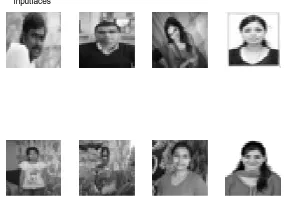
Eight different Input faces are used for PCA-EVD as known as training images. The pictures used in the training set must have taken under the same lighting conditions, and it must be normalized to have the eyes and mouths aligned properly across all images Then their eigen faces are calculated by MATLAB software. Fig. 1 shows the input faces for face recognition algorithm.
Fig. 2 Eigen faces for PCA-EVD
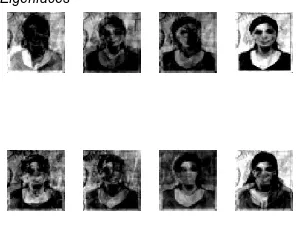
The eigenfaces are calculated by a mathematical process called principal component analysis (PCA) on a large set of images having different human faces. Eigenfaces appear as light and dark areas that are arranged in a specific pattern. The eigenfaces images look very little like a face. Each eigenface have eigenvalues shows how much the images in the training set vary from the mean image in that direction. Fig. 2 shows the corresponding eigen faces for EVD-PCA algorithm.
Fig. 3 Test image for PCA-EVD
input faces
Eigenfaces
Fig. 3 shows the test image. The testing image will be compared to the input images. The image having least Euclidean distance will be displayed showing the best match of the testing image.
Fig. 4 Identified image for PCA-EVD
Fig. 4 shows the identified face using EVD-PCA.
B. Face Recognition using SVD-PCA
Here, experiment is preformed using singular vector decomposition- Principal Components Analysis for the face recognition problem.
Fig. 5 Input faces for PCA-SVD
PCA can be implemented by using EVD or SVD methods, both can be used to find principal components and will give the same results in most cases. Same Input faces are used for PCA-SVD as known as training images. Fig. 5 shows the input faces for face recognition SVD-PCA algorithm.
Fig. 6 Eigen faces for PCA-SVD
Same procedure is done on PCA-SVD. Fig. 6 shows the corresponding eigen faces for SVD-PCA algorithm.
input faces
Fig. 7 Test image for PCA-SVD
Similarly, the testing image will be compared to the input images and the image having least Euclidean distance will be displayed showing the best match of the testing image. Fig. 7 shows the test image.
Fig. 8 Identified image for PCA-SVD
Fig. 8 shows the identified face using SVD-PCA. In case of SVD-PCA algorithm the identified image is more accurate or same as that of Test image where as in EVD-PCA algorithm identified image is not accurate as that of test image. .
C. Face Recognition using SVD-LDA
Face recognition using Eigenvalue Decomposition-Linear Discriminant Analysis Algorithm is applied in this example.
Fig. 9 Input faces for LDA-EVD, Fig. 9 shows the input faces for face recognition algorithm.
Testing face
Fig. 10 Fisher faces for LDA-EVD Fig. 10 shows the corresponding fisherfaces for SVD-LDA algorithm.
Fig. 11 Test image for LDA-EVD Fig. 11 shows the test image.
Fig. 12 Identified image for PCA-EVD
Fig. 12 shows the identified face using SVD-LDA algorithm. In case of SVD-PCA algorithm the identified image is more accurate or same as that of Test image where as in SVD-LDA algorithm identified image is not accurate as that of test image. SVD-PCA algorithm gives better result if we compare with SVD-LDA
VI. CONCLUSION
Principle Component Analysis (PCA) is well known scheme for dimension reduction. It has been used widely in many applications involving high-dimensional data, such as face recognition. In this paper we present a new variant on Principle Component Analysis (PCA) for face recognition by reducing dimensions of input data using matrix representation and after that using Singular Value Decomposition (SVD) to get the projection matrix, to project the high dimensional face images into low dimensional face space. Experiments on face database shows the effectiveness of our proposed algorithm and results compared to PCA using Eigen Value Decomposition (EVD) shows that the proposed scheme gives comparatively better results than previous methods in terms of reduced time complexity without effecting its accuracy.
fisherfaces
REFERENCES
[1]. A.S. Tolba, A.H. El-Baz and A.A. El Harby, "Face Recognition: A Literature Review", International Journal of Information and Communication Engineering, february 2006.
[2]. Rabia Jafri and Hamid R. Arabina,"A Survey of Face Recognitionv Techniques",Journal of Information Processing Systems, Vol.5, No.2, June 2009.
[3]. Ming Hsuan yang,Narender Ahuja and David J Kreigman, "Detecting Faces in Images: A Survey, IEEE transaction on Pattern Analysis and Machine Intelligece vol 24 No.1 January 2002.
[4]. Matthew A. Turk and Alex P. Pentland, "Face Recognition Using Eigenfaces", In Proc. IEEE Conference on Computer Vision and Pattern Recognition, pp. 586–591, 1991.
[5]. Tamal bose, Digital signal and image processing, Asia: Wiley 2004.
[6]. L. Sirovich and M. Kirby, “Low-dimensional procedure for the characterization of human faces”, J . Opt. Soc. Am. A, Vol. 4, No. 3, March 1987, 519-524.
[7]. S. H. leng, H. Y. M. Liao, C. C. Han, M. Y. Chern, and Y. T. Liu. Facial feature detection using geometrical face model: an efficient approach. Pattern recognition, 31(3):273-282, 1998.
[8]. C. C. Han, H. Y. Mark Liao, G. 1. Yu, and L. H. Chen. Fast face detection via morphology-based pre-processing. In Image Analysis and Processing, pages 469--476. Springer, 1997.
[9]. L. F. Chen, H. Y. M. Liao, M. T. Ko, 1. C. Lin, and G. 1. Yu. A new LDA-based face recognition system which can solve the small sample size problem. Pattern recognition, 33(10):1713-1726,2000.
[10].B. Moghaddam and A. Pentland. Probabilistic visual learning for object representation. Pattern Analysis and Machine Intelligence, IEEE Transactions on, 19(7):696-710,2002.
[11].Pentland A. Turk, M. Eigenfaces for recognition. Journal of Cognitive Neuroscience, 3(1):71-86, 1991.
[12].P. N. Belhumeur, J. P. Hespanha, and D. J. Kriegman. Eigenfaces vs. fisherfaces: Recognition using class specific linear projection. Pattern Analysis and Machine Intelligence, IEEE Transactions on, 19(7):711-720,2002.
[13].Bansal, A. ; Mehta, K. ; Arora, S., "Face Recognition Using PCA and LDA Algorithm”, International Conference on Advanced Computing & Communication Technologies (ACCT), 2012 , Page(s): 251 – 254, 2012.
[14].Haitao Zhao ; Pong Chi Yuen, “Incremental Linear Discriminant Analysis for FaceRecognition”, IEEE Transactions on Systems, Man, and Cybernetics, Part B: Cybernetics, Vol: 38 , Issue: 1, Pag: 210 – 221, 2008.
[15].Hu, H. ; Zhang, P. ; De la Torre, F., "Face recognition using enhanced linear discriminant analysis”, IET Computer Vision, Vol: 4 , Issue: 3 , Pag: 195 – 208, 2010.
[16].Zizhu Fan ; Yong Xu ; Zhang, D., "Local Linear Discriminant Analysis Framework Using Sample Neighbors”, IEEE Transactions on Neural Networks, Vol: 22 , Issue: 7 , Pag: 1119 – 1132, 2011.
[17].Huxidan Jumahong ; Wanquan Liu ; Chong Lu, “A new rearrange modular two-dimensional LDA for face recognition”, IEEE International Conference on Machine Learning and Cybernetics (ICMLC), 2011 Vol: 1, Pag: 361 – 366, 2011.