International Journal of Research (IJR)
e-ISSN: 2348-6848, p- ISSN: 2348-795X Volume 2, Issue 07, July 2015Available at http://internationaljournalofresearch.org
Evaluation of Internet Protocol Addressing and
Comparison between Ipv4 & Ipv6: A Study
¹Mohammad Firoz Alam*; ²Jai Singh & ³Ravinder Kumar
¹˒²Reaserch Scholar, ³Assistance Professor¹˒²˒³Department of Electronics & Communication Engineering AFSET, Al-Falah University
Dhauj, Fridabad, Haryana (INDIA) *Corresponding Author: [email protected]
ABSTRACT
The TCP/IP protocol suite is so named for two
of its most important protocols
namelyTransmission Control Protocol (TCP) and Internet Protocol (IP). TCP/IP is an industry standard suite of protocols that is designed for large networks consisting of network segments that are connected by routers. TCP/IP is the protocol that is used on the Internet, which is the collection of thousands of networks worldwide that connect research facilities, universities, libraries, government agencies, andindividuals.Present paper provides an introduction to IPv6 by giving the results that can be obtained by deploying the technology. It explains some of the technical features and advantages of IPv6.
Keywords–Internet protocol version 4 (IPv4); Internet protocol version 6 (IPv6); Network broadcast; Broadcast address; Multicast address Subnet broadcast and Loopback address
1. INTRODUCTION
Transmission control protocol/Internet protocol TCP/IP– A suite of networking protocols, including both IPv4 and IPv6, that are widely used on the Internet and that provide communication across interconnected networks of computers with diverse hardware architectures and various operating systems.The main design goal of TCP/IP was to build an interconnection of networks, referred to as an internetwork, or internet, that provided universalcommunication services over physical networks. The clearbenefit of such an inter
network is the enabling of communication between hostson different networksseparated by a large geographical area.
2. HISTORY OF TCP/IP
In 1970, ARPANET hosts started to use Network Control Protocol (NCP), a preliminary form of whatwould become the Transmission Control Protocol (TCP). In 1974, the Transmission Control Protocol (TCP) was specified in detail. TCP replaced NCP andprovided enhanced reliable communication services. In 1981, the Internet Protocol also known as IP version 4 (IPv4)was specified in detail.
IPprovides addressing and routing functions for end-to-end delivery.In 1982,the Defense Communications Agency (DCA) and ARPA established the Transmission ControlProtocol (TCP) and Internet Protocol (IP) as the TCP/IP protocol suite.In 1983, ARPANET switched from NCP to TCP/IP. In 1996, the first set of IP version 6 (IPv6) standards were published. On a TCP/IP based network, a router can forward packets that are not addressed to the router, a host cannot, and a node is either a host or a router.Ipconfig and Ping are the primary tools for troubleshooting basic IP configuration and connectivity.
3. THE TCP/IP PROTOCOLS SUITE
International Journal of Research (IJR)
e-ISSN: 2348-6848, p- ISSN: 2348-795X Volume 2, Issue 07, July 2015Available at http://internationaljournalofresearch.org
are Application, Transport, Internet, and Network Interface.Each layer in the DARPA model corresponds to one or more layers of the seven layers OSI model.
Fig.1 The architecture of the TCP/IP protocol suite
The TCP/IP protocol suite has two sets of protocols at the Internet layer:
3.1.IPv4 is the Internet layer in common use today on private Intranets and the Internet.
3.2.IPv6 is the new Internet layer that will eventually replace the existing IPv4 Internet layer.
4.INTERNET PROTOCOL VERDION4 (IPv4)
IPv4 is a datagram protocol primarily responsible for addressing and routing packets between hosts.IPv4 is connectionless, which means that it does not establish a connection before exchanging data,and unreliable, which means that it does not guarantee packet delivery. IPv4 always makes a “besteffort” attempt to deliver a packet. An IPv4 packet might be lost, delivered out of sequence, or delayed. IPv4 does not attempt to recover from these types of errors. A higher-layer protocol, suchas TCP or an application protocol, must acknowledge delivered packets and recover lost packets ifneeded. IPv4 is defined in RFC 791. An IPv4 packet consists of an IPv4 header and an IPv4 payload. An IPv4 payload, in turn, consists of an upper layer protocol data unit, such as a TCP segment or a UDP message. basic structure of an IPv4 packet.
Fig.2The basic structure of an IPv4 packet
4.1.IPv4 Address:An IP address is an identifier that is assigned at the Internet layer to an interface or a set of interfaces.Each IP address can identify the source or destination of IP packets. The IPv4 address is a logical address because it is assigned at the Internet layer and IPv4 addresses are 32 bits long.
Fig.3 IPv4 address in dotted decimal notation
Where W, X, Y, Z are called octets and each octets are of 8 bits.
4.2. Classes of IPv4 Address: IPv4 addresses are classified into five classes as given below:
Fig.4 IP address classification
There are three types of Internet addresses as defined below:
International Journal of Research (IJR)
e-ISSN: 2348-6848, p- ISSN: 2348-795X Volume 2, Issue 07, July 2015Available at http://internationaljournalofresearch.org
Fig.5 Structure of an example unicast IPv4 address
4.4.MulticastAddress:Assigned to one or more network interfaces located on various subnets used for one-to-manycommunication. IPv4 uses multicast addresses to deliver single packets from one source to many destinations. On anIPv4 intranet that is enabled for multicast,routers forward an IPv4 packet addressed to an IPv4multicast address to the subnets on which hosts are listening to the traffic sent to the IPv4 multicastaddress. IPv4 multicast efficiently delivers many types of communication from one source to manydestinations. IPv4 multicast addresses are defined by the class D Internet address class: 224.0.0.0/4. IPv4 multicastaddresses range from 224.0.0.0 through 239.255.255.255. IPv4 multicast addresses for the224.0.0.0/24 address prefix (224.0.0.0 to 224.0.0.255) are reserved for multicast traffic on a localsubnet.
4.5.BroadcastAddress: Assigned to all network interfaces located on a subnet used for one-to-everyone on a subnetcommunication. IPv4 uses a set of broadcast addresses to deliver packets from one source to all interfaces on thesubnet. All the interfaces on the subnet process packets sent to IPv4 broadcast addresses. Thefollowing are the types of IPv4 broadcast addresses:
4.5.1.Network Broadcast: Formed by setting all the host bits to 1 for a classful address prefix. For example, 131.107.255.255 is a network broadcast address for the classful address prefix 131.107.0.0/16. Network broadcasts send packets to all interfaces of a classful network. IPv4 routers do not forward network broadcast packets.
4.5.2.Subnet Broadcast: Formed by setting all the host bits to 1 for a classless address prefix. For example, 131.107.26.255 is a network broadcast address for the classless address prefix 131.107.26.0/24. Subnet broadcasts are used to send packets to all hosts of a classless network.
4.6.Loopback Address: It is known as the IPv4 loopback address, it is assigned to an internal loopbackinterface. This interfaceenables a node to send packets to itself.127.0.0.1 is an example of loopback address.
5. INTERNET PROTOCOL VERSION6 (IPv6)
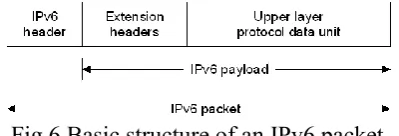
IPv6 is a connectionless, unreliable datagram protocol that is primarily responsible for addressing and routing packets between hosts.IPv6 defines many improvements over IPv4. However, the primary goal of IPv6 is to significantly increase the number of available IP addresses. To that end, IPv6 uses a 128 bits IP address, rather than 32 bits defined by IPv4. A 32-bits address space allows for 2ⁿ where n=32 or 4.3 billion addresses.A 128-bits address space allows for 2ⁿ where n=128 or 340 undecillion (340 followed by 36 zeros) possibleaddresses.For IPv6, the 128-bits address is divided along 16-bit boundaries, each 16 bits block is converted to a 4 digit hexadecimal number and adjacent 16 bit blocks are separated by colons. RFC 4291 describes the IPv6 addressing architecture.RFC 2460 defines IPv6 packet structure. An IPv6 packet consists of an IPv6 header and an IPv6 payload. The IPv6 payload consists of zero or more IPv6 extension headers and an upper layerprotocol data unit, such as an ICMPv6 message, a TCP segment, or a UDP message. Figure below shows the basic structure of an IPv6 packet.
Fig.6 Basic structure of an IPv6 packet
6. TYPES OF IPV6 ADDRESS
International Journal of Research (IJR)
e-ISSN: 2348-6848, p- ISSN: 2348-795X Volume 2, Issue 07, July 2015Available at http://internationaljournalofresearch.org
single interface within the scope of the type of unicast address. Withthe appropriate unicast routing topology, packets addressed to a unicast address are delivered to asingle interface. A unicast address is used for communication from one source to a singledestination. A multicast address identifies multiple interfaces. With the appropriate multicast routing topology,packets addressed to a multicast address are delivered to all interfaces that are identified by theaddress. A multicast address is used for communication from one source to many destinations, withdelivery to multiple interfaces. An anycast address identifies multiple interfaces. With the appropriate routing topology, packetsaddressed to an anycast address are delivered to a single interface, the nearest interface that theaddress identifies.
6.1.IPv6 Unicast Address: The following types of addresses are unicast IPv6 addresses:
6.1.1.Global Unicast Address: Global unicast addresses are equivalent to public IPv4 addresses. They are globally routable andreachable on the IPv6 portion of the Internet, known as the IPv6 Internet.
Fig.7Structure of a global unicast address
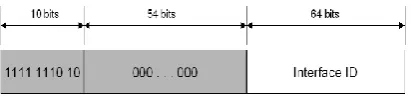
6.1.2.Link-Local Address:Nodes use link-local addresses when communicating with neighboring nodes on the same link, alsoknown as a subnet. A link-local address is required for Neighbor Discovery processes and is always automaticallyconfigured, even in the absence of all other unicast addresses.
Fig.8 Structure of the link -local address
6.1.3.Site-Local Address: Site-local addresses are equivalent to the IPv4 private address
space. Site-local addresses are not automatically configured and must be assignedeither through stateless or stateful address configuration.
Fig.9 Structure of the site-local address
6.1.4.Unique Local Address:RFC 4193 defines unique local IPv6 unicast addresses. Figure below shows the structure of unique local addresses.
Fig.10 The unique local address
The first 7 bits have the fixed binary value of 1111110. All unique local addresses have the addressprefix FC00::/7. The Local (L) flag is set 1 to indicate a local address. The L flag value set to 0 has notyet been defined. Therefore, unique local addresses with the L flag set to 1 have the address prefix ofFD00::/8. The Global ID identifies a specific site within an organization and is set to a randomly derived40-bit value.
6.1.5.Special IPv6 Address:IPv6has slightly complex structure of IP address than that of IPv4.IPv6 has reserved a few addresses and address notations for special purposes.
IPv6 address Meaning ::/128 Unspecified
address
::/0 Default Route
::1/128 Loopback address
Fig.11 Special IPv6 address
6.1.6. Transition Address:The IPv4 compatible address, 0:0:0:0:0:0:w.x.y.z or
International Journal of Research (IJR)
e-ISSN: 2348-6848, p- ISSN: 2348-795X Volume 2, Issue 07, July 2015Available at http://internationaljournalofresearch.org
decimalrepresentation of a public IPv4 address is used by IPv6/IPv4 nodes that are communicating usingIPv6. IPv6/IPv4 nodes are nodes with both IPv4 and IPv6 protocols. When the IPv4 compatibleaddress is used as an IPv6 destination, the IPv6 traffic is automatically encapsulated with an IPv4header and sent to the destination using the IPv4 infrastructure. IPv4 mapped addresses are used for internal representation only. It is never used as a source or destination address of an IPv6 packet.The 6to4 address is used for communicating between two nodes running both IPv4 and IPv6 overthe Internet. It can be formed the 6to4 address by combining the global prefix 2002::/16 with the 32 bits ofa public IPv4 address of the node, forming a 48-bit prefix. 6to4 is an IPv6 transition technologydescribed in RFC 3056.
6.2. IPv6 Multicast Address: IPv6 multicast addresses have the first eight bits fixed at 1111 1111. Therefore the address prefix for all IPv6 multicast addresses is FF00::/8. Beyond the first eight bits, multicast addresses include additional structure to identify flags, their scope, and the multicast group.
Fig.12 The structure of the IPv6 multicast address
6.3. IPv6 Anycast Address: An anycast address is assigned to multiple interfaces. The routing structure forwards packetsaddressed to an anycast address so that they reach the nearest interface to which the anycast addressis assigned. To facilitate delivery, the routing infrastructure must be aware of the interfaces assignedanycast addresses and their “distance” in terms of routing metrics. At present anycast addresses areused as destination addresses only.
7. COMPARISON OF IPv4 AND IPv6
IPv4 address IPv6 address
It is internet
protocol version 4. It is internet protocol version 6. It is 32 bits,4 octets It is 128 bits,16
octets No. of addresses
4.3 billion No. of addreses 340 undecillion Internet address
classes available
Not applicable in IPv6
IPv4 multicast addresses (224.0.0.0/4)
IPv6 multicast addresses (FF00::/8) Support Broadcast
addresses
Not applicable in IPv6
Public IPv4 addresses
Global unicast addresses Address syntax:
dotted decimal notation
Address syntax: colon hexadecimal format
Unspecified address
is 0.0.0.0 Unspecified address is ::
8. ADVANTAGES OF IPv6
To continue the growth of the Internet and private intranets, IPv4 must eventually be replaced.The following are the key technological and business benefits in the case to deploy IPv6.
8.1.Large Address Space
Global reachability and flexibility
Aggregation
Auto configuration
Plug and Play
Support for encapsulation of itself and other protocols.
Compatibility methods to coexist and communicate with IPv4.
8.2. Mobility and Security Mobile IP
IPSec Native (default , Mandatory)
Built-in authentication and encryption
8.3. Simpler Header
Performance and forwarding scalability
International Journal of Research (IJR)
e-ISSN: 2348-6848, p- ISSN: 2348-795X Volume 2, Issue 07, July 2015Available at http://internationaljournalofresearch.org
No checksum
Extension Header
No fragmentation
Flow label
8.4. Translation Richness Dual Stack
6to4 or 4to6 Tunnels
Translation
9. CONCLUSION
IPv6 represents one of the most significanttechnology changes in the history of the Internet.The Internet is at an inflection point. Urgency centering on IPv6 is being driven by the exhaustion of IPv4 addresses, which has already occurred around the world. IPv6 holds thekey to continue growth of the Internet.IPv6 deployment will happen and IPv4 will go away.The Internet will continue to grow and the numbering system and the routing system will change to accommodate that growth. The most obvious change in going from IPv4 to IPv6 is the increase in the address space from 32 bits in IPv4 to 128 bits in IPv6.This will allow for the connection of far more devices to the Internet or any network using Internet Protocol.
10. REFERENCES
[1] Computer Network by A. Tanenbaum, FiftEdition, PHI.
[2] Cisco Certified Network Associated by Richard Deal,Tata Mcgraw-Hill Edition, 2010
[3] Data and Computer Communication by William stallings, 8E.
[4] ICND1 Official Exam Certification Guide by Wendell Odom,2E, Cisco Press.
[5] Understanding IPv6 by Joseph Devies,Microsoft 3rdEdition.
[6] Cisco.com IPv6 information at http://www.cisco.com/ipv6.
[7] ICND2 Official Exam Certification Guide by Wendell Odom. 2E,Cisco Press.
[8] Importance and Benefits of IPV6 over IPV4: A Study/Palukuru Venkata Praneeth Reddy, Kavali Mohammed Imran Ali, B. Sandeep, T.Ravi/International Journal of Scientific and Research Publications, Volume 2, Issue 12, December 2012 ISSN 2250-3153.
[9] IPv4 & IPv6 Integration and Transition / Mohd.Firoz Alam , Jai Singh and Ravinder
Kumar /VSRD INTERNATIONAL
JOURNAL OF ELECTRICAL,
ELECTRONIS & Communication Engineering, Vol. V Issue June 2015
e-ISSN:2231-3346,
p-ISSN:[email protected]