Removing Of Rain Streaks in an Image Using
Dictionary Learning and Sparse Coding With
Compression
Deepa M. Gavhande1, K. R. Khandagle2
PG Student (M.E. Communication Engineering), MIT, Aurangabad, Maharashtra, India1
Professor, Dept. of Electronics & Communication, MIT, Aurangabad, Maharashtra, India2
ABSTRACT: Rain produces sharp intensity variation in images and videos, which degrade the performance of outdoor vision systems.. Removal of rain streaks in video is a challenging problem because rain component are highly mix with non rain component. There are several rain removal algorithms, where photometric, chromatic, and probabilistic properties of the rain have been used to detect and remove the rainy effect. Rain removal has found various applications in the field of security surveillance, vision based navigation, video/movie editing and video indexing/retrieval. In this paper, we propose a single-image-based rain removal framework via properly formulating rain removal as an image decomposition problem based on morphological component analysis. Instead of directly applying a conventional image decomposition technique, the proposed method first we have to compress that image so it’s become small sized image hence accessible by proposed system then decomposes an image into the low- and high-frequency parts using a bilateral filter. The HF part is then decomposed into a “rain component” and a “non rain component” by performing dictionary learning and sparse coding, and the MCA based image decomposing is done. As a result; the rain component can be successfully removed from the image while preserving most original image details. Experimental results demonstrate the efficacy of the proposed algorithm.
KEYWORDS:Dictionary learning, image decomposition, morphological component analysis (MCA), rain removal, sparse coding
I. INTRODUCTION
Bad weather degrades not only the perceptual image quality but also the performance of various computer vision algorithms which use feature information such as object detection, tracking, segmentation and recognition. Thus, it is very difficult to implement these computer vision algorithms robust to weather changes. There are different types of bad weather conditions, e.g., fog, rain, snow, haze, mist, etc. rain is the major component of dynamic bad weather. for removing these component from image this MCA based image decomposition is used The major contribution of this paper is that the learning of the dictionaries used for removing rain steaks from an image/video is fully automatic and self contained without any prior knowledge, where no extra training samples are required in the dictionary learning stage .
II. LITRATURE SURVEY
A. By using correlation model and motion blur model:
Rain consists of spatially distributed drops falling at high velocities. Each drop refracts and reflects the environment, producing sharp intensity changes in an image. A group of such falling drops creates a complex time varying signal in images and videos. In addition, due to the finite exposure time of the camera, intensities due to rain are motion blurred and hence depend on the background intensities. Thus, the visual manifestations of rain are a combination of both the dynamics of rain and the photometry of the environment. In this method developed a correlation model that captures the dynamics of rain and a physics-based motion blur model that explains the photometry of rain.
B .Using combining temporal and chromatic properties:
the camera. Rain in image is removed, but new image means non-rain image is a little blurry. This paper presents a new rain removal algorithm that incorporates both temporal and chromatic properties of rain in video.
C .Using histogram of orientation of streaks:
Bossu[15] proposed a method in which detection of rain is done using histogram of orientation of streaks. In this the orientations of the different connected components are obtained by the method of geometric moments. The data of this histogram are then modeled as a Gaussian-uniform mixture. A decision criterion on the smoothed histogram then allows detecting the presence or absence of rain.
D. Using probabilistic model:
K. Tripathi and S. Mukhopadhyay [3] proposed a efficient, simple, and probabilistic model based rain removal algorithm. This algorithm is better to the rain intensity variations. Probabilistic approach automatically adjusts the threshold and effectively differentiates the rain pixels and non-rain moving object pixels. Differentiation is done between the rain and non-rain moving objects by using the time evolution of pixels in consecutive frames. This algorithm does not assume the shape, size and velocity of the raindrops and intensity of rain, which makes it robust to different rain conditions.
E. Using motion segmentation
Jie Chen and Lap-PuiChau [5] used a novel approach for rain removal. These algorithms are based on motion segmentation of dynamic scene. The pixel intensity variation of a rainy scene is caused by rain and object motion. The variation caused by rain need to be removed, and the ones caused by object motion need to keep it as it is. Thus motion field segmentation naturally becomes a fundamental procedure of these algorithm. These are the various previous methods are used for removing rain streaks but remove more image details also to overcome this problem proposed method is used.
III. SYSTEM MODEL AND ASSUMPTIONS
3.2.1. MCA-Based Image Decomposition
It is nothing but morphological component analysis based image decomposition. MCA based decomposition algorithm Is ,In this method, an image is first decomposed into the low frequency (LF) and high-frequency (HF) parts using a bilateral filter. The HF part is then decomposed into “rain component” and “non rain component” by performing dictionary learning and sparse coding based on MCA
3.2.2. Compression
Image compression is minimizing the size in bytes of a graphics file without degrading the quality of the image to an unacceptable level. The reduction in file size allows more images to be stored in a given amount of disk or memory space. It also reduces the time required for real time images to process in MATLAB.
There are several different ways in which image files can be compressed. For Internet use, the two most common compressed graphic image formats are the JPEG format and the GIF format. The JPEG method is more often used for photographs, while the GIF method is commonly used for line art and other images in which geometric shapes are relatively simple The image compression algorithm for proposed schema has following
Steps:-
(A) Compression:-
1. Firstly image is converted in digital form and read by respective software (MATLAB (That I am using)). 2. The RGB image is converted into YCbCr format.
3. Separate Y, Cb and Cr component of image.
4. Decompose each component by using 2-DWT with proposed filter coefficient schema. 5. Code the coefficient of each component by using SPIHT coder.
3.2.3. Sparse Coding and Dictionary Learning
Sparse coding is a technique of finding a sparse representation for a signal with a small number of nonzero or significant coefficients corresponding to the atoms in a dictionary. The pioneering work in sparse coding proposed by Olshausen states that the receptive fields of simple cells in mammalian primary visual cortex can be characterized as being spatially localized, oriented, and band pass. It was shown that a coding strategy that maximizes sparsity is sufficient to account for these three properties and that a learning algorithm attempting to find sparse linear codes for natural scenes will develop a complete family of localized, oriented, and band pass receptive fields. The proposed rain removal framework described uses two local dictionaries learned from the training patches extracted from the rain image itself to respectively decompose a rain image into its rain component and geometric (non rain) component without using any global dictionary. The main reasons include: 1) we do not assume or empirically decide any type of global dictionary for representing either of the rain and geometrical components in the rain image; 2) because the geometric component is usually highly mixed with rain streaks in some regions of the rain image, segmenting the image into local patches would be easier to extract rain patches that mainly contain rain streaks to facilitate self-learning of rain atoms; and 3) since rain streaks in different local regions of an image often exhibit different characteristics, local-patch-based dictionary learning would usually learn rain atoms that better represent rain streaks than a global dictionary does.
3.2.4 Automatic Rain Streak Removal Frame work
IV. PERFORMANCE ANALYSIS
4.1 Experimental evaluation:
In this section, we first compare the proposed method with a low-pass filtering method called the bilateral filter proposed in [34], for image processing such as image de-noising [35]. to demonstrate that existing image de-noising methods cannot well address the problem of single-image-based rain removal, we also compare the proposed method with the state-of-the-art image de-noising method based on K-SVD dictionary learning and sparse representation proposed in [20] with a released source code available from [23] (denoted by “K-SVD-based de-noising”)
Table 1.
Performance (in VIF value) comparisons among the bilateral Filter , the k-SVD-based de-noising method [20],MCA Based method, the proposed Method,
Fig no.
Bilateral filter K-SVD based de-noising
MCA based
Proposed method
1 0.33 0.34 0.50 0.57
2 0.31 0.41 0.53 0.56
On other hand, to evaluate the quality of a rain-removed image with a ground-truth image, we used the visual information fidelity (VIF) metric [39] in the range of [0, 1], which has been shown to outperform peak signal-to-noise ratio metric.
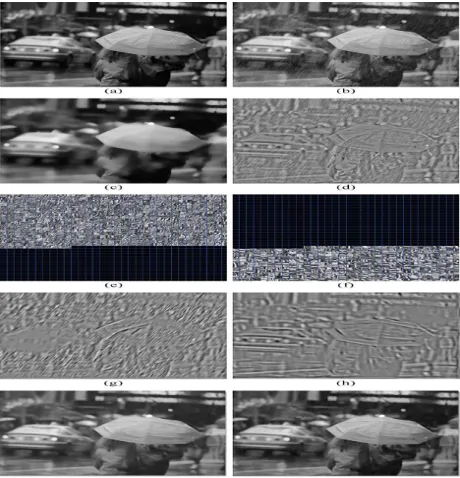
Fig. 2 Step-by-step results of the proposed rain streak
removal process: (a) LF part (b) HF part (c) rain component (d) geometric component. (e) the rain-removed version for the rain image (f) the rain-removed version for the rain image with DE
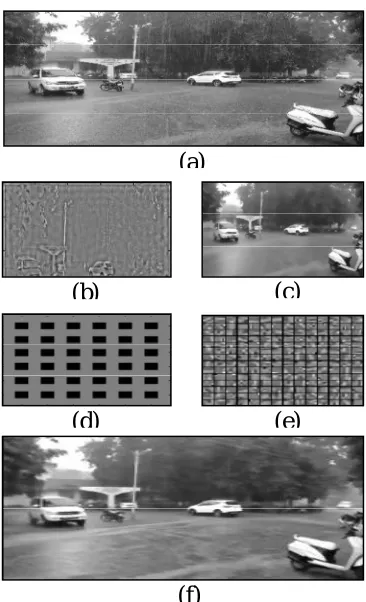
Fig.4 (a )Rain image, (b) High frequency component, (c) Low frequency component, (d) Patches, (e) Dictionary, (f) Derain image
(a)
(b)
(c)
(d)
(e)
(f)
4.2 Experimental result with calculating different parameter:Table 2.
PSNR(I/P) PSNR(O/P) VIF DURATION
108.47 125.43 0.57 2min
In proposed method we have calculated psnr value of the rainy image before rain removed and after rain remove, from this we are able to see the difference between two PSNR’s. Now what is PSNR? For this purpose we have to calculate MSE fist on the basis of MSE (Mean square error) It is nothing but difference between two images. Here the difference between rainy and non rainy image. MSE should have small value because it is nothing but error.
Formula for MSE is given by,
MSE = sqrt(sum(sum(((Original Image)- (noisy Image)).^2))/nRow / nColumn)
From this formula we can calculate PSNR
Now PSNR is nothing but peak signal to noise ratio.
PSNR is use for measure the quality of image after reconstruction. Higher the PSNR value reconstruction is good. Here is the formula for psnr
PSNR = 20*log10 (Q*Q/MSE)
4.3. Comparison of results of different format (png, jpg, bmp):
This is the major advantage of proposed method that it is applicable for all types of format such as .jpg .png .bmp and from result we can conclude that the PSNR values of different formats are nearly same.
V. CONCLUSION AND FUTURE WORK
In this paper, we have proposed a single-image-based rain Streak removal by MCA-based image decomposition problem solved by performing sparse coding and dictionary learning algorithms with image compression. The dictionary learning of the proposed method is fully automatic and self-contained where no extra training samples are required in the dictionary learning stage. We have also provided an optional scheme to further enhance the performance of rain removal by introducing an extended dictionary of non rain atoms. Various parameters we have calculated so we can compare proposed technique with previous one. Our experimental results show that, it is applicable for large image size using image compression so this method is applicable for real time images.
REFERENCES
[1] Y. H. Fu, L. W. Kang, C. W. Lin, and C. T. Hsu, “Single-frame-based rain removal via image decomposition,” in Proc. IEEE Int. Conf. [2] K. Garg and S. K. Nayar, “Detection and removal of rain from videos,”in Proc. IEEE Conf. Comput. Vis. Pattern Recognit., Jun. 2004, vol. 1, pp. 528–535.
[3] K. Garg and S. K. Nayar, “When does a camera see rain?,” in Proc.IEEE Int. Conf. Comput. Vis., Oct. 2005, vol. 2, pp. 1067–1074. [4] K. Garg and S. K. Nayar, “Vision and rain,” Int. J. Comput. Vis., vol.75, no. 1, pp. 3–27, Oct. 2007.
[5] K. Garg and S. K. Nayar, “Photorealistic rendering of rain streaks,”ACM Trans. Graph., vol. 25, no. 3, pp. 996–1002, Jul. 2006. [6] X. Zhang, H. Li, Y. Qi, W. K. Leow, and T. K. Ng, “Rain removalin video by combining temporal and chromatic properties,” in Proc. IEEE Int. Conf. Multimedia Expo., Toronto, ON, Canada, Jul. 2006,pp. 461–464.
[7] N. Brewer and N. Liu, “Using the shape characteristics of rain to identifyand remove rain from video,” Lecture Notes Comput. Sci., vol. 5342/2008, pp. 451–458, 2008.
[8] J. Bossu, N. Hautière, and J. P. Tarel, “Rain or snow detection in image sequences through use of a histogram of orientation of streaks,” Int. J. Comput. Vis., vol. 93, no. 3, pp. 348–367, Jul. 2011.
[9] M. S. Shehata, J. Cai, W. M. Badawy, T. W. Burr, M. S. Pervez, R. J. Johannesson, and A. Radmanesh, “Video-based automatic incident detection for smart roads: The outdoor environmental challenges regarding false alarms,” IEEE Trans. Intell. Transp. Syst., vol. 9, no. 2, pp. 349–360, Jun. 2008.
[10] M. Roser and A. Geiger, “Video-based raindrop detection for improved image registration,” in IEEE Int. Conf. Comput. Vis.Workshops, Kyoto, Sep. 2009, pp. 570–577.
[11] J. C. Halimeh and M. Roser, “Raindrop detection on car windshields using geometric–photometric environment construction and intensitybased correlation,” in Proc. IEEE Intell. Veh. Symp., Xi’an, China, Jun. 2009, pp. 610–615.
[12] Google Goggles [Online]. Available: http://www.google.com/mobile/ goggles/
[13] D. G. Lowe, “Distinctive image features from scale-invariant keypoints,” Int. J. Comput. Vis., vol. 60, no. 2, pp. 91–110, Nov. 2004. [14] H. Baya, A. Essa, T. Tuytelaarsb, and L. V. Gool, “Speeded-up robust features (SURF),” Comput. Vis. Image Understand., vol. 110, no. 3, pp. 346–359, Jun. 2008.
[15] N. Dalal and B. Triggs, “Histograms of oriented gradients for human detection,” in Proc. IEEE Conf. Comput. Vis. Pattern Recognit., San Diego, CA, Jun. 2005, vol. 1, pp. 886–893.
[16] O. Ludwig, D. Delgado, V. Goncalves, and U. Nunes, “Trainable classifier-fusion schemes: An application to pedestrian detection,” in Proc. IEEE Int. Conf. Intell. Transp. Syst., St. Louis, MO, Oct. 2009, pp. 1–6.
[17] S. Maji, A. C. Berg, and J. Malik, “Classification using intersection kernel support vector machines is efficient,” in Proc. IEEE Conf. Comput. Vis. Pattern Recognit., Anchorage, AK, Jun. 2008, pp. 1–8.
[18] L. Itti, C.Koch, and E. Niebur, “A model of saliency-based visual attention for rapid scene analysis,” IEEE Trans. Pattern Anal. Mach. Intell., vol. 20, no. 11, pp. 1254–1259, Nov. 1998.
[19] A. Buades, B. Coll, and J. M. Morel, “A review of image denoising algorithms, with a new one,” Multisc. Model. Simul., vol. 4, no. 2, pp. 490–530, 2005.