Image Segmentation based on Mean Shift
Algorithm and Normalized Cuts
C.Hari Hara Suthan1, Dr.R.V.S.SatyaNarayana2
M.Tech student, Dept. of ECE, SVU College of Engineering, Tirupati, Andhra Pradesh, India1
Professor and HOD, Dept. of ECE, SVU College of Engineering, Tirupati, Andhra Pradesh, India2
ABSTRACT: A novel approach for Image segmentation is proposed based on mean shift algorithm and normalized cuts algorithm. The normalized cuts algorithm gives good accuracy and better segmentation compared to all most of the existing methods. But it requires high computational power, also it takes huge time. The reason for this is it takes entire image as one matrix and computes. By using Mean Shift algorithm on the original image to partition it into sub graphs we can create image matrices with lower dimensions. The proposed algorithm first applied Mean Shift algorithm to obtain sub graphs. The normalized cuts algorithm is applied on the sub graphs. The experimental results also show that the results obtained by the proposed algorithm are better than results obtained by individual algorithms of Mean shift, normalized cuts.
KEYWORDS: Image segmentation, Normalized cuts, Mean shift, Graph partitioning
I. INTRODUCTION
The process of subdividing an image into its constituent parts and objects is called image segmentation .More precisely image segmentation is the process of assigning a label to every pixel in an image such that pixels with same label share certain visual characteristics. The result of image segmentation is a set of segments that collectively cover the image. There is a large amount of literature on Image segmentation. The various techniques include Thresholding, Edge detection, Region growing, Split and merge methods, Partial Differential equation based methods, Histogram based methods, Graphs Partitioning methods, Watershed Transformation, Model based segmentation, Multi Scale Segmentation etc.
Among these techniques graph based techniques gained importance due to its easiness to implement on digital computer. In these methods the image is treated as a weighted undirected graph. An image can be represented as a graph which can be represented as G=(V ,E), where the nodes of the graph are the points in the feature space, and an edge is formed between every pair of nodes. The weight on each edge, w(i,j), is a function of the similarity between nodes i and j. In grouping, we seek to partition the set of vertices into disjoint sets V1,V2, . . .,Vm, where by some measure the similarity among the vertices in a set Vi is high and, across different sets Vi, Vj is low.
A lot of Image segmentation algorithms based on graph theory were present. Among them the more popular ones are Normalized Cuts algorithm proposed by Shi and Malik [3], Mean shift algorithm proposed by Comariciu and Meer [4]. We propose an approach which consider the merits of the both algorithms and produce more efficient result.
II. LITEARTURE SURVEY
There are many possible partitions of the domain I of an image into subsets, how do we pick the right one? There are two aspects to be considered here. The first is that there may not be a single correct answer. A Bayesian view is appropriate there are several possible interpretations in the context of prior world knowledge. The difficulty, of course, is in specifying the prior world knowledge. Some of it is low level, such as coherence of brightness, color, texture, or motion, but equally important is mid or high level knowledge about symmetries of objects or object models. The second aspect is that the partitioning is inherently hierarchical.
Prior literature on the related problems of clustering, grouping and image segmentation is huge. The clustering community has offered us agglomerative and divisive algorithms; in image segmentation, we have region-based merge and split algorithms. The hierarchical divisive approach that we advocate produces a tree, the dendrogram. While most of these ideas go back to the 1970s (and earlier), the 1980s brought in the use of Markov Random Fields and variational formulations The MRF and variational formulations also exposed two basic questions What is the criterion that one wants to optimize and Is there an efficient algorithm for carrying out the optimization. Many an attractive criterion has been doomed by the inability to find an effective algorithm to find its minimum greedy or gradient descent type approaches fail to find global optima for these high-dimensional, nonlinear problems.
III. THE NORMALIZED CUT AND MEAN SHIFT ALGORITHM
A. The Normalized cut algorithm
A graph G(V,E) can be partitioned into two disjoint sets A,B, AUB=V. By simply removing edges connecting the two parts. The degree of dissimilarity between these two pieces can be computed as total weight of the edges that have been removed. In graph theoretic language, it is called the cut.
(1)
(2)
(3)
B. Mean Shift Algorithm
Mean shift is a procedure for locating the maxima of a density function given discrete data sampled from that function. It is useful for detecting the modes of this density.[1] This is an iterative method, and we start with an initial
estimate . Let a kernel function be given. This function determines the weight of nearby points for
re-estimation of the mean. Typically a Gaussian kernel on the distance to the current estimate is
used, . The weighted mean of the density in the window determined by is
(4)
where is the neighbourhood of , a set of points for which .
The mean-shift algorithm now sets , and repeats the estimation until converges.
III.PROPOSED ALGORITHM BASED ON NCUTS AND MEAN SHIFT ALGORITHMS
the advantages of the mean shift segmentation and the normalized cut (Ncut) partitioning methods, the proposed method preprocesses an image by using the mean shift algorithm to form segmented regions, we use region nodes instead of these regions, then use the Ncut method for region nodes clustering. In many literatures, the Ncut method is applied directly to image pixels.
So for some large images, the weight matrix W is large, which brings huge computational complexity. However, the proposed method offers a considerable reduction of computational complexity, because the number of image region nodes is much smaller than that of the pixels, the size of the weight matrix W is significantly reduced. Moreover, the mean shift algorithm not only removes noise, which limits the accuracy of graph partitioning in the Ncut method, but also achieves improved segmentation performance. Nonetheless, it will produce the phenomenon of over-segmentation. The Ncut algorithm is a global clustering method, it can compensate for the phenomenon of over-segmentation, but it is very dependent on the selection of classification parameter K. however, mean shift is a non-supervised clustering segmentation method, it is a good solution for solving the drawback of the Nuct. This shows that the combination of the two methods is also feasible. The proposed method consists of the following steps:
1) An image is preprocessed into multiple separated regions using the mean shift algorithm.
2) These regions are much smaller than the image pixels, so we extracted each region, and use one region node
instead of one region. The information of the region nodes includes features vector information and spatial location.
3) According to the step 2, these region nodes are represented as a weighted undirected graph, the graph as the
Ncut algorithm input, and use these region nodes to construct the weight matrix W, and then use the Ncut method for region nodes clustering.
IV. RESULT AND ANALYSIS
In this paper, we demonstrate the superiority of the proposed method by comparing the performance of the proposed approach to existing methods using two images. The weight W(i, j) between regions i and j is defined as
(5)
where F(i)={ R(i) ,G(i) ,B(i)} is the color vector of region i, if the image is the gray-level image, then F(i) is the gray value. and X(i) is the spatial location of region node i. in this paper, we defined the F(i) is the average gray of the region i, and the X(i) is the center of the region i. in this case, the select of F(i) and X(i) are more representative.
The fig 1 shows the result obtained by only Normalized cuts algorithm on an image which has approximately equal number of rows and columns and of size less than 50kB. As the image size increases the processing time also increases.
(a) (b)
(c) (d) (e)
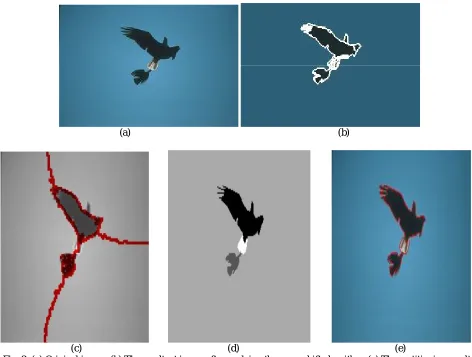
Fig. 2. (a) Original image. (b) The resultant image after applying the mean shift algorithm. (c) The partitioning results by directly applying the Ncut algorithm to the image pixels. (d) The results of the proposed algorithm partitioning
grayscale display. (e) The results of the proposed algorithm partitioning.
The fig 2 shows the results of normalized cuts algorithm and mean shift algorithm separately and the result obtained when both the algorithms are combined to form the proposed algorithm.
1 2 3 4 5 6 7 8
1 1 0.2257 0.4804 0 0 0 0 0
2 0.2257 1 0.2210 0.6888 0.2738 0 0 0
3 0.4804 0.2210 1 0 0.6706 0.0135 0.4260 0
4 0 0.6888 0 1 0.3291 0.1376 0 3.6470e-04
5 0 0.2738 0.6706 0.3291 1 0 0.7491 5.7401e-04
6 0 0 0.0135 0.1376 0 1 0.1418 0.0014
7 0 0 0.4260 0 0.7491 0.1418 1 5.4429e-04
8 0 0 0 3.6470e-04 5.7401e-04 0.0014 5.4429e-04 1
Region number of mean shift
Value of K Computational
Time of mean shift (s)
Computational Time of Ncut
Merging (s)
Computational Time of the
proposed method (s)
Computational Time of Ncut algorithm (s)
24 4 0.54 0.36 0.9 3.76
Table 2 : Compared computational cost between the proposed method and the Ncut method
Table 1 gives the edge weights corresponding to the image 2(a). To calculate the edge weights we have used the standard formula. Table 2 gives the comparisons between Normalized cuts algorithm, Mean shift algorithm and the proposed algorithm.
V. CONCLUSION
In this paper a novel image segmentation algorithm has been proposed and designed based on the conventional mean shift algorithm and Ncut algorithm. The effectiveness and robustness of the proposed algorithm have verified by some experimental results to express an improved performance compared to the Ncut algorithm. Also the significant reduction to the computational cost of the proposed algorithm in the experiments is favourable for practical applications.
REFERENCES
1. R.Balakrishnan, K.Ranganathan, “A Text Book of Graph Theory”, second edition springer 2. Rafael C.Gonzalaez, Richard E.Woods, “Digital Image Processing ”, second edition pearson
3. J. Shi and J. Malik, “Normalized cuts and image segmentation,” IEEE Trans. on PAMI, vol. 22, no. 8, pp. 888-905, 2000
4. D. Comariciu and P. Meer, “Mean shift: a robust approach toward feature space analysis,” IEEE Trans. on PAMI, vol. 24, no. 5, pp. 603-619, 2002.
5. J. Carballido-Gamio, S. J. Belongie, and S. Majumdar, “Normalized cuts in 3-D for spinal MRI segmentation,” IEEE Trans. on Medical Imaging, vol. 23, no. 1, pp. 36-44, 2004.
6. Y. Cheng, “Mean shift, mode seeking, and clustering,” IEEE Trans. on Pattern Analysis and Machine Intelligence, vol. 17, no. 8, pp. 790- 799,1995.