R E S E A R C H
Open Access
On the solutions of some nonlinear systems
of difference equations
Elsayed M Elsayed
1,3*and Hamdy El-Metwally
2,3*Correspondence:
[email protected]; [email protected] 1King Abdulaziz University, Faculty
of Science, Mathematics
Department, P.O. Box 80203, Jeddah 21589, Saudi Arabia
3Department of Mathematics,
Faculty of Science, Mansoura University, Mansoura 35516, Egypt Full list of author information is available at the end of the article
Abstract
In this paper, we deal with the existence of solutions and the periodicity character of the following systems of rational difference equations with order three:
xn+1=
xnyn–2
yn–1(±1±xnyn–2)
, yn+1=
ynxn–2
xn–1(±1±ynxn–2)
,
where the initial conditionsx–2,x–1,x0,y–2,y–1andy0are nonzero real numbers.
MSC: 39A10
Keywords: difference equations; periodic solution; solution of difference equation; system of difference equations
1 Introduction
Recently, rational difference equations have attracted the attention of many researchers for various reasons. On the one hand, they provide examples of nonlinear equations which are, in some cases, treatable but their dynamics present some new features with respect to the linear case. On the other hand, rational equations frequently appear in some biological models. Hence, their study is of interest also due to their applications. A good example of both facts is Ricatti difference equations because the richness of the dynamics of Ricatti equations is very well known (see,e.g., [, ]), and a particular case of these equations pro-vides the classical Beverton-Holt model on the dynamics of exploited fish populations []. Obviously, higher-order rational difference equations and systems of rational equations have also been widely studied but still have many aspects to be investigated. The reader can find in the following books [–], and works cited therein, many results, applications, and open problems on higher-order equations and rational systems.
A preliminary study of planar rational systems can be found in the paper [] by Camouzis et al.In the work, they give some results and provide some open questions for systems of equations of the following type:
xn+=
α+βxn+γyn
A+Bxn+Cyn
, yn+=
α+βxn+γyn
A+Bxn+Cyn
, n= , , , . . . ,
where the parameters are taken to be nonnegative. As shown in the cited paper, some of these systems can be reduced to some Ricatti equations or to some previously studied second-order rational equations. Furthermore, for some choices of the parameters, one
obtains a system which is equivalent to the case with some other parameters. Camouziset al.arrived at a list of non-equivalent systems that should be focused on. They list such systems as pairsk,l, wherekandlmake reference to the number of the corresponding equation in their Tables and . There are many papers that are related to the difference equations systems. For example, the periodicity of the positive solutions of the rational difference equations systems
xn+=
m yn
, yn+=
pyn
xn–yn–
has been obtained by Cinar in [].
In [] Clark and Kulenovic investigated the global asymptotic stability of the system
xn+=
xn
a+cyn
, yn+=
yn
b+dxn
.
The behavior of the positive solutions of the following system:
xn+=
xn–
+xn–yn
, yn+=
yn–
+yn–xn
has been studied by Kurbanliet al.[].
Touafeket al.[] investigated the periodic nature and got the form of the solutions of the following systems of rational difference equations:
xn+=
xn– ±±xn–yn–
, yn+=
yn– ±±yn–xn–
.
In [] Yalçınkaya investigated the sufficient conditions for the global asymptotic stability of the following system of difference equations:
xn+=
xn+yn–
xnyn––
, yn+=
yn+xn–
ynxn––
.
Similarly, difference equations and nonlinear systems of the rational difference equations were investigated, see [–].
In this paper, we investigate the periodic nature and the form of the solutions of some nonlinear difference equations systems of order three
xn+=
xnyn–
yn–(±±xnyn–)
, yn+=
ynxn–
xn–(±±ynxn–)
,
where the initial conditionsx–,x–,x,y–,y–andyare nonzero real numbers.
Definition(Periodicity) A sequence{xn}∞n=–kis said to be periodic with periodpifxn+p=
xnfor alln≥–k.
2 On the solution of the systemxn+1=yn–1xny(1+nxnyn–2 –2),yn+1=xn–1ynx(1+nynxn–2 –2) In this section, we investigate the solutions of the two difference equations system
xn+=
xnyn–
yn–( +xnyn–)
, yn+=
ynxn–
xn–( +ynxn–)
, ()
Theorem Assume that{xn,yn}are solutions of system().Then for n= , , , . . . ,we see
that all solutions of system()are given by the following formulas:
xn–=
×
Also, we can prove the other relations. The proof is complete.
The following theorem can be proved similarly.
Theorem Assume that{xn,yn}are solutions of the following system:
xn=
an+fn
cndn n–
i=
( – (i+ )cd)
( + (i+ )af), xn+=
an+fn+
ecndn( +af) n–
i=
( – (i+ )cd) ( + (i+ )af),
yn–=
cndn anfn–
n–
i=
( + (i)af)
( – (i+ )cd), yn–= ecndn
anfn n–
i=
( + (i+ )af) ( – (i+ )cd),
yn=
cndn+
anfn n–
i=
( + (i+ )af)
( – (i+ )cd), yn+=
cn+dn+
banfn( –cd) n–
i=
( + (i+ )af) ( – (i+ )cd).
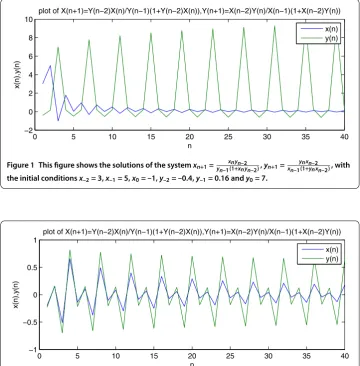
Example For confirming the results of this section, we consider numerical example for
the difference system () with the initial conditionsx–= ,x–= ,x= –,y–= –.,
y–= . andy= . See Figure .
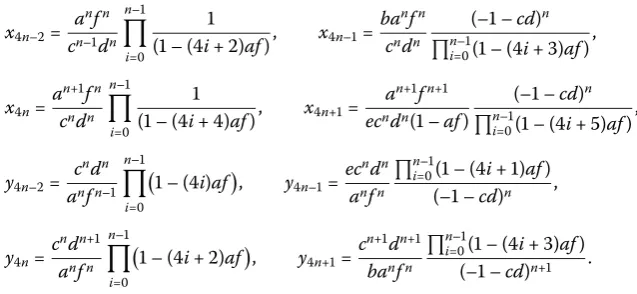
Example We assume that the initial conditions for the difference system () arex–=
–.,x–= .,x= –.,y–= –.,y–= . andy= –.. See Figure .
Figure 1 This figure shows the solutions of the systemxn+1=yn–1(1+xnyn–2)xnyn–2 ,yn+1=xn–1(1+ynxn–2)ynxn–2 , with the initial conditionsx–2= 3,x–1= 5,x0= –1,y–2= –0.4,y–1= 0.16 andy0= 7.
3 On the solution of the systemxn+1=yn–1xnyn(1+xnyn–2 –2),yn+1=xn–1(–1+ynxnynxn–2 –2)
In this section, we obtain the form of the solutions of the two difference equations system
xn+=
wheren∈Nand the initial conditions are arbitrary nonzero real numbers withx–y= .
Theorem Let{xn,yn}+n=–∞ be solutions of system().Then{xn}+n=–∞ and{yn}+n∞=–are given
Proof Forn= the result holds. Now suppose thatn> and that our assumption holds forn– , that is,
Now, we obtain from Eq. () that
= (
Also, we can prove the other relations. This completes the proof.
We consider the following systems, and the proof of the theorems is similar to the above theorem, and so it is left to the reader,
xn+=
Figure 3 This figure shows the behavior of the difference systemxn+1=yn–1(1+xnyn–2)xnyn–2 ,
yn+1=xn–1(–1+ynxn–2)ynxn–2 , when we take the initial conditionsx–2= 0.2,x–1= 0.15,x0= –0.11,y–2= 0.23,
y–1= 0.16 andy0= 0.17.
yn=
cndn+ anfn
n–
i=
– (i+ )af, yn+=
cn+dn+ banfn
n–
i=( – (i+ )af)
(– +cd)n+ .
Theorem Suppose that{xn,yn}are solutions of system()where x–y= –.Then for
n= , , , . . . ,
xn–=
anfn cn–dn
n–
i=
( – (i+ )af), xn–= banfn
cndn
(– –cd)n
n–
i=( – (i+ )af)
,
xn=
an+fn
cndn n–
i=
( – (i+ )af), xn+=
an+fn+
ecndn( –af)
(– –cd)n
n–
i=( – (i+ )af)
,
yn–=
cndn
anfn–
n–
i=
– (i)af, yn–=
ecndn
anfn
n–
i=( – (i+ )af)
(– –cd)n ,
yn=
cndn+ anfn
n–
i=
– (i+ )af, yn+=
cn+dn+ banfn
n–
i=( – (i+ )af)
(– –cd)n+ .
Example We consider an interesting numerical example for the difference system () with the initial conditionsx–= .,x–= .,x= –.,y–= .,y–= . andy=
.. See Figure .
Example See Figure , where we take system () with the initial conditionsx–= .,
x–= .,x= .,y–= .,y–= –. andy= ..
4 On the solution of the systemxn+1=yn–1(–1+xnynxnyn–2 –2),yn+1=xn–1(–1+ynxnynxn–2 –2) In this section, we get the form of the solutions of the difference equations system
xn+=
xnyn–
yn–(– +xnyn–)
, yn+=
ynxn–
xn–(– +ynxn–)
, ()
where n= , , , . . . and the initial conditionsx–, x–, x,y–, y– andy are arbitrary
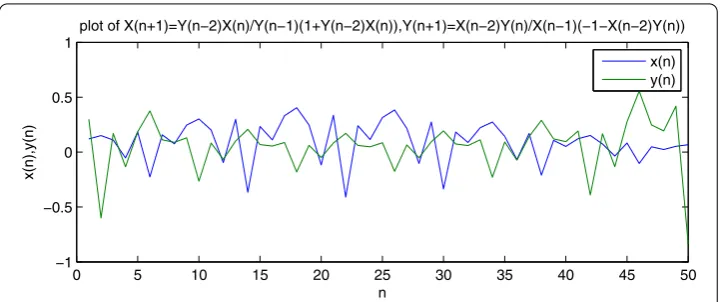
Figure 4 This figure shows the qualitative behavior of the solutions of system (3) with the initial conditionsx–2= 0.12,x–1= 0.15,x0= 0.11,y–2= 0.3,y–1= –0.6 andy0= 0.17.
Theorem If{xn,yn}are solutions of difference equation system(),then for n= , , , . . . ,
xn–=
anfn
cn–dn, xn–=
banfn cndn
(– +cd)n (– +af)n,
xn=
an+fn
cndn , xn+=
an+fn+(– +cd)n
ecndn(– +af)n+,
yn–=
cndn
anfn–, yn–=
ecndn
anfn
(– +af)n
(– +cd)n,
yn=
cndn+
anfn , yn+=
cn+dn+(– +af)n
banfn(– +cd)n+.
Proof Forn= the result holds. Now, suppose thatn> and that our assumption holds forn– , that is,
xn–=
an–fn–
cn–dn–, xn–=
ban–fn–(– +cd)n–
cn–dn–(– +af)n– ,
xn–=
anfn–
cn–dn–, xn–=
anfn(– +cd)n–
ecn–dn–(– +af)n,
yn–=
cn–dn–
an–fn–, yn–=
ecn–dn–(– +af)n–
an–fn–(– +cd)n–,
yn–=
cn–dn
an–fn–, yn–=
cndn(– +af)n–
ban–fn–(– +cd)n.
Now, we conclude from Eq. () that
xn–=
xn–yn–
yn–(– +xn–yn–)
=
(ecann–fnd(–+n–(–+cd)naf–)n)(
ecn–dn–(–+af)n–
an–fn–(–+cd)n–)
(acnn––fdnn–)(– + (
anfn(–+cd)n–
ecn–dn–(–+af)n)(
ecn–dn–(–+af)n–
an–fn–(–+cd)n–))
= (
af
(–+af))
(acnn––fdnn–)(– +
af
(–+af))
= a
nfn
yn–=
yn–xn–
xn–(– +yn–xn–)
=
(bacnn–dnf(–+n–(–+af)ncd–)n)(
ban–fn–(–+cd)n–
cn–dn–(–+af)n–)
(can–nfdnn––)(– + (
cndn(–+af)n–
ban–fn–(–+cd)n)(
ban–fn–(–+cd)n–
cn–dn–(–+af)n–))
= (
cd
(–+cd))
(cna–nfdn–n–)(– + ((–+cdcd)))
= c
ndn
anfn–.
Also, we can prove the other relations. This completes the proof.
We consider the following system, and the proof of the theorem is similar to the above mentioned theorem and so it is left to the reader,
xn+=
xnyn–
yn–(– +xnyn–)
, yn+=
ynxn–
xn–(– –ynxn–)
. ()
Theorem Let{xn,yn}+n=–∞ be solutions of system()and xy–= ,x–y= –.Then for
n= , , , . . . ,
xn–=
anfn
cn–dn, xn–=
banfn
cndn
(– –cd)n
(– +af)n,
xn=
an+fn
cndn , xn+=
an+fn+(– –cd)n
ecndn(– +af)n+,
yn–=
cndn
anfn–, yn–=
ecndn
anfn
(– +af)n
(– –cd)n,
yn=
cndn+
anfn , yn+=
cn+dn+(– +af)n
banfn(– –cd)n+.
Lemma The solution of system()is unbounded except in the following case.
Theorem System()has a periodic solution of period four iff cd=af = and it will take
the following form:{xn}={c,b,a,afe,c,b,a, . . .},{yn}={f,e,d,cdb,f,e,d, . . .}.
Proof First, suppose that a prime period four solution exists
{xn}=
c,b,a,af
e ,c,b,a, . . .
, {yn}=
f,e,d,cd
b ,f,e,d, . . .
of system (). We see from the form of the solution of system () that
xn–=c=
anfn
cn–dn, xn–=b=
banfn
cndn
(– +cd)n
(– +af)n,
xn=a=
an+fn
cndn , xn+=
af
e =
an+fn+(– +cd)n
ecndn(– +af)n+,
yn–=f =
cndn
anfn–, yn–=e=
ecndn
anfn
(– +af)n
(– +cd)n,
yn=d=
cndn+
anfn , yn+=
cd
b =
Then we getcd=af = . Second, assume thatcd=af = . Then we see from the form of the solution of system () that
xn–=
anfn
cn–dn =c, xn–=
banfn
cndn
(– +cd)n
(– +af)n=b,
xn=
an+fn
cndn =a, xn+=
an+fn+(– +cd)n
ecndn(– +af)n+ =
af e ,
yn–=
cndn
anfn–=f, yn–=
ecndn
anfn
(– +af)n
(– +cd)n=e,
yn=
cndn+
anfn =c, yn+=
cn+dn+(– +af)n banfn(– +cd)n+ =
cd b .
Thus, we have a periodic solution of period four and the proof is complete.
Lemma The solution of system()is unbounded except in the following case.
Theorem System () has a periodic solution of period eight iff cd = –, af = and it will take the following form: {xn} = {c,b,a,afe, –c, –b, –a, –afe,c,b,a, . . .}, {yn} =
{f,e,d,cd
b, –f, –e, –d, – cd
b,f,e,d, . . .}.
Example We consider a numerical example for the difference system () when we put the initial conditionsx–= .,x–= .,x= .,y–= .,y–= –. andy= ..
See Figure .
Example Figure shows the behavior of the solution of the difference system () with
the initial conditionsx–= ,x–= –,x= –.,y–= –,y–= andy= ..
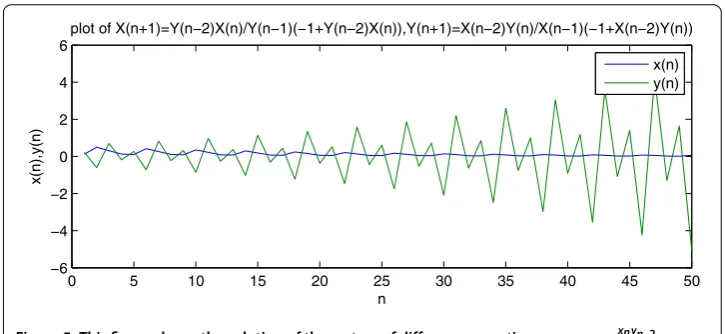
Example We consider a numerical example for the difference system () when we put the initial conditionsx–= .,x–= .,x= –.,y–= .,y–= . andy= ..
See Figure .
Figure 5 This figure shows the solution of the system of difference equationsxn+1=yn–1(–1+xnyn–2)xnyn–2 ,
yn+1=xn–1(–1+ynxn–2)ynxn–2 , when we put the initial conditionsx–2= 0.12,x–1= 0.5,x0= 0.31,y–2= 0.23,
Figure 6 This figure shows the periodicity of the solutions of difference equations system (6) with initial conditionsx–2= 4,x–1= –7,x0= –0.5,y–2= –4,y–1= 6 andy0= 0.5.
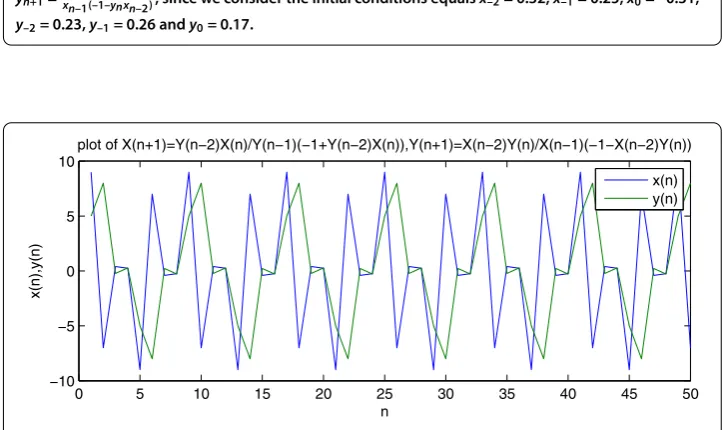
Figure 7 This figure shows the behavior of the solutions ofxn+1=yn–1(–1+xnyn–2)xnyn–2 ,
yn+1=xn–1(–1–ynxn–2)ynxn–2 , since we consider the initial conditions equalsx–2= 0.32,x–1= 0.25,x0= –0.31,
y–2= 0.23,y–1= 0.26 andy0= 0.17.
Example Figure shows the periodicity of the solution of the difference system () with the initial conditionsx–= ,x–= –,x= .,y–= ,y–= andy= –/.
Competing interests
The authors declare that they have no competing interests.
Authors’ contributions
The authors declare that the study was realized in collaboration with the same responsibility. Both authors read and approved the final manuscript.
Author details
1King Abdulaziz University, Faculty of Science, Mathematics Department, P.O. Box 80203, Jeddah 21589, Saudi Arabia. 2Department of Mathematics, Rabigh College of Science and Art, King Abdulaziz University, P.O. Box 344, Rabigh 21911,
Saudi Arabia.3Department of Mathematics, Faculty of Science, Mansoura University, Mansoura 35516, Egypt.
Acknowledgements
This work was funded by the Deanship of Scientific Research (DSR), King Abdulaziz University, Jeddah, under grant No. (130-028-D1433). The authors, therefore, acknowledge with thanks DSR technical and financial support.
Received: 11 December 2012 Accepted: 23 May 2013 Published: 7 June 2013 References
1. Cull, P, Flahive, M, Robson, R: Difference Equations: From Rabbits to Chaos. Undergraduate Texts in Mathematics. Springer, New York (2005)
2. Elaydi, S: An Introduction to Difference Equations, 3rd edn. Undergraduate Texts in Mathematics. Springer, New York (2005)
3. Beverton, RJH, Holt, SJ: On the Dynamics of Exploited Fish Populations. Fishery Investigations Series II, vol. 19. Blackburn Press, Caldwell (2004)
4. Ahlbrandt, CD, Peterson, AC: Discrete Hamiltonian Systems: Difference Equations, Continued Fractions, and Riccati Equations. Kluwer Texts in the Mathematical Sciences, vol. 16. Kluwer Academic, Dordrecht (1996)
5. Kocic, VL, Ladas, G: Global Behavior of Nonlinear Difference Equations of Higher Order with Applications. Kluwer Academic, Dordrecht (1993)
6. Kulenovic, MRS, Ladas, G: Dynamics of Second Order Rational Difference Equations with Open Problems and Conjectures. Chapman & Hall/CRC Press, Boca Raton (2001)
7. Camouzis, E, Kulenovic, MRS, Ladas, G, Merino, O: Rational systems in the plane. J. Differ. Equ. Appl.15(3), 303-323 (2009)
8. Cinar, C, Yalçinkaya, I, Karatas, R: On the positive solutions of the difference equation systemxn+1=m/yn, yn+1=pyn/xn–1yn–1. J. Inst. Math. Comput. Sci.18, 135-136 (2005)
9. Clark, D, Kulenovic, MRS: A coupled system of rational difference equations. Comput. Math. Appl.43, 849-867 (2002) 10. Kurbanli, AS, Cinar, C, Yalçınkaya, I: On the behavior of positive solutions of the system of rational difference
equations. Math. Comput. Model.53, 1261-1267 (2011)
11. Touafek, N, Elsayed, EM: On the solutions of systems of rational difference equations. Math. Comput. Model.55, 1987-1997 (2012)
12. Yalcinkaya, I, Cinar, C, Atalay, M: On the solutions of systems of difference equations. Adv. Differ. Equ.2008, Article ID 143943 (2008)
13. Agarwal, RP: Difference Equations and Inequalities, 1st edn. Dekker, New York (1992) (2nd edn. (2000)) 14. Agarwal, RP, Elsayed, EM: On the solution of fourth-order rational recursive sequence. Adv. Stud. Contemp. Math.
20(4), 525-545 (2010)
15. Battaloglu, N, Cinar, C, Yalçınkaya, I: The dynamics of the difference equation. Ars Comb.97, 281-288 (2010) 16. Din, Q, Qureshi, MN, Qadeer Khan, A: Dynamics of a fourth-order system of rational difference equations. Adv. Differ.
Equ.2012, 215 (2012)
17. Elabbasy, EM, El-Metwally, H, Elsayed, EM: On the solutions of a class of difference equations systems. Demonstr. Math.41(1), 109-122 (2008)
18. Elabbasy, EM, El-Metwally, H, Elsayed, EM: Global behavior of the solutions of difference equation. Adv. Differ. Equ.
2011, 28 (2011)
19. Elsayed, EM: Solution and attractivity for a rational recursive sequence. Discrete Dyn. Nat. Soc.2011, Article ID 982309 (2011)
20. Elsayed, EM: On the solution of some difference equations. Eur. J. Pure Appl. Math.4(3), 287-303 (2011)
21. Elsayed, EM: Behavior and expression of the solutions of some rational difference equations. J. Comput. Anal. Appl.
15(1), 73-81 (2013)
22. Elsayed, EM: Solutions of rational difference system of order two. Math. Comput. Model.55, 378-384 (2012) 23. Elsayed, EM, El-Dessoky, MM: Dynamics and behavior of a higher order rational recursive sequence. Adv. Differ. Equ.
2012, 69 (2012)
24. Elsayed, EM, El-Dessoky, M, Alotaibi, A: On the solutions of a general system of difference equations. Discrete Dyn. Nat. Soc.2012, Article ID 892571 (2012)
25. Keying, L, Zhongjian, Z, Xiaorui, L, Peng, L: More on three-dimensional systems of rational difference equations. Discrete Dyn. Nat. Soc.2011, Article ID 178483 (2011)
27. Mansour, M, El-Dessoky, MM, Elsayed, EM: The form of the solutions and periodicity of some systems of difference equations. Discrete Dyn. Nat. Soc.2012, Article ID 406821 (2012)
28. Papaschinopoulos, G, Radin, MA, Schinas, CJ: On the system of two difference equations of exponential form:
xn+1=a+bxn–1e–yn,yn+1=c+dyn–1e–xn. Math. Comput. Model.54(11-12), 2969-2977 (2011)
29. Papaschinopoulos, G, Schinas, CJ: On the dynamics of two exponential type systems of difference equations. Comput. Math. Appl.64(7), 2326-2334 (2012)
30. Touafek, N, Elsayed, EM: On the periodicity of some systems of nonlinear difference equations. Bull. Math. Soc. Sci. Math. Roum.55(103)(2), 217-224 (2012)
31. Yalçınkaya, I: On the global asymptotic behavior of a system of two nonlinear difference equations. Ars Comb.95, 151-159 (2010)
32. Yang, X, Liu, Y, Bai, S: On the system of high order rational difference equationsxn=yna–p,yn=xnbyn–q yn–p–q. Appl. Math. Comput.171(2), 853-856 (2005)
33. Wang, C, Wang, S, Wang, W: Global asymptotic stability of equilibrium point for a family of rational difference equations. Appl. Math. Lett.24(5), 714-718 (2011)
34. Wang, C, Shi, Q, Wang, S: Asymptotic behavior of equilibrium point for a family of rational difference equation. Adv. Differ. Equ.2010, Article ID 505906 (2010)
35. Wang, C, Gong, F, Wang, S, Li, L, Shi, Q: Asymptotic behavior of equilibrium point for a class of nonlinear difference equation. Adv. Differ. Equ.2009, Article ID 214309 (2009)
36. Wang, C, Wang, S, Wang, Z, Gong, F, Wang, R: Asymptotic stability for a class of nonlinear difference equation. Discrete Dyn. Nat. Soc.2010, Article ID 791610 (2010)
37. Zayed, EME, El-Moneam, MA: On the rational recursive sequencexn+1=Axn+ (βxn+γxn–k)/(Cxn+Dxn–k). Commun. Appl. Nonlinear Anal.16, 91-106 (2009)
38. Zhang, Q, Yang, L, Liu, J: Dynamics of a system of rational third order difference equation. Adv. Differ. Equ.2012, 136 (2012)
39. Zkan, O, Kurbanli, AS: On a system of difference equation. Discrete Dyn. Nat. Soc.2013, Article ID 970316 (2013)
doi:10.1186/1687-1847-2013-161
Cite this article as:Elsayed and El-Metwally:On the solutions of some nonlinear systems of difference equations.