R E S E A R C H
Open Access
Spectrum sensing using low-complexity
principal components for cognitive radios
Zeba Idrees
1*, Farrukh A Bhatti
2and Adnan Rashdi
1Abstract
Principal component (PC) algorithm has recently been shown as a very accurate blind detection technique in comparison with other covariance-based detection algorithms. However, it also has a higher complexity owing to the computation of the eigenvectors. We propose a low-complexity Lanczos principal component (LPC) algorithm that utilizes Lanczos iterative method to compute the eigenvectors. In comparison with the PC algorithm, the proposed LPC algorithm offers significant reduction in complexity while giving a similar detection performance. Low-complexity LPC algorithm allows for the use of larger sized covariance matrix that further improves the detection performance. Maximum-minimum eigenvalue (MME) algorithm is also included in the comparison and it gives an inferior
performance as compared to both PC and LPC algorithm. All the algorithms were tested with experimental data while using universal software radio peripheral (USRP) testbed that was controlled by GNU radio software.
Keywords: Spectrum sensing; Cognitive radio; Covariance-based detection; Software defined radio
1 Introduction
Cognitive radio has the ability to communicate over the unused frequency spectrum intelligently and adaptively. Spectrum sensing in a cognitive radio (CR) is crucial in generating awareness about the radio environment [1]. Blind detection methods such as covariance-based detection (CBD) algorithms enable signal detection in low signal-to-noise ratio (SNR) conditions without rely-ing on the prior knowledge of the primary user’s (PU) signal. CBD techniques also overcome the issue of noise power uncertainty that exists in an energy detector [2, 3]. These methods use the covariance and variances of the received signal and do not require information about the noise variance. The performance of the CBD algorithms is associated with the number of samples involved in the detection. However, using a large number of samples also increases the sensing time and complexity [4–8]. Recently, principal component analysis (PCA) has been applied for spectrum sensing in cognitive radios [9–11]. The princi-pal of dimension reduction has been used in [12] to devise PC algorithm that outperforms other CBD algorithms,
*Correspondence: [email protected]
1Department of Electrical Engineering, National University of Sciences and Technology (NUST), H-12 sector, 44000 Islamabad, Pakistan
Full list of author information is available at the end of the article
such as Maximum-minimum eigenvalue (MME), mum eigenvalue detection (MED), and energy with maxi-mum eigenvalue (EME). PCA reduces the dimensionality of the data and retains the most significant components that account for the greatest variation of the original data [13–16]. However, the PC algorithm also has the highest complexity in comparison with other CBD techniques.
As envisaged in internet of things (IoT), the number of things (or devices) connected to the network might exceed the number of human users. The same idea also derives the research on 5G networks where the network capacity will be enhanced by a 1000 fold. Opportunistic spectrum access may help in this scenario where multi-ple overlaid devices try to access the spectrum. Spectrum sensing can help eradicate collisions and excessive con-tention delay experienced by dense node deployment. Such devices/sensors have embedded computing nature, hence energy efficiency is their major concern. There-fore, low complexity, energy efficient spectrum sensing algorithms are vital for implementation in such devices.
In this paper, we firstly analyse the performance of the PC algorithm while considering the effect of dimension reduction on the detection performance and the related complexity. Next we describe the proposed Lanczos prin-cipal component (LPC) algorithm, which is an energy efficient version of the PC algorithm. The LPC can be used
in low powered devices (e.g. sensors employed in IoT) for blind signal detection. The performance of LPC is com-pared with PC as well as MME algorithms. MME has been included in the comparison as it is the best-known CBD technique. All the algorithms were tested with actual wire-less microphone signals using a universal software radio peripheral (USRP)2 testbed and GNU radio software. The specific contributions of this paper are as follows.
• The detection performance of the PC algorithm is analysed under a low SNR (<−15dB) scenario while varying the number of principal components
included in the decision test statistic. The effect of dimension reduction on the sensing performance is also considered along with the complexity involved in each case.
• A low-complexity LPC algorithm is proposed that employs an iterative approach to compute the principal components and achieves the similar detection performance as of the PC algorithm with a reduced complexity. This reduction in complexity saves the sensing time and improves the energy efficiency.
• The performance of the proposed LPC algorithm is compared with the PC and the MME algorithms while using the actual signals. In addition,
computational complexity of all the three algorithms (MME, PC and LPC) is also computed and compared mathematically and graphically.
• All the algorithms has been evaluated under both single and multiple receive antenna system with actual wireless microphone signals. Experimental setup is established using USRP2 and GNU radio software.
2 System model, detection with MME and PCA 2.1 System model
We have considered both a single and a multiple receive antenna system. fs is the signal’s sampling rate and
fs>>w, herew is the received signal’s bandwidth. The
signal is over-sampled to get a high correlation between the samples. Let Ts=1/fs be the sampling period. We
define y(n)y(nTs), s(n)s(nTs) and w(n)w(nTs),
where y(n) is the received signal after passing through the channel,s(n)is the PU’s signal andw(n)is the addi-tive white Gaussian noise (AWGN).w(n)follows a normal distributionw(n)∼N(0, 1). Complex baseband samples from a single receive antenna system can be represented as
y(n)=y1(n),y1(n−1),· · ·,y1(n−N+1). (1)
WhereNis the total number of samples used in making a single decision about the signal’s presence under both hypotheses. For a multiple receive antenna system withM
radio frequency (RF) front ends, the complex base band samples are represented as
Spectrum sensing can be expressed as
y(n)=
w(n): H0
s(n)+w(n): H1, (3)
WhereH0is the null hypothesis that shows the absence of the PU’s signal.H1is the alternative hypothesis which indicates the presence of the signal. Probability of detec-tion(Pd)and probability of false alarm(Pfa)characterizes
the sensing performance. Where Pd=Pr(H1|H1) and Pfa=Pr(H1|H0).
2.2 MME
MME algorithm calculates the eigenvalues (λ) and finds the ratio of maximum to minimum eigenvalue [7].
λmax/λmin> ψ (4)
PU’s signal exists if the ratio is greater than ψ, whereψ is the threshold set according to desired probability of false alarm. MME is a blind detection algorithm with-out noise uncertainty issue, but calculation of eigenvalues using conventional method is computationally intensive.
2.3 PC Algorithm
ConsideringLconsecutive outputs whereLis the smooth-ing factor andNsamples are involved in making a detec-tion decision. Data set consists of baseband samples that are complex, and follow a normal distribution. k=2M dimensional data set in the matrix form is
X=[X(n),X(n−1), ....,X(n−N+1)] . (5)
We have a finite number of samples which needs to define a sample covariance matrix instead of a statistical covariance matrix, expressing X(n−i) as Xi covariance matrix will be
HereIis the identity matrix with dimension as of covari-ance matrixR.γ1,γ2,γ3....γkare the characteristic vectors
taken. The transformation of the original data set is as below
pi=FTxi, (8)
F is the feature matrix containing G most significant eigenvectorsi=1, 2, ..,Ncomplete PC can be expressed as Pj=[pj1,pj2,. . .,pjN], j=1, 2, .. . .G. The set of PCs
with no redundant data isP=[P1,P2,. . .,PG]Twithgrow
vectors each containingNentries.
N
i=1
p2ji=λj. (9)
(9) follows thatjth PC gives the distribution of the energy given by thejth eigenvalue [15]. Test statisticTto distin-guish between signal and noise is as follows [12]
T =1/N
g
j=1
p2j1+p2j2+p2j3+. . .+p2jN > ψ. (10) Herepjiis theith element ofjth PC andψis the detection
threshold determined empirically at a desired probability of false alarm. PU exists ifT > ψ.
2.4 Performance analysis of the PC algorithm
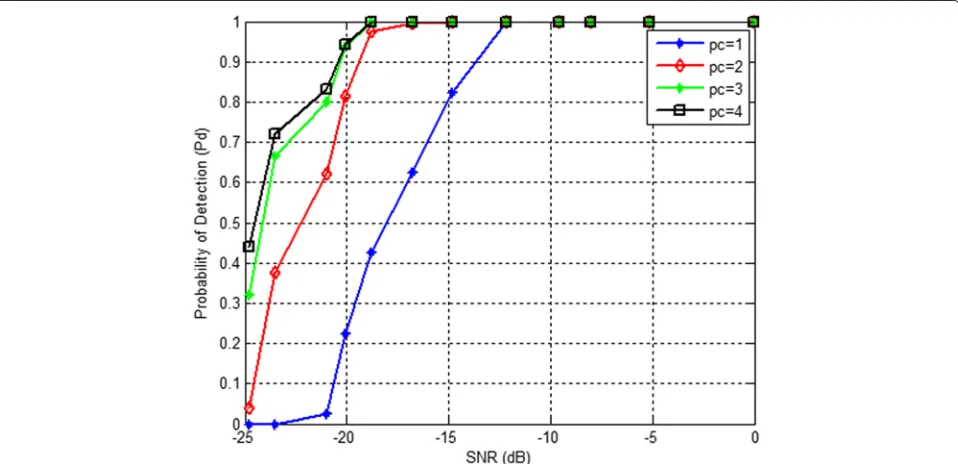
Wireless microphone signals were used to formulate the PU, simulations were done using N samples. The value of N is set to 20,000. Figure 1 represents the probabil-ity of detection versus SNR curves with varying number of PCs. It can be seen from the figure that the probabil-ity of detection is improved as we include more principal
components for detection; in Fig. 1, ‘pc’ represents the number of principal components included in test statistic. It is also clear that the first two PCs retain the most use-ful information as compared to the last ones. There is an improvement in detection performance while moving from one to two and two to three PCs, but no significant improvement is observed when we include all four PCs, that is the point where we encounter the redundant data that can be discarded to save the sensing time. This sup-ports the statement that the variables with little variances could be discarded without significantly influencing the total variance, thereby reducing the number of variables. The use of smaller number of PCs not only reduces the sensing time but also loses some useful info that results in a low probability of detection in our case. As we increase the number of PCs, detection time also increases because it gets involved more number of operations to calcu-late the test statistic that increases the complexity of the algorithm.
3 Proposed LPC algorithm
From the performance analysis of the PC algorithm, it is observed that the detection performance can be improved by including more PCs while using larger sized covariance matrix. However, doing so increases the complexity. In this section, we propose the LPC algorithm that uses the iterative method to compute the eigenvectors, required to generate PCs; the use of this approach significantly reduces the complexity. The proposed method performs much faster than the existing method, as it only computes
the eigenvectors corresponding to the highest eigenvalues, whereas the direct method computes all the eigenvec-tors, thus wasting resources in computing in significant eignvectors. This approach is more efficient as it obvi-ates the calculation of all the eignvectors and then sorting them at the end. Advance algorithms such as Lanczos and Arnoldi save this data and use the Gram-Schmidt pro-cess or Householder algorithm to reorthogonalize them into a basis spanning the Krylov subspace correspond-ing to the matrix. As the matrix size increases, the direct method becomes very slow, therefore not feasible prac-tically, while the proposed method only calculates the desired eigenvectors via an iterative approach.
There are many iterative approaches like Arnoldi algorithm, Jacobi-Davidson algorithm and Lanczos algo-rithm [17]. We found Lanczos algoalgo-rithm appropriate for our scenario as it has the least convergence time as com-pared to other approaches [17]. A disadvantage of this algorithm is that the number of iterations can be large. To cater for this issue, a variation of the Lanczos algo-rithm known as implicitly restarted Lanczos algoalgo-rithm (IRLA) is used to compute the desired eigenvectors [18]. Implicitly restart (IR) extracts the useful information from a large Krylove subspace and resolves the storage issue and the difficulties associated with the standard approach. IR does this by compressing the useful data into a fixed
size k dimensional subspace. IRLA is summarized in
Algorithm 1 [18]. A is the symmetric matrix of inter-estvis the starting vector,Tk∈ k×k is real, symmetric
and tridiagonal with nonnegative subdiagonal elements. Vk ∈Cn×k(the columns ofVk) are the Lanczos vectors.
Herek represents the desired number of eigenvectors to calculate and r is the residual. Selection of shift μj
depends upon the user’s required set of vectors.osteps of shiftedQRiterations are applied toTmusingμ1,μ2, ....μo
as shifts. [βk =Tm(k+1,k)]=0 if we use exact shifts.
LPCA can be summarized as follows:
1. Calculate the covariance matrix as in (6). 2. Decompose the covariance matrix via implicitly
restarted Lanczos algorithm as described in Algorithm 1.
3. Generate the principal components. 4. Calculate test statisticTas in (9).
5. Decide betweenH1andH0by comparing theT with a predetermined threshold (Empirically determined at the desired probability of false alarm).
3.1 Computational complexity comparison
As of the other covariance-based detection techniques, complexity of the PC algorithm also comprises of two major steps, one is the computation of the covariance matrix as in (6) and the other is the decomposition of the covariance matrix to calculate eigenvectors in our
case. As the covariance matrix is a block Toeplitz and Hermitian, due to these properties of covariance matrix, we only need to evaluate its first block. Calculation of the covariance matrix requires (M2LN
s) multiplications
and O(M2L(N
s−1)) additions; here M is the number
of receive antennas,Lis the smoothing factor andNsis
the number of samples [4]. Eigen decomposition of the covariance matrix requiresO(M3L3)multiplications and additions [5].
Therefore, the total complexity of eigenvalue-based detection algorithm (i.e. MME) isO(M2LNs)+O(M3L3).
Hence, after sorting, the total complexity of the PC algorithm becomes O(M2LNs)+O(M3L3)+O(L2), the
complexity involved in the generation of principal com-ponents is negligible as compare to the calculation and decomposition of covariance matrix. The use of the iter-ative approach reduces the complexity up to 2L2 [17]. Complexity with purposed LPC algorithm reduced to O(M2LN
s)+O(M3L). Figure 2 shows the lognormal plot
of the complexity of all three algorithms (MME, PCA and LPCA).
Algorithm 1:Implicitly restarted Lanczos algorithm Starting fromv1=v/v
herevis the starting vector
Compute an m-step Lanczos factorization(m=k+o) AVm=VmTm+rme∗m
Repeat untilconvergence(Tk=Dkdiagonal)
Computeσ(Tm)and selectpshiftμ1μ2, ....,μo
Beginning withk−stepsLanczos Factorization AVK =VkTk+rke∗k
To get a new m-step Lanczos Factorization do apply on additional steps
AVm=VmTm+rme∗m
End repeat
4 Experimental setup
Fig. 2Lognormal plot of complexity. Complexity plot of proposed LPCA, existing PC and MME method
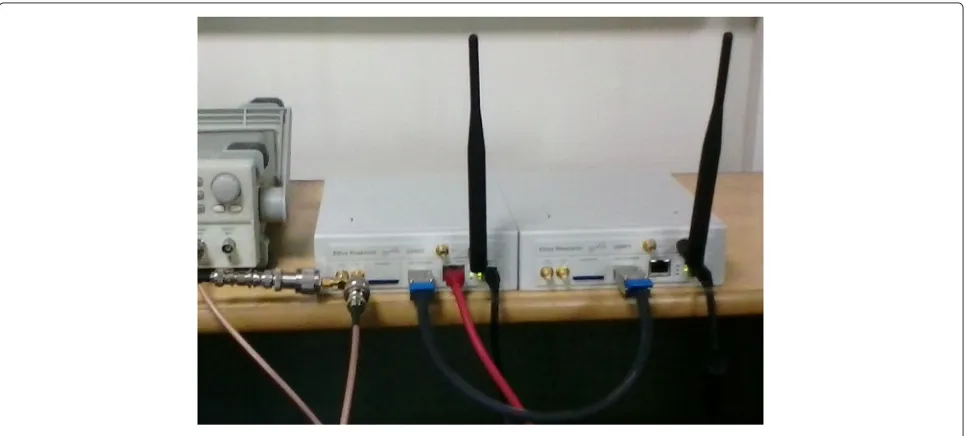
of cognitive radios and SDR provided by Ettus Research [19]. It consists of a motherboard and a selectable RF daughter boards along with a gigabit ethernet port that can be attached to a host computer for further process-ing. WBX was connected to the motherboard. It has a single transmit and receive antenna and covers a wide frequency range of 50 MHz to 2.2 GHz [19]. One of the advantages of USRP2 is that it works with GNU radio, open source software along with an abundance of resources, which simplify its usage [20]. Signal reception
and down conversion was performed by the RF daugh-terboard. Afterwards a gigabit ethernet was used to pass the down-converted signal to host computer for further processing. A master/slave configuration was established to connect the two USRPs. The host computer was con-nected to the master USRP through an ethernet interface. The two USRP kits were interconnected via a MIMO cable that enables the synchronization between them. In addi-tion, it also transfers down-converted signals from slave to master. Synchronization is achieved by feeding two
reference signals to the master USRP. A frequency refer-ence is provided by a 10-MHz signal and sample time is synchronized by a one pulse per second (1 PPS) signal. In our experimental setup, the PU was emulated using an Rhode & Schwarz SMF100A microwave signal gener-ator that transmits an FM signal at a frequency of 410 MHz with a bandwidth of 200 kHz [21]. The SNR was varied by changing the transmit power of the signal gen-erator. The sampling rate of the received signal was 6.25 Mega samples per second. A high correlation between the samples is achieved by over-sampling. The received sig-nals were fed to the host computer through an ethernet cable for subsequent performance analysis. The SNR was measured by tuning off the transmitter and recording the noise at each RF front end. The power of the signal at Mthfront end is calculated byPM =1/SnS=1|XM(n)|2.
WhereSis the total samples used for computing power, PM,1represents the power of signal andPM,0is the power of noise.
SNRM =10log10[(PM,1−PM,0)/PM,0] . (11)
5 Results and discussions
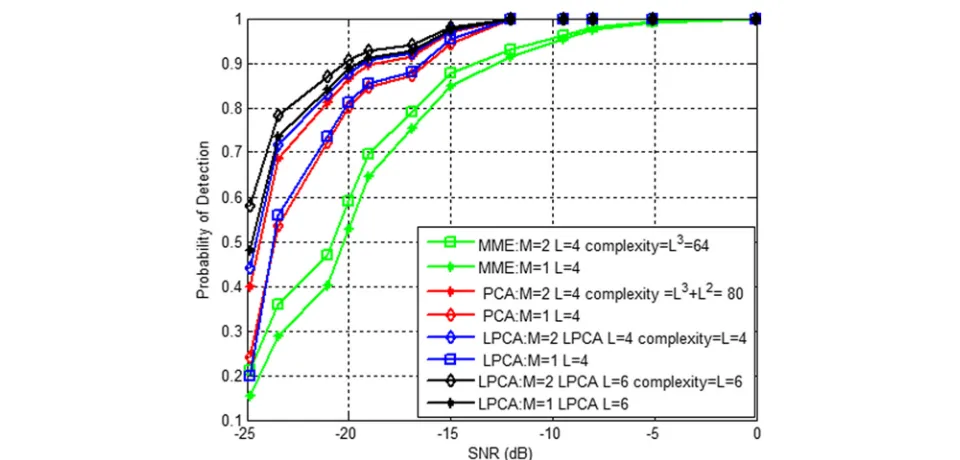
This section describes the performance comparison of the LPC, PC and MME algorithms. Figure 4 shows the performance analysis of the three algorithms in terms of probability of detection vs. SNR at 10 % probability of false alarm for single (M=1) and multiple(M=2) receive antenna cases. Probability of detection improves for theM=2 case as the use of multiple antennas at the receiver overcomes the effect of channel fading and also
enhances the robustness against interference [22]. Anten-nas were configured for correlated reception (i.e antenna spacing< λc/2) which enhance the received signal’s
cor-relation between the samples. The results obtained from
the PC and LPC algorithms were with G=2 and the
number of samples used in making a single detection deci-sion N was kept constant for all the three algorithms. It was observed that the proposed method (LPCA) gives similar detection performance as of the PC method with significantly reduced complexity and it also outperforms the MME algorithm. There is no effect on the detec-tion test statistic except the reducdetec-tion in computadetec-tional complexity, this allows the inclusion of more PCs that ulti-mately improve the detection performance. The proposed algorithm reduces the complexity by using an iterative approach and subspace method. Improvement in proba-bility of detection is attained using LPCA, this improve-ment is achieved by using the covariance matrix of order L=6 instead ofL=4 while in case of PC and MME algo-rithmL=4. With thisLthe complexity of PC algorithm is L3+L2=80 and MME has the complexity L3=64 while that of the LPCA isL=6, the proposed LPCA gives the better detection with low complexity even using large covariance matrix.
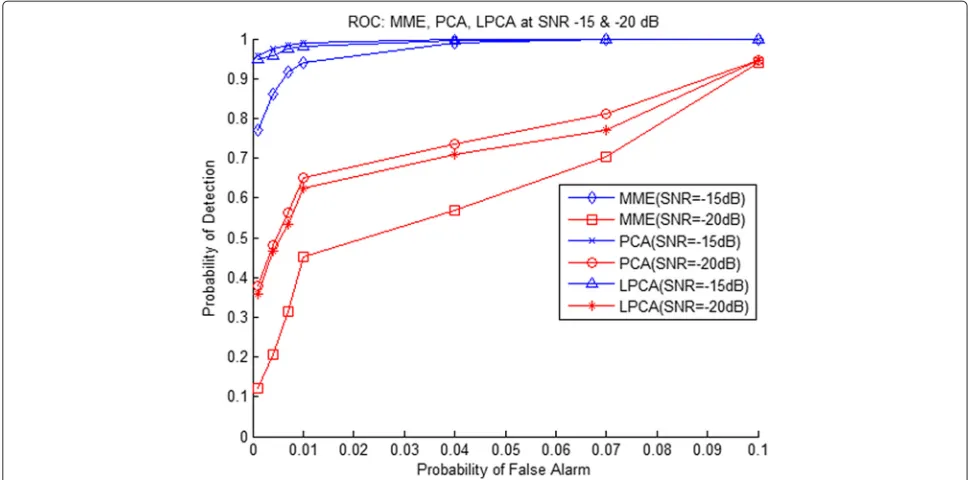
The direct method becomes slow as the matrix size increases; therefore, it is not feasible practically. With the direct method, while getting the required eigenvector, we also got a series of vectors, which were, finally, discarded, this can result in a large amount of disregarded informa-tion; LPCA overcomes this issue and makes the things simpler. Receiver operating curves at different SNR are
Fig. 5ROC. Receiver operating curve probability of detection(Pd)vs. probability of false alarm(Pf)at SNR−15 and−20 dB
shown in Fig. 5 for MME, PC and LPCA at SNR −15
and −20 dB with L=4 and N=60, 000. Detection
threshold was empirically calculated by considering the normalized histogram of the test statistic underH0 and corresponds to probability of false alarm of range 0 to 1. It can be seen from the figure that receiver operating characteristics (ROC) of both PC and LPCA are almost the same (Fig. 5). As expected, the proposed algorithm gives the same performance as that of the PC algorithm with a reduced complexity and significantly exceeds the sensing requirements defined by the FCC, that is, achiev-ing 90 %Pd with 10 %Pfaat SNR of−12 dB for wireless
microphone signals.
6 Conclusion
Complexity is a major issue in blind signal detection algo-rithms that are based on a covariance matrix. The use of a large number of received samples increases the size of the covariance matrix and as a result the complexity. In this paper, we proposed a novel algorithm for blind signal detection, i.e. LPC algorithm that has an iterative nature which reduces the complexity and saves sensing time. LPC achieves the same detection performance as PC, yet its complexity is significantly less than the PC algorithm. Thus, LPC can be used in even low-powered devices for blind signal detection. The performance of LPC is compared with PC as well as MME algorithms. The pro-posed method gives the best sensing performance while reducing the complexity from O(L3+L2) to O(L). All the algorithms are tested with actual wireless microphone signals while using a USRP2 testbed and GNU radio
software. In the future, these algorithms can be tested on a stand-alone platform for real-time performance evaluation.
Competing interests
The authors declare that they have no competing interests.
Authors’ information
Zeba Idrees received her B.E. degree in telecommunication engineering from the Govt. College University Faisalabad, Pakistan and a Masters degree in elec-trical engineering from the National University of Sciences and Technology (NUST), Islamabad, Pakistan in 2012 and 2014, respectively. She possesses pro-fessional and research experience of more than 2 years in academia as well as industry. During her research period, she conducted research on Cog-nitive radio networks. She has a research interest in the areas of Wireless communications and Signal Processing.
Farrukh A Bhatti received his B.E. and M.S. degrees in avionics engineer-ing and electrical engineerengineer-ing from the National University of Sciences and Technology, Pakistan, in 2004 and 2008, respectively. He received his Ph.D. degree in electrical and electronic engineering from The University of Auck-land, New ZeaAuck-land, in 2014. During his Ph.D., he undertook research field trips to the Industrial Research Ltd Wellington and the Wireless @ Virginia Tech research group, Virginia Polytechnic Institute and State University, Blacksburg, VA, USA. Presently, he is an Assistant Professor in the department of elec-trical engineering at the Institute of Space Technology, Islamabad, Pakistan. His research interests include advanced cellular networks, multiple-antenna systems, software-defined radios and cognitive radio networks.
Adnan Rashdi received his B.Sc, M.Sc and Ph.D degrees in Electrical Engineer-ing from the University of EngineerEngineer-ing & Technology (UET), Lahore, Pakistan in 1994, 2003 and 2008, respectively. His research interest includes software defined radios, cognitive radios, wired and wireless multiuser communica-tion systems, signal processing and optimizacommunica-tion techniques. He has published many research papers in international journals and conference proceedings. He has established SDR Lab at Military College of signals (MCS) and is heading SDR Research Group. Currently he is working as an assistant professor at the National University of Science and Technology (NUST).
References
1. S Haykin, DJ Thomson, JH Reed, Spectrum sensing for cognitive radio. Proc. IEEE.97(5), 849–877 (2009)
2. DD Ariananda, M Lakshmanan, H Nikookar, inCognitive Radio and Advanced Spectrum Management, 2009. CogART 2009. Second International Workshop On. A survey on spectrum sensing techniques for cognitive radio (IEEE, 2009), pp. 74–79
3. T Yücek, H Arslan, A survey of spectrum sensing algorithms for cognitive radio applications. Commun. Surv. Tutorials IEEE.11(1), 116–130 (2009) 4. Y Zeng, Y-C Liang, Spectrum-sensing algorithms for cognitive radio based
on statistical covariances. Vehicular Technol. IEEE Trans.58(4), 1804–1815 (2009)
5. Y Zeng, Y-C Liang, Eigenvalue-based spectrum sensing algorithms for cognitive radio. Commun. IEEE Trans.57(6), 1784–1793 (2009) 6. Y Zeng, CL Koh, Y-C Liang, inCommunications, 2008. ICC’08. IEEE
International Conference On. Maximum eigenvalue detection: theory and application (IEEE, 2008), pp. 4160–4164
7. Y Zeng, Y-C Liang, inPersonal, Indoor and Mobile Radio Communications, 2007. PIMRC 2007. IEEE 18th International Symposium On.
Maximum-minimum eigenvalue detection for cognitive radio (IEEE, 2007), pp. 1–5
8. Y Zeng, Y-C Liang, R Zhang, Blindly combined energy detection for spectrum sensing in cognitive radio. Signal Process. Lett. IEEE.15, 649–652 (2008)
9. AM Rao, B Karthikeyan, GRK DipayanMazumdar, Energy detection technique for spectrum sensing in cognitive radio. SAS_TECH.9(2010) 10. S Hou, R Qiu, M Bryant, M Wicks, inIEEE Waveform Diversity and Design
Conference. Spectrum sensing in cognitive radio with robust principal component analysis, vol. 514, (2012)
11. Y Han, H Lee, J Lee, inVehicular Technology Conference (VTC Fall), 2013 IEEE 78th. Spectrum sensing using robust principal component analysis for cognitive radio (IEEE, 2013), pp. 1–5
12. FA Bhatti, GB Rowe, KW Sowerby, inWireless Communications and Networking Conference (WCNC), 2012 IEEE. Spectrum sensing using principal component analysis (IEEE, 2012), pp. 725–730
13. J Ma, GY Li, BHF Juang, Signal processing in cognitive radio. Proc. IEEE. 97(5), 805–823 (2009)
14. JE Jackson,A User’s Guide to Principal Components, vol. 587. (John Wiley & Sons, Canada, 2005), pp. 26–58
15. BC Moore, Principal component analysis in linear systems: Controllability, observability, and model reduction. Automatic Control IEEE Trans.26(1), 17–32 (1981)
16. JF Hair, WC Black, BJ Babin, RE Anderson, RL Tatham,Multivariate Data Analysis, vol. 6. (Pearson Prentice Hall Upper Saddle River, NJ, New York, 2006), pp. 1–22
17. A Ikram, A Rashdi, inCommunications (APCC), 2012 18th Asia-Pacific Conference On. Complexity analysis of eigenvalue based spectrum sensing techniques in cognitive radio networks (IEEE, 2012), pp. 290–294 18. D Calvetti, L Reichel, DC Sorensen, An implicitly restarted lanczos method
for large symmetric eigenvalue problems. Electronic Trans. Numeric. Anal. 2(1), 21 (1994)
19. Ettus Reserch. http://www.ettus.com/ 20. GNU RADIO. http://www.gnuradio.org/
21. C Clanton, M Kenkel, Y Tang, Wireless microphone signal simulation method. IEEE 802.22-07/0124r0 (2007)
22. Y-C Liang, G Pan, Y Zeng, inGlobal Telecommunications Conference (GLOBECOM 2010), 2010 IEEE. On the performance of spectrum sensing
algorithms using multiple antennas (IEEE, 2010), pp. 1–5
Submit your manuscript to a
journal and benefi t from:
7Convenient online submission
7Rigorous peer review
7Immediate publication on acceptance
7Open access: articles freely available online
7High visibility within the fi eld
7Retaining the copyright to your article