R E S E A R C H
Open Access
On the performance of cognitive full-duplex
relaying under spectrum sharing constraints
Samuel B. Mafra
1*†, Hirley Alves
1,2†, Daniel B. Costa
3, Richard D. Souza
1†, Evelio M. G. Fernandez
4and Matti Latva-aho
2Abstract
In this paper, a new full-duplex (FD) relaying scheme for a cooperative cognitive underlay network is proposed. The secondary network is composed of one secondary transmitter, one full-duplex secondary relay, and one secondary destination. The relay employs the selective-decode-and-forward (SDF) protocol. The secondary destination jointly decodes the signals from the secondary transmitter and the FD secondary relay so that the direct link can be seen as useful information rather than interference. The analysis includes the effect of the interference from the primary transmitter and the self-interference at the relay. Under equal power allocation strategy, closed-form expressions for the outage probability are derived for the proposed FD cooperative cognitive scheme, and the feasibility of FD relaying under cognitive constraints is shown. Our results also reveal that the proposed full-duplex joint-decoding (FDJD) cognitive network considerably outperforms the known full-duplex dual-hop (FDDH) scheme. Moreover, we propose an optimal power allocation (OPA) scheme. On the basis of the signal-to-interference-plus noise of the secondary network, the OPA strategy can choose between two modes of operation, cooperation between source and relay or source transmission only. Our results show that the FDJD scheme under the proposed OPA policy presents the best performance among all schemes investigated in this paper.
Keywords: Cooperative cognitive networks; Full-duplex relaying; Joint-decoding; Self-interference; Spectrum sharing
1 Introduction
With the objective of obtaining a more efficient utiliza-tion of the radio spectrum, in a cognitive radio network, the unlicensed users (also referred to as secondary users) may communicate using frequencies of the licensed spec-trum [1–4]. The most practical cognitive radio protocols are interweave and underlay [1]. In the interweave proto-col, the unlicensed users monitor the radio spectrum and communicate over spectrum holes without causing inter-ference to the licensed users (primary users). Differently from the interweave protocol, in the underlay protocol, the secondary network may transmit concurrently with the primary network as long as the primary communi-cation is not compromised. In this scenario, a maximum allowable interference level at the primary receiver is defined so that the secondary users (SUs) must take into account this threshold during the transmission in order
*Correspondence: [email protected]
†Equal contributor
1Federal University of Technology—Paraná (UTFPR), 80230-901 Curitiba, Brazil Full list of author information is available at the end of the article
to adjust their transmit powers. This allows a more effi-cient use of the frequency spectrum since the interference is limited at the primary receiver [1–4].
Recently, cooperative communications emerged as an alternative technique to boost the performance of com-munication systems [5, 6]. The idea behind this strategy is to make use of one or more nodes, known as relay(s), to help the communication between source and desti-nation. The result is a virtual antenna array formed by single antenna devices. Thus, through cooperation, the same benefits obtained in multiple-input multiple-output (MIMO) systems can be achieved. The relay behavior is governed by cooperative protocols which can operate either on half-duplex (HD) or on full-duplex (FD) modes, using parallel or repetition coding, selective or incre-mental strategies, etc. [5, 7–9]. Specifically, in HD mode, the relay transmits and receives in orthogonal channels, whereas in FD mode, the transmission and reception are performed at the same time and at the same frequency band. Owing to this fact, HD relays require the use of addi-tional system resources, while FD relays arise as a viable
option to alleviate this problem. However, although ideal FD relaying can achieve higher capacity than HD relaying [8], its use introduces self-interference since perfect isola-tion between transmitted and received signals is hard to be guaranteed [8–12].
Nevertheless, the works [9–17] showed that FD is fea-sible even in the presence of high self-interference levels. Even though sophisticated signal processing techniques are employed at the FD node, it is unfortunate that the self-interference cannot be completely mitigated [10, 11]. Experimental results in [10] showed that with advanced signal processing together with antenna isolation tech-niques, self-interference can be considerably reduced but not to the noise level. Thus, residual interference still remains, and it can be modeled as a fading channel as investigated in [9, 11–17]. For instance, in [13], it is shown that FD relaying is feasible even if the relay expe-riences strong self-interference, while enhancing capacity when compared with HD relaying. In [14, 15], the authors compare the performance of selective and incremental cooperative HD protocols to FD cooperative protocols. The authors show that FD operation can considerably increase performance in terms of outage probability as well as throughput even in the presence of strong self-interference. More general fading settings such as Rice and Nakagami-m fading are investigated in [16, 17]. The common conclusions among [9–17] are that FD operation is feasible and that overall performance can be consider-ably enhanced with respect to HD relaying.
1.1 Cooperative cognitive networks
Motivated by the great benefits acquired through cog-nitive radio and cooperative techniques, several works analyzed the performance of cooperative cognitive net-works under spectrum sharing constraints, as for instance [18–29]. Nevertheless, a common characteristic of these works is that all proposed schemes operate under HD mode with exception of [29]. For instance, [18] assumes an underlaid cooperative secondary network in a multi-node primary network. The authors consider that the secondary user adjusts its transmit power according to maximal interference link; however, neglecting the direct link between secondary source and destination. In [19], the authors assume that the dual-hop cooperative sec-ondary network suffers with the primary interference and draw a discussion on how it impacts on the secondary performance.
Further, in [20], the outage probability of a dual-hop cognitive relay network under general fading setting is analyzed. Thus, assuming two different strategies to deter-mine the transmit power of the secondary network, the authors show that the diversity order is dominated by the minimum fading severity between the two hops of
the secondary network. A similar setting was investigated in [21], where the authors account for the direct link at the secondary cooperative network and show that the diversity order is solely dependent on the fading sever-ity parameters of the secondary network. In [22], the authors ignore the direct link but include the interference of the primary network in their analysis of outage prob-ability showing the impact on performance because of the interference from the primary network. The authors in [23] exploit the primary network retransmissions in order to increase performance of the underlaid network. The results show that cooperation at the underlaid layer considerably increases performance without harming the performance of the primary network.
In [24], the performance of a multi-relay secondary network is evaluated revealing that the diversity gain is defined by the number of available relays. Correspond-ingly, in [25], outage probability and ergodic capacity are evaluated constrained by the interference of the primary network. The authors show that the interference can be combated with the inclusion of more relays at the sec-ondary network. In [26], the authors evaluate the outage probability and power allocation for a cognitive network with multiple primary transmitters and primary receivers; the secondary network is composed of a cooperative net-work with multiple relays, and the direct link at the secondary network is also considered. The number of pri-mary users has a very severe impact on the performance of the proposed scheme. In [27], the outage probability is evaluated for a cognitive scenario where a relay helps the transmissions of the primary users as well as the sec-ondary users. The results show that the outage probability decreases in comparison to schemes without coopera-tion in both networks. In [28], the authors evaluate two spectrally efficient schemes for a secondary cooperative network with multiple (L) destinations, in which the best destination is selected. Such schemes consider incremen-tal DF relaying protocol. The proposed schemes achieve full-diversity order, being equal toL+1.
In [30], in a non-cognitive radio scenario, the authors evaluate the outage probability of a cooperative network, where the signal of the direct link is exploited at the secondary destination and the relay employs the selective-decode-and-forward (SDF) protocol. In [31], the authors evaluate the protocols proposed in [30], for a scenario subject to Nakagami-m fading. The proposed protocols have better performance in terms of outage probability than half-duplex and other full-duplex protocols. In [32], we evaluated the performance of the scheme proposed in [30] assuming a cooperative cognitive network oper-ating in a spectrum sharing scenario with a FD relay subject to self-interference. However, the interference of the primary network into the secondary network was not considered in the analysis and the relay employed the fixed-decode-and-forward (FDF) protocol. Moreover, in [32], only equal power allocation (EPA) between source and relay is considered. The results show that the pro-posed joint-decoding full-duplex dual-hop secondary net-work outperforms its dual-hop full-duplex [29] and joint-decoding half-duplex counterparts, even in the presence of strong self-interference.
1.2 Proposed scheme and summary of contributions In this paper, we consider a similar scenario as in [29, 32], in which the transmission through the direct link is exploited at the secondary destination and the interfer-ence of the primary network into the secondary network is taken into account. However, as in [30], the relay employs the SDF protocol. Additionally, an optimal power allo-cation (OPA) policy is proposed. The OPA strategy can choose between two modes of operation: (i) coopera-tion between source and relay or (ii) source transmission only. The proposed scheme, named as FD joint-decoding (FDJD) relaying, is compared with the FDDH scheme pre-sented in [29] as well as with the standard HD relaying scheme. Closed-form expressions for the outage proba-bility under EPA are derived and insightful discussions are drawn. Monte Carlo simulations are also presented in order to corroborate the proposed analysis.
Another contribution of this paper is to show that the proposed FDJD relaying scheme can considerably outper-form the method proposed in [29] for the whole signal-to-noise ratio (SNR) range. Our results also show that the proposed FDJD method performs better than the HD scheme even in the presence of strong self-interference.
The remainder of this paper is organized as fol-lows: Section 2 introduces the system model, while in Section 3, an analytical performance analysis of the pro-posed scheme is carried out in terms of outage probability. In Section 4, an OPA strategy is introduced for the FDJD scheme. In Section 5, representative numerical results are provided and insightful discussions are drawn. Finally, Section 6 concludes the paper.
1.2.1 Notations and functions
Mathematical expectation is denoted by E [·]; Pr[·] stands for probability; fW(·) and FW(·) represent the
probabil-ity densprobabil-ity function (PDF) and cumulative distribution
function (CDF) of a given random variable (RV) W,
respectively.
2 System model
2.1 Network model
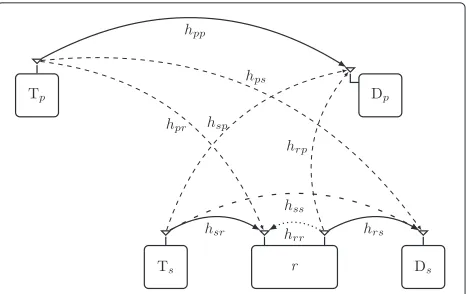
We consider a similar scenario as in [29, 32], with a cooperative cognitive network composed by one sec-ondary transmitterTs (source), one FD secondary relay
r, one secondary destination Ds (destination), one
pri-mary transmitter Tp, and one primary destination Dp,
as depicted in Fig. 1. The cognitive network operates in a spectrum sharing environment, where the secondary users are able to transmit their messages, if the interfer-ence on the primary network is below a certain threshold Ith[1–3]. The transmit power constraints will be detailed later.
2.2 Relay operation
The main motivation behind FD schemes is the poten-tial to overcome the spectral inefficiency of the HD ones, since the whole communication process occurs within one time slot. Nevertheless, such great potential comes at a price of self-interference, since it is a strenuous task to iso-late transmit and received powers [10, 11]. In the last few years, great efforts have been done on the mitigation of the self-interference [9–11]; however, these works also show that self-interference cannot be completely removed but considerably attenuated—even though employing sophis-ticated schemes of interference cancelation. Thus, there
remains residual self-interference at the relay, that is mod-eled as a fading channel which, by its turn, allows the emu-lation of various (non)line-of-sight configurations arising from antenna isolation and interference cancelation tech-niques [9, 10, 15–17].
In FD mode, conversely to the HD schemes, the relay receives and transmits simultaneously in the same fre-quency band [8]. Thus, in a first phase—known as broad-cast phase (BC)—the source broadbroad-casts its message to the relay as well as to the destination. Simultaneously, the relay starts the decode-and-forward process—known as multiple access phase (MAC). In this second phase, the destination receives both signals from source and relay as in a multiple access channel [8].
2.2.1 Encoding/decoding
We rely on a variation of the DF scheme initially proposed in [33] and later extended to fading scenarios [8, 15]. The DF protocol proposed in [33] is based on a combination of block Markov encoding at source and relay, associ-ated with coding for cooperative multiple access channel and superposition coding [8, 33]. As pointed out in [8], the same achievable rates for the DF protocol proposed in [33]—named irregular encoding/successive decoding [8]—can be achieved through different strategies: regu-lar encoding/sliding-window decoding [34] and reguregu-lar encoding/backward decoding [30, 35]. As indicated in [8], the latter is more suitable for quasi-static fading channels. Therefore, hereafter, we assume regular encoding and backward decoding [30, 35]. Figure 2 depicts such
encod-ing/decoding strategy where the frame is split into L
blocks. Notice that x denotes the message sent by the
source, while x˜ is the re-encoded message at the relay. There is a delay between source and relay transmission— which we assume to be of one block in this work. We recall that the backward decoding scheme is generalized in [30] for any number of delayed and total number of blocks. In that work, it is shown that performance is not affected as long as the ratio between delay and number of blocks is small.
2.2.2 Selective-decode-and-forward
In [30], the authors extended the traditional DF protocol to its variant, in which the relay only forwards the message if correctly decoded—such variant is named SDF, and is well known in the literature for the HD case [5]. Hereafter,
we assume that the relay employs the SDF in FD mode. Further details are given later in Section 3.1.
2.3 Channel model
At timet, the received signals at the secondary relay and at the secondary destination are, respectively,
yr[t]=
Pshsrx[t]+
Prhrrx˜+
Pphprxp[t]+nr[t] ,
(1)
yd[t]=
Prhrsx˜+
Pshssx[t]+
Pphpsxp[t]+nd[t] ,
(2)
wherePi represents the transmit power, and indexesi ∈
{p,s,r}andj∈ {r,s,p}represent the transmitter/receivers, with p denoting the primary transmitter or receiver, s the secondary transmitter or receiver, and r the relay. Note that x[t] is the message sent by the source, and
˜
x x[t−D] is the message sent byrafter a processing delayD. Additionally,xp[t] is the message sent byTp, and
nj[t]∼ CN(0,σn2) stands for the complex additive white
Gaussian noise at nodejwith varianceσ2
n =N0, whereN0 is the one-sided noise power spectral density. We assume hereafter to be D = 1. The quasi-static fading channels are denoted byhij, and all channels undergo independent,
identically distributed (i.i.d.) circularly symmetric com-plex Gaussian distribution with zero mean and variances σij. The average fading power isλij E
|hij|2
d−ijνσij,
wheredij represents the distance between nodesiandj,
and υ is the path-loss exponent (υ ≥ 2). Moreover, as aforementioned, the residual self-interference is modeled as a fading channel such that hrr ∼ CN(0 ,σrr), with
average fading powerλrr Prδ σrr, whereδ represents
the interference cancelation factor which arises from the association of antenna cancelation and interference can-celation techniques. Hereafter, for simplicity of notation, let us definegij=. hij2.
As aforementioned, the message is divided intoLblocks, as shown in Fig. 2. Note that after the destination receives theL-th block from the relay, the destination is able to per-form backward decoding and jointly decode the messages from source and relay [8, 30]. As pointed out in [12], this delay is large enough to guarantee that the simultaneously received signals are uncorrelated, and therefore can be jointly decoded.
Inspired by [29], after matched filtering, we can approx-imate the interference from the primary network by an additional noise, whose variance depend solely on the channel statistics of the primary network [29]—which can be estimated by the secondary network. This is a common assumption in the literature, as can be seen in [36–39]. Keeping this in mind, we can consider the pri-mary interference as having a Gaussian distribution with zero mean and varianceσpr2 =Ppλprat the relay and
vari-anceσps2 = Ppλpsat the destination. Then, according to
([29], Eq. 7), the overall Gaussian noise variance at the des-tination including the effect of the interference from the primary transmitter isσ2
s = σn2+σps2, while at relay, we
haveσr2=σn2+σpr2.
2.3.1 Spectrum sharing environment
The primary receiver tolerates a maximum interference threshold given byIth. Since a FD relay is employed, the
secondary transmitter and the secondary relay transmit their messages simultaneously, which means that primary destination receives interference from both secondary transmitters at the same time. Bearing this in mind, the transmission power of the secondary transmitter and the secondary relay must be constrained as [29]:
gspPs+grpPr ≤Ith. (3)
In case of EPA, each transmitter has its transmission power constrained to half of the maximum interference thresholdIth. Thus, the secondary transmitter and the sec-ondary relay have their transmit powers limited, respec-tively, by [29]:
Ps=
Ith
2gsp
, Pr=
Ith
2grp
. (4)
3 Outage probability analysis
In this section, we present the outage probability analysis, but first, let us define the attempted transmission rate and outage probability as follows.
Definition 1.Attempted transmission rate: the
trans-mission rate in bits/s/Hz, which is denoted byR.
Definition 2.Outage probability: the probability of a
failure in the communication between nodes i and j [40], so that an outage can be defined as the event that the mutual information between nodes i and j,Iij, is lower than the
attempted transmission rate R [40]. Assuming unitary bandwidth and Gaussian inputs, the outage probability is [40],
Oij=PrIij<R=Pr
log2
1+gijPi N0
<R .
(5)
Next, we introduce the proposed protocol—FDJD. We also include the outage formulations for the cases of the FDDH and HD schemes, which are already known [14, 15, 29] and are used as benchmarks for the proposed scheme. The derivations are included for the sake of completeness.
3.1 Full-duplex joint-decoding (FDJD)
The proposed cooperative communication scheme— FDJD—relies on the help of a FD relay such that the direct link is seen as useful information rather than interfer-ence at the destination. Thus, when the source-relay link is in outage, the message can still be successfully received through the direct link. Note that in the FDDH scheme [29], the direct link is never seen as useful information, but as interference at the destination. In the FDJD scheme, the direct link can be seen as useful information because we assume a more elaborated transmission scheme, as detailed in [30, 31] which makes use of backward decod-ing, that is superior than the one used in FDDH scheme [29].
First, the source broadcasts its message to relay and destination. Then, after a processing delayD, during the multiple access phase, the relay forwards the received message to the destination. Note that if the source-relay link is in outage, then the relay remains silent; other-wise, it forwards the message to the destination. By its turn, the destination jointly decodes the signals received from source and relay [8, 15, 17, 30], which is an itera-tive process dependent of block decoding [8, 30]—whose purposed is to combine the transmissions from source and relay—using advanced detection techniques and the acquired knowledge from previously received frames [30]. Additionally, based on [30] and in order to make a fair comparison with the schemes FDDH [29] and HD [5],
we set D = 1. In other words, there is a delay of one
block among the messages sent by the secondary trans-mitter and the relay. Recall that small delays do not affect the overall performance of the FD protocol for a largeL [8, 30].
Next, we assess the overall mutual information of the FD scheme in the following lemma.
Lemma 1.The mutual information of the FDJD scheme
is characterized as a function of the mutual information of the two decomposed phases: BC and MAC, respectively, IBCandIMAC[8] and the mutual information of the direct
link [30]. Thus,
IFD=max{Iss, min{IBC,IMAC.}} (6)
FD mode, the authors in [30] show that the mutual infor-mation can be written in similar fashion when backward decoding is applied.
Thus, from Lemma 1 and in the context of a cognitive cooperative network and relying on [8, 15, 17, 30], we can write the mutual information of the BC phase of the FDJD scheme as
while the mutual information between relay and destina-tion, in the MAC phase, is
IJD
Note that in (9), the signals coming from source and relay are seen as useful information by the destination. Moreover, also note that the self-interference at the relay is taken into account in (7). Next, given Definition 2, the overall outage probability of the FDJD scheme is given as follows.
Theorem 1.Given Definition 2 and Lemma 1, the
over-all outage probability of the proposed FDJD scheme is OJD=Pr [IFD<R]
=OJD sr OssJD+
1−OJDsrOrsJD. (10)
Proof. All RVs are i.i.d., which allows us to write the overall outage probability as a function of the outage prob-abilities of the individual links. Moreover, from [15, 30], we know that the outage event from the backward decod-ing of source and relay messages can be represented by OJD
rs, which includes the joint-decoding processes at the
destination.
In order to assess (10) in Theorem 1, we investigate next the outage probability of the individual links.
Lemma 2.Assuming that all RVs are i.i.d and
exponen-tially distributed with rateλ−ij1, the outage probability of the link between the relay and the secondary destination OJD
Bearing this in mind, the outage probability of the link between relay and destination can be written as
OJD
Thus, after a few algebraic manipulations into (15), we attain (11), which concludes the proof.
Following [29], the outage probability of the source-relay link is given by
OJD
Remark 1.With the objective of obtaining a more
gen-eral approach, we consider, differently of [29], that the channel between the source and the relay has average fading powerλsrdifferent of one.
The outage probability of the source-destination link is [41]
Finally, the overall outage probability of the FDJD scheme can be attained by plugging (11), (16), and (18) into (10).
3.2 Full-duplex dual hop (FDDH)
Differently from the proposed FDJD scheme, in the FDDH scheme, the direct link is seen as interference at the destination [29].
the the mutual information of the relay-destination link
The overall outage probability of the FDDH scheme is [15, 29]
Differently from FD schemes, in the HD mode, the sec-ondary transmissions occur within two time slots accord-ing to the SDF protocol [5], therefore incurraccord-ing in multi-plexing loss. In the first time slot, the source broadcasts its message, while in the second time slot, the relay acts only if the source message was decoded free of error. Thus, at the destination, both messages are combined and jointly decoded—which can be seen as maximal ratio combining [5].
Finally, since only one transmission per time slot occurs in the HD scheme, the transmission power of the sec-ondary transmitter and of the relay are constrained, respectively as:
The overall outage probability of the HD scheme can be finally defined as [7, 29]
OHD=OHDss OsrHD+
1−OHDsr OrsHD. (23)
The outage probability OrsHD is written as in (11), but replacingbyε. The outage probability of the source-relay link can be expressed as [41]
OHD
sr =
λspε
λspε+2λsrμr
, (24)
while the outage probability of the source-destination link is given by (24), but replacingμrbyμsandλsrbyλss, with
ε=22R−1.
4 Power allocation policies
In this section, we propose an OPA for the proposed FDJD cognitive network. We consider that in an OPA policy, the secondary nodes may obtain the information of the chan-nels to the primary network by direct feedback from the primary receiver [3].
Moreover, we recall that under the FDJD scheme, the direct link is seen as a useful source of information, and therefore the proposed power allocation strategy can choose between two modes of operation: (i) cooperation between source and relay or (ii) source transmission only. In order to achieve the maximal performance, we attempt to minimize the overall outage probability or equivalently to maximize the signal-to-interference-plus-noise ratio (SINR) of the secondary network. Thus, as we consider that the system operates in one of two modes (cooperation or source transmission only), the optimiza-tion problem can be formulated as
maxγss, γcoop,
is the SINR when the coop-eration is favorable. In this case,γJDis the SINR of the
virtual link between source, relay, and destination as seen at the destination after joint-decoding.
4.1 OPA policy for FDJD relaying
The proposed cooperative cognitive network may operate in one of two modes:
1. The relay cooperates with the secondary
transmission and the destination jointly decodes the signals from source and relay. For the cooperative case, the maximum ofγcoopoccurs when the links
between source and relay, and the virtual link between source, relay, and destination present the same achievable rate. If one of the links works with greater achievable rate than the other, there is an excess of the SINR in one of the links and
consequently a waste of power that could be allocated to increase the achievable rate of the weaker link. In order to ensure that two links achieve the same rate, we must enforce that the SINRs seen at the relay and at the destination are equal. We consider that the channels remain constant for at leastL+Dtime slots, to ensure the optimal power allocation. 2. If the equivalent SINR with the two links working
Next, we define the SINR of the linksγsr,γss, andγJD, as
where Pr andPs, respectively, are the optimal transmit powers for the relay and the secondary transmitter when the cooperation is favorable. The transmit power for the secondary transmitter when the relay is turned off is rep-resented byPsss. We recall that after the whitening filter, the noise powers at source and relay are, respectively, σ2
s =σn2+σps2 andσr2=σn2+σpr2.
When cooperation is favorable, it follows thatγcoop > γss, which allows us to rearrange the optimization problem
as
In the following, we introduce a procedure that calcu-lates the OPA for the FDJD scheme as shown by Algorithm 1. Notice that the relay is put in idle mode if direct trans-mission is more favorable. Moreover, by Algorithm 1, we observe that first, the transmit powers assuming coop-erative and non-coopcoop-erative transmissions are calculated, and then the SINRsγcoopandγssare compared.
Algorithm 1OPA procedure for the FDJD protocol
1: DeterminePs,Pr, andPsssaccording to (31), (32), and (36) for the OPA scheme and given (26)-(28)
2: ifPs>0 andPr>0 andγcoop> γss, then
9: Put relay in idle mode
10: Pr ←0 11: end if
Theorem 2.Assuming that source and relay cooperate
under the FDJD protocol, the solution of the system of equations—composed of (29) and (30)—gives the source’s optimal transmit power as
while the relay’s optimal transmit power is
Pr = Ith−P
Proof. IsolatingPrfrom (30) and putting it into (29), we attain a quadratic equation, whose roots give (31). Once Psis attained, we readily obtain (32) from (30).
On the other hand, when the cooperation is not favor-able such thatγcoop < γssorPs < 0 orPr < 0, the relay is turned off, remaining idle until the next time slot when the process is repeated.
When cooperation is not viable, the secondary transmit-ter optimally allocates its power according to
Psss= Ith gsp
. (36)
Further, once the optimal transmit powers is attained, we can assess the outage probability under OPA policy as follows.
Theorem 3. Assuming OPA policy, the overall outage
probability of the FDJD schemes is
OOPA=
O
ssOcoop γcoop> γss
Oss otherwise. (37)
Proof. Cooperation only happens if γcoop > γss, and since symmetric rates in the SR and in the virtual JD link maximizeγcoop, the outage probability becomes
Ocoop=Pr
log2(1+γcoop) <R)
=Prlog2(1+γJD) <R), (38)
whereγJDis given in (28). On the other hand, when the relay is put in idle mode, the outage probability becomes
Oss=Pr
log2(1+γss) <R, (39)
4.2 OPA policy for FDDH relaying
Now, we investigate the optimization problem for the FDDH scheme, proposed in [29]. The optimization prob-lem can be written as
min
Ps,Pr≥0
ODH =Pr
min{γsr, γDH}< , (40)
s.t. gspPs+grpPr<Ith. (41)
The outage probability for the FDDH scheme is domi-nated by the link with the worst SINR. Therefore, the outage probability is minimized when the SINR at the relayγsr—which is given as in (27)—is equal to the SINR at the destinationγDH, which is given as
γDH=
grsPr
gssPs+σs2
. (42)
Following [29], the optimal transmit power at source is given by
Ps = 1 2α
−β+β2−4α κ, (43)
while the optimal transmit power of the relay is
Pr = Ith−P
sgsp
grp
, (44)
where
α=gssgsrgrp2 −grrgsp2grs (45)
β =2grrgspgrsIth+grp2gsrσs2+grpgspgrsσr2 (46)
κ = −Ith
grrgrsIth+grpgrsσr2
. (47)
The outage probability of the FDDH scheme,ODH, under
OPA policy is [29] ODH =Pr
log2(1+γDH) <R. (48)
5 Numerical results and discussions
In this section, some numerical representative results along with insightful discussions regarding the perfor-mance of the proposed scheme are presented. Unless stated otherwise, for the plots we assume—without loss of generality—path-loss modeld−ijυwith exponentυ=4, wheredsr= 14,dsp=1,dss= 21,drs= 14,drp=1,σrr=1,
δ = −40 dB,R= 4 bpcu,Pp = 10 dB, andN0= 1. We
also consider that the relay is positioned in a straight line between source and destination.
Figure 3 depicts the outage probability of the EPA for the FDJD scheme as a function of the interfer-ence thresholdIthimposed by the primary network. We
also account for different levels of self-interferenceδ ∈
{0,−10,−20,−60}dB, and assumePp = 5 dB andRs =
6 bpcu. Monte Carlo simulations regarding the EPA policy are represented by red circles. Notice that the simulations agree very well with the analytic results. Moreover, as we can see from Fig. 3, FD relaying is feasible once the per-formance increases with the increase of the quality of the
Fig. 3Outage probability of the EPA FDJD scheme as a function of the primary interference thresholdIth, for different values ofδ, with
Pp=5 dB andR=6 bpcu
interference cancelation at the relay, which is reflected in low values forδ.
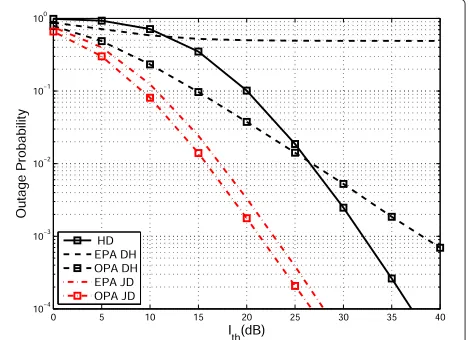
Figure 4 presents the outage probability as a function of the primary interference threshold Ith such that the
proposed schemes are compared to FDDH [29], consid-ering EPA and OPA, and to the half-duplex HD method. The proposed EPA FDJD scheme outperforms even the OPA FDDH proposed by [29]. Such performance gain comes from the additional diversity seen by the destina-tion because the direct link is seen as useful informadestina-tion rather than interference. Furthermore, the proposed OPA FDJD has the best performance among all schemes, and we observe a larger diversity gain in comparison with FDDH.
Fig. 4Outage probability for the different schemes as a function of the primary interference thresholdIth, withR=4 bpcu,Pp=10 dB,
Next, Fig. 5 evaluates the outage probability for the EPA and OPA schemes as a function of the attempted trans-mission rate R. Note that for low values of R, the HD scheme has better performance than the FDDH schemes because of the performance floor caused by the self-interference at the FD relay for high values ofIth.
More-over, the proposed OPA FDJD has the best performance
among all schemes for the wholeRrange, which means
that under OPA policy, the FDJD protocol can operate at a much higher rate given an outage probability threshold.
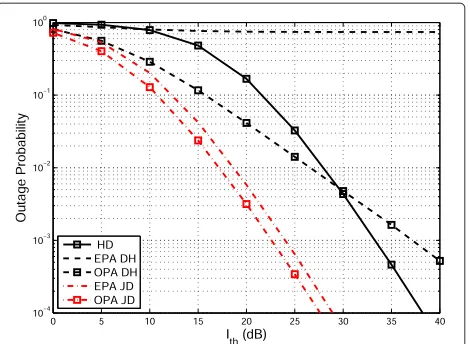
Figure 6 compares the outage probability for the differ-ent schemes with the relay near the secondary transmitter. In this case, we consider dsr = 18,dss = 12,drs = 38, dsp =1,drp =1,dpr =1,dps = 1,R= 4 bpcu,Pp =10
dB, andδ = −40 dB. On the other hand, Fig. 7 consid-ers the relay near the secondary destination. In this case, dsr= 38,dss= 12,drs= 18. From the figures, we can see that
regardless of the relay positioning, the proposed FDJD scheme has the best performance among all the schemes considered.
Figure 8 compares the outage probability versus the pri-mary transmit power Pp. We consider dsr = 14,dss =
1
2,drs= 14,dsp=1,drp=1,dpr =1,dps=1,R=4 bpcu, Ith = 10 dB, andδ = −40 dB. From the figure, we can
see that the OPA FDJD scheme outperforms the others schemes, even though suffering strong interference from the primary network.
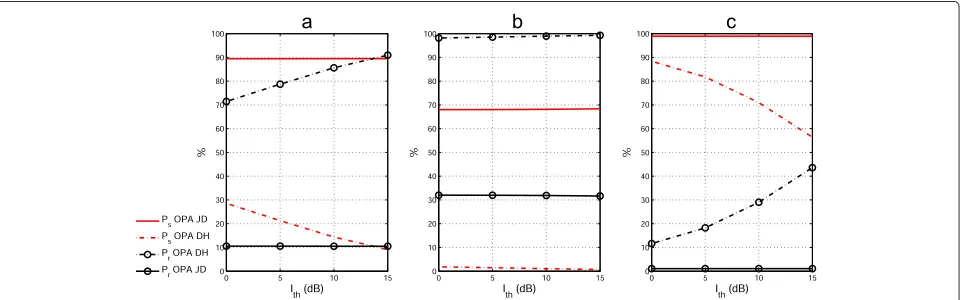
In the following, Fig. 9 compares the percentage of power that is allocated for the secondary transmitter and for the relay as a function of the primary interference thresholdIthfor three different positions of the relay: (a)
exactly in between the secondary transmitter and desti-nation dsr= 14,dss= 12,drs= 14
; (b) near to secondary transmitter dsr= 18,dss= 12,drs= 38
; and (c) near to secondary destination dsr= 38,dss= 12,drs= 18
. In (a),
Fig. 5Outage probability for the different schemes as a function of the attempted rateR, withPp=10 dB,δ= −40 dB, andIth=10 dB
Fig. 6Outage probability for the different schemes with the relay near to the secondary transmitter, withdsr= 18,dss= 12,drs= 38, dsp=1,drp=1,dpr=1,dps=1,R=4 bpcu,Pp=10 dB, and
δ= −40 dB
the FDJD scheme allocates more power for the secondary transmitter than for the relay. Recall that in FDJD, the direct link is seen as a useful source of information and also the relay can be put in idle mode, differently from the FDDH scheme where the relay is always fully operational. This also explains the fact that under the FDDH protocol, more power is allocated to the relay than to the source. While in (b), the OPA FDJD scheme allocates more power for the relay than in (a); once in this case, cooperation is preferred over direct transmission because the relay is closer to the source. We recall that the source-relay link is the bottleneck of cooperative relaying schemes; since the source and relay are closer, less outage events
Fig. 7Outage probability for the different schemes with the relay near to the secondary destination, withdsr= 38,dss=12,drs= 18, dsp=1,drp=1,dpr=1,dps=1,R=4 bpcu,Pp=10 dB, and
Fig. 8Outage probability as a function of the primary transmit power Pp, withdsr= 14,dss= 12,drs= 14,dsp=1,drp=1,dpr=1,dps=1, R=4 bpcu,Ith=10 dB, andδ= −40 dB
may occur which turns cooperation favorable. Next, in (c) and conversely to (b), the OPA FDJD strategy allocates more power for the secondary transmitter than the relay because the SINRγcoopis similar to the SINR of the direct
link.
5.1 Throughput analysis
In this subsection, the spectrum efficiency of the full-duplex schemes are compared. The throughput of the
full-duplex schemesch ∈{EPA FDDH, OPA FDDH, EPA
FDJD, OPA FDJD} (Tsch) is given byTsch=R(1−Osch),
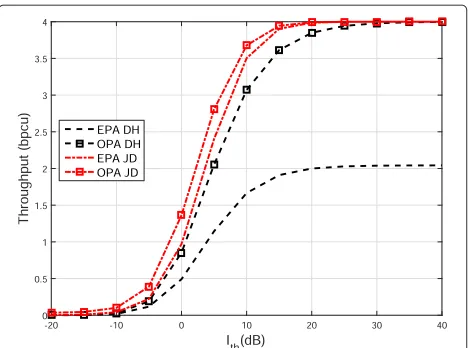
where the outage probabilities of EPA and OPA FDJD schemes are given by (10) and (37), while the outage prob-abilities for EPA and OPA FDDH schemes are written as in (20) and (48).
In Fig. 10, we present the throughputTschas a function
of the primary interference thresholdIthfor the FDJD and
FDDH schemes, withR= 4 bpcu,Pp = 10 dB, andδ =
−40 dB. From this figure, we can see that the proposed FDJD scheme has the best performance. Furthermore, the throughput of EPA DH saturates for Ith > 20 dB. This is caused by the increment of the self-interference at the relay and the interference of the direct link. Notice that even though suffering similar self-interference levels as the EPA DH, both JD protocols are able to decrease the effects of the self-interference.
6 Conclusions
This paper proposes a new FD scheme for a cognitive underlay network subject to self-interference as well as primary interference. The secondary destination jointly decodes the signals from the secondary transmitter and the relay—which differs from other works proposed in the literature where the direct link is seen as interfer-ence rather than useful information. We introduced new closed-form expressions for the outage probability of the proposed FD cooperative cognitive network under EPA policy. We first evaluated the FD schemes under EPA policy and show the feasibility of FD relaying under cognitive constraints. Our results showed that the pro-posed FDJD scheme considerably outperforms the known FDDH scheme and can operate at a much higher rate regime than other schemes. We propose a new optimal power allocation policy for the FDJD scheme. The OPA strategy can choose between two modes of operation, cooperation between source and relay or source transmis-sion only. Our results show that the FDJD scheme under the proposed OPA policy presents the best performance among all schemes investigated in this paper.
Appendices
Appendix 1: PDF and CDF ofZkl
LetZkl be a RV defined as Zkl = gkl/gkp, wheregij ∼
Exp(λij)andk= {s,r}andl= {s,r}. Then, based on
stan-dard statistical methods [42], we readily attain the PDF of
Fig. 9Power allocation forPsandPrfor three different positions of the relay:aexactly in between the secondary transmitter and destination,bnear
Fig. 10Throughput for the different FD schemes as a function of the
Appendix 2: PDF and CDF of W
We recall thatW = Zss+ZsrandfZkl(zkl) =
while the CDFFW(w)is obtained by integrating (49) from
0 to μ
s, which results in (11).
Competing interests
The authors declare that they have no competing interests.
Acknowledgements
This work was partially supported by the University of Oulu Graduate School, Infotech Oulu Graduate School, Academy of Finland, Araucaria Foundation (Brazil), CAPES (Brazil), and CNPq (Brazil).
Author details
1Federal University of Technology—Paraná (UTFPR), 80230-901 Curitiba, Brazil. 2Centre for Wireless Communications (CWC), University of Oulu, Oulu, Finland. 3Federal University of Ceará (UFC), Fortaleza, Brazil.4Federal University of
Paraná (UFPR), Curitiba, Brazil.
Received: 30 November 2014 Accepted: 23 May 2015
References
1. A Goldsmith, SA Jafar, I Maric, S Srinivasa, Breaking spectrum gridlock with cognitive radios: an information theoretic perspective. Proc. IEEE.97(5), 894–914 (2009)
2. S Srinivasa, SA Jafar, The throughput potential of cognitive radio: a theoretical perspective. IEEE Commun. Mag.45(5), 73–79 (2007) 3. A Ghasemi, ES Sousa, Fundamental limits of spectrum-sharing in fading
environments. IEEE Trans. Wireless Commun.6(2), 649–658 (2007) 4. L Lu, X Zhou, U Onunkwo, G Li, Ten years of research in spectrum sensing
and sharing in cognitive radio. EURASIP J. Wirel. Commun. Netw.2012(1), 28 (2012)
5. JN Laneman, DNC Tse, GW Wornell, Cooperative diversity in wireless networks: efficient protocols and outage behavior. IEEE Trans. Inf. Theory.
50(12), 3062–3080 (2004)
6. A Nosratinia, TE Hunter, A Hedayat, Cooperative communication in wireless networks. IEEE Commun. Mag.42(10), 74–80 (2004)
7. H Alves, R Souza, G Fraidenraich, M Pellenz, Throughput performance of parallel and repetition coding in incremental decode-and-forward relaying. Wirel. Netw.18(8), 881–892 (2012)
8. G Kramer, M Gastpar, P Gupta, Cooperative strategies and capacity theorems for relay networks. IEEE Trans. Inf. Theory.51(9), 3037–3063 (2005)
9. T Kwon, S Lim, S Choi, D Hong, Optimal duplex mode for df relay in terms of the outage probability. IEEE Trans. Veh. Technol.59(7), 3628–3634 (2010)
10. M Duarte, C Dick, A Sabharwal, Experiment-driven characterization of full-duplex wireless systems. IEEE Trans. Wireless Commun.11(12), 4296–4307 (2012)
11. T Riihonen, S Werner, R Wichman, Mitigation of loopback self-interference in full-duplex mimo relays. IEEE Trans. Signal Process.59(12), 5983–5993 (2011)
12. T Riihonen, S Werner, R Wichman, Hybrid full-duplex/half-duplex relaying with transmit power adaptation. IEEE Trans. Wireless Commun.10(9), 3074–3085 (2011)
13. T Riihonen, S Werner, R Wichman, Optimized gain control for single-frequency relaying with loop interference. IEEE Trans. Wireless Commun.8(6), 2801–2806 (2009)
14. H Alves, G Fraidenraich, RD Souza, M Bennis, M Latva-aho, inWireless Communications and Networking Conference (WCNC), 2012 IEEE. Performance analysis of full duplex and selective and incremental half duplex relaying schemes (Paris, France, 2012), pp. 771–775. doi:10.1109/WCNC.2012.6214475
15. H Alves, RD Souza, G Fraidenraich, Outage, throughput and energy efficiency analysis of some half and full duplex cooperative relaying schemes. Trans. Emerg. Telecommun. Technol.25(11), 1114–1125 (2014) 16. Y Zhu, Y Xin, P-Y Kam, Outage probability of rician fading relay channels.
IEEE Trans. Veh. Technol.57(4), 2648–2652 (2008)
17. H Alves, D Benevides da Costa, RD Souza, M Latva-aho, Performance of block-markov full duplex relaying with self interference in nakagami-m fading. IEEE Wireless Commun. Lett.2(3), 311–314 (2013)
18. TQ Duong, PL Yeoh, VNQ Bao, M Elkashlan, N Yang, Cognitive relay networks with multiple primary transceivers under spectrum-sharing. IEEE Signal Process. Lett.19(11), 741–744 (2012)
19. TQ Duong, VNQ Bao, H Tran, GC Alexandropoulos, H-J Zepernick, Effect of primary network on performance of spectrum sharing AF relaying. Electron. Lett.48(1), 25–27 (2012)
20. TQ Duong, D Benevides da Costa, M Elkashlan, VNQ Bao, Cognitive amplify-and-forward relay networks over nakagami-m fading. IEEE Trans. Veh. Technol.61(5), 2368–2374 (2012)
21. TQ Duong, D Benevides da Costa, TA Tsiftsis, C Zhong, A Nallanathan, Outage and diversity of cognitive relaying systems under spectrum sharing environments in nakagami-m fading. IEEE Commun. Lett.16(12), 2075–2078 (2012)
22. W Xu, J Zhang, P Zhang, C Tellambura, Outage probability of decode-and-forward cognitive relay in presence of primary user’s interference. IEEE Commun. Lett.16(8), 1252–1255 (2012)
23. S Mafra, R Souza, J Rebelatto, E Fernandez, H Alves, Cooperative overlay secondary transmissions exploiting primary retransmissions. EURASIP J. Wirel. Commun. Netw.2013(1), 196 (2013)
selection in non-identical rayleigh fading. IEEE Commun. Lett.17(3), 475–478 (2013)
25. J Si, Z Li, H Huang, J Chen, R Gao, Capacity analysis of cognitive relay networks with the PU’s interference. IEEE Commun. Lett.16(12), 2020–2023 (2012)
26. X Jia, M Zhou, X Dang, L Yang, H Zhu, Adaptive power allocation and outage performance of cognitive best relay cooperation systems with multiple primary transceiver pairs and direct path between cognitive source and destination. EURASIP J. Wirel. Commun. Netw.2014(1), 122 (2014)
27. F Zhao, X Sun, H Chen, R Bie, Outage performance of relay-assisted primary and secondary transmissions in cognitive relay networks. EURASIP J. Wirel. Commun. Netw.2014(1), 60 (2014)
28. EE Benitez Olivo, DP Moya Osorio, DB Costa da, JC Silveira Santos Filho, Outage performance of spectrally efficient schemes for multiuser cognitive relaying networks with underlay spectrum sharing. IEEE Trans. Wireless Commun.13(12), 6629–6642 (2014).
doi:10.1109/TWC.2014.2360204
29. H Kim, S Lim, H Wang, D Hong, Optimal power allocation and outage analysis for cognitive full duplex relay systems. IEEE Trans. Wireless Commun.11(10), 3754–3765 (2012)
30. M Khafagy, A Ismail, M-S Alouini, S Aissa, On the outage performance of full-duplex selective decode-and-forward relaying. IEEE Commun. Lett.
17(6), 1180–1183 (2013)
31. MG Khafagy, A Tammam, M Alouini, S Aissa, Efficient cooperative protocols for full-duplex relaying over nakagami-m fading channels. IEEE Trans. Wireless Commun. (2015). doi:10.1109/TWC.2015.2406712 32. S Mafra, H Alves, RD Souza, D Benevides da Costa, E Fernandez, M
Latva-aho, in31st Brazilian Telecommunications Symposium - SBrT’13. On the performance of cognitive full-duplex relaying systems under spectrum sharing constraints (Fortaleza, Brazil, 2013)
33. T Cover, AE Gamal, Capacity theorems for the relay channel. IEEE Trans. Inf. Theory.25(5), 572–584 (1979)
34. A Carleial, Multiple-access channels with different generalized feedback signals. IEEE Trans. Inf. Theory.28(6), 841–850 (1982)
35. C-M Zeng, F Kuhlmann, A Buzo, Achievability proof of some multiuser channel coding theorems using backward decoding. IEEE Trans. Inf. Theory.35(6), 1160–1165 (1989)
36. A Jovicic, P Viswanath, Cognitive radio: an information-theoretic perspective. IEEE Trans. Inf. Theory.55(9), 3945–3958 (2009) 37. E Pei, S Wang, Z Zhang, Capacity and optimal power allocation for
spectrum-sharing with primary transmission consideration in fading channels. IEEE Commun. Lett.15(4), 389–391 (2011)
38. X Gong, SA Vorobyov, C Tellambura, Optimal bandwidth and power allocation for sum ergodic capacity under fading channels in cognitive radio networks. IEEE Trans. Signal Process.59(4), 1814–1826 (2011) 39. A Punchihewa, VK Bhargava, C Despins, Capacity and power allocation for
cognitive mac with imperfect channel estimation. IEEE Trans. Wireless Commun.10(12), 4001–4007 (2011)
40. G Caire, D Tuninetti, The throughput of hybrid-arq protocols for the gaussian collision channel. IEEE Trans. Inf. Theory.47(5), 1971–1988 (2001) 41. VNQ Bao, DH Bac, inICT Convergence (ICTC), 2011 International Conference
On. A unified framework for performance analysis of df cognitive relay networks under interference constraints (Seoul, South Korea, 2011), pp. 537–542. doi:10.1109/ICTC.2011.6082656
42. A Papoulis, SU Pillai,Probability, Random Variables, and Stochastic Processes. (Tata McGraw-Hill, New York, 2002)
43. IS Gradshteyn, IM Ryzhik,Table of Integrals, Series, and Products, Fifth Edition. (Academic Press, New-York, 2007)
Submit your manuscript to a
journal and benefi t from:
7Convenient online submission 7Rigorous peer review
7Immediate publication on acceptance 7Open access: articles freely available online 7High visibility within the fi eld
7Retaining the copyright to your article