BIOLOGIC ARMAMENTARIUM IN PSORIASIS
GANESH PAI
1*, NITHIN SASHIDHARAN
21Medical Director, Derma-Care ‘The Trade Centre’, Mangalore - 575 003, Karnataka, India. 2Consultant Clinical Pharmacologist, Derma-Care ‘The Trade Centre’, Mangalore - 575 003, Karnataka, India. Email: [email protected]
Received: 14 July 2015, Revised and Accepted: 24 August 2015 ABSTRACT
Psoriasis is an autoimmune disease and further classed as a chronic inflammatory skin condition serving as a global burden. A moderate to severe psoriasis can be treated with conventional therapies. Less efficacy, poor patient compliance, and toxicity issues were the major problems associated with conventional therapies. The introduction of biologic therapy has a great impression on psoriatic treatment duration and enhanced quality of life in psoriasis patients. The new biologic therapies are tailor-made medications with the goal of more specific and effective treatment; less toxicity. The biologic therapy is aimed to target antigen presentation and co-stimulation, T-cell activation, and leukocyte adhesion; and pro-inflammatory cascade. They act as effective and safer substitute to traditional therapy. Secukinumab, certolizumab, itolizumab, golimumab, ustekinumab, adalimumab, infliximab etanercept, alefacept, etc. are the approved biologic with the global market. This review briefs about psoriasis pathogenesis, traditional treatments, and biologic therapies potential.
Keywords: Psoriasis, Biologic, Non-biologic treatment.
INTRODUCTION
Psoriasis is an autoimmune disease and further classed as a chronic inflammatory skin condition with prevalence ranging 1-3% in the world [1]. The five types of psoriasis are plaque psoriasis (psoriasis vulgaris), guttate, inverse psoriasis (intertriginous psoriasis), pustular, and erythrodermic. The most common is chronic plaque psoriasis [2]. This disease is characterized clinically by red-colored plaques with a silvery scale. It may affect all parts of skin but most commonly seen on the skin trunk, elbow, knees, scalps, in the finger nails and toe nails. Genetic, immunologic and environmental factors are playing an important role in the pathogenesis of psoriasis [3].
PATHOGENESIS OF PSORIASIS
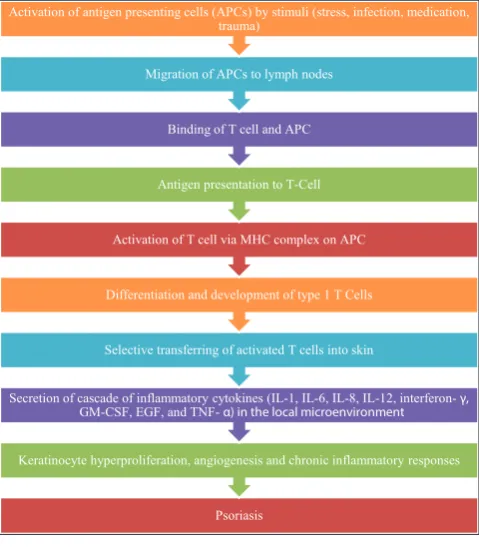
The pathogenesis of psoriasis is complex and includes mediators of the innate immunity (especially dendritic cells [DCs] and keratinocytes) and adaptive immunity (T-lymphocytes). T-cells (T helper 17 [Th17] and Th1 cells) are mainly involved in the immunopathogenesis of psoriasis [4]. DCs are important constituent of the innate immune system, which are located in the epidermis as Langerhan cells and in the dermis as myeloid and plasmacytoid cells. The activation of antigen presenting cells (APCs) may be initiated due to stress, infection, medication, trauma, or unknown trigger. Antigen processing starts after activation of APCs. APCs are migrated to the regional lymph node where antigen is presented to T-lymphocytes [1].
The activation of T-cell by APC requires the presence of primary signal and presentation of antigen via the major histocompatibility complex on the APC to the T-cell receptor and a variety of co-stimulatory interactions. This process involves linkage of LFA-1, CD3, CD4/ CD8, CD2, CD40L, and CD28 on the surface of the T-lymphocyte with intracellular adhesion molecule-1 (ICAM-1), LFA-3, CD40, and B7 on the surface of the antigen-presenting cell [5].
The signaling between T-cell (CD28 glycoprotein) and APC (CD80/CD86 glycoprotein) initiates transcription of wide range of cytokines, which are produced in the local microenvironment includes interleukin-1 (IL-1), IL-2, IL-6, IL-12, interferon gamma (IFN-γ), tumor necrosis factor-alpha (TNF-α), and granulocyte-macrophage colony-stimulating factor [6]. These cytokines are important mediators of T-cell activation in psoriasis. The effects of these cytokine include keratinocyte
migration, potentiation of Th1 type of response, angiogenesis, and epidermal hyperplasia [7].
TNF-α is plays vital role in the pathogenesis of psoriasis. It acts by promoting the release of various chemokine as well as inflammatory processes via expression of ICAM-1 and vascular adhesion protein-1 in keratinocytes and endothelial cells. This led to increased proliferation of keratinocytes and endothelial cells, resulting in epidermal hyperplasia and the formation of neocapillaries [6].
In psoriasis, presence of Th1 cytokines (IFN-γ, TNF-α and IL-12) in the dermis and epidermis induces proliferation and disordered maturation of keratinocytes, as well as the vascular changes were observed [8].
In addition, keratinocytes and DCs produce a higher level of IL-23, which stimulates Th17 cell production of IL-6, IL-17A, IL-17F, IL-21, and IL-22 in the dermis [9]. IL-22 predominantly stimulates keratinocyte hyperproliferation and epidermal acanthosis and hyperparakeratosis [10].
All these inflammatory responses and tissue changes finally lead to a condition of psoriasis (Fig. 1).
SEVERITY OF PSORIASIS
The severity of psoriasis is measured as mild, moderate, and severe depending on body surface area affected [2].
Mild psoriasis
Affects up to 3% of the body, generally in isolated patches on the knees, elbows, scalp, hands, and feet. It can often be controlled with topical therapy.
Moderate psoriasis
Affects 3-10% of the body’s surface. It often appears on the arms, legs, torso, scalp, and other areas. Topical agents, phototherapy, systemic medications, including biologics, may be appropriate.
Severe psoriasis
or combination of these, with or without topical agents are usually necessary to achieve adequate results [11].
Etiology
The etiology of psoriasis is not known completely. It is associated with a complex interaction of genetic, environmental factors and other factors.
Genetic factor
Psoriasis belongs to the class of complex autoimmune genetic diseases that include diabetes, rheumatoid arthritis (RA), multiple sclerosis and Crohn’s disease [12].
Environmental factors
Environmental factors such as trauma, stress, infection (e.g., beta-hemolytic streptococcal infection, staphylococcal, human immunodeficiency virus), and drugs (e.g., lithium, beta-blockers, non-steroidal anti-inflammatory drugs) can stimulate an extravagant immune-mediated response in the skin of genetically-susceptible individuals. This process eventually leads to hyperproliferation and inflammation of epidermal cells which is characteristic of psoriasis [6].
Hot weather and sunlight may be beneficial for psoriasis. Heller et al. said that proportion of psoriasis patients who believe stress affects their skin condition (i.e., “stress responders”) is considerably high, ranging from 37% to 78%. Stress may worsen psoriasis severity and may even lengthen the time to disease clearance [13].
Smoking
In one of a cross-sectional study of 338 patients, study findings revealed that the severity of psoriasis was more among smokers than among non-smokers. In this study, author correlated increased severity of psoriasis to nicotine dependence [14].
Immunologic factors
Recent advances in genetics and immunology have demonstrated the immune pathways relevant to psoriasis pathogenesis. Psoriasis lesions show high levels of dermal and circulating TNF-α, hence treatment with TNF-α inhibitors is often useful in psoriasis.
Psoriasis is a common dermatological disorder in India. In India, the prevalence of psoriasis varies from 0.44% to 2.8%, it is twice more common in males compared to females, and most of the patients are in their third or fourth decade at the time of presentation. There is a paucity of data related to Indian psoriasis patients on its genetics, epidemiology, pustular psoriasis, childhood psoriasis, disease severity, relapse, remission patterns and its associations [15].
Available treatment options for psoriasis are topical, oral systemic agents, phototherapy, and biologic therapy [5]. Traditional therapies such as methotrexate, cyclosporine A, retinoid therapy have a potential for long-term toxicity and not targeted against to root cause of psoriasis [1]. The main aim of a biologic is arresting the disease by specific targeting the immune or genetic mediator of pathogenic processes [16].
PSORIASIS TREATMENT BEFORE BIOLOGICAL
Traditionally, since biblical time’s patients with psoriasis treated with sun exposure and several clinical studies have strengthened this observation [17]. Moderate to severe psoriasis can be treated with conventional therapies like topical therapy, phototherapy and systemic therapy [18]. Broadly psoriasis treatment before biological is classified as a topical treatment, phototherapy, and non-biologic systemic therapy.
Topical treatment
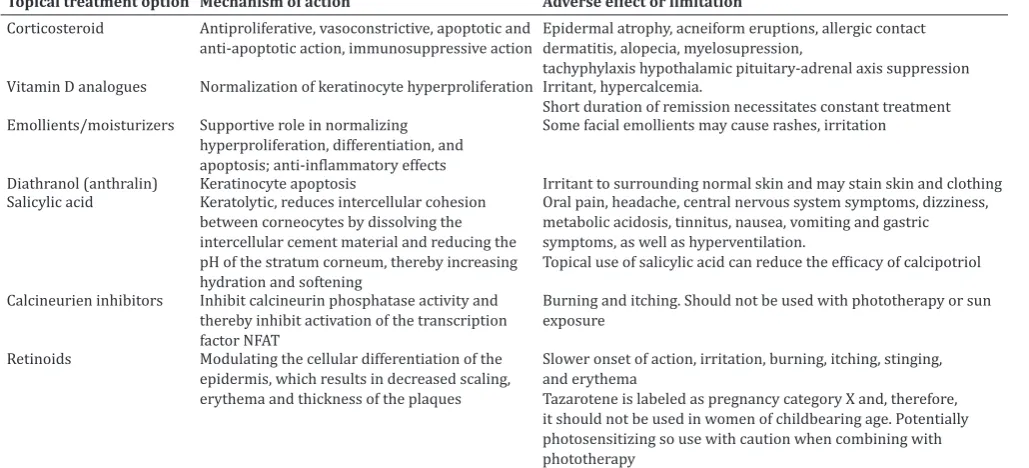
Topical therapy is preferential treatment for mild psoriasis [19]. They can be used as adjuvant therapy to treat moderate to severe psoriasis. Emollients, dithranol, tar, deltanoids, vicorticoids, tacrolimus, anthralin, corticosteroids, salicylic acid, tars, tazarotene, vitamin D analogue (calcipotriene, calcitriol) are mostly used for topical treatment of psoriasis. Corticosteroids are mainstay in topical treatment especially for plaque psoriasis [18]. Betamethasone valerate, desonide, fluocinonide, hydrocortisone acetate, triamcinolone acetonide, clobetasol 17-propionate, halobetasol propionate are the few examples of frequently used topical corticosteroid. Corticosteroid act via a different mechanism like anti-proliferative, vasoconstrictive, apoptotic and anti-apoptotic action, immunosuppressive action. In rare cases, long-term widespread use of high-potency topical steroids is associated with suppression of the hypothalamic pituitary-adrenal axis [5,20]. Vitamin D analogues like calcipotriene, calitrol are also efficient options. Other topical treatments used are emollients/moisturizers, diathranol (anthralin), salicylic acid, calcineurien inhibitors, and retinoids [21-25]. Details of treatment option with their mechanism of action and adverse effect are explained in Table 1.
Phototherapy
application of vitamin D after phototherapy to avoid degradation of vitamin D [28]. Adachi et al. reported in 2008 topical application of vitamin D3 analogs either before or after irradiation by psoralen and UVA radiation (PUVA) or NB-UVB showed exactly similar effects in all patients [27].
Non-biologic systemic therapy
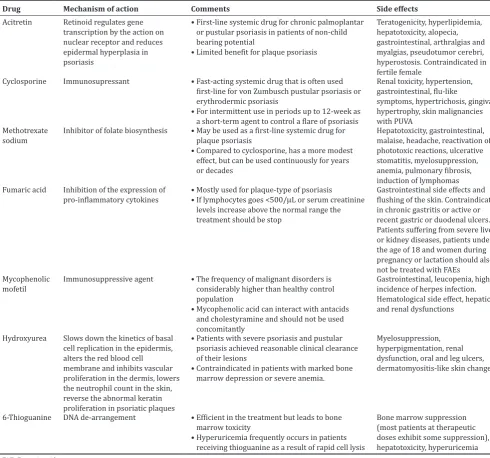
Methotrexate, cyclosporin, acitretin are most frequently used systemic therapy for psoriasis [29,30]. Drug, such as fumaric acid esters, mycophenolic mofetil, 6-thioguanine and hydroxyureas, is also used as non-biologic systemic therapy for treatment of psoriasis (Table 2) [31-33].
BIOLOGIC TREATMENT IN PSORIASIS
Biologic therapy contains protein biomolecules which are manufactured by living organisms. They have the aim to target specific points of inflammation cascade, including antibodies against cytokines, cell surface markers, and adhesion molecules [3]. The market available biologic for psoriasis treatment specifically targets T-cell, APCs and inflammatory mediator TNF-α. The introduction of biologic therapy has a great impression on psoriatic treatment duration and enhanced quality of life in psoriasis patients. They act as effective and safer substitute to traditional therapy as well as phototherapy for treatment of psoriasis [16].
Several biologic were approved for treatment of moderate to severe psoriasis (Table 3) since last decade and many mores in clinical trials (Table 4).
Secukinumab
Regulatory status
Secukinumab was first approved in Japan on December 26, 2014, for the treatment of psoriasis and psoriatic arthritis (PsA) in adults who are not sufficiently responding to systemic therapies (other than biologic therapy). It is a fully human monoclonal antibody against cytokine family member IL-17A, developed for the intravenous and subcutaneous route of administration. In early 2015, Secukinumab was approved by the USA and the EU, for the treatment of patients with moderate-to-severe plaque psoriasis. It is also under investigation for patients with ankylosing spondylitis and RA [34].
Mechanism of action
Secukinumab is a human monoclonal antibody which specifically binds and neutralizes the pro-inflammatory cytokine IL-17A. It neutralizes the activity of IL-17A but do not interfere with other functions of Th17 cells. In addition, it does not neutralize IL-17F. This new mechanism action results into the normalization of skin histology with almost clear skin in most of the patients [35]. IL-17 plays an important role in the pathogenesis of psoriasis which is produced by Th17 cells, neutrophils, mast cells, and T-cytotoxic 17 cells. IL-17 involved in host defense facilitated through certain mechanisms that include up-regulation of cytokine, chemokine, and antimicrobial peptide production [36]. IL-17A acts on keratinocytes to induce expression of chemokines required in recruiting myeloid DCs, Th17 cells, and neutrophils to the lesion site [37]. The increased level of Th17 cells in the circulation of psoriatic patient observed as compared to healthy subjects, and their level is strictly related to disease severity measured by psoriasis area and severity index (PASI) score [9].
Clinical trials
In four Phase III trials of secukinumab primary end point (at week 12) was measured ≥75% improvement in PASI 75 from baseline and a score of 0 (clear) or 1 (almost clear) on a 5-point Investigator’s Global Assessment scale (IGA mod 2011 0/1) versus placebo.
In the Phase III study (ERASURE), primary end point PASI 75 was attained at week 12 in 81.6% of the Psoriasis patients who received treatment 300 mg of secukinumab, 71.6% of those who received 150 mg of the drug, and 4.5% of those in the placebo group (p<0.0001). IGA rates were 65.3% with 300 mg of secukinumab, 51.2% with 150 mg of secukinumab, and 2.4% with placebo [38]. Subsequent ERASURE study of secukinumab exhibited higher PASI 75 and IGA mod 2011 0/1 responses in 300 mg (82.8% and 55.2%, respectively) or 150 mg (86.2% and 55.2%, respectively) versus placebo (6.9% and 3.4%, respectively). Secukinumab 300 mg dose was found more effective than 150 mg dose, in the maintenance period [39].
In the FIXTURE trial, PASI 75 was achieved by 77.1% (secukinumab 300 mg) and 67% (secukinumab 150 mg); 44% (etanercept group) and 4.9% of patients in the placebo group. The IGA rates were 62.5% (300 mg of secukinumab), 51.1% (150 mg of secukinumab), 27.2% Table 1: Topical treatment for psoriasis
Topical treatment option Mechanism of action Adverse effect or limitation Corticosteroid Antiproliferative, vasoconstrictive, apoptotic and
anti-apoptotic action, immunosuppressive action Epidermal atrophy, acneiform eruptions, allergic contact dermatitis, alopecia, myelosupression, tachyphylaxis hypothalamic pituitary-adrenal axis suppression Vitamin D analogues Normalization of keratinocyte hyperproliferation Irritant, hypercalcemia.
Short duration of remission necessitates constant treatment Emollients/moisturizers Supportive role in normalizing
hyperproliferation, differentiation, and apoptosis; anti-inflammatory effects
Some facial emollients may cause rashes, irritation
Diathranol (anthralin) Keratinocyte apoptosis Irritant to surrounding normal skin and may stain skin and clothing
Salicylic acid Keratolytic, reduces intercellular cohesion between corneocytes by dissolving the intercellular cement material and reducing the pH of the stratum corneum, thereby increasing hydration and softening
Oral pain, headache, central nervous system symptoms, dizziness, metabolic acidosis, tinnitus, nausea, vomiting and gastric symptoms, as well as hyperventilation.
Topical use of salicylic acid can reduce the efficacy of calcipotriol
Calcineurien inhibitors Inhibit calcineurin phosphatase activity and thereby inhibit activation of the transcription factor NFAT
Burning and itching. Should not be used with phototherapy or sun exposure
Retinoids Modulating the cellular differentiation of the
epidermis, which results in decreased scaling, erythema and thickness of the plaques
Slower onset of action, irritation, burning, itching, stinging, and erythema
Tazarotene is labeled as pregnancy category X and, therefore, it should not be used in women of childbearing age. Potentially photosensitizing so use with caution when combining with phototherapy
Table 2: Non-biologic systemic therapy
Drug Mechanism of action Comments Side effects
Acitretin Retinoid regulates gene transcription by the action on nuclear receptor and reduces epidermal hyperplasia in psoriasis
• First‑line systemic drug for chronic palmoplantar or pustular psoriasis in patients of non-child bearing potential
• Limited benefit for plaque psoriasis
Teratogenicity, hyperlipidemia, hepatotoxicity, alopecia, gastrointestinal, arthralgias and myalgias, pseudotumor cerebri, hyperostosis. Contraindicated in fertile female
Cyclosporine Immunosupressant • Fast‑acting systemic drug that is often used
first-line for von Zumbusch pustular psoriasis or erythrodermic psoriasis
• For intermittent use in periods up to 12‑week as a short-term agent to control a flare of psoriasis
Renal toxicity, hypertension, gastrointestinal, flu-like
symptoms, hypertrichosis, gingival hypertrophy, skin malignancies with PUVA
Methotrexate
sodium Inhibitor of folate biosynthesis • May be used as a first‑line systemic drug for plaque psoriasis • Compared to cyclosporine, has a more modest
effect, but can be used continuously for years or decades
Hepatotoxicity, gastrointestinal, malaise, headache, reactivation of phototoxic reactions, ulcerative stomatitis, myelosuppression, anemia, pulmonary fibrosis, induction of lymphomas Fumaric acid Inhibition of the expression of
pro-inflammatory cytokines • Mostly used for plaque‑type of psoriasis• If lymphocytes goes <500/µL or serum creatinine levels increase above the normal range the treatment should be stop
Gastrointestinal side effects and flushing of the skin. Contraindicated in chronic gastritis or active or recent gastric or duodenal ulcers. Patients suffering from severe liver or kidney diseases, patients under the age of 18 and women during pregnancy or lactation should also not be treated with FAEs
Mycophenolic
mofetil Immunosuppressive agent • The frequency of malignant disorders is considerably higher than healthy control population
• Mycophenolic acid can interact with antacids and cholestyramine and should not be used concomitantly
Gastrointestinal, leucopenia, higher incidence of herpes infection. Hematological side effect, hepatic and renal dysfunctions
Hydroxyurea Slows down the kinetics of basal cell replication in the epidermis, alters the red blood cell membrane and inhibits vascular proliferation in the dermis, lowers the neutrophil count in the skin, reverse the abnormal keratin proliferation in psoriatic plaques
• Patients with severe psoriasis and pustular psoriasis achieved reasonable clinical clearance of their lesions
• Contraindicated in patients with marked bone marrow depression or severe anemia.
Myelosuppression, hyperpigmentation, renal dysfunction, oral and leg ulcers, dermatomyositis-like skin changes
6-Thioguanine DNA de-arrangement • Efficient in the treatment but leads to bone marrow toxicity
• Hyperuricemia frequently occurs in patients receiving thioguanine as a result of rapid cell lysis
Bone marrow suppression (most patients at therapeutic doses exhibit some suppression), hepatotoxicity, hyperuricemia FAE: Fumaric acid esters
Table 3: List of biologic approved for psoriasis treatment
Biologic Description Mechanism Status
Secukinumab
(AIN457) Human monoclonal antibody Anti-IL-17 Approved for psoriasis in 2015 (FDA)
Certolizumab Humanized monoclonal antibody TNF‑α inhibitor Approved for PsA in 2013 (FDA)
Itolizumab Humanized IgG1 monoclonal antibody Anti-CD6 T-cell Approved for psoriasis in 2013 (DCGI for India)
Golimumab Human monoclonal antibody TNF‑α inhibitor Approved for PsA in 2009 (FDA)
Ustekinumab Human monoclonal antibody IL-12/23 inhibitor Approved for psoriasis in 2009 (FDA)
Adalimumab Human monoclonal antibody TNF‑α inhibitor Approved for psoriasis in 2008 (FDA)
Infliximab Chimeric monoclonal antibody TNF‑α inhibitor Approved for psoriasis in 2006 (FDA)
Etanercept 1-235-TNF receptor (human) fusion protein with 236‑467‑immunoglobulin G1 (human γ1‑chain Fc fragment), dimer
TNF‑α inhibitor Approved for psoriasis in 2004 (FDA)
Efalizumab Recombinant humanized monoclonal antibody LFA-1 inhibitor Approved for psoriasis in 2003 (FDA)
Alefacept 1-92-antigen LFA-3 (human) fusion protein with human immunoglobulin G1 (hinge-CH2-CH3 gamma1-chain), dimer
Anti-CD4+and
CD8+T-cells Approved for psoriasis in 2003 (FDA)
(etanercept), and 2.8% with placebo, respectively. The rates of infection were higher with secukinumab than with placebo in both ERASURE and FIXTURE studies and were similar to those with etanercept [38]. In another Phase III study, similar types of PASI 75 response and IGA score was reported when secukinumab was administered via pre-filled syringe (PFS) in subjects. PFS usability was high, all (100%) of subjects successfully self-administered treatment at week 1 [40].
In another study (JUNCTURE) secukinumab was administered via autoinjector/pen in moderate to severe plaque psoriasis patients. PASI 75 and IGA mod 2011 0/1 responses were superior with secukinumab 300 mg (86.7% and 73.3%, respectively) and 150 mg (71.7% and 53.3%, respectively) versus placebo (3.3% and 0%, respectively) (p<0.0001 for all). Patient acceptability of auto-injector was high throughout the period. Adverse events were observed as mild/moderate nasopharyngitis with secukinumab (300 mg, 70.0%; 150 mg, 63.9%) versus placebo (54.1%) [41].
SCULPTURE study was planned to compare a fixed maintenance schedule of once-monthly dosing of secukinumab with dosing as needed to treat relapse. PASI 75 or greater response achieved patients on either 150 or 300 mg of secukinumab were re-randomized at week 8 to receive either 150 or 300 mg of secukinumab monthly injections or re-treatment as needed when relapse occurred. At week 52, 78% patients achieved PASI 75 responses who received 300 mg once monthly and did 68% of those in the as needed 300 mg drug group. PASI 75 was estimated in 62% patients who received 150 mg of secukinumab at 52 week with monthly dosing, while did 52% of those in the as-needed dosing group. PASI 90 responses were observed in 60% and 46% of patients who received 300 mg and 150 mg of secukinumab once monthly, at week 52 respectively. Considerably, lower PASI 90 score were detected for those patients who received either dose of secukinumab on an as needed basis [42].
Adverse events
Secukinumab treated psoriatic patients mainly susceptible for Candida
infection; in addition, occurrence of adverse events, such as neutropenia, nasopharyngitis, upper respiratory tract infection, and headache, were reported [35,38,40,43].
Certolizumab (CZP)
Regulatory status
The U.S. Food and Drug Administration (FDA) approved CZP (Cimzia®)
for use in the United States for the treatment of Crohn’s disease On April 22, 2008. European Medicines Agency first refused approval of CZP for the treatment of Crohn’s disease later on it was granted to UCB Pharma SA on October 1, 2009. FDA on May 13, 2009, approved it for RA afterward on September 27, 2013 it was approved for treatment of adult patients with active PsA later on October 18, 2013, it was approved in the treatment of ankylosing spondylitis. It was approved for axial spondyloarthritis in 39 countries [44-46].
Mechanism of action
CZP is a recombinant, humanized anti-TNF-α antigen binding fragment (Fab’) whose structure differs from other anti-TNF-α agents [47]. Overexpression of TNF-α is believed to play a key role in the pathogenic mechanisms linking psoriasis and arthritis. CZP
selectively neutralizes TNF-α but does not neutralize lymphotoxin α (TNF-β). Incubation of monocytes with CZP caused a dose-dependent inhibition of lipopolysaccharide-induced TNF-α and IL1β production in human monocytes. It does not induce apoptosis in vitro in human peripheral blood-derived monocytes or lymphocytes, or neutrophil degranulation [46-48].
Clinical trials
In a Phase II trial, PASI 75 response was achieved by 75%, 83% and 7% patients with moderate-to-severe plaque psoriasis in the CZP 200 mg, CZP 400 mg and placebo groups, respectively. Similar results were observed in the re-treatment study conducted in PASI 75 responders in both CZP groups [49].
Two doses of CZP were compared with placebo in a Phase III study of PsA. ACR 20 response was significantly greater in CZP 200 mg every 2 weeks (58.0%) and 400 mg every 4 weeks (51.9%) treated patients than placebo (24.3%) (p<0.001). Significant improvements observed by week 1 and maintained up to week 24. Moreover, CZP resulted in sustained improvements in psoriatic skin involvement, enthesitis, dactylitis and nail disease and quality of life [50].
Gladmen et al. examined the effect of CZP pegol on patient-reported outcomes in PsA patients with and without prior TNF inhibitor exposure. At week 24, significantly more CZP patients attained the minimum clinically important differences in pain, fatigue, physical function, and physical and mental component scores of the SF-36. The benefits of CZP treatment for health-related quality of life were seen across generic, PsA-specific and dermatology-specific measures and were observed in patients regardless of prior TNF inhibitor exposure [51].
Adverse events
Infections (respiratory tract, urinary tract, viral, etc.) are the most common side effect observed under CZP [49,50,52]. Other common side effects were fever, high blood pressure, rash or itching, headaches (including migraines), liver problems, injection site reactions, and sensory abnormalities such as numbness, tingling, burning sensation [46,49,50,52]. Increased risk of serious infections like tuberculosis, bacterial sepsis, invasive fungal infections (such as histoplasmosis) and infections due to other opportunistic pathogens may occur with CZP. Lymphoma and other malignancies have been reported in children and adolescent patients treated with TNF blockers, it is not indicated for use in pediatric patients [53].
Itolizumab
Regulatory status
Itolizumab is a humanized recombinant anti-CD6 monoclonal antibody, prepared by a T-cell epitope humanization approach from the murine clone ior t1 [54,55]. Itolizumab (alzumab) was approved in January 2013 for the treatment of chronic plaque psoriasis by the Drugs Controller General of India [56]. It is also approved in Cuba for the treatment of moderate to severe plaque psoriasis [54].
Mechanism of action
Itolizumab targets CD6, which is predominantly expressed by T-cells and a subset of B-cells [57]. It inhibits CD6-mediated co-stimulation of T-cells and down-regulates production of multiple pro-inflammatory Table 4: Biologics in clinical trials
Biologic Description Mechanism Status
Ixekizumab (LY2439821) Humanized monoclonal antibody Anti-Th17 Phase III completed
Briakinumab Human monoclonal antibody IL-12/23 p40 inhibitor Phase III completed
Brodalumab (AMG827) Human monoclonal antibody Anti-IL-17 Phase III ongoing
Guselkumab (CNTO1959) Human monoclonal antibody Anti-IL23p19 Phase III ongoing
Tildrakizumab (MK3222/SCH-900222) Humanized monoclonal antibody Anti-IL-23 Phase III ongoing
cytokines. The effect is achieved by influencing mitogen-activated protein kinase and a signal transducer, in addition, activator of transcription-3 signaling pathways which lead to a reduction in production of pro-inflammatory cytokines such as IFN-γ, IL-6 and TNF. T-cells in circulation are not reduced so general immunity is not compromised [56,58].
Clinical trial
In a Phase II trial, itolizumab exhibited consistent reduction in PASI score from baseline visit to week 12. Itolizumab showed prompt PASI 75 response in 42.5 % patients at week 8 while 45 % in patients at week 12 [58]. Krupashankar et al. reported that itolizumab was effective and well tolerated in chronic plaque psoriasis patient. At week 12, significant PASI 75 response was achieved in 27.0% and 36.4% in two regimens of itolizumab as compared to 2.3% in placebo-treated patients. At week 28, the PASI 75 score was comparable for placebo and itolizumab treated patients [59].
Adverse events
Diarrhea, infusion-related reactions, upper respiratory tract infection and pruritic were the most common side effects reported [58,59].
Ustekinumab
Regulatory status
In 2009, FDA was the first approved Ustekinumab (Stelara) for adults who have a moderate to severe form of psoriasis. Further, it was approved for PsA in 2013. Ustekinumab is a human monoclonal antibody that targets IL-12/23 p40 to treat psoriasis. It is administered as a subcutaneous injection [60].
Mechanism of action
Ustekinumab is the first of a new class of biological drugs that specifically binds to common p40 protein subunit of human cytokines IL-12 and IL-23. It inhibits the activity of human IL-12 and IL-23 by averting p40 subunit interaction with IL-12Rβ1 receptor protein expressed on the surface of immune cells. IL-12 and IL-23 are cytokines secreted by activated macrophages or DCs. These cytokines involved in activation of NK-cells and CD4+ T-cell differentiation as well as activation. Thus, it targets both Th1 and Th17 arms of immunity [61]. IL-23 stimulates proliferation of Th17 cells, these cells regulate the production of inflammatory cytokines (IL-17, IL-22, IL-21, IL-6, TNF-α which are predominantly observed in psoriatic plaques [62]. Th1 cell express the transcription growth factor-β after exposure to IL-12 as well as produces pro-inflammatory cytokines (IFN-γ, TNF-α, IL-2) [63].
Clinical trials
PHOENIX (1 and 2), and ACCEPT studies proved beneficial in patients who were less responsive to immunosuppressive treatment including cyclosporine or methotrexate, phototherapy and unable to use or tolerate other therapies [62].
In PHOENIX 1 trial, PASI 75 score was found equal (67.1%) in both ustekinumab 45 mg and 90 mg groups than the placebo group (3.1%); (p<0.0001) [64]. While in PHOENIX 2 trial significantly more patients achieved a PASI 75 response at week 12 on ustekinumab 45 mg (66.7%) or 90 mg (75.7%) than on placebo (3.7%); (p<0.0001) [65]. Griffiths
et al. reported similar results as in PHOENIX 2 trials with additional arm of etanercept 50 mg, who achieved PASI 75 score 56.8%. Both dose of ustekinumab found superior than etanercept (p=0.01) and injection-site reactions were significantly more commonly observed with etanercept-treated patients than on ustekinumab [66]. In a PSUMMIT 1 trial, both doses of ustekinumab found effective in PsA patients and achieved ACR20 score 42.4% (45 mg), 49.5% (90 mg) in ustekinumab-treated patients than placebo-treated (22·8%) patients (p<0.0001) [67].
Adverse events
The adverse events were generally mild. The most commonly reported were a headache, cough, nasopharyngitis, injection site erythema, upper respiratory tract infections, and arthralgia [64-66]. The development of antibodies against ustekinumab was observed in partial responders [65].
Adalimumab
Regulatory status
Adalimumab is a human monoclonal antibody against TNF-α. It is produced by recombinant DNA technology using a mammalian cell expression system [68].
U.S. FDA approved adalimumab to treat RA in 2002, PsA in 2005, ankylosing spondylitis in 2006, Crohn’s disease in 2007, plaque psoriasis in 2008, juvenile idiopathic arthritis in 2008, ulcerative colitis in 2012 and pediatric patients with Crohn’s Disease in 2014 [69].
Mechanism of action
Adalimumab acts by prevention of the interaction of TNF-α with the p55 and p75 cell surface TNF receptors [70]. Adalimumab causes inhibition of release of serum cytokines (IL-6), acute phase reactants of inflammation, matrix metalloproteases, and other markers of cartilage and synovium turnover. It also modulates biological response level of adhesion molecules like endothelial leukocyte adhesion molecule 1, vascular cell adhesion molecule 1, ICAM-1 responsible for leukocyte migration [70,71].
Clinical trial
In a Phase II study, adalimumab exhibited statistically significant improvement in mean PASI score from week 1. Further, it achieved PASI 75 response in 53% of patients (40 mg every other week) and 80% of patients (40 mg/week) as compared to 4% of patients treated with placebo. The response to adalimumab was continued over week 60 in the majority of patients without any major side effects [72].
Adalimumab proved radical improvement in psoriasis patients compared with methotrexate and with placebo in CHAMPION trial (16-week study). The complete clearance of disease was observed in 16.7%, 7.3% and 1.9% patients treated with adalimumab, methotrexate and placebo-treated patients respectively. The occurrences of adverse events were similar in treatment groups [73,74].
Sub analysis of CHAMPION study suggests that week 12 may be an ideal time to decide whether a patient should continue methotrexate or switch to a different therapy because patients who achieved PASI 75 responses after 16 weeks of treatment with methotrexate in CHAMPION study had achieved a PASI 50 response by week 12, and did so with dosages not exceeding 20 mg per week [75]. In another Phase III trial, 71% of adalimumab and 7% of placebo-treated patients achieved greater than or equal to 75% improvement in the PASI score at week 16. Limitation of this study was the absence of an active comparator and evaluation of maintenance of response beyond week 52 [76].
Adverse events
Upper respiratory infections, nasopharyngitis, headache, fungal infections and injection site reactions were the most common side effects observed [70,71,76,77].
CONCLUSION
the understanding of the pathogenesis of psoriasis have agreed for the identification of more selective targets. Currently approved biologic for psoriasis treatment are adalimumab, infliximab, etanercept, ustekinumab, alefacept, and secukinumab. Long-term side effects and efficacy will become beneficial to determine which one is a best suitable candidate for long-term care of psoriasis.
ACKNOWLEDGEMENT
The authors gratefully acknowledge the assistance of Karmic Lifesciences LLP, Mumbai in drafting and editing the manuscript.
REFERENCES
1. Khandpur S, Bhari N. Newer targeted therapies in psoriasis. Indian J Dermatol Venereol Leprol 2013;79 Suppl 7:S47-52.
2. Available from: http://www.psoriasis.org/about-psoriasis/treatments/ severity. [Last accessed on 2015 Feb 11].
3. Sivamani RK, Correa G, Ono Y, Bowen MP, Raychaudhuri SP, Maverakis E. Biological therapy of psoriasis. Indian J Dermatol 2010;55(2):161-70.
4. Sanchez AP. Immunopathogenesis of psoriasis. An Bras Dermatol 2010;85(5):747-9.
5. Rahman M, Alam K, Ahmad MZ, Gupta G, Afzal M, Akhter S, et al.
Classical to current approach for treatment of psoriasis: A review. Endocr Metab Immune Disord Drug Targets 2012;12(3):287-302. 6. Available from: http://www.the-dermatologist.com/content/
immunopathogenesis-psoriasis-and-mechanism-biologics. [Last accessed on 2015 Feb 11].
7. Das RP, Jain AK, Ramesh V. Current concepts in the pathogenesis of psoriasis. Indian J Dermatol 2009;54(1):7-12.
8. Panchal MR, Coope H, McKenna DJ, Alexandroff AB. Long-term safety of biologics in the treatment of psoriasis. Psoriasis Targets Ther 2014;4:1-9.
9. Di Nuzzo S, Feliciani C, Cortelazzi C, Fabrizi G, Pagliarello C. Immunopathogenesis of psoriasis: Emphasis on the role of Th17 Cells. Int Trends Immun 2014;2(3):111-5.
10. Zheng Y, Danilenko DM, Valdez P, Kasman I, Eastham-Anderson J, Wu J, et al. Interleukin-22, a T(H)17 cytokine, mediates IL-23-induced dermal inflammation and acanthosis. Nature 2007;445(7128):648-51. 11. Available from: http://www.psoriasis.org/document.doc?id=354. [Last
downloaded on 2015 Feb 11].
12. Alshobaili HA, Shahzad M, Al-Marshood A, Khalil A, Settin A, Barrimah I. Genetic background of psoriasis. Int J Health Sci (Qassim) 2010;4(1):23-9.
13. Heller MM, Lee ES, Koo JY. Stress as an influencing factor in psoriasis. Skin Therapy Lett 2011;16(5):1-4.
14. Asokan N, Prathap P, Rejani P. Severity of psoriasis among adult males is associated with smoking, not with alcohol use. Indian J Dermatol 2014;59:237-40.
15. Dogra S, Yadav S. Psoriasis in India: Prevalence and pattern. Indian J Dermatol Venereol Leprol 2010;76(6):595-601.
16. Dogra A, Sachdeva S. Biologic therapy in psoriasis. Indian J Dermatol Venereol Leprol 2006;72(4):256-64.
17. Parrish JA. Treatments for severe psoriasis. Pharmcol Ther 1981;15(2):313-20.
18. Lebwohl M, Ting PT, Koo JY. Psoriasis treatment: Traditional therapy. Ann Rheum Dis 2005;64 Suppl 2:ii83-6.
19. Li K, Armstrong AW. A review of health outcomes in patients with psoriasis. Dermatol Clin 2012;30(1):61-72, viii.
20. Uva L, Miguel D, Pinheiro C, Antunes J, Cruz D, Ferreira J, et al.
Mechanisms of action of topical corticosteroids in psoriasis. Int J Endocrinol 2012;2012:561018.
21. Kim GK. The rationale behind topical vitamin d analogs in the treatment of psoriasis: Where does topical calcitriol fit in? J Clin Aesthet Dermatol 2010;3(8):46-53.
22. Fluhr JW, Cavallotti C, Berardesca E. Emollients, moisturizers, and keratolytic agents in psoriasis. Clin Dermatol 2008;26(4):380-6. 23. Reynolds NJ, Al-Daraji WI. Calcineurin inhibitors and sirolimus:
Mechanisms of action and applications in dermatology. Clin Exp Dermatol 2002;27(7):555-61.
24. Norris DA, Mechanisms of action of topical therapies and the rationale for combination therapy. J Am Acad Dermatol 2005;53 1 Suppl 1:S17-25. 25. McGill A, Frank A, Emmett N, Turnbull DM, Birch-Machin MA,
Reynolds NJ. The anti-psoriatic drug anthralin accumulates in keratinocyte mitochondria, dissipates mitochondrial membrane
potential, and induces apoptosis through a pathway dependent on respiratory competent mitochondria. FASEB J 2005;19(8):1012-4. 26. Kostovic K, Pasic A. Phototherapy of psoriasis: Review and update.
Acta Dermatovenerol Croat 2004;12(1):42-50.
27. Adachi Y, Uchida N, Matsuo T, Horio T. Clinical effect of vitamin D3 analogues is not inactivated by subsequent UV exposure. Photodermatol Photoimmunol Photomed 2008;24(1):16-8.
28. Lebwohl M, Quijije J, Gilliard J, Rollin T, Watts O. Topical calcitriol is degraded by ultraviolet light. J Invest Dermatol 2003;121(3):594-5. 29. Guidelines for the Management of Psoriasis. Available from: http://
www.dermnetnz.org/doctors/guidelines/psoriasis-guidelines.html. 30. Cooper KD, Voorhees JJ, Fisher GJ, Chan LS, Gupta AK, Baadsgaard
O. Effects of cyclosporine on immunologic mechanisms in psoriasis. J Am Acad Dermatol 1990;23:1318-26.
31. Roll A, Reich K, Boer A. Use of fumaric acid esters in psoriasis. Indian J Dermatol Venereol Leprol 2007;73(2):133-7.
32. Mydlarski PR. Mycophenolate mofetil: A dermatologic perspective. Skin Therapy Lett 2005;10(3):1-6.
33. Yamauchi PS, Rizk D, Kormeili T, Patnaik R, Lowe NJ. Current systemic therapies for psoriasis: Where are we now? J Am Acad Dermatol 2003;49 2 Suppl: S66-77.
34. Sanford M, McKeage K. Secukinumab: First global approval. Drugs 2015;75(3):329-38.
35. Available from: http://www.fda.gov/downloads/AdvisoryCommittees/ CommitteesMeetingMaterials/Drugs/DermatologicandOphthalmic DrugsAdvisoryCommittee/UCM419023.pdf.
36. Girolomoni G, Mrowietz U, Paul C. Psoriasis: Rationale for targeting interleukin-17. Br J Dermatol 2012;167:717-24.
37. Qu N, Xu M, Mizoguchi I, Furusawa J, Kaneko K, Watanabe K, et al.
Pivotal roles of T-helper 17-related cytokines, IL-17, IL-22, and IL-23, in inflammatory diseases. Clin Dev Immunol 2013;2013:968549. 38. Langley RG, Elewski BE, Lebwohl M, Reich K, Griffiths CE, Papp K,
et al. Secukinumab in plaque psoriasis 7esults of two phase 3 trials. N Engl J Med 2014;371(4):326-38.
39. Ohtsuki M, Morita A, Abe M, Takahashi H, Seko N, Karpov A, et al.
Secukinumab efficacy and safety in Japanese patients with moderate-to-severe plaque psoriasis: Subanalysis from ERASURE, a randomized, placebo-controlled, phase 3 study. J Dermatol 2014;41(12):1039-46. 40. Blauvelt A, Prinz JC, Gottlieb AB, Kingo K, Sofen H, Ruer-Mulard M,
et al. Secukinumab administration by pre-filled syringe: Efficacy, safety and usability results from a randomized controlled trial in psoriasis (FEATURE). Br J Dermatol 2015;172(2):484-93.
41. Paul C, Lacour JP, Tedremets L, Kreutzer K, Jazayeri S, Adams S,
et al. Efficacy, safety and usability of secukinumab administration by autoinjector/pen in psoriasis: A randomized, controlled trial (JUNCTURE). J Eur Acad Dermatol Venereol 2015;29(6):1082-90. 42. Mrowietz U, Leonardi C, Girolomoni G, Toth D, Morita A, Balki S,
et al. Secukinumab ‘‘fixed-interval’’ vs. ‘‘retreatment-as-needed’’ regimen for moderate-to severe plaque psoriasis: A study comparing secukinumab use in long-term psoriasis maintenance therapy (SCULPTURE). Oral Presentation at: 22nd Annual Congress of the European Academy of Dermatology and Venereology; October 2-6, 2013; Istanbul, Turkey.
43. Gisondi P, Dalle Vedove C, Girolomoni G. Efficacy and safety of secukinumab in chronic plaque psoriasis and psoriatic arthritis therapy. Dermatol Ther (Heidelb) 2014;4(1):1-9.
44. Available from: http://www.fda.gov/downloads/advisorycommittees/ committeesmeetingmaterials/drugs/arthritisadvisorycommittee/ ucm361565.pdf. [Last accessed on 2015 Feb 12].
45. Available from: http://www.ukmi.nhs.uk/applications/ndo/record_ view_open.asp?newDrugID=5013. [Last accessed on 2015 Feb 12]. 46. Cimzia® EU Summary of Product Characteristics. Available from:
http://www.ema.europa.eu/docs/en_GB/document_library/EPAR_-_ Product_Info. [Last accessed on 2015 Feb 12].
47. Hansen RB, Kavanaugh A. Certolizumab pegol for the treatment of psoriatic arthritis. Expert Rev Clin Immunol 2015;11:307-18.
48. Chimenti MS, Saraceno R, Chiricozzi A, Giunta A, Chimenti S, Perricone R. Profile of certolizumab and its potential in the treatment of psoriatic arthritis. Drug Des Devel Ther 2013;7:339-48.
49. Reich K, Ortonne JP, Gottlieb AB, Terpstra IJ, Coteur G, Tasset C, et al.
Successful treatment of moderate to severe plaque psoriasis with the PEGylated Fab’ certolizumab pegol: Results of a phase II randomized, placebo-controlled trial with a re-treatment extension. Br J Dermatol 2012;167(1):180-90.
double-blind randomised placebo-controlled study (RAPID-PsA). Ann Rheum Dis 2014;73(1):48-55.
51. Gladman D, Fleischmann R, Coteur G, Woltering F, Mease PJ. Effect of certolizumab pegol on multiple facets of psoriatic arthritis as reported by patients: 24-week patient-reported outcome results of a phase III, multicenter study. Arthritis Care Res (Hoboken) 2014;66(7):1085-92. 52. Ferrante M, Vermeire S, Rutgeerts PJ. Drug safety evaluation of
certolizumab pegol. Expert Opin Drug Saf 2014;13(2):255-66. 53. Prescribing Information of CIMZIA. Available from: http://www.
cimzia.com/assets/pdf/Prescribing_Information.pdf. [Last accessed on 2015 Feb 12].
54. Budamakuntla L, Madaiah M, Sarvajnamurthy S, Kapanigowda S. Itolizumab provides sustained remission in plaque psoriasis: A 5-year follow-up experience. Clin Exp Dermatol 2015;40(2):152-5.
55. Le Dantec C, Alonso R, Fali T, Montero E, Devauchelle V, Saraux A,
et al. Rationale for treating primary Sjögren’s syndrome patients with an anti-CD6 monoclonal antibody (Itolizumab). Immunol Res 2013;56(2-3):341-7.
56. Dubel S, Reichert JM. Itolizumab (Alzumab®), mogamulizumab (Poteligeo®), and tositumomab (Bexxar®). In: Handbook of Therapeutic Antibodies. 2nd ed. Weinheim, Germany: Wiley-Blackwell Press; 2014. p. 2113-214.
57. Reichert JM. Antibodies to watch in 2013: Mid-year update. MAbs 2013;5(4):513-7.
58. Precribing Information of Alzumab. Available from: http://www. biocon.com/docs/prescribing_information/immunotherapy/alzumab_ pi.pdf.
59. Krupashankar DS, Dogra S, Kura M, Saraswat A, Budamakuntla L, Sumathy TK, et al. Efficacy and safety of itolizumab, a novel anti-CD6 monoclonal antibody, in patients with moderate to severe chronic plaque psoriasis: Results of a double-blind, randomized, placebo-controlled, phase-III study. J Am Acad Dermatol 2014;71(3):484-92. 60. FDA Approval History for Stelara. Available from: http://www.drugs.
com/history/stelara.html.
61. Benson J, Orlovsky Y, Luo J, Wu SJ, Lacy E, Li J. Ustekinumab neutralizes human IL-12 and IL-23 mediated Th1 and Th17 cell function and provides clinical benefit to patients with plaque psoriasis. FASEB J 2008;22:664.14.
62. Koutruba N, Emer J, Lebwohl M. Review of ustekinumab, an interleukin-12 and interleukin-23 inhibitor used for the treatment of plaque psoriasis. Ther Clin Risk Manag 2010;6:123-41.
63. Harrington LE, Hatton RD, Mangan PR, Turner H, Murphy TL, Murphy KM, et al. Interleukin 17-producing CD4 effector T cells develop via a lineage distinct from the T helper type 1 and 2 lineages. Nat Immunol 2005;6(11):1123-32.
64. Leonardi CL, Kimball AB, Papp KA, Yeilding N, Guzzo C, Wang Y,
et al. Efficacy and safety of ustekinumab, a human interleukin-12/23
monoclonal antibody, in patients with psoriasis: 76-week results from a randomised, double-blind, placebo-controlled trial (PHOENIX 1). Lancet 2008;371(9625):1665-74.
65. Papp KA, Langley RG, Lebwohl M, Krueger GG, Szapary P, Yeilding N,
et al. Efficacy and safety of ustekinumab, a human interleukin-12/23 monoclonal antibody, in patients with psoriasis: 52-week results from a randomised, double-blind, placebo-controlled trial (PHOENIX 2). Lancet 2008;371(9625):1675-84.
66. Griffiths CE, Strober B, Fidelus-Gort R, Menter A. A phase 3, multicenter, randomized study comparing ustekinumab and etanercept for the treatment of moderate to severe plaque psoriasis. P3318. AAD Meeting, San Francisco; 2009.
67. McInnes IB, Kavanaugh A, Gottlieb AB, Puig L, Rahman P, Ritchlin C,
et al. Efficacy and safety of ustekinumab in patients with active psoriatic arthritis: 1 year results of the phase 3, multicentre, double-blind, placebo-controlled PSUMMIT 1 trial. Lancet 2013;382(9894):780-9. 68. The Drug Bank Database. Available from: http://www.drugbank.ca/
drugs/DB00051.
69. FDA Approves Humira for Rheumatoid Arthritis. Available from: http://www.drugs.com/newdrugs/fda-approves-humira-rheumatoid-arthritis-77.html.
70. Summary Product Characteristics of Humira. Available from: http://www.ec.europa.eu/health/documents/community register/2003/200309086865/anx_6865_en.pdf.
71. Vena GA, Cassano N. Drug focus: Adalimumab in the treatment of moderate to severe psoriasis. Biologics 2007;1(2):93-103.
72. Gordon KB, Langley RG, Leonardi C, Toth D, Menter MA, Kang S, et al. Clinical response to adalimumab treatment in patients with moderate to severe psoriasis: Double-blind, randomized controlled trial and open-label extension study. J Am Acad Dermatol 2006;55(4):598-606. 73. Saurat JH, Stingl G, Dubertret L, Papp K, Langley RG, Ortonne JP, et al.
Efficacy and safety results from the randomized controlled comparative study of adalimumab vs. methotrexate vs. placebo in patients with psoriasis (CHAMPION). Br J Dermatol 2008;158(3):558-66.
74. Alwawi EA, Mehlis SL, Gordon KB. Treating psoriasis with adalimumab. Ther Clin Risk Manag 2008;4(2):345-51.
75. Saurat JH, Langley RG, Reich K, Unnebrink K, Sasso EH, Kampman W. Relationship between methotrexate dosing and clinical response in patients with moderate to severe psoriasis: Subanalysis of the CHAMPION study. Br J Dermatol 2011;165(2):399-406.
76. Menter A, Tyring SK, Gordon K, Kimball AB, Leonardi CL, Langley RG, et al. Adalimumab therapy for moderate to severe psoriasis: A randomized, controlled phase III trial. J Am Acad Dermatol 2008;58(1):106-15.