© 2015, IRJET.NET- All Rights Reserved
Page 49
Design & Analysis of Torque Limiter Timer Belt Spindle Drive for
Overload Protection
1Kare Rohan Nandkumar , 2Raut L.B.
1
Lecturer,Mechanical eng , Swami Vivekananda Institute of Technology (Polytechnic) Solapur, Maharashtra, India
2
Professor, Mechanical engineering , SVERI’S College Of engineering Pandharpur Solapur, Maharashtra, India
---***---
Abstract --- Power is transmitted from motor to output shaft without any interference when no excessive load acting on the machine. But major problem is faced by industry on the machine that is when excessive load will act on the output shaft then problem of overloading that the input and output shafts be disconnected in case of sudden overloads. The isolation of the input driver member i.e.; motor from the output member is absolutely necessary to avoid damage itself.
Such serious problem which face by the industry can be avoided by use of Torque limiter timer belt spindle protects the transmission elements from any breakage or damage and to cope up with this situation static structural analysis is done on the different parts of Torque limiter such as Base flange, Test rig, output shaft, plunger etc. In this case according to the discussion with company person we will decide to done the static analysis of various parts such as base flange, test rig, output shaft etc.
Key Words:
Timer belt, Torque limiter, FEA, Static
structural Analysis, Overload protection, Ball clutch.
1. INTRODUCTION
equipment’s gauge and on their reliability (so implicitly on
the materials and energy consumptions). Taking into consideration all of these, one of the solution is
represented by the use of some safety clutches. In this way, the designers can decrease the value of the safety coefficient for the dimensioning of the mechanical transmissions of equipment’s. The safety clutches fulfill –
besides the main function of the torque transmission and rotational motion transmission between two consecutive elements of a kinematic chain - the function of transmitted torque limitation, in the case of some overloads occurrence, during the performance. In this way it is avoided the kinematic chain elements overstressing and their deterioration. The overloads – that occur in transmission thanks to some causes like machine starting or stopping, the passing through resonance zone, too high overloads of the driven mechanism – can be dynamic (with shocks), with very short duration or quasi-static with long duration. Indifferently of the overloads type, these can lead to the machine deterioration and its retirement. Taking into consideration all overloads, for the transmission calculus, it can lead to an excessive over-measure of this, situation that cannot be accepted. If a safety clutch is assembled in the kinematic chain of the mechanical transmission, then the mechanical properties of the materials, for the transmission component elements can be used to maximum.
The clutches are used largely in machine buildings, and by the correct selection of these depends to a great extent –
the safe and long working, both of these and of the kinematic chain equipped with them. The guarantee of these demands, for the mechanical power transmission between shafts, represents a ticklish problem for all areas and engineering applications that require compact, simple and reliable systems. By their advantages, the safety clutches are preferred in different top techniques areas like cars, naval industry and so on.
© 2014, IRJET.NET- All Rights Reserved
Page 50
of revolution; the one-sense transmission of the motion. All of these functions can appear singularly or concomitantly. Clutch is a mechanism which enables the rotary motion of one shaft to be transmitted, when desired to a second shaft the axis of which is coincident with that of the first.
2. PROBLEM IDENTIFICATION AND PROBLEM
DEFINITIO
Fig-1: Problem Identification in the Torque Limiter
Above diagram shows that power is transmitted from motor to output shaft without any interference when no excessive load acting on the machine. But major problem is faced by industry on the machine that is when excessive load will act on the output shaft then problem of member i.e.; motor from the output member is absolutely necessary to avoid damage itself.
Such serious problem which face by the industry can be avoided by use of Torque limiter timer belt spindle drive for overload protection and this can be achieved by the overload slipping ball clutch which is an safety device used in the transmission line to connect the driving and driven elements such that in case of occasional overload the clutch will slip there by disconnecting the input and output members. This protects the transmission elements from any breakage or damage and to cope up with this situation static structural analysis is done on the different parts of Torque limiter such as Base flange, Test rig, output shaft, plunger etc.With this I have defined following problems regards with torque tender.
Excess load on output shaft.
Incomplete constrained motion.
Excessive load on the motor.
Less power transmission by output shaft.
More power consumption.
3. SCOPE OF WORK
3.1 In many cases pump shaft drives either electrical or engine drives are normally furnished with the overload slipping ball clutch to avoid the breakage or damages arising due to pump clogging or blockage Compressor drives, especially in many mining applications are equipped with the over load slipping ball clutch.
3.2 Compact size: The size of the Torque limiter is very compact; which makes it low weight and occupies less space in any drive.
3.3 Ease of operation: The changing of torques gradual one hence no calculations of speed ratio required for change torque .Merely by rotating adjuster lock nut torque can be changed.
3.4 Machine tool slides are driven by electrical drives connected to lead screw. The over load slipping ball clutch isolates the electrical drive from the output in case of overload.
4. OBJECTIVES OF PROJECT
To design a Test rig and plunger which easily avoid the excess load acting on the output shaft.
To prevent the Motor from stalling or burning which cause due to overloading on output shaft by doing static structural analysis.
To vary Torque carrying capacity by Varying number of Ball & spring sets. Integration of the timer pulley set and torque limiter to form final drive system.
5. METHODOLOGY
5.1 Preparation of CAD model.
© 2014, IRJET.NET- All Rights Reserved
Page 51
Fig-3: Plunger5.2 FEA model and meshing by using ANSYS
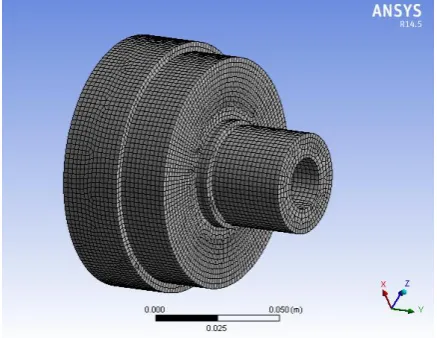
Fig-4: Meshing of Clutch body assembly
Fig-5: Meshing of Plunger
Meshing of Test rig and plunger can be done in the ansys itself and total number of nodes and element are as shown in the table below.
Table -1: Number of Nodes and Elements for Meshing.
Sr.No Name of
components
Number of Nodes
Number of Element
1 Test Rig 239095 65233
2 Plunger 34365 23891
5.3 Procedure for Static structural analysis in ANSYS:
Following is the procedure of actual analysis of individual part in torque limiter timer belt pulley.
Part 1: Test rig
The static analysis of base flange is done by means ANSYS Workbench 14.5.7 following are important steps which carried during the analysis
Step 1.
First of all we have to select the analysis type from main menu i.e. static structural analysis. After that we have use drag and drop option in order import the base flange to apply the material properties.
Step 2
In this step we have to call the existing model of Test rigANSYS Workbench.
Step 3
The most important step is to enter into the analysis window by double clicking on geometry icon.
Step 4
The object which calls in step number 3 is followed by the boundary condition, constraints and mesh tool.
Step 5
© 2014, IRJET.NET- All Rights Reserved
Page 52
Fig-6: Meshing of Clutch body assembly
Step 6
Now we have to apply the boundary condition like fixed support, force, moment. In this step we fix the outer end of Test rig and apply the moment on extreme end of Test rig.
Fig-7: Application of fixed support
Fig-8: Application of Moment
Step 7
We have to insert the actual parameters that we want like Maximum shear stress. Now solve this analysis by
considering the above stress at each node of the Test rig and it gives the Maximum shear stress regarding static analysis of Test rig. This value of Maximum shear stress executes the safe and failure region in the Test rig.
Fig-8: Analysis of Test rig.
Part 2: plunger
For above part same steps are followed to obtain the exact analysis of plunger.
Fig-9: Meshing of Plunger
© 2014, IRJET.NET- All Rights Reserved
Page 53
Fig-11: Application of ForceFig-12: Analysis of Plunger
6. RESULTS AND DISCUSSION
By tabulating theoretical data and FEM analysis along with experimental data ,we conclude that the obtained results of each component that is maximum shear stress can be given in table is safe when we compare the value of therotical,ansys and experimental data with theoretical one.
Excess load acting on output shaft can be reduced by Design and Analysis of Torque Limiter Timer Belt Spindle Drive for Overload Protection.
The torque carrying capacitycan be obtained by varyingthree number of Ball & spring sets. With the help ofIntegration of the timer pulley set and torque limiter to form final drive system can be achieved.
© 2014, IRJET.NET- All Rights Reserved
Page 54
8. REFERENCES
[1] I. Stroe.,Transilvania University Brasov, Romania. “Design Procedure of Elastic And Safety Clutches using Cam Mechanisms”,12thIFToMMWorld Congress France.
[2] Stroe Lone., “Elastic and safety clutches with intermediate rubber elements”,Annals of the Oradea University Fascicle of Management and Technological Engineering, Volume IX (XIX), 2010, NR1.
[3] Nicolae Eftiimie., “Dynamic simulation of the safety clutches with ball”, Faculty of Technical Science, Novi Sad. I. Stroe., Transilvania University Brasov, Romania.
[4]Guy James Burlington, Stroud (GB)
“ClutchMechanism”United states patents, Patent No.US 7,731,618 B2.
[5] Neal I. “Simple Mechanical Clutch with Multiple Functions”. In: Proceedings of SYROM 2009, pp. 433-438. I. Visa (Ed) Springer (2009).
[6] PSG design data book.