© 2015, IRJET.NET- All Rights Reserved
Page 332
A Survey: Usage of Brain- Machine Interface in Various Applications
Deepak R
1, K R Rachith
1, Kevin Leo Jacob
1, Prashanth Kambli
21
Student, Department of ISE, MSRIT, Bangalore
2Assistant Professor, Department of ISE, MSRIT, Bangalore
---***---Abstract -
A brain and computer interface (BCI), also called a Mind and machine interface (MMI) is a direct communication pathway between the external device and the human brain. BMI is an association between a brain and a device that authorizes brain signals to direct some external action, such as controlling of a wheelchair. For instance in the case of cursor control, the signal is imparted directly from the brain to the process directing the cursor instead of taking the normal path through the neuromuscular system of a person to the finger on a mouse from the brain. Here we have taken measures to find the people who have worked on different applications on BCI to be accommodated in a single paper.Keywords:
BCI, MMI, HMI, P300, DNI, EEG.1. INTRODUCTION
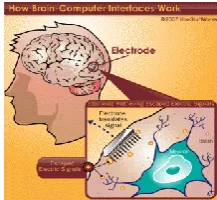
The rapidly progressing field of Human Machine Interface (HMI) may blossom proficient technologies, with a greater positive impact on individuals and society as a whole. Meanwhile, the development of BCI awards significant ethical and legal conflicts. BCIs have attracted prominence recently, based on the new scientific experimentations in interpreting brain functions and by impressive applications. A BCI is a computer aided interface that helps an individual use a computer by using their brain signals. Brain signals are patterns of electrical brain activity. The cells in the brain can interact with each other by electricity and chemicals known as neurotransmitters. This electrical activity of the brain is determined by an experiment called the electroencephalogram (EEG). For this experiment, small metal discs are painlessly stuck to the scalp. These small metal discs are generally called electrodes. Electrical impulses of the brain are picked up by the electrodes, which travels through the skull. Brain waves calculated by EEG do not represent any specific thought or movement, but relatively embody a certain amount of brain electrical activity at a recording point on the surface of the head. These electrical impulses extracted are classified and recorded. Then after pre-processing, feature extraction and classification, it translates these signals into meaningful commands to drive a device or application which can also be used to provide accurate control, after sufficient training. To use EEG as a control system, a phenomenon
known as Event Related De-synchronization (ERD) is utilized. Subject’s can learn to control and manage ERD, which allows us to use it as the basis for a one-dimensional BCI.
1.1 P300-based BCI
Event related potential (ERP) is a measure of brain communication to specific intellectual, sensory or motor events. One among the main approaches towards BCI is on the basis of ERPs. P300 is a dominating and leadingly used component of an ERP. The introduction of stimulus in an eccentric prototype can develop a positive peak in the EEG, 300msec after onset of the stimulus. The stimulus can either be visual, auditory or somatosensory. This evoked response in EEG is called P300 component of ERP[2]. Variant brain signals can be utilized as the input of BCI system. Due to its fine temporal resolution and ease of use, Electroencephalography (EEG) based BCI is the most potentially considered non-invasive direct neural interface (DNI). P300 potential being one component of EEG signals, is a positive pinnacle with a latency of about 300 ms after the target stimulus onset in the EEG, occurring in response to infrequent or particularly significant stimuli. This positive pinnacle in neuroscience literature is also commonly known as the P300 signal [4]. In 1988, Farwell and Donchin developed a P300 based BCI speller which presented letters and symbols in a matrix and repeatedly flashed each row and column [4, 9, 10 ]. P300 is referred to the central-parietal region of the brain. It can be found throughout on a number of channels of EEG [4].
Some of the research related headsets identified for the working principle of EEG are shown below :
www.emotiv.com
Epoc Emotive Headset: It works on a hydration sensor pack with 16 sensor assembly units of which two are reference.
www.neurosky.com
Neuro Sky : It works on single sensor unit located towards the frontal lobe of the skull.
© 2015, IRJET.NET- All Rights Reserved
Page 333
Table 1: EEG signal bands, frequencies and waves1.
BRAIN COMPUTING INTERFACE (BCI)
BCI requires at least four components for its activity, of which first is the sensors that detects the brain activity, next is a signal processing in order to translate the acquired signals from the brain activity into commands, then this information needs to be sent to an application on a device (application displayed on a monitor) etc. and finally there must be an application interface to determine how these components interact with each other and the user. The following diagram 2.1 depicts the BCI architecture.
Fig 2: BCI architecture
2.
BCI CAN BE PERFORMED IN THREE METHODS:
Invasive method:
Invasive BCI devices are the ones that are implanted directly into the brain and acquire the highest quality signals. These BCIs are used to provide functionality to people with disabilities and are also used to reinstate vision by coupling the brain with externally connected cameras and to rehabilitate the use of arms and legs by making use of robotically controlled arms and legs with the help of brain activities. As this device rest in the grey matter, they yield the best quality signals of BCI
devices but lead to scar-tissue build-up, resulting in the signal interpreted being weaker or even vanished as a result of the reaction of the body with the alien object in the brain.
Fig 3: (Courtesy: http://static.ddmcdn.com/gif/brain-computer-interface-3.gif )
Partially Invasive method:
Partially invasive BCI devices are the ones that are implanted inside the skull but dwell outside the brain instead of dwelling within the grey matter. The signal strength using this type of BCI is comparatively little weaker than those of the invasive BCIs. These partially invasive BCIs yield signals of better resolution than non-invasive BCIs. To a certain limit, the partially non-invasive BCI shave less risk of scar tissue formation when compared to Invasive BCI.
Fig4:(Courtesy:http://en.wikipedia.org/wiki/Brain%E2%80%93computer_interfac e#mediaviewer/File:BrainGate.jpg)
Band & Frequency
Rhythmic activity Wave patterns
Alpha (8-12Hz)
Eye closed, relaxed, not agitated, not drowsy and tranquil conscious
Beta (12-30Hz)
Formerly SMR, relaxed yet focused, integrated, thinking, aware of self and surrounding
Gamma (25-100Hz)
Alertness and agitation
Delta (1-4Hz)
Deep, dreamless sleep, non-REM sleep and unconscious
Theta (4-7Hz)
© 2015, IRJET.NET- All Rights Reserved
Page 334
Non Invasive method:
Non-Invasive method is one in which sensors or scanning medical devices are horsed on headbands or caps read brain signals. Non invasive BCI has the lowest signal clarity when it compared to the interaction with the brain (skull distorts signal), but it is considered to be simplest and safest when compared to the other types of BCIs. This category of devices has been found to be successful in providing a patient with disability the capability to move muscle implants and restore partial movement. This approach is less obtrusive but also read signals ineffectively as the small metal electrodes cannot be directly placed on the desired portion of the human brain. One of the most popular devices under the non invasive
category is the EEG or electroencephalogram which has been proved to be capable of providing a fine and temporal resolution which is easy to use, cheap and portable.
Fig 5: (Courtesy:http://www.frontiersin.org/files/Articles/103134/fnsys-08-00144-HTML/image_t/fnsys-08-00144-g003.gif)
3.
REVIEW WORKS ON BCI:
Sl.No.
Paper Name
Application
Methodology
Publication
Year
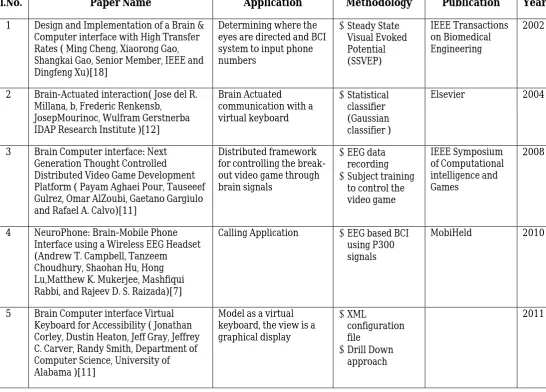
1 Design and Implementation of a Brain & Computer interface with High Transfer Rates ( Ming Cheng, Xiaorong Gao, Shangkai Gao, Senior Member, IEEE and Dingfeng Xu)[18]
Determining where the eyes are directed and BCI system to input phone numbers
Steady State Visual Evoked Potential (SSVEP)
IEEE Transactions on Biomedical Engineering
2002
2 Brain-Actuated interaction( Jose del R. Millana, b, Frederic Renkensb,
JosepMourinoc, Wulfram Gerstnerba IDAP Research Institute )[12]
Brain Actuated communication with a virtual keyboard
Statistical classifier (Gaussian classifier )
Elsevier 2004
3 Brain Computer interface: Next Generation Thought Controlled Distributed Video Game Development Platform ( Payam Aghaei Pour, Tauseeef Gulrez, Omar AlZoubi, Gaetano Gargiulo and Rafael A. Calvo)[11]
Distributed framework for controlling the break-out video game through brain signals
EEG data recording Subject training
to control the video game
IEEE Symposium of Computational intelligence and Games
2008
4 NeuroPhone: Brain-Mobile Phone Interface using a Wireless EEG Headset (Andrew T. Campbell, Tanzeem Choudhury, Shaohan Hu, Hong Lu,Matthew K. Mukerjee, Mashfiqui Rabbi, and Rajeev D. S. Raizada)[7]
Calling Application EEG based BCI using P300 signals
MobiHeld 2010
5 Brain Computer interface Virtual Keyboard for Accessibility ( Jonathan Corley, Dustin Heaton, Jeff Gray, Jeffrey C. Carver, Randy Smith, Department of Computer Science, University of Alabama )[11]
Model as a virtual keyboard, the view is a graphical display
XML
configuration file
Drill Down approach
© 2015, IRJET.NET- All Rights Reserved
Page 335
4.
CONCLUSION
BCI as a computer aided interface helps in individual use of computer by using their brain signals. This interpretation of the EEG signals related to the characteristic parameters of brain electrical activity is considered for various applications, have been surveyed in
this paper for a detailed structure about BCI and its types, by reviewing different works documented in research papers, such that it’s usability on various applications have been clearly depicted for further references. Future work would regard in exploring of BCI and creating an application for calling and messaging using EEG signals. 6 EEG-Based Brain Computer Interface for
Game Control (Xing Song, S. Q. Xie , and
7 Ethical issues in Brain-Computer interface Resecrch, Development, and Dissemination ( Rutger J. Vlek, MSc, David Steins, MSc, Dyana Szibbo, MSc, Andrea K”uber, Prof.Mary-Jane
Schneider, PhD, Pim Haselager, PhD, and Femke Nijboer,PhD)[17]
8 User-centered EEG-based Multimedia Quality Assessment (Arghir-Nicolae Moldovan, Ioana Ghergulescu, Stephan Weibelzahl and Cristina Hava Muntean )[14]
Android application Single Stimulus Continuous
9 EEG PATTERN RECOGNITION
Application to real time control system for android based Mobile device (Liliana Gut errez-Flores, Carlos Avil’es
Ferreyra-Ram’irez) EEG Sensors for Mobile Applications (Syed Muhammad Anwar, Muhammad Majid, Muhammad Ehatisham-ul-Haq, and Bilal Khan)[16]
11 Secret Brain to Brain Communication via Wireless Brain-Computer Interface System (Soogil Woo)[8]
© 2015, IRJET.NET- All Rights Reserved
Page 336
5.
REFERENCES:
1. James Cannan and Huosheng Hu, Human-Machine Interaction (HMI): A Survey, University of Essex (2011).
2. Setare Amiri, Ahmed Rabbi, Leila Azinfar and Reza Fazel-Rezai, A Review of P300, SSVEP and Hybrid P300/SSVEP Brain-Computer Interface Systems. 3. Andrew T. Campbell, Tanzeem Choudhury, Shaohan
Hu, Hong Lu, Matthew K. Mukerjee, Mashfiqui Rabbi, and Rajeev D.S. Raizada, NeuroPhone: Brain-Mobile Phone Interface using a Wireless EEG Headset. Copyright 2010, ACM.
4. Prashanth Kambli , Lingaraju G M and Bhavana S, A study on BCI from the context of Mobile based Application.
5. Danny Plass-Oude Bos, Boris Reuderink, Bram van de Laar, Hayrettin Gürkök, Christian Mühl, Mannes Poel, Anton Nijholt and Dirk Heylen, Brain-Computer Interfacing and Games.
6. Bram van de Laar and Danny Oude Bos and Boris Reuderink and Dirk Heylen, Actual and Imagined Movement in BCI Gaming.
7. "NeuroPhone: brain-mobile phone interface using a wireless EEG headset." Proceedings of the second ACM SIGCOMM workshop on Networking, systems, and applications on mobile handhelds. Campbell, Andrew, et al. ACM, 2010.
8. Soogil Woo, Secret Brain to Brain Communication via Wireless Brain-Computer Interface System.
9. Swartz, B.E and Goldensohn ES, "Timeline of the history of EEG and associated fields." Electroencephalography and Clinical Neurophysiology. Vol. 106, pp.173–176, 1998.
10. Millett and David, "Hans Berger: from psychic energy to the EEG”, Perspectives in Biology and Medicine, Johns Hopkins University Press.
11. Corley and Jonathan, "Brain-Computer Interface Virtual Keyboard for Accessibility".
12. Pour and Payam Aghaei, "Brain-computer interface: Next generation thought controlled distributed video game development platform", Computational Intelligence and Games, 2008. CIG'08. IEEE Symposium On. IEEE, 2008.
13. Millán, José del R, "Brain-actuated interaction", Artificial Intelligence159.1 (2004): 241-259.
14. Moldovan, Arghir-Nicolae, "User-centered EEG-based multimedia quality assessment," 8th IEEE International Symposium on Broadband Multimedia Systems and Broadcasting (BMSB 2013). 2013. 15. Emotiv Website. < http://www.emotiv.com >.
16. Anwar and Syed Muhammad, "Mapping Brain Activity Using Wearable EEG Sensors for Mobile Applications." 17. Vaidehi Baporikar and Dr.N.G.Bawane , A Literature
Survey on Wireless sensor network for Brain Computer Interface using ATMEGA128RFA1, International Journal of Engineering Science and Technology (IJEST). ISSN : 0975-5462 NCICT Special Issue Feb 2011.
18. Vlek and Rutger J, "Ethical issues in Brain–Computer
interface research, development, and
dissemination." Journal of Neurologic Physical Therapy 36.2 (2012): 94-99.
19. "2010 IEEE International Conference on Acoustics, Speech, and Signal Processing." Hotel, Sheraton Dallas. (2010).