Cite as: Can Urol Assoc J 2019;13(11):E371-6. http://dx.doi.org/10.5489/cuaj.5750
Published online February 26, 2019
Abstract
Nephron-sparing surgery (NSS) is the treatment of choice for T1 renal cell carcinoma (RCC). Since the first robotic-assisted partial nephrectomy (RAPN) was performed in 2004, NSS is being imple-mented with increasing frequency. RAPN will likely become the gold standard procedure for T1 RCC due to improved dexterity, enhanced visualization, shorter learning curve, quicker recovery time, and shortened warm ischemic time. Although RAPN appears to be the preferred treatment for select renal tumors, there are notable complications in up to 35% of cases. While complica-tions associated with RAPN are well-described, there is a lack of literature describing appropriate management strategies. Herein, we review complications associated with RAPN and design an appropriate systematic management algorithm.
Introduction
Nephron-sparing surgery (NSS) is the treatment of choice for T1 renal cell carcinoma (RCC). The American Urological Association and European Association of Urology advo-cate nephron preservation when suitable, as this approach reduces the risk of chronic kidney disease (CKD).1,2 Open
partial nephrectomy (OPN), laparoscopic partial nephrecto-my (LPN), and robotic-assisted partial nephrectonephrecto-my (RAPN) are the currently available surgical options for excision of T1 RCC. Although LPN has demonstrated excellent onco-logical outcomes and improved recovery times, it has not been widely implemented due to technical difficulties in comparison to OPN; LPN is, therefore, generally limited to high-volume centers.3
The first RAPN was performed in Germany in 2004 and is now being performed with increasing frequency.4 Robotic
surgery is associated with improved dexterity, better visu-alization, and ergonomic advantages, making minimally invasive partial nephrectomy more accessible to urologists.
In addition, RAPN has less warm ischaemic time (WIT) com-pared to OPN and LPN, which may reduce the risk of CKD.5,6
Although RAPN appears to be the preferred treatment for select renal tumors, there are notable complications in up to 35% of cases.7 The vast majority are classified as low-grade
complications, with 50% being medically related.8
High-grade complications, where an intervention is required, has an incidence of 6‒8% after RAPN.9,10 Although
complica-tions associated with RAPN are well-described, there is a lack of data describing appropriate management strategies. Herein, we discuss complications associated with RAPN and design an appropriate systematic management algorithm.
Methods
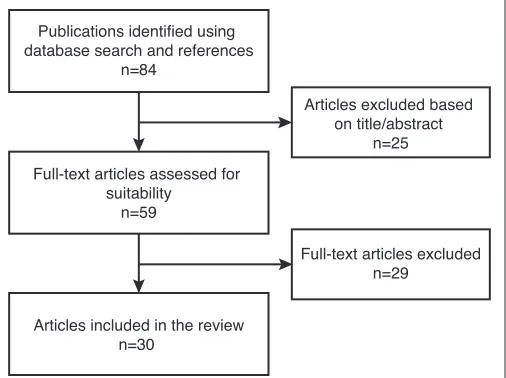
A systematic literature search was performed using the PubMed and Embase databases to identify peer-reviewed articles that studied perioperative complications related to RAPN. The search was conducted on September 26, 2018. The search was performed using the following search algorithm: “partial nephrectomy” and “complications” and “robot” and “management.” Studies between January 2008 and September 2018 were included. Publications compar-ing complications between RAPN, LPN, and OPN were included. Case reports and case series were excluded. Publications not in the English language were included if the data could be interpreted. Two authors (JR and EM) examined the title, abstracts, and full-texts of potentially eligible articles in detail. References in each paper were reviewed for suitability to be included in the literature review. From the literature search, 30 papers were suitable for this narrative-based review (Fig. 1, Table 1). The main data analyzed were types and incidence of complications specifically related to RAPN and the respective manage-ment of each. Medical complications were excluded.
James Ryan, MD
1; Eoin MacCraith, MD
1; Niall F. Davis, MD
2; Liza McLornan, MD
11Urology Department, Connolly Hospital, Blanchardstown, Dublin, Ireland; 2Urology Department, Austin Hospital, Melbourne, Australia
Results
Predictive factors
Current guidelines recommend a detailed risk assessment prior to partial nephrectomy to identity patients that are at an increased complication risk.1,2 Several factors relating to
the patient, tumor, and the surgeon affect the perioperative outcome. The most common patient factors associated with increased risk of perioperative complications and lower five-year survival rates are male gender, increased age, lower preoperative hemoglobin, and presence of comorbidities such as uncontrolled hypertension, diabetes, and respira-tory or cardiovascular disease.11-13 Mari et al performed a
large, prospective, multicenter study looking at predictive factors for postoperative complications in 979 patients who underwent a partial nephrectomy. However, only 117 of these patients underwent a RAPN and nephrometry scores were not reported.11 Several studies have used predictive
nephrometry (C-index, RENAL, and PADUA) scoring sys-tems based on tumor characteristics with some success.12,14-16
Location of the tumor adjacent to the hilum, involvement of the collecting system, and increasing tumor size over time demonstrated a statistically significant association with perioperative complications. A higher nephrometry score is also associated with a decrease in estimated glomerular filtration rate (eGFR) in the immediate postoperative period.13
However, all studies were performed retrospectively and were not used the in the preoperative planning of every case.
RAPN has significantly decreased the learning curve for laparoscopic tasks, such as suturing, compared to traditional laparoscopic surgery. For LPN, an estimated 100‒150 cases are required to overcome the learning curve compared to
≤35 cases for RAPN.15 A more favorable learning curve may
decrease complications relating to the surgeon’s experience, as demonstrated in one study where there was a reduction in estimated blood loss, length of stay, postoperative com-plications, and conversion rate as the surgeon’s learning curve improved.16
Complications
Perioperative
Perioperative complications are classified according to the Clavien-Dindo system.17 Clavien-Dindo grades 3‒5 will be
the main focus of this narrative review, with exclusion of medical complications. Studies describe an overall periop-erative complication rate of 7‒35% for RAPN.5,7,15,18 This
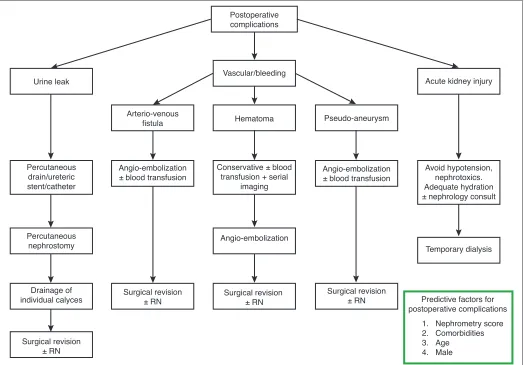
wide range is likely due to under-reporting of lower-grade (Clavien-Dindo 1‒2) complications among groups. The inci-dence of higher-grade complications (i.e., Clavien-Dindo 3‒5) varies from 3‒8% when medical complications are excluded.9,10,19,20 A stepwise management algorithm for
post-operative complications specifically associated with RAPN is illustrated in Fig. 2.
Intraoperative complications
Intraoperative complications for RAPN are infrequent and are typically due to hemorrhage. Estimated blood loss intra-operatively is usually 150‒350 ml.10,20 One study reviewed
886 patients undergoing RAPN and described an incidence of 2.6% (n=23) for intraoperative complications. Nine were related to hemorrhage requiring blood transfusion, of which two transfusions were due to a venotomy and two were due to an unclamped accessory renal artery. In addition, one transfusion occurred due to an inferior epigastric artery injury after insertion of a laparoscopic trochar and four transfusions were due to bleeding in the renal bed.21 Management of
bleeding is dependent on the location. A contrast-enhanced computed tomography (CT) scan will aid in the preoperative planning and identification of hilar structures. Benway et al advise that, once the mass has been excised, meticulous hemostatic measures, such as cauterization and suturing of the renal bed with placement of sliding clip renorrhaphy sutures, can be performed.22 In this study, the renal bed
of 13 RAPN were closed with traditional tied sutures and sliding clip renorrhaphy was performed on 37 RAPN. The use of sliding clip renorrhaphy resulted in significant reduc-tions in operative time and WIT. In cases of large-volume intraoperative haemorrhage, conversion to laparoscopic or open radical nephrectomy may be required.23
Other associated intraoperative complications include visceral injuries. Bowel injury rarely occurs, and the inci-dence rate is 0.25%.24 Manipulation of the bowel during
Publications identified using database search and references
n=84
Full-text articles assessed for suitability
n=59
Articles included in the review n=30
Articles excluded based on title/abstract
n=25
Full-text articles excluded n=29
surgery should be performed gently with atraumatic instru-ments. Small lacerations in the bowel with no spillage of bowel content into the abdomen can be closed primarily if identified at the time of surgery. Larger, full-thickness lacera-tions or ones diagnosed postoperatively may require resec-tion and input should be sought from a colorectal surgeon. Splenic injuries during RAPN occur in around 0.08% of cases.24 Splenic injuries can occur due to manipulation of
the left kidney when traction is exerted on the splenic liga-ments. Treatment of splenic injuries is dependent on the severity of the injury. Electro-cautery and hemostatic agents are used to control bleeding, however, if this fails, a sple-nectomy is required. Hepatic injury is typically related to a thermal injury or laceration from retraction. In general, thermal injuries do not require any intervention. Hepatic lacerations cause significant bleeding and should be initially addressed with electrocautery and hemostatic agents. Larger lacerations with uncontrolled bleeding or damage to the bili-ary system should involve a hepato-bilibili-ary surgeon. Injury to the pancreas is a rare occurrence and capsular injuries
can be closed primarily. However, pancreatic leaks may require a partial pancreatectomy and patients require close postoperative monitoring for pancreatitis. Incisions above the 12th rib can result in pleural or diaphragmatic injuries.
Pneumothorax during RAPN occurs infrequently; the report-ed incidence rate is 0.75%.25 Management of a
pneumotho-rax should be in consultation with a cardiothoracic surgeon or respiratory physician, as carefully selected cases can be managed conservatively. A pneumothorax causing hemody-namic instability or respiratory compromise will require a chest drain and serial chest radiographs to ensure resolution.
Postoperative complications
The most common Clavien-Dindo grade 3‒5 postoperative complications are bleeding requiring blood transfusion or surgical/radiological intervention, urine leak, acute kidney injury, arteriovenous fistula (AVF), and pseudo-aneurysm.
Re-bleeding during the postoperative period is relatively common after RAPN. In one large study among 400 patients, Postoperative
complications
Vascular/bleeding
Hematoma
Conservative ± blood transfusion + serial
imaging
Angio-embolization
Surgical revision ± RN Arterio-venous
fistula
Angio-embolization ± blood transfusion
Surgical revision ± RN Urine leak
Percutaneous drain/ureteric stent/catheter
Percutaneous nephrostomy
Drainage of individual calyces
Surgical revision ± RN
Pseudo-aneurysm
Angio-embolization ± blood transfusion
Surgical revision ± RN
Acute kidney injury
Avoid hypotension, nephrotoxics. Adequate hydration ± nephrology consult
Temporary dialysis
Predictive factors for postoperative complications
1. Nephrometry score 2. Comorbidities 3. Age
4. Male
15.3% (n=63) developed a postoperative complication, of which, 47% (n=29) of all complications were due to bleeding requiring blood transfusion.19 This study collected data
retro-spectively on a proretro-spectively maintained database and gave a detailed description on their operative technique. However, authors did not comment on the patient demographics and operative factors that were specifically associated with an increased risk of postoperative hemorrhage. Management of postoperative hemorrhage is dependent on the volume of blood loss and can vary from conservative, to blood transfu-sion, to angio-embolization or emergency nephrectomy.
Hyams et al reviewed 998 patients undergoing RAPN and found an incidence rate of 1.7% for renal artery pseudo-aneu-rysms and 0.3% for AVF.26 Renal artery pseudo-aneurysms
arise from intraoperative arterial trauma resulting in commu-nication with the extravascular space or formation of a fistula with the collecting system. Patients typically present at day
14 postoperatively with symptoms of hematuria and/or flank pain. AVFs occur less frequently than renal artery pseudo-aneurysms. Most AVFs are asymptomatic but can also present with symptoms of pain, hematuria, hypertension, or high-output cardiac failure. Angio-embolization is the treatment of choice for an actively bleeding vessel, AVF, or pseudo-aneurysm when interventional radiology is readily available, as surgical revisions are more likely to result in a comple-tion nephrectomy. Selective angio-embolizacomple-tion is effective for the management of AVFs and pseudo-aneurysms in ≤95% of cases.26 This is the largest study to date looking at AVFs and
pseudo-aneurysms post-partial nephrectomy. However, this multicenter study included both LAPN and RAPN and did not compare the outcomes of both separately. New renorrhaphy techniques providing better closure of the renal bed may also decrease the incidence of this complication.
Urine leak is associated with larger, more complex tumors that are centrally located or near the renal collecting system. Urine leak is a relatively rare complication post-RAPN in comparison to OPN or LPN (0.5‒4% for RAPN vs. 1‒16% for LPN vs. 1‒17% for OPN).5,7,24,27 This is more than likely
due to enhanced vision and improved dexterity from robotic surgery in conjunction with novel techniques for closure of the renal capsule, such as sliding clip renorrhaphy, to provide a high-tensile closure.22 Higher tumor complexity
necessitating OPN may also contribute to the differences in urinary leak rate.13 Symptoms and signs of a urine leak
include increased drain output, fever, abdominal pain, and peritonitis. The time at presentation is variable, with a medi-an of 13 days (rmedi-ange 3‒32).27
Caputo et alreferred to three key principles involved in the management of a postoperative urine leak:
1) Drainage of urinoma;
2) Unobstructed distal urinary flow; and 3) Prevention of infection.28
This management strategy is achievable with a percutane-ous drain, ureteric stent, or urethral catheter, depending on the injury. For persistent urine leaks, urinary diversion with a percutaneous nephrostomy may be necessary to facilitate healing. Percutaneous nephrostomy in this patient cohort can be difficult, as typically, the renal pelvis is not dilated due to the urine leak. Erlich et al reviewed 752 who under-went partial nephrectomy, of which 2.8% (n=21) experience a urine leak postoperatively. Four of the patients had sponta-neous resolution of the urine leak, one patient underwent a nephrectomy, and 16 patients were treated with retrograde ureteric stents. Out of the 16 patients who required a ure-teric stent, one patient required insertion of a percutaneous nephrostomy.29 This study is retrospective and only looked
at complications from LPN and OPN. Erlich et al also com-pared a number of surgeons over a 30-year period and could not exclude different surgical technique as an attributable factor. In the vast majority of cases, drainage of the urinoma
Table 1. Level of evidence of each paper included in the review based on the Oxford Center for Evidence-based Medicine
Study Study design Level of
evidence
Campbell et al2 Systematic review 2A
Reifsnyder et al3 Retrospective cohort study 2B
Gettman et al4 Case series 4
Benway et al5 Retrospective cohort study 2B
Vittori et al6 Retrospective cohort study 2B
Ellison et al7 Retrospective cohort study 2B
Wülfing et al8 Narrative review 2B
Benway et al9 Retrospective cohort study 2B
Aboumarzouk et al10 Systematic review 2A
Mari et al11 Retrospective cohort study 1B
Mathieu et al12 Retrospective cohort study 2B
Reddy et al13 Retrospective cohort study 2B
Hew et al14 Retrospective cohort study 2B
Wang et al15 Narrative review 2B
Kaouk et al16 Retrospective cohort study 2B
Spana et al18 Retrospective cohort study 2B
Kaouk et al19 Prospective cohort study 2B
Bertolo et al20 Retrospective cohort study 2B
Tanagho et al21 Prospective cohort study 2A
Benway et al22 Case control study 3B
Nepple et al23 Expert opinion 5
Zargar et al24 Retrospective cohort study 2B
Khalifeh et al25 Retrospective cohort study 2B
Hyams et al26 Retrospective cohort study 2B
Potretzke et al27 Retrospective cohort study 2B
Caputo et al28 Narrative review 2B
Erlich et al29 Retrospective cohort study 2B
Gonzalez-Aguirre et al30 Narrative review 2B
Porpiglia et al31 Prospective cohort study 2B
is sufficient to allow healing of the collecting system defect.30
Collecting system strictures may inhibit unobstructed distal urinary flow even in the presence of a ureteric stent, and drainage of isolated calyces may be necessary.
Acute kidney injury is more common in patients with pre-existing renal disease, in patients with solitary kidneys, and in patients with bilateral tumors. Acute kidney injury occurs as a result of acute tubular necrosis secondary to global renal ischemia. Methods to reduce renal ischemia involve decreasing WIT and reducing the effects of decreased renal perfusion by early unclamping of the artery, which decreases the rate of acute kidney injury. Importantly, this should be counterbalanced with the increased risk of bleeding. WIT should not exceed 25 minutes for partial nephrectomy.31
Prolonged WIT has been shown to negatively impact renal function postoperatively. Reduced renal function has been shown to last at least one year after a prolonged ischemic time during partial nephrectomy.31 One method for
reduc-ing the effects of ischemia is coolreduc-ing the kidney with ice; this should be considered if the anticipated ischemic time is >25 minutes.
Treatment of an acute kidney injury involves reducing further insult to the kidney by ensuring adequate hydration, avoiding hypotension, and avoiding nephrotoxic agents in consultation with a renal physician. Although the risk of CKD is significantly less with partial nephrectomy compared to radical nephrectomy, it is still a relatively common compli-cation. Kim et al reported a 6.2% incidence of new-onset CKD after partial nephrectomy.32 Khalifeh et al
demonstrat-ed upstaging in CKD ≥1 class after partial nephrectomy in 20.2% of patients.25 This study was performed
retrospec-tively. Of the 427 patients that underwent a RAPN in this center, only 134 were suitable, as patients were required to have a minimum of two-year followup.
Conclusions
Current guidelines recommend an organ-preserving pro-cedure whenever technically possible. RAPN is associated with fewer complications in comparison to OPN and LPN. Urologists should be familiar with predictive factors for complications associated with RAPN so that they can be promptly recognized and addressed during the perioperative period. A stepwise management algorithm provides appro-priate guidance to urologists for managing perioperative complications after RAPN.
Competing interests: The authors report no competing personal or financial interests related to this work.
This paper has been peer-reviewed.
References
1. Merseburger AS, Herrmann TRW, Shariat SF, et al. EAU guidelines on robotic and single-site surgery in urology. Eur Urol 2013;64:277-91. https://doi.org/10.1016/j.eururo.2013.05.034
2. Campbell SC, Novick AC, Belldegrun A, et al. Guideline for management of the clinical T1 renal mass. J Urol 2009;182:1271-9. https://doi.org/10.1016/j.juro.2009.07.004
3. Reifsnyder JE, Ramasamy R, Ng CK, et al. Laparoscopic and open partial nephrectomy: Complication comparison using the Clavien system. JSLS J Soc Laparoendosc Surg 2012;16:38-44. https://doi.org/10.4293/108680812X13291597716942
4. Gettman MT, Blute ML, Chow GK, et al. Robotic-assisted laparoscopic partial nephrectomy: Technique and initial clinical experience with DaVinci robotic system. Urology 2004;64:914-8. https://doi.org/10.1016/j.urology.2004.06.049
5. Benway BM, Bhayani SB, Rogers CG, et al. Robot-assisted partial nephrectomy vs. laparoscopic partial nephrectomy for renal tumors: A multi-institutional analysis of perioperative outcomes. J Urol 2009;182:866-72. https://doi.org/10.1016/j.juro.2009.05.037
6. Vittori G. Open versus robotic-assisted partial nephrectomy: A multicenter comparison study of perioperative results and complications. World J Urol 2014;32:287-93. https://doi.org/10.1007/s00345-013-1136-x
7. Ellison JS, Montgomery JS, Wolf JSJ, et al. A matched comparison of perioperative outcomes of a single laparoscopic surgeon vs. a multisurgeon robot-assisted cohort for partial nephrectomy. J Urol 2012;188:45-50. https://doi.org/10.1016/j.juro.2012.02.2570
8. Wülfing C, Humke U. Offene und minimal-invasive partielle nephrektomie. Urologe 2014;53:960-7. https://doi.org/10.1007/s00120-014-3512-6
9. Benway BM, Bhayani SB, Rogers CG, et al. Robot-assisted partial nephrectomy: An international experience. Eur Urol 2010;57:815-20. https://doi.org/10.1016/j.eururo.2010.01.011
10. Aboumarzouk OM, Stein RJ, Eyraud R, et al. Robotic vs. laparoscopic partial nephrectomy: A systematic review and meta-analysis. Eur Urol 2012;62:1023-33. https://doi.org/10.1016/j.eururo.2012.06.038 11. Mari A, Antonelli A, Bertolo R, et al. Predictive factors of overall and major postoperative complications
after partial nephrectomy: Results from a multicenter prospective study (The RECORd 1 project). Eur J Surg Oncol 2017;43:823-30. https://doi.org/10.1016/j.ejso.2016.10.016
12. Mathieu R, Verhoest G, Droupy S, et al. Predictive factors of complications after robot-assisted laparoscopic partial nephrectomy: A retrospective multicentre study. BJU Int 2013;112:E283-9. https://doi.org/10.1111/bju.12222
13. Reddy UD, Pillai R, Parker RA, et al. Prediction of complications after partial nephrectomy by RENAL nephrometry score. Ann R Coll Surg Engl 2014;96:475-9. https://doi.org/10.1308/00358841 4X13946184903522
14. Hew MN, Baseskioglu B, Barwari K, et al. Critical appraisal of the PADUA classification and assessment of the R.E.N.A.L. nephrometry score in patients undergoing partial nephrectomy. J Urol 2011;186:42-6. https://doi.org/10.1016/j.juro.2011.03.020
15. Wang L, Lee BR. Robotic partial nephrectomy: current technique and outcomes. Int J Urol 2013;20:848-59. https://doi.org/10.1111/iju.12177
16. Kaouk JH, Hillyer SP, Autorino R, et al. 252 robotic partial nephrectomies: Evolving renorrhaphy technique and surgical outcomes at a single institution. Urology 2011;78:1338-44. https://doi.org/10.1016/j. urology.2011.08.007
17. Dindo D, Demartines N, Clavien P-A. Classification of surgical complications: A new proposal with evaluation in a cohort of 6336 patients and results of a survey. Ann Surg 2004;240:205-13. https://doi.org/10.1097/01.sla.0000133083.54934.ae
18. Spana G, Haber G-P, Dulabon LM, et al. Complications after robotic partial nephrectomy at centers of excel-lence: Multi-institutional analysis of 450 cases. J Urol 2011;186:417-21.https://doi.org/10.1016/j. juro.2011.03.127
19. Kaouk JH, Khalifeh A, Hillyer S, et al. Robot-assisted laparoscopic partial nephrectomy: Step-by-step con-temporary technique and surgical outcomes at a single, high-volume institution. Eur Urol 2012;62:553-61. https://doi.org/10.1016/j.eururo.2012.05.021
20. Bertolo R, Autorino R, Simone G, et al. Outcomes of robot-assisted partial nephrectomy for clinical T2 renal tumors: A multicenter analysis (ROSULA Collaborative Group). Eur Urol 2018;74:226-32. https://doi.org/10.1016/j.eururo.2018.08.031
21. Tanagho YS, Kaouk JH, Allaf ME, et al. Perioperative complications of robot-assisted partial nephrec-tomy: Analysis of 886 patients at 5 United States centers. Urology 2013;81:573-80. https://doi. org/10.1016/j.urology.2012.10.067
22. Benway BM, Wang AJ, Cabello JM, et al. Robotic partial nephrectomy with sliding-clip renorrhaphy: Technique and outcomes. Eur Urol 2009;55:592-9. https://doi.org/10.1016/j.eururo.2008.12.028 23. Nepple KG, Sandhu GS, Rogers CG, et al. Description of a multicenter safety checklist for intraoperative
24. Zargar H, Allaf ME, Bhayani S, et al. Trifecta and optimal perioperative outcomes of robotic and laparo-scopic partial nephrectomy in surgical treatment of small renal masses: A multi‐institutional study. BJU Int 2015;116:407-14. https://doi.org/10.1111/bju.12933
25. Khalifeh A, Autorino R, Eyraud R, et al. Three-year oncological and renal functional outcomes after robot-assis-ted partial nephrectomy. Eur Urol 2013;64:744-50. https://doi.org/10.1016/j.eururo.2013.03.052 26. Hyams ES, Pierorazio P, Proteek O, et al. Iatrogenic vascular lesions after minimally invasive partial
nephrectomy: A multi-institutional study of clinical and renal functional outcomes. Urology 2011;78:820-6. https://doi.org/10.1016/j.urology.2011.04.063
27. Potretzke AM, Knight BA, Zargar H, et al. Urinary fistula after robot-assisted partial nephrectomy: A multicenter analysis of 1791 patients. BJU Int 2016;117:131-7. https://doi.org/10.1111/bju.13249 28. Caputo PA, Kaouk J. Management of complications arising from the treatment of small renal masses. Int
J Surg 2016;36:583-7. https://doi.org/10.1016/j.ijsu.2016.03.063
29. Erlich T, Abu-Ghanem Y, Ramon J, et al. Postoperative urinary leakage following partial nephrectomy for renal mass: Risk factors and a proposed algorithm for the diagnosis and management. Scand J Surg 2016;106:139-44. https://doi.org/10.1177/1457496916659225
30. Gonzalez-Aguirre AJ, Durack JC. Managing complications following nephron-sparing procedures for renal masses. Tech Vasc Interv Radiol 2016;19:194-202. https://doi.org/10.1053/j.tvir.2016.06.004 31. Porpiglia F, Fiori C, Bertolo R, et al. The effects of warm ischaemia time on renal function after
laparos-copic partial nephrectomy in patients with normal contralateral kidney. World J Urol 2012;30:257-63. https://doi.org/10.1007/s00345-011-0729-5
32. Kim CS, Bae EH, Ma SK, et al. Impact of partial nephrectomy on kidney function in patients with renal cell carcinoma. BMC Nephrol 2014;15:181. https://doi.org/10.1186/1471-2369-15-181